¡Soy Capitán!

“Opposition research” — reading some of the right wing websites from the U.S. — is normally an exercise in wasting my time with fools, but every once in a while it pays off. With October being “Hispanic Heritage Month” in most U.S. school districts (which seems to account for the sudden jump in hits on this site lately… kids doing their homework, something that is definitely NOT a waste of time), the righties have picked up on an idea first floated by Texas “educational consultant” Reverend Peter Marshall. Marshall is the yin-yang who wants to cut Cesar Chavéz from Texas school books in favor of some guy who built the first yo-yo in America.
This particular right-wing waste of time website was pushing schools to teach about some minor figure of the Confederacy, whose “Hispanic” credentials are, at the very least, dubious. The proposal — which appeared in a Canadian right wing website — figures that since the guy’s grandfather was a Sephardic Jew (and by family tradition had left Spain in the 1490s for Holland), he was “Hispanic.” This is the same line of misreasoning was recently used by Karl Rove when he attempted to downplay the historical importance of Justice Sonya Sotomayor’s nomination to the Supreme Court, referring to Benjamin Cardozo (with a Portuguese surname and distant Iberian-Sephardic ancestry) as “Hispanic”… to the bemusement of Hispanics, and the annoyance of Portuguese-surnamed Americans.
I couldn’t find this particular Confederate on a handy-dandy list of “Hispanics in Gray and Blue” produced by the Education Committee of the Sons of Confederate Veterans. The site, lists a couple of Union officers as well, including Admiral David G. Farragut, on the strength of his having been a Southerner.
A little more linking and cross-linking and I found an amazing Mexican connection. Farragut, who is an important figure in U.S. Naval history, was not only Hispanic, so was his dad… a Spanish sea captain who joined the revolutionary Navy (i.e., he was a privateer… a pirate with a cause) and fathered the future U.S. Admiral (in Tennessee, making him a southerner, though David went to sea at the age of 12). And — AHA!– the Mexican connection. When Jorge Farragut died in 1817, David was adopted by another American Naval officer, David Porter.
Porter would become the first Commander-in-Chief of the Mexican Navy, though a path only slightly less convoluted than my discovering the connection with David Farragut.
 Born in Illinois according to Wikipedia (or in Boston, according to a short biography published by Centro de Estudios Superiores Navales de la Armada de México), Porter had a checkered career before coming to Mexico. After action against the French (during a not so cold naval war in 1799), Porter managed to crash into the shores of Tripoli — running aground in 1803 and held prisoner by the Barbary Pirates for the next two years — on his way to the Halls of Montezuma.
During the War of 1812, he managed to capture several British ships off New Orleans, and again get taken prisoner, once more far from home. Off Valparaiso Chile (those sea captains got around, he was captured by the British (along with future step-son David Farragut). Porter had been wounded, and it was a rough sea battle, so no shame was involved in being taken prisoner, but he was put on desk duty for the next few years, got bored with that, and finanged sea duty in the Caribbean, hunting for pirates.
Somewhat over-enthusiastic about his task, Porter invaded Fajado, Puerto Rico (where the U.S. “liberators” would land in 1898), annoying not just the Spanish colonial officials (to say nothing of the Puerto Ricans), but the United States Department of State and the Navy. In 1826 he was court-martialed and… rather than wait to be drummed out or keel-hauled, resigned his commission, and prevailed upon his friend Joel Roberts Poinsett, to help him find a job. Which Poinsett did: as Commander of the new Mexican Navy.
At the time, Spain still had hopes of regaining Mexico, and without a decent navy, was continually under attack. Porter may have screwed up a few times, but as a Mexican Admiral, he is highly praised for pulling together an ad hoc collection of ships, foreign captains, Mexican fishermen and assorted quasi-pirates into an effective defensive force.

Source: Secretaría de Marina
In 1828, when the Spanish again tried to invade Mexico, Porter went on the offensive, attacking Spanish ships in Cuban waters… and again came to grief. Taking refuge in Florida put Mexico into the middle of a U.S.-Spanish diplomatic problem… just as anti-foreigner violence had broken out in the Capital and there were demands for removing foreigners from their perceived control of the economic and political affairs of the nation. Porter claimed there were two assassination attempts, and returned to the United States in 1829.
Not quite sure what to do with Porter… and certainly not about to put him back in the Navy, the United States government finally found a job for him in the Diplomatic Corps, packing him off to Constantinople, where he remained as Minister to the Ottoman Empire until his death in 1843.
When he first left for Mexico, he was accompanied by his then 13-year old son, David Dixon Porter, who would learn his trade as a Mexican cadet. David Dixon Porter would be the U.S. Navy’s first Rear-Admiral. Another son would also become a naval officer. Besides spawning a second generation of U.S. naval commanders (and being the step father to another), Porter’s short time in Mexico did instill discipline and traditions still part of the Mexican Navy today.

ARM Cuautémoc

ARM Manuel Azueta
Alas, poor Mexico…
… too far from God, too close to the United States!
One can’t do much about the geography of Heaven, although Cardinal Norberto Ribera would like to see a Legislature a little closer to the people… or, rather, as “Secret History” suggests, to the Cardinal’s chosen people.
And the United States isn’t about to undergo any tectonic plate shifts in the near future either. Justin Thody, who directs Latin American analysis for the Economist Intelligence Union, blames Mexico’s anemic 2.8 percent expected growth rate on its too close economic ties with the United States. As an unsigned editorial in yesterday’s “The [Mexico City] News says, “President Calderon tends to blame the unemployment crisis on the United States; he is partly right as this year alone the maquiladora industry lost 125,500 jobs — dragged down by the U.S. auto industry’s problems.”
The News is ignoring the one industry tied to the United States that IS creating jobs… narcotics exports. But, that probably is not a sustainable industry, and so far the Calderón Administration (like its recent predecessors) has bucked the trend in the rest of Latin America, where nations have aggressively courted markets in Asia, Europe and throughout the rest of the Americas.
Plan B… C… D… X…for taxes
With the Calderón administration admitting, when it submitted the federal budget, that it had not “Plan B” for how to pay the bills beyond a two percent across the board raise in the Value Added Tax, it was clear the administration was taking a “my way or the highway” approach. Which, given that their party, PAN, is now a minority in the legislature, was a non-starter.
PRD, going back to ideas floated during the López Obrador presidential campaign, has resurrected the idea of public austerity (cutting back on perks and benefits for public officials), as well as raising the graduated income tax rate and the price of oil.
PRI has its own proposal, which is still being tweaked, which would also also raise petroleum prices. The PRI proposals for the most part would accept a two percent tax raise, but most would exempt food and medication (presently untaxed, as reading material, and school supplies).
A few PRD politicians — state governors, who under the present system, depend on federal tax revenue for their own operating funds — have supported the across the board raise, but with conditions. Buying the Administration’s claim that an across the board tax would benefit the poor, Chiapas Governor Juan Sabines Guerrero wants any revenues raised to be tied to measurable progress in Mexico’s Human Development Index figures.
Magic mushroom
The colors… the colors! This could be really freaky after consuming some other mushrooms…

Mycena abieticola is one of the thirty-three (of an estimated five hundred) Mycena mushrooms that glow in the dark. Brazilian chemist Cassius Stevani photographed abieticola (which is also found in Mexico) and several bioluminescent mushrooms found in Brazil for the National Geographic.
How are we doing?
The United Nations 2009 Human Development Report is on-line for those of a wonkish frame of mind.
As I’ve said before, Mexico is not a particularly poor country, it just looks that way being next to a very rich one. The “Human Development Index (HDI)
provides a composite measure of three dimensions of human development: living a long and healthy life (measured by life expectancy), being educated (measured by adult literacy and gross enrolment in education) and having a decent standard of living (measured by purchasing power parity, PPP, income).
With 1.0 being the highest possible number, and Norway at the top (at 0.971), Mexico comes in a respectable 0.854 … 53rd out of the 182 nations surveyed. Noting that intangibles like political rights are not included, Mexico ranks just below Uruguay, Cuba and the Bahamas in HDI, and well above supposedly “advanced” European nations like Bulgaria and Romania.
We’re generally healthy, with a long life expectancy (76 years), although five percent of Mexicans have a probability of not surviving to age 40. That’s the same percentage of Mexican babies who are underweight, and of Mexican homes do not have access to clean water, both of which may be a factor in the survival rate.
While the adult illiteracy rate is a little high (7.2 percent), it’s not particularly bad (especially in a country with 50 plus spoken languages), it’s not as bad as it looks. With the phenomenally high literacy rates in Europe, even in non-European Union countries like Russia, I’m surprised that Mexico has a higher literacy rate than at least one E.U. nation, Malta.
One place we are doing very well is in overcoming gender disparity.
The HDI measures average achievements in a country, but it does not incorporate the degree of gender imbalance in these achievements. The gender-related development index (GDI), introduced in Human Development Report 1995, measures achievements in the same dimensions using the same indicators as the HDI but captures inequalities in achievement between women and men. It is simply the HDI adjusted downward for gender inequality. The greater the gender disparity in basic human development, the lower is a country’s GDI relative to its HDI.
Mexico’s GDI value, 0.847 should be compared to its HDI value of 0.854. Its GDI value is 99.2% of its HDI value. Out of the 155 countries with both HDI and GDI values, 72 countries have a better ratio than Mexico’s.
And who comes just behind Mexico? Canada! The United States comes in way behind at #105. However, when it comes to gender empowerment (“the share of seats in parliament held by women; of female legislators, senior officials and managers; and of female professional and technical workers- and the gender disparity in earned income, reflecting economic independence”), the two NAFTA partners blow us away. At #39, we’re not so bad, though the United States comes in at #18, and Canada blows us away at #12.
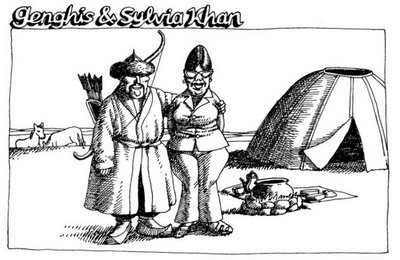
Although it lags far behind when it comes to gender empowerment, the most gender-equal country (at least by GDI) is Mongolia… Yes, we khan?
Honduras… all things considered…
The “de facto” regime in Honduras is playing still more games … stretching out any attempts at “dialogue” by changing the conditions once again. Basically, the United States government forcing the Honduran government to do what the U.S. says it will never do… negotiate with terrorists, only with the terrorists being aided and abetted by congressional representative from the United States.
It was well reported in the U.S. and other “mainstream media” that the fake president had called off HIS “state of siege” (which, even if the defacto president was President, he didn’t have the legal power to impose (that’s the job of Congress) was not so much lifted, as was no longer needed. The opposition radio stations were destroyed during the “state of emergency” (their equipment hauled away and the stations taken off the air) and… as to getting back on the air, Micheletti said they can “reapply for broadcast licenses”.
Coupled with threats against foreign reporters, this is not, like the situation in Venezuela — a country with a thriving opposition press — where ONE television network that was openly calling for rebellion was not granted a new broadcasting license when it came up for renewal (and led to world-wide condemnations of press censorship), there still is only the sketchiest of notice that civil liberties are under attack in the Americas.
Better late than never, the U.S. press is FINALLY starting to notice. Now that the New York Times has finally decided, well, yeah, maybe there was a coup in Honduras, and maybe the “de facto” government is a bunch of lying scumbags, National Public Radio is able to more or less report on what’s been happening with some accuracy…
Honduras is one of the original “banana republics.” In the 1800s, U.S. firms set up fruit companies that exploited cheap Honduran labor to export bananas to the port of New Orleans.
While things have improved since the days of the company store, the vast majority of Hondurans remain in poverty.
Ramon Romero, a professor of economics at the National Autonomous University, says power in Honduras is in the hands of about 100 people from roughly 25 families. Others estimate the Honduran elite to be slightly larger, but still it is a tiny group.
Romero says the country’s elite have always selected the nation’s president. They initially helped Zelaya get into office, and then they orchestrated his removal from power.
Micheletti, the de factor president, says Zelaya was “taken out” because he tried to change the rule of the Honduran Constitution, which prohibits presidents from even trying to extend their one term in office.
“[Zelaya] was doing that. He [doesn’t] care. He disobeyed the Supreme Court and the Congress and everything,” Micheletti says.
Micheletti and his supporters say Zelaya, despite only having a few months left in his term, was on the verge of creating a socialist state modeled after Hugo Chavez’s Venezuela.
But Romero, the economics professor, says this was a ruse. “The principal reason why the elites split from Zelaya was for economic and not political reasons,” Romero says.
Zelaya ran for president as a center-right candidate but then moved sharply to the left while in office.
He governed with a bravado that endeared him to the poor and infuriated the rich…
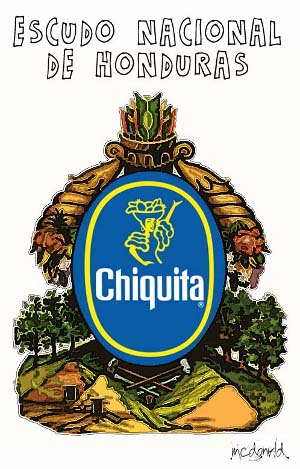
Could it be that in Venezuela, the opposition was in favor of keeping U.S. oil companies happy, and in Honduras, the illegitimate government will keep the United States in cheap bananas?
Living in a country that sells both oil and bananas to the United States, should I start to worry about media access here?
Our Latin America wants you!
Now you too can be a pundit! Er… erudito.
 Our Latin America” (aka, The Latin Americanist), one of the pithier, and better general Latin American news sites in English, has been a collective effort by several young, smart, general experts on this part of the planet. Most of them are grad students, which means they’re overworked and underpaid by definition.
The five of them are looking to expand their efforts. Posts are usually very short (a couple of bullet points of information from various countries) and a paragraph or two of explication.
That is now. While that is needed on a regular, rotating basis throughout the week, they also need a person to blog over the weekends and people to do weekly reviews of specific fields like sports, music, business and so on.
While in the age of the internet, even people in on the Mexican Pacific coast can get an overview of what is said, and done, throughout the region, the Latin Americanist gang of five is mostly New York City based, which creates some distortion in their point of view… call it “mainstream media” thinking. Posters — even those without higher academic degrees — and even cranky geezers from provincial backwaters — who can write clearly in English, and commit themselves to some regular posting, are welcome to join their crew.
At some point, they may even be able to pay a little bit. Write:
H1N1– a worthy victim
The Guadalajara Reporter’s Tom Marshall on the best public health news from the State of Jalisco in a long time:
In the midst of increasing discontent over the uncertain way the dengue epidemic, H1N1 flu and seasonal flu has been dealt with by the state government, Jalisco Health Secretary Alfonso Gutierrez Carranza resigned Tuesday.
Just last week Gutierrez, who held the post for 30 months, was staunchly defending himself against rounding critics. He said health authorities in Jalisco were well equipped to handle the increase in dengue and H1N1 flu cases.
…
Gutierrez’ time as Health Secretary was laden with controversy and many top Jalisco politicians have come out in support of his decision to resign.
Gutierrez had problems confronting unionized workers within the Health Department, was accused of sexual harassment and scandals such the death of the young boy Miguel Angel Lopez Rocha. Even as H1N1 hysteria was sweeping Mexico and Jalisco, Gutierrez was noticeably absent with Elizabeth Ulloa, the state’s public health director, taking over most of the press duties.
Gutierrez has been a joke since he was appointed by Governor Emilio González Márquez, although his negligence (and basic incompetence) wasn’t so funny. The thankfully now ex-Secretary of Health didn’t appear to have an up to date license to practice medicine at the time of his appointment. At the time he was working as González Márquez’ chauffeur.
The only downside so far is that the newly elected Presidente Municipal of Guadalajara, Alfonso Petersen Farah, who was State Secretary of Health prior to 2006, has been tapped to return to his old post, leaving the country’s third largest city’s administration in the lurch.
Petersen, besides being a PAN politician, obtained his MD at Univeridad de la Salle, and a second degree in internal medicine from UNAM.
NYTimes… all the news that fits… eventually.
Although reports like the one below (from the highly respectable, independent Mexican public station, Canal Onze) have been in the news for the last three months, it’s welcome news that the New York Times is FINALLY reporting the news:
Since Mr. Zelaya was removed in a June 28 coup, security forces have tried to halt opposition with beatings and mass arrests, human rights groups say. Eleven people have been killed since the coup, according to the Committee for Families of the Disappeared and Detainees in Honduras, or Cofadeh.
The number of violations and their intensity has increased since Mr. Zelaya secretly returned to Honduras two weeks ago, taking refuge at the Brazilian Embassy, human rights groups say.
The groups describe an atmosphere of growing impunity, one in which security forces act unhindered by legal constraints. Their free hand had been strengthened by an emergency decree allowing the police to detain anyone suspected of posing a threat.
“In the 1980s, there were political assassinations, torture and disappearances,” said Bertha Oliva, Cofadeh’s general coordinator, in an interview last week, recalling the political repression of the country’s so-called dirty war. “They were selective and hidden. But now there is massive repression and defiance of the whole world. They do it in broad daylight, without any scruples, with nothing to stop them.”
In Dutch?
I don’t know anything about this… but Ana Maria Salazar (Mexico Today) picked up this intriguing (and not yet explained) item:
A pair of trained dogs at the Mexico City airport sniffed out a large shipment of cocaine – more than 10 kilos – inside a container coming from Amsterdam… Federal Police seized the drugs…
They grow tulips, not coca, in Netherlands, and I always thought it was cocaine came into Mexico from Colombia or Peru for shipment TO, not FROM, decadent wealthy northern countries.

This is not the source of cocaine.

And this is not a tulip
Gabo and the virgin whore
With the molestation of young girls in the news elsewhere, it was only a matter of time before Lydia Cacho would weigh in. Cacho turns her rightful wrath, weirdly enough, not Mexican child molesters, nor the still on-going sex tourism trade, but Gabriel García Márquez‘ short 2004 novel, Memoria de mis putas tristes.
Cacho, who was illegally jailed in Puebla after Los demonios del Edén was published, shocked the Mexican establishment, in 2005. Los demonios was “muckraking” at its muckiest… dealing with child prostitution and child pornography rings, headed by wealthy Cancún business executive, Jean Succar Kuri. Based on complaints of a Succar associate Kamal Nacif, Puebla governor, Mario Marín Torres, personally ordered Cacho’s arrest. She was kidnapped from Quintana Roo and jailed in Puebla, leading to not just a political scandal, but eventually to a change in Mexican libel laws, under which the writer was originally jailed.
Cacho is an expert on sexual abuse of children, and exposing the nasty sex tourism trade, but I think she may have misfired here. She is, after all, writing in a country where 14 year old girls are still bartered brides on occasion. In the 21st century… in reality, not in fiction.
 Until fairly recently, this was not just the case in “traditional” Latin American societies, but in even the more “advanced” regions as well. The photo on the left — from 1935 — is a promotional photo of a performer who, after a few years of experience in the provinces, was moving on to the Buenos Aires. Not a prostitute, but a young woman seen as an adult at a very early age. In 1935, young Eva Duarte (who ten years later would marry Juan Peron) was only 15.
Andre Gide writes that “fiction is a mirror held up to reality”*. Dealing with the sexual mores of the “real” time of the novel does not mean that one necessarily approves or disapproves. The reality is just the background, as it is in Vladimir Nabokov’s 1955 Lolita, is set in a very real 1950s United States. The fact that a middle-aged literary scholar could be sexually obsessed with 12 year old Lolita is only the frame for a darkly comic version of the great American road trip novel.
Which brings us to Gabriel García Márquez. As John Updike wrote in a New Yorker essay in 2005:
The works of Gabriel García Márquez contain a great deal of love, depicted as a doom, a demonic possession, a disease that, once contracted, cannot be easily cured. Not infrequently the afflicted are an older man and a younger woman, hardly more than a child…perhaps not so curious in the social context of the author’s native Colombia in the years of his youth…
Love — and the impossibility of love — are García Márquez’ themes, and there is nothing salacious about that. The main character, the best years of an empty life behind him, has nothing to look forward to on his 91st birthday:
I have never gone to bed with a woman I didn’t pay … by the time I was fifty there were 514 women with whom I had been at least once … My public life, on the other hand, was lacking in interest: both parents dead, a bachelor without a future, a mediocre journalist … and a favorite of caricaturists because of my exemplary ugliness.
If anything, the 14-year-old (not 13-year-old, as others have misstated) girl, who sells her virginity to save her working class family from destitution and ruin is making an economic and political decision as an adult… in 1930s Colombia is the heroine of the tale.
That García Marquez uses sexuality (and the “sadness” of prostitutes) to explicate class and age and gender issues does not mean he’s supporting child prostitution — quite the opposite. It is, as Updike writes of another García Márquez story involving young prostitutes, “Whoredom as martyrdom”. For a Marxist steeped in Catholicism, greater love has no woman than she lay down… offering up her youth and her virginity to the ugly realities of tradition and unyielding tradition… to save her family.
And what happens in the fictional world of a fictional 1930s Colombia (the same period that the real Evita was having her photo shoot in the real Buenos Aires), was — in the real world — legal at the time. No disrepect is meant to Ms. Cacho… she has been vital in the fight both to protect the rights of minors, and those of journalists, and deserves our complete respect, but fictional mirrors held up to a reality that has changed for the better — in good part because of her excellent reporting — has nothing to do with what a Polish film director may have done in California in 1977… nor with what she knows best, and would be better off focusing her attention on: the sexual exploitation of minors in the real Mexico of 2009.
* The quote is found in yet another 20th century novel that includes adults having sexual realtions with adolescents: Les faux-monnayeurs (1925). Gide’s novel, set in Paris, includes as a sub-plot the story of a middle-aged novelist (the source of the statement about fiction and reality), sexually involved with his teen-aged nephew.
Ya’ think?
AFP:
A judge Monday sentenced former Costa Rican president Rafael Calderon, the first former head of state tried for corruption here, to five years in jail, likely shooting down his plans to seek reelection.
I could see how that might make campaign appearances problematic.


 mexfiles.net