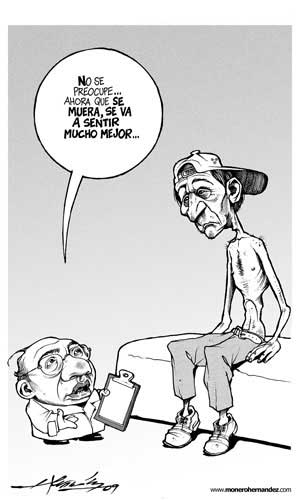
Health care the Calderon way
GDP (Gross Domestic Product) figures are due out today. Otto, at Inca Kola is predicting a ten percent drop. The Calderon Administration is making noises about cutting domestic and social spending (including education — though sparing teachers’ salaries since Esther Elba Gordilla is about the only labor leader who still pretends to support the administration) which is being sold as a not-so-bad thing.
In the bag
As of yesterday, stores in the Federal District are can no longer use non-biodegradable bags. While this will only affect the District itself (which is about 9 million of the 18 million inhabitants of metro Mexico City) it will have a huge impact on businesses throughout Mexico — and beyond.
Businesses within metro Mexico City (about 18 to 20 million people) will, of course, be getting their supplies from the same companies that ship to businesses within the District. And, with half the metro area (and the largest concentration of commercial activity) within the District, suppliers aren’t going to mess with looking at which side of the street businesses are located on, and ship biodegradable bags throughout the region. Given that this is a quarter or more of all Mexican retail outlets, it’s going to be easier for suppliers to switch to providing biodegradable bags throughout the Republic… and to their customers in Central America.
The Federal District is desperate to resolve its mounting (for the last 500 years) trash problem. Sorting organic from inorganic trash has only been a first step (and a little less than a quarter of households and businesses now sort their trash) — one challenge being that most households use old grocery sacks to bad their trash… and tossing all your kitchen waste in a non-biodegradable bag is kind of self-defeating.
Calderon’s “Enemies List”
I made a few small revisions from the original post, to clear up an inadvertent slur. There are U.S. conservatives here, but what they say about Mexican politics is usually so very wrong that for U.S. conservative views I go right to the horse’s ass and quote some U.S. source.
Patrick Corcoran’s Gancho Blog posts:
The army accidentally searched a Juárez house of Manuel Espino, one of Calderón’s prickliest critics from the PAN. High-ranking officers have apologized to Espino, calling the incursion a “mistake”. That’s quite an embarrassing mistake to make. I have a friend in Los Pinos who tells me that other houses to be “mistakenly” searched in the comings weeks include those of Creel, AMLO, Ebrard, Encinas, and Beltrones.
I haven’t seen any mention of this yet in “my” newspapers[1], and languishing out here in provincia, don’t have any Los Pinos contacts these days, but still, the idea of an “accident” is a little incredible. During the last election, the Calderon administration did everything it could to claim their opponents were criminally-motivated (or bought) and it wouldn’t be the first time the administration has used military “investigations” to harass opponents.
I’m dismissive of the “three-ten theory” (there was a 14 year war of independence starting in 1810, a ten year revolution starting in 1910, therefore, in 2010…) but I did say way back in 2007 that Felipe Calderon reminded me of Porfirio Diaz. Make that Porfirio Diaz ca. 1909 when Don Porfirio was still considered an indispensible man outside of Mexico despite troubling allegations of human rights abuses. Then, as now, there were clear signs of dissatisfaction with the President — from the left, right and center; poor farmers were being hammered by the “free trade” of their day (with many rural residents supporting those who turned to alternative businesses — like Pancho Villa); the intellectuals fussed about economic and social domination from the north, and looked for more ties to the south; and the President was using the Army to harass political opponents.
The big difference is that Porfirio’s “lame-duckitude” was mostly a matter of old age where Calderon is about to become the first real President we’ve had to face a united opposition. While Congresses during the Madero, Salinas de Gortari and Zedillo administrations also had opposition majorities. Madero wasn’t able to control his congress (and it ended up badly for him), but Salinas and Zedillo were able to finish out their terms and carry out most of their own agenda, mostly because they faced a fractured opposition of opposing parties. Calderon faces a PRI plurality boosted into a majority by the Greens (a weird Green party to be sure, but unlikely to buck the PRI in anything but symbolic measures), and a PRD vehemently opposed to the Calderon agenda. And the Supreme Court has taken on a more active role in political affairs than previously.
There is not going to be an armed uprising, but between an isolated president dependent on the Army and foreign support, intellectual and political calls for change and economic uncertainty, 2010 will be a year of change.
[1] Everybody seems to have their favorites. Patrick, being a more conservative sort than I am, usually references the “mainstream” media pundits or Excelsior. I’m supposedly leftist (though I don’t think particularly so in Mexican terms) and tend to look at the middle-of-the road Milenio and El Universal, as well as the socialist Jornada, and folks like “Blogotitlan” although I try to find links in English-language sources.
One thousand guilty…
Judeo-Spanish legal theorist Moses Maimonides… argues [in the 290th “Negative Commandment”] that …”the Exalted One has shut this door” against the use of presumptive evidence, for “it is better and more satisfactory to acquit a thousand guilty persons than to put a single innocent man to death once in a way.”
“n Guilty Men”, Alexander Volokh
Via “Under the Volcano: Notes on Mexican Politics“:
The Supreme Court voted 4-1 to free 20 men imprisoned for more than 11 years for a massacre in the village of Acteal, Chiapas in 1997. Another 30 are expected to be freed soon. Citing severe misconduct by the prosecutors and lower court judges, including the fabrication of evidence and testimony, the Court ruled that the accused were denied the constitutional rights of due process and an adequate defense. The killing of 45 Tzotzil Indians, mostly women and children, by assailants from a rival community and the railroaded prosecutions by the Zedillo government during the Zapatista rebellion has long been an open wound. The Court pointedly did not declare the innocence of those freed…
Although the ruling has been criticized by those who are disappointed that the Mexican Supreme Court did its job and looked at how justice was dispensed, rather than attempting the impossible and re-opening this case, the ruling is a victory for legal reform. And, as in so many Mexican news items, is rooted in events centuries old, and has implications well in other aspects of Mexican life today — the so-called ‘drug war’ among them.
The Mayan peoples have been divided for the last millennium and more not just by language and custom, but within their own communities, by clan. In recent years, these divisions have been complicated, starting with religious difference in the 1950s, and taking on a more intransigent political identity since the 1990s.
Those killed in the 22 December 1997 massacre were members of Las abejas, a pacifist organization supported by the Liberationist “wing” within the Roman Catholic Church, although the group also includes Evangelicals and other Protestants, and mixes traditionalist Mayan. However, at the same time, Las abejas threaten some traditions — both eschewing alcohol and allowing women to hold leadership roles. As such, they are seen by many of the traditionalists as a threat to their own community value system.
Las abejas identify God with the Queen bee, and see themselves as the worker bees. The “worker bee” identity echoes the synarchist (Mexican fascist) philosophy, which — under the more benign guise of “usos y costumbres” — means no dissent is allowed among enforced communal political positions. While I’ve seen no evidence of violence within Las abejas (who remind me of the Quakers), the usos y costumbres and enforced community standards within traditional communities have led to violence and internecine warfare within the larger community — the Tzotzil community as a whole. As religious communists, Las abejas are politically allied with other communal-oriented groups like the ELZN.
The proximate cause to the massacre was an ungoing dispute over inheritance of a 120 hectare plot. There was some question as to whether or not the plot was communal or private property, and adjucation by the Agrarian Land court was at a standstill. The strongest claimant, a PRI supporter, gave half the land to his supporters, while a nephew — who also stood to inherit if the property was private and not communal — offered his claim to the commune. This split the local local Tzotil into several factions, with different political and social groups backing different claimants.
As so often in family feuds — especially when land is at stake — violence ensued. The nephew, and several of his supporters were gunned down in 1992. Dissatisfaction with medical treatment after the gun fight led to founding Las Abejas by one group supporting the communal land claimants. Adding fuel to the fire, in 1996, the Zapatista uprising brought the Army into what was already a tense community.
Las Abajos — and the ELZN — claim the Army knew in advance that the attack on the church service was in the works, but did nothing to stop it. At the very least, they suggest that the Army covered up the incident, for the benefit of the PRI. Interestingly, the ELZN had an English-language press release about this the day after the attack.
International outcry over the massacre of women and children was immediate. With the ELZN seen as innocent peasants fighting the entrenched powers of the state, the Zedillo administration had to order an immediate investigation and there was a rush to judgement — leading to several arrests and convictions.
Although the actual number of killers is probably closer to ten than to the sometimes estimated hundred, there was prosecutorial misconduct in the trials that followed, scapegoating those who were simply supporters of the private claim over the communal claim. It was the trials — not the rightness or wrongness of the cause — that the Supreme Court considered.
What seems important is not that a mistake has been rectified after eleven years, but that the Supreme Court has recognized that justice — and no one claims the 45 victims have received justice — rushed is justice denied. Especially when the rush to judgement is clouded by political considerations.
In Michoacan and elsewhere, where rural property ownership, religion, party politics and communal rights also lead to violence, and where international attention simplifies the situation (in our day, to a “war on drugs”) there is also a tendency to short-circuit the legal process.
The present administration made a good start in reforming the courts, but has focused on the unwinnable “war on drugs” — and applied military force in a civilian legal matter — which not only exacerbates the violence, but creates a whimsical justice system.
Do not suffer fools gladly
Absolutely nothing to do with Mexico, but everything to do with responding to fools:
The Mouse to Mexico?
There are rumors floating that Fiat, which bought out Chrysler (which tried, but never overcame, it’s muscle car, and big honking boat mentality) will begin assembling the Fiat 500 at their Toluca plant for North American distribution beginning next year.
 The Fiat 500 has been around longer than the VW bug now, having been in production since 1937. This is the Topolino — the mouse that conquered Rome. Although when first produced, Fiat was never able to meet their goal of creating a car that sold for 5000 lira (it retailed just under 9000 lira), it had one big advantage over the VW Beetle — it was actually in production, whereas the Beetle wasn’t available to the public until after World War II. After the War, the Topolino and Italy seemed to go together in the public image. It ‘s not a powerful car, but it has it’s own instinsic cuteness, and it beats having no car.
Originally designed as a two seater, Italians crammed as many as five (not counting bambinos and livestock) when they took to the road. Fiat lengthened the car to meet demand, and the Topolino eventually gave way to the Bambino — slightly longer and with a better rear suspension in the 1950s. With technical and design changes, it’s still a little, four-cylinder city car today: with the redesigned (technically “retro”) Fiat Nuova 500 already available in Mexico (and selling well).
Anyguey gives five good reasons to buy a Fiat 500, among them beating out the competition in one important area — hipness potential:
With SUVs regarded as morally reprehensible by the educated elite, buying a Fiat will soon be the trendy choice for the eco-hipster-pseudo thoughtful man about town. The Mini Cooper has lost all counterculture edge and is now a favorite among suburban lesbians. The Smart Car looks like a toy, boasts none of the Fiat 500’s 52 year heritage and is too small inside to get your freak on.
Franciso Javier Mina: Mexico’s Che

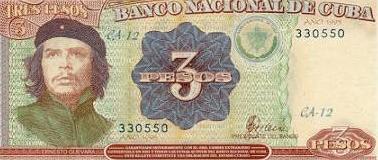 Che Guevara: middle-class, well educated Argentine, thwarted in his ambition to break the oligarchical stranglehold on his own people, took the revolution to other countries, dying in Bolivia at the age of 39… his handsome face becoming the icon of one revolution, and gracing the Cuban three-peso note.
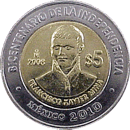 Francisco Javier Mina: middle-class, well-educated Spaniard, thwarted in HIS ambition to break the monarchy, took HIS revolution to Mexico, dying at the age of 29. His handsome visage was also an icon of revolution, and is the only foreigner among the many figures depicted on our our five peso bicentennial coins.
Mina, like Guevara, didn’t seem destined for a career as a dashing revolutionary figure. Both came from solidly middle-class families, took to revolution in the name of liberation, and went abroad to continue the struggle, dying young — and leaving a beautiful corpse to project the image of the dashing Latin American revolutionary.
Born 1 July 1789 near Pampalona in Navarre, Mina’s family was wealthy enough to send him to the University, a rarity among rural families in his day. In 1808, when the French invaded Spain and put Napoleon Bonaparte’s brother, Joseph on the throne, the 19 year old Javier organized a small resistance group of nine friends and headed for the hills. Javier’s natural charisma attracted others, older and better armed to put themselves under his leadership. Even his uncle, the future General, and Spanish national hero, Francisco Espoz y Mina, put himself under the younger man’s command.
The collaboration government coined a new word for the unconventional soldiers: guerrilla. It was meant to be dismissive, to suggest the unconventional untrained band was not a “real army” but “little soldiers” — something, to their detriment — they didn’t take seriously. With young Javier as their leader, the band grew to 1200 men. Taken prisoner in 1810, Mina’s youth and natural leadership made him popular with his captors, who styled him “The Prince of Guerrillas”, and treated him, not as an “enemy combatant” (or shot him out of hand), but as an honorable high-ranking prisoner of war.
During the occupation, a resistance movement had taken advantage of the temporary absence of the legitimate king to redefine the nature of government. While they, like the British parliament, retained the monarchy and the State church, going much further than even the radical United States, put power in the hands of the people, eliminating all property qualifications for voters and office-seekers.
The restored king, Fernando VII, had other ideas however, and Javier joined the struggle to free Spain. Forced into exile in England, his good looks and revolutionary opinions made him a favorite with the Whigs, that era’s “leftists”. He met an unlikely Fidel Castro in Theresa Servando Mier, a Mexican monk and lawyer, who had been sent to represent New Spain in the resistance parliament and had been kicking around in exile himself. Servando Mier told Mina of the Mexican struggle, and spoke of the ideals of Morelos — whose movement took the Spanish consistution as their model in crafting their own radical vision of a new society.
Servando Mier, though a man of the cloth, was something like Benjamin Franklin — a charming self-taught diplomat schmoozing his way through the Euopean halls of power, seeking support and arms for his revolutionary comrades in the Americas. And not above getting his hands dirty dealing with the less reputable arms dealers of his times. The monk put Mina in touch with a group of French pirates, recruited veterans of the Spanish resistance and other democratic radicals, as well as arms and cannons, putting the whole crew into Mina’s capable hands. They sailed out of Liverpool (the crew disguised as a merchant ship headed for Baltimore) on 16 May 1816. Briefly stopping in Baltimore, they headed for Mexico, by way of Cuba and New Orleans. At Matagorda (now in Texas), and Rio Bravo (today’s Matamoros) Mina’s group attempted to contact the Mexican fighters, but was unable to do so until they reached Soto la Marina, Veracruz — where they also engaged Royalist forces.
Fighting their way inland to Fuerte los Remedios, where the put themselves under the command of Morelos’ generals, Mina’s seasoned foreign volunteers fought several battles across the country. Mina himself was known throughout New Spain, and — despite his youth — was listened to when he proposed that criollos, penisulares and the native people all had a stake in creating an independent Mexico … the formula that eventually would be used to create the “Triguarante” government of Augustine Iturbide.
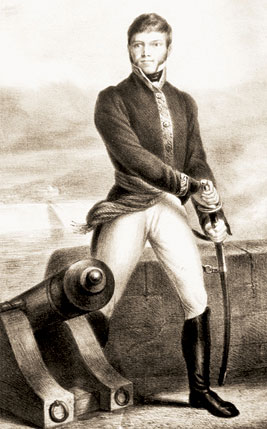 The hazards of war — and guerrilla warfare — being what they are, Mina was captured by the royalists 11 November 1817. Like with Che Guevara in Bolivia, there would be no formal trial for a rebellious foreigner rousing the rabble — just a firing squad.
In 1823, his remains were reburied in an honorable tomb in Mexico City’s Metropolitan Cathedral, later moved to the Monument of Independence, under the Angel. Tee shirts didn’t exist in the 19th century, but woodcuts and cheap prints of Francisco Javier Mina were popular with students and leftists throughout Latin America in the 19th century.
Aduana: maybe not so bad, but still…
As I said yesterday, Army soldiers took over most Aduana functions over the weekend. What was left out of the reports I looked at was that this was preparatory to replacing the Aduana with an entirely new set of workers, under a different contract. However, the fact that it’s only petty corruption — i.e., the workers — and not a “culture of corruption” — the management and those who set up the contracts in the first place – – that is driving the change cannot be seen as a particularly bold initiative. Nor does the Calderon Administration’s perceived need to use armed soldiers to thwart a potential labor dispute speak well to the government’s trust of its citizens.
Nixon’s ghost
Just about everyone who writes on Latin America has noted the postings at National Security Archives of documents related to the Nixon Administration’s (successful) efforts to gain support from the Brazilian military dictator Emilio Médici (no relation — except in spirit — to Machievelli’s Lorenzo) for the overthrow of the Chilean government in the early 1970s. But nobody but Inca Kola News caught on that Nixon’s ghost — or his still breathing relic, Henry Kissinger — is still haunting the Americas:
“And on a personal note, let me say that since taking this job, I’ve relied on the wise counsel of many of my predecessors, and Secretary Kissinger has been among the most generous and thoughtful with his guidance and advice”.
As that old song goes, “I Wonder Who’s Kissinger Now?”.
Meanwhile, in Honduras (where the old “anti-communism” theme song is still being played), Nixon’s ghost made a surprisingly benign appearance, witnessed by Hermano Juanicito:
In the skit, a woman in a grotesque mark was selling tatascán, the strongest moonshine available, to three young guys who proceeded to get drunk and roll around on the floor. A catechist came to her and tried to get her to convert, to desist from selling guaro, moonshine. She said no and the catechist said he’d have to send in the priest.
The priest arrives in what look like an old cassock and stole – with a Richard Nixon mask.
It’s bad enough if you drink moonshine and see snakes… seeing Nixon might sober anyone up.
Privatization and corruption — again
Along with the PEMEX security scandal, caused in large part by privatizing some sectors of the “paraestatal” (state-owned business) another semi-privatized government function has also run into trouble: the aduana (customs service).
Beginning with the Salinas Administration, management of the customs service was privatized, ostensively to control corruption in the service. In 2001, the new Fox Administration used an amusing scandal (a circus elephant was smuggled across the border from Texas, without the United States Department of Agriculture noticing him) was used to justify a major overhaul of Aduana personnel. Once again, the customs service agents are being replaced, but in the meantime, “1000 soldiers are taking over customs duties.
Now, as if the Army doesn’t have enough to do, a thousand soldiers have been assigned to border control posts. While there is a need to control the illegal arms trafficking entering the country, this is being touted as preventing narcotics from leaving Mexico.
Blogotitlan (my translation) sees the situation this way:
Every customs inspector has been disarmed, decertified and discredited, only to be replaced by soldiers with no experience in customs management, but blindly obedient to their superiors. The official pretext, as always, is the need to “purify” the Aduana, and stop the flow of contraband and arms into the country. The problem is that none of those responsible for managing Aduana, least of all the superiors, have been thrown out… Aduanas was made another “private business” –exploited by Marthita Fox and her gang, together with Paco Gil Díaz (then Secretary of the Treasury) and his wife, now a director of Movistar Mexico – as a “fideicomisios privados.” As usual, when you “combat corruption” in Mexico, you punish the plebians and reward the bosses.
Besides the negative image that comes with putting armed soldiers on the border, there is a secondary problem that — if successful — this won’t mean less narcotics overall, but more narcotics available in the domestic market.
Unless, of course, the smugglers just find another route into their largest market… which is likely. But they’ll probably be able to stop an elephant.
ANOTHER COUP??
Not unexpected, the British Government has imposed direct rule over the Overseas Territory of the Turks and Caicos Islands, the southermost islands of the Bahamaian Archipelego, north of Hispanola (Haiti and the Dominican Republic).
One of the last vestiges of European colonialism in the Americas, a movement towards independence led by Prime Minister Galmo Williams was undermined by charges of massive corruption in the elected local administration, including allegations of fraudulant land sales of “crown lands” (state property) to private developers under former Prime Minister Michael Misick. A British investigation concluded that “there were ‘clear signs of political amorality and immaturity and of a general administrative incompetence’.” Just like the British Parliament, I guess.
The territory will be directly ruled from Britain under a royal governor for at least a year. Though not unexpected, Williams called the action a coup:
“A coup is anything that has been done without the will of the people and being a colony anything the British government wants to do to us they can do to us,” he told the BBC.
He said he accepted the territory faced challenges, but argued that by imposing UK rule, the will of the islands’ people had been ignored.
“We will never be able as a nation to move forward [if] every time we reach a crossroads our rights get taken away, our freedom gets taken away.”
The Turks and Caicos economy is based on money laundering and tourism. In addition to an independence movement, there is strong political force seeking annexation by Canada. As a self-governing territory, it is (or was) a member state of the Organization of American States, which Bloggings by Boz points out, makes the situation “interesting”.
Tijuana — a religious experience… no, really!
You thought Catholics were the only ones for whom a trip to Mexico was inspired by religion? It was good old fashioned American Protestantism that made Tijuana a destination for tourists that rivals — and probably surpasses — Guadalupe when it comes to religiously motivated visitors.
In the 1920s, California was not the place to be for a man in a sinning frame of mind. The temperance folks had given America Prohibition, and had  thrown in a ban on gambling while they were at it. A guy couldn’t cavort with women, and thanks to the ban on cabaret dancing, he couldn’t even watch women cavorting by themselves. If he was discovered in a hotel room with a woman not his wife, his name would appear in the section of the newspaper reserved for public shaming. Everything was closed on Sundays. The only place to go was church. There he could hear the usual warnings about alcohol, gambling, dancing, and cavorting. When Southern California ministers were really whipping their congregations into a froth, they would get rolling on the subject of “the Road to Hell,” a byway that ran south from San Diego. At the end of it stood the town of Tijuana, “Sin City,” a place where all those despicable things, and a whole lot more, were done right out in the open.
You can’t buy that kind of advertising. Thousands of Americans a day were sprinting for the border.
Laura Hillenbrand, Seabiscuit: An American Legend (NY: Ballantine Book, 2001)


 mexfiles.net