Best advise for Honduran de facto regime yet…
And I’m not going back, to my old school… until
Opposing the coup, the Honduran teachers went on strike, only to be order back into the classroom. At which point the students have gone on strike. Hey, golpistas… leave them kids alone.
Enrique Ortiz Colindres, the (potty) mouth of the coup is out, being replaced as Foreign Minister yesterday. When you’re trying to maintain a shred of credibility as a government, having a foreign minister who insults the president of the only country still giving any support at all to the golpistas (and lukewarm support at that) is not good policy. So, the coup leaders, in their infinite wisdom, made the guy Minister of Justice instead!!!
WTF????
Check Inca Kola News and BoRev for up to the minute snark.
Honduran F.M… “I’m not a racist, I’m an idiot”
With the lame excuse that he hadn’t been sworn in yet by the “de facto regime” in Honduras as foreign minister, Enrique Ortez Colindres, brushed aside strongly worded condemnation from the United States of his characterization of U.S. President Barack Obama as ““Ese negrito que no sabe nada de nada” {most politely translated as “that pickaninny who knows nothing”].
Being a trained diplomat (and holding a diplomatic post when he was appointed to his “de facto” post — and knowing he was speaking publicly — of course that excuse doesn’t fly. But every political figure is entitled to say something stupid, as long as they ‘fess up and admit it was stupid.
However, Ortez Colindres referred to Obama twice with the offending term… and now a third quotation has surfaced, made during an interview with a Honduran television station and cited in El Tiempo newspaper:
He negociado con maricones, prostitutas, con ñángaras (izquierdistas), negros, blancos. Ese es mi trabajo, yo estudié eso. No tengo prejuicios raciales, me gusta el negrito del batey que está presidiendo los Estados Unidos.
I have negotiated with queers, prostitutes, bird-brains (leftists), blacks, whites. This is my job, I studied for it. I am not racially prejudiced. I like the little black sugar plantation worker who is president of the United States.
This is an insult peculiar to the Caribbean, used only by “criollos” — often used to specifically mean illegal workers from Haiti [“batey” is a barracks for migrant workers]. Given that the “de facto regime’s” only support has come from the extreme right in the United States, it’s possible that Ortez is being somewhat subtle… the far right in the U.S. “blaming” Obama for “supporting Chavez” (and, like Hugo Chavez being of mixed race ancestry) and, in a coded way, feeding off the lunatic fringe’s attempts to claim Obama is a foreigner.
Nah… more likely Ortiz is a fuckin’ racist fool.
The more than Mormon Murders — Chihuahua
(06 November 2019: thank you for the hits, but this is from 2008. It is background for today’s post, “LeBaron: Cartels… or…“)
The story line sounds simple enough: teenager is kidnapped; family demands return and refuses to pay ranson; teen is released unharmed; brother becomes “star” anti-crime crusader; somebody kills brother. Dudley Althous — writing in the Houston Chronicle — presents what will probably form the basis of any “meaning” given to the murders in Colonia Le Barón, Galeana, Chihuahua:
A top member of a breakaway Mormon sect was dragged from his home by marauders and killed early Tuesday in a village founded and named for the American families that settled the remote community in the northern Mexican desert.
Benjamin LeBaron, 31, and Luis Widmar, 29, a brother-in-law who tried to help him, were grabbed by at least 15 commandos shortly after midnight in Colonia LeBaron, which is about 200 miles southeast of El Paso, witnesses said.
The bodies of the men, both naturalized U.S. citizens with five children each, were found nearby shortly afterward, each shot several times in the head, Brent LeBaron, a cousin of Benjamin who lives in the village, said by telephone.
Benjamin LeBaron had led successful protests earlier this year to free his kidnapped brother and demand police protection for their isolated rural community.
“We are fighting a cause that should be heard throughout the world,” said Brent LeBaron, who was helping build the slain men’s coffins Tuesday and prepare for their burials.
Mennonite and Mormon communities in Chihuahua have both complained that the have been targeted by kidnappers and thieves who assume their thriving agricultural communities have ready cash. But, when Eric LeBaron was kidnapped, his family refused to pay the requested million dollar (U.S.) ranson, and his older brother Benjamin rallied Mormons and Mennonites to lobby the State Government for special assistance, which was forthcoming. And — quite unusual — federal soldiers were used to hunt down the alleged kidnappers, with 25 persons being arrested in a nearby community. Benjamin was turned into something of a cause celebre, taken to address Federal police cadets and then… the killings.
It would seem straight-forward, but something bothered me. I didn’t recognize Le Barón from any of my reading on the Mormon colonies during the Mexican Revolution, though the family name seemed familiar.
The town, and the founding family — have a history in Mexico that doesn’t start until 1924, but which suggests this could be much, much more complex than just another good gun v. bad guy scenario.
The community was founded in 1924 by “apostate” Mormon Alma Dayer LeBaron, who supposedly fled Utah with a lynch mob and federal marshals on his trail. Although technically against the law, polygamous communes were tolerated in Chihuahua (often under the protection of Pancho Villa) and one more wouldn’t have upset anyone. Alma, and the LeBaron community were excommunicated by the “official” Mormon Church (the Church of Jesus Christ of the Latter Day Saints) in 1944, the community officially joining the Apostolic United Brethren — a break-away Mexican based Mormon church … the “mainstream polygamous” branch of Mormonism.
When Alma died in 1951, leadership in the community passed to his son, Joel. Joel left the Apostolic United Brethern to found his own church, the “Church of the Firstborn of the Fulness of Times”. At least some of the LeBarons, including second in command, Joel’s younger brother Ervil, later moved to Baja California. Ervil moved to San Diego, California to start a second church.
And, then it gets very, very weird. As Time Magazine reported 29 August 1977:
Ervil LeBaron, 52, polygamous (13 wives, at least 25 children) leader of the tiny Church of the Lamb of God, is the target of investigations by police departments from San Diego and Los Angeles to Salt Lake City and Denver. Even the Secret Service is interested in his whereabouts, since some of his followers sent a threatening letter to the then presidential candidate Jimmy Carter in September 1976. LeBaron’s alleged crime: inducing several of his 40-odd disciples, including a number of women, to murder between 13 and 20 people who failed to abide by what he decreed to be the “constitutional law of the Kingdom of God.”
In 1974, after murdering his brother Joel, Ervil and his followers burned down the Baja California community. He later murdered the head of the Apostolic United Brethren before moving on to the United States, where he and his gang (mostly his wives and numerous children) were indicted for five murders in Houson.
Eventually caught in Mexico, Ervil and his son, William, were sentenced to life without parole in federal prison. The F.B.I. is offering a $20,000 reward for the capture of another child, Jacqueline, who was last seen in Honduras in 2007. William has a jailhouse conversion to Christianity, and his on-line testimonial includes the family history.
Given the isolated geography of northern Chihuahua (meaning you’ll have some inbreeding) and the polygamous history of the Le Baron family, it’s impossible to work out the exact relationship of the various LeBarons and it would be unfair to assume all LeBarons are as crazy as Joel and Ervil. Probably the only reporter in either Mexico or the United States who could keep it straight would be Brooke Adams of the Salt Lake City Tribune, whose “The Plural Life” follows, among others, “The LeBaron Group”.
One thing William LeBaron mentions in his testimonial is the family’s various businesses in Houston, Denver and elsewhere, which employ family members and — he implies — are meant to provide a rationale for U.S. citizenship for the family members. I did find two different LeBarons on myspace.com, both claiming to live in the Chihuahua community, but residing in the United States. One, a 19 year old man, was looking forward to returning home to find a girl.
Le Barón — the community — also made the news last year when the state of Texas investigated the Fundamentalist Church of Latter Day Saints for child abuse charges (which turned out to be unfounded) and several members of the sect considered moving to Mexico to escape persecution. Alfredo Corchado, of the Dallas Morning News, found that only some of the community practiced polygamy (and modified the practice to fit the letter of the Mexican legal code) and seemed reluctant to admit troublesome outsiders. “‘The last thing we need here are a bunch of outlaws,’ said Lillian Tucker, 40, a mother of 18 who practices polygamy…”
The note left on Benjamin LeBaron’s body read “You can see the LeBarons are not untouchable.” Was the kidnapping only about a wealthy odd community, or directed specifically at the LeBaron family. Could this have been another turn in the LeBaron family’s bloody religious war? Why was the federal government involved, and so quick to use Benjamin LeBaron as a poster-child for anti-crime activity? And were the alleged kidnappers the whole story? If 25 were arrested, who were the six who attacked Benjamin LeBaron and Luis Widmer? That’s an awful lot of people for an area where a village like Le Barón (pop. about 1500) is the biggest community in the region.
The question in Chihuahua is whether the “bunch of outlaws” were outsiders or not.
Reading assignment
Some backgrounders should keep me out of trouble for the next couple of days.
Shannon O’Neil (“LatIntelligence” and the Council on Foreign Relations) has a long article in Foreign Affairs (July/August 2009) “The Real War in Mexico“. This was written, of course, before the election, and I don’t think there is a “war” (real or simulated), but should be a nuanced, intelligent discussion of the narcotics situation from the “inside the beltway” perspective.
Hal Brands (recommended by Maggie’s Madness) argues that the Merida Iniative “may not represent an optimal solution to the current crisis.” “Mexico’s Narco-Insurgency and U.S. Counterdrug Policy”, written for the Stategic Studies Institute of the United States Department of the Army, this too is going to take some time to read through.
And, affecting economic policy… perhaps more here in Latin America than elsewhere… is Caritas in Veritate, which I’ve downloaded from the Vatican Library — ran the ink cartridge dry on my printer.
Best report yet on Honduras
Real News Network managed to put together an excellent overview of recent events, and growing resistance within Honduras to the coup. At about 07:40 into the 11:00 minute report, Sandra Cuffe makes an important — and often overlooked — observation. Even people who ” I hate Mel Zelaya and say they would never vote for him” do not support the coup, and are also starting to resist.
Oh.. and one more thing. The “de facto government” has been selling all kinds of stories about Zelaya´s crimes and supposedly had 18 indictments… which, besides leading to the question of why the “de facto government” won’t let the guy surrender to authorities also makes one wonder why no Interpol warrant has been issued. And now we know. Clarin (Buenos Aires) reports that Interpol DID receive an arrest request… but for political crimes, not for any of the crimes claimed by that silly woman in La Cieba, who needs to tend to her own garden.
Good background for a pol
Someone was complaining the other day that Mexican politicians form a “political class” with no outside experience, or background, in anything other than the chincanery of governance. But Burro Hall notes that the Pepe Calzada, the new governor of Queretaro, another pick-up for the PRI, has one qualification almost no other elected official in the world can match.
Minnesota may have had a governor who could wrestle with the issues, and Caifornia (and the entire United States) a guy whose profession was lying with a straight face as Chief Executive… and California’s sitting governor made his start in the United States as a model in gay magazines (relatively safe for work link)–knowing how to handle public exposure is always considered a political plus — but Pepe Calzada has one skill none of these guys ever mastered… Pepe know how to cut the bull.
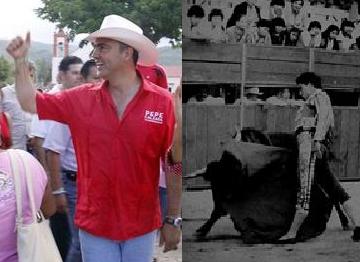
Calzada. L, campaigning; R, learing how to handle opponents
First priority for the Mexican gov….
With the new legistlature, the Mexican government is expected to change it’s priorities some… as everyone else seems to have noticed, one very good — and well overdue — project is finally getting off the ground. .
PANdering to the base off-base
Patrick Corcoran, at “Gancho Blog” was trying to figure out which U.S. public figure most closely resembles Germán Martínez, who was (until today) PAN party chair.
Patrick looks at various hapless figures (Michael Steele of the Republican Party, Floyd Mayweather) but if I ever tried to find an analogy in the U.S. to Martínez, my figures would be someone more like Ralph Reed (of the now defunct Christian Coalition), former Texas Congressman (and future Federal inmate) Tom DeLay, or one-time Speaker of the House Newt Gingrich.
PAN, like the U.S. Republican Party, appeals to — as Dr. Johnson said of the Metaphyical Poetry — “the most heterogeneous ideas yoked by violence together.” At the same time the parties push “traditional religious values”, they encourage cupidity, and looking forward to a glorious past, hoping to broaden their appeal to to the masses with a nationalism that excluded a goodly number of the nation’s people.
Ironically, Felipe Calderon chose Martinez to prevent rifts in the party between the religious right and the more pragmatic business wing. As David Agren writes (and YEAH! … he’s writing on Mexican politics again) on his own website, “Tales From San Lazaro”:
Martínez promised unity for a party that was split among warring factions, and divided over the leadership of polemic outgoing president Manuel Espino, whose conservative and Catholic factions never warmed to the 2006 candidacy of President Felipe Calderón. Martínez also promised to put an end to an electoral losing streak that had cost the PAN state and local governments in places such as Yucatán, Aguascalientes and Mazatlán. He said that the continuation of such electoral calamities – blamed on party infighting over nominations – would ultimately result in the PAN losing the presidency in 2012.
Martínez — like Reed, DeLay and Gingrich might have been a brilliant organizer, but was limited in his appeal outside his own “comfort zone”, and his own prejudices kept popping up at inconvenient times. Anti-Semetism might still lurk in some Mexican hearts, — and his published attack on then U.S. President-elect Barack Obama and the Jews it might have earned PAN some points with its own “base” — but it served only to remind Mexican intellectuals of PAN’s fascist roots, and served the rest of the Mexican electorate as a reminder of the party’s upper-class biases. Anti-Semetism never made much of a headway in Mexico (other than an outbreak — among the fascists who later founded PAN) and was never particularly relevant to working class or middle class Mexico. What Mexicans are proud of, and what distinguishes them from other Latin American countries like Peru (and Honduras) is that there is no real “criollo elite”. Most Mexicans were highly impressed when the U.S. elected a president who is — as they are — of mixed ethnicity and rather… uh… brown.
Another Mexican trait has been politesse and consensus building. In the 17th and 18th century, “Polite as a Mexican” was used in Spanish to mean someone very, very polite. And, though politics is a rough sport in this country, politness is expected. Something Martinez tended to forget when talking about his political opponents. Mexican Fascism — with dominance over one’s opponents the ultimate good — may still leave room for good manners, but Martinez, coming from the “piety wing” also tended to see opponents not as people to be dominated (politely if possible, by force if necessary), but as sinners. This does not build consensus (especially when it came to complex, morally neutral issues like changing the tax code) and did not make him popular within his own party. Or effective outside it. As Agren says:
Martínez also was the public face of a fierce PAN electoral offensive that accused the PRI of being a half-hearted participant in the war on drugs and blamed it for failing to tackle the cartel problem during the years that it ruled the country. That strategy may have worked; it perhaps prevented the July 5 vote from being a complete wipe out, but not much more.
That strategy angered many in the PRI, whose leadership largely responded to the attacks in a non-combative fashion. And now with the PRI wielding power in San Lazaro, Martínez became an obstacle to Calderón pushing any sort of reforms through Congress in the latter half of his administration. Martínez’s departure became even more necessary since the lower house is entirely responsible for the passing the budget – the PAN-led Senate has no role in the process.
I don’t know if Martinez is totally to blame for his problems in drawing support to the party. Felipe Calderon, just before the election, went off on a riff on Michael Jackson’s death, attacking narcotics users and atheists which — fortunately for the Party — was pretty much overlooked.
I’ve written elsewhere on other PAN attempts to make a political issue out of a non-existent social “problem“, so — despite the party’s poor performance during its two installations at Los Pinos (unemployment has doubled, narcotics violence has skyrocketed, and the gringos are seen as controlling more and more of the Mexican economy)… it may not just be political and economic issues that are causing voters to look for alternatives. It may be, as with the Republicans as a result of listening to Gingrich, and De Lay and Reed, that the base is not really representative of the voters, or the nation. It just thinks it is.
Tegucigalpa Two-Step
In the kerfluffle over Honduran army attorney Col. Herberth Bayardo Inestroza’s admission that the army’s role in the coup was illegal (although, according to the Colonel, necessry to avoid violence), a small admission that was overlooked, may be the key to why the discredited, and disasterous “de facto government” is hunkering down for the long haul.
Col. Bayardo, speaking to the Miami Herald and ElFaro.net (El Salvador)
… acknowledged that after 34 years in the military, he and many other longtime soldiers found Zelaya’s allegiance to Chávez difficult to stomach. Although he calls Zelaya a ”leftist of lies” for his bourgeoisie upbringing, he admits he’d have a hard time taking orders from a leftist.
Memories of the 1980s fight against guerrilla insurgents are still fresh in Honduras.
”We fought the subversive movements here and we were the only country that did not have a fratricidal war like the others,” he said. “It would be difficult for us, with our training, to have a relationship with a leftist government. That’s impossible. I personally would have retired, because my thinking, my principles, would not have allowed me to participate in that.”
And if Zelaya comes back, he’ll have to retire anyway.
”I will resign and leave the country, and so would most of the military,” [Bayardo] Inestroza said. “They would come after us and the other political leaders who were involved in this.”
It’s no surprise that the Colonel says that the military sees the political coloration of their civilian leaders as changing their loyalties. Although some want to make an issue out of the close Honduran-U.S. military ties (and they are there… and are scary — like those of new “ministry assessor” Billy Joya, a fugitive from justice wanted for various crimes against humanity dating from his days as a death squad leader) what’s more to the point is that the 1982 Constitution was written to permit the transition frrom a military dictatorship only removed direct military control over the nation by preserving military perogatives, while at the same time preserving the economic and social status quo.
For people like Col. Bayardo, a change in the political system that could mean a change in the status quo — installing, in his words, a “leftist” — is unthinkable. To him, a “leftist”, even an elected one, is not a legitimate leader. Which doesn’t fare well for democracy, the choice of the people and all that.
What’s more interesting is the refusal of the “de facto government” to give in, and admit they’ve blown it. Relying on a constitution that was designed to protect their perogratives (and fearful of even a call for amending or replacing the document) they’ve backed themselves into a corner. With Foreign Minister Enrique Ortez FOR THE SECOND TIME using crude racist epithets against the President of the only country which sort-of maintains a “de facto” recognition of the “de facto government” , the coup leaders are likely to find no place to run when the thing is over (Andres Oppenheimer says there will be a settlement in three months. As any student of Latin American politics can tell you, whatever Oppenheimer says WILL happen, won’t).
Obama probably isn’t as petty — or as much a drama queen as Mel Zelaya and Roberto Micheletti — but there’s less and less chance the United States will be able to plausibly find a reason to give the coup-mongers political asylum. No one in the Americas, or in Europe wants them… which doesn’t give them a lot of choices if they have to take it on the lam.
Mel Zelaya may be something of an incompetent buffoon when it comes to governance, but he’s likely to win this round, thanks to Micheletti’s handling of the intended return of the deposed president. As Honduran blogger “figgy” (no “Friend of Mel”, she) sees it:
… Micheletti has given Zelaya a perfectly good excuse for not coming to Honduras as he has said he would. By giving the order that Z’s plane would not land, M is looking TERRIBLE to the international community. If Z does decide to El Salvador, he can have the higher ground by simply saying that M is a liar and is abusing his power. This will give Z even more leverage internationally and it will make M look even worse than he does now. Z can call for a peaceful dispersion of his people, which will make him (and them) look peaceful and rational, which in turn might make people HERE turn to Z’s side again. Politically speaking, going to El Salvador where all his supporters wait would be the smartest move Z can make at this point.
And it REALLY doesn’t help that the government has now done one of the ‘national broadcasts’ where they take over every TV and radio station to broadcast their signal. This isn’t rare, mind, Zelaya was particularly fond of the broadcasts. But by keeping the people uninformed (or at least UNILATERALLY informed), M is looking worse and worse. Which is exactly what Z wants. Very, very bad move.
And — pissing off the only country that still supports the “de facto government” and alienating everyone else — is also a very, very bad move. For when you will need to move. Which will be very, very soon.
In the meantime, as the two dueling prez’s play games….
Too much democracy?
Voter confusion reigned Sunday as midterm elections were held throughout Mexico, on the whole, in a peaceful way, as expected.
Confusion did not stem from organization nor the fact that voters are not intelligent or ill-informed, but from the proliferation of political parties supporting the candidacies of thousands of hopefuls for deputies, mayors and governors.
A total of eight parties are contending in this race. So in any given district, municipality and/or borough, you have eight candidates to choose from.
Lead editorial, The [Mexico City] News (06 July 2009)
Not quite true (most districts had two or three candidates) but I expect we’ll be hearing this argument again, if the null vote campaign gets going, with its goal of allowing un-affliated candidates on the ballot.
And one election update: while PRI swept the legislative elections in Sonora, it does look like the PAN candidate, Guillermo Padrés Elías, has won the governorship. Although, of course, the out-going governor, Eduardo Bours Castelo, was not up for re-election, PAN blamed Bours — and by extention — PRI control of the governor’s office — for the conditions that led to the Hermosillo day-care fire.
Hermano Juancito’s Sunday
Father Henry celebrated Mass this morning in the chapel of San Martín de Porres up the hill from my house in Santa Rosa. Padre Fausto had gone to Tegucigalpa to join the thousands protesting the coup.
Father Henry spoke very pointedly about the role of Christians as prophets. “Do you get mad because you hear denunciations of injustice?” he asked.
Vaguely referring to yesterday’s demonstration for peace and democracy in Santa Rosa’s central plaza, he asked “How can you ask for peace if you are full of hatred, of resentment?…How can you ask for peace if you do not go to church or if you don’t pay your employees a decent wage?”
Juancito notes some small acts of rebellion, like the Catholic Church station NOT broadcasting the endless repetition of the coup-leader’s pronunciamentos (which are getting a bit silly — claiming Nicaragua was invading, then saying, well… maybe… probably not… but they might think of it — and that President Zelaya’s plane was landing in El Salvador within an hour of leaving Washington — a four hour flight even in a fighter jet).
He’s had quite a day, and appreciates the e-mails he’s been receiving from those who are depending on a voice of sanity from Honduras.


 mexfiles.net