No honor among thieves?
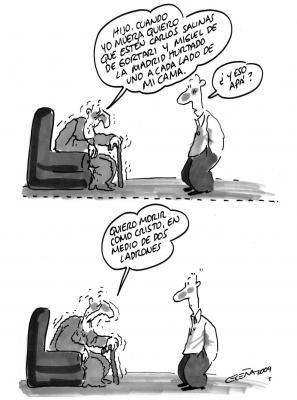
OLD GUY: “Son when I die, I want Carlos Salinas de Gotari and Miguel de la Madrid Huertado at my bedside”
YOUNG GUY: “Why, Pops?”
OLD GUY: “I want to die like Christ… between two thieves!”
It’s hard to keep up with this story… interviewed by respected journalist Carmen Aristegui on April 14, ex-President Miguel de la Madrid said basically if he’d known Salinas was as big a crook as he was, he wouldn’t have kept silent about how much Salinas stole from “secret party accounts”. Not that de la Madrid isn’t viewed as a crook himself (he’s suspected, with good reason, of having abetted Salinas’ theft of the 1988 Presidential elections from probable winner Cuauhtemoc Cardenas) and his own “illicit enrichment” but c’mon…
Salinas claims de la Madrid is “prematurely senile”, but then, de la Madrid has never fled Mexico, nor is he sending pathetic letters from London blaming reporters for taking advantage of some old geezer. De La Madrid (who is 74) sent his own letter to the press, saying he understood perfectly well what was asked, and what he was saying.
Mario Benedetti 14-IX-1920 — 17-V-2009 D.E.P.
The headline in el Noroeste de Sinaloa read simply “El Mundo llora a Benedetti”. Although a citizen of tiny Uruguay, the poet, novelist, playwright, journalist andexile for sixty years recorded, and gave meaning to, not only the Uruguayan experience, or the Latin American experience, nor even enriched the Spanish language, but pondered the essense of what it meant to be human in an uncertain world.
Quasi-annual computer repairs
The computer is going into the shop for long-overdue repairs. Manaña, y’all….

Chichen Itza West

Or… the Mexican Pyramid Scheme.
By the way, used paperbacks are still only 50 pesos (and romance novels 10 for 20 pesos) at Mazatlan Book and Coffee Company (new website coming) across from the Costa D’Oro on Av. Camarón Sábalo in Mazatlán.
Seeing the books are in a foreign language, and book prices are generally higher in Mexico than in countries that produce paper (like the United States and Canada), and it’s a seasonal market, that’s a bargain. But, if the price seems high, you can try the OTHER English language bookstore on the west coast … Puerto Vallerta is ONLY 450 Km. away.
Fidel Herrera: rata, cursi… and uncensored!
Mexican campaign laws are designed — in theory — to avoid negative campaigning and outside influence. Elections are federally financed and what in the United States are called “campaign contributions” here go by the less euphemistic name of “bribery.”
The parties have a budget (controlled by IFE, the Federal Elections Institute) for advertising, and all are given equal access to media time. Their ads are supposed to be informational only, and… for the most part they are. Also, they tend to be dull.
Given the success of negative campaigning by PAN in the last presidential election (which may have owed something to PAN’s use of U.S. campaign advisors… illegal though that may have also been), election law was recently changed to preclude attacks on opponents. IFE said nothing about internet advertising, and all parties have been turning to the web in this latest round of electioneering.
The Greens have been testing the system — some say openly flaunting it, running on-line negative ads paid for with private funds. Their reasoning seems to be that any fines they face are just part of the cost of doing business. The Mexican Green Party is not really a “Green Party” — it lost its membership in the international group because of its support for the death penalty. It usually acts a junior partner for PRI, and may be testing the elections laws for the benefit of the older, and much larger party.
Given IFE’s mishandling of complaints about the Greens, there is some justification for IFE writing regulations regarding internet advertising. However, whether IFE understands how the internet works… or whether all negative comments about Mexican political figures are political advertising… is an impossible conundrum. And IFE is handling it very badly.
Governor Fidel Herrera Beltran of Veracruz — who lately has been accused of coddling Smithfield Farms and agro-giants to the detriment of his constituents (and, faced with overwhelming criticism, has morphed into a “people’s champion” of more controls and investigations into the giant hog operations in his state) is also well known for having won the lottery — TWICE — during his tenure and is suspected of a number of frauds by certain political (and apolitical) observers. So, Fidel Herrera has argued — successfully — that a recent Youtube video that pokes fun at the Governor is a negative campaign practice and ordered it removed.
The video appears to be a PAN production (though not directly so), but censoring the video means, of course, attempting to censor the internet. Alfredo (Citius64) comments (my translation) — in a high dudgeon — that this is not campaign regulation, just old fashioned censorship.
When fascism arrives, it’s not going to march in with something so blatant as a patriotic parade. It’s more subtle than that: usually beginning with an attempt to silence “libertines”– for the protection of the helpless people, of course.
Yesterday (12-May) IFE took a frightening step in that direction, ruling in favor of the Governor of Veracruz, who complained about a You Tube video that mocks him.
Fidel Herrera is no idiot. He knowns any request that IFE censor the newspapers would backfire badly on him. But never, never before in the history of Mexico has any authority sought to censor the internet, and Herrera wants to see if it is possible, and if he can do it.
And IFE, the defender of democracy yielded up one of its prized values: freedom of expression. One wonders what those who died to defend the freedom of ideas would say about this. What would Belisario Domínguez* say? What would the journalists assassinated over the last several years say?
IFE, having prohibited using the Internet to make fun of a Mexican politican only proves that IF does not understand the Internet. The web of webs is a new paradigm at bureaucrats have not studied, nor do they understand. Luckily, the video in question has gone viral, and IFE has no way to stop it.
What’s tragic is that the electoral autorities want to treat voters like children. And to defend democracy, act as if we are living in China or Cuba. They seem to follow the logic of Orwell’s 1984: as Big Brother tells us, “Freedom is Slavery.”
Fidel Herrera is no idiot. He knowns any request that IFE censor the newspapers would backfire badly on him. But never, never before in the history of Mexico has any authority sought to censor the internet, and Herrera wants to see if it is possible, and if he can do it.
And IFE, the defender of democracy yielded up one of its prized values: freedom of expression. One wonders what those who died to defend the freedom of ideas would say about this. What would Belisario Domínguez say? What would the journalists assassinated over the last several years say?
IFE, having prohibited using the Internet to make fun of a Mexican politican only proves that IF does not understand the Internet. The web of webs is a new paradigm at bureaucrats have not studied, nor do they understand. Luckily, the video in question has gone viral, and IFE has no way to stop it.
What’s tragic is that the electoral autorities want to treat voters like children. And to defend democracy, act as if we are living in China or Cuba. They seem to follow the logic of Orwell’s 1984: as Big Brother tells us, “Freedom is Slavery.”
The censored video makes reference to colorful incidents in the career of the present governor of Veracruz — like winning the lottery… TWICE! — and expresses some doubts about the sources of the governor’s financial resources vis-a-vis the conditions of the state budget.
Uploading the censored video might be construed as a political act, and — as a foreign resident, who cannot by law participate in political action — I’d never think of such a thing (nor — if I was a citizen — would I be pushing PAN propaganda in all likelihood). As far as I know, there are no such restrictions on videos from Kazahikastan, where “u8hio” lists his (or her) residence. I’m sure others outside Mexico (or Mexican citizens) might upload the video elsewhere with legal impunity. But that would be wrong… right?
* Dr. Belisario Dominguez, a Puebla physician and congressman, was the only member of the Chamber of Deputies with the balls to say that Victoriano Huerta, who became president in the U.S. sponsored coup that overthew the democratically elected Francisco Madero in 1912 was a dictator. Huerta agreed… having the doctor shot down in the street.
A sombrero tip Laura Martinez, who noticed Damien Cave of the New York Times‘ explanation for what caused Padre Alberto to stray (er… his hands to stray, anyway)….
Father Cutié’s parish sits in the heart of South Beach, where even the mannequins have extra-large breasts, and many here have also questioned whether this was the time or place for Catholic priests to stay celibate.
What a boob!
Economic recovery is gonna be slow…

Then and now… selling Mexico
If you consider moving to Mexico, hoping that a new country will improve your financial situation, it might be worth remembering what happened to the “first family” of gringo Mexpats — the Austins.
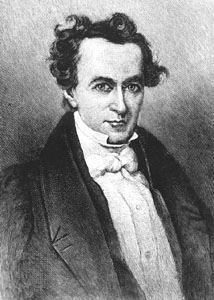
The sensitive real estate salesman
Everyone (or at least Texans… and they’re everyone, right?) remembers Stephen F. — who moved to Mexico back when it was still Nuevo Espagna to sell “unique investment opportunities in MEXICO!” to the gringos… who promptly over-ran the place, led to less-scrupulous investors setting up as competitors and leaving him a broken (and broke) embittered man… and a Mexican turncoat.
Even those of us with slightly purer motives — wanting a cheap way to maintain a lifestyle should take heed. And, especially, those of us who have the idea that we can maintain that lifestyle by writing about…. oh…. how to live in Mexico and maintain a gringo lifestyle.
Perhaps it’s not Stephen F. Austin we need to think about, but his cousin, Mary Austin Holley.
Born in Connecticut in 1784, Mary was fortunate to enjoy the educational opportunities open to women in her native town of New Haven, becoming especially knowledeable in the fine arts (a genuine rarity in the early United States). When she married the Reverend Horace Holley in 1801, she planned to settle into the conventional life of a New England minister’s wife, and school-ma’rm, although she dabbled in writing from time to time, and assisted Horace with his own intellectual labors. From 1805 to 1808, the Holleys lived in Greenfield, Connecticut where they boarded Mary’s young cousin from the west, Stephen F. Austin.
Stephen, who was 12 when he came to live with the Holleys, spent his adolescence in under the Holley roof — where art, music, literature and Christian precepts were the order of the day. Developing what would prove to be a life-long crush on his older cousin, the teenager dared hope for a career that would allow him the leisure to pursue intellectual and esthetic interests.
Stephen’s father, Moses, had already started what was to become the family tradition of cross-border wheeler-dealering. Shortly after the American Revolution, Moses — having already failed in a retail business in Philadelphia, found his niche as one of the United States’ first defense contractors — and defense industry lobbyists.
Convincing investors to put up the money for a Virginia lead mine was easy. Lead, of course, was essential to a lot of things at the time, among them, bullets. Moses, looking to make a hefty return, convinced the Washington Administration to pass a bill protecting the American lead industry from foreign imports, and — more importantly — buy HIS lead.
Which wasn’t as much lead as Moses and his investors thought. So… taking along four-year old Stephen, Moses packed up and moved across the Mississippi into what was at the time Spanish Luisiana to mine lead in what’s now Missouri. There, Moses swore allegience to Carlos IV, and — no surprise — began lobbying the viceroy in Mexico City to buy Spanish-American lead for HIS defense forces.
Napoleon Bonaparte sort of put a kibosh on that move… annexing Luisiana back to France, then turning around and selling it to the United States. The flexible Moses changed his citizenship back, but the Jefferson administration wasn’t nearly as business-friendly (or, at least not as Moses Austin friendly) as its predecesor, and.. besides… the new Northwest Territory was a bit off the beaten track.
Getting yourself ON the beaten track meant there had to be people beating a path to your door… and, as it was, Moses caught on that western real estate sales had a booming future. So, while Stephen was packed off to the Holleys for an eduation, Moses neglected the mining business and focused on land sales.

The mother of all "My life in Mexico" bloggers
By the time Stephen was in college, studying the law (which, with luck, would allow him to write, or paint, or enjoy musical performances in some civilized community) the mine’s investors had begun to lose patience with Moses. The value of their stock was… er… plummeting. Partly (maybe mostly) to avoid the inevidible lawsuits, and to attempt to pay off the debts, Moses pulled Stephen out of college, “sold” him the mines, and concentrated on pushing real estate.
On the basis of his Spanish nationality, he headed for Texas — where he could obtain claims to huge tracts of land, provided he could find buyers… then promptly upped and died.
It was up to Stephen — back in Missouri, still hoping to get out from under the mines, find a nice girl like his cousin Mary, and move somewhere civilized — to handle the Texas properties. Despite his natural inclinations, he proved to be a pretty good real estate salesman… which created a whole new set of problems.
Stephen did his best to show loyalty to his new country, but it created some tensions. He served (with some distinction) as an officer in the War of Independence, and did his best to keep would-be buyers informed on the requirements of Mexican immigration (and tried to assure that his buyers fit the requirements). The problems he had were mostly in communicating with the authorities — with Texas part of Coahuila, and no decent roads (let alone telegraph, which hadn’t been invented yet) and the closest thing to local administration being a small military command in Bexar (today’s San Antonio), and a few customs agents, it was next to impossible to keep within the contractual bounds set between his father and Mexico City.
Developers in our day, once word filtered back that there is cheap property somewhere in Mexico, find everyone and their brother wants in on the deal. And, in our day, those who move to Mexico to make a new life, and — to support themselves — create a business catering to gringos are stuck between a rock and a hard place. Whatever it is they sell depends on more and more gringo customers — which changes the whole dynamic of the market, and means more competition.
Meanwhile, up in Connecticut. Mary Holley was raising her kids, and helping the Reverend write his sermons and writing a little — “for herself”. When Rev. Holley unexpectedly died of yellow fever, Mary needed to support herself somehow. Editing his uncollected sermons (and writing a memorial book about her husband) proved she could write, and — having inherited at least some of the same genes for self-promotion Stephen and Moses had — she looked for a project to sell a publisher, as well as a way to live cheaply. She was the first to hit on the two-fer… move to Mexico to live cheaply… and write a book on how to move to Mexico and live cheaply.
And, for her, it would be … ahem… relatively easy.
Mary arrived in Galveston for the first time in 1831. Her 1833 “Texas: Observations, Historical, Geographic and Descriptive” set the standard template — what to pack (durable casual clothing… and pillows), when to go (October, so you could gradually adjust to the warmer climate), how to get there (boat from New Orleans), hotels in Mexico with English-speaking managers, finding “American” food, and dealing with the “foreigners.” Along with the “Historical, Geographic and Descriptive” material — and colorful encounters with colorful natives — to keep things moving along. The generic “Move to Mexico” book.
By the time Mary arrived, gringos outnumbered Mexicans (and even legal immigrants like Stephen F.) in Texas. Unable to adjust to Mexico, and — justifiably annoyed with the new centralized administrative structure that replaced the stil unsatisfactory federal system that kept Texas from administering its own affairs, the gringos rebelled. And brought in more, and more, and more gringos with the promise of free land (often as not, Stephen F. Austin’s land). Austin — very reluctantly — joined the Texas rebels, hoping to at least control the situation, but, in the end, left broke, embittered, and — although Secretary of State of the Texas Republic, dying in a drafty rented room.
Mary, who couldn’t afford to live in Texas — and every time she returned found it more and more expensive (thanks in large part to her glowing reports) became more Texan than the Texans, raising support for the rebellion (and the Texas Republic) while she eked out a living as a governess to a wealthy New Orleans family.
Promoters are in no danger today (one certainly hopes) of setting off a gringo rebellion (though many say gringos overwhelm at least a few communities in Mexico) to force Mexicans to do things the gringo way. But, as in the 1830s, they still want to try. Things would have been very different back then — and a lot of gringos today would save themselves a lot of grief — if they had paid attention to what she actually wrote:
Those persons… who are established in comfort and competency, with an ordinary portion of domestic happiness; who have never been far from home, and are excessively attached to personal ease; who shrink from hardship and danger, and those who, being accustomed to a regular routine of prescribed employment in a city, know not how to act on emergencies or adapt themselves to all sorts of circumstances, had better stay where they are.
El crimen del Padre Alberto
With the economic situation worsened by the flu contingency, the resurrection of Carlos Ahumada (and more evidence that the Fox Administrations and Carlos Salinas really were plotting against Lopez Obrador) , Euro-terrorists, murdered reporters, narco-related environmental degradation, and corporate sponsorship of human rights violations … thank God for something serious to write about … like El escandalo Cutié.
Miami native priest* Alberto Cutié has a huge following across Latin America, especially among older women and stay-at-home moms. Univision’s answer to Doctor Phil, Cutié has a huge advantage over the bald Texas therapist. The wise counsellor dispensing advise to ordinary people with ordinary life problems, isn’t a ground-breaking idea and such programs are “women’s shows”, but Univision is shameless about appealing to the female audience — not just a guy with a good head of hair, but a really handsome Latin guy with a full head of hair.
Cutié — based on the show, on his looks and his social circle, a regular on the Miami Latino “A” list, endlessless covered by the Latin entertainment press. His photograph has been in the Mexican/U.S. rag, TV Notas before. Having your photograph in your speedos — and more importantly, being able to be photographed in your speedos at age 40 — is something Latino stars would kill for. Being photographed with your hand wrapped around a hot babe is even better.
Normally. But, part of Cutié’s schtick is to wear black on his show. Like Johnny Cash, or Juanes, he’s making a statement. So did his Bishop after the photos appeared:
Father Cutié’s actions cannot be condoned despite the good works he has done as a priest. I ask for everyone’s prayers at this time.
Even if your posse includes the late Celia Cruz (at whose funeral Father Cutié officiated) and Shakira (a regular communicant at Padre Alberto’s St. Francis de Sales Church), being in gringolandia means having to say you’re sorry:
Before God – full of love and mercy – I ask for the forgiveness of those who may be hurt or saddened by my actions. Since I entered the seminary at the age of 18, the priesthood has brought me great joy. The commitment that I made to serve God will remain intact. I am grateful for the love and support I have received today from so many in our community, especially my parishioners and the supporters of the radio stations who have demonstrated great compassion and understanding toward me as a human being. I ask for your continued prayers and support.
Cutié, trying to have it both ways — very gringo in that — is supposedly considering becoming an Episcopalian Priest. I can’t see it. Episcopalians will tell you they are “God’s Frozen People” and, yeah, I know it’s a stereotype, but I can’t imagine a Cuban Episcopalian … not a straight one anyway
I think this is what makes the United States different than Latin America. In Latin America, it’s almost assumed that priests who don’t have girlfriends are gay. One 81-year old Cuban exile said, “What’s the problem? At least he likes girls.”
The Latin American Church is about culture, and not rules. I always suspect the reason Mexican-American immigrants are church-goers much more than Mexicans are is that Catholicism here is in the air, and is unavoidable, even if one is something else (I’ve seen Mormon homes with a picture of the Virgin of Guadalupe in them).
Sinaloa, where I live, is famously anti-clerical, even more so than most of Mexico. But, in affirmatively rejecting the clergy, one is paying a back-handed compliment to the Church… ceding it’s power, and recognizing it as a serious opponent. And, as with its people, imperfect and flexible. And, not being Puritans — hung up on individual salvation, nor on giving moral weight to every little thing in life — people just say “nobody’s perfect”… and go (or don’t go) to confession. And live their imperfect, messy lives.
And, speaking of falling short of perfection — here’s Padre Cutié pushing … abstinence.
* slight correction, 18-July-2011. Alberto Cutié was born in San Juan, Puerto Rico in 1969.
What a friend we have in Jesus
Or, at least His General.
(and that’s all I’m going to post… I shouldn’t even be looking at a computer until I get my other stuff done!)
A quaint little blog
This is the Mex Files’ 2000th post.
In October 2003, an Australian computer goddess — and regular Latin American traveler –Catherine O’Neil, took it upon herself to set up something called a “blog” for the e-mails and sometimes overly long posts on Lonely Planet’s Thorn Tree Mexico Message Board I was writing from (and about) Mexico City. I sometimes think she created a Frankenstein’s Monster, but — with a few rewritten emails from 2002, the Mex Files has outlasted three or four computers (including a laptop built from cannibalized parts from a medical engineering firms’ junk pile and held together with duct-tape) two different hosting sites and three URL name changes.
The “numbers”, if they’re important, have been going up… averaging (and not counting the huge spike from earlier this week) about a thousand hits a day over the last year. That’s a respectable number for an eccentric niche site, and nothing to sneeze at.
No, the Mex Files is not a superpower in the cyberworld, or even a major regional power. If the big sites — nearly all in the United States — are the superpowers, then this is the “third world.”
Being a Bolivia of cyberworld is nothing to be ashamed of. The Mex Files has a tumultous history, has always been financially shaky and — while for a time, there was a second writer, Lyn from Boulder (whose family situation required her full-time attention and disappearance from these pages) — has achieved relative stability under a less than perfect governance: for now a caudillo .., me. The Mex Files is, however, open to immigration (and the caudillo isn’t going to be around forever) . And, while the Mex Files does require foreign aid from time to time, it still, like Bolivia, entitled to its autonomy.
What struck me about comments on my run-in with The Huffington Post was the assumption — very first-worldish — that the cyber-superpowers had an absolute right to my resources (i.e., writing and translation) and I was mistaken in assuming “a quaint little blog” had any reason to reject the argument that they had a right to take my resources for their own (presumably better) use.
There is also the unspoken assumption that bigger and richer is better, and that the superpower knows what is best for us cyber-third worlders … and not buying into their assumptions makes us “fools”. My reasons for not wanting to be on Huffington Post are not particularly relevant (mostly having to do with their history of running only those posts on Latin America that sensationalize the region, or buy into stereotypes) — like Bolivians and their lithium (and tin, and oil and gas), it’s up to the owners of the resources to decide how they want to manage those resources… or, if we think of posting as “intellectual property,” then the Mex Files has the right to decide ownership rights.
What those who thought I MUST allow Huffington Post to link to my site without my permission remind me of is the World Bank or International Monetary Fund… they try to convince small, marginal countries (or, in my analogy, websites) that following the prescription of their big clients is the only way to “succeed.” Unspoken of course, as with World Bank prescriptions, is that this benefits not the little third-world folks (my regular readers), but the superpower.
Finally, who says bigger is better? I try to keep my regular readers in mind when I post. What would Nezua say, what would Mr. Rushing say, what would the Council on Foreign Relations say…? Those are the “citizens” of this funky little republic… who are the ones whose needs should be met. And, just having more “stuff” — or hits in this case — doesn’t make one better … it just means more stuff.
The superpower incursion has nothing to do with it, but The Mex Files is closing it’s borders for at least the next week. I need to get work on an editing project and get some personal things taken care of, and take a break.
In the meantime, for general U.S. and English-language Mexico coverage, Mexico Institute is a good bet. Commentary on the Mexican political scene from Xico is always worth reading. Gancho Blog usually has a news item or two that the English-language media has overlooked. U.S. immigration issues are well-covered by The Sanctuary, history by Secret History and snark and general Mexican weirdness by Burro Hall.
José Emilio Pacheco, born in Mexico City (30 June 1930), has been publishing poetry, novels and essays since his first volume, Los elementos de la noche, appeared to critical acclaim throughout the Spanish-speaking world, in 1963).
Pacheco was honored today with the Queen Sophia Prize for Poetry. The 42,000 Euro prize, given by the University of Salamanca is considered the most prestigious poetry award in Hispanic letters.
Influenced by the Spanish “50s Generation” poets — who reacted against the banality of the Francoist era by turning to philosophical verse and a preoccupation with language — Pacheco does have some resemblance to that preceding generation of poets. While Pacheco and his friend Carlos Monsiváis have been co-editors for at least two cultural publications, Pachecho is unusual for a Mexican writer in NOT being a “public intellectual”.
Sticking to “sensual, durable, romantic” poems has been Pacheco’s life work. He saw the prize as a small consolation for Mexico and his native city, after the “apocalypse” of cultural life last week (when everything that matters to a poet — museums, libraries, cafes and cantinas — were shuttered).
Certainly a Mexican, but his patriotism and public utterances are of a different order.
(my translation from “Alta tración”)
High Treason
I don’t love my country.
Such dazzling abstractions
are beyond my grasp.
But (I know it sounds wrong)
I’d give my life
ten times over,
for certain people,
ports, pine forests,
attitudes,
a worn-down city,
gray and monstrous,
various historical figures,
mountains
– and three or four rivers.


