Viral campaigning in a time of viruses
The usurper government has abandoned the people and for that simple reason, these epidemics affect the Mexican population.
The official campaign season for the 2009 elections started last Sunday, and there has been concern that the Calderon Administration is using the “sanitary contingency” to control either control the opposition parties ability to reach the voters, or to surpress voter turnout — which would presumably benefit PAN.
PAN Party Chair German Martinez had floated the suggestion of delaying the election, but found little support for such an obvious ploy. Most parties agreed to certain “temporary” restrictions — supposedly voluntary — that limit candidate meetings to small gatherings between 10 A.M. and 3 P.M. (which basically means workers wouldn’t be attending) and limiting campaigning to a media campaign.
While election and media laws require the television and radio broadcasters to run campaign material during prime time for all the parties, and even the minor parties are given equal access, it does limit the effectiveness of some campaigning, which has always been more hands-on in Mexico.
BUT… There are no restrictions on internet advertising.
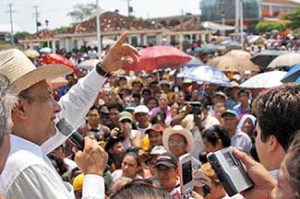
AMLO, campaigning the old fashioned way. Photo: Gobiernolegitimo.org.mx
The Social Democrats (SD), a very small party and always in danger of losing their registration, seems to be “winning” the on-line campaign. At least it’s SD advertising which pops up most regularly on my screen when I look at a site with random advertising. The SD ads push a “progressive” social agenda (drug legalization, abortion rights, gay and lesbian equality) and pays less attention to economic policy, perhaps appealing for the geek vote — which may be enough to keep their party registration.
Andres Manuel Lopez Obrador (who I quoted at the top of this post) — and is not a candidate for anything, but is stumping for Convergencia and the Workers’ Parties outside Mexico City (and for the PRD-Convergencia-Workers coalition in the Federal District) is arguing that, not being a candidate, he doesn’t have to follow the “temporary” restrictions, and recently addressed a daytime crowd of 2000 in Tamulté de las Sabanas, Tabasco. David Agren drew attention to the fact that AMLO was pointedly was NOT wearing a cubreboca.
His “Goberierno Legitimo” has also had a strong cyber-presence. It’s websites aren’t always as slick as SDs (or the other party’s which can afford professionals) but the Mexican “netroots nation” is out there… and no one has any idea of how powerful it might be.
With recent polls (which others have commented on) showing a slight PRI lead over PAN, the discussion among the foreigners who pay attention to Mexican politics has been on the two main parties. I expect this may have something to do with the U.S. assumption that no democracy can — or should — have more than two parties (something I’ve always felt was a weakness in the U.S. system). Depending on the writer, the fact that PRI support had fallen a point was good or bad news, but what the commentators missed was that PRI’s 28 percent support and PAN’s 27 percent support doesn’t mean there is a huge bloc of “undecided voters” but that there is a huge bloc of voters who may chose other parties — PRD, Convergencia, PT, SD or the Greens (who weirdly enough are pushing the death penalty for kidnapping and murder, when you think the flu’s suspected ties to corporate agriculture and environmental damage would give them a winning “green” issue).
Lopez Obrador has been out of the media eye for the last two years, which doesn’t mean he hasn’t been active. He has been organizing grassroots campaigns for the smaller left-wing parties (which were part of the old “Benefit for All” coalition), lending support to some factions within PRD and may have a built a stronger organization than we realize. His supporters, especially in rural regions, tend to be the voters who are hard to poll anyway… often being people who don’t have landline telephones or regular internet access.
I expect more “flu-fallout” will emerge in the next few days as the campaigns get more heated. And, I expect that the broad support for the Calderon administration’s proactive approach to the flu will somewhat limit the expected fall in PAN support, but it may not all be to the advantage of PRI… though with a stronger left, the Administration will be forced to make more concessions to the left in legislative iniatives.
A contingency is not a war
Shannon O’Neil, at LatIntelligence (Council of Foreign Relations) argues persuasively that the biggest news to come out of Mexico about the “swine flu” epidemic is that the system is working:
Despite the severity of the crisis, there have been no panics or riots. And while far from over, the numbers of deaths in Mexico are beginning to drop, suggesting (at least for now) that the government’s efforts are working. …
Mexico’s reaction reflects the strength – not the weakness – of its government. Despite a few grumbles, citizens have supported the tough measures, even when they affect people’s very livelihoods. This is a testament to Mexico’s elected leaders, and the slowly developing trust in a government of the people actually working for the people. It is also the result of steps taken to strengthen the health care system over the last few decades.
She’s right, of course, but I’m not sure that “working to develop and implement a comprehensive policy” holds true in the “drug war.” The sanitary contingency (the nice neutral name given the emergency measures) were temporary, there was a specified goal, defined mileposts for measuring progress, and a known end-date. And, unlike the on-going, ill-defined, amphorous “war” on some narcotics traffickers, there was already broad consensus within Mexico that the “enemy” was a bad guy.
In the sanitary contingency, people were asked to take precautionary measures for a limited time — and for the benefit of everyone. In the “drug war” some people (soldiers and policemen, mostly) are asked to die to bring down an industry that employs somewhere around 400,000 people… for the perceived benefit of another country.
The Mexican government itself can’t make up it’s mind whether it should be breaking up cartels (which just scatters the traffickers and opens up new business opportunities for other gangsters … who may be less well organized than the present bunch) or pressure the United States to do more to stem the trade at the retail level and to curtail the money and weapons supply.
And, the measures taken by the government — often riding roughshod over civil rights (and getting people killed) are not building confidence in the government. Quite the opposite. PAN leaders accuse PRI deputies of being in bed with the gangsters, the PRD and SD accuse the PAN executive of wasting money on military expenditures, and there is little confidence that the continual shifting of police responsiblities to the Army (or consolidating the police into a national force) is really going to curtail the violence.
Former U.S. “Drug Czar” John Waters raised several eyebrows when he said “the drug war cannot fail because it will never end.” That’s true about disease — if controlling disease is said to be a “war” . There are post-battle issues to be handled — the environmental contamination from feed-lot farming for example, and perhaps some improvment in testing and reporting procedures, but the point is that the “drug war” is two, or more, things — no one of which is being systematically looked at.
While Mexico has pulled back to treating narcotics (and marijuana) use as a social issue, or a health one, and not a criminal matter, there is less support for that measure than one might think. Eighty percent of those polled by El Debate de Sinaloa oppose legalizing or de-criminalizing narcotics use.
On the other hand, simply arresting the many, many, many people who make their livelihood from growing, transporting, processing two rural industries — marijuana and poppy farming — isn’t viable. Narcocorredos and other pop culture forms suggest the individual gangsters enjoy sympathy and support that H1N1 never will.
Ms. Dr.* O’Neil is exactly right when she says that the public health response proves Mexico is not a “failed state.” But, when it comes to the narco-“war” it may be engaging in a policy that cannot succeed.
(Sombrero tip to Esther at Xico for first posting on this article)
* I’m glad to make this correction, though it wasn’t requested (I noticed my mistake when I checked how her last name is spelled — one “l” not two). Shannon O’Neil is one of the smartest people around when it comes to Latin America, and “around” for her includes people like Madelyn Albright and Ernesto Zedillo
I’m in a snit about the Huffington Post right now, so rather than directly link, I’ll point you to the NON-COMMERCIAL MEXICAN site, Burro Hall for the first clue as to what brought on this bout of snititude:
… a marketing consultant named Betsy Perry … in the Huffington Post last week and … manages, in fewer than 500 words, to incorporate so many offensive and idiotic remarks about Mexico that, really, it defies our ability to excerpt it and still do justice to the author’s ignorance.
Ms. Perry, who was forced to resign from the New York City Commission on Women’s Issues, in part because of her offensive and idiotic remarks (I guess she somehow thought New York City’s large Mexican community did not include women, or — more likely — she just didn’t think at all), wrote a lame “apology” on the Huffington Post, which said the offending essay was being taken down… and then was followed by the offending essay!
This is not the first time the Huffington Post has published outrageously racist and boneheaded know-nothing material on Mexico. I was not the only one who complained back during the 2006 Presidential Elections about an article by some college kid (it was supposedly humor) saying “I didn’t know Mexican had elections… I thought the guy with the biggest mustache got to be president.”
Part two of this snit goes back to last December, when I was solicited by some third party, Global Post, which said “Do we have a deal for you!” … which came to mean THEY would profit from my posts here, by sending them to the Huffington Post. I would get something called “exposure” … which I believe is a fatal condition afflicting those lost in the Sierra Madres or Chihuahua Desert.
It worked like this. “Global Post would repost my material on commercial websites (and get paid for doing so) and I’d get…. squat. My mama din’t raise no fool, and we had some back and forth correspondence, between myself, Global Post and “Nino Pitney” about the matter.
Pitney wrote, in an e-mail I received 31 December 2008:
Just to be clear, it is against our policy to run any of your material without your permission. As far as I know, we have not done that, but if we have, let me know and we will immediately remove it.
OH?
They did run my material today without a “by your leave.” It was short enough to be called an excerpt, and it does properly credit “Mex Files,” but a story about prostitutes (which I made damn sure was noted as a translation of a short AFP article) under a picture of high school kids is an insult to Mexican women, to Mexicans… and a violation of my authorial rights to boot. While I don’t mind the extra “hits”, as I said back in December, “if you plan to make a profit off my work, you damn well better pay me.”
Mexico conquers the world
Mexico, has been reinterpreting the wider world in its own terms for as long as there has been a Mexico (or longer — there are those who believe that the Chinese and Mayans were in contact with each other). Today is Cinco de Mayo… a rather unimportant holiday as far as Mexico is concerned, but one celebrated elsewhere as a day to celebrate all things Mexican. Sometimes, as in the United States, this takes the odd form of politicans inviting Puerto Rican pop stars to their fund raising events… or melting Velveeta cheese and frying some hamburger to stick in fried corn shells… but giving a bit of thought to something other than flu and narcotics is appreciated.
And, when it comes to reintrepreting Mexico through a secondary source, the results can be … um… interesting. I found this in Manil Suri’s “The Death of Vishnu” (2002, Perennial) about life, death and apotheosis in Mumbai:
As Mrs. Pathak dabbed the sweat on her forehead, she wondered again why she had embarked upon the recipe for Russian-salad samosas. It was all Mrs. Jaiwal’s fault, of course — serving those strange Mexican things at the last kitty party — “tocos” she had called them. They had been nothing more than fried chapatis wrapped around salad leaves and califlower curry, but the woman had been shrewd enough to mix in lots of mango pickle and chili, and the ladies (including Mrs. Pathak, despite herself) had just gone wild over them. “Rohit tells me that tocos are very popular in Omaha right now,” Mrs. Jaiwal had crowed, lest anyone forget that her son was currently enrolled at the University of Nebraska, in the States. This had been particularly galling, vien that Mrs. Pathak’s elder son, Veeru, had just failed his first-year exams at Bombay University.
Chili, tomatoes, turkey, corn, squash, beans, avocado … Mrs. Pathak, and the rest of us, whether in Mumbai or Minnesota, Malawi or Mongolia, Munich, Manchester, Mukdin or Melbourne… serve up Mexican food every day even if we don’t identify it as such.
Happy Cinco de mayo, enjoy your tocos.
While I agree with Naomi Klein’s “shock doctrine” for the most part (that reactionaries welcome chaos, or even foster it, as a justification for consolidating power), but I think any smart political organization takes advantage of unforeseen circumstances.
When thinking about possible effects on the upcoming July federal elections, the flu — and reaction to the flu — usually center on PRI and PAN (and PRD in Mexico City). Less noticed has been Andres Manuel Lopez Obrador’s patient “under the radar” “legitimate government” movement. AMLO has been touring the countryside, usually speaking to rural or marginal groups, and building an organization on behalf of Convergencia and the Workers’ Party (PT) outside the Federal District (inside DF, his movement is part of PRD). Those two smaller parties are particularly strong in rural Veracruz.
How much effect the flu will have on these minor party’s chances in the election, but well worth passing on is this, (translated from Blogotitlan, a pro-AMLO website) in what is going to be a rough campaign season. And I dearly love good political invective:
The governor of Veracruz, Fidel Herrera (PRI), showed nothing but contempt for the constant denunciations against Carroll Farms, the transnational piggery in the Valle de Perote (which includes the small town of la Gloria, believed to be the point of origin of the present outbreak of flu caused by a pig virus mutation).
The Governor discounted or ignored protests by la Gloria’s residents about the transnational, jailing those who filed formal denunciations, and unwilling to investigate the so-called “biodigestores” — which use rotting pig carcasses to generate electricity for the farm … as well as generating flies and environmental contaminants.
More worried about possible fallout in the next federal election, Fidel Herrera did not want word to leak out that young Edgar Hernandez, one of the 600 out of a total of 5000 inhabitants of la Gloria who contracted the flu was the first known case of the repirator disease bred in those contaminants in the multi-national piggery. Protected by Governor Herrera. PROFEPA (the Federal Prosecutor for Environmental Affairs) was convinced not to investigate the matter, and, thus, closed off focus on the source of the infection.
When all fingers point to the source of this scourge of Mexico and the world, towards la Gloria, Fidel Herrera has tried to justify his criminal omission and elude his true responsibility. Blaming first China, which responded with the contempt he deserved, Herrera then tried to attribute the problem to the State of Puebla, whose governor and citizens didn’t take kindly to the suggestion either. Herrera seeks to save his own, and his piggish patrons, hides.
For Fidel Herrera everyone is responsible… except him. So he continues his desperate attacks on anyone who seeks to investigate the serious environmental damange caused by Carroll Farms, already fined for the same abuses in their native Virginia…
(The last two paragraphs depended on untranslatable puns on “Fidel” — faithful — and the PRI and PAN colors, basically boiling down to a pox (or flu?) on both mainstream parties and the “establishment”.
In the street, the only mask is a condom
Welcome Huffington Post link-ees, but … given that I clearly state that commercial sites are expected to ask permission to use my material, and the Huffington Post did not… I would appreciate your letting Huff Po know they owe me for my work as a translator.
I am in no way responsible for the photograph which appeared illustrating the link, which shows high school students, who are not prostitutes. I, for one, consider it highly offensive and inappropriate (and possibly slanderous, which is a jailable offense here in Mexico). My thoughts on this post — and the Huffington Post’s anti-Mexican biases are here. I’ve written on their underhanded way of appropriating work from writers like myself here.
So says Fátima, a 40 year old Parque Sullivan “strolling hostess” interviewed by AFP.
If AIDS and other sexually transmitted diseases are a industrial illness, I’m not going to worry about this fucking flu, that’s curable. AIDS has no cure.
(my slightly cleaned up translation)
Sexoservadoras (“sex workers”) have been particularly hard-hit by the santitary contingency. According to Jamie Montejo, press spokesperson for Brigada Callejero (a streetwalkers’ support and mutual assistance group), 70 percent of the street walkers are out of a job right now, and there has been a 40 percent decline in customer demand.
Jessica, a 25-year old who has only been a streetwalker for two months, sees the recommended cubreboca as a practical impossiblity to workers in her trade.
When I go to the store, yes. But anyone wearing a mask in this job is not going to work.
Jessica said she has seen only one masked client.
World-wide, 17 people have died of “Swine Flu” (or H1N1, or “Mexican Flu”).
38,500 People die each week around the world from the Aids virus.
But, AIDS is the pandemic that dare not speak its name.
Support your independent bookstore
Jackson Street Books carries a great line of worthwhile books, and takes the time to read and review them. And, even if you’re not in the Seattle area, they do mail order.

I’ve been meaning to write on the effect the flu will have on Mexican elections, but I hadn’t expected “spin” from the United States meant to bolster one of the parties… but I should have.
The Washington Post has an editorial today, that in a break with tradition, actually says Mexico is doing things right:
Mr. Calderón’s government is getting some credit for detecting the new virus relatively early, for quickly supplying information to international health authorities and for taking sweeping measures to contain the outbreak, such as shutting down most of the country for five days that began Friday. It’s a performance that contrasts sharply with China’s secretive and clumsy handling of its SARS and bird flu cases earlier in this decade, and it’s no surprise…
The dot, dot, dot is
…coming from a Mexican president with a record of courageously facing the country’s problems — as exemplified by his frontal attack on the drug trade, using tens of thousands of Army troops.
In other words, the WaPo is spinning a good reaction by the often-maligned public health care system and its bureaucrats to press for continued U.S. support for something not necessarily supported by the Mexican people or voters.
The WaPo, true to it’s traditions, can’t write an editorial without attacking Hugo Chavez of Venezuela (what he has to do with all this, I don’t know) and repeating the nonsense that AMLO was a creature of Chavez:
Mr. Calderón just barely won the 2006 presidential election over a leftist populist candidate backed by Venezuela’s Hugo Chávez. Mr. Chávez’s fondest ambition remains adding Mexico to his anti-American bloc. That the United States is failing to fully support a friendly, democratic and capable Mexican government is not only shortsighted; it is dangerous.
I am one of those foreigners who — like half of all Mexicans — thinks Calderon’s 2006 election was at least as dubious as George W. Bush’s 2000 election as president of his country. As a Mexican resident, I’m certainly no alone in finding absurd the idea that Mexican democracy and Mexican anti-americanism depend on a Venezuelan politician’s preferences. The Washington Post still hasn’t wrapped its head around the idea that Mexico is not the United States, and that there are not two candidates in Presidential elections. Obviously, there were two front runners, but it wasn’t a horse race. The third largest “vote getter” was no-one. If you count those that “voted Zapatista” by abstaining, Calderon got only 20 percent of the vote. If you don’t count that, and you assume he actually did win, he still only got about a third of the votes.
If there was any “foreign influence” in that campaign, the most obvious people were those like Dick Morris and Rob Allyn, who were, at the very least, skirting the law, by working as “advisors” to the Calderon campaign. Chavez may have expressed his druthers during the campaign, but it’s no different than Calderon having openly said he’d prefer John McCain’s election during the 2008 U.S. campaign. Chavez, I’d note, was hardly the ony foreigner who would have preferred AMLO.
As to the “drug war.” As David Agren noted in his comment on my post about the Senate approval of some narcotics reforms, all political partieis are on board with making reforms not backed by the “de facto President” and he’ll likely sign the bill into law. And, opposition to the “drug war” runs to people like the Roman Catholic heirarchy, which is hardly a “Chavista-influenced” bunch.
Secondly, I’m not sure how competence in the public health sector translates into need to support financially a second issue which … ironicially enough…. is a security problem BECAUSE it is not being seen as a public health issue in the country that the Washington Post thinks should back a particuar action.
And, as to AMLO. Anti-americanism, and pan-Latinism, has been a staple of Mexican political thought long before Hugo Chavez — at least since 1828, when the presidential campaign issues revolved around trade and investment with the United States.
I’m not even sure that AMLO was all that “anti-American” in his politics, or his presidental agenda anyway. There was nothing specifically anti-American (more anti-Spanish, if anything) in his critiques of the banking industry, and his calls for investigation into the bank bailouts of the 90s. While criticism of U.S. farm policy, and product dumping might be considered anti-American, it was more anti-NAFTA (or rather a call for amending NAFTA) and pro-farmer than anything. Maybe the Washington Post was referring to AMLO’s campaign promise to move industrial development away from the U.S. border and to focus on trade with countries other than the United States (something most Mexican economists, and many others — including Vicente Fox — have also recommend).
Maybe the Washington Post just has a hard-on for Hugo.
Flu update: 3-May. “Stabilization Phase”
Jonathan Clark writes in this morning’s The [Mexico City] News:
Officials continued to offer an improving picture of Mexico´s swine flu epidemic on Saturday, taking some of the urgency away from an earlier call for citizens to stay home and businesses to close through Tuesday.
On a day that began with Health Secretary José Angel Córdova announcing no new flu-related deaths confirmed overnight and Mexico City officials reporting no deaths for a second straight day, some citizens and business owners felt confident enough to ignore the nationwide shutdown.
“I was afraid a few days ago, but now I know it´s under control,” said Jenny Chagoya, who opened her manicure shop in the Colonia Narvarte on Saturday – in part because she needed the business, and in part, she said, “to keep from getting completely bored.”
But while Córdova said the nation had entered a “stabilization phase,” he also cautioned against complacency, saying that “it would be hasty to say that we have passed the trickiest moments” of the outbreak.
International health officials agreed, saying the virus could still mount a comeback here.
The joke going around Mexico City right now is that boredom is killing more people than the flu ever could. People are returning to the streets. Here in Mazatlan, where restaurants are allowed to remain open because of the huge number of tourists — and, yes, they’re still coming, in about the same number they normally do in the off season — but have to close at 11 p.m. as if the flu vampires only rise at midnight, I guess), the people who were wearning face masks, like bus drivers, have started to “forget” them. And, we’ve been staying open on the theory that reading and buying books is essential… to stave off boredom if you are going to be stuck at home after 11.
Previous posts tagged “Swine Flu”:
How Many Died of Swine Flu So Far? 12
Cocolitzi to Swine Flu
When the history of the “Mexican Flu” (we’ll probably be stuck with that name) is written, the story should be that while everyone was losing their heads and acting stupid, the Mexicans took rather drastic measures, but managed to contain the illness. How Mexico dealt with — and was affected by — previous disease outbreaks was the subject of a short article by Tania Molina Ramírez for Jornada on 24 April (my translation):
During the well-documented outbreak of what was called cocoliztli (and was probably typhus, Bernardino de Sahagún asked some of the indigenous teachers of the Colegio de Tlatelolco how previous epidemics were treated. He was told that while there were some medications available for the afflicted, mostly people relied on prayers for the intercession of the god Tezcatlipoca, writes anthropologist and historian Miguel Leon-Hidalgo. The cocoliztli epidemic occurred about 1540, the afflicted including Sahagún.
On the other hand, Rafael Valdez Aguilar, professor at the Universidad Autónoma de Sinaloa writes (in the magazine Elementos, published by the Universidad Autónoma de Puebla ) that “between 1450 and 1456, there was a great epidemic in Mexico associated with several years of bad harvests and consecutive years of famine. Defined by the texcocanos chroniclers as a “pestilential cold” it was without a doubt an influenza epidemic, complicated by opportunistic illnesses that showed no mercy to population already debilitated by hunger. We also know of similar epidemics in 1496 in Tehuantepec and neighboring communities and of one in 1507 in Tuctepec and Intzitlán, that also produced the great mortality in the central part of the territory that today constitutes Mexico”.
In la Relación de la Conquista, written in 1528 and including in Visión de los vencidos (edited by Miguel León-Portilla) one reads for 2-Flint year: “This was the year that Motecuhzoma died, when they (the Spaniards) were based in Acuenco and went to Tlaxcala. There the epidemic spread: coughs, pustules and fever.”
This was probably smallpox [my addition].
In the last century, in 1902, there was an outbreak of bubonic plague in Mazatlán, and a smallpox epidemic.
And, in 1918, there was the flu pandemic, the so-called Spanish influenza.
However, Rafael Valdez Aguilar assures us that, despite the name, the disease originated with the United States Army in Funstone, Kansas, the first known fatality on 4 March of that year. “Spanish flu” reached Mexico in June from its neighbor to the north. Madagascar, South Africa, New Zealand, Guatemala and Mexico appear among the countries most punished by the outbreak, with mortality rates oscillating between ww and 35 percent of those afflicted.
Valdez writes that “according to E. Oakes Jordan, the influenza pandemic of 1918-19 in Mexico – which then had 14 million inhabitants – took 500,000 lives”.
Between 1948 and 1955 1,100 cases of poliomielitis were registered each year. After a vaccination campaign, by the 1970s, there were only about 600 per year. After 1986, the number of polio cases dropped progressively to the point where by 1990 there were only seven cases a year, and five years later, the Pan-American Organization of the Health certified that polio had been eradicated in Mexico.
Approaching the present time, there were two measles outbreaks, both originated in Asia. The first, in 2003, put the Federal District and the State of Mexico at risk. A year later, the same virus was found in the Federal District, Hidalgo and the State of Mexico.
For more information on the history of the epidemics in Mexico, consult Ensayos sobre la historia de las epidemias en México (Instituto Mexicano del Seguro Social, 1982), compiled by Enrique Florescano and Elsa Malvido.
Also the bulletin Epidemiología is published by the Dirección General Adjunta de Epidemiología of the Secretaría de Salud every Monday (www.dgepi.salud.gob.mx).
The Texas flu-step
A renowned Texas research journal, following up on reports on an outbreak in Finland, of “TexMex Flu” notes that the Finns seem to be misidentifying H1N1 viral infection for the more common North American endemic illness. The two diseases appear to show a markedly similar symptoms (headache, joint pains, weakness, sensitivity to light, dehydration) but field study under the direction of noted researcher Shelly West uncovered most likely cause of the dreaded TexMex flu, which, Ms. West’s extensive study showed, has little to do with pigs… of the four-legged variety:
What goods a crisis, if you can’t dance?
Marc Monster y la Agrupación Cariño with “la cumbia de la influenza”, and Bandaloz with “Influenza cancion duranguense”.


