More than a year after the U.S. Department of State began denying passport applications of Rio Grande Valley residents delivered by midwives, the issue is still being addressed in Congress and in pending class action lawsuits.
U.S. Rep. Solomon Ortiz, D-Corpus Christi, broached the issue of arbitrary passport denials at a March 24 meeting between the Congressional Border Caucus and Secretary of State Hillary Clinton.
“Denying passports or questioning the eligibility of an individual solely because the birth certificate is issued by a midwife is an arbitrary practice that has subjected thousands of U.S. citizens to unfair treatment,” Ortiz said in a prepared statement.
With the requirement that U.S. citizens returning from Mexico show a passport, and people along the border having to cross into Mexico regularly for business and family reasons, this is a serious problem, especially in rural Texas where medical services aren’t always available and, besides, being born is seen as a natural occurrence and not something necessarily requiring hospitalization. As was crossing the border. But, consideration of how people “not like us” live is not something the bone-heads who wrote the regulations would ever let cross their narrow minds. A bunch of prissy bureaucrats.
(sombrero tip: South Texas Chisme)
Withdrawal symptoms
According to the Office of National Drug Control Policy, Americans spend about $9 billion a year on Mexican pot… Mexican drug cartels reap 62 percent of their profits from U.S.
That last stat, provided by the White House drug czar, is the silver lining. Every American concerned about Mexico’s security problems should be thankful that the cartels are so dependent on marijuana, and not a genuinely hazardous substance like heroin. Why? Because that means through pot legalization, we can bring the marijuana trade out of the shadows and into the safety of the regulated economy, consequently eliminating the black market the cartels rely on. And here’s the best part: We can do so without fearing any more negative consequences than we already tolerate in our keg-party culture.
(David Sirota “This is the truth on drugs“)
Since Felipe Calderón launched this latest “war on drug dealers” the body count has been mounting…. 9000 at last count. Mexicans are rapidly losing patience with the “negative consequences” surrounding its ties to the U.S. drug (and anti-drug) industry… and there is growing consensus in the United States for some reforms of its own draconian drug laws.
The possibility of some change, as well as recognition of where the problem lies, is welcome, but don’t expect everything to be hunky-dory this year… or maybe even in this decade.
First off, drug users may be a huge market, but both the U.S. and Mexico (to a lesser extent) have turned security and incarceration into mega-billion dollar industries… ‘too big to fail’. Everything from the local community college with a “police science” program to the Drug Enforcement Agency has a vested bureaucratic interest in keeping “drugs” off the market. Otto, at Inca Kola News recently plotted out an interesting chart that shows drug busts in Andean nations go up when the DEA is not involved. Still, it’s a powerful bureaucracy, and it is going to do everything it can to keep up its inefficient (and probably counterproductive) work.
In Mexico right now, there is a political incentive to keep the “drug war” going. PAN uses the specter of “drug money corruption” in politics to justify their attacks on the other parties. And, given Calderón’s only tenuous legitimacy, the “drug war” — and the foreign support his administration enjoys for pursuing it — are useful politically. The Army bureaucracy, now having more weaponry and a limitless supply of cannon fodder (we still have a draft here) are going to want to keep their bigger budget even after this “war” is over. There are already signs that social movements are being targeted by the military as replacement targets for the drug lords, and let’s not forget about “corruption.”
Whether its more or less corrupting for Mexican Army officers to claim every social disruption is “cartel related” as it is for U.S. Homeland Security to claim there are “terrorist threats” everywhere is hard to say… but it’s the nature of bureaucrats to invent a mission to justify their existence and expansion. While I might add (sotto voce) that the bribes paid to NOT see activities (like narcotics smuggling) are probably less harmful in the long run than the bribes paid to PERFORM socially destructive acts (like getting into a war to benefit oil companies and Haliburton, or writing banking laws that benefit speculators), old fashioned narcotics-trafficker bribery is not just in Mexico. Felipe Calderón, interviewed by the BBC last week, said that of course there is corruption in Mexico, but the narcotics trade also depends on complicity by United States officials … and given the amount of money and manpower spent on preventing the trade (and how spectacularly unsuccessful the efforts are) it’s no secret that U.S. officials are also corrupted. Expect howls of protest from the usual sources in the U.S. in the coming weeks on that point.
It’s true that marijuna is the main “drug” exported from Mexico, but even if the U.S. was to completely decriminalize marijuana nationwide (which is highly unlikely), this will not end the need for smugglers. Even the most “progressive” proposals are rather timid, merely allowing home gardeners to grow a few marijuana plants… which certainly is not going to meet consumer demand. The Mexican marijuana grower wil still be needed, and so will smugglers. Should Mexico also legalize the trade, this would improve the lot of marijuana farm workers (who presently don’t even receive the minimal labor protects afforded to other Mexican farm workers, and are more likely to end up with a bullet in the back of their heads than an inadequate paycheck), but it doesn’t mean a sustainable rural industry.
If anything, there is still strong support for agricultural protectionism in the United States, and should by some miracle commercial marijuana become acceptable, agricultural corporate farmers are likely to dominate U.S. domestic production, and keep Mexican farmers out of the “free market.” I only see lip service from U.S. “Progressives” on the issue of agricultural subsidies, but it’s not a sexy enough issue for them to sustain any interest, and, while legalizing marijuana is probably an excellent policy idea, when it comes to Mexican-U.S. relations, probably is much less important than agricultural subsidies.
The second most popular illegal drug in the United States is cocaine… which is one of the few agricultural products that doesn’t grow in Mexico. Coca passes through Mexico, and… even if marijuana is legalized the cocaine will continue to flow into the United States. Hopefully, for Mexico, though some other source, but with the cartels aleady in control of the distribution routes, they are unlikely to just cede control graciously to Miami gangsters or whomever responds to consumer demand and tries to set up new distributorships.
Mexican heroin isn’t the best of its kind (or so I’m told), but poppy farming is another agricultural industy the “progressives” haven’t thought about. The heroin trade has been around a long time, and is a “mature industy” but with U.S. foreign policy and military action focused on the leader in the heroin supply business, Afghanistan, the Mexican poppy farmers may find themselves once more in demand. And, should demand go up, it’s not that hard for the marijuana and cocaine transport companies to switch products.
Don’t get me wrong… I think marijuana should be legal, but then I think heroin should be too (assuming the United States gets on the stick and starts treating narcotics use as a social and public health problem — and more importantly — funding social and public health needs). And, I do think even a watered-down “decriminalization” as long as it is coupled with other needed reforms (like more control on firearms exports, money transfers and better public health facilities) would be a step in the right direction, and would benefit us here in Mexico.
Of course, just decriminalizing marijuana will mean SOME farmers will either go out of production, or go legit… but absent any real rural development or free trade agreement, it doesn’t mean the illegitimate trade won’t still be a better financial option for cash-strapped rural workers. The gangsters will have to move into other fields of opportunity, taking over the construction or garbage hauling business or robbing unions (as U.S. gangsters did after liquor prohibition ended) and the guns are not going to magically disappear, nor are the gangsters. But things will be better.
Violence in border towns…eh?
“It’s a combination of our geography, a somewhat more laid-back approach to drugs and drug use, and the proximity to the border, easy export routes primarily to the United States…”
So says Rob Gordon, director of the criminology school at Simon Fraser University about Vancouver, British Colombia. Apparently Vancouver is having a spate of “drug related murders”, and shootouts (in a country where it’s hard to obtain personal firearms), but when the usual methods employed in illegal business disputes are applied to retailers in the United States, for some reason I don’t think we’re going to see headlines like “Canadian Drug Cartel Violence Spills Over, Alarming U.S” for the simple reason that Canadian organized criminal groups are called “gangs” and not “cartels”.
Canada, and British Colombia in particular, is a major supplier of marijuana and a transit point for cocaine to the United States.
In Eastern Canada, where there is a river border and rugged county mostly inhabited by indigenous people, smugging and cartels are also operating...
Last year, 13 billion illegal cigarettes were sold in Canada, according to Imperial Tobacco, which is losing hundreds of millions of dollars worth of sales to the native cigarettes and pushing Ottawa to clamp down.
In 2006, illegal smokes had 16.5 per cent of the market, 22 per cent in 2007 and 32.7 per cent in 2008. Imperial says that amounts to $2.5 billion in federal and provincial taxes evaded in 2008.
Imperial says 95 per cent of the smokes come from clandestine factories on reserves, mostly from the New York State side of Akwesasne, the centre of a massive spiderweb of smuggling operations. The riverside Mohawk community of Akwesasne straddles three borders, Ontario, Quebec and New York State, and it is a smugglers’ paradise.
Smugglers there, both Mohawks and non-native, pick up easy money smuggling the smokes across the St. Lawrence River to Cornwall Island in faster boats than the Mounties have.
Semana Insana
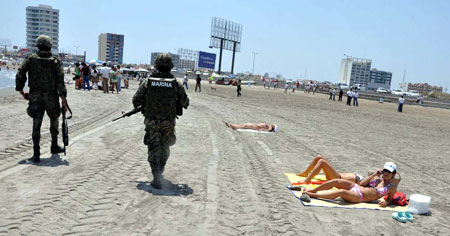
Boca del Rio, Veracruz (photo by Miguel Ángel López Solana for Jornada)
This is Semana Santa… and in honor of the crucifixion and resurrection of Jesus, there is the traditional pilgrimage to the beach. These marines are a little overdressed for the occasion, but some of us have to work over the unofficial holiday.
The Marines aren’t the only ones working. Mexico City’s main water station will be shut down this week for three days for overdue (by decades) maintenance. There’s no good time to do the repairs (and the entire system is in need of upgrade, as well as improved water resources) and with at least the wealthy and most of the middle class out of town, and industrial users able to shut down with minimal disruption, it’s probably the ONLY time the repairs can be done.
Chilangos will just have to drink more beer, which is what everyone who can get to the beach will also be doing… leading to stupid actions which means having to call in the Marines. Who will deserve a beer (or three) by the time this week is over.
They dream a little DREAM
The DREAM (Development, Relief, and Education for Alien Minor) Act (H.R. 1751, S. 729) would
… provide undocumented immigrant youth in the United States with conditional residency and a pathway to citizenship provided they came here before the age of 16 and maintained continuous residence for 5 years, graduate from high school or obtain a GED, attend 2 years of college or join the military and have no criminal records.
You expect opposition from the “what part of illegal didn’t they understand” crowd (what part of “minor child” do the nativists not understand?), but it is immigrant rights advocates who are the loudest opponents of the proposed legislation.
Kyle de Beausset (Citizen Orange) sees two main objections from these opponents:
One argument that migrant advocates will make against the DREAM Act is not that it shouldn’t be passed, but that it shouldn’t be passed now. Influential migrant advocacy organizations and politicians will argue that the DREAM Act should be passed as part of “comprehensive immigration reform” (CIR), whatever that means.
The second argument migrant advocates will advance against the DREAM Act is that it should be opposed because of the military provision of the DREAM Act. I actually am much more sympathetic to this argument than the previous one. I hate the military provision of the DREAM Act and I know many unauthorized migrant youth that hate it, too… The DREAM Act, in it’s present form, only has two routes for unauthorized migrant youth to secure legal status, and eventually citizenship, either through college, or through the military. As unauthorized migrant youth are generally underprivileged, it’s easy to see how most would have to serve in the military to get legal status.
“Manuel”, the pseudonym used by the author of “I Am A Shadow” is one of those DREAMers, has little patience with both those taking an “all or nothing” approach and with those who would kill the bill because of the military option:
In the war of immigration, the Dream Act to be exact, people like myself not only have to fight against the nativist who hate us, but also against people who you would expect be on our side. But no, they aren’t. Why? Because of the fact the Dream Act also makes people like myself elegible to join the army. America is embroiled in two unpopular fronts on regards to war, Iraq and Afganistan, and I can understand why you can say that the Dream Act is wrong in the regards to the military. My answer for that …
Opposing an educational opportunity such as the DREAM Act is precisely what creates conditions for military recruitment. Undocumented students are joining the military right now, putting themselves at risk of death and deportation, just to get legalized since going to college does not give them that option…
Right now, the death and deportation of thousands of undocumented youth fall directly on the heads of those that oppose the DREAM Act…
Get a life and start doing some real advocacy for migrant rights.
From the far fringes of niche advertising, miraculously resurrected by the incomparable Laura Martinez:

“If English was good enough for our Lord Jesus,
it’s good enough for the children of Texas,”
— attributed to Miriam Anderson (“Ma”) Ferguson
The 17 percent solution
The latest spin from the “it’s all Mexico’s fault” crowd is that only seventeen percent of guns recovered at the scene of narcotics-dealer related crimes are TRACED to the United States.
As “Mr. Pink Eyes” (a reactionary site chosen for the simple reason that it popped up in WordPress’ “Possibly Related Posts” thingy) wrote yesterday:
90% of the guns sent to the ATF to be traced did in fact originate in the United States, but 68% of the guns recovered at crime scenes were not sent to the ATF for tracing. Most of these guns were not sent to the ATF for tracing because it was evident by their markings that they did not come from the United States.
“Mr. Pink Eyes” is, of course, repeating a FOX News report that gave these figures, and which depends on a pretty poor understanding of math. Part of what Fox reported is perfectly true:
In 2007-2008, according to ATF Special Agent William Newell, Mexico submitted 11,000 guns to the ATF for tracing. Close to 6,000 were successfully traced — and of those, 90 percent — 5,114 to be exact, according to testimony in Congress by William Hoover — were found to have come from the U.S.
But in those same two years, according to the Mexican government, 29,000 guns were recovered at crime scenes.
But, then, it veers off into “spin”:
In other words, 68 percent of the guns that were recovered were never submitted for tracing. And when you weed out the roughly 6,000 guns that could not be traced from the remaining 32 percent, it means 83 percent of the guns found at crime scenes in Mexico could not be traced to the U.S.
In other words, Fox doesn’t understand statistical sampling. A sample trace of 6000 guns, found 5,144 of them originated in the U.S. While one (former) A.T.F. agent is quoted as saying 11,000 guns were originally sent for tracing, but most were untraceable (gangsters have been filing off serial numbers as long as guns have had them) doesn’t mean anything in itself. And, out of an original 29,000 guns recovered, 6000 is a damn good sample size.
While Fox does get points for highlighting a secondary issue… that some of these guns are legal exports to Mexican police agencies and end up in the hands of gangsters, means those guns ALSO came from U.S. sources. It’s no secret that guns sent under State Department license end up in illegal arsenals. Bill Conroy, who has been following the “NarcoWars” for years writes in Narco News:
The deadliest of the weapons now in the hands of criminal groups in Mexico, particularly along the U.S. border, by any reasonable standard of an analysis of the facts, appear to be getting into that nation through perfectly legal private-sector arms exports, measured in the billions of dollars, and sanctioned by our own State Department. These deadly trade commodities — grenade launchers, explosives and “assault” weapons —are then, in quantities that can fill warehouses, being corruptly transferred to drug trafficking organizations via their reach into the Mexican military and law enforcement agencies, the evidence indicates.
These “legal” purchases account for most of the Korean grenades , Israeli rocket launchers, old Soviet and other “foreign” weapons… which are legally (though State Department license) imported into the United States for resale to supposedly legitimate users. And, as it is, these exotic weapons only account for a fraction of the criminal arsenal … good old American 50-cals and AR-15s outnumber (I was gonna say “outgun”) the AKs and rocket launchers by a huge margin. I wish I could say that they only made 17% of the gangsters’ tool kit, but I doubt it’s even that high. Just that rocket launchers tend to get our attention, and get more press.
t’s not that difficult to become an arms distributor to police agencies, and even to police agencies that don’t exist… I knew someone who used to sell police equipment to Brazil that he knew was going to “private security forces”, but was perfectly legal.
While the extent of thefts from government arsenals, or fraud (by either Mexican police, or from exporters) needs to be looked into, that doesn’t change the point of origin of these weapons. It raises troubling questions about the advisability of transferring still more firepower from the United States to Mexico, but that’s a different story.
Going after John Doe and Jose Lopez the gun-runners may do some good, but going after the corporate dealers, phony (or crooked) licensees and more controls on gun shipments (which will slow down border crossings into Mexico, but that’s the price the tourists are going to have to pay for feeling secure) are both necessary. In the meantime, getting rid of even 17 percent would be a damn good start. 90% would be even better.
Weed at Sam’s Club… (a Friday video)
Jackie and Dunlap, the Tennessee pundits at “Red State Update” weigh in on solutions to the “Mexican” Drug War.
Money money money…. MON-eeee
Bloomberg (via The [Mexico City] News):
The peso, stocks and bonds surged after the government said it will seek a $47 billion credit line from the International Monetary Fund, more than President Calderón indicated on Tuesday.
The currency jumped as much as 2.4 percent as the central bank said it would also tap a $30 billion swap line from the U.S. Federal Reserve to help companies meet financing needs.
Gerardo Rodríguez, head of public credit at the Finance Secretariat, told reporters in Mexico City that the government would use the IMF credit line to bolster its reserves, not finance the budget.
…
The peso has gained 9.7 percent in the past month, stemming a 32 percent tumble over the previous six months that was sparked by a slump in exports to the United States and capital outflows. The peso rose 1.9 percent to 13.9025 per dollar at 5 p.m. New York time.
The central bank bought $100 million worth of pesos at two auctions today. It has spent $21.2 billion from its foreign reserves to shore up the peso since the global credit crisis sent it tumbling in October. Reserves have fallen 7 percent to $79 billion since the bank began intervening six months ago…
Mexico has a good credit history, when it comes to paying off loans… and restoring the peso’s value against the dollar probably is a good thing, but I am a little leery about taking IMF loans. Rogelio Ramírez de la O, notes other dangers in Wednesday’s El Universal, nicely translated by Patrick Corcoran at Gancho.
If the American economy recovers starting in the second semester of 2009, as many think it will, then the productive sector [in Mexico] can begin to bounce back before it is too late. This is the implicit gamble that the government is taking.
If, in contrast, the American crisis extends beyond 2009, around the middle of 2010 the economy would be in an unsustainable situation, but the government will have already spent all of its reserves and taken out loans to sustain the peso artificially. The crisis in the productive sector and in the population would be much deeper and the official gamble will have been incorrect.
Using today the international reserves and external loans without the support of the productive sector will reduce the space for maneuvering the country in near future. Not listing to the warnings that the private sector offers everyday about the deterioration of the productive base and the absence of public infrastructure spending is a mistake.
In other words, Mexico is even more dependent on the United States than it was before this crisis, and — although not as affected directly by the financial meltdown — has wedded itself to a U.S. recovery.
As it is, I wonder what makes the G-20 nations think that ponying up 100,000,000,000,000 dollars to the World Bank is THE solution to anything. Weren’t they the guys who fucked things up to begin with?
No Fear
Maggie is no slouch when it comes to covering the north end of the Baja, but what happens in the Baja often stays in the Baja. Or maybe, what doesn’t happen in the Baja (tourist visits) doesn’t happen in the rest of Mexico…
This evening, Frontera ran the story that Janet Napolitano said today in a speech at the Otay Port that visitors are safe in Mexico. She said,”…Americans, who are reasonably careful are safe [in Mexico], we have no information to suggest that American tourists are a target.” Well yah there Janet, there haven’t been any American tourists lately, so how could they be?
True enough for where she lives (and she’s THE go-to surfer for the northern Baja), but tourism is up… way up… for Mexico this year:
Reuters’ Daniel Trotta writes:
…
Mexico’s tourism has continued to grow despite the drug violence and the U.S. recession, with international visits up 2 percent in the first quarter of 2009 from the same period of 2008, Carlos Behnsen, executive director of the Mexico Tourism Board, told reporters in New York on Wednesday.
That followed a full year in 2008 in which international visits rose 5.9 percent from 2007, Behnsen said, with U.S. tourists accounting for 80 percent of the total.
“It is a victory, I think,” Behnsen said. “Our concern is looking forward.”
Tourism was a $13.3 billion industry in 2008, ranking it third behind oil and remittances from Mexicans living abroad, he said.
Violence involving drug cartels and security forces killed an estimated 6,300 people last year, leading the U.S. State Department to issue a travel alert on February 20 for U.S. citizens living and traveling in Mexico.
The U.S. alert, which superseded an alert from October 15, 2008, generated increased media attention that officials are attempting to counter by reassuring visitors that the most popular destinations remain safe.
“The violence is basically contained in the northwest of the country in five municipalities,” Behnsen said, naming Tijuana, Nogales and Ciudad Juarez along the U.S. border plus Chihuahua and Culiacan, where drug traffickers operate to feed what U.S. Secretary of State Hillary Clinton recently called an insatiable U.S. appetite for illegal drugs.
The Mexican resort of Los Cabos is nearly 1,000 miles from Tijuana and Cancun is some 2,000 miles away, he said.
The U.S. recession may be helping Mexican tourism because U.S. visitors could be choosing Mexico over destinations that are more expensive and further away, Behnsen said. Moreover, the weaker Mexican peso — which hit a 16-year low against the U.S. dollar on March 9 — could also be attracting U.S. visitors, he said.
Of course, visits are down, way, way down in Tijuana, and the peso is rebounding as the dollar and U.S. economy continue to slide, so this could change.
Of course, the gangsters are still out there, and there is still violence being reported (though all violence may not have anything to do with the narcotics trade), but with what seemed to be the rationale for the anti-drug war (making Mexico safe for foreign tourists, not safe for Mexicans), it’s time perhaps to reel in the Army and reassure those of us who live in Mexico (citizens and resident aliens alike) that maybe civil liberties will be respected, and get on with more important things, like rural development, job creation, education, watershed protection… the kinds of actions that in the long run will do more to keep Mexicans from having to work in the narcotics trade (or join the police, which is often the same thing) and get on with life.
Latin American at the forefront of world affairs
… too bad it’s just a photo op…

Globe and Mail
Oily gangsters
While there has been some coverage in the English-language (and U.S.) press, most of what has been written about the latest PEMEX scandal has focused on the arrest of a PRD elected official who was involved in the on-going theft of Mexican oil for resale to U.S. refineries. According to an EFE report published in the Caracas-based “Latin American Herald Tribune” (not connected with the International Herald Tribune):
Police arrested the nine members of a gang that stole oil from state-owned oil giant Pemex and resold it in the United States, operating under the protection of “Los Zetas,” the armed wing of the Gulf drug cartel, officials said.
Bank accounts holding $98 million and belonging to the gang’s members were also frozen, federal police commissioner Rodrigo Esparza said.
The suspects allegedly stole fuel from Pemex’s fields in the Burgos Basin in Tamaulipas state…
Prosecutors “have accounted for transactions (by the gang) in the financial system of nearly $46 million and 750 million pesos (some $52 million) between 2007 and 2008,” the head of the SIEDO organized crime unit, Marisela Morales, said.
Esparza, for his part, said the suspects stole oil from the storage tanks in Burgos and shipped it into the United States in tanker trucks, using falsified customs documents.
The suspects sold the oil to refineries in the United States and deposited the large payments in scores of accounts in an effort to hide where the money originated and was going.
While the political fallout will be interesting to watch, what’s more interesting is how this is going to impact U.S. – Mexican relations. Will the co-conspirators (which oil companies were involved, and who had responsiblity for buying stolen oil) be named? More importanly, will they face charges, and better yet, be extradited to Mexico?
Follow the money. This has been going on for some time now, which means the gangsters have been looking for new revenue streams though smuggling oil isn’t all that different from smuggling narcotics… they’re both high-demand Mexican substances for which there are willing buyers in the United States, and the money from one criminal operation isn’t any different from money from another criminal operation.
While the Mexicans have identified assets in Mexico, there are bound to be assets in the United States… and, if the oil companies were refining and selling the oil, there will be, at the very least, some entertaining law suits and sweaty suits to watch. I kind of doubt any oil executives will go to prison over this, but should the oil companies be forced to fess up to any criminal wrong-doing, it’s not out of the ballpark for the Mexican government, or PEMEX, to file civil suits against the oil companies, which should be highly entertaining.


