Ward Churchill, Moctezoma and the Stockholm Syndrome
Mary O’Grady brought this to my attention, for which she deserves a deep doff of the sombrero. From an article by Maev Kennedy in the Guardian (U.K.) on a British Museum exhibition :
The traditional account of the death of [Moctezoma] … is that having been taken a willing hostage by Hernán Cortés and the conquistadors, he was killed by his own outraged people.
According to several versions of the story, in 1520, the Spanish brought him out onto a balcony of his own palace to try and calm the riotous mob, but he was pelted with stones and killed.
One Spanish account, written years later, even insists that he refused medical help and food from his Spanish captors, who “spoke very kindly to him”, before suddenly dying.
However, the exhibition will include two small images from later manuscripts, one now in Glasgow, one in Mexico, both probably made by Aztecs working for Spanish patrons, which show the leader distinctly less kindly treated, brought out with a rope around his neck, or shackled. Once the Aztecs began to revolt against the presence of the Spanish in their capital city, Tenochtitlan, this version suggests, Moctezuma was useless to them, so they killed him before just managing to escape with their lives.
The claim that the Castillians killed Moctezoma is based on oral tradition, and has to be treated carefully. Oral tradition can be right, but can also move one event to another time or place. An example of this came up in a U.S. courtroom recently.
Last week, a Colorado jury found that [University of Colorado tenured professor] Ward Churchill had been improperly fired, and awarded him $1 in damages. Churchill … wrote the essay that described the financial workers who died in the World Trade Center on 9/11 as “little Eichmanns inhabiting the sterile sanctuary of the twin towers.”
… Churchill sued the university for firing him from his tenured position for expressing politically unpopular, but constitutionally protected, views. The university argued in the trial that he was not fired for his political views but rather for sloppy academic work.
While Churchill won his case, his “sloppy academic work” has resulted in a separate investigation by a team of independent scholars. Among their complaints:
… Churchill’s claims … that the U.S. Army deliberately spread smallpox to Mandan Indians in what is now North Dakota in 1837 by giving them infected blankets. This claim is important not just because the results of the epidemic were devastating, but because it is widely believed: Buffy Sainte-Marie referred to it in a song, and it has been widely asserted by American Indian activists. This widespread belief, as the authors note, probably originates in the fact that British troops did in fact attempt to infect Indians at Fort Pitt in 1763.
…Trying hard to be fair to Churchill and nontraditional modes of evidence like oral traditions, as they do throughout the report, the scholars conclude that Churchill did not fabricate his account of the causes of the epidemic .
In other words, the oral tradition might take the details of a verified event (the 1763 attempt at biological warfare) and transfer them to another event (the smallpox epidemic in the Missouri Valley in 1837).
While I am not a professional scholar (and not looking for tenure), and was open to using oral history in my own book (though I was careful to note that such and such “is believed”, or “is said”… ), I don’t buy the idea that Montezoma was stabbed by Cortés’ men. But, they were quite capable of needless violence, and more than once committed atrocities for which there is no logical explanation. My belief, and that of most “real” scholars is a bit more nuanced than the Guardian story might have us believe though.
Moctezoma was not a powerful ruler, coming to the throne during a crisis (his predecesor, Ahuítzotl, had been in a coma for several years, and only the military leadership and the bureaucracy had held the state together) and various parts of the Empire were in rebellion already when the Cortés and company landed.
It’s a matter of record that Moctezoma was a prisoner of the Castillians, and seemed to suffer what today we call the “Stockholm Syndrome“… in which both hostages and their captors start to see each other as friends. Bernardo Díaz del Castillo might not have been exaggerating (any more than he usually did) when he wrote:
Cortes and all of us captains and soldiers wept for him, and there was no one among us that knew him and had dealings with him who did not mourn him as if he were our father, which was not surprising, since he was so good.
However, Díaz did not have access to the Aztec side of the story, which recalls Moctezoma as vacillating and widely despised even before his disastrous decision to tolerate and parley with the Castillians.
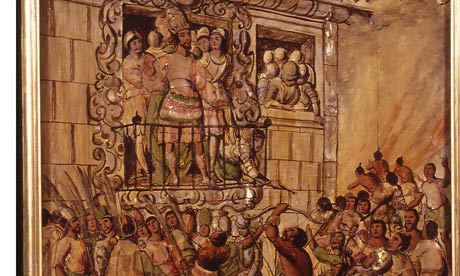
Detail from Enconchado 16, by Juan y Miguel Gonzalez, AD1698. Photograph: Museo de America, Madrid posted in The Guardian
There were many in the Aztec ruling circle who wanted a more war-like and decisive leader, but the Aztecs had no way to replace a bad ruler except to have him killed. The Castillians were quite capable of doing Moctezoma in themselves — the cold-bloodedly executed Cacama who was also a hostage before retreating — but, given that holding the Emperor hostage was their only claim to legitimacy, and it was Moctezoma’s death that forced the Cortés to consider a retreat from Tenochtitlan, I don’t think Díaz was wrong in claiming the Emperor was beloved by his captors. He was certainly useful.
While there are Aztec sources that claim Moctezoma was stabbed by a Castillian soldier, it is more likely that his people (egged on by Cuitláhuac and Cuauhtémoc) were throwing rocks at him when he appeared in public, and he probably was killed when struck by one in June 1520 (the exact day is unknown).
The people — or at least the ruling class — was desperate for a strong ruler, and we know that Cuitláhuac and Cuauhtémoc were organizing anti-Castillian resistance groups. Moctezoma was the only person who stood in the way of a general uprising, and there was no other way for the Aztecs to replace their ruler except to kill him.
The oral tradition — the one that the British Museum exhibit explores — might not be factually correct, but it makes perfect psychological sense.
With an entire society still suffering post-traumatic stress disorder, taken hostage as it were, many did show signs of the “Stockholm Syndrome” … hispanicizing themselves and adopting the oppressor’s values as their own. Others, suffering post-traumatic stress disorder, made sense and gave meaning to their nightmares by transferring the cruelties of the conquest. One ruler was stabbed for no good reason, therefore another was probably also stabbed (much as the belief persists that because the English Army attempted biological warfare one time, the U.S. Army did it another time). And… wtransformed their own failures into Transforming the incompetent ruler into a fellow victim — and even a sort of hero — was necessary if the surviving Aztecs were maintain their own identity.
It takes two to tango…
Porteño brothers Enrique and Guillermo di Fazio(youtube posted by “helisch). It freaks some gringos out or they misinterpret what they see (I saw a longer “los Hemanos Macana” — the Slagheap Brothers — in an article on gay marriage. Enrique and Guillermo are brothers … in the biological sense), but Latin American men just don’t have hangups about physical contact … and besides, tango started as a guy thing. There weren’t any guachettes around when the gauchos wanted a hoe-down out there on the lonesome pampas.
Well, there were saloon girls …
10 April 1919

A dozen or so posts on Emiliana Zapata here.
David Agren in today’s The (Mexico City) News on the anniversary:
Zapata died April 10, 1919, in an ambush, but his legacy lives on in modern Mexico, especially in his home state of Morelos. His call for “land and liberty” during the Mexican Revolution and his refusal to waver from his armed campaign to break up large haciendas and distribute the properties to those who worked the soil made him an icon for agricultural leaders, politicians, rebels and even some in the Catholic Church. To this day, Zapata inspires many of those same groups, even though some historians question the fidelity of modern-day Zapatistas – such as the EZLN rebels in Chiapas – to his agrarian ideals.
“All those who have thought at one time that the country could be modernized through some other path, can’t help but think of Zapata and the Zapatista experience,” said Ilán Semo, a political historian at the Universidad Iberoamericana. “Zapata represents the possibility of a solution to the transformational problems of Mexico that is not individualist.”
Axis of weevil
“We face a new and dangerous dimension since the September 11 attacks,” said Robert C. Gómez, New Orleans Operations Director for the Customs and Border Patrol.
And, with the federal budget in the works, September 11 is as good a reason as any to duplicate Department of Agriculture functions. Which is why, when an unidentified weevil was found in a shipment of Colombian bananas arriving in Gulfport, Mississippi, it wasn’t treated as an agricultural problem, but as an “agro-terrorist threat.” And the Customs and Border Patrol went… oh… bananas.
Osama bin-weevil, aka “Faustinus rhombifer champion“, was detained, briefly questioned by Agricultural Department experts and expelled from the country. Probably to weevil Gitmo.
Sombrero tip to Colombia Reports.
Leonora Carrington: not the English way
Gabriel Garcia Marquez, who is only 80, was busily (and angrily) denying rumors this week that his creative life was at an end. Another of Mexico City’s intellectual and artistic elders was also in the news this week, with no questions asked about possible retirement.
Leonora Carrington turned ninety-two last Sunday. One’s ninety-second birthday normally would not be considered a memorable event outside of one’s own family, but Ruth McLean and Rachel Rickert Straus (Happy Birthday, Leonora Carrington!) took notice and for a good reason: not many people had the foresight to write a novel ahead of time about a ninety-two year old. Carrington’s 1976 novel, The Hearing Trumpet is the story of the aging Miriam Leathersby, who, thanks to her new hearing aid discovers what her relatives really think… mostly that she’s around the bend. Where Alice fell into a looking glass, Miriam falls into her trumpet… or more prosaicly, ends up in an old-folks home, and a liberation of her mind.
A sort of “magic realism” for the aging? Not at all, but a projection of Carrington’s own continuing liberation into what was then the future.
Born into a proper, upper-class British family, Leonara spent her early years getting herself thrown out of a string of English and Irish convent schools. Her Irish mother, with some exasperation, finally packed her off to Mrs. Penrose’s Academy of Art in Florence, Italy… a proper English school for improper Englishwomen. Still, the family tried their best to reform their daughter. She was presented at court in 1936, but not in the least impressed, found herself a quiet corner and read Aldous Huxley’s new novel, Eyeless in Gaza.
A proper upper-middle class Englishwoman might dabble in art, and might even dabble seriously, but Carrington, against her family’s wishes, continued her studies, and — rebelling also against the British art establishment — developed her style as a surrealist. By 1936 though, surrealism was well enough accepted in Britain that a thousand people a day came to see the London Surrealist Exhibition in June of that year. The highlight wasn’t Salvador Dali nearly killing himself when he decided to lecture in a deep-sea diving suit and got stuck, but Carrington’s introduction to the work of Max Ernst.
The attraction must have been mutual. Ernst abandoned his wife and ran off with Carrington the next year, fleeing to the south of France. The artistic couple were a team until the German invasion. Ernst was briefy detained as an undesirable alien, but released only to be arrested by the Gestapo. He managed to escape and eventually made his way to the United States, where a timely marriage to arts patron Peggy Guggenheim allowed him to remain. A devasted Carrington was unable to leave France until 1943, when she managed to make her way to neutral Spain.
Proper Englishwomen, of course, did not become artists, did not run off to France with married men, were not abandoned in France by said married men, and did not end up as distraught refugees in Spain. She must have been nuts. Or, so her proper English family decided, having her committed to a Spanish mental hospital.
Gilberto Bosques, the Mexican diplomat who saved so many from the Nazis was imprisoned by this time, but the Mexican diplomatic service — with an assist from Pablo Picasso — still did what it could to rescue those threatened by Fascism, and — as on other occasions — showed unusual creativity in finding a loophole.
Diplomatic service in Mexico, as in other Latin nations, has always attracted the artistic and eccentric. Attending to Secretaria de Hacienda y Credito Publico business in Paris, was not particularly time consuming or onerous overseas duty for Renato Leduc. He had plenty of time to devote to his “deliberately romantic” poems, and to indulge in his very undiplomatic habit of — as a fellow poet once said in admiration — dropping in two obscenities for every conventional word in conversation. Those conversations were often as not with his fellow Spanish speaker (and afficianado of grocerías) Pablo Picasso. Before the Mexican diplomatic corps was clapped in detention after breaking relations with occupied France, Leduc had managed to escape to Portugal, where he was given some vague consular duties that let him keep his diplomatic immuity.
Though their mutual acquaintance, Picasso… who was still in France, Leduc learned that Carrington was locked up in Madrid. When Carrington managed to escape the asylum through a bathroom window, and seek out the Mexican Embassy, Leduc was prepared to stave off the Nazis, the very proper Carringtons and the Spanish nuns who managed the mental hospital. Mexican diplomats in Madrid arranged for Carrington to travel to Lisbon where Leduc cut through bureaucratic red tape very neatly. He married the artist and escorted her to Mexico City.
Andres Breton may have found Mexico City too surreal for him, but Carrington at last found a place where she was appreciated for her own abilities, and where she could make a life on her own terms.
The marriage of convenience (or desperation) wasn’t expected to last, but it was an amicable parting, as the two continued to remain fixtures in the Mexico City intellegencia, mutual friends of composer Augstin Lara, poet and diplomat Octavio Paz, journalist and novelist Elena Poniatowska and actress Maria Felix (to whom Leduc would later propose marriage). Carrington would eventually marry Emerico (Imre) Weiz, a photographer and fellow European refugee.
In Mexico, Carrington finally found artistic recognition as an important surrealist. Since 1947, when she was mis-represented as “England‘s only female professional artist”, she has been consistently listed as a major English painter, though her work was never recognized there until after she became a Mexican citizen. In addition, she has published a number of her “adult fantasy” novels and illustrated books.
As a Mexican, not English, intellectual, she has taken an active part in national issues. Although physically unable to participate, Carrington — in common with other Mexican public figures — protested the U.S. occupation of Iraq. In 2006, she contributed art work to Andres Manual Lopez Obrador’s Presidential campaign, and continues to support the “legitimate presidency”.
Having touched the lives of so many men — poets, painters and politicos — from Max Ernst, to Picasso to AMLO, you’d expect to hear more paeons of praise from the men. But, as Carrington said in 1983:
I didn’t have time to be anyone’s muse…I was too busy rebelling against my family and learning to be an artist.
And she is still learning.

Self portrait, 1936
¡Aguas!
A quarter million people, including myself, went without running water when — ironically enough — “The Great Flood of 1993” — took out the Des Moines, Iowa water pumping station, and it took eleven days (and a hell of a lot of sandbags, engineers and the U.S. Army Corps of Engineers) to overcome our perverse pride in suddenly being known as the stinkiest city in America.

Fisgon, in Jornada
There was flood water everywhere, as well as “Flood-weiser” (the breweries canned water and distributed it free everywhere… I spent more than one night on the sandbagging lines with a ball-park beer tray tossing out cans) as well as National Guard water distribution plants in all the parks, so it really was more an inconvenience than anything else. Every day was “casual Friday” at work, and it took some ingenuity to stay clean, but people more or less got by.
This was national, and international news at the time. Modern cities have gone without electricity for a time, or had other breakdowns in what are considered essential services, but not their water systems. We assume the water is always there (and, in wet places like Iowa, it is), but water is just taken for granted. Even in desert communities (like Los Angeles, or Phoenix), people don’t think about the water. They better start.
The complete shutdown of the Cutzamala station for the next three days is going to leave 5,000,000 people with no running water. There doesn’t seem to be much international coverage on either because we assume Mexican infrastructure will collapse or because we assume Mexicans can tolerate anything… or, most likely, we assume Mexico is a special case, and what happens there is uniquely Mexican.
Of course, “¡Como México no hay dos!” when it comes to geographic and geological challenges, and the strain on a water system in a city that’s grown exponentially over the last half century, coupled with what was considered good engineering practices for the last 500 years (draining Lake Tezcoco) made Mexico City’s water system more vulerable to dramatic problems than others.
And, of course, Mexicans are extremely tolerant and resourceful, having spent the last couple of milenia figuring out how to live in a challenging environment where the basics can’t always be counted on.
But, 5 million people shut off? I think there’s an assumption that Mexicans go down to a well, and fill up big clay pots that they load on the back of a burro… then, of course, take a siesta under a cactus (with a big sombrero to block out the sun). Or people just don’t think of water as a limited resource.
It is. What struck me in Des Moines was the panic over going without water in the taps… and how flummoxed everyone was by the idea of not having potable water… water you could drink. Despite the stereotypes, people do drink Mexico City tapwater (though it tastes crappy, and nearly everyone has a garafon or two of ozonated water delivered every week for drinking water) and, in some ways, the only reason this is a huge story even in Mexico City is that for the first time, even wealthy and “first world” colonias are going to be shut off.
There will be plenty of finger-pointing and attempts to spin the situation for political advantage (there already is), and I expect to hear more demands — especially from people who wouldn’t be affected by it — that water, like other natural resources — must be privatized, or that some magic economic solution will resolve the problems we can expect to have with water over the coming years, but right now, the infrastructe — pumping stations and pipelines — need urgent repairs.
This should be a wake-up call to start paying attention to the basics, but I expect we’ll wake up one morning in Chicago, or New York or London shocked, shocked that OUR systems have just stopped working and we won’t have a clue how it happened. Same way it’s happening in Mexico City. Just not paying attention to the basics of life.
Disorderly conduct
Boz (my “inside the beltway” mole) writes (my emphasis):
Unitas, now in its 50th year, will be based out of Mayport, FL (most years, it does a circuit around Latin America) and will focus on countering piracy and drug trafficking. Participating this year will be Argentina, Brazil, Canada, Chile, Colombia, Ecuador, France, Germany, Mexico and Peru. Mexico’s participation in the joint naval exercise would be a first and still hangs on a controversial congressional vote next week that is uncertain…
There’s nothing controversial about the vote. The Constitution is clear on this — Congressional approval is required any time the Mexican Navy is dispatched to foreign waters. What is controversial is that that the Joint Chiefs of Staff Vice-Chairman, Marine Corps General James “Hoss” Cartwright took it upon himself to say that Mexico WOULD participate.
There’s a logical argument (one I don’t agree with, but logical) that Mexico should participate in military activities outside its own borders, and there may be nothing wrong with a training exercise. There is genuine opposition to breaking with tradition and concerns within all Latin American military circles about the 4th fleet, but given the General’s statement, what might have passed through Congress without much opposition now is a controversy.
The Obama Administration has shown itself to be woefully tone-deaf when it comes to Mexican law and sensibilities (no change from any administration since James Monroe’s tenure). One has to assume the General is speaking for the United States government, and it sounds like an order.
Mexicans hate being told what to do, even by other Mexicans. When it’s the U.S. Navy doing the telling, it can get ugly.
Have gun, will travel?
From the Mexico City “Craig’s List”
prior us army infantry
Reply to: job-jk59v-1099806096@craigslist.org
Date: 2009-03-30, 5:27PM CST
prior millitary looking for short term or long term contracts, to provide personal security, convoy escorts, and residential secutity. have mercinary state of mind,
I guess the English teaching market is in a downturn, and time-share salesman requires too many ethical and moral compromises, but maybe this guy does have a shot at a job here in Mexico. It seems to me I’ve seen ads for people with his particular skill set, but from what I can tell Spanish comprehension is a job requirement, and I’m told the employer has a really crappy retirement plan.
Whether they pay for the employee’s work permit may be negotiable. I think you have to apply in person… the employer doesn’t seem to list an email address.
Onward Christian Soldiers…
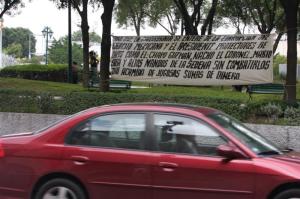
With more than some justification, the Santa Muerte faithful picketed outside the Metropolitan Cathedral in Mexico City last Sunday to protest what they see as “official repression” of their church.
While religious prejudices have always existed in Mexico, previous religious persecutions were more aimed at curtailing the power of the Roman Catholic Church than at minor sects. Reports on the government action seem to stress that Santa Muerte is not recognized by the Roman Catholic Church, which doesn’t seem to mean anything. There are any number of non-officially Catholic sects in Mexico, which share some rituals and beliefs with the Vatican-centered Church, and whose adherents may refer to themselves as “Catholic” but whose beliefs are not subject to state sanctioned controls.
 Most of these sects, like Santa Muerte, have sprung from pre-colombian religious beliefs, and survived the conquest by blending in ostensibly “Catholic” elements. Santa Muerte’s only really unusual feature is that it also has blended in Afro-Caribean religious customs (“voodoo”). Santa Muerte is basically a nature religion, that accepts good and evil, life and death as part of the cosmic cycle. There have been extra-legal actions against these sects, as there have been against indigenous Evangelical groups, usually grounded in local political disputes disguised as protecting “traditional values.” But, in the years since the end of the Cristero War, this is the first time I can recall FEDERAL action against a sect.
While there is some evidence that Santa Muerte congregants are active in the narcotics trade or other illegitimate activities, other “drug cult” religions … like Jesus Malverde worshippers have not been suject to official attacks, which in Nuevo Laredo included sending the Army to destroy shrines.
Santa Muerte has its appeal for criminals… as does the Jesus Malverde sect which has been left alone… but criminals among the congregants doesn’t a criminal organization make (with the possible exception of the Legionaires of Christ).
Santa Muerte has run into trouble with the government before. Santa Muerte in its present form has been around Mexico City and Veracruz since at least the 1880s, but as a formal sect, it is relatively recent. Its present Archbishop, David Romo, came to the sect from the “Tridentine Church of Mexico/U.S.A.” a breakaway sect of the Roman Catholic Church (as were Presbyterians, Lutherans, Anglicans, Baptists, etc… though not as recently). Romo organized the various Santa Muerte groups into a formal church, and registered them with the state under the Tridentine Church”. In Mexico, “cults” (which includes any religious organization) are registered with the Secretaria de Gobernacion, and the Roman Catholic hierarchy took the unusual step of seeking to de-certify the Santa Muertes, when Santiago Creel was Secretary.
While I’m no expert in Santa Muerte, or Roman Catholic, theology, the so-called “Death Cult” openly tolerates the less-than-respectable — prostitutes, policemen, gangsters — that aren’t always welcome in the more mainstream congregations. It’s a growing church within Mexico City, and thoughout the country. I have a sense that the anti-Muerte spin has as much to do with politics as religion. Creel, of course, was a PAN leader, in a PAN administration, and PAN has been and is the “Catholic” party. Creel had also recently lost an election to Andres Manuel Lopez Obrador, whose political strength lay in his appeal to the urban poor… the kind of people who find Santa Muerte a more congenial outlet for their religious fervor than the Roman Church and who are more likely to vote for leftist candidates.
While religious persecution on a small scale has happened, and is troubling, what’s worrisome her is that the ARMY was used for the iconoclasm. Which means the Federal Government is willing to bend the laws for the benefit (or to the detriment) of various sects (the Roman Catholic Church denies any involvement with the Nuevo Laredo actions, but requires we take that on faith, and faith alone)… and, even more troubling… that, as I have predicted in my more morose states, that the government would start using military forces to attack non-conformity, and excuse under the rubric of “drug gang” the oppression of the poor and dispossessed.
Gee, ya’ think?
Colombia Reports (an excellent on-line English-language Bogota daily) indirectly notes one of the draw-backs of a militarized “war on (some) agricultural growers and distributors”:
Colombia’s Prosecutor General Mario Iguarán revealed Monday his office is investigating 22,000 cases of people who disappeared during Colombia’s ongoing violent conflict.
“We are talking about 22,000 people who disappeared in Colombia. We have found 1,040 of them and identified a few hundred of them. One has to conclude that we had a genocide here“…
And you thought 10,000 Mexican deaths in a proxy war to preserve U.S. social policy was outrageous.
Sleight of hand
Would you play poker with the Banco de Mexico Governors? From AFP:
Mexico’s central bank announced Friday that it would activate a credit swap with the US Federal Reserve in an auction of up to four billion dollars on April 21.
“The purpose of this credit is to provide financing to members of the private sector under pressure to obtain resources to meet dollar commitments,” a statement said.
The Federal Reserve agreed last October to swap dollars for the local currencies of Brazil, Mexico, South Korea and Singapore to unfreeze money markets in emerging market countries.
Mexico this week also requested a new International Monetary Fund mechanism granting a 47-billion-dollar line of credit, to add to foreign reserves of almost 80 billion dollars.
The request marked the first time in a decade that Latin America’s second biggest economy has sought IMF help and aimed to give a positive signal amid worsening predictions for the economy closely tied to the United States.
The request “should reduce the perception of risk from investors in relation to the Mexican economy,” central bank governor Guillermo Ortiz said Wednesday.
Mexican companies wanted to borrow money, but Mexican banks have very tight credit requirements, and make their loans in pesos. So the Mexican businesses borrowed their money from U.S. lenders who loan dollars and expect to be repaid in dollars.
The U.S. lenders didn’t have the dollars to lend, but that didn’t bother them. The lenders gambled that the borrower would have enough dollars to pay the loan, so borrowed the dollars from other U.S. lenders who gambled that the money would be there to pay their loans. In turn, these lenders borrowed from other guys who also were gambling that eventually the dollars would be there… and, in the end, everybody was wrong. The dollars were never there.
And the peso — which is what the Mexican banks have — lost value because everyone assumed there would be enough dollars to cover the Mexican debts. Game over… unless the dollars magically appear.
The Federal Reserve Bank has dollars, but not enough to cover all the gambling debts… some, but not all. The Banco de Mexico also has dollars, and is gambling that IF the Federal Reserve has a few dollars more to cover some of the gambling debts of the U.S. lenders, then the peso will go up in value.
The Banco de Mexico is borrowing 47 billion dollars from the International Monetary Fund on this gamble. That’s almost comprehensible. What’s hard to fathom is that the BdeM is going to sell off 4 billion DOLLARS in IOUs… which will turn into pesos and give the Federal Reserve more dollars.
If they pull this off, the Banco de Mexico governors belong in Vegas — not at the poker table, but on stage, performing magic tricks.
You really can’t take it with you…
A widow living in Cuba whose fortune was trapped in a Boston bank by the US trade embargo has died at the age of 108 without having ever received her money. Mary McCarthy died in her rundown Havana mansion after failing to get treatment for respiratory problems due to a shortage of cash, according to her godson and heir, Elio Garcia. “She had been suffering the embargo for 50 years,” he said.
McCarthy, born in Newfoundland in 1900, moved to Cuba in 1924 when she married her husband, a wealthy Spanish businessman. She became a member of Cuba’s high society, co-founding the Havana Philharmonic Orchestra and an orphanage for boys. Her husband died in 1951, but she stayed in Cuba.
She was not able to touch the money her husband left her after the US imposed a trade embargo against Cuba in 1962, and lived in near poverty for years. In 2007, after a Canadian diplomat intervened, Washington allowed her to withdraw just $96 a month. Mrs McCarthy had to postpone treatment for respiratory problems when the US did not transfer extra money allowed for medical purposes in time.
She died on Friday morning and in the afternoon, two dozen friends gathered in her home. A candle burned atop the old Steinway piano where she had given music lessons. They accompanied her humble coffin, wrapped in grey cloth, in a funeral procession to Columbus Cemetery, where she was buried next to her husband. “Mary McCarthy was perhaps the best welder of the friendship between the people of Cuba and Canada,” said the Canadian consul, Mark Burger.


