New skins for old whines…
Is green the new white? Via Stace Medellin’s “Dos Centavos” (which focuses on the overlapping fields of Mexican-American and Houston area Democratic Party politics) I learned about “Progressives For Immigration Reform” — which promotes a more environmentally-friendly version of white supremacism.
Progressives for Immigration Reform is the latest in a series of “progressive” front groups set up by John Tanton to present a plausible excuse for racism and, more to the point, limiting U.S. immigration to the “right kind” of people (white ones from Europe). The rationale this time is that “those people” aren’t as environmentally conscious as Europeans or white middle-class U.S. nationals, therefore will never be environmentally conscious, therefore are a drain on resources. This on top of Tantton’s claims that immigrants don’t practice birth control (which has more to do with U.S. health care policy, Mexico… the largest source of U.S. immigrants … having one of the world’s best records on making birth control available to all, and on sex education).
Tanton was originally involved in Zero Population Growth, which was a fairly respectable idea back in the 1970s, but the organiztion veered into racial stereotyping (assuming that high birthrates among non-European countries were somehow innate, and not a reflection of two important 20th century events — the nearly continuous warfare in Europe in the 20th century up unil the 1950s which killed off a lot of “white” people and the emancipation of women… a job being the best birth control life there is). With ZPG eventually losing progessive support, Tanton moved to the Sierra Club, pushing the idea that non-whites (specificially Latin Americans, and more specifically Mexicans) were environmentally dangerous. His baleful influence on the Sierra Club and other environmentalist groups is still felt here locally in Mazatlan, where the tuna fleet is harbored. We can’t sell tuna in the United States because of specific “dolphin safe” rules designed not to save dolphins (Mexican dolfin-safe tuna is available, and Mexican fleets use the recommended nets that prevent dolphin deaths), but because… well… it’s Mexican tuna. When the Sierra Club got to the point where they were lobbying Congress to prevent Mexican tuna sales on the grounds that cocaine COULD be smuggled in cans of tuna (as opposed to dolphins, which was the whole issue), I don’t think I’m the only one who realized the respected environmental organiztion had gone around the bend.
Tanton went on to found the reasonable sounding “FAIR” — Federation for American Immigration Reform” — the “reform” being envisioned being restrictive immigration, even more arcane legal hurdles for would-be immigrants and outright racial stereotyping. When last July two Pennsylvania yahoos beat Luis Ramirez to death, in what was a racially motivated hate crime, FAIR was falling all over itself to distance itself from the conclusion that its own inflamatory rhetoric on immigration might have some effect on people.
FAIR’s media outlets being more and more those associated with the far right and the lunatic fringe (Lou Dobbs reguarly includes their information on his television program), its time for a new, improved, greener and cleaner racism. So… Progressives for Immigration Reform. Given that one of the usual side complaints about immigration (the less than legal kind) is that people wandering through the desert leave stuff behind — i.e., litter — I expect they’ll be focusing on that. It sound better for people to claim they’re not against immigrants, but they are against littering.
I notice, being supposedly “progressive,” the newest whine from this group is that economic stimulus assistance might reach “illegal” immigrants. So? The point is to get consumers to spend money. OH well, idiocy marches on.
It’s not easy being green. Or progressive.
Democracy, it is said, is the worst possible political system… except for all the others. Democrats everywhere have my condolences on the loss of one of the great champions of that imperfect system, Raúl Alfonsín, who died yesterday at the age of 82.
The Buenos Aires Herald writes today
… Alfonsín faced the illness that ultimately took his life last night with the same courage, frankness and determination that were so characteristic of him as a politician. … It is not by chance that Alfonsín’s political standing persisted even after he stepped down in 1989. Throughout the memorable campaign that ushered him to office in 1983 Alfonsín was a man with a mission that far surpassed defeating a rival in an election. Alfonsín, almost single-handedly at the time, championed democracy as a supreme value above all others. It is a concept that in other times in his political career was used against him to the point of ridicule. But in the end it served him well. We owe to Alfonsín that public opinion now considers democracy is not negotiable under any circumstance. He is the father of Argentina’s democracy: a flawed and perfectible democracy, yes. But a democracy after all.
Raúl Ricardo Alfonsín Foulkes seemed destined for a career as a minor footnote in the political history of his nation, the leader of a respectable old political party (the Radical Civic Union) known mostly for good intentions and losing elections. Alfonsín, like other Argentine leaders, had military training (something often overlooked is that his education was in a military academy) which stood him no good when he first ran for a congressional seat in 1945, which he lost (badly) to a Peronist opponent.
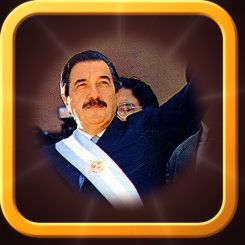
Portaplaneta.com.ar
Studying law for the next five years, as a fledgling lawyer he took up human rights issues under the Peronist administrations of the fifties, edited a newspaper (as have so many Latin leaders) and dabbled in politics, eventually earning a seat on the Buenos Aires city council. His newspaper’s editorial opposition to Peron earned him that badge of honor in dictatorhips, a prison sentence. With Peron’s overthrow in 1955, and the new ban on Peronist political parties, Alfonsín’s Radical Civic Union was left as Argentina’s most important political party.
He had a respectable, but not stellar career in the Party, moving up to a leadership role in the Chamber of Deputies and a government supporter by 1966, when another in the dreary history of military coups in Argentina again pushed Alfonsín into the wilderness. As his party moved towards accommodation with the military and conservative governments, Alfonsín moved towards leadership in a wing seeking a democratic alternative for his country. With a return to democracy in 1973, he was unsuccessful in his attempts to become the Radical Civic Union candidate for president in the national elections… which the party lost to the recently returned from exile Juan Peron.
Following the violent coup that overthrew Peron’s widow and successor, Isabel, in 1976 left in place the Chamber of Deputies as democratic window-dressing. Alfonsín, like other opposition Deputies, had no real political power, but did what they could to assist the families of the growing number of “disappeared”. Which was very little but keep the hope of an eventual accounting alive.
One of the few voices brave enough to oppose the Malvinas/Falklands War, Alfonsín was one of the few untainted national figures left when the defeat in the war, and the economic melt-down, forced the military government to seek a retreat from their role in running the nation. Alfonsín managed to eke out a victory in the October elections, taking on the thankless job of President of a discredited, bankrupt Argentine Republic.
The military, seeking a quick withdrawal, moved up the presidential term by three months, giving the new president almost no time to transition or plan for a renewal of Argentine political and economic life.
Alfonsín could not perform economic miracles, and even a new currency (the Austral, which chopped three zeros off the old Argentine peso) could do nothing to control the 700 percent inflation rate, and the effects of Argentina’s turn to World Bank and International Monetary Fund mandated solutions may not — over the long run — have been the wisest of all possible choices. But what Alfonsín did in reforming Argentine — and Latin American — political culture was inspiring.
First, although he had been a military man himself, he rescinded a blanket amnesty for human rights abuses imposed by the outgoing military regime. Five days after taking office, he ordered the trial of military leaders who were responsible for thousands of kidnappings and murders during the 1976-1983 dictatorship. Leaders of guerrilla movements were also ordered to face trial.
He cancelled an inherited presidential decree allowing warrentless wire-tapping and removed the country’s largest defense contractor from military control. And, he was just getting warmed up. The defense contract scandal gave Alfonsín the cover he needed to demand (and receive) seventy generals and admirals retire.
Bringing the armed forces under civilian control (something Argentina is at the forefront of, recently doing away with military courts, which, among other things, gives basic civil rights to the ordinary soldier), by itself was a huge step towards democracy, but Alfonsín did what would have been thought impossible… restoring confidence in the ability of the government to protect and defend its citizen’s rights. Though imperfect and openly criticized as falling short of what it could have been, Alfonsín appointed novelist Ernesto Sábato and nobel prize winner Alfonso Perez Esquivel to head the National Commission on the Disappearance of Persons (CONADEP) which documented human rights abuses, and 8,960 forced disappearances.
With even supposedly “mature” democracies still grappling with the concept of bringing leaders who have committed crimes to justice, Alfonsín, if he did nothing else, deserves praise for being wiling to admit not just that his nation’s leaders were capable of horrific acts, but willing to trust his countrymen to atone for their leaders, and lay blame squarely on the guilty.
While there were other accomplisments — restored relations with Great Britain and Chile, the start of closer economic and political cooperation with traditional rival, Brazil, and shepherding a bill that gave rank and file the right to elect their own union leaders, it was the economic situation that forced Alfonsín to call for early elections for his successor. His “courage, frankness and determination” to trust the people, meant he was willing to abide by the people’s wishes and peacefully (something that had not happened in sixty years) turn over power to his successor, Carlos Menem. That Menem had to flee into exile after his term in office is instructive. A graceful tribute to Alfonsín came from Supreme Court Judge Raul Zaffaroni, who wrote in Critica de la Argentina in October 2008. “Alfonsin is the only ex-president who can walk the streets at ease.”
Guns don’t kill Mexicans… U.S. guns kill Mexicans
The Houston Chronicle, as much by default as anything else, is one of the few U.S. papers with enough Mexican coverage to be worth looking at right now. For the second time in as many days, I’ve found the comments on articles more enlightening than the articles.
“AnimuX”, a 32-year old man from Austin is as far as I tell, a supporter of the right to keep and bear arms, but his comments on the commentators who think a hearing on weapons smuggling FROM the United States shows that at least some “gun guys” get it … a hearing is not a plot to take a citizen’s right to bear arms (and you never know when you might need to assault a nursing home) , but to keep people from smuggling guns to places that don’t want them.
I see that many people responding to this article continue to harp on about how worried they are about gun control such as weapons bans. – I don’t approve of an AWB. I support 2nd amendment rights.
However, that does not mean that Obama, the ATF and the State Department are inventing a problem just to push an anti-gun agenda. The fact of the matter is that this is not a new problem and it is a very real threat to Mexico and the USA. – For YEARS law enforcement has been dealing with gun smuggling operations run by Drug Trafficking Organizations. – The ATF has made repeated public statements that most of the weapons are coming from US gun dealers.
They’ve run traces on weapons confiscated form the cartels after raids/battles and traced up to 90% of the weapons back to the USA.
The cartels are recruiting American citizens to steal or purchase firearms legally in the USA and smuggle them to Mexico. Law enforcement has nicknamed them a “parade of ants” because they only move a couple of weapons at a time. With a thousand people moving 1-2 guns a month each you have a successful smuggling operation where if any individual gets busted the guns keep flowing. The border with Mexico has been nicknamed the “Iron River”.
People who call for the government to secure the border and then turn around and act as if the agencies responsible for doing so are secretly and underhandedly trying to disarm them don’t make any sense. This is a real problem and US gun dealers and US citizens are part of it.
=-=-=-=-=-=-=-=-=-=
1) http://www.usdoj.gov/ndic/pubs25/25921/border.htm
This government document published during THE BUSH ADMINISTRATION specifically mentions weapons trafficking by DTOs and the fact that DTOs stockpile these weapons in caches on both sides of the border.
2) http://www.usatoday.com/news/nation/2009-03-18-cartelguns_N.htm
This article details ATF efforts to combat weapons trafficking and includes the statement made by the ATF that 90% of the weapons confiscated from Cartel raids/battles in Mexico came from US gun dealers.
3) http://www.nytimes.com/2009/02/26/us/26borders.html?_r=1
This article also discusses the trafficking problem with the ATF and features a gun dealer who was busted by the Feds with details on how the weapons are being smuggled and cases are being investigated.
Little Big Brother
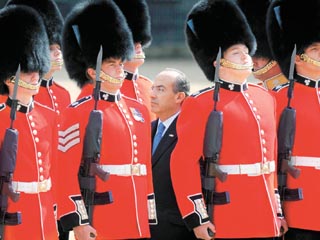
Reuters photo by Stefan Rouseau
Mexico, unlike other major Latin American nations, is supportive of British plans for “reforming” the International Monetary Fund rather than looking at new and different economic systems, like the pan-Latin Bank of the South.
With Brazilian President Lula de Silva’s impolitic remarks about blue-eyed white bankers putting him in the British doghouse, the president of the “other” large Latin American nation is being given the royal treatment ahead of next week’s G-20 Summit in London.
Felipe Calderon is being housed with the nice elderly couple at Buckingham Palace, where he told his hostess that “Mexico has returned to its role as the natural leader in the region [Latin America] and will be playing an important role in multilateral conferences.”
Mrs. Windsor, or “Reina Isabella” as she’s styled in these parts, responded that Great Britain was prepared to assist Mexico in taking a more integral role in world affairs. The Queen didn’t plunk down any cash, but she did give Calderon a lovely gift, a first edition of George Orwell’s 1984.
The British are known for their dry wit, but presenting the Mexican President with Orwell’s dystopic novel about duplicitious language used to justify control by competing hyper-states, might not be a joke.
Maybe the British just want to sell more security cameras. Just saying.
Mooo-ving back
One of the issues in the 2006 Presidential election was whether Mexico should invest more in their domestic market (as proposed by the PRD coalition candidate) and assist small business development or continue to depend on the U.S. market (from the PAN candidate). The U.S. economic and social climate is such that the PRD-coalition proposals are being implemented.
James Pinkerton in the Houston Chronicle (which still has at least some decent Mexican coverage) writes on the economic impact of returning immgrants in Mexico. Most immigrants are sending money home, or saving money in the United States with the intention to invest at home, while the government and some private funding (Western Union has been particularly innovative in this area) are also providing start-up funds
One of the ventures in Guanajuato is the Nuevo Lindero Dairy Society,a dairy cooperative founded by former immigrants on the outskirts of Leon that provides employment for 45 families. Many of the farmers are immigrants who have returned from the U.S. or are relatives of immigrants still working there.
“Here, almost 50 percent of the population goes to the United States. When they reach 18, they say, ‘See you later,’” explained Jesus Ramirez, a former illegal immigrant who is president of the Nuevo Lindero Dairy Society. “With this source of jobs, we hope our children will stay.”
The cooperative produces an average of 4,000 liters of milk daily from a herd of 250 cows. By offering the raw product collectively to wholesalers, they were able to command a higher price. To do that, the cooperative installeda distribution center next to the highway with a 9,000-liter stainless storage tank.
Follow the bouncing peso
Business taxes are due today, which had an interesting effect on the peso. Mexican companies, which have been socking away dollars suddenly and collectively all said, “oh shit!” and ran to the exchange houses to trade in the greenbacks for Sor Juanas (and Benitos, and Jose-Marias and Nezahuacoatls)… making the peso the only “emerging market” currency to gan value against the dollar yesterday.
Or, at least that’s the rationale given for the 6.8 percent rise in the peso’s value over the last month by Bloomberg (which also reports that the peso is falling).
Must be the taxes that are confusing people. It couldn’t be the G-20 Summit, the U.S. auto bailout, or the growing consumer protests against credit card and bank lending rates, the conflicting reports from the Banco de Mexico or sunspots that have anything to do with it.
I’ve given up trying to make sense of it… I can’t spend dollars, and figure a peso is still worth a peso.
Janet Roseberg Jagan
Who was the first President from Chicago? Not Barack Obama.
Born 20 October 1920 in Chicago into a Guyanese-Jewish family, Janet Rosenberg Jagan moved to what was then British Guiana with her new husband, dentist Chedi Jagan 1943. The Jagan’s dental clinic doubled as headquarters for the People’s Progressive Party, an anti-colonialist and socialist party. Working as a dental assistant by day, and organizing sugar cane workers by night, Janet Rosenberg Jagan made herself some powerful enemies… like Winston Churchill.
The People’s Progressive Party managed to become the first elected socialist government in South America, following elections in what was then a colonial parliament in 1953. But Britain under Prime Minister Churchill, who had returned to power in 1951, promising “not to preside over the decline of the British Empire” did not look favorably on either Socialists (not the non-English ones, anyway) nor on colonial upstarts.
British Guiana’s Constitution was suspended in 1955, and both Dr. Jagan and his wife (who was also Party Secretary and deputy speaker of Parliament) were imprisoned for six months then released under house arrest. During her incarceration, Janet continued to edit “The Thunder”, the pro-independence newspaper. Following her release from detention, Janet immediately returned to politics, being elected to the new Legislature which replaced parliament and serving as Minister of Labour and Health, and later as a Senator and Home Secretary.
Finally achieving independence from Britain in 1966, Dr. Jagan became the first Prime Minister of the new state, while Janet built a dual career as a journalist and parliamentarian. For the first several years both the United States Central Intelligence Agency and the British government channelled money to anti-People’s Progressive Party groups.
Guyana is an unusual country for many reasons, not the least of which is its ethnic and religious diversity. About half the people being of Indian (from India) descent, with the rest being Afro-Caribbean, European, Chinese, indigenous American or “all of the above”. Ethnic divisions provided a handy wedge for foreign governments to undermine the left-wing PPP Government:
[The Jagan’s] politics, along with their admiration for Fidel Castro’s revolution in Cuba, caused alarm in a foreign capital — this time, Washington. According to long-classified documents, President John F. Kennedy ordered the Central Intelligence Agency in 1961 to destabilize the Jagan government. The C.I.A. covertly financed a campaign of labor unrest, false information and sabotage that led to race riots and, eventually, the ascension of Forbes Burnham, a black, London-educated lawyer and a leader of the People’s Progressive Party [sic]who had become a rival of the Jagans. He became president and prime minister in 1966.
Burnham had left the PPP in 1958 to form a Afro-Caribbean Protestant party. Religious divisions had also exploited by the outsiders to prevent a return to a socialist government. Only about half the people are Christians, with Hindus making up a quarter of the population, and Guyana has the largest percentage of Muslims (11 percent) in the Americas. With even Rastifarians making up a larger percentage of the population than Jews, Janet was at least an outsider (and above the fray) in one critical area. However, being of Indian descent (something that surprises many, who assume all Jews are Europeans), Janet as a journalist and opposition parlimentarian had to work to overcome criticism of the PPP as the “Hindu Party” building a true “People’s Progressive Party” on one hand, and continuing to protest rigged elections on the other.
Burnham, almost immediately upon his election, pushed through a “National Security Act” which effectively turned Guyana into a police state. Perhaps surprising to the CIA and the British, Burham’s government — although remaining a member of the Commonwealth — abolished the monarchy, changed the name of the country and became what it called a “Cooperative Republic.”
Overt corruption and political fraud led Janet to organize a PPP election boycott in 1973. The struggle for the PPP and the Jagans was to return Guyana to a democratic state while the Burham government (and its successors) destroyed the economy (taking advice from both the Soviet Union and the Rev. Jim Jones) and any semblance of democracy. Guyanese emigrated in massive numbers in the 1980s, while the Janet Jagan continued to foment resistence and build a concensus for political change through both newspaper work and through labor organizing. The continual push for change finally resulted in monitored elections in 1992, and a return to parlimentary democray. Dr. Jagan was elected President.
Dr. Jagan died in March 1997, shortly after Janet had been elected Prime Minister. In the special election that followed, she was elected to the Presidency in November. Although ill-health cut short her own term in office (she resigned in August 1999) her election was a harbinger of a leftist electoral trend in the Americas.
While Isabelita Peron and Lidia Guillar were the first women presidents of American nations, and Indira Gandhi was the first woman of Indian descent to lead a nation, Leon Blum the first Jewish president (of France!) and Golda Mier was the first Jewish woman to become a prime minister (and the first U.S. born woman to become head of a foreign government), Janet Rosenberg Jagan was the first to do all of the above. And did it while battling the the CIA, Soviet “advisers”, Winston Churchill, colonialism, ethnic strife and crazed apocalyptic preachers while doing it.
Janet Rosenberg Jagan died Saturday in the capital city of Georgetown.
Stay safe
Given the recent concern of tourists about the dangers of being shot in Mexico, I thought I’d give you a little guidance on what to avoid in Mexico, and in the United States if you want to stay safe and alive.
In Mexico avoid: In the U.S. avoid:
|
Narcotics busts |
Narcotics busts |
|
Feuds between narcotics dealers |
Feuds between narcotics dealers |
|
Leaving a bank with millions in cash |
Carrying twenty bucks |
|
|
High Schools |
|
|
Universities |
|
|
Shopping Malls |
|
|
Restaurants |
|
|
7-11s |
|
|
Gas Stations |
|
|
Nursing Homes |
Did I miss any?
Actually, I did expect the Spanish Inquisition
As I thought, it’s up to Spain to initiate war crimes charges against the Bush administration.
With the United States apparently unable or unwilling even to take the half-step of setting up a “Truth and Reconciliation Commission” I thought that Spain or Belgium — both of which recognize “Universal Jurisdiction” for international war crimes — would sooner or later have to start the ball rolling. Spain has.
What I said back in mid-February was that
The Spanish — having experience with trying foreign human rights criminals — and being able without any stretch of legitimately applying “extraterritorial jurisdiction” — have the best claim of taking the first shot at the Bushistas. Spaniards were killed in Iraq (quite a number of them) and it’s not incoceivable that we we will find a Spaniard, or someone who is covered by Spanish law (say, a refugee in Spain, of which there are many from Iraq) who was abused, tortured, waterboarded… extraordinarily rendered… anything to set off an investigative magistrate.
Julian Borger and Dale Fuchs (The Guardian, U.K.) explain that the Spanish claims of jurisdiction are based on the fact that “six Spaniards were held at Guantánamo and are argued to have suffered directly from the Bush administration’s departure from international law.” Given that the courts have accepted the charges (an investigative magistrate has found enough evidence to go forward), Despite the expected diplomatic problems this will create for Madrid and Washington, “Gonzalo Boyé, one of the four lawyers who wrote the lawsuit, said the prosecutor would have little choice under Spanish law but to approve the prosecution…It will be against the law not to go ahead.”
Judge Baltzar Garzon, who oversaw the prosecution of Augustin Pinochet has oversight of this case:
The officials named in the case include the most senior legal minds in the Bush administration. They are: Alberto Gonzales, a former White House counsel and attorney general; David Addington, former vice-president Dick Cheney’s chief of staff; Douglas Feith, who was under-secretary of defence; William Haynes, formerly the Pentagon’s general counsel; and John Yoo and Jay Bybee, who were both senior justice department legal advisers.
Court documents say that, without their legal advice in a series of internal administration memos, “it would have been impossible to structure a legal framework that supported what happened [in Guantánamo]”.
Boyé predicted that Garzón would issue subpoenas in the next two weeks, summoning the six former officials to present evidence: “If I were them, I would search for a good lawyer.”
If Garzón decided to go further and issued arrest warrants against the six, it would mean they would risk detention and extradition if they travelled outside the US. It would also present President Barack Obama with a serious dilemma. He would have either to open proceedings against the accused or tackle an extradition request from Spain.
I don’t bring this in here to beat up on the discredited, disgraceful, disgusting Bush administration … but I would hope that when Judge Garzon gets a few minutes, he look into Luis Echiverria’s escape from justice on a technicality. The Fox Administration promised a “truth commission” years ago, and it stalled out, never really getting to the bottom of the Tlatelolco Massacre, or the disappearances of the 1970s. Right now, pressure is growing (especially from the Rector at UNAM, who is more than just a major college president, but an important political figure in his own right) for finding some mechanism to bring the truth to light.
If it takes a Spanish Inquisition to pry information out of the Bushes, so be it. And, if that’s what it takes to nail down what happened in Mexico in 1968, I’d hope we can get it done before the bicentennial of the start of the War of Independence from Spain next year.
This could hurt
The “Obama Administration New Path to Viability for GM and Chrysler” (pdf file) envisions forcing Chrysler into “structured bankruptcy” and makes United States assistance contingent on a forced merger with Fiat. In return,
Fiat is prepared to transfer valuable technology to Chrysler and, after extensive consultation with the Administration, has committed to building new fuel efficient cars and engines in U.S. factories.
All that is very good, BUT, for Mexico, the question will be what happens to the three Chrysler products built in this country. The Chrysler products built in Mexico are mostly for the U.S. market, and only secondarily for the Mexican and Latin American one.
From what I’ve read of the “Obama Aministration New Path” it sounds as if the plan is contingent on Fiat doing its manufacturing in the United States. Chrysler has two plants in Mexico — in Toluca, where Chrysler PT Cruisers and Dodge Journeys are assembled — and in Ramon Arzarpe, Coahuila (Dodge Ram pickups).
The Ramon Arzarpe plant sits — almost literally — on the border. While the truck may have a loyal following in the United States and Mexico (for a time, Vicente Fox had a Presidential King-cab), the “New Path” funding is in return for using Fiat technology to build more fuel efficient automobiles. The RAM has a lousy fuel efficiency and carbon-footprint rating.
The PT Cruiser (built in Toluca) has not been selling well, but has a relatively good carbon footprint for an SUV and is a moderately popular domestic (in Mexico) SUV. However, with an engine that only gets about 20 to 25 miles per gallon, it may be a line likely to be discontinued.
The Dodge Journey, a “cross-over SUV” (also built in Toluca) has a poorer MPG rating than the Cruiser (21 miles per gallon combined city and open road driving) and about the same carbon footprint as the Chrysler.
I don’t know if both, or either of these two SUVs will stay in production, and while there is a Mexican and Latin American market for the Cruiser, I’d expect Fiat to phase both brands out in favor of the existing Palio SUV. Palios are not sold in the United States, but the Brazilian built Fiat SUVs (different versions of the Palio — sedans, SUVs and trucks — are also manufactured in India, Turkey, South Africa and China) are relatively good sellers here. It might be possible for the Toluca plant to turn out some U.S. market version of the Palio, or a Palio-ized version of the Cruiser or Journey, but I don’t think the Mexican auto workers are the Obama Administration’s first priority in this restructuring.
(Mileage and carbon footprint data from “FuelEconomy.gov“)
Weirdest metaphor of the month…
A guy pissed at “illegals” comments on a Houston Chronicle story, about Mexican immigrant returning to Mexico to set up small businesses:
If the US is our house, the illegal immigrant is the house guest that can’t pay and has overstayed their welcome, and refuses to raise up the toilet seat when they take a whiz.
U.S. = “house”
“illegal alien” = “unwanted house guest”
toilet = ?? Economy?
Free the rich!
Austin American-Stateman, via Bender’s Immigration Daily:
Homeland Security officials say the border fence was not intended to stop illegal immigration but to make it more difficult for people to enter the U.S. illegally. …
But Jeff Wilson, an assistant professor at UT-Brownsville, says that when the fence is completed, it will have gaps in places where the wealthy live.
He recounted a trip to meet a reporter at a Cameron County country club. He said the two encountered dozens of armed border patrol agents at the club on the day they met. A suspected drug smuggler had driven a black Suburban into the Rio Grande and swam to Mexico, Wilson said. “And yet,” he told an audience of about 20 people Saturday, “the fence stops at the country club.”
Mexican gangsters just aren’t clubbable?

I'd never join a club that would have me for a member


