Behind blue eyes…
Right-wing sources are quoting Luiz Inácio Lula da Silva as using the phrase “blue-eyed devils” in referring to the cause of the international banking crisis.
Never mind that “blue-eyed devils” as an epithet goes back to the possibly Afghani, possibly Maori, but definitely not blue-eyed Wallace Fard Muhammad, and it’s not exactly what Lula said. The same web-sites and writers who’ve suggested that the Mexico is run by a “corrupt white power elite” (vdare.com 05-05-00, and I’m not going to link to that piece of racist shit site) — which one assumes includes more people with blue-eyes than the general population — are apoplectic over the remarks not made by Lula, and going to extreme lengths to claim Franklin Raines and Vikram Pandit, neither of whom are white men, and neither, as far as I know, blue-eyed, are the only bankers that count in this world. A few made reference to the tired old “international Jewish conspiracy”, but that would have created a real conundrum for the yahoos… having to decide which they hated more… socialists, Jews or Latin Americans.
And, as an aside, I will mention that the only World Bank official I knew in Mexico was … you got it, a white guy with blue-eyes. But, he was also French, which makes him devilish in the blue-eyes of the U.S. reactionary right anyway.
New York Times columnist Maureen Dowd — who seems to be under the impression that “Lula” is the Brazilian President’s alias, and not his family name — at least gets the statement more or less correct (as far as I can tell, my Portuguese being limited to what I need to download pirated videos off Brazilian websites):
“This crisis was caused by the irrational behavior of white people with blue eyes, who before the crisis appeared to know everything and now demonstrate that they know nothing,” charged the brown-eyed, bearded socialist president.
As the brown-eyed Brown grew a whiter shade of pale, Lula hammered the obvious point that the poor of the world were suffering in the global crash because of the misdeeds of the rich.
“I do not know any black or indigenous bankers,” said Lula.
Dowd airily dismisses the gist of Lula’s complaint — that the world economic crisis was created by the elite in the northern countries — and riffs on blue-eyes, beauty and everything but economics.
Saúl Arellano, in the very conservative Mexican daily, Cronica de Hoy, paraphrases the remarks as saying the latest economic crisis, like those of the past century were caused “FUNDAMENTALLY by white men with blue eyes”.
President Lula may be a bit quick with the lip, but he’s “fundamentally” correct. It was northern “elites” (overwhelmingly male, overwhelmingly “white” and statistically much more likely to be blue-eyed than the rest of the human race) have made the decisions, and made very bad decisions, that affect the rest of the planet.
I’ve never known exactly how to respond to the right-wingers and neo-fascists who claim this country doomed because it’s run by “white elites” for the advantage of the rich, and that unless the submerged masses rebel it’s not going to change.
Um, well, OK. A lot of my book talks about the multiculturalism of Mexico, and just pointing out that a lot of wealth in Mexico is concentrated either in the hands of those who inherited wealth (as in any other place) or those who emigrated (mostly from Europe) with money and technical skills at the right time (as in the United States, Britain and Canada) doesn’t phase people whose minds are made up, and don’t want to be confused by facts.
And, then I’m told, Mexico is doomed because it’s a brown country with “white leaders” from that upper crust. Most countries leadership is from the wealthy classes. The only U.S. presidents I can think of in the last century who lived mostly on their salaries when they entered the White House were Harry Truman and Bill Clinton. Most Mexican presidents of course have been rich, but most came from fairly humble backgrounds.
In the United States, all but two of the Vice-Presidents, have been of British or British Isles descents, and only a few Presidents. Religious affliliation is a more important social indicator in the United States, and all but one president (and the incumbent Vice-President) have been Protestants. The one Catholic President made up for his religious non-conformity by having inherited wealth. Aside from Harry Truman and Bill Clinton, all modern U.S. Presidents have inherited or earned (or, like Lyndon Johnson, married into) fortunes before entering the Presidency.
And, anyway, Mexicans aren’t running the world economy. We have a few blue-eyed white guys, and so do the Brazilans, but not many of them are bankers, and it isn’t Mexicans and Brazilians who created this mess.
Maybe Lula needed to clarify his remarks, or maybe the people north of the border need to, as the right-wing commentators suggest the Mexicans do, rise up and overthrow the corrupt white elites who control the country.
But, somehow, I can’t see the right-wingers… or Maureen Dowd… going to the barricades to shout “Workers of the world unite… we have nothing to lose but blue-eyed bankers.”
All the news that fits
Two news stories about the news this week.
One piece of good news.
Notimex reports (my loose translation) that what I’ve always thought was the best news and information programming in the country will be reaching a much wider audience:
President Calderon, speaking a a ceremony to introduce a new postage stamp honoring the 50th anniversary of Television Channel Eleven, announced that the Secretary of Gobernacion (the Home Secretary) and the Secretary of Communication and Transportation have agreed to transmit the Mexico City public television station nationwide.
One troubling trend:
Cox Newspapers is closing its Mexico City bureau. The “bureau” was basically Jeremy Schwartz, who wrote in his last column from Mexico City:
Since I arrived in Mexico in 2005, I’ve seen the foreign press corps dwindle. One longtime correspondent remarked that any gathering of reporters quickly assumes the air of a wake. I’ve seen the bureau closures of the San Antonio Express-News, Newsday and the San Diego Union-Tribune, seen the McClatchy chain’s position remain unfilled, and a significant reduction in the size of the Dallas Morning News bureau. Great journalists remain in Mexico, doing amazing work. But too many are nervous about their jobs.
Canal Onze, “Channel Eleven” was envisioned, like its sponsor, the Instituto Politécnico Nacional, as a people’s institution. Canal Onze began as “popular education” … or at least education for the masses: plunking down a television camera in a classroom where a math professor … and zooming in on a blackboard… wasn’t all that “cutting edge,” but it was well in the spirit of IPN, founded in IPN 1936 as a “Revolutionary” institution that could both meet the needs of the masses not looking for an academic degree such as that offered by the other national university, UNAM, but needing the skills to succeed in a technically and economically changing world.
While there are programs like “Discovery Channel” or “Animal Planet” available in Mexico, they are only on cable, out of the financial reach of even most of the Mexican middle class. Canal Onze is hard to find outside Mexico City, but makes the animal and history shows available… and creates several programs specifically for Mexican audiences.
Oprah might be educational, but she’s a lightweight compared to Christina Pacheco, a well-known journalist and author as well as a talk-show hostess as likely to interview klezmer players, tortilla pounder and nobel prize winners with the same sense of respect for their work and importance.
And I admit having a big crush on Noticiero Nocturno news-reader, Adriana Pérez Cañedo. Image Jim Leher channelling Rachel Maddow. The only time I ever saw Pérez lose her cool when when she was reading a news-script about the looting in Bagdad, where she had to read a quote from Donald Rumsfeld to the effect that there was no looting. Pérez read the quote, crumpled the script, threw it at the camera, and apologized for insulting the intelligence of the viewers. And went on with the broadcast.
—
Compare Canal Onze — expanding its coverage and reach — with the U.S. media, which is shrinking, even domestically. You would think a government financed station would have to toe the political line, just as a corporate one (or, like PBS in the United States, “underwritten with the financial support of… “) would be relatively tame. But, Canal Onze is not directly a governmental body, but a University-owned one. Universities, even technical universities like IPN, are “autonomous bodies” in Mexico. They have a constitutional right to funding, and to decide how they use those funds. In other words, the government cannot censor the station by cutting it’s funds without also cutting the funds for the entire school… which would be political suicide.
And, while journalists are terribly paid in Mexico, they are broadly educated. Although this creates some problems with those reporters who are paid by word count (like police reporters) trying to show off their language skills (and, alas, there is still a tendency within Latin American journalism to write in a euphemistic and allusive style, the top journalists — what in the U.S. would be the “inside the beltway” class, are very well educated men and women indeed. Most base their reputation on their work as historians or economists or social researchers, and journalism is simply what they do to pay the bills.
I don’t mean to imply that Mexican journalists are amateurs (that’s what we bloggers are accused of being!), but that even those who make journalism the focus of their working lives are not the “political class” as in the United States. True, Televisa’s long-time CEO back in the PRI era, Emilio Azcárraga Milmo, supposedly said, “Mexico …will never stop being fucked. Television has the obligation to bring diversion to these people and remove them from their sad reality and difficult future.” And, Azcárraga and his family did interfere with news on behalf of the PRI, but even the network’s news stars, like Jacobo Zubidovski, see their job as afflicting the comfortable more than comforting the afflicted these days.
—
An astute, cankerkous, small town Texas writer (and, wiser than I, sticking to the news of a much smaller geographical area and a much smaller circle of usual suspects to make him cranky) always says, “bad journalism is better than no journalism”. We “amateurs — those of us who at least report on what’s being reported — may not be “bad journalists” and we may not even be, by some definitions, journalists. But we don’t see our job as removing you from the sad reality and difficult future,” but to prepare you to face it, or call on you to change it. The corporate media isn’t going to pay our bills, and we’re going to remain amateurs in that sense, but if you want even “bad journalism” we can use your support.

Then I saw the Congo… thieves or spies?
Mexico doesn’t print any huge denomination bills (a thousand pesos is the largest denomination there is) and Latin American business transactions are often cash deals. So, it’s not all that rare to read about someone being shadowed as they go to the bank, then relieved (at gun point) after withdrawing a few hundred thousand in currency. Normally, the victim isn’t physically injured, although the murder of a French citizen about a month ago was given more news space — mostly because the death or injury of any foreigner is newsworthy — than most holdups, or murders, for that matter.
A few days ago, the papers were reporting on another Frenchman’s murder, which suggested at first that there was a pattern of some kind. In 2004, several Spaniards ended up dead in what seemed a mysterious pattern, and had the Spanish Ambassador demanding an explanation (and blaming the Lopez Obrador administration for stirring up anti-gachupine sentiment) until it became obvious the Spaniards were all members of the same crime syndicate, and the Mexican government came very close to expelling the Ambassador for interfering in Mexican political affairs. I though something similar might develop with the French murders, but the latest victim turns out not to be French, and what’s not in the news is more intriguing … and maybe troubling… than a murder.
The victim, whose name is not appearing in news reports yet (I’m writing this on Wednesday night), was a naturalized Mexican, a refugee from the Democratic Republic of Congo, formerly Zaire. According to press reports, two men got on the bus (at the same stop with the victim?) walked down to his seat and shot the Congolese native and his companion, another Congolese political refugee. She is a resident of France, which may have been responsible for the original reports saying two French citizens had been killed.
While this could be a simple robbery, it doesn’t appear that any money was taken, nor that there was any attempt to take money. It doesn’t sound likely that a person carrying a large amount of currency would be taking a bus, and not a taxi, nor does it sound likely that there is a gang out there targeting French-speakers. Nor, does there seem to be any rift in Mexican-Congolese affairs, though Mexico obviously accepts refugees from that “failed state” as it does other political asylum seekers.
The press seems to be playing this as “just another example of insecurity on Mexico City buses” (which seems to be their kick right now. Nacha Cattan’s article in The (Mexico City) News used the occasion of the murder to mention the start of a new program whereby buses on the routes perceived to be dangerous have an armed police officer on board). But, I’m willing to bet that this has nothing to do with bus routes or banks or theft.
We tend to forget that Mexico City used to be a great place for refugees, spies and international intrigue. From the time of the “Zimmerman Note” and the back and forth between German, British, U.S. and the various Mexican Revolutionary factions competing secret services, up until World War II, German and British agents were busy chasing each other around the city and occasionally popping each other. From the 1930s up into the 1970s, there were Spanish Republican refugees and Francoist spies keeping a wary eye on each other. Particularly gruesome incidents — like Leon Trotsky’s assassination — gave the city a sinister reputation as a setting for political intrigue.
Even since the end of the “Cold War” the “War on Drugs” has occupied fiction writers who use Mexico City as a setting, but we forget that Mexico had good relations with both the Soviets and the United States. While the CIA had their largest foreign office in Mexico City, the capital was also host to a thriving colony of U.S. Communists who found asylum and work in the capital. And the CIA was not the only foreign spy service in town. In the pre-computer era of the Cold War, “Tekkies” used to stop and admire the collection of the latest and greatest in electronic communications gear poking out of the eaves of the Soviet Embassy. A few years ago a Mexico City politician was “unmasked” by an opposition leader as an ex-KGB operative. The commie agent freely confessed, saying that being paid to sit on a park bench on Reforma across from the U.S. Embassy and watch who went in or out was probably the best job a college student could get. It gave him plenty of time to keep up with his readings, and the KGB kept him in beer and pizza money.
In the 1970s and 80, Mexico had
… an almost schizophrenic political culture. While there was repression at home (small rural dissident groups were branded as Communist revolutionaries and were disappeared…or murdered), the country was more open than at any time since World War II to political refugees— generally from other Latin American nations where repression was much more overt.
Although the Fox administration extradited a few Basque separatists back to Spain to face twenty or thirty year old “terrorism” charges, foreign political organizations aren’t much heard from in Mexico. With the exception of fascists, whatever a refugee did in his or her past (or was doing or planning to do in the old country) is pretty much ignored as long as Mexico itself isn’t involved, and normally it has no reason to be. The farce that followed a botched British intelligence mission in 2004 has pretty much killed off Mexico’s reputatin for clandestine glamour. Only when Mexican were recruited or involved (as the Colombian government claimed about “FARC sympathizers” when they killed several Mexican students during their incursion into Ecuador) would you hear anything in the media about foreign groups. And, the complaints coming from a foreign government, they backfired. Although both are conservative “free-traders”, President Calderon was forced by Mexican public opinion to demand a retraction of the charges and an apology from his Colombian counterpart, Alvaro Uribe.
Mexico City is a cosmopolitan place. The old European and Latin refugees (and the small number of political refugees from the United States) There are a number of Arabs as well as Asians and increasing numbers of African refugees. Who may be involved in all kinds of things… or may be the unfortunate victims of street robbers.
We’ll probably never know.
Off to the Center for Social Readaption?
Somebody didn’t do their homework. Maggie’s Madness relates what could make a not-very-nice “dumb blond” joke:
Hillary has made some huge social gaffs in the past day, it is almost an embarassment. At the Basilica de Guadalupe in Mexico City she prayed for the American people which was thoughtful, but expressed absolute surprise at the importance of the Virgin of Guadalupe not only for Mexico, but for the entire continent. Now, this one is too much, she actually asked who painted the shroud*. Wow, if it wasn’t such a stupid question, it could have been easily taken for an insult.
*The Basilica Rector said: “Dios“. Whether he was answering Clinton’s question, or making a comment on being roped into escorting bone-headed gringas was not clear . As the Secretary of State was taken into custody for questioning preliminary to handing her over to the Inquisition, the Virgin was quoted as saying “Who’s Hillary?”

Shamelessly stolen from Burrohall.blogspot.com
Off the hook…
Speaking of old people facing criminal charges, 87-year-old ex-president Luis Echeverría Álvarez probably will never face criminal charges for his role in the 1968 Tlatelolco Massacre.

Echevarria, 2007. Photo: Liga Mexicana por la defensa de los derechos humanos
The possibility of bringing Echeverría to justice seemed hopeless for many years. As in other countries, there is a strong reluctance to bring criminal charges against even despised former presidents, and by the time there was enough political and social change to consider charges, the statute of limitations for murder had expired. However, there is no statute of limitations on charges of genocide, and Echeverría, who was Secretario de Gobernacion in 1968, finally was briefly detained and questioned, but — because of his age (and politically sensitivities) was never jailed. In 2006, a federal judge issued an amparo (injunction) against prosecution saying that the massacre, even if Echeverría was responsible, was not genocide.
The Fifth Collegial Tribunal for Penal Affairs (the equivalent of a Federal Appeals Court in the United States) has upheld the ruling. While I agree with Mexican commentators who say it sucks, and are rightly angry about this, I think the legal grounds for dismissal are valid. Genocide under international law (the 1948 Convention on the Prevention and Punishment of the Crime of Genocide and which Mexico was an original signatory) specifies that genocide is an act designed to kill, cause bodily harm to, intimidate, prevent the birth of children (or remove children from) ” a national, ethnical, racial or religious group, as such”. Students, as the original judge had said, may have been killed or subject to bodily harm, or intimidated as a group, but they are not one of the groups covered under the definition.
While there is always hope that Echeverría will be Augustin Pinochet’s cell-mate in the not so distant future, but barring some new and untried criminal charge (like Pinochet, Echeverría could face charges for his shady financial activities), it’s unlikely he’ll face any justice this side of the grave.
What a drag it is growing old…
 As she’s grown older — and scarier — Irma Serrano’s ventures into the public eye have gotten weirder and weirder. The former 60s “sex-kitten” and presidential mistress (of Gustavo Diaz Ordaz), was known as “La loca de Polanco” (The nut from Polanco) during her stint as a plurinomal Senator for a small left-wing party. She resigned her seat to launch a losing campaign for Governor of Chiapas (which not only did her party lose, it lost badly enough to lose its registration).
Never one to stay out of the public eye long, in 2003, Serrano was back in the news when she announced she was pregnant, carrying the child of a long-dead boyfriend. While the idea of in vitrio fertilzation by sperm aged 12-years in the test tube wasn’t all that implausible, reporters doing a little bit of math, and checking published biographical data were, shall we say, rather skeptical of the claims of a 70 year old publicity hound.
When Serrano’s alleged pregnancy became a standard joke for late night comedians and even on the newscasts, she called a news conference to announce a miscarriage. Less publicized was her feud with the manager of Serrano’s former nightclub (“Club Fru-Fru”, next door to the former federal congressional building, which now houses the District Assembly, and famous more as one of the few surviving burlesque theaters in the world than for the life-size guilded statue of a nude… and much younger… Irma in its lobby). The club was robbed in 2006, and the owner held at gunpoint as fixtures, cash receipts and memoriabilia were carted out.
Last week, Serrano was picked up in Chiapas on a federal warrant charging her with participating in robbery. Normally, a woman charged with a 10 million peso armed robbery (along with kidnapping and carrying illegal firearms) is going to stay in Santa Martha Acatitla women’s penitentary until trial, but Serrano is, after all, 75 years old, and — as in other Latin American countries — elderly prisoners are eligible for conditional release.
Serrano was released at 2 in the morning in an attempt to avoid the press… an impossiblity for her. She did, however, say “not now, I have a headache” before being whisked away to an unknown location.
Truth to power, from those in power
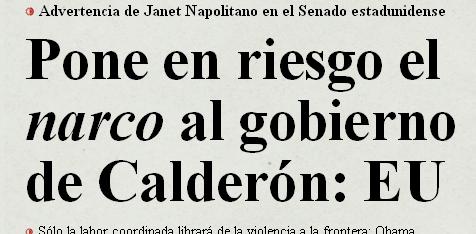
(Today’s Jornada)
It’s not that Mexico is a “failed state” (a meaningless term to begin with, and one that could be easily applied to a lot of places, including Janet Napolitano’s own Arizona), but that the Calderon administration’s “hard hand” has not worked… therefore… the United States government wants to throw money and resources at the Calderon Administration to continue a failed policy.
…la secretaria de Seguridad Interior estadunidense, Janet Napolitano, aseveró que la lucha contra el narcotráfico pone en riesgo existencial
el gobierno del presidente mexicano. Sin embargo, horas más tarde la funcionaria declaró que México no se ha convertido en un narcoestado.
“United States “internal security” Secretary, Janet Napolitano swore that the fight against narcotics trafficking poses an “existential risk” for the government of the Mexican president. However, hours later, the bureaucrat stated that Mexico has not been converted into a “narco-state.”
In other words, as Mex Files and others have been saying, the “war on drugs” is not necessarily good for Mexico, and it’s not Mexico that’s in danger of “failing” (whatever that means), but one particular, pro-U.S., pro-corporate administration … that was only elected with 20% of the overall vote (34 percent if you don’t count those who didn’t “vote” Zapatista by abstaining).
I don’t think it’s necessarily wrong that the Obama Administration backs the Calderon one… Juarez said governments should stay out of each other’s internal affairs, and Mexican diplomacy has always been founded on the idea of accepting whatever government another nation has as the legitimate one. That the United States (or at least the Bush Administration and the Republican Party) did interfere in Mexico’s 2006 Presidential election is a matter of some — but not much — dispute. And, the legitimacy of the Calderon Administration is also a matter of dispute in Mexico.
However, to confuse the Administration with the country is a mistake. Yes, I know I moved to Mexico in large part because I considered the Bush Administration illegitimate (and — not that I’m psychic or anything — had a feeling that the U.S. was cruisin’ for a bruisin’ economically and likely to get itself into a war with somebody), but that never made me think the U.S. was on the verge of collapsing as a nation. Cut down to size, perhaps, and likely to experience waves of violence and domestic terrorism (which it still could as the downturn beomes more pronounced) but hardly likely to break up, or “fail” whatever that means.
Administrations fail, and make bad decisions. I think the “war against some drug dealers” has been a mistake, but we’re stuck with it for now. I think the Calderon Administration could have made better economic and social choices (and that the alternative proposals from the other candidate might have — in the long run — been better), but that doesn’t mean life is coming to a grinding halt, or anything else. It means there’s problems, like in any country.
And, I’m not convinced that the U.S., having outsourced its failed drug policy to Mexico, is really going to accomplish anything by following the same policy. But, neither country — as a country — is likely to “fail”.
So, to prop up the Calderon Administration, the U.S. response… as the Bolivian site, El Gaviero puts it, is a statement by the Secretary of State admitting the same old, same old doesn’t work, so they’ll do more of the same:
Clinton fesses up to the Mexicans and says the “‘insatiable’ appetite in the United States for illegal drugs is to blame for much of the violence ripping through Mexico,” according to Reuters. And then she promises more guns: “Washington plans to ramp up border security with a $184 million program to add 360 security agents to border posts and step up searches for smuggled drugs, guns and cash.” Great. How about ending this disastrous war on drugs, for f’s sake?
We won’t get fooled again… or will we?
Newsweek, under the alarming section header “Terror Watch” reports:
After fierce resistance from the gun lobby and its allies in Congress, Attorney General Eric Holder has dialed back talk about reimposing a federal assault weapons ban to help curb the spiraling violence in Mexico.
As much as 90 percent of the assault weapons and other guns used by Mexican drug cartels are coming from the United States, fueling drug-related violence that is believed to have killed more than 7,000 people since January 2008, according to estimates by Mexican and U.S. law enforcement officials. But the political obstacles to addressing the U.S.-to-Mexico weapons flow are dramatically underscored by Holder’s experience in just the last few weeks.
Certainly, the carnage caused by those U.S. weapons is terrifying to the residents of the communities bordering the United States where there has been out-of-control violence during the Calderon Administration’s imposition of military force against gangsterism. The violence, suggests ABC News, could get worse:
…according to a confidential federal law enforcement assessment obtained by ABC News.
“We have a criminal insurgency by organized crime that may well be a precursor to civil anarchy in part or all of Mexico,” warns the assessment.
At least ABC admits there is such a thing as “legitimate insurgency” (at least one assumes that’s the opposite of “criminal insurgency”), but I don’t know who’d really be surprised by this sort of warning. Those of us who’ve opposed U.S. interference (aka “help”) in solving the U.S. drug crisis have been warning since the beginning that there is a real danger of making gangsters into “insurgents” just by giving them legitimacy as a “national security danger” rather than treating them as just plain ordinary criminals.
And not everyone in Mexico supports the militarization of the anti-narcotics crusade. Painting those who oppose it — often for the best of reasons (“violence begets violence,” and “rural development is a more effective strategy“) — and who see U.S. “assistance” coming not for Mexico but for the Calderon Administration — are likely to be painted as “terrorists” themselves, and subject to military persecution.
While it’s a step forward that Secretary of State Hilary Clinton said in Mexico City today (Wednesday) that
“Our insatiable demand for illegal drugs fuels the drug trade. Our inability to prevent weapons from being illegally smuggled across the border to arm these criminals causes the death of police officers, soldiers and civilians,” Clinton told reporters during her flight to Mexico City.
“I feel very strongly we have a co-responsibility.”
… the U.S. is still in denial about WHO is responsible. It’s not Mexico’s fault that with the collapse of agriculture, there are few rural employment opportunities, and few legitimate craps that the United States will pay a fair market price for. It’s not Mexico providing the guns and money.
Since it appears that even a mild attempt to control the gun-running trade is unlikely to come to fruition, it might have been better if the Secretary of State had stayed home, and worked on getting Mexico a United States Ambassador (not having an Ambassador means the Secretary of State is going to have to deal with Mexico City’s complaints about the U.S> Embassy’s zoning irregularities, instead of dealing with what should be more substantial issues*). You would think that when President Obama said Latin America was a priority for his administration, a little thing like appointing an Ambassador to Mexico might have crossed someone’s mind.
Sorry to sound so cynical, but after the previous U.S. administration (and it’s really moronic ambassador, who no one will miss) made extravagent promises to “fix” Mexican-U.S. relations — sort of the way the Clinton, BushI, Reagan, Carter, Ford, Nixon, Johnson, Kennedy, Eisenhower, Truman… Monroe administrations all said things would be different this time.
* UPDATE: The Obama Adminstation today (Thursday) named Carlos Pascual as Ambassador to Mexico. Pascual is a vice-president of the Brookings Institute and a specialist in East European affairs (he was Ambassador to Ukraine) whose only Latin American experience is having been born in Cuba and emigrating to the United States as a baby.
 About the same time television producers in the United States were attempting to create an audience for cartoon super-hero Mighty Mouse, Mexican … and later Latin American and other viewers… found their own heroic mouse in the very real, and — if not super-heroic, at least impressive — Raúl “Ratón” Macías.
Standing an imposing 5’3½” (161 cm), and topping out in his prime at an imposing 118 pounds (54 Kg), Raúl Macías was yet another of those oversized Mexican figures to fight his way from Tepito to prominence and respect throughout Latin America, if not the world.
 Tepito is a tough neighborhood, maybe even more so in the thirties and forties when El Ratón… the mouse… was a little kid (as if he’d be any other kind) and he — like so many other of the Barrio Bravo’s sons who earned the neighborhood it’s unusual Metro logo — learned to defend himself very, very well.
Taking a bronze medal as a flyweight at the 1951 Buenos Aires Pan-American Games, Macías’ launched his professional career on New Years’ Day, 1952, knocking out Memo Sanchez in the first round of a Culiacan bout. It was the start of a stellar boxing career: 43 professional bouts between that New Years Day fight and his last, also a knock-out, against “Chocolate” Zambrano, in Guadalajara, 13 October 1962. In all, the Mouse fought 43 bouts, lost only 2, and won 25 by a knockout.
 Television, still a novelty in the 50s, made El Raton a household name throughout Mexico, and throughout Latin America. Some of the earliest live television broadcasts in Latin America were those of el Raton knocking yet another chump out.
After his retirement, the little-big man made a new career for himself as a telenovela star, and sometimes guest starring as himself… the popular little boxer who could … on sitcoms.
In recent years, El Raton has developed a new following, both among those who — as he did — defended amateur athletics against the growing tendency to channel resources and government support to the sports industry — and those who simply admired his skill in training and developing young boxers.
Always having credited the Virgin of Guadalupe for his success. The usually solemn and quiet Basilica of the Virgin erupted into gritos of “¡Raton! ¡Raton! ¡Raton!” from the thousands who attended Tuesday’s funeral mass.
TCOs
I’d never seen the acronym “TCO” until this morning. It stands for “Transnational Criminal Organization”. Bloggings by Boz explains:
In the US, our business news and economic debate often focuses on the giant multinationals, the “too-big-to-fail” banks and corporate earnings. We know that most new jobs and a huge percentage of our economy rely on small businesses and self-employment, but we can’t help but focus on the big fish.
Cartels are the same way.
Intelligence agencies, law enforcement and the media necessarily focus on the big fish. Pablo Escobar’s Medellin Cartel in the 90’s or Guzman’s Sinaloa Cartel operations in Mexico today dominate our discussion of the illicit trafficking industry. Yet, analytically, we know that the vast majority of transnational criminal activity is committed by “small businesses” and individual entrepreneurs trying to make a living in a tough environment…
One could, I suppose, note the transnational security company Blackwater recently changed its name to Xe … pronounced like the English letter “Z”. There’s already a business organization in the transnational security business that uses the Spanish-language pronunciation of the letter Z, called “los Zetas.” But be it far from me to draw a comparison between two organizations that happen to be in the same kind of business.
Anyway… it raises some interesting questions. Are Chapo and Company “too big to fail” — where breaking them up will create economic difficulties unrelated to their own business, or are the narcotics transport industry healthier in the long run when the cartels are broken up (and do we call breaking up the cartels “mis-trust busting”? Or, perhaps we should call bank re-regulations “The War On something”).


