We had to kill the border in order to save it…
… or, that’s what Homeland Security is likely to be saying in a couple of years.
Arguing that “Getting rid of Carrizo cane should improve the Border Patrol’s ‘line of sight up and down the river,'” along the Laredo-Del Rio stretch of the Rio Grande/del Norte, Homeland Security plans to spray stands of Carrizo (Arundo donax) with Imazapyr, which is about the only thing that will effectively kill cane. Unfortunately:
Imazapyr by its nature does not distinguish between the plants it kills. Thus, rare and endangered plants are particularly at risk from exposure to the herbicide. The EPA has stated that “jeopardy” will occur to terrestrial and aquatic plant species from the use of Arsenal.
In soils, imazapyr is persistent. The EPA reports that the half-life of imazapyr is 17 months. If applied to soil, imazapyr is expected to have very high mobility and thus is likely to contaminate water. Studies have detected imazapyr in surface as well as groundwater. If released into water or if the chemical moves through soils and finds its way to water, imazapyr is not expected to adsorb to suspended solids and sediment based upon the adsorption coefficient.
So, to recap. The Border Patrol is supposedly protecting Texas agriculture and business from Mexican workers. To do this, they need to watch the River. Carrizo Cane grows along the river, so they poison the river that permits agriculture and business to exist. Not to mention the Texans.
Smart, huh?
What the Border Patrol seems to have overlooked is that the international border they’re patrolling is … well… an international border.
On Thursday, March 19, the Tamaulipas State Legislature issued a statement requesting information about the proposed spraying from the Mexican and US sections of the International Boundary and Water Commission as well as Mexican federal agencies.
The zone targeted for spraying is across the Rio Grande from Nuevo Laredo’s Hidalgo neighborhood and only hundreds of yards from the Mexican city’s public water intake system.
Carlos Montiel Saeb, general manager for Nuevo Laredo’s water utility, said the Border Patrol advised his office to turn off water pumps a few hours prior to spraying. “If there is no problem, why are they asking us to do this?” Montiel questioned.
In Laredo, on the Texas side, there is also growing opposition, but then, the Border Patrol is part of Homeland Security, which doesn’t need to get permission from anyone, it seems.
(Quotes from Frontera Norte/Sur, via NarcoNews)
Marx, Smith, Pirates and Dracula: the Mexican system
Persons who who do not have a mortal lifespan, are not subject to the same moral code as you and I, and have to be killed if they are to die are called vampires. In the United States, they’re also called corporations.
Sam Smith, Shadows of Hope (Indiana University Press, 1994)
In the beginning, if you wanted to form a corporation you needed a state charter and had to prove it was in the public interest, convenience and necessity. During the entire colonial period only about a half-dozen business corporations were chartered; between the end of the Revolution and 1795 this rose to about a 150. Jefferson to the end opposed liberal grants of corporate charters and argued that states should be allowed to intervene in corporate matters or take back a charter if necessary.
With the pressure for more commerce and indications that corporate grants were becoming a form of patronage, states began passing free incorporation laws and before long Massachusetts had thirty times as many corporations as there were in all of Europe.
…
after the Civil War that economic conditions turned sharply in favor of the large corporation. These corporations, says Huston:
. . . killed the republican theory of the distribution of wealth and probably ended whatever was left of the political theory of republicanism as well. . . .[The] corporation brought about a new form of dependency. Instead of industry, frugality, and initiatives producing fruits, underlings in the corporate hierarchy had to be aware of style, manners, office politics, and choice of patrons — very reminiscent of the Old Whig corruption in England at the time of the revolution — what is today called “corporate culture.”
Concludes Huston:
The rise of Big Business generated the most important transformation of American life that North America has ever experienced.
By the end of the last century the Supreme Court had declared corporations to be persons under the 14th Amendment, entitled to the same protections as human beings.
During the same period (about the time of the American Civil War), Mexico was in the midst of it’s own argument about the nature of corporations. As a business structure, the corporation sprung from two enterprenueual entities, neither of which was seen as beneficial to Mexican reformers like Benito Juarez.
The first was the Catholic Church. The world’s first, and still most successful, multi-national enterprise, the problem seen by Mexican and European thinkers was that the Church was involved in activities that, while profitable, had nothing to do with its core values. Running farms, or lending money (at the time, the Church was the only reliable source of credit in Mexico), or managing factories had nothing to do with the original Mission Statement.

You though "corporate raider" was a metaphor?
The second very successful business innovation was piracy. Shareholding, which allowed private individuals to invest in an enterprise but avoid the consequences of personal responsibility for failure, was invented by the English as a way of giving plausible deniability to Elizabeth the First, who created the English Navy on the cheap… basically underwriting pirates to rob Mexican and Peruvian treasure ships in return for “shares” in the booty. The Queen and her courtiers could easily hide their certificates, and … as negotiable instruments… would not be physically involved in divvying up the loot.
Certainly, shareholding has been a useful tool in raising funding outside official channels … and the advantage to the common people was obvious. People have always pooled their resources to meet a mutually beneficial goal (whether snarfing up somebody elses peices of eight or building a market hall), and usually its people with some extra resources that can afford to risk some of their capital.
And… at least as far as money went… this was in theory democratic. It meant a rich commoner could compete (or at least join in the competition) against the entrenched powers. But, unlike the King, or the Pope who would not be held responsible for the misdeeds of any royal or clerical business enterprise, the investors in a private enterprise were. Of course, one does not need a “corporation” for joint-risk enterprises.
Of course, democracy has a checkered past. The guys almost at the top reach the top, then want to pull the ladder up. As the investors did, seeking the same rights as royal monopolies for their new business enterprises. But in the American republics, at least it was the people (in theory) who granted the special rights.

Too big to fail
In the United States, where a single multi-national, was not “too big to fail”, this never became a burning issue, and corporations quietly became more and more the norm. Massachucetts, by 1850, had chartered more corporations than the rest of the world together. In Mexico, where there was only one corporation of any note — and it didn’t need no stinkin’ charter — it was. Much of the early history of the Republic, with its tedious list of coups and counter-coups, was faction fights over the economic rights of the Church.
Benito Juarez, and the 1850s reformers, in common with liberal thinking at the time, saw free thought as the trade-off for free trade. They sought not so much to undermine the Church as a religious institution as to democratize the economy when they simply wrote corporations out of existence.
Of course, opening Mexico to the world, and the world to Mexico, as happened over the course of the next 60 years, created its own new set of challenges. Businesses from the Untied States (with their “personhood”) and elsewhere wanted to shield their Mexican investments from the vaguaries of risky ventures in what was seen as a risky environment. Porfirio Diaz acted more like a King than the head of a Republican government (and we forget Mexico did have elections — of a sort — during Porfirio’s long reign) in granting foreign “concessions”. And, the late 19th and early 20th centuries saw a huge change in the way businesses were organized.
In Europe, where political practice delved more from theorists (like Karl Marx and Adam Smith) as well as the more empirical Americas, corporate power became a major political and social issue at the start of the 20th century. In the United States — where corporations were persons — controlling corporations became a major political and social cause.
Mexico was a little slow off the mark in joining the “developed world”, but with the 1910-20 Revolution, it had to synthesise about 50 years of economic and social change in one bite. The Church was not the only untouchable foreign power around any more. And it wasn’t relatively small investments like mine shafts or apartment houses under outside control… it was things like steel mills and oil companies and telephone systems.
And were those steel mill owners persons, or not?
Very few Mexicans had the financial resources to take on the new mega-businesses that had appeared since the 1850s, but those who were already very, very rich (usually landowners) could easily maintain their power and wealth by transferring from the now limited land ownership to other forms of wealth. Land ownership was always risky (pesky peons might take it into their heads to take back what was once theirs, and pick up machetes, for example) and the personal liability of owning a factory was less than owning a farm. The really huge enterprises — the oil business and the telephone system, for example — could be turned into state enterprises, as the most popular of the new European theories (Socialism) recommended. As well as the older, Catholic tradition of free will.
Mexico, always pragmatic, has adjusted over the years, and no one economic theory is seen as Holy Writ. Smith, and others talked about “economic man” and in the United States, corporations were persons in law. Marx said all power to the proletariat. The Church said man has free will and is responsible before God and the community.
In Mexico, as things have evolved, the European concepts of Marx and the Church both were part of the new system.There are a few corporations that are basically state enterprises: PEMEX, for example. When I write about PEMEX, I use the Spanish word, paraestatal — since, unlike a U.S. corporation (or, a Dubai one, or a Cayman Islands one), it doesn’t have a good English word to descibe a state-chartered and controlled (and financed) operation.
Telmex, while a state enterprise, had millions of shareholders — the users. Buying a telephone required buying stock from the state company. When it was privatized, the state was selling its shares to the consortium put together by Carlos Slim. Twenty-odd years later, there are still brokers sitting outside the main office in Mexico City offering to buy up those old shares to transfer to the privatized telephone company.
Nearly every other business could function, and did, under existing structures, or a few new ones added along the way. NONE were corporations as we know them… the personal fiscal who held shares was trusting a persona moral to make the good or bad financial decisions for them… and that persona moral — accepted the risk.
And, unlike Dracula — or AIG, or Bank of America — a persona fiscal has a life span. Because the business enterprise exists for a specific reason (avoiding the problems that arose from a church, meant to save souls, also saving floundering haciendas or acting as a savings bank) to exist. Its charter includes a “Razon social” — about equivalent to a “mission statement” but not an exercise in corporate marketing, but a clear and consise statement of what activities the business is involved in… and it can only be involved in those specific enterprises) and only exists for a limited life span. All men are mortal, all personals morales are mortal, and all personas fiscales are simply reflections (something vampires lack) of personas morales.
Unlike in the U.S., if a company goes down through mismanagement, the shareholders of the business are personally liable (and, if there were criminal acts involved, are the ones who go to the slammer). A persona fiscal is assumed to be acting on behalf of the persona moral. And unlike vampires or corporations, real persons are moral beings, who possess free will and are responsible for their actions.
Comment of the week
Heather Williams, from Durham North Carolina, commenting on a New York Times article (Mexican Drug Cartel Violence Spills Over, Alarming U.S.) nails the reality of U.S. “concern” over our war on (some) drug dealers:
I wish the NYTimes would refrain from this kind of yellow journalism that characterizes the drug trade as a form of contagion that is spreading from Mexico. This story comes off as barely veiled racism when it speaks of violence “spilling over” from Mexico and suggesting that Mexicans are importing methods of violence that we (white) people never would have thought of. Fact is, the drug trade is a transnational commodity chain that links consumers i the U.S. with a pyramid of distributors, processors, financiers, and growers. In that sense, the violence is a product of the trade itself, not a disease vector from Mexico. Drug transshipment is a 35 billion dollar a year business in Mexico, but it’s estimated to be a 70 billion dollar a year retail industry here in the U.S. Do we really think that all the people profiting from this trade are colorful (and brown) cartel leaders walking around with Tec-9 pistols in their coats? Give me a break. You can’t move that kind of cash without bankers, real estate agents, trucking firms, lawyers, bureaucrats, cops, border patrol agents, etc helping out at every stage of the game.
What has really changed here? What about the crack trade that peaked in violence in the early 1990s? At that point, the U.S. had 24,000 murders a year, and Mexico less than 8,000, but no one ever worried that our violence would “infect” them. Since that was mostly African Americans killing and suffering and dying, it was never seen as “spilling over” from anywhere, but instead was reported as a homegrown pathology. And when Rep. Maxine Waters led an investigation of a news story that turned out to be true that the CIA had been involved in introducing crack to U.S. consumers to fund their illegal wars in Central America, she was painted as an antipatriotic extremist.
On this story, you’ve got a reporter here who’s repeating some bloody anecdotes but no universal statistics. Russia, for example, as a violent crime rate 50 percent higher than Mexico, and their gangs are unbelievably violent and yes, transnational (according to the FBI, a Russian gang likely has access to your credit card number– they have most of the world’s numbers on file right now), but we don’t have front page news about Russian gangsters “spilling over” into Brooklyn and Queens and slitting throats and cutting people up with chain saws because that would get the NYT in trouble with some sensitive constituencies, no?
Seems like there is no end to what we want to imagine about Mexico and Mexicans. I saw Just stop this kind of xenophobic reportage and stick to measured facts.
No shit
Today’s The (Mexico City) News:
On Friday in Washington, local and international rights groups told the Inter-American Commission on Human Rights that rights abuse claims against the Army have shot up 600 percent since President Felipe Calderón dispatched troops to take on the nation’s drug cartels in 2006.
Of the 500 formal complaints lodged with the Defense Secretariat by civil authorities over the past two years, only 174 were investigated by the military, the groups said. Those investigations have resulted in just 11 arrests and no sentences, they added.
Meanwhile in Mexico, the president appeared at a National Human Rights Commission event and rejected calls to pull the Army from the nation’s streets. Such a move would be impossible as long as Mexico lacks police forces capable of taking on organized crime, he said.
Culiacan has the same number of police officers it had six years ago, and I suspect other communities are in the same situation. It appears that rather than focus on police reforms… paying police officers enough to attract educated recruits, and educating those they do hire… it’s relying on 18 and 19 year old soldiers to handle police matters. Of course there are abuses.
Castañeda stikes out
Jorge Castañeda has always had more credibility with conservatives (or even “paleo-conservatives”) in the United States than with his own countrymen. Like many academics, he tends to put the cart before the horse, seeing the world in terms of his own theories — which don’t always fit.
In some ways, his popularity among the U.S. right is surprising, given that his mother was a Soviet diplomat, and Castañeda himself was, at one time, a member of the Mexican Communist Party. On his paternal side, his father was Secretary of Foreign Relations during the Lopez Portillo Administration. Jorge moved to the right … and his assumption is that everyone else did too.
Castañeda reputation as an academic rests on his biography of Che Guevarra and on a second book, arguing that the Latin American left has moved from revolutionary to electoral politics in response to the Cuban Revolution.
Perhaps, but in Cuba, the Revolutionary government that came to power in 1959 is still there. Castañeda seems to be saying that people like him (and Che, who though not enjoying the advantages of a diplomatic family and French and U.S. schooling, hardly sprang from the loins of the underclass or even the lower middle-class) moved away from revolutionary politics and towards electoral middle-class parties.
 And… was there during Castañeda’s tenure as the Fox Administration’s first Secretary of Foreign Relations. As Foreign Minister, Castañeda and his boss both made the huge mistake of assuming George W. Bush would actually tell the truth (something any Texan could have told you was unlikely) when it came to the Mexican immigration issue.
Hoping for what the Foreign Minister kept calling “The Whole Enchilada” (a comprehensive immigration agreement with the United States) Castañeda’s diplomatic career crashed and burned after the March 2002 Monterrey Summit of the Americas, when the Cuban expert convinced President Fox to snub Fidel Castro.
Smarter than you knew

Photo copyright © 2001 Jean K. Rosales and Michael R. Jobe
Today is Benito Juarez’ 203rd birthday. His statue stands in every Mexican town, but this one in Washington, D.C. shows what an astute and prescient guy he really was — or the sculptor. Enrique Alciati’s monument, unveiled during the first Nixon administration, stands in front of the Watergate Complex. Juarez, a good country lawyer, and nobody’s fool, is shown with an accusing finger pointed towards the White House.
Fantasy Island… Bermeja
Where did Bermeja go?
Although shown on maps since 1669, the 31 sq. Km. islet of Bermeja, located at 22° 33′ 0″ N, 91° 22′ 0″ W seems to have gone missing.
Why does it matter if an uninhabited island disappears, or if it never existed? Bermeja lies (or laid?… or was believed to be?) almost directly north of the Yucatan peninsula, about halfway between Campeche and Brownsville, Texas. Until the 1970s, it was the official landpoint from which Mexico’s 200-nautical mile “economic zone” was determined.
Then…. poof!
The United States Navy reported NOT finding the islet in 1997, although it is mentioned in a 1998 Mexican document. Satellite photos indicate the seabed is 40 m. deep at that point. Global warming may have raised sea levels, but 31 sq. Kilometers don’t just disappear under 40 meters of water without someone noticing.
The “mystery of the deep” gets murkier. In 2000, Mexico and the United States signed an agreement to hold off new oil prospecting and drilling in oil reserves in their respective economic zones until 2011. With Bermeja missing, Mexico’s economic zone — and control of the Hoyos de Dona reserve — is gone. And the documents relating to Bermeja have — like Bermejaitself — disappeared.
Mexican legislators — especially on the left — are starting to take an interest. There has been next to nothing in the foreign press, although AFP had a brief article about the Bermeja mystery in February:
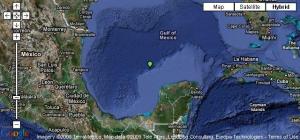
Where'd it go?
“There are two stories about how it disappeared: one is that global warming raised the sea level and it is under water,” said Mexican lawmaker Elias Cardenas, of the Convergence Party.
“The other is that … it was blown up by the CIA so that the United States would get the upper hand in Hoyos de Dona” — the oil reserves area.
Even better for conspiracy theorists, when the treaty defining oil rights in the gulf was being considered, A PAN Senator, the Chairman of the Mexican Senate Foreign Relations Committee, José Angel Conchello Dávila, was dismissed as something of a crank when he became incensed over foreign explorations in what was then acknowledged as Mexican territory, and began raising objections to the proposed moritorium on drilling. Then was killed in an unexplained auto accident.
And Bermeja disappeared. As have documents about both the treaty negotiations, like the islet itself, have sank out of sight. Although official archives appear to have been destroyed, Bejame has been described on nautical charts as early as 1570. The Biblioteca del Instituto de Geografía at UNAM, the Sociedad Mexicana de Geografía y Estadística and the Secretaría de Gobernación have historical maps that show Bermeja in Mexican waters. The Secretarías of Gobernacion, Marina and Comerico all include Bermeja on official maps. Travel Journals Net (based on 1994 CIA data) lists Bermeja as lying in the State of Yucatan.
With an estimated 22.5 billion (thousand million) barrels of oil potentially at stake, Bermeja is more than just a intriguing mystery of the sea. It’s a multi-trillion dollar buried treasure.
Snatch o’ the day
El Debate (Sinaola) — my translation:
Five men armed with pistols and rifles assaulted a resident of this city [Los Mochis] and a man from Hidalgo, who were deprived of their liberty, and relieved of a trailer carrying 11 tons of shrimp, 10 thousand pesos and two cellular telephones.

Sniff around, and maybe you'll find the missing loot. Photo: El Debate
Several truck hijackings — not just shrimp, but low value agricultural commodities like beans — have plagued northern Sinaloa lately.
Selling black market frozen shrimp requires an organization, which suggests this particular operation was put together by one of Sinaloa’s better known entrepreneurial groups. However, truck hijacking is not a particularly sophisticated crime, which also suggests that those entrepreneurs are getting desperate for quick cash.
In other words, either the cartels are either really strapped for cash, or they’re having a really big party. The former is more likely.
We didn’t do it, and we promise not to do it again
(Added later: it occurred to me that the United States expects Mexico to change — or bend — its laws to protect a couple of bankers, but is unwilling to change or bend its own laws to protect ordinary Mexican citizens in return. Maybe we can hold Banamex hostage until the U.S. does something serious about its out-of-control gun-running problem, and stop dicking people around down here).
Or, that seems to be the reasoning behind Augustin Carsten’s acceptance of the Banamex situation. As you recall, the U.S. government now owns a huge chunk of Citibank, which in turn owns Banamex. However, Mexican law clearly states that foreign governments cannot control a Mexican bank. Which, right now, they do.
Carstens is claiming this is an exception to the rule, but wants Congress to change the law, illogically claiming, “The law does not cover emergencies derived from the global crisis.”
Uh, no… the law was written to prevent another MEXICAN banking crisis like that in the 1990s, when Mexican banks had to be nationalized, then de-nationalized and sold to the highest bidders (which were usually foreign entities).
What makes Mexican banks safe is not their maddening high credit rates, nor their whimsical attitude towards “user fees”, but that investors and account holders are protected from mismanagement by a simple rule. If the bank loses money, it’s sold off. Citibank lost a shit-pile of money.
Citibank is only staying afloat because Banamex was properly managed, and has to be propped up by the United States government. So, to avoid the failure of a foreign bank, the Mexican government risks the failure of a Mexican bank (and having to invoke even more serious legal remedies) by changing existing laws to fit the kind of situation that the law was designed to prevent.
No, I don’t understand that either. Neither does Inca Kola News, which understands a lot more about banks and money than I do.
Are they serious?
The U.S. government made a big show of FINALLY going after the source of the guns that gangsters here are using to scare off the tourists…
… but what they’re not saying is that they aren’t prosecuting the people. While I’m all in favor of protecting the rights of the accused, I’ve yet to see any of these gun runners — or dealers — actually found guilty of more than minor state charges.
Milenio:
Phoenix, Arizona.- A judge yesterday threw out the penal charges against the reputed owner of a Phoenix armory, charged with providing arms to Mexican drug trafficking cartels.
Maricopa County Superior Court Judge, Robert Gottsfield, determined that the evidences presented by the prosecutor was insufficient to find the defendant guilty, based on a legal technicality.
For lack of evidence, Gottsfield declared George Iknadosian, who faced 21 counts, innocent*.
Iknadosian, 47 years old, was accused to selling more than 700 fire arms to “straw buyers”, knowing full well that the armament, including A-K 47,s were bought for narcotics traffickers in Mexico.
The “straw buyers” had plead guilty to falsely signing declarations that the weapons were for their own use at the time of the purchase, and had cooperated with the prosecution.
* I’m aware that the American legal system presumes innocence, and the judge doesn’t declare one “innocent”, but only admits you are “not guilty,” but this is the way it’s reported in our newspapers.
Eduardo Medina Mora and Fernando Francisco Gómez-Mont Urueta (the Procuraduría General de la República and Secretaría de Gobernación) are scheduled to meet with U.S. Attorney General Eric Holder and U.S. Secretary of Homeland Security Janet Napolitano next week in Cuernavaca to avoid discussing the problem.
According to a Reuters report by Randall Mikkelson (which spelled Gomez-Mont’s apellado paterno wrong, but then I tend to forget it’s one of those double-barreled names too), Napolitano and Holder will not consider any serious measures to control the U.S. arms trade:
This week, neither Holder nor Napolitano revealed any intention of offering an assault-weapons ban to their Mexican counterparts.
“I think what we’re going to do is try to enforce the laws that we have on the books,” Holder told reporters on Wednesday.
The purpose of this meeting, instead, seems to be simply justifying what the U.S. probably intends to do anyway… maintain military levels by moving resources from the unpopular intervention in Iraq, and transferring resources to the United States/Mexican border:
… officials in Washington are drawing up new contingency plans for sending military troops if needed to U.S. areas affected by drug violence.
“The only issue is at what level do we [invoke] in the worst-case scenarios, and we’re not at the worst-case scenarios yet,” she said.
The plans are expected soon, along with a more-immediate border security plan to be announced separately, Napolitano said. She said she did not expect regular military forces to be deployed to any violent scenario. Rather, she said, “the real issue is the National Guard right now.”
In other words, rather than deal with the drugs, guns and money problem the U.S. is going to inflict on border residents on the U.S. side the same “solution” that the Calderon administration has been using in Mexico. Whether on the same scale (the 4000 Mexican soldiers sent to Juarez, given the size of the Mexican army, is the equivalent to sending 41,000 soldiers to El Paso).
Whether U.S. citizens will enjoy the “security” in return for their continued support for the arms industry (and the money laundering and retail narcotics industry) and destroying legitimate business along and across the border remains to be seen.
The truth about Mexico (and the Mex Files)
I’ve slightly changed my sidebar, adding a section for “Cooperative Sites”. I sort of agonized (for maybe 15 seconds) about what to call the collection of links.
I didn’t want to come off as pretentious and claim I was writing regularly for any of these sites, or even a “contributing writer” on any regular basis. I’m not. These are sites that sometimes find posts from The Mex Files fit their editorial needs. But, I can’t commit to writing for them on any regular basis, or with any consistency. I don’t always have the luxury of writing as well as I’d like, or the energy to edit myself into grammatical coherence, so if another site finds what I’ve produced sometimes useful, I’m flattered.
I’m flattered when one of the other independent sites (and … properly attributed… the biggies) link to me, and a few do regularly, but what I mean by “Collaborative Sites” are those sites that collect posts sharing an ideology (like Truth About Mexico and Pro-Migrant), a scholarly interest (like Mexico Institute), or — like Global Voices or World Focus — are not-for-profit international news sites that depend on collaboration from from independent sites like Mex Files throughout the world.
In putting together my list of “Collaborative Sites” I added one. “The Truth About Mexico”
want[s]… to serve as a balance for the news we are hearing from the North, and to provide you, the reader, the opportunity to learn a little more about what life Mexico is REALLY like.
Something the Mex Files tries to do now and again, too.
18 de marzo de 1938

You know how hard it is to find a Oil Expropriation Day greeting card since the neo-liberal PANistas came to power?
Though the poster shows Marxist leader Vicente Lombardo Toledano, the timing of the oil expropriation depended very much on another outstanding, but overlooked, 1930s Mexican public figure, Luis María Martínez y Rodríguez, the Archbishop of Mexico City, who could find no theological reason the Mexican government could not expropriate the oil.
Cárdenas announced the take-over on a Saturday night. On Sunday morning, every Catholic Church in the country read the archbishop’s letter justifying the act…and then took up a collection to help pay off the debt!
On Monday morning, there were photographs of Mrs. Cárdenas contributing her wedding ring to the state fund to buy the oil companies. News photos and films soon featured campesinas – farm women – contributing chickens or sacks of grain, and priests blessing the offerings. It was a brilliant stroke, popular with everyone from the Catholics to the Communists…though it soon dawned on everyone that, as with Guerrero’s expulsion of the Spaniards in 1829, the country had lost critical skilled labor.
Of course, the move was not popular with the foreigners. The British acted badly, breaking off diplomatic relations. Together with the U.S. and the Netherlands, where the other companies were headquartered, the British pushed for an international boycott of Mexican oil. Cárdenas played hardball. Unable to buy supplies, or hire technicians from the old companies, the Mexicans turned to the Soviet Union and to Nazi Germany for assistance. Despite very bad diplomatic relations with the fascist countries (Germany, Italy, Spain and Japan), they were willing to buy oil.
In 1938 everyone knew that the next big war was about to begin. While the British were not nearly as dependent on Mexican oil as they were in 1914, they couldn’t hire a mercenary army like they did during the Revolution nor could they do without the oil. Cárdenas told U.S. President Franklin Roosevelt that México was quite willing to pay for the expropriated businesses as soon as a fair price could be worked out. Although the U.S. was the world’s largest oil producer at the time, so there was less sense of urgency about the coming war, it still needed Mexican imports and couldn’t endanger its supply.
Roosevelt agreed to arbitration with the Netherlands quickly joining in. The British were slower to come in, but eventually did. Because of the war (1939–45), when everyone was withholding payments on long-term debts, the repayment was delayed, but the debt and interest were paid off. Britain, the last to join in arbitration, was the last to be paid. The final checks were written in 1962.
Gods Gachupines and Gringos, © 2008, Richard Grabman


