Off the road, no thanks to the Obama Administration?
Porter Corn, at Mexico Trucker, sends along this urgent message:
At the moment, the FY09 Omnibus Appropriations” bill is being debated
in the Senate after passing the House last week. This is a
conglomeration of the normal 13 appropriations bills that are voted on
annually. This time around, the have consolidated them into one
massive “Porkulus II”
Hidden within this bills under Department of Transportation Funding is
a small paragraph (SEC 136) in another attempt to close, once and for
all, the Mexican Cross Border Pilot Program.
I have been very successful with my site http://mexicotrucker.com in
fighting the opponents of this program, exposing their agenda and the
strategy of lies and inaccurate information they use to foster fear
and opposition to the program.
The latest and final report from the DOT Office of Inspector General
has verified all that I have written on this subject, and validates
the safety and compliance of Mexican carriers operating in this
country. This program was established as part of our obligations under
NAFTA. Canadian trucks have had access under the same rules for 14
years. Mexican trucks have been denied.
Opposition has come from two groups primarily, The Teamsters and a
group called Owner Operators Independent Drivers Association (OOIDA)
All of the claims of unsafe dangerous Mexican trucks have been
debunked by the OIG report, yet these two groups continue to press for
it’s demise.
At present, OOIDA is broadcasting an urgent action alert. (
http://www.ooida.com/action_alerts/2009/022709.htm ) once more.
One of their stations, the host is actually crying (tears) and
pleading his listeners to call Congress and urge them to keep this
section in the bill. In his words, “if this passes, it will be the end
of the United States as we know it. And I love my country”
And the morons buy it.
I’m not going to go into a long discussion here. In a nutshell, the
OIG report shows the Mexican carriers in the program are in
compliance, have a lower out of service rate than American carriers (a
safety thing) and in the past 18 months of the program, have had ZERO
ACCIDENTS and ZERO MAJOR SAFETY VIOLATIONS.
The opposition has used the immigration debate to stir up opposition
to this program. Indeed FAIR, in it’s 2009 Plan of Action against our
efforts at CIR, lists STOP THE MEXICAN TRUCK PROGRAM as one of their
issues.
These trucks, this program has absolutely nothing to do with
Immigration nor the debate. It is about commerce and our obligations
under a treaty we willingly entered into.
The program is slated to run for another 18 months to collect data in
which a determination can be made if these trucks are capable of
operating in our environment.
I need all of you to send out an alert on your action lists, emails
lists ecetera,, to please call both of your Senators today and next
week to tell them and their staff that you oppose Section 136 of the
omnibus appropriations bill and support continuation of the
crossborder trucking pilot program.
To contact the 2 Senators from your state, call the U.S. Capitol
switchboard at (202) 224-3121, provide the operator with your home
state and they will connect you with the appropriate offices.
You can also use the same number to contact your Representatives as
the bill will go back to committee for reconciliation.
There is opposition to this in the Senate, but not enough. The White
House has indicated that they may send a letter urging the Senators to
remove this Section 136 from the bill, citing our treaty obligations
under NAFTA.
The US Chamber of Commerce and more than 700 US companies support this
action and this program.
WHAT HAPPENS IF IT PASSES?
In 1994 after being denied access to the US, went before the NAFTA
arbitration panel where they won their case. The US was told it must
follow their treaty obligations but had the right to put in place
safety mechanisms to insure Mexico could comply with our laws. This
pilot program is that Mechanism.
IF this program is stopped, Mexico can fine the US 10,000,000 per
month until the US DOT is in compliance. They have also indicated
willingness to through up tariffs at the border on ag products. That
cost will be passed onto the American consumer.
We do not need a trade war with our third largest trading partner in
this recession, and over such an insignificant issue.
The program has not had any economic impact on American truckers nor
has it cost any American jobs.
It need to be completed and Jimmy Hoffa, OOIDA and other special
interest groups need to be reminded we are a country of “We the
People”, not a land of special interests.
Thanks folks, and I hope we can get this going. The vote could come as
early as tomorrow
!Feliz cumpleaños!
 Having a 29 February birthday does make it hard to celebrate, but La Jornada dates its beginning as Mexico’s most intelligent hell-raiser to a public fundraiser slash consciousness raiser, held in the Hotel de Mexico 29 February 1984.
The story of that first “editorial meeting” (Gabriel Garcia Marquez had to pay for a ticket like everyone else) is here.
I once described Jornada as the kind of paper where the review of last night’s baseball game includes sly references to Antonio Gramersci and where the editorials include footnotes and bibliography (the second of those statements is sometimes true), but then, it is an intellectual read.
Though — like all Mexican newspapers — high priced (10 pesos a copy), it’s always been worth the investment. It doesn’t matter if you don’t ascribe to their political persuasion. Jornada is the voice of the Mexican left and the Mexican intelligencia.
For a newspaper with no advertising, surviving twenty-five years is an accomplishment. Surviving… and thriving to the point where it now includes nine regional editions as well as the national edition… and the on-line edition which receives 73 million hits a year (in a country that supposedly doesn’t read), Jornada has become required reading for anyone interested in Mexican politics and culture.
Sunday paseo
 I spent most of the past week (when I wasn’t holed up with the aftereffects of minor dehydration*) here in Mexico City doing book bidness, so this morning, took a paseo down Paseo de la Reforma — which manages to live up to its name on Sundays from 8 until 2 in the afternoon.
While the Sunday paseo was originated in the 17th century as a means for the upper crust to show off their carriages and horses (and cruise for suitably well-set up prospective husbands for their dowered daughters), by the 19th century, the gachupine colonial show had been thoroughly Mexicanized. The Mexicans appropriated it for their own uses. In smaller communities, you will still see the girls walking around the local park clockwise and the boys counterclockwise (or is it the other way around?), doweries have little to do with it these days.
This may be the Twenty-first century, but tradition in Mexico finds a way to accommodate change. In Matamoros, nicely meshing the old gauchupine carriage trade and the Mexican courting… and maybe with an ecologically conscious bow to “American Grafitti”, the weekend paseo is by bicycle.
Foreign guidebooks like to claim Paseo de la Reforma was laid out by Emperor Maximilian, though the truth is that the path was that taken by the Emperor’s more intelligent Mexican horse from Chapultepec down to the Alameda. By the way, Time Out: Mexico City (I drafted much of the history section) has the right story, making it probably the first European guide book to get it right.
Benito Juarez — who saw the Castle as a white elephant anyway — had better things to worry about than the Emperor’s European advisors’ unfinished civic improvement projects, but Porfirio Diaz — with his own European-influenced concept of the modern city, created what was intended as a dramatic showcase of the elite and modern to tie his home in the Castle (Juarez never lived in the place) to his capital.
Diaz’ vision has largely held up, though the Parisian-styled architecture has long given way to international style. It’s continually changing, with several new buildings either recently completed (like the 222 Reforma building, proudly displaying its address in Korean… the Koreans being the latest of Mexican immigrant groups to do well and put their mark on the capital) or in progress (like the new Senate building). Incidentally, the number of cranes and building permits you see walking up Reforma sort of belie the idea that this is a failed state… failed states are not usually aren’t in the middle of a building boom). While there are some unfortunately dull 1950s era constructions (the United States Embassy, which also requires security fencing that blocks parts of the street), Paseo de la Reforma has always been a monument to modernity.
Unfortunately, in the latter half of the 20th century, modernity meant automobile traffic. Automobiles and Paseos do not mix easily. Historical monuments, were relegated to traffic islands — still impressive, but impossible to study close up and stressful to contemplate.
Except for mega protests, when some version or another of Reforma took the form of massive Paseos with banners and music and gritos — a simple paseo down the Paseo was fraught with challenges. Slightly less than a quarter of Chilangos travel by automobile. While this is a significantly higher number of people than those who in the 17th century could afford a carriage, the private auto is still not the people’s choice… and although the Mexican people are justifiably noted for their ability to adjust to incongrous inconveniences, they would just as soon let modernity accommode them.
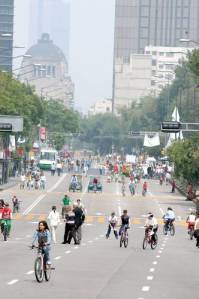 Modernity and tradition are — as they always eventually do in Mexico — converging. Sidewalks have been widened, more trees planted, and — in the areas abutting the Zona Rosa where widening the pedestrian paths elminated what had been an oasis in the median — at least an aesthetically pleasing prospect (small pyramids) — keeps the traffic and people separated.
And… on Sundays… the automobiles must accommodate the people. The main center lanes become bicycle, rollerskate, skateboard, Segway (the police travel on Segways) and pedestrian pathways. Today, besides the people watching, cruising, biking, etc. there was also free entertainment outside the Secrtariat of Social Development, courtesy of whatever group is camped in protest out front, as well as a slightly more “official” rock-n-roll band — in the modernist way –with a corporate sponsor (wish I’d taken a picture …something about an “edican” waving a big flag reading “Bimbo” that’s photogenic), freebie aerobics lessons and bike repair.
The Paseo… and the traditional weekend “paseo” … is moving into the next stage… that of enlightenment and higher consciousness. The park benches are meant not just as a convenience, but as a means of developing an aesthetic sensibility, a connection between the people and the city.

The kiosks display poems

Taking the park bench to new level(s)
* I should have known better, having lived in DF for several years. But, having been at sea level for the last year, my “fergetter” kicked in, and I just forgot that the harder work the body does at high altitude (combined with aging) and the high and dry climate can take a lot out of you. Literally. The only thing to do is sit on the crapper, down a couple of liters of water and wait for everything to pass. It will. Or, rather, stop.
Rescue me … Citibank and Banamex
Here’s a story you probably WON’T read north of the border.
Mexican banks can be (and are, except for Banorte) foreign owned, but foreign governments cannot be shareholders. So, what happens when — under the latest rescue plan (#3 in a series of ??) — the United States government becomes a shareholder in Citibank, whose only profitable unit right now is Banamex?
Citibank and the United States government are going through contortions to claim they’re not nationalizing the bank and Citibank is having to deny that they’ll be forced to sell off their only profitable unit so they can get the cash to keep operating.
The PRI senses a political opportunity in this, ahead of next years elections when they’re expected to return to their former position as majority party, based on growing dissent not just from the Calderon Administration’s bungled “War on Drugs” , but on issues like this, where the present administration is tarred with being too accommodating to foreign — specificially U.S. — interests. Attacking the big banks is usually the PRD’s issue (its one of those things that won Andres Manuel Lopez Obrador a national following), but here the PRI can defend a big Mexican insitution (Banamex) with the added bonus of tapping into the always crowd-pleasing anti-gringo nationalism.
Rites of Spring (Break) warnings
The U.S. State Department issues its annual warning against Spring Break in Mexico, the Mexican Attorney General issues his, and Guanabee offers theirs:
· Shouting “Arriba arriba!” or “Qué paaaasa, Mexico!?” at random passersby will not make you any friends.
· Drinking yourself into a state of belligerent idiocy is probably a good way to meet American girls, but not such a good way to keep your ass from getting beaten.
· If you insist on beads, foam parties and giant sequined sombreros, you forfeit all rights to be taken seriously. Hooting, whistling and wadded up newspaper thrown at your head may all occur, but don’t say we didn’t warn you.
· If a man in a dark alley beckons to you, it is not going to be “a cultural experience.” Walk away.
· So we support drugs and sex in theory (at least, we’ve heard they’re pretty fun?) but really, listen to your government- stay away from drugs and hookers. You’re already out of your element just by being in a foreign country, no need to go skipping into the seedy, ungoverned underbelly.
· No demands to see “the donkey show.” Just…no.
Mexfile’s annual warning…

If you can’t beat ’em… sponsor ’em
Maria Gallucci, writes in The (Mexico City) News about one small way the Mexico City administration continues to turn our pre-conceived notions of crime and punishment on their heads. Don’t punish what really isn’t in need of punishment:
Standing outside Estadio Azteca in Mexico City, Méndez Rodríguez shakes a can of gold paint and puts his finger to the trigger. He stomps out his cigarette, points the can at a barrier and sprays the word “Spat” – his tag.
Police officers are close at hand, but the 19-year-old “grafitero” pays them no mind. After all, it was the police department who invited him here.
Rodríguez is one of 450 young graffiti artists who participated in the city´s second Mega Graffiti Exhibition last weekend. As part of the event, the city´s Public Safety Secretariat, or SSP-DF, encouraged high school-age artists to spray-paint their way to cash prizes, asking the teens to cover the stadium´s exterior walls with colorful murals and designs.
The Federal District attempted to criminalize the graffiteros after former New York City Mayor Rudolph Giuliani and his “Giuliani Group” managed to get Mexico City businessmen to pony up 4.3 million U.S. dollars to come up with various anti-crime suggestions. I remember Giuliani touring Tepito in an armored anti-personnel vehicle, and… not doing a heck of a lot else. He didn’t even seem to understand the legal structure or the police bureaucracy, confusing federal and district police responsibilities and not knowing the difference between preventative and investigative police agencies.
But… rather than admit they pissed away the money, the “powers that be” did try adopting some of Giuliani’s “zero tolerance” policies… which basically made being poor and/or young criminal offenses. Somehow graffiti — which I do think is vandalism when done without the consent of the property owner (who has rights to what appears on his or her walls) — was, in itself, a gateway to criminality. Please… it’s a gateway to, one hopes, an appreciation for the fine arts. What criminals come from the graffitero class? Art thieves? Forgers?
The city wants to channel its young talent and give the youth viable forms of self-expression, SSP-DF official Nora Frias Melgosa said. Last year, the graffiti unit commissioned 7,000 high schoolers in Mexico City to paint murals in designated spaces, she said.
Othón Sánchez Cruz, the police department´s director of institutional prevention programs, said the graffiti exhibition brings kids who would normally run from the police together with the authorities, providing a context in which the painters can be encouraged to reject vandalism in favor of more positive expressions.
Mexican businessmen are getting smarter. “To help accomplish the task, Comex S.A., Mexico´s largest paint producer, provided 13,000 cans of spray-paint and 2,500 liters of traditional paint to participants.”
One for our side!
From the New York Times:
WASHINGTON — A federal identity-theft law that has become a favorite tool of the government in immigration prosecutions appeared imperiled on Wednesday after the Supreme Court heard arguments about it.
Prosecutors have relied on the law to seek or threaten two-year sentence extensions in immigration cases against people who used fake Social Security numbers that turned out to belong to real people.
The case, Flores-Figueroa v. United States, No. 08-108, turns on whether a person using a false social security number KNOWINGLY used that belonging to another person. Besides its implications for undercutting one of the more common — and egregious methods — of applying criminal law to unregistered alien cases (which are a matter of administrative, not criminal, law):
After nearly 400 illegal immigrants were arrested in May in a raid at a meatpacking plant in Postville, Iowa, prosecutors brought identity-theft charges against about 270 of them who were found to have used identity information, like Social Security numbers, that corresponded to other real people and were not simply fabrications.
The Iowa criminal prosecutions were an abrupt departure from past immigration enforcement practice, in which illegal work cases had generally been handled under civil law.
Prosecutors used the charges to pressure the immigrants both to plead guilty to lesser charges of document fraud and to agree to summary deportation, waiving their immigration rights. Almost all the immigrants did, and they have served their sentences and been deported.
But a court interpreter who worked in the hearings, Prof. Erik Camayd-Freixas of Florida International University, later broke his professional silence. He testified before Congress that most of the immigrants for whom he translated, many from Guatemala, did not know what a Social Security card was or whether the numbers they used at the Postville plant belonged to other people.
There is a Mexfiles connection to this. The laptop I’m writing this on (at the famous Cafelibría el Péndulo — located somewhat fittingly for a literary cafe on calle Alexandro Dumas in Polanco) was formerly owned by the defense attorney quoted in the New York Times article, Kevin Russell. Kevin, in the loose Mexican way of determining things, would count as a relation… the boyfriend of a niece who can be persuasive when convincing guys they have too much electronic stuff around that could be put to other use.
Good work Kevin!
Money and manners: Stanford
Reporting last Thursday (19-February) on what promises to be a theft along the lines of fifty billion U.S. dollars, Justin Rood and Brian Ross of ABC News report:
Offshore banking experts say that the fraud charges this week against accused financial scammer R. Allen Stanford have been a long time coming.
Authorities claim billionaire investor R. Allen Stanford may rival Madoff.
“There’s no surprise at all,” said Washington lawyer and IRS consultant Jack Blum. “This man has been on law enforcement’s radar screen for the better part of 10 years.”
But the SEC didn’t move forward until this week …
Perhaps there was a rationale for the U.S. Securities and Exchange Commission not acting until last week, but a lot of investors lost their shirts (some, as Bina notes, deservedly ), and more would have been hurt had it not been for the real heroes in all this — Alex Dalmady and Otto Rock, of “Inca Kola News”.
It wasn’t the Securities and Exchange Commission, it wasn’t the United States Senate, it wasn’t the Treasury, the Attorney General or the mainstream media that discovered the fraud… it was a wonky Venezuelan financial blogger, double-checked by the pseudonymous Peruvian mining stock analyst (who tells everyone who asks about investments, “do your own due diligence, dude”) to realize the enormity of the disaster.
And disaster it was … had Alex and “Otto” not written what they did, more money would have been lost. Sure, I can understand Bina’s schaudenfreud at the thought of rich Venezuelan tax evaders screwing themselves, but – as Otto noted – “I’m already hearing stories about people with their life savings with Stanford that may have lost everything.” And, like it or not, those people who lost everything were usually employers. A lot of people who had nothing to do with Stanford, with avoid Venezuelan tax authorities, or anything else, are also screwed.
I would prefer to chalk it up to boorish provincialism, but the failure of most media outlets and officials in the United States (with the exception of Mick Weinstein of Yahoo Finance ) isn’t all that surprising. The U.S. ignores what happens outside its borders anyway. Even Weinstein only credited “bloggers”, leaving the impression that the Texas based scandal was uncovered by out-of-work U.S. journalists, not by Latin Americans.
Although some of the financial press has mentioned the extreme fallout in Venezuela (sort of hoping, it seems, that it will reflect badly on Hugo Chavez ), the only mention of Latin Americans in this whole mess seems to be in connection with allegations that Stanford was laundering money for some of the Mexican narcotics cartels (which wouldn’t surprise me in the least – I expect Citibank, and Bank of America, and HSBC and most investment houses have at least some “dirty” money floating around).
And, there was only the barest mention of Mexican investors for one good reason. Although, as Bloomberg’s Laurel Brubaker Calkins reported yesterday
Two Mexican investors asked a U.S. judge for permission to sue R. Allen Stanford and his companies in Mexico after federal regulators accused the Texas financier of orchestrating an $8 billion fraud.
David Quintos and Diana Dimitiova told U.S. District Judge David Godbey in Dallas that they want to try to recover investment losses under Mexican securities laws. Mexico’s laws provide broader investor protections than U.S. laws, including the rights to sue for legal fees and “moral damages,” lawyer Randy Pulman said in a motion filed yesterday.
“It is hard to see how counsel for the government of the U.S. can simultaneously represent the interests of U.S. citizens and foreign nationals in this case,” Pulman wrote on behalf of the Mexican investors.
Please note the bold-face. Investors like Quintos and Dimitova invested in U.S. or Antiguan securities, which – if they were sold in Mexico – was in violation of the country’s securities laws . As it is, Guillermo Babatz, President of the Comisión Nacional Bancaria y de Valores (the Mexican Securities oversight agency), said the Commission has opened an investigation into whether or not Stanford offered these investments in Mexico, and whether they were sold through the Mexican subsidiary.
Forty percent of Mexican investors have demanded their money from Stanford Fondos. In theory, the Mexican bank should have the assets to meet its obligations.. But the fear among those investors, and among Mexicans like Quintos and Dimitova, is that their funds (even among saavy investors who were not misled into investing in U.S. or Antiguan securities) may have already been transferred (illegally, of course) to the other countries, both notoriously lax when it comes to oversight and regulatory discipline. And, of course, as Alex and Otto can tell you (though both are too modest and “buen educado” to bring it up), the investors rightly suspect Latin Americans are just not taken seriously in the world of finance. Or the law.
Armed and gassy…
I got a kick out of the statement that “agriculture is being eyed by criminal elements in [northern Sinaloa]”. Well some crops, yeah. Marijuana, poppies and… beans.
Agricultural business owners in the northwestern state of Sinaloa demanded the intervention of judicial officials on Monday after heavily armed bandits stole nearly 40 tons of beans, the third such heist in under two weeks.
The latest lift took place at a warehouse in the municipality of Guamúchil early Sunday morning.
El Universal reported that the bandits had overpowered two truck drivers and a night watchman, and loaded up two tractor trailers with more than 1,000 sacks of beans.
We gotta?
This weekend the Wall Street Journal has a long story on the Drug War in Mexico (see here). Murder, torture (some gruesome cases are mentioned), turf battles, extortion, kidnappings, and corruption are up, and in some areas civil society is on the verge of collapse.
… writes Mark Bauerlein, a professor of English at Emory University, in the Chronicle of Higher Education. Bauerlein missed some of the more obvious problems with the Wall Street Journal article (where is “Tepitoto” for example? And why did he find it remarkable that cruising a poor neighborhood in an armoured Jeep — with no license plates, and in the company of a police officer — drew some rude remarks from teenagers? Not to mention throwing together misleading facts (saying eight percent of Mexican “counties” — supposedly he means “municipios” — have narcos in them is like saying eight percent of U.S. counties have some gangsters… with no mention of the population of these “counties”, nor of the amount of “corruption” involved. Is every “county” employee working for gangsters, or are there just some gangsters known to sometimes be in the “country”. Or does the Wall Street Journal have a clue what they are talking about?
Still, he caught the biggest error in the reportage of what used to be, once upon a time, a respectable business newspaper.
Only at the very end of the essay do we get the plain and simple fact at the root of it all: ““Demand in the U.S., of course, is the motor for the drugs trade.”
But do the U.S. officials quoted in the article recognize that fact? Never. Here is what the article says about U.S. response to the crackdown:
“The U.S., which is providing Mexico with some $400 million [!] a year for equipment and training to combat drug traffickers, backs Mexico’s stand. U.S. law enforcement officials are ecstatic about Mr. Calderon’s get-tough approach.”
Nice to see that U.S. officials are happy, and the taxpayers pump $400 million annually into the policy.
And what do the U.S. officials say about the violence?
“A U.S. law enforcement official says the Mexican military is trying to break down powerful drug cartels into smaller and more manageable drug gangs, like ‘breaking down boulders into pebbles.’ He adds: ‘It might be bloody, it might be ugly, but it has to be done.’”
So there you are, brilliant and firm—a rock-crushing strategy with lots of blood and guts, but we gotta do it. We just gotta.
We… in Mexico… gotta? I don’t think so.
Slouching towards Chiapas
I spent one night in Guanajuato (which, despite what norteños and Spanish teachers tell you, is pronounced Hwa-na-WHA-to) and a couple of hours in San Miguel de Allende, but both are already well known from the tourist websites to require much description here.
Guanajuato is full of students — and tourists — as always, and every downtown plaza (which are legion.. it’s a city of plazas attached to plazas, which are downstairs from… more plazas) had some entertainment going on. Being a UNESCO cultural site, and well-preserved from its glory days in the 18th century (when it was the richest city in the Americas, thanks to mining), there aren’t the 21st century cultural clues (like neon signs) to tip you off, so finding something like an Oxxo store is a slight challenge, but that’s the price you pay for eschewing progress, I guess.
I realized that with one appointment in Guanajuato, and a couple in San Miguel (which has a compact center, the better to let the gringos pretend they’re in a Mexican “village”), it made more sense to stay in Guanajuato than in the overpriced “village.” There are plenty of cheap hotels in the college town/state capital, but anything reasonable in San Miguel is going to be a youth hostel. And … as has been less than kindly pointed out to me… I ain’t a youth anymore.
I get a little confused by 18th century streets and plazas, but was staying across from the Borda family joint (the Bordas being the mining family that skewed the statistics of 18th century America enough to make Guanajato so much richer than any other community). Jose de Borda himself started as a miner, and ended up as sort of the Carlos Slim (combined with Warren Buffet) of his era. He had a few bucks (er… reales) to toss around, and it isn’t exactly a modest family home. More like a city block… and larger than the state capital building. But then, the Bordas were probably richer than the State ever was.
My abode was a bit less impressive… but, then, it was only $150 (pesos, not dollars) a night. And, I had indoor plumbing, which I don’t think the Bordas did back in the day.
Connie Coté, of the “pun-ishingly” named “Donkey Joté” bookstore (given Guanajato’s huge student population — including those from the U.S. there for Spanish classes), it’s practically an institution in that town… less pretentious than Casa Borda, but then… a lot more useful in the 21st century. Besides, Donkey Joté carries Editorial Mazatlan books (including Gods, Gachupines and Gringos) and a good collection of new and used English-language paperbacks.
San Miguel is about an hour and a half by bus, or a couple of light years in attitude. Where Guanajuato is — like some of its famous residents — preserved, San Miguel is — like those who visit one its better known attractions — self-consciously seeks to deny the march of time. Like Puerto Vallarta (and much of downtown Mazatlan), it’s colonized by foreigners seeking to save Mexico from … Mexicans.
Oddly enough, one business owner told me that more and more the foreign residents are coming to San Miguel to avoid even contact with the “pretty” Mexico… chosing to live in new gringo ghettos outside the main city, where they can buy imported U.S. foods, pay to have U.S. furniture and appliances imported, and then complain that the Mexican prices aren’t as low as they thought they’d be. And that sometimes the “help” speaks Spanish.
Ah well… it is a good place for shopping. Zocalo Arts (which has another store in Patzcuaro) is there for those who really want Mexican crafts and arts… or books from Editorial Mazatlan.
Tecolote… the best know of the two English-language bookstores in the city (not “village”) … also carries Editorial Mazatlan books.
I was supposed to go to dinner with grinogs who tend to privately agree with my assessment of their community, but I was just too tired to do anything but sleep for a while, and it was still early enough in the afternoon that I could sleep for four hours on the bus to Mexico City. Which I did.
I won’t go into the details of what I did Friday night in Mexico City, but did realize I was just around the corner from the apartment house where Jack Kerouac turned Neil Cassady into a cultural icon (and Neil… managing to fall asleep on a railroad track… managed to make San Miguel seem “colorful”, before James Michener weighed in on the place and made it tourist-safe, too). And where William S. Burroughs shot his wife.
But, I ended up in Mexico City on a Friday night because I was beat… not because of The Beats. Though, after that nap, I did go out to a few places best left off the tourist sites. The kinds of places good Mexicans go to be bad… or very bad. But, as always… politely so.
I’ll be in Mexico City the rest of the week, heading for Chiapas this weekend.
Who’s sorry now?
I’ve always been of the mind that marijuana only became a “social problem” when it was discovered that the mostly African- and Mexican-American rural workers were being joined by urban middle-class in indulging in the habit. That, and growing it isn’t exactly something that requires much in the way of corporate investment.
So, as over the years the use has grown in the wealthy countries to the north, those in the south have been expected to tolerate miltaristic responses to a foreign social problem, wasting resources better spent on public health on police and prosecutors, and allowing an unregulated industry to spiral out of control, sometimes said to threaten the state.
Three former presidents, Fernando Enrique Cardosa (Brazil), César Gaviria (Colombia) and Dr. Ernesto Zedillo (now of Yale University, formerly President of Mexico), suggest at least an alternative approach for their own nations:
Prohibitionist policies based on eradication, interdiction and criminalization of consumption simply haven’t worked. Violence and the organized crime associated with the narcotics trade remain critical problems in our countries. Latin America remains the world’s largest exporter of cocaine and cannabis, and is fast becoming a major supplier of opium and heroin. Today, we are further than ever from the goal of eradicating drugs…
The revision of U.S.-inspired drug policies is urgent in light of the rising levels of violence and corruption associated with narcotics. The alarming power of the drug cartels is leading to a criminalization of politics and a politicization of crime. And the corruption of the judicial and political system is undermining the foundations of democracy in several Latin American countries.
The first step in the search for alternative solutions is to acknowledge the disastrous consequences of current policies. Next, we must shatter the taboos that inhibit public debate about drugs in our societies. Antinarcotic policies are firmly rooted in prejudices and fears that sometimes bear little relation to reality. The association of drugs with crime segregates addicts in closed circles where they become even more exposed to organized crime.
In order to drastically reduce the harm caused by narcotics, the long-term solution is to reduce demand for drugs in the main consumer countries. To move in this direction, it is essential to differentiate among illicit substances according to the harm they inflict on people’s health, and the harm drugs cause to the social fabric.
In this spirit, we propose a paradigm shift in drug policies based on three guiding principles: Reduce the harm caused by drugs, decrease drug consumption through education, and aggressively combat organized crime. To translate this new paradigm into action we must start by changing the status of addicts from drug buyers in the illegal market to patients cared for by the public-health system.
We also propose the careful evaluation, from a public-health standpoint, of the possibility of decriminalizing the possession of cannabis for personal use. Cannabis is by far the most widely used drug in Latin America, and we acknowledge that its consumption has an adverse impact on health. But the available empirical evidence shows that the hazards caused by cannabis are similar to the harm caused by alcohol or tobacco.


