Brain dead at CNN
Ho-hum… another “heads in ice chest” story:
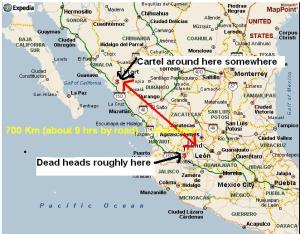
(CNN) — Five human heads were found in ice chests on Tuesday under a ficus tree in the central Mexican state of Jalisco, police said.
The grisly find appeared to be the latest indication of drug cartels fighting for supremacy in battles that have left thousands dead.
You knew they were going to get “drug cartels” into the story somehow, but in this case they really, really had to stretch a few things…
Jalisco is near the state of Sinaloa, where the Sinaloa cartel is based.
Well, yeah… the “Sinaloa Cartel” – if it’s based anywhere, is based in Culiacan, which is a city in the state of Sinaloa. It’s sort of like writing something about a poligamist in San Francisco, and saying “California is near Utah, where the Mormon Church is based.”
Hasn’t anyone at CNN ever looked at a map?
Is it safe?
Yeah, if you read the U.S. press (and, to some extent, the Mexican press too), it sounds like there’s a whole lotta killin’ goin’ on. But, it’s cops, and gangsters and those nearest and dearest to them. Not, as in other parts of the world, “ordinary people going about their business”:
(CNN) — At least 10 people were killed Tuesday in a shooting spree that spanned two small southern Alabama towns, state officials confirmed. The gunman, who turned the gun on himself, and the wife and child of a sheriff’s deputy were among those killed.
The shooting started in a neighborhood in Samson, a town of about 3,000 about 15 miles north of the Florida border, just after 4 p.m. (5 p.m. ET) and ended 12 miles away at a manufacturing plant in Geneva, said Alabama state Sen. Harri Anne Smith, who represents Geneva County.
“He was shooting at just ordinary people going about their business,” Smith told CNN, saying she had been briefed by state and local law enforcement.
Blackhawks down and talking trash
With the chair of the U.S. House Committee on Foreign Relations asking “dude, where’s the money?”, still more questions are being raised about the supposed “Merida Iniative” funding... that never was going to come to Mexico in the first place, being designed to assist U.S. businesses (and — no surprise — those businesses with a history of support for the Bush Administration).
Although I don’t think Mexico should be fighting the U.S. drug war, if it is going to do so, it will need technical assistance. But, given the propensity for the Bush administration of make promises it never intended to keep (remember the March 2007 announcement of aid to Central America?), there is no reason Mexico should wait 18 to 24 months for promised help.
Apparently, the U.S. forgets that Mexico does not HAVE to buy from the United States, nor does it need that Merida money particularly (nor, for that matter, does it have to fight this proxy “war”).
U.S. National Security Director Dennis Blair is scaring everyone, claiming the United States has a “responsiblity” to “help” Mexico in this war (for whose benefit?). Sort of like the “responsibility” Woodrow Wilson had to “help” Mexico after the spectacular failure of the Taft Administration?
I wouldn’t compare Taft to Bush II (for one thing, William Howard Taft, unlike George W. was an honorable and ethical person of proven administrative ability before he came to the White House. For another, the Taft Administration was reformist when it came to domestic issues), but I have compared Obama to Woodrow Wilson. Both have this sense that the United States MUST have a role in Latin America, wanted or not… and that they have the right to implement change. With a Secretary of State like Hillary (“What good’s an Army if you don’t use it?”) Clinton, it’s no wonder Felipe Calderon is tripping all over himself this week to claim that “support” from the U.S. military does not mean “intervention”. Uh… sure.
 Interesting enough, I found Calderon’s statement in the Veracruz edition of Milenio, not in the national edition. Veracruz may be a little more sensitive to U.S. “intrusion” … (that’s the word used on the Naval Museum exhibit about the 1914 U.S. invasion), memorializing it — especially Teniente Jose Azueta who did not quite appreciate the “help”.
The Naval Museum — of course — also includes exhibits on the various French invasions (in 1838 and 1862). The French can act like real dickheads, but they’ve learned a few things from their own — and Mexican — history. The two French invasions were justified (by the French) on the grounds that they were owed money. That makes sense to Mexicans. Business is business. As long as the Mexicans are willing buyers, and the French willing sellers, and nobody’s pointing a gun at anyone else, everyone can get along just fine.
French President Nicolas Sarkozy has been here on a sales trip, taking orders for investigative technology (probably including heliocopters, something promised by the Bush Administration but due for delivery the manana after manana.. if then). Incidentally, Sarkozy also met with Mexico City’s Jefe de Gobierno, Marcello Ebrard to talk trash…. literally. Mexico City has a solid waste disposal problem, and the French have engineering experience and equipment to sell.
Co-dependent no more?
As Inca Kola, Bo Rev and others are beginning to notice, Latin America is rapidly losing patience with the addict north of the Rio Bravo/Rio Grande River.
Inca nicely captures the problem we face in Latin America, by quoting from a short article on addiction and treatment:
The principal obstacles to recovery from any addiction are ignorance, shame, dishonesty, and personal exceptionalism..
On the latter, the author, Floyd P. Garrett, M.D., writes:
Addictive rationalizations and justifications usually involve both denial or minimization of the actual negative consequences of the addictive behavior together with a displacement of responsibility for it.
I was raised in the New York State wine country, and my father made his living supplying the wineries. No one would blame liquor stores, let alone wineries… or grape growers, or the manufacturer of the pipes and valves my father sold for alcoholism. Yet, U.S. exceptionalism seems to blame others… the growers and suppliers… for their own addictions.
Worse, especially for Mexico, is the assumption that those others — the Mexican people — should shoulder the burden of the addictive behavior of their neighbor. Why should a thousand people … even if they are mostly gangsters and cops (often the same thing)… die in Mexico because the U.S. cannot control it’s own problems?
I hate to say it, but the United States needs a 12-Step Program. It is powerless over it’s addictions, but is unwilling to admit it. It has not done an inventory of those who are harmed by their actions, nor are the willing to make amends. Until such time, maybe the best, and kindest, thing to do is for the Latin American nations to adopt the Al-Anon program:
“David P.”, talking about his wife’s particular addiction (alcoholism) writes:
Each person has the right to experience the consequences of his or her own actions, and I denied my wife that right. Al-Anon explained to me that my wife has her own Higher Power, and it’s not me. I was not responsible for her recovery.
Grain growers, distilleries, breweries, the corner convenience store… none are responsible for Mrs. P’s alcoholism. Colombian farmers, Chapo Guzman, small time pot salesmen are not the “higher power” of the world’s most powerful nation. Or, at least they shouldn’t be. They are not responsible for the U.S. national addiction.
Should we, in Latin America, be doing anything other than perhaps showing our concern for the still suffering addict among the family of nations? Perhaps we need to reign in our unlicensed agricultural exporters, perhaps not (what other source of rural development funds are there?). Whatever Latin American nations do or do not do , they are not responsible for the recovery of the United States.
The United States may not want to recover… and that’s its right. But — then — the best thing to do is let it “experience the consequences” of its own actions. The choice for Latin America is simple. Continue to act as the proxy… or rather… co-dependent of the big addict, or force the addict to clean up their own messes. If that means letting the gangsters kill police chiefs in Phoenix and Detroit and Des Moines or lobbing disembodied heads into CNN headquarters… all the better.
Just don’t expect Mexico… or Colombia, or Bolivia, or anywhere else, to take responsibility for the problem. Or continue paying the price.
No place like home
In most of the world nowadays, anything related to mortgage is synonymous with high risk. Mortgages in Mexico are an opportunity for economic growth and social development. And I think that if anything, Mexico is not only prepared to confront the current crisis but also jumpstart the economy in harsh times.
Mexico’s mortgage solution, “The World” (Public Radio International, BBC, WGBH), via Mexico Today . It surprises people that Mexicans aren’t faced with a homeowner’s crisis… but then, in Mexico, a home is NOT an investment, but a place to live in. It is a basic human right.
Article 123 (Section A, paragraph XXX) of the Mexican Constitution mandates “cooperative societies established for the construction of low-cost and hygienic houses to be purchased on installments by workers, shall be considered of social utility.” Other articles require local governments to define what constitutes a dignified and hygenic home, and protect the homeowner from losing their property.
Does everyone in Mexico live in dignified and hygenic surroundings? Of course not, but the State is obliged to do its damndest to get everyone a livable place. This is the real reason the idea of a “mortgage crisis” doesn’t make any sense. In the United States, people think a house is an investment, and are shocked when their investment loses money… in Mexico, a house … hopefully one that is dignified and hygenic… is where you live.
The mota in thine own eye
OUCH! It must be the cosmic convergence if Felipe Calderon, the Mex Files and God himself (or… His official mouthpiece here in Mexico, anyway) are all singing from the same hymnal.
The lead editorial in the official Mexico City Archdiocesan weekly, Desde la Fe (not updated regularly on-line), rejects United States claims that it wants to “save Mexicans from drug trafficking”, calling such claims “hypocrisy and double morality”.
Desde la Fe doubts the U.S. has any intention of confronting what the Church publication calls the “addict culture”, while the country does absolutely nothing to control arms trafficking, nor makes any attempt to restrain the free flow of financial resources to the Mexican cartels.
“It seems that [the United States] wishes to preserve a society fed on drugs and arms,” the Church publication writes, adding that the United States needs to develop its own anti-corruption program, before listening to “vain and illogical” people within the United States military community.
The Archdiocesis openly questions the motives of “a country with the most sophisticated antiterrorist technology, as well as the latest in anti-drug trafficking tools techniques and tools” in offering to help its neighboring country while unable — or unwilling — to control its his own territory, “as evidenced by the abysmal transit of drug and the flow of money used in the these transactions.”

Yucatan … another Mexico
The last leg of my “gringo ghetto blaster tour” was to the Yucatan. As Jim Fields, of Yucatan Living was careful to tell me, “The Yucatan is different from the rest of Mexico.” Historically, and culturally, quite true.
First off, it’s Mayan, and
México has been more or less synonymous with the Náhuatl-speaking, or Náhuatl-dominated, peoples north of the Isthmus of Tehuanatepec. The Mayan territories… include the Yucatán Peninsula.
Secondly, it has a very different political history.
Yucatecas staged violent uprisings and almost succeeded in taking over the peninsula in 1847 and 1860…
During those various Yucateca uprisings, by the way, the “ladinos” (the non-Mayan over-class) was quite willing to sell out to the British, the French or the United States to maintain control… or rather, maintain the apartheid system (“Indians” and everybody else) and the medieval serfdom that lingered there until the Revolution, and — in some sense — beyond.
It was only with the Mexican Revolution of the early 20th century and with the recent spectacular growth of tourism on the Yucatán Peninsula (Quintanao Roo – whose largest city is Cancún – has only been a state since 1974) that Mayan political and economic needs and aspirations were recognized.
 Mexpats often adopt not Mexico, but their “chica patria” as the center of the universe. Jim is no exception. If he had one criticism of my book, it was that I glossed over a major figure in the Peninsula’s history. Felipe Carillo Puerto. Until Carillo Puerto became Revolutionary governor,
By law, indigenes – mostly Mayans – still could not walk on the sidewalks in Yucatán. Much of the barbarity in Kenneth Turner’s Barbarous Mexico had occurred on Yucatán haciendas, which mostly grew henequen – a variety of agave – or sisal – yet another variety of agave – both raw materials for making rope before nylon was invented. There, a coalition of leftist intellectuals, Mayans and feminists gook control under Governor Felipe Carillo Puerto. They collectivized the land and processing plants, and Mayans, for the first time, were brought into the government. Furthermore, Carillo Puerto pushed through voting rights for women, and brought radical feminists into his cabinet.
Getting Crillo Puerto killed for his troubles. Jim claims Obregon done it, but I’m not so sure it wasn’t just the old entrenched “powers that be” that offed the one great Revolutionary figure from the Peninsula.
Still, Jim’s point is well-taken. The Yucatan is its own political and social world. And… thanks in large part to saavy tourism marketing, we often think places like Chichen Itza or Tulum — not to mention Cancun ARE “typically” Mexican… and we often think of Mexico as a lush tropical country (rather than the semi-arid ruggedly mountain country it most is) because of the Peninsula.
The Peninsula definitely is part of the “real Mexico” … Yucatecas and Yucatecos are — thanks to people like Carillo Puerto — part of the Mexican whole. Indeed, the first “modern” Mexicans were from the Yucatan. Gonzalo Guerrero, a shipwrecked Spanish sailor turned down his chance to be “rescued” by Hernan Cortes in 1519. Guerrero was the first foreigner to go Mexican. He married the local chief’s daughter, gave himself a “border promotion” from able-bodied seaman to naval advisor and fathered the first mestizos we know of. If that’s not “typically Mexican” I don’t know what is.
Guerrero is Mexican, though Jim will tell you he’s Yucateco, and that’s not the same thing.
(quotes, of course, from Gods, Gauchupines and Gringos: A People’s History of Mexico, © 2008 Richard Grabman)
A cranky stop on the Ruta Maya
San Cristobal de las Casas is a very, very weird place.
 The sizable gringo (the North American variety) population in San Cristobal de las Casas … like the denizens of all other gringo enclaves… will tell you there is something “magical and different” about San Cristobal.
After Oaxaca (where Editorial Matzaltan books, including Gods, Gachupines and Gringos are sold by Amate Books), I spent a day in San Cristobal. La Pared in San Cristobal is quite a good bookstore (and also carries Editorial Mazatlan books). Those on the “Ruta Maya” trail are encouraged to stop.
San Cristobal has a lot to offer tourists, but I really wasn’t planning to say very long. As to being “magical” or “unique”, I’m convinced that’s in the eye of the beholder… or, perhaps more realistically, in the brochure of the promoter.
Its charm for the U.S. gringos is that not being near an airport — or much of anything really — you actually have to do some work to get there.
Once there, you either sell real estate, or you reinvent yourself as a “free spirit” and artist. Given our propensity to believe that indigenous peoples somehow possess some secret wisdom the rest of us forgot, never mind that the indigenous people have been treated like dirt for the last half millenium. Having them around makes it seem like you’re one with the ages… or can claim the Tzotzil cleaning lady is your friend, the “indian.” And, you can drop a few French phrases and sound wordly. And… Chiapas having been left behind by the Mexican Revolution, you can live out that fantasy of being a great white colonial at a fraction of the cost of, say, San Miguel de Allende.
And, while the Mexican south has always attracted more European tourists than the rest of Mexico, there’s something distinctly odd about a town best known for having been the center of an uprising against foreigners and outsiders becoming… in a very short time… a mecca for those foreigners as a result.
In their native costume (based on the San Cristobal sampling, this consists of dirty, rumpled tee-shirts and shorts, mixed with scarves from the local market covering unwashed dreadlocks) they travel in packs crowding the indigenous Tzotzil, Tzeltel and Chontal people out of the downtown area — as per the tradition of their European oppressor ancestors.
What the locals make of the exotic contemporary foreigners I can’t say. But, the locals weren’t shoving their cameras into the faces of the colorful visitors, nor taking photos of them doing everything but taking a dump. Though, maybe issuing a few cameras might be the way to touch off the “real” revolution.
I’d never been in a Mexican town where it was hard to find Mexican businesses… every third building seemed to be a hostel for grubby European backpackers, a cafe (for grubby European backpackers) or a den of internet-iquity (for grubby European bloggers).
At La Pared, the English language bookstore (which ALSO carries Editorial Mazatlan books), I was clued in. The children of the European bourgois revolutionaries (those Italians who voted Communist, just because the Christian Democrats were hopelessly incompetent and corrupt, for example) have the luxury — and arrogance — to “take the revolution” to the people. As long as it’s not their own people.
Given the way the Italian and French tourists treat the locals, I’d hate to see how they treat their own Romas, Albanians, Africans. Ah well… one must cater to one’s market.

Photo: "Josepatu", http://www.flickr.com/photos/pepel/2618180144/
And those Zapatistas are so darn cute!
And these jokers want to “help” Latin America?
“We can make a person disappear,” a high-level ICE official told the audience at the 2008 Police Foundation conference. Jaws dropped. ICE is the Homeland Security agency in charge of deporting immigrants from the nation’s interior. The spokesman was alluding to ICE’s extraordinary powers under civil immigration law. Although “civil” sounds less serious than “criminal,” civil immigration law has fewer constitutional protections than criminal law. Civil immigtion arrests can happen without probable cause of a crime; the arrestee facraes trial without a public defender; and there’s no statute of limitations.
Disappearances would seem to still be official U.S. policy, something we have enough experience in down here. Thank you very much.
When it comes to the U.S. “disaperacados” Nezua writes:
… we have but weak and startled declarations of ignorance by Secretary of Homeland Security Janet Napolitano and silence from the Oval Office. Public News Service reports on the many human beings are “living in limbo“as they wait for the Obama administration to push forward on immigration reform. Even President Obama’s Aunt Zeituni is facing deportation. In an interview with Katie Couric on Nov. 2, 2008, Obama deflected the issue by claiming he hasn’t “been able to be in touch with her” but that immigration laws, “have to be obeyed.”
I don’t know where people got the idea that a change in administration (and electing a Labrador Retriever would have been an improvement in the presidency over the last guy) was going to lead to change in a system in which all the political parties (both of them… the Wall Street Party and the Other Wall Street Party) backed a bad idea like the PATRIOT Act and creating a gestapo-like bureaucracy like Homeland Security.
Banamex… Tzotzil for WTF??
Being on the road, I’m afraid my only real connection with the world of banking and finance lately has been trying to locate Santander ATMs in bus stations, and — in San Cristobal — standing in line with all the Tzotzil ladies who were in the “no account” line (I had a check from another bank to cash). I don’t know a word of Tzotzil, but the language seems to have a rather extensive vocabulary for dealing with banks that have only one teller for the longest line of customers.
But, the big news out of Mexico — making a nice change from the usual “narcos behead another couple narcos and U.S. State Department craps its panties” has been the Banamex-Citibank story. To review, the non-socialist United States government is buying a chunk of Citibank, basically to preserve the jobs and reputation of the guys who lost everybody’s money.
Citibank owns Banamex. Semi-socialist Mexico does not allow foreign governments to control its banking industry. SO…. while Citibank has been spinning tales of how the rules don’t apply to them (I guess they’re right, in that the U.S. government is willing to bend the rules of capitalism to benefit the capitalists).
Not so, say the Mexicans. We don’t need no stinkin’ foreign government control. They’ve been there, done that. And, no one believes anything said by the Citibank executives these days anyway. The Banamex executives are already jumping ship to other banks.
FiNETEK, a Latin/Asian financial site, reports that while the likeliest Banamex buyer, Brazilian banking giant, Banco Itau is claiming it is not negotiating to buy Banamex. More interesting, IXE, a Mexican group with good ties to the Calderon Administration (and partially owned by the Slim family) is trying to put together a deal whereby Mexican investors would put up 30 percent of the buying price, with the rest of the funds coming from government loans… or from funds raised on the Mexico City Bolsa… or a combination of both… a sneaky way for the “capitalist” Calderon Administration to re-nationalize Banamex.
While you’re scratching your head over the difference between a capitalist government in a socialist country nationalizing a bank, and the quasi-socialist administration in a capitalist one doing the same thing, you can keep up with the lastest twists and turns at Inca Kola News.
Personally, I think Tzotzil is probably easier to understand.
Economic meltdown… priceless!
I only half-caught this story on a One A.M. re-broadcast of Noticieros con Joaquin Lopez Doriga (sort of the Dan Rather of Televisa). While it´s refreshing to see neo-colonialist pond scum at least speak the native language with some fluency, it´s a lot more fun to watch him flounder, make excuses… and hang up on his interviewer. And… having it broadcast to the nation… PRICELESS!
http://video.esmas.com/noticias/se-complica-el-caso-stanford/4/39114#canal_video
I meant to upload this clip to youtube, so I could post it here, and will when I have my laptop with me. Long story, but I had only expected to be in Oaxaca for the morning, and already checked out of my hotel, but ended up here all day. Rather than cart books, laptop and the goods and chattels one carries on the road, I rented a room in the cheapest hotel I could find, and … well… the laptop´s in the hotel of no-repute (and no wireless connections) and I´m in a hot zone, working out of an internet cafe surrounded by Benito Juarez Autonomous University students (undoubtedly planning the overthrow of the local government… or not. If there are ¨signs of discontent just below the surface¨as every right’-on foreigner writes about this city, those signs are way, way below the surface. Not that there isn´t political repression… just that it isn´t at the top of anyone´s agenda right now. Economic survival is).


