Secret Agent Man: Sherburne Hopkins
The best secret agents have the best covers. Who would ever believe that Mexico’s “Agent #1” was a WASP attorney at a Washington law firm?
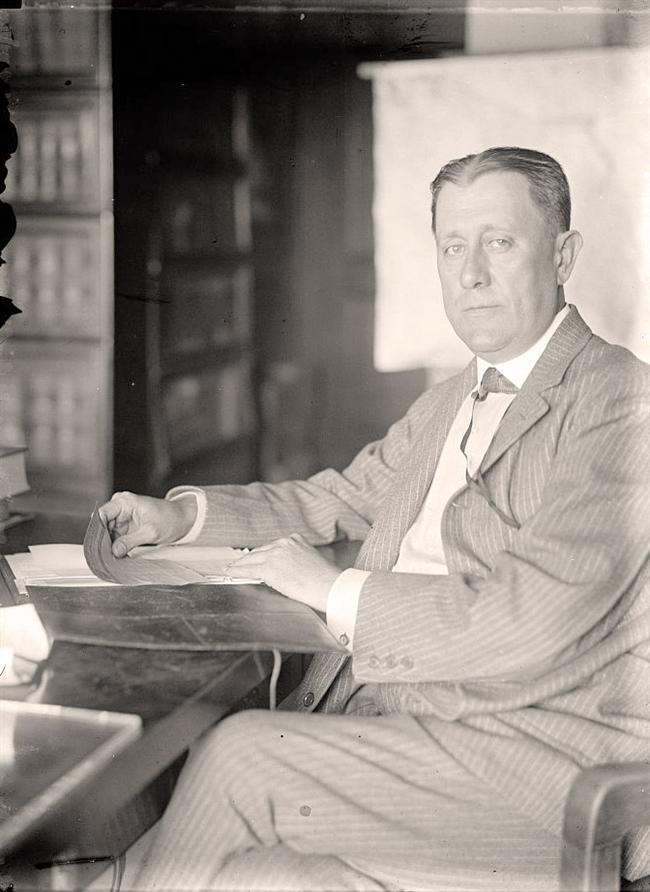 Sherburne Gillette Hopkins was born (1869) into the Washington establishment, and grew up being groomed for his eventual role as partner in the top-shoe law firm of Hopkins and Hopkins. Despite enjoying a more than adequate income for not particularly daunting tasks — or as Mexican historian Alejandro Rojas (“Dólares y armas” Relatos e historías en México, February 2009) or because he found the political and social stability of the United States stupefyingly dull — Sherburne Hopkins nurtured a special fondness for rebellion.
His 1891 involvement in gun-running to Chilean rebels might have been chalked up to “youthful indiscretion”, but following his service in Cuba as a Marine Corps officer during the Spanish-American War of 1898, Sherburne developed a serious interest in Latin American politics and – for an establishment lawyer – a strange affinity for overthrowing the establishment….in other countries.
While today, law firms representing foreign interests are required to register as such, then – as now – such work is bread and butter for Washington firms. There was nothing particularly unusual in Hopkins and Hopkins work for clients in Guatemala and Honduras… other than usually representing groups trying to overthrow whatever government was in place at the time. Otherwise, it was fairly routine work – arranging meetings with financial lenders and exporters (although most exports handled by Hopkins were munitions), hunting up sympathetic media contacts and the like. In 1910, when the very establishment MEXICAN Madero family went shopping for agents for brother Francisco’s scheduled November Revolution, the family’s Wall Street broker recommended Hopkins and his firm.
Gustavo Madero – less ethereal than brother Francisco – recognized Sherburne’s talents, but was careful to note some shortcomings. Hopkins was not a particularly brilliant lawyer (he tended to lose in court), was a poor business administrator and had no particular ideological commitment to the Revolution. However, when it came to organizing a Latin American revolution, he had the right contacts, and – having trouble managing his own finances – was willing to convince those contacts to work with the Maderos… if the price was right.
The agreed-upon retainer, 50,000 dollars (a huge fortune in those days), was contingent upon the Revolution’s success. Hopkins did excellent work, finding reliable arms suppliers, friendly reporters to spin the Madero story in the national media and lobbying Congress and judges to go easy on Madero supporters who were technically violating the Neutrality Act.
He did good work, and earned his fees. With the success of the Madero Revolution, Hopkins work, for the Madero family and for the Mexican government would have been routine, if U.S. Ambassador Henry Lane Wilson had not decided – on his own authority – to back the Huerta coup that led to Madero’s murder, and took the Revolution in a new direction.
Certainly, he was paid for his work for Madero’s avengers, especially Pancho Villa, but it was not just business as usual. Hopkins and Gustavo Madero were good friends. Gustavo’s particularly brutal murder (The body was unrecognizable after Gustavo’s one good eye was gouged out with a bayonet and he was literally beaten to a pulp) made it personal.
Having backed Villa, the Mexican agent was not particularly supportive of Venustiano Carrenza. It didn’t take much for Adolfo de la Huerta, the small town banker turned Constitutionalist Secretary of Treasury (and underground Obregon supporter) to “turn” they informal agent. Under Obregon, the Mexican government had the stability to regularize the government operations that had been run “ad hoc” for the previous ten years. That included the intelligence services. During the 1920s, with the United States government openly hostile to Mexico, it was critical for the Mexicans to have good information on Washington establishment thinking. It wasn’t so much a matter of breaking and entering, or the spycraft of James Bond, but what today is called “open source intelligence”…not so much spying, as keeping tabs on what the thinking was among the power elites, a “heads up” on what the economic and foreign policy decision makers were saying about Mexico.
There was nothing illegal about any of that, although today, Hopkins would have faced charges for not registering as a foreign agent. And, at the time, with the very bad relations between Mexico and the United States, he would have been viewed as an agent for a country like Venezuela or Syria. It was highly confidential work, and impossible for a Mexican or person identified as working for the Mexican government to do. One couldn’t just go to a cocktail party or button-hole a Senator considering an oil bill and say “Hi, my friends in Mexico want to know…”
Maybe because he also recruited artists, intellectuals and teachers for service to the Revolutionary government, Education Secretary José Vasconcellos also ran the foreign intelligence service. He was an unlikely control, but until Hopkins death in July 1932, confidential instructions, and payments, were sent in care of Vasconcellos, addressed simply to “Agent #1.”
Hopkins’ obituary made no mention – nor could it – of his “real” job. It says only that “He practiced law for more than 40 years, and on several occasions, his name appeared in connection to several internationally important foreign affairs.”
Death took away his number, and gave him back a name worth some mention in Mexican history.
¿Narco-presidentes?
Sort of typically for conservative governments that start wars to prop up their legitimacy… the Calderon Administration is now working on a two-pronged campaign to justify their war… and, incidently, to try to scare the voters into accepting the Administration.
First — and I apologize in advance for not having a good link, but traveling, I’ve been reading newspaers the old fashioned way (on paper) and watching TV once in a while — but the other day, when there were protests against Army abuses of civilians brought on my he Calderon Adminstration’s use of military forces in border communities as law enforcement officers — the “de facto” President was quick to suggest that women and children were “easily swayed” and that the narcos were the ones behind the protest. So what?
Even if narcos paid for transportation and placards (the same charges brought against protests after the Badaguino massacre protests) that doesn’t mean women and children don’t object to being raped by soldiers. At best, Calderon’s remarks were sexist and retrograde… at worst, he’s blaming rape victims for crimes against them. By the way… in case anyone’s forgotten… the Army is supposed to protect the people…. not rape them!!
Secondly, by way of scare tactics, Secretario de Economía, Gerardo Ruiz Mateos has been making the rounds, suggesting that if Mexico does not continue the failing Calderonista “war” then… horror of horrors… a narco might become President. Sort of the way the former (and present?) United States Presidential Administration — having botched their war on “terror” — claimed if it wasn’t escalated and the bone-headedly wrong policies continued indefinitely, then the bad guys would “win.”
In the United States, the criminal justice issues surrounding the narcotics trade is usually compared to the liquor trade during the Prohibition Era. By that standard, we already have had a President who profited — quite openly — from U.S. “drug policy”, or more specifically, from violating that policy.
Abelardo L(ujan) Rodriguez, who served as interim president from 1932 to 1934 (the elected President, Pascual Ortiz Rubio resigned office because of poor health made his fortune as a wholesale liquor dealer during Prohibition. Although Alvaro Obregon was elected to a six year term to begin December 1, 1928, he was assassinated soon after his election, but before he took the oath of office. Outgoing President Plutarcho Elias Calles insisted that the Constitution be followed, but continued informally to control the presidency through elected surrogates. The first interim president, Emilio Portes Gil, did — as the constitution specifies — hold office only until the next scheduled Congressional election, when a president would be elected to fill the rest of the normal six year term. However, Pascual Ortiz Rubio sort of objected to Calles’ continual “suggestions” and crossing Calles could be hazardous to one’s health. So… Ortiz Rubio resigned — for reasons of health — and Abelardo Rodriguez filled in.
Though something of a crook … or having been in business with crooks north of the border … he wasn’t the best of Mexican presidents, but he wasn’t an abject failure either. Mexico continued to recover from the Great Depression and Rodriguez didn’t make any major political or economic or cultural mistakes. Burro Hall — your home for Mexican snark — suggests a new narco-presidente might not be so bad:
…we don’t think a cartel boss would necessarily make a bad president. These guys have executive experience managing businesses larger than GM or Microsoft, and the past year has shown that they’ve got an excellent sense of military strategy and tactics. You can bet that Presidente Narcotraficante would make upgrading the nation’s transportation infrastructure a priority, and would have a soft spot in his heart for the farming and agricultural sector. The arts would be generously patronized, and while there would likely be an immediate and spectacular spike in violence (assuming he doesn’t stock his cabinet with officials from rival cartels, there’s bound to be some “taking care of unfinished business”up front), street crime would drop to zero after about a year, because, you wanna fuckin’ piece of me? Plus, how fast would the US and Canada race to re-open NAFTA? There would probably be less emphasis on human rights and the rule of law, of course, but that implies you’re impressed with the way things are today under our non–drug-lord regime.
Friday Night Video for Silvio Berlusconi
If you don’t know why Latin Americans are appalled by the Italian Prime Minister, read Lillie’s short commentary (with links) at Memory in Latin America.
Silvio “Mussolini wasn’t so bad” Berlusconi seems to find the idea of throwing human beings (including Italians) out of airplanes humorous. But then… he’s a dick. Or, rather, at Otto (Inca Kola News) uncovers, Berlusconi has other short-comings as well … link not work-safe for those given to loud bursts of laughter.
This (not safe for work) is dedicated to the one we despise…
Set to rights
What’s wrong with Latin America? Don’t they know that the “rule of law” is a metaphor… and really isn’t meant to be applied to everyone?
According to Joshua Partlow of the Washington Post, there’s something just not right about the new Constitutions springing up in Latin America — too many civil rights:
While the U.S. Constitution has seven articles and 27 amendments, Venezuela’s constitution has 350 articles, Bolivia’s has 411, and Ecuador taps out at 444. Each document spells out a lengthy list of rights. The Bolivian constitution, for example, guarantees rights to food, water, free education and health care, sewer service, electricity, gas, mail and telephones, cultural self-identification, privacy, honor, dignity and a life free from torture and physical, psychological or sexual violence. There are special rights for children, old people, families and the disabled and 18 different rights for indigenous groups.
Partlow manages t find people (and seems to agree) that giving people MORE rights somehow is wrong… or a plot by shadowy Spaniards (as opposed say, to the Scottish writers who influenced the United States Constitution) — to undermine United States influence in Latin America. I donno… maybe giving people the right to working sewers is a Spanish plot to throw the U.S. out of Boliva, but it seems a tad of a stretch.
Must be a Washington thing. Apparently, rights are all fine and good, but there’s a finite number of them and only those thought of in 1793 are to be enjoyed by some of the people, some of the time. Certainly not by Latin Americans (who — Parlow suggests, need Spaniards to think them up… unlike, say, the way Thomas Jefferson and Co. didn’t turn to Scots philosphers and English legal scholars).
And, as Partlow reports, there’s likely to be some delay in the State living up to its obligations. Sort of unlike, say, the 150 years or so it took to get around to actually (usually) enforcing the right to avoid self-incrimination. Or, the 100 plus years it took to make the 14th Amendment sort of a reality… most of the time.
It must be a Washington mindset. Even some so-called “liberals” are annoyed that the United States Constitution makes treaties binding on U.S. courts. According to the Washington Post, the Bolivians shouldn’t give the Indians the right to an education. I guess it’s a similar argument to that made by even U.S. “liberals” that it wouldn’t be good “bi-partisanship” to actually follow the law, specified in “The Convention Against Torture, signed by Ronald Reagan in 1988 and ratified by the U.S. Senate in 1994” . Latin Americans may have — with great reluctance (and not under any binding legal agreement) have tried leaders and caused political tormoil in their own countries, but … really now.
The Bolivian Constitution gives Indians the right to an education. And — the Washington mindset seems to say — Bolivians shouldn’t upset the pro-ignorance lobby, and Gringos shouldn’t upset the pro-torture one. Wouldn’t be prudent.
(Sombrero tip to El Duderino in La Paz for starting me off on this riff)
The Revolution will be marketed
 A show of hands (for the geezers amongst us): how many of you ever heard of Chiapas before the Zapatistas started marketing their revolution?
I’ve always been of two minds about the Zapatistas. While I tend to agree with their critique of globalization and its negative effects on traditional communities, I’ve always been bothered by both the assumption that traditionalism is — in itself — good (“Traditional values” in the United States is a code phrase for reactionary politics and repressive social policies); and bemused that a movement which includes traditionalists, Stalinists like “Subcomandante Marcos” and even a few synarchists (Mexican fascists) has been so successfully marketed to the “first world” as a left-wing movement.
I’ll give credit to the Zapatistas for their brilliant branding campaign, but only if they take their share of the blame for “Commodifying the Revolution:”
The commodification of the Zapatista movement recently reached absurdist heights with the New York Times’ designation of rebel villages in southeastern Chiapas as a hot budget tourist destination. “Chiapas Is Cheap! Indian Villages Flourish And The Price Is Right!” read the cut line in the NYT’s Sunday Travel section November 16 – ironically, the eve of the 25th anniversary of the founding of the Zapatista Army of National Liberation (EZLN.)
…
Spearheading the state of Chiapas’s all-out tourism assault on the rebel zone is the on-again, off-again through highway from San Cristobal (“the new Soho” according to tourism publicists) to the magnificent Mayan ruins at Palenque that would infringe on a dozen Zapatista autonomous villages en route. The push to open up Chiapas as a transnational tourist venue continues to generate violence between Zapatista and non-Zapatista communities over control of such sites as Agua Azul, an eco-tourist resort in the San Cristobal-Palenque corridor.
Further south, both Zapatista and non-Zapatista communities have been forcibly evicted from the Montes Azules Biosphere, a 300,000-hectare swatch of the Lacandon jungle as Big Eco-Tourism combines, backed by such transnationals as Ford Motors, stake a claim on the untrammeled sanctuary. The eco-tourism boom has brought five-star hotels and Israeli-led caravans to the region.
…
I doubt I’ll be on an “Israeli-led caravan…” (what for? There are perfectly decent First Class buses running from Mexico City) but I expect I will be stopping in San Cristobal –the new Soho — probably about the First of March. Off to Guanajaunto today… assuming my next shipment of books arrived here in Guadalajara where I’m writing this at night for posting tomorrow morning.
The phantom crown for real?
Oh… ohhh… it must be payback for dissing royalty. OK, so she’s a blond, and this isn’t the first time she’s been tied to a short, rich, dark-skinned guy with a mustache, but this may be a real deal: a Queen for Mexico not selected by a Bolivian beauty pagent.
Queen Noor of Jordan, the U.S. born, 57-year-old widow of the late King Hussein of Jordan, is reportedly dating H.M. Carlos Slim, King of Telmex, Prince of Sanborn’s and Count of the many-many dollars.
According to Spain’s Semana magazine, the two are an item and have been seen globe-trotting in super luxurious planes and automobiles.
In a lot of ways, its a perfectly normal match. Both Queen Noor and Carlos Slim outlived their previous spouse, both are descended from Arab immigrant families that did well in the Americas (Queen Noor, nee Lisa Halaby is the daughter of Najeeb Halaby, the son of a Syrian immigrant who started out selling rugs and ended up a Texas oil man. Najeeb, who served as head of the Federal Aviation Administration during the Kennedy and Johnson administrations, was later chairman of Pan American Airways).
Queen Noor will be a godsend to the silly twits who are fixated on Crown Princess Leticia of Spain — who spent some time in Guadalajara as a rock band promoter before helping branch out the Bourbon family tree. At the very least, it means the snob-appeal glossies will have a second crowned head to grace their cover every other month.
True, there is still an heir to the self-appointed Emperor, Augustin Irturbide and the imposed emperor Maximiliano. The same guy. Irtubide’s grandson, was kidnapped by the imposed emperor and his loony wife, Carlota… and “adopted” on the premise that the Mexicans would accept a Mexican heir to the Hapsburgs. Um… there was a slight problem. The youngster’s mother was a United States citizen, and no part of the adoption scheme (the kid’s aunt had sold the kid, then aunty was kidnapped by the Hapsburg’s agents and hustled out of Mexico). Mom complained, the press had a field day with the story of decadent Euro-trash kidnapping American kids and things didn’t turn out so well for Max or Carlota.
The kid – Augustin Irtubide Green – later taught Romance Languages at Georgetown and died childless, the “phantom crown” of Mexico passed off to various distant relations, now resting on the head of Maximilian Gustav Richard Albrecht Augustin von Götzen-Irtubide (I wonder if he includes all that on his business cards?). Maximilian Gustav etc. is an Australian businessman, who seems uninterested in the thing, or of being interviewed by the Mexican glossies.
There is also Elena Pontiaskawa… who IS royalty, but making her an unworthy object of the slavering attentions of high society rags, a leftist intellectual. Besides, being the head of the Polish royal family, and heir to a throne that hasn’t existed since the 18th century won’t get you much. That and 14 pesos will buy you a cup of coffee at Sanborns. And help keep Queen Noor, if she becomes the new matriarch of the Telmex von Sandborn und Carso clan in the style to which she is accustomed.
Off the road … temporarily
 An estimated 500,000 truckers and bus drivers are staging a 24 hour strike today to protest high diesel fuel costs. It wasn’t so long ago that people were talking about Mexico’s “subsidized” gas and diesel prices. They weren’t really… it’s just that Mexican pump prices are based on the cost of living index and other factors, which means the price is stable throughout the country (with a few exceptions for border communities). Because Mexico doesn’t have refinery capacity to meet demand, and U.S. prices went haywire, for a time Mexican gasoline and diesel was much less expensive than in the U.S.
Conveniently, this was also when the Calderon Administration was pushing for private investments in the oil industry, and the supposed “subsidy” was used to spin the administration’s arguement. NOW… with U.S. prices LOWER than Mexico… and a real economic crisis in the making… truckers and bus drivers (who often rent their vehicles and have to pay the fuel costs out of pocket) are demanding a subsidy.
So, they’re on a 24-hour walkout. The strikers include 25,000 passenger-transport operators, and — in some places — taxi drivers, machinists and others. While I can get around Guadalajara with no problem, I’m not even going to try getting out to Ajijic or Chapala today, nor count on any package delivery.
A day to sit in the sun and take a siesta.
Orozco’s horse
 I spent a good part of this afternoon at the Instituo Cultural Cabañas, like so many of the great cultural institutions in Mexico, housed in a recycled religious institution. Since the 1980s, it has been an art museum of international reputation,housing not only the great Mexican artists (Rivera, Siqueiros, Izquierod, Barragán, Toledo, etc.) but an eclectic collection of international artists — from Marcel Duchamp to Yoko Ono — as well.
The building itself had an interesting history, being considered the finest example of ecclesiastical neo-classical design by the late colonial artist and architect, Manuel Tolsá. It was not a meant as a church, nor a monastery, but as a shelter for destitute children. With the backing of Bishop Juan Cruz Ruiz de Cabañas y Crespo, though, Tolsá was free to over-design. He didn’t live to see the building to completion: 23 courtyards (plenty of room for playground equipment) lined with rooms of various sizes, and a chapel/refractory topped with both doric and ionic columned domes.
Bad timing. The Casa de Caridad y Misericordia opened in 1810, the same year the war for Independence broke out. It was a military barracks for the next seventeen years, finally opening its doors as a shelter in 1829 — on and off. The clean lines and open design made it an ideal military barracks during the troubled early years of the Republic, the kids being tossed into the streets again and again as various generals and caudillos fought for control. After the Reform Wars, it FINALLY was turned over to the Sisters of Charity, although, of course, by then ecclesiastical properties became state properties. The nuns were replaced by state workers in 1912. In 1937, Jalisco native son, Jose Clemente Orozco was hired to paint the chapel interior.
Orozco had overcome his own traumatic childhood (he never knew his father, and lost a hand in an accident) and had served as a foot soldier in the Revolution. The religious and charitable impulse that went into building that chapel, coupled with its history of use by military forces, matched the perfect artist with the perfect medium.
As Octavio Paz wrote (Los Privilegios de la vista):
History is not, for Orozco, an epic of heroes, villains and peoples, a temporal progression endowed with purpose and sense. History is a mystery, in the religious sense of the word. It is the mystery of transfiguration of men into heroes; of willing victims whose blood sacrifice transforms them into living emblems of the human condition. Orozco neither shows, nor tells. Much less does he interpret. He only looks at the facts to seek a revelation.
Orozco, unlike Rivera and the other muralists, knew first hand the dehumanizing effects of war. A skeptic, he never mythologized the past … recognizing both the glories of the pre-hispanic world, while at the same time the militaristic, hierarchal, ecclesiastical structure that made it possible. The same oppressive over-lay of the Conquest, New Spain, the Republic… and even — under a different guise — of the Revolution in which he fought. All with notable exceptions… the humane impulse, “progress” for lack of a better word, was always there… but always subject to subversion and only knowable as myth.
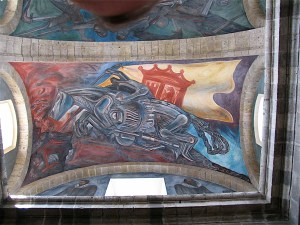
Consider that invaluable friend of man, beloved by Mexicans, the horse. And how the horse came to Mexico. On the roof of the chapel, Orozco’s vision of the conquest is that friend of man — and the crown of Spain — transfigured into a weapon of destruction.
As is said of the Conquest (and of Mexican history) the horse was “neither a triumph nor a tragedy, but the birth-pangs of a people”. It’s odd, to see people laying on their backs (and doing so myself — the chapel has benches and you are encouraged to lie down and contemplate the ceiling) engrossed in their own painful birth as a people.
Veni, vidi, bitch-i… Puerto Vallarta
I’ve rented a rooftop room (an unknown trick in Mexico… often the rooftop has a few rooms mostly for the staff, and — if all you want is a bed and a bathroom, and aren’t turned by unrestored antiques, is usually a bargain). A bed, a chair and a shower is all I really need, and a room’s a room, so I’m staying for the next few days at the Posada Regis in downtown Guadalajara. Besides the rooftop view, there is the added advantage that I’m right across the street from a high-class hotel with wireless … and can tap in by sitting in my doorway.
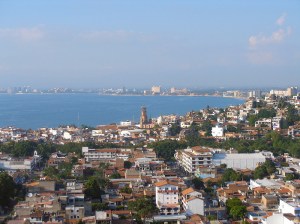 I was originally planning to be in Puerto Vallarta for three nights, but couldn’t see hanging around after calling on the one English-language bookstore (THE Book Store, which, for those in Puerto Vallarta… or environs… is inside the Soriana at the Caracol Shopping Mall… right across from Register #1. And, yes, it does carry Gods, Gachupines and Gringos, among a wide selection of new English and Spanish titles). I was going to go to a meeting of the local writers’ group, but never really heard back from them, other than to suggest it would not be “fair” to their writers’ to allow me to present anything on such short notice. I was also planning to get up to another bookshop in one of the other little resort towns, but didn’t hear anything until Saturday morning (or rather tonight, when I got around to accessing my email). I may be going back to Puerto Vallarta in a month or two — for a signing perhaps — so will try to get up the road then.
If I’m invited back after giving my impressions of PV.
One thing I am happy to report is that my stated impression that Mexicans know their history and appreciate those who do was confirmed. I have to warn baggage handlers and taxi drivers that my luggage is very, very heavy (I’m managing to keep in shape on this trip, anyway). They generally ask what I’ve got in there, and I don’t mind telling them. Which leads to conversations about the books. Which leads to Mexican history. Being a tourist-cetric community, the bus station is out in what seems the middle of nowhere… by the airport… close to the resort hotels, but not anywhere near the city itself, and rather inconvenient for we humble vendores, who aren’t staying in some high-dollar resort hotel out there. So, the taxistas and I had time to converse.
My first taxista was tickled that someone had written Mexican history in English. “They need it,” he said, before launching into a litany of “saints”… Carranza, Lazaro Cardenas, Emiliano Zapata. My driver back to the airport, like me, was a resident of Santa Maria de Ribera in the pre-hip days. He was my best bud when I knew that Madre Conchita (the terrorist nun of the 1920s) lived there… but not until I confirmed — diplomatically — that I don’t think Lopez Obrador lost the 2006 election. It wasn’t so much that he and I are somewhat in political agreement (though it helps), but I at least knew about the election and the controvery. And… he was interested in indigenous languages… specifically Otomi and Zapoteca. Being a long ride (there was some constuction delays), he also got into a riff on Pancho Villa, a man he greatly admires — for two things. The first really surprised me. It was the use Villa made of Felipe Angeles’ expertise in artillery. I only mentioned Angeles in passing in my own book, but here’s a blue collar guy who can speak with confidence about a figure probably as important (or, rather, as obscure) in our history as Count von Stuben without being an expert on the Revolutionary War. I can’t tell you a thing about Count von Stuben, other than there was a county near where I grew up named for him.
The other thing my taxista admired about Villa was that Villa attacked the gringos, for what he argued, were good tactical and political reasons. What struck me was not so much that I’m right that Mexican — even working class guys like taxi drivers — know their history and are knowledable of it, but that the gringos have no concept of the inner life of their neighbors. If they even see the Mexicans as neighbors and not as scenery.
While I think it’s worth mentioning that unlike other tropical “paradise resorts”, its safe for the tourists to leave their permiter zone… you find perfectly nice — ahem, “Mexico-challenged” brightly-pink people on buses and in the supermarkets everywhere (try that in Jamaica or the Dominican Republic!). Good on them.
The locals seem to accept — or at least tolerate — the inability of those from north of the border to ever be at ease with their environment. In Mazatlan, at least one humorist has re-named our north of the border quasi-residents “los robotos” for their tendency to march — not saunter — looking neither right nor left, and bowling over anyone in their path. WITHOUT SO MUCH AS SAYING “¿Con permiso?“. That, and the unfortunate need for everyone connected with tourism (even bus drivers and cleaning women and waiters) to speak more than a little English, are probably the trade-offs one should expect in a tourism centered community.
 It’s downtown is quicky becoming “quaint” and sanitized for gringos (at inflated prices) to be sure, but downtown Puerto Vallarta seems to be a city without Mexicans (except as workers, or a few shopkeepers). Being of the theory that “English spoken here” is code for “we inflate prices by at least 25%”, I was hard pressed to find a MEXICAN Mexican restaurant. I did, run by a couple little old ladies — real home cooking — but it took some doing.
And, much as I enjoyed the civilized eclecticism of “Uncommon Grounds Chill-out Lounge” (a Buddhist coffeehouse slash bar slash restaurant slash aromatherapy center slash et cetera) and was impressed by The Book Store, both seem exceptions to the rule. While both of course cater to the gringos, that is as much an accident of their product as anything. What was appalling was the number of restaurants, bars, clubs, that are designed to discourage Mexican clientele… or at least “THOSE Mexicans”.
 What I’m talking about was my visit to what the tourism brochures have started referring to as “Playa Romantico”… and is more properly known as Playa de los muertos” (“Dead-men’s beach”). This is where you find “The Blue Chairs” — written up in every tour book as THE gay place of Mexico. It isn’t. It’s the gay white foreigners of a certain age place of Mexico. I saw almost no one under the age of 50, only one or two persons of color (who stood out for that reason alone). Apparently, one occupies a chair and buys overpriced (by Mexican standard) snacks and drinks, and talks about the same old shit you talk about back in Fargo or Vancouver or wherever. It was a giant “wrinkle room” with less clothing.
If that wasn’t appalling enough, I noticed that THE big gay club’s cover charge is 150 pesos. That may be acceptable in the United States for all I know, but very few Mexicans can afford that kind of money (disriminatory cover charges are either legal in Jalisco, or the law is bent for the colony. Discrimination based on economic status is certainly illegal in the Federal District, and such a cover charge would earn at least a visit from the Human Rights Commission). There was a line waiting to enter the place… all in English, obviously not Mexicans.
I did go to another club, up the street, where there actually were a few Mexicans…. who spoke English, and who were there as “guests” (or would-be uhhh…. temporary employees?… of foreigners). I will admit there were also French speakers there, so it’s not just a U.S. thing.
Visitors (mostly oblivious to the whole thing) seem happy with the services they receive in Puerto Vallarta, and I can’t blame them for pouring in, to the point where the coast is wall-to-wall condos, hotels, developments. But, the colonists I spoke with seem just as oblivious.
I know I’m painting with a broad brush, but when I had breakfast and asked for a nota the old guy at the next table wanted to know what I had said. And he ate there every day for years. When I said a receipt for my business expenses, he was not only surpised that some of us work for a living (ok, I’ll accept that there’s an assumption that all foreigners are retirees or living off ill-got gains from elsewhere), but DEMANDED to know why I’d bother paying taxes. “Um, I live here.” And, I heard much more about circumventing Mexican law and custom — and looking for an opportunity to work with other gringos — than about actually just living in Mexico.
A visit to PV is an immersion in colonialism. In Tennesee Williams’ 1948 short story (and subsequent 1961 drama), “The Night of the Iguana”, “the central theme of temptation in a paradise that may be imprisonment“. The successful 1964 film version — which made it into my book as a seminal event in Mexican history (or at least seminal in the post-world war II tourism boom) — may be partially responsible for turning paradise into a prison. A rather nice, sunny prison, but a prison nonetheless.
Friday night video from Jalisco…
Mariachi!
One intriguing tidbit mentioned by the narrator: trumpets didn’t become standard in mariachi until the 1930s (trumpets sound good on radio). I guess it’s something else to nit-pick about the next time you see a movie on late night TV set in “old Mexico”.
On the road…
Now comes the “fun part” of the Gods, Gachupines and Gringos experience. Working for my publisher, I’m also peddling the Editorial Mazatlan line along the way, which means books — lots of books — and luggage that’s barely lug-able. And doing some author type events along the way.
Tentatively — based on what appointments are set, and depending on imponderables (including a possible transportation strike next Monday) — I will be in Puerto Vallarta later this weekend, Guadalajara, Ajijic and Chapala the 16-20 February; Guanajuato and San Miguel de Allende 20-24 February; Mexico City 25 – March 3… then San Cristobal, Merida, Cancun… and back towards the west coast.
It’ll be rough.
About time…
South Florida Sun Sentinel (Alexia Campbell):
While most of the nation focused on the stimulus bill winding through Congress, nine representatives introduced a bill calling for an end to the 46-year-old ban on travel to Cuba.
The Freedom to Travel to Cuba Act introduced in the U.S. House of Representatives on Feb. 4 would allow American citizens unrestricted travel to Cuba for the first time since 1963. The bill by Rep. William Delahunt, D-Mass., and eight co-sponsors would also lift limits on travel by Cuban exiles living in the United States. The president would not be able to regulate travel to the island unless an armed conflict or armed danger arises.
The bill has gone too far, said Francisco “Pepe” Hernandez, president of the Cuban American National Foundation.
Being a South Florida paper, the link read “Stealth Bill…” as if there is something underhanded about not paying attention to a CANF, which is tied to terrorist activities and smuggling here in Mexico. Alas, with people like Ron Paul behind it, a common sense bill is likely to be written off as lunatic.


