Its the end of the world as we know it (and I feel fine)
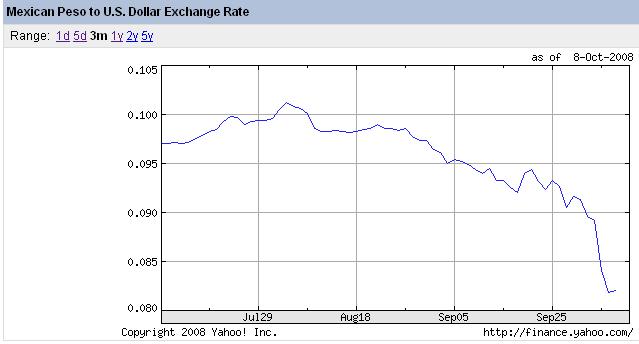
OUCH! It’s counter-intuitive that the Peso keeps dropping … Mexican banks are in no trouble, the only housing crisis is that there aren’t enough being built fast enough to meet demand, and the Banco de Mexico is unloading dollars by the billions from its huge foreign reserves there is the assumption that the peso SHOULD fall when the U.S. economy goes in a tailspin.
While of course, with Mexico dependent on the U.S. as its largest customer for consumer goods, commodities and agricultural products, there will be less dollars coming in, and growth will be flat for a while, things aren’t all bad by any means. Besides being a perfect opportunity to make your donations to the Mex Files stretch much further there are some likely long-term benefits. Mexican consumer goods are made for a resource (and cash) limited market: manufactured goods like washing machines, not to mention automobiles and trucks, made for the domestic market (smaller and using less energy) have been on the market for years. With the cheaper peso, they might do better in the U.S. market against the overbuilt products now available.
Secondly, while the luxury tourism business is going to go to pot, and what U.S. market there will be for foreign travel in the dumper, Mexico will be the only travel option available for most tourists. Retirees who find themselves priced out of higher end U.S. locations are likely to consider Mexican destinations as well.
And… Mexico has already been through most of the financial upheavals that will unsettle the United States. Bank nationalization and restructuring is done; the country has a healthy reserve in a basket of foreign currencies to carry through bad times. And — though the present administration has not been as aggressive as I would hope about it — finding markets outside the United States, and building a stronger internal market is in the country’s long-range interests.
In the short term, the government is making the right mores, looking at basic Keynsian, “New Deal” projects — more spending on infrastructure, flexibility in that spending, a speeded up refinery building project, assistance to small and medium-sized business and lowering tariffs on exports outside the NAFTA region.
HOWEVER– and I did a “huh?” when I read it (and then double-checked with Otto, who actually knows something about finances) — the Calderon administration is also trying to sneak in a proposal to let PEMEX invest earnings without government oversight. In the stock market? Don Felipe… are you on drugs?
Good idea or not?
I don’t know.
Manuel Mondragón y Kalb, the Federal District’s Secretary of Security (basically, Police Commissioner) proposes creating a medical registry of persons arrested for carrying narcotics. Having narcotics in one’s possession for personal use is — while not quite legal — akin to an affirmative defense in U.S. criminal law. It’s not a crime if you need the drugs for medical reasons (like being an addict). The tricky part has always been proving need… and gangsters have been known to suborn doctors who will affirm that whatever quantity your guy happened to have in his possession was for legitimate personal use. A friend of mine who did a stretch for alleged check fraud in Nayarit claims one of his cellmates was a trucker carrying a four ton load of marijuana… which his lawyers later presented evidence was for personal use. And the judges, even if they were dubious, had no choice to accept.
I’m dubious about the story, but even so…
The proposal to define “personal use” narcotics is back on the table, after being vetoed (at U.S. insistence) by Vicente Fox with the sweetener that users would be forced into treatment. This is not legalization, but follows the trend in Latin American legal thinking about the issue.
I’m not certain what to make of the police maintaining a medical registry, but this does show that even the police officials are looking at better ways to use their resources, and at dealing with narcotics as a public health issue.
Guerrero election — PRI recovery or PRD fumble?
In the Guerrero state elections over the weekend, the PRI showed surprising strength, capturing 45 of 81 municipios, including Acapulco, Zihuatanejo anc Chipancinco. The former ruling party appears to have won 13 of the 28 directly elected seats in the State Legislature (State Legislatures are selected both by “winner takes all” in district elections, and proportional reprentation for at-large seats. No single party can hold more than 2/3rds minus one of the seats, thus preventing legislation from being passed on purely party lines). The PRI will become the largest party in the State legislature, which was held — like the Governorship — by the PRD.
On Lonely Planet’s “Thorn Tree Message Board” — normally a tourist site, but often drifting into Mexican politics — one Guerrero resident had this to say about the PRI victory in his community:
The PRI no longer exists as a civilized respectable political party. It is now completely controlled and financed by the criminal mafia directly related to los narcotraficantes.The night before the election here in Guerrero MASSIVE and I mean massive amounts of money flowed into communities all across the state given freely to many many voters to vote for the PRI, as well as HUGH amounts of false voter crediancials were distributed. Here in the municipio de Cuajinicuilapa, even though the PRIs candidate for mayor was highly unpopular, in the all the small villages where money was handed out the PRI won by landslide margins, whereas in the communities where money was not given out the PRI lost by landslide margins.
How much of that is true, I have no way to assess, but there are credible reports of PRI fraud throughout the state. PRD had controlled the State, and some Mexican observers have tried to spin the party’s losses as an indictment of former candidate (and “presidente legitimo”) Andres Manuel Lopez Obrador. PRD is still split between “lopezobradoristas” and members willing to work with Calderon administration. In Guerrero, the PRD pulled out of its usual coalition with Convergencia, with the Lopez Obrador factions generally backing Convergencia, which finished a close second in former PRD stronghold Acapulco.
This was a tactical error on the PRD’s part, but might not be as bad as some think (or as hopeful, to those praying for the demise of PRD and/or Lopez Obrador). The broad coalition (FAP) led by PRD is about a a quarter to a third of voters, and PRD has normally only represented about 15 to 20 percent of all voters nationally. Anti-Lopez Obrador sentiment could be a factor in keeping many who see PRI as a pragmatic leftist party, but are bothered by its lingering corruption in several states. Should, as some expect, Lopez Obrador’s faction within PRD formally joins with Convergencia, it would remove that political difficulty from the PRD, while keeping the Lopez Obrador factions within the broader (and successful) “Wide Progressive Front” (FAP for its initials in Spanish). FAP, cobbled together from three leftist parties (PRD, Convergencia and the Workers’ Party) would have a vested interest in maintaining their common electorial front, since none of them are strong enough to win in more than a few specific districts.
Fan mail and sodomy
Everybody’s a critic.
I received this from my e-mail account at my publisher’s website:
What if I want my money back. I may not like your book for all kinds of reasons. America is full of trivia and trash and, well, you know, sodomists. Money is what you count on getting. I’m not one to waste my time on prevarication. It’s like feeding that lust.Good luck anyway.
Maybe I’ll see your book in the library whenever.
I hate gringos.
I not sure why my correspondent tells me they will not buy my book, then seems to think the author has any control over the bookseller. A little secret. Authors write books for people called publishers. They produce books, that are sent to distributors. Who send books to retailers. Who sell the books. Whether they allow returns has nothing to do with the author.
When it comes to money, the author will admit that it “is what you count on getting” at some vague point in the future. While I hope the book does have very good sales, I’m afraid my “fan” hasn’t a clue as to the economics of writing. I suppose its possible to make money from writing (though genres other than Latin American history — like industrial magazine articles or technical writing or porn — pay much, much better). As it is, the publisher will need to sell around 10,000 copies before my royalties begin to cover the income I would have earned while working on this book, had I been doing something lucrative, like … oh… cleaning toilets at the salario minimo for this part of Mexico.
America is full of trival and trash and , well I know, sodomists [sic… the word the correspondent means is ‘sodomite’]. I’m rather disturbed about the first two — it’s one of the reasons I live in Mexico and hope to cut through some of the trivial and trashy misconceptions about this country. As to sodomists, the more the merrier. But, when it comes to sodomy, I’m not sure my correspondent has looked around Mexico.
While I’m surprised to see anyone in the 21st century using such a dated term, one that I don’t even find in Church documents any more, but I can guess what the correspondent means. Apparently unaware of the very good statistical work in the sexual habits of this country (no need to get into them here) suggesting it’s a fairly common practice, my correspondent is ignoring Mexican history.

Are you sure your Aztec history is … ummm… straight?
After all, the Olmecs — like every other human society — made reference to gay oral sex (see Gods, Gachupines and Gringos, page 23, footnote #4 … assuming the page numbers don’t change from the galleys I have) and Nahuatl had plenty of words for various same-sex activities. And, although I don’t think Sor Juana’s erotic references to other women necessarily meant she was a lesbian (as detailed in GGG, page 98), it is difficult to overlook “obvios” like the pirate Jean Lafit (page 105) or Porfirio Diaz’ son-in-law, Ignacio de la Torre (GGG, page 217, footnote 89; page 235, footnote 96). And, since I have said I’m writing about foreigners, one would be remiss in not noting that Langston Hughes’ very pro-Mexican sympathies were at least partly due to his homosexuality (GGG, page 316). And, Mexico, being very much part of the 21st century, not paying attention to gay rights in the country (GGG, pages 410, 427, 429, 432, 437) would indeed create a “trivial and trashy” book.
One “sodomical” (if that’s a word) incident I did exclude… frankly because I’d never heard of it and I think it’s a load of caca … is the contention by Mexican writer and career diplomat José Luis Basulto Ortega that Moctezoma and Hernan Cortés had, in the delicate phrasing of Laura Martinez, “an amourous relationship.” ¡Cuiloni! Historia de una Lágrima was only published last month, and I never had a chance to read it.
Basulto, according to Martinez,:
… claims to have “fifteen documents” that irrefutably prove a homosexual relationship between Cortés and Moctezuma, and that, in a nutshell, Mexico was lost because of a queer (”México se perdió por una loca.”)
“Loca,” I’m sure my correspondent realizes, is not an unknown word for “sodomist” — and a not very nice one at that — which obviously shows again that the acts are not unknown in Mexico. And, while I don’t pretend to any sort of fluency in the language, even the most jejune student of Nahuatl knows that cuiloni translates as “cock-sucker”, a rather trivial and trashy term that pre-dates the Conquest.
I doubt I would have included the book among the fifteen or so pages of reference works (though I do mention an important Mexican novel, Adonis Garcia: Vampire of Colonia Roma — that’s the English translation, since I wrote the book for English-speakers — yet further evidence that “sodomists” are not unknown in Mexico, in this case, one who turn a better profit from it than one does from writing histories). The very scholarly “sodomist” magazine Enkidu dismisses the MEXICAN writer’s book on two grounds.. it’s irresponsible (in implying that “sodomists” are malanchistas) and those “fifteen documents” are never referenced, nor… does it seem… do they exist.
¡Cuiloni! Historia de una Lágrima is only a novel… but it seems Mexican writers can turn out a work “full of trivia and trash and, well, you know, sodomists”. Basulto probably wrote his novel expecting to make money. Sort of like a lot of hated gringo writers do.
This is scary…
Otto (Inca Kola News) wrote today on the latest statements on the economy by the hapless George W. Bush:
So after the enormous nationalization program being undertaken by the Bush administration at the moment, what more evidence do you need for Dubya’s conversion to the Axis of Evo than his press conference in Chantilly today?
My worst suspicions are confirmed. As I wrote back in September 2005:
I smell a plot. Fidel wants a leftist Latin America; the Bush family got rich the old fashioned way – kissing the butts of dictators and various baddies (Prescott Senior laundered money for Adolph Hitler, George I and Prescott Jr. have business ties to the Chinese Communist Party – and Saddam Hussein and the King of Saudi Arabia – as does George II, who also was in business with an obscure Saudi construction magnate named Osama bin Ladin). So Fidel, on behalf of dictators and baddies everywhere, cleared out the mental wards and prisons of Cuba, sending the cracked, the crazed and the criminal by the boatload to Florida back during the Carter Administration. The crazies helped elect Jeb Bush as Governor; Jeb did everything possible to disenfranchise anti-conservatives, and to swing his state’s presidential votes to big brother George W. in 2000. The un-elected President of the United States, in return, has done everything in his power to give capitalism and corporatism a really, really bad name. Pro-U.S., or pro-corporate Latin American leader look like fools. Fidel’s interest is a leftist Latin America: the conservatives are voted out and the people opt for the left. The Bush family’s interest is the Bush family. A win-win for both Fidel and George II.
I think Comrade George is going above and beyond his brief though. His job was only to destroy U.S. prestige in the Latin America. No one really expected him and his minions to go out and actually try to bring down the whole capitalist system. Even if he does claim he “had to destroy Wall Street in order to save it.”

Yeah, of course we have police abuses and strong arming from time to time here in Mexico, but hey… Mexico doesn’t claim to be the land of the free and the home of the brave, either…
from VivarLatino:
ICE and the media can try and sell the story that the raid on the home of a 68 year old Latina woman was a mistake. Pero there are no mistakes in this age of war and terror. Perhaps its the cynic in me or the history I carry inside me that thinks this was more than a a mere clerical error.
Olga Savage said she went through a harrowing life-changing experience that might have been a total mistake. The 68-year-old woman told Action 4 News that she heard a knock at her door Tuesday morning. But before she had a chance to get up she said U.S. Immigration & Customers Enforcement (ICE) agents were inside her home. “They came in with guns, grenades and holding their pistols,” Savage recalled. When she asked them why they came into her home they allegedly responded, “Show us your papers.” Savage complied by showing them documentation proving that she’s been a United States citizen for 40 years. She said they were shocked to see the paperwork. “They looked confused and said, ‘They told us you didn’t have your papers’,” she recalled. After verifying her documentation, they made copies and left. Olga said they didn’t offer an apology or help.
They could have at least called an ambulance. the poor woman very nearly had a stroke as a result of her blood pressure going through the roof. And who were “they” that said Mrs. Savage “didn’t have papers?”
What’s wrong with Jose Seis-chelas?
One of the deciding factors in United States Ambassador Henry Lane Wilson’s support of the 1913 coup against Francisco Madero — and the anarchic violence that resulted from that coup — was the administrative change in the United States that would take place on 21 March of that year. At the time, that’s the day the new President would be sworn in. Ambassador Wilson, of course, would be expected to hand in his resignation when President Woodrow Wilson took office. Making the minor point that Woodrow Wilson, as well as outgoing president William Howard Taft, and Progressive Candidate Theodore Roosevelt were all intellectually capable and the tragedy can’t be blamed on sheer Presidential stupidity, I added this small footnote to my discussion of the Ten Tragic Days in Gods, Gauchupines and Gringos:
The candidates in the 1912 election were probably the most scholarly ever in U.S. history. Taft was a recognized legal scholar, Wilson a professional historian and third-party candidate, ex-President Theodore Roosevelt, among his many other accomplishments, was a well-regarded popular writer on natural history as well as a naval historian.
It was unusual at the time to have a university education, and of course Roosevelt was known for many other things as well as his scholarship, but I don’t think voters then would have voted for a President who was “just like you”. Nor would they have wanted to.
I’m not sure when it happened, but even when a candidate for President of the United States was of somewhat modest educational achievement (Dwight Eisenhower, Harry Truman), they always highlighted thier intellectual abilities. Ike was only “dumb” compared to the witty Adiai Stevenson — and he was President of Colombia University, when he started his political career. Barry Goldwater in 1964 was a brilliant orator, but running uphill against a popular president who — though crude and devious — was never seen as an average Joe. Besides, what Goldwater was saying was nuts. Nixon, Carter and Clinton all let you know exactly how smart they were. Their oppenents were intellegent, and sometimes witty (like Bob Dole), but none of them ran on being “an average Joe.” Jerry Ford came off as kind of an oaf… and lost badly when he ran for President. Ronald Reagan wasn’t any sort of intellectual, but made up for it by his soaring oratory and verbal flair.
George W. Bush did run against a smart guy, who let you know it … and did not capture the popular vote (or, some say, even the Electorial vote). But, assuming Bush did win that 2000 election, it marked the first time in a century that a President ran on the “Average Joe” platform. I’ve seen a theory (and forgot where I saw it), the Bush really isn’t as dumb as he acts… but studies his verbal gaffes for political purposes to make him appear less like the graduate of private schools and a Yale MBA, and more like a Bubba from Midland.
I compare that (like I do everything else, sooner or later) to Latin America in general, and Mexico in particular. Right now, three Latin American Presidents (Bachelet of Chile, Colom of Guatemala and Vasquez of Uruguay) are medical doctors. Ecuadorian President Correa and Mexico’s Felipe Calderon (and Haitian Prime Minister Michele Pierre-Louis) have advanced degrees in economics and experience in international finance. Parguay’s President Lugo studied abroad in Rome… quite an accomplishment for a Paraguayan President. Even relatively uneducated leaders, like Venezuela’s Hugo Chavez (who isn’t shy about anything) lets you know what books he’s read, and they aren’t things like “My Pet Goat”.
While we haven’t always had the best leaders in Mexico, we’ve generally had highly educated ones…. or historically at least, those acheived an education against the odds. Another footnote from my book:
A surprising number of Mexican leaders have been teachers, raised by teachers, or orphans. Some, like Obregón have been all three. Besides Obregón, Juárez and Calles were orphans. All three, as well as Porfirio Díaz were schoolteachers at one time or another…and interim president de la Huerta became a dance teacher.
(I poke fun at Adolfo de la Huerta who was the figurehead leader of a coup in 1924, and had to flee to the United States, where the highly cultivated, intellectual banker and diplomat made a good living in the 1920s, running a dance school). Sure, because of the Revolution, and the conditions before the Revolution, there weren’t a lot of leaders with university degrees, but all made a point of pride in speaking as learned men, and all surrounded themselves with intellectuals. Pancho Villa joined the Revolution in large part because of his thirst for education, and to be educated was to be a patriot for most of the last century.
And say what you will about the PRI era, political leaders were drawn from academia and the professions. Lopez Portillo, like Obregón in the 1920s, saw their poetry as something to be celebrated, not dismissed. Even Carlos Salinas (who earned his PhD in economics) fancies himself a scholar, and writes long, unreadable books. Ernesto Zedillo took up an academic career after the Preisdency. No one in Mexico finds in remarkable that their presidents are remarkable.
Vicente Fox, elected the same year as George W. Bush (though there is no doubt that Fox really was elected), probably comes closest to running as an “average Jose”. He’s known as something of a naco (a redneck boob) — one of his famous gaffes was when he met a group of indigenous women who were part of an adult education program, he told an illiterate, “you’re probably better off not reading the newspapers”.). But Fox ran as a successful international businessman — not “Jose Seis-chelas”. In the 2006 election, Felipe Calderon certainly made sure voters knew he had TWO masters’ degrees (one from Mexico in economics, one from the United States in Public Administration); Andres Manuel Lopez Obrador’s campaign literature listed his several books (including his Masters’ Thesis).

Is it enough to be a maverick?
Waymon Hudson, at the Bilirico Project, calls the present U.S. election, “the War on Intellectualism”. A Harvard-educated law professor is attacked for… horrors… being “professorial” while praise is heaped on a vice-presidential candidate with a journalism degree who can’t name the newspapers she reads. The head of her ticket glorifies in telling people he graduated near the bottom of his class… as if that were somehow an asset for the job
Is that screwed up, or are the rest of the Americas behind the curve?
Foreign affairs
Speaking at an Americas Conference panel discussion Friday on the next U.S. president’s Latin American policy, McCain advisor Richard Fontaine started out by mentioning an old Brazilian flame of McCain’s, who recently emerged in the press.
”Talking a little about his personal experience, he was famously born in Panama and has traveled all over the hemisphere for many years.” Fontaine said. “In fact, I saw, I guess it was last week, that his old girlfriend in Brazil has been found from his early days when he was in the Navy and was interviewed. She’s a somewhat older woman now than she was then, but it sorta speaks to the long experience he has had in the region — in the most positive terms.”
Although McCain was born in Panama and has represented a border state for many years, I’d been bothered by his (and his opponent’s) apparent lack of interest — or knowledge of Latin American affairs.
I admit, a tryst of mine kick-started my interest in Mexico, and not to brag or nothin’ … but if John McCain’s fling with (in Eric at BoRev’s words) “former hoochie coochie girlfriend lady” counts as foreign policy experience, then I’m qualified for this guy’s job.
Ah, memories!
Girls just want to have fun(ds): La Maya
One reason I’ve cut back on posting is that I’m supposed to be working on a history of Mazatlan. The problem I’ve been having is that the local histories are full of dull, respectable types… and they’re so frigging boring. This town was founded by pirates and cut-thoats and only really took off when they could skin the gringos during the California gold rush (our cartels and time-share touts are heirs to a venerable tradition around these parts). Alas, the local historians tend to write more about dull German brewers and bankers and generals… and, naturally, I prefer the rouges.
Though, you do find, from time to time, a respectable person worth writing about. This is, of course, only a draft, and copyright © 2008, Editorial Mazatlan, all rights reserved.
 Although the “Great Depression” of 1929 affected Mazatlan just as it did everywhere else, the real blow to the economy came on 23 March 1933 with the passage of the 21st Amendment to the United States Constitution, repealing liquor prohibition. Mazatlan had profited from the “noble experiment” – two of the city’s most profitable industries – smuggling and brewing – were hit hard. Times were tough. Margareta Montes Plata was tougher. As a ringer on the Cerveceria Diaz de Leon women’s baseball team, Margarita’s ten pesos per game helped get her family though the tough times, but weren’t enough.
With nothing but a strong pitching arm (which she attributed to a childhood spent making tortillas by hand and wielding a machete on the family farm) was desperate to find some source of income. What was then the Teatro Rubio (today’s Angelina Peralta) was desperate for any kind of act that would bring in a paying crowd. When woman boxer Josefina Coronada offered to put on an exhibition match, who knew it would be the start of one of the more amazing careers in the history of women’s sports?
The amateur trained for a month, won the bout and Margarita, fighting under the name “La Maya” boxed throughout Mexico and the United States, fighting 28 men and 5 women (she said “I prefer to fight men, they punch better”) before her early retirement in 1936.
La Maya’s only real problem with boxing had been the presumption that a women boxer was not lady-like. One Mazatlan parrandaro (a guy hanging out) probably wished he hadn’t told her one day that she wasn’t a “real woman.” she knocked him out.
And she was a proper Mexican lady. Her retirement from the ring came when, after marrying bullfighter Jose Valdez, she was expecting her first baby. For some reason, her obstetrician thought boxing might interfere with pre-natal care.
He said nothing about bullfighting. Say what one will about bullfighting, matadors from racial minorities, matadoras and openly gay matadors have been part of the sport for centuries before other professional sports. But, with a growing family – she would eventually have five children – and the bullring circuit requiring too much time away from home, she settled for the less exciting world of bicycle racing.
Widowed in 1961, and starting to feel her own age, she took up truck driving for several years. Rather than retire, she bought a gasoline station with her grandsons, continuing to take an active part in the business well into her late eighties.
I’m rubber, you’re glue…
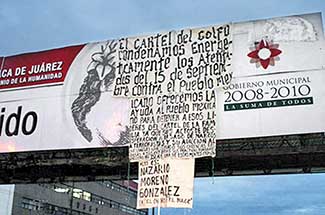
Photo: Max Nuñez, Cuartoscuro.com (via The News)
The Calderon administration (and the foreign press) aren’t the only ones who were quick to blame the grenade attacks in Morelia on 15 September on los Zetas. Their rivals in mayhem, la Familia, the bible-toting meth distribution people, who dabble in such “good works” as killing kidnappers and warning about the dangers of cocaine use (go figure) fingered los Zetas (not known for bible-toting, though their activities do have their Old Testament echoes (especially the smiting and “vengence is mine” parts) say they didn’t do it — and, blaming la Familia, are offering a hefty reward for the head (or the head of the head) of la Familia.
I always thought things cost more in Cancun, but the banners there only offer a 500,000 dollar reward, while elsewhere they’re offering a cool five million bucks. The banners appeared all over the country, but not in Michoacan where you’d think that if the gangsters were really responsible you might find people who actually knew anything about the attacks.
The situation has its humorous aspects, to be sure (is anyone keeping a head count by gang? Is Team Zeta, Team Familia or Team Chapo … ahem… a-head in the standings?), but in the back of my mind, I wonder if what’s going on isn’t somewhat similar to what happened in Colombia in 1992 when kidnapping victims went out and hired their own gangsters to hunt for the cocaine “kingpin” Pablo Escobar. Escobar, like the Mexican gangsters (especially Chapo Guzman), built local support through charitable contributions to local communities, and seen by the establishment as a political threat, although they were willing to accept funding from him. As here, it was kidnapping, not narcotics dealing that prodded the establishment media and leadership into action.
In 1992 “Los Pepes” (Perseguidos por Pablo Escobar — People Persecuted by Pablo Escobar) were either hitmen hired by wealthy victim’s families, or recruited by the Colombian government (and the United States Drug Enforcement Agency) to start bumping off Escobar’s people. Or both. Or, Escobar’s business rivals were in a strategic alliance with the government (as Mark Bowden’s “Killing Pablo” seems to suggest).
I’ve been expecting some extra-official anti-narco response (a nice way of saying “death squads”) to spring up. Bowden suspected that Colombian police officers were involved with los Pepes — at the very least, giving them the information they needed to find their victims. Given that the Fox Administration’s strategy was to weaken one gang at a time. Fox, good businessman that he was, let predatory capitalism at its most predatory, weaken the gangsters. The Calderon administration has been more proactive and might very well be at least rooting for one gang or another, hoping to create dissention and open warfare between the groups.
Of course, there is no evidence as of yet that the Morelia attack had anything to do with narcotics gangs, but given both the Calderon Administration’s inherent legitimacy problem and their willingness to resort of force against non-conformists, AND the multi-billion dollar Merida Iniative’s modelling on “Plan Colombia”, it’s not unreasonable to speculate on possible Federal Government motives for involvement in the grenade attack.
(After writing the above, I read John Ross’ “Massacre in Morelia” in Counterpunch. Ross quotes an anonomous Mexico City detective as saying; “You terrorize the people into thinking only you can protect them. A lot of the cuates (buddies) who I’m talking to say it’s the government that did this.”)
Hit and run: Sunday readings — 05-10-08
Pheewww…
One American government won’t have to intervene in their national bank anyway… (Penguin News, via Mercopress):
IN the light of the global financial situation, Standard Chartered Bank’s Stanley Manager, has offered reassurance to individuals, companies and the Falkland Islands Government, all of whom have significant funds held by the bank.
“At this time, we can reassure you that, despite the turmoil in the financial markets, Standard Chartered remains in great shape. We have a clear and consistent strategy; we do business in markets that we know intimately, with products we fully understand, and with customers with whom we seek to nurture and build relationships.
“At Standard Chartered’s Interim Results announcement in August, we demonstrated that we are well capitalised, with a strong liquidity position and no direct exposure to the US sub-prime housing situation.
Laugh, and the world laughs with you
Chilean President, Dr. Michelle Bachelet explains recent Latin American history to U.S. investors (Santiago Times):
“Why has there never been a coup in the United States?” joked Bachelet to a group of prominent U.S. investors. “Because there is no U.S. embassy in the United States.”
A new world order…
Venezuela, according to John McCain (Jesus’ General):

And, one longer piece to read:
“During the past decade, Latin America has become the most exciting region of the world,” Latin America’s favorite gringo writes, in an article also suggesting that the United States of America is becoming Bolivia or Guatemala… and not in a good way:
…
Sixty years ago, US planners regarded Bolivia and Guatemala as the greatest threats to its domination of the hemisphere….…This wonderful anti-market system designed by self-proclaimed market enthusiasts is now being implemented in the United States, to deal with the very ominous crisis of financial markets. In general, markets have well-known inefficiencies. One is that transactions do not take into account the effect on others who are not party to the transaction. These so-called “externalities” can be huge. That is particularly so in the case of financial institutions. Their task is to take risks, and if well-managed, to ensure that potential losses to themselves will be covered. To themselves. Under capitalist rules, it is not their business to consider the cost to others if their practices lead to financial crisis, as they regularly do. In economists’ terms, risk is underpriced, because systemic risk is not priced into decisions. That leads to repeated crisis, naturally. At that point, we turn to the IMF solution. The costs are transferred to the public, which had nothing to do with the risky choices but is now compelled to pay the costs – in the US, perhaps mounting to about $1 trillion right now. And of course the public has no voice in determining these outcomes, any more than poor peasants have a voice in being subjected to cruel structural adjustment programs.
A basic principle of modern state capitalism is that cost and risk are socialized, while profit is privatized. That principle extends far beyond financial institutions. Much the same is true for the entire advanced economy, which relies extensively on the dynamic state sector for innovation, for basic research and development, for procurement when purchasers are unavailable, for direct bail-outs, and in numerous other ways. These mechanisms are the domestic counterpart of imperial and neocolonial hegemony, formalized in World Trade Organization rules and the misleadingly named “free trade agreements.”
Just in passing
Laura Carlson (CIP Americas Policy Program):
… In April 2007, on the eve of the North American Trilateral Summit, Thomas Shannon, the U.S. assistant secretary of state for western hemisphere affairs, described the SPP’s purpose with remarkable candor: The SPP, he declared, “understands North America as a shared economic space,” one that “we need to protect,” not only on the border but “more broadly throughout North America” through improved “security cooperation.” He added: “To a certain extent, we’re armoring NAFTA.”
Mexicans and other Latin Americans have learned that adopting the U.S.-promoted neoliberal economic model—with its economic displacement and social cutbacks—comes with a necessary degree of force, but this was the first time that a U.S. official had stated outright that regional security was no longer focused on keeping the citizens of the United States, Canada, and Mexico safe from harm, but was now about protecting a regional economic model….
With the U.S. in economic “lockdown”… or meltdown, or whatever it is right now, Mexico might be wise to consider its security FROM U.S. economic dominance.


 mexfiles.net