Don’t do the math
One of the hardest things for foreigners here to wrap their minds around is that we do have a “sales tax” … or rather IVA — Impuesto al Valor Agregado — a value added tax, but it’s part of the listed price. That is, if the list price is 100 pesos, the price is actually 87 pesos, plus 15% tax.
Simple enough. But, for Mexicans (and most Latin Americans and Europeans) paying a tax on top of the purchase prce, and discovering that the five dollar purchase is $5.40 or whatever can be slightly confusing.

And ten percent for me, mwahaaahaaahhaaahaa!
Groceries are not taxed in Mexico, nor in most places in the United States… though one Colorado food chain has taken it on themselves to charge an extra ten percent, “…for taxes in Mexico and we think that people would feel better if they are charged for taxes as if they were in Mexico.”
From Pandagon:
The Nash Finch stores Avanza, Food Bonanza and Wholesale Food Outlets add the 10 percent charge to food at the register and specialize in serving Hispanics, according to store workers.
However, the Nash Finch stores Sun Mart Foods, Econo Foods, Family Fresh Market, Pick N Save and Prairie Market stores do not charge extra at the register and do not cater to Hispanics, according to the store workers.
For the record, Secretaría de Hacienda y Crédito Público does not receive ten percent of sales from grocery stores in Colorado.
Don’t count your chickens before they’re hatched
In a chicken and egg conundrum, the Senate Finance committee has held up final approval of the 2009 Federal budget until the PEMEX reform package is finalized.
The budget, as it stands, assumes the Federal Government will spend 3,460,636,600,000 pesos from existing resources, and will have to contract a debt of 253,497,000,000 pesos. That means, the Mexican national debt is only going up about 23 billion dollars… about two monts worth of U.S. military spending in Iraq. This could go down if oil and commodity prices (like food) go up.
Return to sender?
The (Edinburg) Scotsman had the best reporting on this quasi-non-event from Monterrey. But, then, the Scots are known for both eschewing speculation and being as parsimonious with their words as they are with everything else:
TWO gunmen yesterday shot at a US consulate in Monterrey, northern Mexico. They also threw a grenade at the building but it did not explode and no-one was injured, officials said.The consulate, which processes immigrant visas for Mexicans and provides services to US citizens in Mexico, was closed for the Columbus Day holiday.
Having no idea why, or who might — or might not — be involved, the other press reports go into the recent history of hand grenade tossing in Mexico, and narcotics dealing and even mention Arab terrorists. Were I to indulge my taste in speculation, I might just note that alleged “terrorist” acts at night, on holiday weekends when no one will be injured (and the hand grenade was tossed without pulling the pin) has been used before in Mexico to create a rationale for state action against imaginary “terrorist groups.”
Or, more likely, the grenade tossers wanted to return their defective purchase to the place of origin, but couldn’t get back in the U.s. and the consulate was the next best thing.
A hummer for the teacher?
In an apparent bid to maintain control of her slowly fracturing union, SNTE (Sindicato National de Trabadores de Educacion … the teachers’ union), “Sra. Hoffa”, the redoubtable Esther Elba Gordilla, has been openly buying local leaders’ loyalties. Recently, she spent union funds to purchase sixty Hummer H-3s for use local presidents — at about 500,000 pesos each.
Section 27 president, Jaime Quiñónez Muñoz, plans to raffle the thing off, hoping to raise 900,000 pesos for indigenous education programs in Sinaloa (though Esther is now trying to claim this was her idea all along). Besides benefiting the Mayo community, the raffle is probably a better idea than giving these cars to the union leaders… driving around a Hummer in rural Sinaloa might give people the idea that — oh, I don’t know — that they’re crooks or something.

For a Hummer, call Esther.... eeeeeeeewwwwwwwww!
We’re not that bad off…
Although the Peso has been bouncing around a bit (not even in release yet, and already we’re talking about having to change the peso price on my book to reflect the changes), Mexico probably will come though the economic meltdown with less damage than it normally receives when the U.S. economy goes south.
The stock market and peso both shot up today, and it looks as if the obvious solution to Mexico’s largest economic problem (being too dependent on a single foreign customer) is also being slowly dealt with. Reuters, via Forbes
The European Union proposed on Monday establishing a strategic partnership with Mexico to forge closer ties in areas including security, diplomacy, trade, and the environment.
‘The partnership should in particular help both parties strengthen their dialogue and cooperation in international fora on crisis situations and global challenges,’ EU foreign ministers said in a statement.
…
The EU is Mexico’s second-largest trading partner after the United States, with bilateral trade of nearly 33 billion euros ($45 billion) in 2007.
:
Opiates and the masses
Maria Sabina, the Oaxaca curandera unwisely let Gordon Wasson and Allan Richardson taste her magic mushrooms in 1955, which the pair then wrote about for Life Magazine.
Giving the secrets of the “little saints” to outsiders, her son was murdered and her house burned to the ground. During the later years of her life she lamented that “the power of the sacrament had been lost in the clouds,” and ending up speaking English instead of the Mazatec.
Legalizing drugs, as my well-appreciated commentator “Mr. Rushing” proposes, is an increasingly popular idea FROM and FOR the United States. As Grits For Breakfast mentions:
A Zogby poll in the United States finds that “Three in four likely voters (76%) believe the U.S. war on drugs is failing, a sentiment that cuts across the political spectrum – including the vast majority of Democrats (86%), political independents (81%), and most Republicans (61%).”
“Grits” looks at justice and incarceration issues, and the criminal prosecution of drug users is beginning to be seen as counter-productive. It has for some time here in Mexico (and our “addict population” is relatively small) and narcotics crimes are — in theory — “Crimes against Public Health”, but have been devastating to us in a different way. “Bloggings by Boz,” which follows “mainstream media” and think-tank reports on Latin America wrote on October 2:
A poll in yesterday’s El Universal showed that Mexicans are very concerned about their security today, but may have some optimism for the future.
Only 25% think they are more secure after the governments crackdown against the cartels while 42% believe they are less secure.
It’s not the narcotics that are our problem, its narcotics wholesalers. While there is some wisdom in just “legalizing” the use of these substances, I don’t see it happening and all assume that the “little saints” are English-speaking.
It’s probably not coincidence that Adam Smith and Karl Marx both concocted their theories in England. We heirs of English (and German via England) — unlike Maria Sabina — see narcotics only in an economic and utilitarian sense. We teach the “little saints” to speak English — to be a commodity. As such, legalizing them makes perfect sense in the United States. But even here in Mexico, the sense of narcotics as “sacred” has been lost. Their use (and trade) falls under “Crimes Against Public Health”, which certainly opens our “doors of perception” to dealing with what is still a minor problem (addiction) as a public health issue, rather than a criminal one. That’s all for the good, but doesn’t look at what causes OUR drug problem.
The third little saint of economics also spoke English: John Maynard Keynes. While the Mexican gangsters have probably been making wiser investments, and have real goods and services to back up their investment cash, they are as dangerous for Mexico as the Wall Street investors have proven to be for — well — everybody. That is, no one knows how much cash they’re sitting on, and even they don’t seem to know, and there is no control over how that cash is being spent.
There’s probably no real difference between Wall Street investors hiring “lobbyists” to suborn American politicians and keep regulations out of their business, and Mexican gangsters “buying” politicians (though it is more straight-forward and honest). The cash pouring in to both Wall Street and the Cartels was not really creating jobs and more goods and services (unless you count lobbyists and bribe-givers and yachts and guns and hitmen) — at least not any productive, long-term development.
The tragedy of the “war on (some non-prescription) drugs” is this. Mexicans are being killed in alarming numbers, we’re being asked to tolerate militarization and loss of our freedoms, for another country’s consumer habits. It won’t be a big deal to “decriminalize” those narcotics, nor will it really resolve the problem. And we can’t afford it anyway. We need to invest in our oil resources, our agriculture, our manufacturing. Unregulated cash, used to consolidate these resources in the hands of who knows (or frittered away on bribes and guns) will not make Mexico more secure. Getting a handle on the gangster’s incomes — in other words — regulating the industry, and getting them to pay their taxes might.
The “little saints” are not going to relearn their Mazatec. Perhaps the best we can hope for is to teach them proper English.
How long has this been going on? 1492 at least
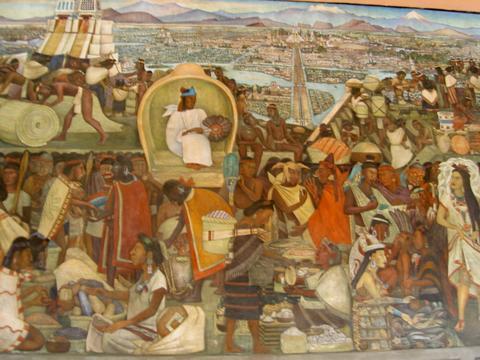
Uncivilized people, pre-1492
Sombrero tip to Abiding in Bolivia for this look at Columbus Day, Canadian Thanksgiving, Indigenous Resistance Day… Dia de la Raza:
The world turned upside down…
Inca Kola News suggests the best way to understand the Latin American reaction to the U.S. economic meltdown comes from Inca and Mayan sources. There’s a Quechua word for it: pachakuti, meaning
the time that, “What became right became wrong; the logical became illogical, and the unreasonable became reasonable.” The word pachakuti is also correctly translated as “the great return”.
As Otto adds, there’s also pop-culture belief that the Mayan calendar predicts the end of the world for precisely 23 December 2012. It’s simply the end of the long count, but after that… who knows?
Both of which he uses to explain the Latin view of the crisis:
… apart from the superficial combo of ridiculing you all up there and fearing for its own short-term future, that is. There is something deeper going on here, people. My only personal observation on this warm and sunny Sunday morning would be to say that for a poor person, becoming poorer doesn’t hurt half as much as for a rich person becoming poor. And this is one poor continent.
I tend to take a simplified Aztec viewpoint: one of the three top gods — Huitzapotchtli (war and strife), Quetzacoatl (peace and justice) or Tezacatlipotchi (the unreality of reality) — is winning the eternal battle for dominance. We’ve spent most of the last century slaughtering each other, so Lord Hummingbird has had his time. then this odd system that really didn’t stop warfare and injustice, but sought to normalize it through political and economic controls. Smoking Mirror has had his day, and maybe the seeming shakeup is just Quetzacoatl’s just over the horizon.
My only personal observation… life will go on, but not things will change.
Another one bites the dust, hey-hey
Comercial Mexicana, one of the larger Mexican owned grocery chains (Mega and Sumesa supermarkets, as well as Mexican Costco Stores) went belly-up last week.
WalMart may be in some trouble here… at least locally there is a lot of buzz about their bland, overpriced VIPs stores closing. WalMart’s Mexican operations include VIPs (which is only good for coffee… and maybe breakfast if you’re in the Zona Rosa at five in the A.M., but that’s more for the floor show — drag queens, cops, hookers, drunk juniors — than the overpriced food) and several different supermarket chains.
I haven’t heard anything about Soriana — which just took over the Gigante store where I usually buy my supermarket type food.
It’s not just supermarkets and retailers… Cemex is in some trouble, but given that the Mexican response to the financial crisis is to build, build, build (the old “New Deal” approach), and other countries may opt for the this kind of tried and true strategy… the international company may actually do very well over the long haul.
Comercial Mexicana had been on a buying binge lately — as have the other big companies — but CM’s debt load was in U.S. dollars. It was over-extended, and… worst of all… it had borrowed in U.S. dollars. The peso this last week lost about 40% of its value against the dollar and — although they argued they were too large to fail — the Treasury (Sec. de Hacienda y Credito Publico, SHCP) refuses to bail out companies with dollar-denominated debts.
Unlike most of the United States, there are alternatives to supermarkets here. Mom n Pop groceries on every street corner, as well as the traditional urban mercados, have been under threat from the big-box stores, so this may actually end up not so bad. I’ve been saying for some time that the real problem with the big box stores was that they did not create wealth except for their stockholders, where the mom-n-pop and mercado stalls created a larger bougeois. That is, the same number of people are involved in the food distribution business, but in the corner store, these people are owners, not employees.
They may earn less, than they would as a senior associate at WalMart, but — unlike mere employees — as owners they are more likely to invest in their neighborhood (even if it only means sweeping the sidewalk every morning), take part in community affairs and instill middle-class virtues like thrift and a respect for education than workers would. Not always, but the person who lives in their business more likely to take some interest in the local community and in the future of that community than if one is just working for a paycheck and — at the end of their shift — is done with the place. The kid bagging your groceries at Mega is just getting your spare change (and, some argue, a “real life education” in job responsiblity). The kid at the corner store is a potential owner… and his or her “real life education” also includes things like accounting and business management. And ownership responsiblity.
It’s very scary that the peso dropped so far — but it may only be psychological — and, it appeared Friday that the slide had stopped (at least temporarily). Things are not going to be good for the next few months (and I’ll probably be whining about it… if not begging for money), but other than listening to the gringo community whine about not being able to find some Canadian brand of tea, or the outrageous suggestion that they buy their Mexican coffee in Mexican brands rather than in the re-imported U.S. packaging… things may not be as bleak as they seem.
Historic Sunday Readings: 12 October 2008
One American History
Former Argentine “illegal” Maria E. Andreu in Newsweek:
When the pundits began to tear into undocumented immigrants last summer, using terms like “parasites” and “criminals,” my first reaction was to bury my head and turn off the TV. I had worked too hard since my own illegal Mexican border crossing 30 years ago, at the age of 8, to blow my cover now. I had assiduously cultivated myself as an American, reading the right books, sporting “the Rachel” haircut in the ’90s, gossiping about reality TV with gusto on the sidelines of my children’s soccer games. I was aided by pasty white skin that placed my ancestry vaguely somewhere in the northern Mediterranean countries or Eastern Europe in most people’s imaginations, not among the stereotype of an illegal immigrant.
Burying the past:
Burro Hall is working in gringolandia:
Later this week we’ll be filming, among other things, the burial of Abraham Lincoln – at 6’4″, the tallest president in American history.
We’re sunk…
(“Nonny Mouse”, Crooks and Liars)
… only ‘Jesus and the Civil War have been written about more.’ Nearly 200 books have been written on the disaster, with countless documentaries, movies, historical and scientific studies analyzing what caused the Titanic to sink. Was it the fault of the captain, running the ship too hard to make a deadline to New York? Was it the fault of the engineers, some defect in the ship’s design? Was the fault of the Marconi wireless officers too busy tapping out passenger’s messages they failed to heed iceberg warning from other ships? Was it the wrath of God angry because the White Star Line didn’t christen their ships? Was it incompetence and the lack of enough lifeboats? Was it just plain bad luck? What they all didn’t know was that a confidential investigation launched by the ship’s builders shortly after the disaster had all too quickly – and all too easily – determined exactly what sank the Titanic.
It was the lack of regulation.
Fouled balls…
Another “drug smuggling” incident thwarted… sort of. Former right fielder (Oakland “A”s and “Way too many to list”) and author Jose Canseco was detained by ICE agents for nine hours after the agents found he was carrying HCG. That’s a hormonal treatment used to prevent miscarriages among certain high risk pregnancies, and for reversing the side effects of long term steroid use. Specifically, as TMZ puts it:
a hormone commonly used to reverse the shrinking effects of jock juice.
HCG is perfectly legal in the United States, but requires a prescription. ICE has been attempting to stem the tide of LEGAL drugs from Mexico into the United States, with probably about as much success as it does the less than legal ones. Maybe they’re having more success with illegal alien penis pumps.
Deja vu for Friday night
When the first video was filmed, it was just a historical and traditional piece. Alas, it’s come back. The second, may be all too relevant to the situation in the United States right now.
<p>
<p>
“What happened?”


