When the U.S. catches a cold, Mexico catches pneumonia, but when the U.S. catches pnumonia…
It may not be so bad…
(Ken Parks, Dow Jones Newswire):
Mexico’s banks have no meaningful exposure to U.S. investment bank Lehman Brothers Holdings Inc. (LEH), which filed for Chapter 11 bankruptcy protection on Monday, according to a government official.
“Lehman really never was a strong counterparty figure in the (Mexican banking) system,” said an official at the National Banking and Securities Commission, or CNBV, who asked not to be named. “It doesn’t represent a risk to the system or ( financial) intermediaries.”
In the case of local institutions owned by foreign banks, any exposure to Lehman Brothers is probably at the parent-company level, the official added.
The Bank of Mexico, which has a hand in regulating the financial system, declined to comment on the matter.
Lehman filed for protection Monday under Chapter 11 of the U.S. Bankruptcy Code in New York, reporting $613 billion in debts.
Mexico’s banking system is largely in the hands of international investors following an acquisition binge in the early part of the decade….
The banking industry’s first-half net profit was nearly unchanged at 30.16 billion pesos ($2.82 billion) compared to the same period of 2007 as rising loan-loss provisions and costs offset higher revenues, according to CNBV data.
STELLLLLLLAAAAAAA! Stanley Kowalski a Mexican stud?
Stace Medellin, who normally writes about Houston area politics on his Dos Centavos site, has shown an understandable interest in the career of actor Benny Briseño, who “unbuttons his sweaty cotton shirt to reveal tight pectorals and a V-shaped torso pointing down to his shaved caramel pubis.”
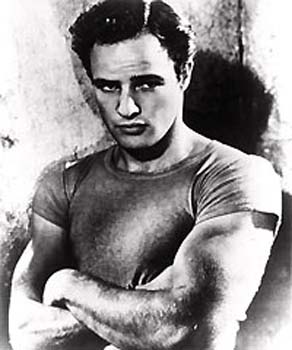
Hey, if he could play Emiliano Zapata, why couldn't Stanley be Mexican?
Don’t get the wrong idea… it’s a family thing. Benny is Stace’s nephew, and — V-shaped torso and all — has been wowing audiences in his role as Tennessee Williams’ toy-boy Francisco “Pancho” Rodriguez in Gregg Barrios’ Rancho Pancho, now playing at the Tennessee WIlliams Festival in Provincetown and returning to San Antonio’s Say Sí Theater 9 – 18 October. Dos Centavos reprints B.V. Olguín’s review for the San Antonio Current:
The nucleus of Barrios’ play is Pancho, who becomes a Pirandello-like character who curses Williams for pimping out his life to create characters and scenes. Streetcar becomes a particularly sore point for Pancho when he realizes their pillow talk is grist for Tennessee’s theater mill. Williams went so far as to model the woman selling funeral flowers (“flores para los muertos”) on Pancho’s mother, who sold handmade wreaths in Piedras Negras, Mexico, where Tennessee and Pancho met.
The play’s bombshell is Barrios’ assertion that Stanley was modeled on Pancho. Williams changes him to a Polish character at his director’s urging, so the play will have a “larger audience.”
Pancho retorts: “But there aren’t any Pollacks in New Orleans!,” and “Pollacks don’t go to the theater!”
New Orleans always was a Latin American city, Williams wrote (and spent time) in Mexico, had his Mexican-American toy boy … and besides… who ever heard of Polish machismo?
Attack in Morelia
I don’t know any more about this than anyone else, but a few preliminary thoughts.
As everyone knows by now, someone threw a hand grenade into the crowd at Gov. Leonel Godoy’s Independence Day Grito, “killing at least seven people, injuring more than 100 others and casting a pall over a country that has experienced unprecedented levels of violence in recent months.” Mark Lacey’s story in the New York Times was headlined “Revelers Killed in Mexican President’s Hometown” suggesting that the attack may have been upon Calderon.
That’s a possibility, but one that goes deeper than the “usual suspects” — narcotics traders. Leonel Godoy is a major figure in the PRD-led opposition to the Calderon Administration, and Michoacan, like the Federal District, is a stronghold of the left. Calderon was nowhere near Morelia, and — if the attack had a political angle, it was more likely an attack on Godoy and his administration than on Calderon.
Andres Manuel Lopez Obrador, of course, condemned the attacks, but several commentators in the Jornada article reporting on AMLO’s statement (Jornada being one of the few major media outlets that report on — and are sympathetic to — the “legitimate government”) suggest I’m not alone in seeing the attack as meant to intimidate the left. La Voz de Michoacan quotes Fausto Vallejo Figueroa, Morelia’s Alcade saying “it would be stupid to write this off” as just organized crime responding to police pressure.
The immediate response from the Calderon administration has been of the “law n’ order” variety (as would be normal), although Don Felipe’s reference to the attackers as “enemies of Mexico” suggests that the event is already being framed as a political issue, requiring a political response. Gangsters aren’t usually described in these terms. Guerrillas are… and there are armed resistance movements in Michoacan.
If it was gangsters… and the possibility exists that the mafias are upping the ante in response to the Calderon Administration’s focus on their activities to the exclusion of other national issues… a hand grenade in a public place is a new and troubling development. The Michoacan Attorney General, Miguel García Hurtado, claims there is already a suspect. But, when there are politically inconvenient — or particularly embarrassing — crimes, it’s amazing how fast the suspects are identified and captured.
Since the weapon was a hand grenade, this is a federal crime, and federal investigators are involved. Until we know the provenance of that grenade (from Mexican military stocks, stolen or smuggled in from the United States… and by whom), it’s going to be hard to say what the “meaning” of the attack was.
I’ve had a few discussions with a cyber-correspondent about the possiblity of “death squds” operating in Mexico. The mass executions in the State of Mexico last week suggested to him military involvement… or paramilitaries operating on behalf of (or in cooperation with) gangsters. In Colombia, upping the ante in the “war on (some) drugs” — as is being done here under the Calderon Administration and being supported by the United States under the “Merida Plan” also led to bomb attacks on civilian intitutions. The Colombian state… which differed only in that the opposition to their questionable legitimacy was armed and had been in rebellion for a very long time — used the violence against civilians to justify its every action…. which has made it a very safe place (for some), but one with neither liberty nor justice.
¡VIVA MEXICO!

…The Queterero Literary Society wasn’t reading the latest novels or discussing poetry—they were discussing things the Inquisition or viceroy forbade, like the American “Declaration of Independence”, military manuals and French and American revolutionary propaganda. They discussed the best type of government for an independent México, and how they might achieve their ends. They planned an army uprising for October 1810. Don Ignacio Allende and Juan de Aldama, both army officers, were in charge of the plans. The pair had been passed over for promotion both for being honest and for being criollos. The two knew officers throughout the army (criollo, honest, or both) who were willing to act.
Miguel Hidalgo y Costilla, a priest from the near-by town of Dolores (modern Dolores Hidalgo), had been a popular professor of religion before he was sent to administer a poor, indigenous community. He had friends throughout the clergy. Like the officers, Hidalgo was criollo, not a gachupín. He could not expect a high position in the church, although his talents would have qualified him to be at least a bishop. Hidalgo had been in some trouble with his Spanish-born bishop (he apparently threw wild parties for his students, liked gambling and had fathered children). Sent to Dolores, more or less as punishment, Hidalgo, like Las Casas and Vasco de Quiroga, dedicated himself to his people. A skinny, bald-headed old man with piercing green eyes, he could command an audience; he was an eloquent defender of the poor against the rich and powerful. He could preach; he could open businesses to employ local people (always something of a rebel, Hidalgo openly grew wine grapes and raised silkworms—both forbidden economic activities.); he also started a shoe factory that is still in business today; but he was helpless to stop Spanish officials from abusing the poor.
The society’s less than literary activities were an open secret. Everyone from the viceroy to the local army commander knew what was going on during the literary gatherings. When the local police chief was ordered to arrest Allende and Aldama, he wasn’t sure what to do. He thought it was a plot to trap him. After all, he and his wife were both members of the Literary Society. Not quite trusting his wife and hoping to keep the arrest orders a secret, he locked her in her bedroom. Josephina Ortega de Dominguez was a stout lady if later portraits are any indication, but she wasn’t the typical indolent criollo lady of her time. According to some stories she broke out her window, tied sheets together and mounted a mule to ride off to warn the plotters. More likely, she sent her maid to warn Allende. Allende and Aldama rode over to Dolores to warn Hidalgo. It was 15 September 1810.
Hidalgo stuck a pistol in his belt, rang the church bell in the middle of the night and preached a sermon. Very few of his parishioners could read or write, and a professorial lecture on the American “Declaration of Independence”, or Paine’s Rights of Man wouldn’t mean very much. These people had not argued over the best form of government for an independent México, but they understood Spanish oppression.
Hidalgo hadn’t taught rhetoric for nothing. He gave the sermon of his life. It began with a three-hundred year history of the people’s abuse by the Spanish. Warming up, he accused the Spanish of plotting to turn the church over to French atheists. Historians have never agreed on exactly what Hidalgo told the people that night, but he worked the crowd into a frenzy and turned the congregation into any army by the time he delivered his Grito de Dolores – Shout (or Cry) of Dolores1 – “¡Viva el rey!, ¡Viva México! ¡Mueran los gachupines!” – “Long live the king, long live México, kill the Spaniards!” …
(Yes, Gods, Gachupines and Gringos will be out very shortly. The review copies are being printed this week. Advance sales direct from the publisher: EditorialMazatlan.com: $24.95 US or 295.00 MX
Remember they got Al Capone for not filing his taxes
This is just weird.
Eight alleged members of La Familia — the criminal gang supposedly responsible for offing 24 people last week in the State of Mexico — were arrested by Federal and State police. Along with the usual guns and SUVs of dubious provinence, the detainees had “originals and copies of death certificates, burial certificates and the documents needed to transport bodies.”
I suppose this is a step in the right direction. The gangsters are still rubbing each other out, but at least they’ve started filing the right paperwork.
All dressed up and nowhere to go?
Anti-immigration groups left with nowhere to go politically? News report from The Real News Network.
I don’t like Ike (update)
Galveston appears to have survived, but something strange is going on. The Houston Chronicle — and national wire services — are reporting on 2000 people rescued in Galveston, but that means 18,000 have not been heard from. Ike did not hit the city head-on and damage may have been less than first feared. So far, only six deaths are reported. But, Kissmybluebutt.com mentions that:
… they will not let reporters into Bolivar peninsula. They won’t even let reporters fly over in helicopters. Governor Perry is trying to blow it off, but everybody here is pretty damned sure that they don’t want more Katrina pictures coming out of Bolivar.
That does not sound good at all. Of all places, the Edinburg (not Texas) Scotsman headlines their story on the story “Searchers take body bags as hurricane toll mounts.” Something is being left out of the news reports.
Grits For Breakfast, who was particulThe Mex Files › Create New Post — WordPressarly concerned about the fate of the thousand inmates in the Galveston County Jail who were not evacuated received news today that at least that particularly vulnerable population made it though alright.
Predicatably, from Houston comes word that FEMA has yet to show up. In Galveston, City Manager Steve LeBlanc is hoping that WalMart will open by the end of the week…
Cuba is cleaning up right now, and probably will be unable to send medical crews. No word yet on Mexican military rescue squads, though I expect they will be sent this week (and probably arrive before FEMA does).
On a slightly loopy note,
Poor babies… life is unFAIR
(Sombrero tip to Duke at The Sanctuary)
FAIR — the Federation for American Immigration Reform — is miffed.
… the Service Employees International Union (SEIU), America’s Voice, Center for New Community, and the Fair Immigration Reform Movement (FIRM) launched a print ad denouncing FAIR … for poisoning the immigration debate with bigoted, xenophobic hate speech.
FAIR’s “Western Region Representative” Joe Turner, is rather annoyed by that. Poor misunderstood Joe. How could anyone think he’s not “fair” minded? After all, as Joe (circled in the photograph) says “just because one believes in white separatism that does not make them a racist.”

Xenophobic and bigoted? Naaahhh!
American Women… Sunday Readings: 14 September 2008
From the sublime… to the absurd… to the inspiring… to the downright scary:
Doris Gibson — More than just a pretty face:

Retrato de Doris Gibson, Sérvulo Gutiérrez, 1948
Via Guanabee, comes the story of legendary Peruvian magazine editor, Doris Gibson, who died last month at the age of 98. Gibson (and yes, she was a native-born Peruvian) was more than just another “very beautiful young woman” who worked for a living. Dan Colliyns (BBC News) tells the story:
She began with 10,000 soles (£2,066), which her uncle had given her, and a typewriter in a single room.
The magazine was going to be called Caras y Caretas – faces and masks – but as Peru was under a military dictatorship at the time they decided to call it just Caretas to symbolise the repression they were living under.
They planned to revert to the original title after the dictatorship but it never happened.
Maria Telpuk: Nothing to declare… and everything to show
Here in Mexico, we’re reading every day about ex-police officers who take up a career as hitmen or kidnappers. At least in Argentina, one former customs officer has found a second career, which at least doesn’t get anyone killed (except maybe old pervs with bad tickers). Revolter at BoRev.Net has the story — and the (not safe for work) pictures:
 Meet Maria Telpuk. This classy lady was the Argentine customs officer who discovered $800,000 in the suitcase of Guido Antonini Wilson last August, setting the whole Valijagate story in motion.
…Telpuk became a minor celeb in Argentina. She changed her name to Lorena, invested in some new boobs, and set out to make her dreams come true. After a photo shoot for Playboy, Telpuk trained to compete for a slot in the hit Argentine teevee program “Skating for a Dream”–sort of a Dancing With the Stars on ice thingy–before producers mysteriously pulled her off the show. Undaunted, she went on to mark the opening of the trial with another nudie spread in second-rate Argentine beaver mag Premium.
Margarita Mbywangi: up from slavery
Lee Glendinning of the Guardian (U.K) profiles Paraguay’s new minister of indigenous affairs.

She was sold between several families as a child. “When I was a girl, four years old, the whites kidnapped me in the jungle and I was sold several times to families of hacienda owners. They sent me to school, so I can read and write,” she told Channel 2 television.
She said her masters told her she was an Indian and began to seek her origins “until I found my people in the community of Chupapou”.
Both in Paraguay and in Bolivia (where separatists, backed by the now departed United States Ambassador, continue to hold slaves) emancipation is coming mostly from new “people power” governments. An English-language broadcast from France24 (unearthed by Duderino at Abiding in Bolivia) looks at the Bolivian slaves and their struggle for freedom.
Maria Estela Martinez Cartas… perhaps a warning is in order.
A presidential candidate in his 70s, once chose a good-looking younger woman with limited executive experience, troubling ties to eccentric religious figures, but ideologically sound as far as the party’s right-wingers were concerned.
 The ticket was elected, the elderly president died and… Maria Estella (“Isabel”) Martinez de Peron became the first woman in the Americas to be head of state of a Republic. As her “Unofficial Biography” makes clear it was wot because she was a she… but because of her inexperience and her choice of advisers … Martinez was a disaster for Argentina:
Isabel had very little in the way of political experience or ambitions…
Isabel was very unpopular. One factor was that [religious crank] Lopez Rega, by this time minister of social welfare, had so much influence over Isabel that he was a de facto prime minister. Despite his right-wing views, his status as the power behind the throne greatly frightened the military. …
… Isabel agreed to fire Lopez, but the military concluded that with the prevailing climate of widespread strikes and political terrorism, a “weak-willed and inexperienced woman” would not be a suitable President. Her time in power resulted in a spike in the inflationary rate and this did not help her case.
To avoid charges of sexism, I’ll add that any resemblance between the Argentine leader and any particular North American one is purely co-incidental, though Pilar Marrero (la Opinion via New American Media) suggests Alaska is a Latin American county:
… One of the reasons Governor Palin is so popular in Alaska is that during her term, she has not had to deal with budgetary problems. She took office in December 2006 in the midst of a huge oil boom, which reminded me of my home country, Venezuela, where the government is swimming in money and mass spending for political purposes.
In the end, Alaska – if it were tropical, warm and the people danced salsa – would be Venezuela. But Sarah Palin is no Hugo Chavez…

U.S. Congress is completely trucked up
P.M. Corn, in Mexico Trucker, on the latest stupid move by the United States Congress to “stop the “mescans”… Keeping Mexican trucks off U.S. roads makes no sense: it is not a safety issue, nor an environmental one, nor will it help consumers. It does, as Corn notes, help Jimmy Hoffa. I suppose it helps the congress-varmits get away with xenophobic rhetoric if they need it, though it is disappointing. And to think I was starting to think the U.S. might actually grow up and act like a normal country.
Dismissing a White House veto threat, the House voted Tuesday to end a pilot program giving Mexican trucks access to U.S. highways.
…
Think you’ve seen the last of Mexican trucks and drivers on US highways? Think again.
Under FMCSA regulations, any Mexican carrier with a “presence” in the US, can operate with the same rights as a US carrier.
Take for example the first Mexican carrier to cross the border under this program, Transportes Olympic.
Owned by Fernando Paez of Apodaca NL, the sister companies are Olympic Transport and Fernado Paez Transport, based in McAllen Texas.
All of these trucks are dual plated, registered in both Texas and Nuevo Leon Mexico, all perfectly legal. Drivers for Transportes Olympic such as our friend Luis Gonzalez, can legally pick up a load in Monterey, and deliver it to it’s destination in the US. All perfectly legal. As Gonzalez stated in an interview last year, he has been doing it safely and without incident for the past 7 years.
Fernando Paez and Transportes Olympic is not the only participant to put themselves in this position. We’ll let the reader figure who the others are. It is not difficult to do.
Then the forgotten element in this mad race to ban 100 Mexican trucks from US roadways is the 800-1300 Mexican carriers who were grandfathered in back in 1982. “Grandfathering” means they were allowed to operate in the US before the 1982 Moratorium and the Moratorium did not effect them.
So for more than 30 years, these Mexican carriers have been operating in the US without incident and safely. Why has no one mentioned these?
As always, Corn point out that not only have Mexican trucks operated on U.S. highways for a number of years, Mexican truckers are subject to more — not less — stringent regulations than U.S. based carriers. And, if it’s the trucks themselves that are the problem, then why do most U.S. trucking companies use Mexican built rigs?
Out of the north…
Looks like more still more foreigners are expected to stay:
Edmunton Journal (7-September 2008 ):
Mexico was named the world’s top retirement destination in an annual look at global retirement trends in International Living Magazine.
The magazine released its 15th annual retirement index and rated Mexico highly for its affordable combination of modern features and old-world charm, health, climate, infrastructure and cost of living.
Mexico is home to close to 700,000 U.S. and Canadian citizens who exchanged urban busyness, frigid temperatures and higher living costs for a more relaxed, warmer and inexpensive lifestyle.
And, Mexico is looking at expanding niche markets within the tourism sector:
Sherice Sánchez, Excelsior (my translation):
Implementing strategies to target services towards gay couples, and to concentrate on the special needs of these tourists would make Mexico one of the best tourist destinations for the coveted lesbian and gay market.
According to Thomas Roth, president of Community Marketing, Inc., lesbian and gay couples from the United States spend about 64.5 billion dollars a year on travel. This is an extremely attractive market for Mexico, which earns about 13 billion dollars per year from international tourists.
During his presentation at the Sixth Annual Mexican Tourism Leadership Forum, Roth indicated that in our country only there are two destinations mentioned by gay couples, though the country has other attractions that would be of extreme interest to this market.
“Puerta Vallarta holds second place among the preference for international gay and lesbian travel world-wide, while Cancún is in eighth place. It is odd that Mexico City does not rank, despite its diversity, which suggests to us that it could do more to attract this sector of the tourist population,” he said.
Based on Report 2007 on Lesbian/Gay Tourism, the speaker explained that gay couples, or those that travel in groups or pairs have a higher disposable income to spend on travel than other niche markets of international travelers.
Because most lesbian and gay tourists do not have children, those that travel regulary can afford to take up to six trips a year.
“Normally three are for vacations, two are visits to friend or relatives, and one is business related. On each trip, tourists in this sector spend an average of six thousand dollars, which annually works out to 36 thousand dollars on travel.”
No word on the wealthy gay retiree market, though it is out there.
Is there still a Galveston?

(Houston Chronicle photo by Johnny Hansen of the memorial to the victims of the 1900 hurricane that killed 8 to 12,000 people out of what was then a population of about 40,000).
Galveston was a link between French New Orleans and Spanish Veracruz (founded by the pre-NAFTA international trader Jean Lafitte… ok, he was a pirate) and is not just a beach resort, but a still important working city — with oil and chemical plants nearby, as well as medical research facilities, including a tropical medicine hospital with a population of about 60,000. Or was. The 20,000 or so who did not evacuate are on their own. It’s an island, and the bridge is closed.
The city is protected by a sand dune, about a third of which is already gone, and the nearby “suburb” of Surfside was wiped out.
“God help you, we can’t,” City Manager Steve Le Blanc said before hunkering down and closing city services.


 mexfiles.net