Bush-whacked economy

(Dollar bill redesign from portfolio.com via Inca Kola News)
Rules seem to be changing all over the place.
George W. Bush has become a “socialist.” Today Mr. Bush pronounced “that the historic federal government takeover of mortgage giants Fannie Mae and Freddie Mac is needed to keep them from failing, a risk he called ‘unacceptable’ for an economy battered by housing and credit crises.”
I don’t think that’s quite true. The socialists in the Americas are spending money that’s being earned from production. Bush isn’t a socialist. He’s a Peronist.
- Strong authoritarian centralized government, with strict control of opposition forces.
- Freedom from foreign influences.
- A third way approach to economics which purported to be neither socialist nor capitalist, but to incorporate elements of both in a corporativist manner.
Of course, Bush would never admit he’s not a capitalist, though He does indeed seek to cut off foreign influence, even when it makes economic sense. Like Peron, he does throw money at local industries, and when things go wrong… seeks to change the rules.
That’s the way Mexico Trucker sees the U.S. attitude towards NAFTA anyway:
The home team trails in the third quarter as the underdog visitors steadily advance the ball. Coaches are nervous; fans are grumbling. Desperate for a turnaround, the home team announces a surprise rule change: From now on, the visitors are banned from crossing the 50-yard line.
Sounds absurd, but that’s what Congress proposes to do with NAFTA, the free-trade accord it approved in 1993. Sure, NAFTA might not be a crowd pleaser. It is, however, a treaty that legally binds the United States. The rules don’t change just because the home team is in trouble.
Miffed sheriff takes his boys and goes home
Guadalupe, Arizona is in Maricopa County, Arizona… BUT apparently won’t receive county services:
The town of Guadalupe’s contract for police services with the Maricopa County Sheriff’s Office will end in March, one year earlier than the contract calls for, the county’s Board of Supervisors decided Wednesday.
The 3-1 vote by the board started the clock for town officials and Sheriff Joe Arpaio to try to negotiate a deal to reinstate the contract and continue law-enforcement services in the small town southeast of Phoenix.
Guadalupe and the Sheriff’s Office have 180 days to strike a deal, and it appears they can.
Arpaio said Wednesday that he would be willing to negotiate with Guadalupe Mayor Frank Montiel only if no one will tell him how to police the town or whether he can launch immigration sweeps, similar to those done in April amid protests, fights with town politicians and accusations of racial profiling.“You will not tell this sheriff what laws to enforce in Guadalupe,” Arpaio said in a news conference.
The 6,000 or so Guadalupanos are 75 percent of Mexican descent. Half are Yaquis, who founded the community as a refuge from Porfirio Diaz’ pograms against the Sonoran native people at the turn of the 20th century. Back on 3 April, the notorious (in all senses of the word) county sherriff, Joe Arpaio, ran into more than he bargained for in one of his publicity-stunt “anti-immigration raids“:
… there were only four horsemen that evening, bolstered, though they were, by about 40 more deputies from the Maricopa County Sheriff’s Office. But as the contingent of gendarmes slowly approached in an attempt to clear the entrance to the Family Dollar parking lot where Sheriff Joe Arpaio’s mobile command center had set up camp, there was the feel of something ugly about to go down.
The crowd of about 200 activists and citizens responded to this menace with high-pitched cries: “Yip, yip, yip, yip!” As if on cue, the horses began to buck their riders and neigh and snort, forcing the sheriff’s mounties to pull back behind the chain-link fence.
“Those are Mexican horses,” someone quipped as folks laughed and cheered. It was but one sign that the two-day anti-immigrant sweep was not proceeding as planned.
Arpaio’s forces were meeting resistance outside the Family Dollar store, where demonstrators wielded homemade placards ordering Arpaio off Yaqui tribal land … and accusing his deputies of racial profiling.
Though advised it was “political suicide” Guadalupe mayor Rebecca Jimenez — in front of television cameras covering the botched operation — told the Sheriff that his alleged press release claiming the city council had invited the sheriff to conduct the operation was phoney. As a result, Arpio angrily said: “”Well, we will be back here tomorrow: full force!”.
Mayor Jimenez has since been replaced with a more concilatory Mayor, Frankie Montiel, who is willing to allow the Sheriff to conduct his made for TV immigration sweeps — but when city residents, joined by immigrant rights groups, showed up at a county supervisors’ meeting last Tuesday, the supervisors “went into lockdown” and in an executive session (which is probably illegal under Arizona’s “Open Meetings Act”) voted to discontinue providing Sheriff’s Department services to the community.

Sheriff Joe, you ready to rumble?
I have to admit I’ve never heard of a U.S. county attempting to punish a community by cutting off mandated services, but Guadalupe is on their own in 180 days(though they may contract for police protection from nearby Phoenix or Tempe).
Though mostly farmers, the Yaqui’s ferocity as fighters even scared the Apaches… heck, the most famous Yaqui of all times — Maria Felix — was never a pushover, in the movies or in real life. You know those old stories about staking guys out in the desert on anthills? That was a Yaqui thing. I wouldn’t hold out much hope for survival of any criminal who has to be dealt with locally.
If they were able to hold off Porfirio Diaz throughout his regime (and were still staging uprisings into the 1920s), I wouldn’t hold out much hope for Sheriff Joe, either. “Yip! Yip! Yip!” for the Municipio Libre of Guadalupe!
Mariachi will never be the same
I’ve posted on the German influence on Mexican music… but what if Mexican music had influenced the Germans?
This is just plain weird…
Wrong guys in Morelia… time to look for the “right” suspects
For a short time I had a cushy job holding “conversation business English” classes with two fraud investigators for American Express — both former agents for the PGR. They were nice enough guys, though their talk about torture and the need for it was kind of creepy. They told the joke about the circus magician who reaches into his hat to discover…. the rabbit ran off with the payroll. The FBI, Scotland Yard and the Mexican police are called in to investigate. The FBI takes DNA swabs from everyone and runs forensic tests, Scotland Yard calls everyone into the big top and suggests they all “assist with the inquiries” and… both come up empty. The Mexican police walk back into a tent where horrible slams and blood-curdling screams are soon heard. Out pops a suspect to confess… the elephant! (The moral of the story… Mexican police arrest the biggest and easiest to find suspect they can, guilt or innocence being secondary to a confession).
I think about that every time I hear of a particularly newsworthy crime in Mexico being solved almost immediately. Especially a complex and politically sensitive one like the grenade attack at the Morelia grito. U.S. — and some Mexican — sources are reporting that suspects are in custody… arrested in Zacatecas and “appeared to bear injuries similar to shrapnel wounds suffered by victims of the grenade attack.” Or, perhaps the auto accident they were being treated for at the time of their arrest.
The PRG (Federal Prosecutor’s Office, which is also the investigative agency in federal crimes) might be getting better. They have already said these aren’t the guys. La Voz de Michoacan reports the prosecutors still have yet to determine a motive, let alone identified suspects…. who, they are sure… are not these guys.
Everyone is quick to assume this is an off-shoot of the Zetas, and suddenly up pops a story on how there is a Michoacan crime syndicate (la Familia) allied with the Zetas (who normally operate elsewhere). All a little too convenient. Nezua suspect the CiA… which is not off the wall at all.
One reason I’ve been posting so much about Bolivia is that it is an obvious example of U.S. attempts to support rightist groups in Latin America, or to provoke rightist reaction in leftist controlled states. Michoacan is a left-wing holdout against the pro-U.S. Calderon administration (Governor Godoy is a plausible PRD candidate for President in 2012, and a leading figure in the opposition).
If this was political, I think the right is the most likely suspect, though not necessarily working for the CIA. Gangsters up to now haven’t had a motive for indiscriminate violence against civilians, and certainly not in urban areas. There’s no upside for them, and the gangsters are not stupid. On the other hand, rightists have provoked violence (some thought last spring’s anti-emo attacks were basically a warm up for rightist violence — then blamed on the punks, who are anarchists and leftists) and, it’s just more logical to expect the right to provoke police crackdowns than for the left to do so… especially in a leftist state like Michoacan.
Secondly, if this is an indication that Mexico is following the Colombian scenario where gangsters turned to indiscriminate urban violence, you’ll recall it was right-wingers who used the gangsters for this purpose or that the gangsters allied themselves with the extreme right in the urban areas (FARC is rural). After all, if gangsters have infiltrated the halls of power, the last thing they want is a change in management. And, in Colombia, the rightist government did quell urban violence… by legitimizing the gangsters connected to the right, and putting one of their own (ALvaro Uribe) in the Presidency.
Maybe the PRG needs to bust some heads… but they need to make sure they’re after rabbits and not elephants.
Shaken… and stirred: 19 September 1985
One can almost pinpoint not only the date, but the minute, that the political and cultural reforms that changed Mexico from a “perfect dictatorship” to a post-modern state occurred. 7:19 A.M, 19 September 1985.
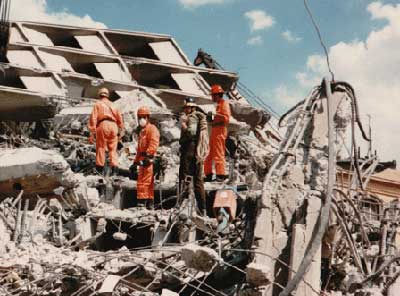 The epicenter of the 8.1 Richter Scale earthquake was the Cocos Plate, off the Michoacan coast, and was felt as far as Los Angeles, Houston and Guatemala City, but the damage was most severe in Mexico City. In less than a minute, according to estimates from the Servicio sismológico nacional 40,000 were killed, 30,000 homes were destroyed and 400 large buildings collapsed. Within the Capital itself, the death toll was somewhere between the 4,200 later estimated by the BBC and 10,000.
The scale of the devastation was suspected, but at the time, not much was know. The day’s BBC News, reported only that:
Mexico City… was declared a disaster zone.
Telephone links were cut, and a communications tower burst into flames, leaving television broadcasts monitored in neighbouring Guatemala the only source of information.
Television reports said hundreds of people are trapped in rubble, and more than a third of all buildings have been damaged.
Clouds of dust hung over the city centre, and broken glass and chunks of cement littered the streets.
There was a strong smell of gas and the city government issued a radio appeal for people not to light matches.
Collapsed buildings
Several high-rise hotels collapsed entirely, as well as a section of the city’s huge medical centre. Many buildings were on fire. The underground system also failed, stranding hundreds of people.
Many people gathered on street corners, several weeping and some fainting. Others joined rescue workers digging through rubble in a frantic search for survivors.

1988 election protests in Mexico City (Center for Latin American Studies, U.C. Berkeley)
It was those digging through the rubble that changed the system. As with Hurricane Ike today, the government attempted to black out news coverage of what happened — and what the death toll might be — and this was the not so recent pre-internet era — but too many people discovered their hidden talent to at least witness the truth, and relay the information accurately. There was no way NOT to see that the Army was looting at worst, and guarding only the wealthy at best. There was no way NOT to notice that the buildings that collapsed tended to be the newest, government-financed constructions. There was no way NOT to notice that the Party and the De La Madrid administation was hapless and incompetent.
And everyone — like it or not — was in the streets. In 1968, those who took to the streets were led by students and intellectuals. The grievances that brought the people out were learned ones — things that required thinking them through, synthisizing the information — the lack of social justice, liberty, freedom of expression. In 1985, literally felt their grievances. And had no choice but to be in the streets.
Not that they openly rebelled. They were too busy trying to survive, and — just in surviving — transformed the political and social landscape. Mexico City, and Mexico itself, has always been a huge village society. While there are always tensions and those who just don’t fit in any village, things are worked out within the group. Which is what neighbors had to do, and basically turned their backs on the official channels.
My favorite story is of the unknown hero, el chamaco... the kid. The earthquake hit as students in the first school shift (schools in the Capital have morning and afternoon/evening shifts to handle what at that time was a huge population growth and a shortage of classroom space) were preparing to leave for school. El chamaco had a scout meeting after school and was prepared: at least he was in his scout uniform. The 14-year old was his block’s undisputed authority in the informal search, rescue, triage, emergency food distribution system that was patched together. And, so its said, did a more than credible job.
While there were great heroes — like el chamaco, the Mole Men of Tlatelolco, the Red Cross and the Fire Department — these were either the individuals whose unknown talents are only discoved in extraordinary circumstances, or apolitical civil institutions. The system was broken.
And the system never recovered. In the city especially, even as people began to recover some semblance of normalalcy, the had lost faith in the party and the bland, academic PRI leaderhip. Right then, at 7:19 AM on 19 September 1985, even if they didn’t know it at the time, Mexico City would become a stronghold of a new political party — the PRD — led by younger leaders who were jolted out of complacency by the system’s failures to deal with disaster and others who noticed the serious cracks in the system, and fled before it all came tumbling down around their ears.
Not being a citizen, I of course, am not a party member, nor am I claiming that party is perfect (or even better than any of the others). But it was the new PRD that transformed Mexico City mostly by paying attention to what the street level leaders were demanding, as well as paying attention to what a city needs… fire brigades, earthquake-proof buildings, a functional transit system. PAN, ironically, was the political beneficiary of the split in the PRI, somewhat plastering over the serious cracks in the edifice of national power, but not completely. A few institutions had to be completely remodeled, like the Army… which recovered its honor though competent disaster relief and taking on the task of protecting the people and the natural resources in times of disaster, and some are still shaky… like the police.
This country may have its problems but — as the 19 September earthquake painfully demonstrated, Mexico can weather disasters, and can creatively solve its problems… not perfectly, and not immediately, but it will muddle through, and at worst, fall back on the untapped resources of tradition.
“I didn’t do nothin’ and I’ll never do it again…”
If you’re wondering why so many down here (myself included) have a jaundiced view of Plan Merida, and the whole “War on (some) drugs” story, it’s because it’s painfully obvious that the United States is not willing to do anything substantial beyond providing taxpayer funding to businesses that might profit from the human control biz:
Mike Marizco in The (Mexico City) News:
A community college graduate, 23 years old, slim, the fat still evident on his baby-faced cheeks, with a pretty bride and a newborn baby, is the face behind the killers of Mexico’s drug cartels.
And I’m hoping it wasn’t that boyish appearance that led to the failed opportunity to make an example of the arms traffickers that are decimating the northern border.
Much of this story is metaphorical old hat: U.S. firepower acting as the fuel for Mexico’s violence. The U.S. Bureau of Alcohol, Tobacco and Firearms, or ATF, estimates 90 to 95 percent of weapons used in crimes in Mexico came from the United States. I’m guessing that stat is simply a weaselly way of saying 100 percent, but I won’t digress.
Varela looks like an all-American kid… He wasn’t simply running semi-auto AKs and handguns down. He ran at least two .50-caliber machine guns to Columbus, New Mexico. He must have been doing a great job for Vicente Carrillo’s people, decided to push it beyond legal U.S. guns, maybe hit the big time. Last April, he went down trying to buy an M-60 from undercover cops in Phoenix.
Mexican Army units identified one of the .50-cals as being used to kill a police commander in Juárez, Francisco Ledesma Salazar.
That’s where the story takes a particular twist. Even though ATF agents in their highly-vaunted “Project Gunrunner” arrested Varela, he never faced federal weapons trafficking charges.
Instead, the young man only faced two state charges, neither of which had anything to do with arms trafficking, a crime I don’t believe the state of Arizona has the capacity to enforce. Instead, Varela was sentenced last Friday to two-and-íhalf years in state prison on one fraud and one forgery count.
…
But our problems in Arizona are only beginning. If Feds can’t – or won’t – prosecute easy, big cases like this one, what possible chance will they ever have of bringing this place under some kind of control?
What a dump!
Diego Cevallos, in Tierramérica (Uruguay) on a growing Mexico City problem that just won’t go away:
MEXICO CITY, Sep 15 (Tierramérica).- If the municipal government of Mexico City were to keep its promises, laid out in laws and plans from 2003 and 2004, the treatment of the 12,300 tons of garbage produced daily by the metropolis would be more environmentally friendly. But instead there is a threat of collapse and a huge contaminated area.
The Bordo Poniente dump emits two million tons of carbon-based gases into the atmosphere each year, which represents 15 percent of the greenhouse effect gases produced by this city of nine million people, second only to automobiles, the main source of climate changing gases. Closing down the dump would be the equivalent of taking some 500,000 cars off the roads. After at least four postponements in five years, the Bordo Poniente, opened in 1985 in the east of the capital, will be shut down in January. But for now there is no alternative dump site, although the authorities are considering various possibilities.
The Federal District picks up garbage twice a day (and it’s quite an experience, the garbage men preceded by a bell man coming down the street… “bring out your trash!”), and with 9 to 12 million resident it does pile up.
The “Cantina Putsch” in Bolivia
I’m not sure whose head was up whose ass at the Washington Post when they published an editorial calling for the elected government to “negotiate” with these yo-yos:

A stupid editorial in support of really stupid people. Uh… dudes… if you’re gonna pretend your uprising is democratic, your “campaign vehicle” is sending the wrong message.
The photo is from a Venezuelan newscast — and even with the Venezuelan spin, it’s hard to overlook who these Bolivian separatists are. (The broadcast is a bit long to post here, but it was uploaded on the Canadian blog, “News of the Restless.)
The presenter’s unusual looks give him added credibility, though when you see a guy like this talking about Nazis, it is a bit creepy.
By the way, the putsch appears to have collapsed. After a civilian massacre by separatist gangs led to the flight, and arrest of one departmental governor, the separatist movement has collapsed. The government is still willing to negotiate legitimate grievances — annoying the United States Government to the point where it has basically broken relations with Bolivia . This is absurd. Ambassador Goldberg got himself mixed up with Nazis and Bolivia is the “axis of evil”. Geeze… When, or IF, relations are restored, perhaps we can find some better representatives — Americans who know how to “negotiate” with Nazis:
Your tax dollars (and my pesos) at work
Two wonky reports for those interested (via NarcoNews). The FY2008 Supplemental Appropriations Spending Plan (the Plan Merida bucks) — at least the public parts — have been posted as a PDF file, and Narconews includes a translation from the 11 September Jornada article by Enrique Mendez and Roberto Garduño on the Mexican security budget (which, as I predicted, stints other government programs, like agriculture):
The Administration of Felipe Calderon proposed to the House of Representatives, a budget for security, armed forces and for the CISEN (National Security and Investigation Center) of 104 billion, 181 million MXP (Mexican pesos) (USD $10.418 billion). This budget is primarily assigned to the SSP (Mexican Federal Department of Public Security), which will have more input in the struggle against organized crime, as part of a strategy to “assure the viability of the State and of democracy”.
…
SSP will establish police stations throughout the country, with a budget of 1 billion pesos (USD $1 million) to “provide citizens with integral attention to prevention, investigation and persecution of crime” as well as to “offer a service of prompt attention crime related complaints, actions to prevent crime and efficient police deployment. This is given it will have personnel for analysis, technical services and investigations to disarticulate criminal organizations”.
I thought the strategy was to let the gangsters “disarticulate” each other… preferably at the neck.
Mexicans are not Spaniards, nor are Spaniards Mexicans
From the U.S. election news (Americablog.com):
… John McCain didn’t appear to know that Spain was in Europe, or that the leader of Spain was named Zapatero. This, after the interviewer told him, and I paraphrase, “Okay let’s switch to Spain – would you be willing to meet with the head of our government, Mr. Zapatero.” McCain then launched into this weird discussion about how friends of America are welcome, but enemies of America are not, and then he starts talking about Mexico. The reporter, obviously sensing something weird, asks him again, and again, would you be willing to meet with our president. McCain again talks about America’s enemies. Finally, she says, and again I paraphrase, “Senator, I’m talking about here in Europe, in Spain, would you be willing to talk to our leader?” And McCain AGAIN starts rambling about America’s enemies.
He just never expected a Spanish inquisition…
No shit!
Geeze, after being the plot of a never made movie, endless blathering by the right wing , complete fabrications by United States Congressmen (one of my favorites, since I know the sherriff in question, and he still shakes his head over this story) and scary stories by Homeland Security apparchiks … you’d expect the obvious would have gotten at least a minimum of attentin last week:
THERE ARE NO AL QUEDA IN MEXICO.
The Associated Press tries to spin the story into “well, not since 9-11, anyway…” but the only other English-language coverage I’ve been able to find, from WW4 Report details what “terrorists” have been detained in Mexico. Mostly Basque separatists and a few Iraqui Christians who were seeking refuge from the U.S. created religious civil war at home.
Mexico has only been involved in one overseas war (the Second World War… and, yes… they were on the Allied side) and is not at odds with any foreign government I can think of. The only country they’ve had any disputes with recently have been Colombia (over claims that UNAM had a FARC cell) and a snit with Cuba when Vicente Fox dissed Fidel Castro at George W. Bush’s insistence before a inter-american conference a few years ago. And, relations are usually strained with the United States.
The only terrorists* around these parts have been right-wing Cubans. But, they don’t count in the U.S., so what’s that fence for again?
*Obviously, I wrote this before the Moreia incident, but if terrorism is involved, it’s more domestic than foreign.


 mexfiles.net