Worst… photo…. ever!
The Associated Press actually used this photo on a story about the Salmonella scare:

Guanabee.com noticed it too, and it is kind of funny to see Manuel Uribe (who you have to admire for trying to live a normal life) with those tomatoes, but — living in Sinaloa, where if it wasn’t for tomato exports, our local farmers would be having to grow still more marijuana for the U.S. market — it can make you a little testy to see a disaster to our local economy being used for a cheap joke. Anyway, if Sinaloa tomatoes made people sick, why didn’t Sinaloa marijuana?
Not being a Mexican, and not overweight (just the opposite, I need to gain a couple kilos), I can’t say… but is this just a cheap insult at Uribe’s expense (who knows damn well he’s really, really fat — and deals with it), or not so hidden racism… or just bone-headed? Do tomatoes make you fat?
As goes Argentina…
(From The Latin Americanist)
Argentinean judges continue to take steps toward decriminalize drug possession after federal courts judges threw out drug possession charges in April.
Last week, a group of judges enforced that opinion, ruling on a case of a young man arrested for marijuana possession.
The judges said criminalization will apply “where the possession of narcotics for personal consumption represents a danger for the public health of others.”
Argentina’s minister of justice, security and health, Anibal Fernandez, said the country’s drug laws are a “catastrophe.”
Mexico, like other Latin American nations, traditionally treated narcotics possession as a public heath issue (and “drug related crimes” are still considered “Crimes Against Public Health”). And, in theory anyway, possession for necessary personal use is an affirmative defense in possession cases. But, if you’re arrested for possession, you’ll probably sit in jail longer waiting to prove your stash was for necessary use than you would if you are eventually convicted.
The biggest problem is that “personal use” is never defined. When the Fox Administration attempted to define what was permissible personal use (and actually made drug possession laws stricter, not more lenient), even left-leaning U.S. sources suddenly went batshit about Mexico “legalizing” narcotics.
With the “surge” in the war on (some) narcotics exporters going about as well as the U.S. surge in Iraq (with about the same number of fatalities among Mexicans as the U.S. has had among its own soldiers — not counting mercenaries, “coalition partners”… or Iraqi civilians), some Mexicans are beginning to wonder if that war isn’t increasing demand even in Mexico. Unable to unload their junk in their normal markets, narcotics — like Sinaloa tomatoes — are deep discounted at home. And, maybe it does need to be treated as a public health matter.
Where there’s a will — or a wall — there’s a way
Marc Cooper, L.A. Weekly News reports from Sasabe, Arizona:
There’s nothing earthshaking about bumping into a clump of undocumented Mexican border crossers down in this part of the world. More than a thousand a day, almost half a million a year, continue to elude the personnel and machinery of an ever-beefier U.S. Border Patrol as they enter this zone immediately south of Tucson.
What was remarkable is that we ran into this particular group barely a two-minute drive from the just-constructed, 15-foot-high multimillion-dollar fence that is a showcase of the Bush administration’s vaunted Secure Border Initiative. The same wall that both parties in Congress have recently embraced as the answer to stemming illegal immigration. Moreover, the group we found — right off the main road leading from the official U.S. port of entry at Sasabe — was but a few clicks away from one of the nine highly touted prototype electronic-surveillance towers that the U.S. government paid the Boeing Company $20 million to build along a 28-mile run of the border.
In other words, the small group of migrants we spoke to had not only just jumped the newest section of the government’s physical fence, they had also dodged the high-tech “virtual fence,” loaded with the latest gadgets and software.
“We got over the fence with a rope,” said the migrant who had flagged us down. “It took about two minutes and we were over.”
A fishy Friday night video
Thanks to BurroHall for finding this in the British tabloid, The Sun. I usually don’t get further in Mexican kinkiness than the Mexican press.
Locals fear ONE rogue shark is responsible but experts believe a pack of deadly bull sharks are actively targeting humans for the first time.
They think the 10ft-long fish could have developed a taste for human flesh after devouring hundreds of corpses dumped into the sea by mobsters.
The story was about the recent spate of shark attacks around Zihuatanejo, but I salute the British reporters for trying their best to write a decent Nota Roja, and did a credible job, given their unfamiliarity with both geography (Zihutanejo is a long way from Sinaloa where the gangsters are killing each other) and local customs (gangsters around here wrap the bodies in plastic and leave them out with the trash at the side of the road… rather considerate of them). Mexicans are NOT British, and — by the Sun’s logic — they must have learned from one of England’s most famous gangsters (even though it was a German who made him famous, and an American who made him popular)… MacHeath, dear:
Factoid of the week…
Canada’s prime minister on Wednesday officially apologized to natives for more than a century of abuses…”
While it is long overdue, it did make me curious about something. When were Native people in Canada recognized as citizens? How about the U.S.? How about Mexico?
Here’s the answer:
1960 Registered Indians are granted the right to vote in federal elections. Prior to 1960, First Nations people were required to give up their Indian status to be considered Canadian citizens under the law.
Eighty years ago, with the passage of the Indian Citizenship Act of 1924, Native Americans were first granted U.S. citizenship and the corollary right to vote-54 years after African-American men were formally enfranchised with the 15th Amendment (1920).
However, voting procedures are delegated to the states, and well past 1924 some states misused this power to continue to deny Native Americans the right to vote. For example, as late as 1962, New Mexico still overtly prohibited Native Americans from voting.
he Mexican Republic’s 1824 constitution declared Indians to be citizens with rights to both vote and hold public office.
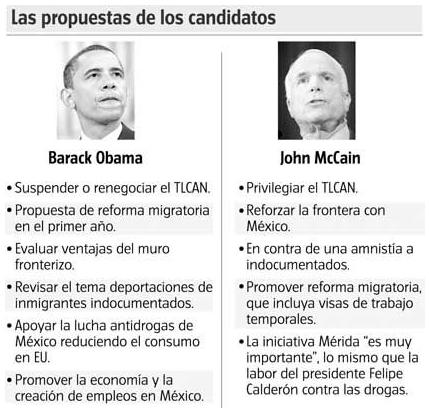
How the Mexican press sees the U.S. elections…

Obama… and some other guy …
Eating tomatos… damn straight I am
Roma tomatoes were 10.80 pesos per Kilo yesterday at Mega. You bet I’m gonna eat em. And already have… so far to no ill effects.
Tomatoes are Sinaloa’s largest legal export crop — there’s even a tomato on the state’s license plate (you were expecting maybe a marijuana leaf?). In El Debate this morning, several growers were openly speculating that blaming Mexican tomato growers for the salmonella outbreak in the U.S. might have more to do with agricultural protectionism than anything else. It makes some sense to me. “Med flies” — which were the big agricultural issue several years ago — were cited as a rationale for keeping Michoacan avocados out of the U.S. … even though the Mediterranean fruit fly can’t live at the altitudes where avocados grow in Michoacan (and the insect isn’t found anywhere in the state).
I also wondered if blaming the growers and the pickers might have something to do with union busting. Burger King, and their bankers, Goldman-Sachs, have been doing everything possible to undo the affront of having to deal with the tomato pickers’ union.
 The PBS News Hour reported yesterday (transcript here) that so far salmonella cases (which are only serious if you have a surpressed immune system — which tomatoes, with their high vitamin C content, keep healthy) have been traced back to New Mexico and Texas. Given that the only way tomatoes could be contaminated is from being washed in water contaminated with snake shit (really!), it’s more likely to have happened at a packing plant than anywhere else.
And, in Mexico, you wash your raw veggies in soap and water — or, if you’re really, really careful, spray them with anti-bacterial stuff (can’t think of the name, but it’s in every supermarket) — before you eat them anyway. Actually, in Mexico, where you never assume the state managed to resolve all life’s little problems — you wash your hands before you handle food. Go in the smallest mom-n-pop hole in the wall greasy cuchilla, and there’s a sink in the corner for you to wash up before you eat. The whole salmonella scare may just come down to the gringo assumption that their food is protected.
So, last night for supper, I had a cheeseburger. The Nuevo Leon beef should be free of mad cow (something you can’t say about U.S. beef). Since you can’t make a decent “hamburgesa” without jalepeños — and anything that survives a jalepeño would have probably killed you otherwise, the only real danger (besides the cholesterol) might have been unpasteurized Chihuahua Mennonite cheese . Sure as hell wasn’t the tomatoes. Which were delicious.
¡AI Papí!
As part of a city health awareness campaign, municipal authorities in Escobedo, Nuevo Leon are giving away “Healthy Daddy” packages for Father’s Day — containing disposable razors, condoms and viagra.
These same municipal authorities canceled permission to hold “Expo Sexo” — featuring porn films and … ahem… adult entertainment items… a couple of weeks ago at the request of conservative citizens.
I guess that means the up-standing citizens of the fastest growing munipality in Nuevo Leon are heeding the words of Municipal Presidenta, Margareta Martínez López, to come together and avoid sterile attacks.
TAXI!!!
No more jokes about Mexican Engineering. With no suitable automobile that could be modified to fit their plans, Arturo Millán Martínez, Eduardo González Morón y Juan Antonio Islas spent two weeks (WEEKS!) coming up with the future Mexico City taxicab. Within two years, Chapulines (“grasshoppers”) should be in production and on the streets.
With a tiny diesel engine that powers the battery system (designed to reduce energy consumption and emissions), the sub-compact sized Chapuline will seat four passengers, including those in wheelchairs and have room for luggage. With an on-board GPS system, generating an estimated time and distance readout, it’s going to be a bit harder for drivers to take the long-way ’round.
And, they’re so darn cute!

(Photo: El Universal)
Taking stock of stock of Mexico
I don’t pretend to understand this, but for those who do, the Financial Times (Great Britain) sees something good about the Mexican Stock Exchange offering stock in themselves. I think.
After 18 months of planning, announcements and delays, Mexico’s stock exchange (BMV) is finally set to launch its own initial public offering on Wednesday.
On the surface, the float is not worth getting too excited about – at least compared with that of Brazil’s exchange last October. For one thing, the BMV is much smaller than its Brazilian counterpart, the Bovespa. Wednesday’s float, which will involve about 40 per cent of the total shares, is expected to value the BMV at about $1bn. The Bovespa, which in May merged with BM&F, the country’s principal futures exchange, is now worth about $20bn.
There is good reason for that huge difference. By the end of last year, the combined market capitalisation of companies listed on the Bovespa was three times greater than that of companies listed on the BMV. The Brazilian exchange is also much more dynamic. Last year, the average number of IPOs exceeded one a week compared with just four in the entire year in Mexico.
But the BMV’s decision is a good one, nonetheless. First, if the history of flotations is anything to go by (and if the rumours from the book-building phase of the IPO are to be trusted), the transaction will generate a nice little profit for the BMV’s 24 current brokerages, which own the exchange.
More importantly, listing the shares should bring about far greater innovation, transparency and corporate governance to an institution that for too long has been run as if it were an uncompetitive quasi-government entity or old boys’ club.
True, most of the obstacles to more listings and greater trading volumes lie beyond the exchange itself and have to do with the way Mexico’s corporate titans squash opposition and stifle competition wherever it tries to surface.
But at least boosting liquidity and introducing innovation – market makers still do not exist in Mexico, for example – will be easier to achieve with profit-seeking investors at the helm. Indeed, while it may be unwise to expect the IPO to perform a miracle, at the very least it should make the exchange better at doing its job.
Copyright The Financial Times Limited 2008
Long live rock…. cumbia… ranchero… jazz… banda…
Mazatlán’s “Dia de musica” celebration shows that Sinaloa is more than “German Omm-paa-paa played by Mexicans on stolen instruments”… and there’s a lot more diversity in Mexico than outsiders realize.
And is there ever diversity! Drag queen Regina Orozco — despite a few cat-calls — was a huge hit, keeping the audience enthralled for an entire ninety-minute performance.


 mexfiles.net