Et tu, Guatemala?
I’ll take this with a grain of salt, considering Cuba’s Prensa Latina sometimes makes more of some minor anti-U.S. sentiment than really exists (as much of the U.S. press does with anti-Cuban sentiment). Still, it’s worth passing on:
Guatemalans Snub Merida Plan
Guatemala, Jun 9 (Prensa Latina) Organizations from the Guatemalan civil society expressed concern over the Merida Plan, a strategy encouraged by the US to have higher military presence in Central America.“Washington intends to control the air, maritime, and land space, and deploy troops in the region with the pretext of fighting drug trafficking,” the leader of the group “Hijos por la Identidad y la Justicia” (Sons for Identity and Justice), Raul Najera told Prensa Latina.
For the National Fighting Front, gathering about 30 associations, the White House”s project is a version of the Colombia Plan, seeking more intrusion in Central America.
The social organizations rejected the recent visit to Guatemala by US Deputy Secretary of State John Negroponte, who in the 1980s led counterrevolutionary Nicaraguan groups.
hr/dig/car
“It is well known that plan is nothing else than a spearhead of remilitarization in the region,” affirmed Najera, and added it responds to Washington”s reaction to the arrival in power of progressive governments in Latin America.
Snark
Secretary of the Treasury (Secretario de Hacienda y Credito Publico) Agustín Carstens said we should keep the gasoline subsidy for now (Mexico doesn’t refine enough gasoline to meet domestic needs and imports high priced U.S. gasoline which it sells far below what it pays for the U.S. gas)… and he’s more worried about food prices.
Ummm… I wonder if he’s not worried that he might have to walk to the grocery?

The customs of the country

The photo ( from El Debate) is of a recent haul in Los Mochis. Senator María Serrano Serrano (PAN), while making the obligatory statements about problems caused by years of PRI-control, notes that her party, which has controlled the Federal Executive branch since 2000, has not done enough to beef up the customs service… and hence, hauls of contraband weapons like this, are all too common here in Sinaloa … and elsewhere throughout the Republic.
I can’t completely blame the customs agents After all, the Customs agents … per good “neo-liberal (i.e. conservative economic) reasoning… are not federal employees, but work for IOASA (Integradora de Servicios Operativos S.A.).
IOASA — like some federal agencies run by private companies in other countries — is suspected of having gained government contracts based on political influence, and of being used by political operatives as a cash cow. Ironically, Senator Serrano’s complaints about the Aduana were aired when she was asked about “disloyalty” by a state legislator from her own party who had not followed the party line on an unrelated matter. She is forgetting that her party proposed turning Aduana over to IOASA, using the infamous “Benny the Elephant scandal” (an elephant made it past both U.S. Department of Agriculture inspectors and Mexican Aduana when smuggled from Texas to Mexico City, where he found work as an illegal alien harmonica player). Benny was allowed to stay, but it gave the Fox administration an excuse to privatize the service.
The Senator is probably just venting her frustration with the failure of Aduana to stop the flow of arms from the United States… but the irony is she is being “disloyal” to her party and her statement that Aduana needed reforming came when she was interviewed about a state party leader’s “disloyalty” (he’d voted in his state legislature to confirm a official the party agreed not to confirm).
The arms trafficking has to be controlled. Even though the Senator seems to suggest the need for a more militarized or at least paramilitary approach to the problem, at least it is finally being recognized. The borders don’t need yet another para-military unit, and customs agents should be speeding legitimate commerce and tourists on their way. There doesn’t seem to be any simple solution.
Cost of bribery going down?
Jeremy Roebuck, in the McAllen (Texas) Monitor has yet another story of corrupt coppers in the border towns… er, wait a minute… these our OUR coppers:
A U.S. Border Patrol agent accused of helping drug and human smugglers made his first appearance in federal court Monday.
Federal authorities arrested Reynaldo Zuniga, 34, of Harlingen, on Friday after he allegedly helped two Mexican nationals sneak a kilogram of cocaine across the Rio Grande.
…
Zuniga told investigators after his arrest that he accepted $1,200 to sneak Arteaga into the country, the complaint states. But the document does not mention whether Zuniga admitted to knowing about the cocaine.
Investigators believe the agent had made six similar smuggling trips since April.
Cocaine — like oil — is one of those things the U.S. just can’t live without. And as long as the U.S. consumers keep buying, somebody’s gonna keep selling… one way or another.
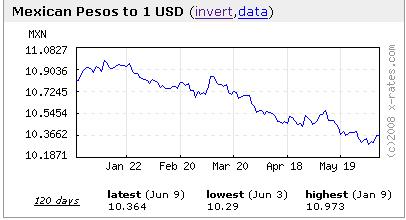
And, with the value of the dollar dropping against the Peso, Mexican gangsters may find it’s cheaper to bribe the U.S. cops than the Mexican ones.
Barking up the wrong tree
I don’t know how many times I’ve been told — by people who never lived in Mexico, or don’t really pay attention to what goes on around them — that “Mexicans don’t like pets.” Uh… ok… that must account for the article in today’s Milenio:
The largest veterinary hospital of the world is in Mexico, on the Ciudad Universitaria campus of UNAM. The Banfield Animal Hospital, treats 250 patients, mostly dogs and cats, weekly, although it has capacity to handle up to 80 animals a day.
 The hospital’s innovative philosophy is to treat pets as parts of their family. Each patient has a “personalized” treatment plan, with administration provided by special software, call petware. The medical at the University in March 2005 by an alliance of School of Veterinary Medicine and students who needing to complete professional practice as well as those looking to fulfill their national services obligations (National service is required, but students can complete their obligations by doing service connected with their training and studies).
The number of pets in Mexico is unknown. Banfield’s General Director, Dr. Fausto Reyes, estimates there are 22 million dogs and 15 million cats. “On one time, we asked that pets be included on the national census, but nothing ever came of it.
Sunday readings
Mexico’s War on Drugs is a Sham says Gardenia Mendoza of Florida’s La Prensa (translation in New American Media)
“This is the experience of 107 countries: If you only go after gangsters without attacking the financial structure or political protection, what happens is a paradox: you add more troops, prosecutors and police, and the criminal groups put more money into corruption,” says Edgardo Buscaglia, advisor to the UN and academic at Mexico’s Autonomous Technological Institute (ITAM).
“This creates an escalation of violence because criminals respond by bribing high-level officials in order to protect themselves against the state’s actions,” he adds.
It has happened in Lebanon, Pakistan, Colombia… and now it is happening in Mexico…
On the other hand, Ralph Blumenthal in the New York Times thinks that war could be “won” by following the example set by the Italian government’s war on the Marfia:
Is there something in the way the Americans and Italians worked together that could be applied to a partnership with the Mexicans? Certainly it is in the interest of the United States to seek such an alliance to stop the flow of drugs, guns and crime across the border, just as the Italian alliance helped stop that flow across the Atlantic. Indeed, President Bush has been pushing Congress to approve the first $500 million installment of a crime-fighting aid package to Mexico. Last week, American border governors met in Mexico with President Felipe Calderón to rally support for the effort and praise him for focusing on the drug lords.
Think Bush was bad for Latin America? Wait til Anheiser-Busch gets into the act! Nicholas Kozloff writes on John McCain (Cindy McCain is the heiress to a beer distribution fortune), U.S. Latin-American policy … and Budweiser at CounterPunch:
For Modelo, a strong incentive for entering the deal with Anheuser-Busch was the North American Free Trade Agreement or NAFTA: under the accord, U.S. import duties on Mexican beer were eliminated. As a Senator, McCain has been a big booster of economic globalization which has made consolidation of the beer industry possible. The Republican presidential hopeful supports NAFTA and has in fact assailed Barack Obama for his criticism of free trade. According to labor unions, NAFTA has cost the U.S. at least one million jobs, a fact of little apparent concern to the Arizona Senator. Though the agreement has led to a social and ecological disaster in Mexico, McCain does not support special provisions which would protect workers and the environment. In recognition of his efforts, the right wing Cato Institute gave McCain a 100% ranking when it came to promoting the free trade agenda.
Speaking of McCain, Quico, on the Venezuelan blog “Caracas Chronicles” looks at both U.S. candidates and who his (Groucho) Marxist president should support:
Now, from a Venezuelan perspective, the main difference between Barack Obama and John McCain isn’t what they are likely to do, but rather how they’re likely to play into Chávez’s strategy of internal-control-through-US-bashing. With his military background, tough-guy image, testosterone fueled rhetoric and penchant for humming tunes about bombing Iran, it’s easy to see how Chávez’s rhetoric could transition smoothly from Bush-whackery to McCainicide. Wouldn’t miss a beat.
But what if a black guy who opposed the Iraq War from the start and pledged to talk directly to him took office? Now things get interesting. An Obama presidency stands to completely scramble Chávez’s key strategy for internal control.
The Texas Association of Counties website (not my usual reading… a sombrero tip to Scott Henson) discusses the unforeseen consequence of expecting local officials to handle immigration arrests, especially when juveniles are involved, and there is no criminal violations (immigration violations are an administrative matter, not criminal one):
… what does a local official or law enforcement officer do when nobody is willing to accept responsibility for a juvenile suspected of being in this country illegally? And with the strengthening of immigration reform, will more situations like this occur and place unfunded mandates on local governments?
When asked … if ICE accepts juveniles into their custody, Mr. Reginald Sakamoto, Acting Chief of ICE’s Juvenile, Family and Residential Unit located in Washington, D.C., suggested local law enforcement “follow the directions provided in the Homeland Security Act of 2002 as it applies to unaccompanied alien children.”
The Uruguayan environmental magazine Tierramérica (available in Spanish, English and Portuguese) has an article by Mario Osava on modern agriculture’s over-dependence on too few crops:
Over the course of human history, people have consumed more than 7,000 species of plants. But in the last 100 years, about 75 percent of food crops have fallen by the wayside and now just three staples — wheat, maize and rice — make up about 70 percent of our caloric intake, according to United Nations figures.
Many ancient crops, like amaranth (Amaranthus) and quinoa (Chenopodium quinoa), both promising Latin American species, are grown by few farmers today, while rice and wheat cultivation continue to expand.
As the older crops disappear, the knowledge associated with them vanishes too, weakening farming and nutrition, say experts.
Food shortages? A local television station in Utah offers a novel way to stretch the family budget:

$6,600,000,000 … more or less
That’s the estimated amount of foreign investments in Mexico over the last two weeks:
General Motors, which is closing plants in the U.S. is investing 1.4 billion in expansion to their Ramos Azarpe, Coahuila operations, which produces transmissions for Saturn Vue and similar “small” SUVs.
Ford Motor Company, meanwhile, is re-tooling it’s F-10 truck production plant in Cuautitlan to turn out Festivas. As part of the 3 billion dollar project, Ford has formed a partnership with Getrag JV for a transmission plant in Guanajuato.
And German solar cell manufacturer, Q Cell, is pumping 3.5 billion dollars into a new plant in Mexicali.
Dumb as a rock video for Friday night
There are approximately 296 spoken (or formerly spoken) indigenous languages north of Mexico, 269 of which are grouped into 29 families (the remaining 27 languages are either isolates or unclassified).
...the survival of Spanish-speaking communities in New Mexico and Louisiana, whose uninterrupted existence from colonial times to the present provides a fascinating example of persistence in the face of overwhelming demographic pressure from speakers of English.
This Pennsylvania Dutch culture was the first foreign language culture in America…Franklin complained that of the six printing presses in Philadelphia two were Dutch and two more were half Dutch. The Dutch were actually printing more and technically better books than literary Boston! Furthermore Franklin actually feared that the Dutch would “outnumber the English and make government and language precarious.” He also rather contradicted himself in his statement, for his criticisms that the Dutch were illiterate and backward did not seem to jibe with his statements about most of the printers being Dutch, and also his statement that they imported many books from Germany.
Louisiana French is a rich tapestry of the French that was spoken in the 18th Century by Acadian and French immigrants and the French and African Creoles who came to Louisiana from the West Indies… As with all living languages that continue to evolve, the accent and expressions of Louisiana French are unique, but the same thing can be said of the French spoken in places like Quebec, Dakar, and even Paris.
An interminable language…it is one of the oldest living languages of the earth, as some conjecture, and may well be classed among the best …the thought to displace it, or to doom it to oblivion by substituting the English language, ought not for a moment to be indulged… Long live the grand old, sonorous, poetical Hawaiian language.
So… what’s her problem?
Collateral (environmental) damage
A small item in Noroeste, that caught my attention today was from Escuinapa, which is still a fairly small fishing town. Like everywhere else on the coast, developers are trying to glom onto whatever beach-front and water access they can… and not always as environmentally conscious as even those who support unrestricted growth would like.
Escuinapa’s importance goes far beyond its small shrimping fleet. The estuaries there are where the shrimp breed. But… you’ve got it, estuaries are unsightly, besides being a convenient place to dump construction trash.
 The problem for Escuinapa is that no one is watching. The Mexican Navy is charged with guarding the natural resources, but there are only so many sailors to go around. Jorge García Santos, a fisherman, complained to the Municipal council that in the last 15 days several tons of trash have been dumped. He blames the lack of enforcement on the fact that the Navy is off in the cities chasing drug dealers, and not focusing on the needs of these Mexican citizens and producers.
Eduardo Garcia Gaspar, in the same paper, makes the argument that chasing the narcos is counter-productive. He’s not the first to recommend just legalizing narcotics usage and treating it as a health problem (as Mexico did until the 1950s), but it’s the first time I’ve seen a Sinaloa “mainstream media” figure making the argument. Carlos Fuentes said the same thing in New York.
I like my shrimp. One thing that keeps me here is I can buy it fresh from the lady who comes down the street in the morning pulling a little red wagon with the catch o the day jumbo shrimp. What are you paying at Long John Silver’s these days… and should you blame the narcotics dealers if the price goes up?
Modest proposals (PEMEX)
Until about three years ago, Mexican gasoline was not such a great buy. People forget that it wasn’t all that long ago that Mexican drivers would cross into the U.S. to fill their tank, and PEMEX regularly had to tweak the pump price in the border region. To keep inflation in check, and to help the Mexican auto industry, gas prices have always been subsidized… one great advantage of living in an oil exporting state. Now, with PEMEX said to be starved for operating capital, very few restrictions on foreign automobiles (especially the large engine ones that used to be rare once to got away from the U.S. border and the gringo ghettos), it makes less and less sense for Mexican gasoline to be sold so low that it has driven up demand to a point where PEMEX is having to import gas… and sell it at a loss.
Bénédicte Larré, Senior economist at the Mexican Economics Institute of the Organization for Economic Cooperation and Development (OECD) sees the contradiction. Larré points out that raising pump prices would have some economic impact, primarily on those driving large vehicles. While his proposal — offsetting the inflationary pressure with more aid to the poor — makes sense, it seems that subsidizing fuel for public transit would keep the price rise from being felt by anyone except those who are driving the bigger gas guzzlers… frescas and some farmers (who could be helped by rural poverty programs). The fresas would switch to smaller autos — which is what Mexico is producing.
Gasoline prices right now work out to about USD 2.60 a gallon, which is ridiculously low.
Geologist María Fernanda Campa has an even more radical — and simple — idea. She suggested to the Mexican Senate that PEMEX simply stop exporting oil. Campa’s argument is based on the idea that PEMEX produces more than enough oil and generates enough capital, to more than meet domestic needs and leave room for growth.
It sounds nutty, but when I think about it, Campa’s idea is brilliant. Where PEMEX is hemorrhaging money is in maintaining and expanding export capability. It just cuts the losses. And, if oil prices stay high (and they will), Mexico might be better off selling oil-based products than just crude oil… or even gasoline. One word: plastics.
Using oil domestically would also buy Mexico the time to develop other energy sources — wind, geothermal, tidal and solar (Zacatecas, being mostly desert highlands, is theoretically one of the best places on the planet for solar power production. And, having a net population loss, new industries could shift people from heavily populated areas where energy has to now be imported — like the Federal District).
The assumption all along has been that PEMEX has to export oil to the United States. No it doesn’t. And, it doesn’t have to import gasoline from Shell either. Both suggestions probably would deeply hurt the U.S. economy, but look at the bright side. Maybe the Mexican congress can loan the U.S. money to deal with the drug problem. Provided they change their legal system and give the Chamber of Deputies oversight, naturally.
Are you listening now?
Federal agents — supposedly for reasons having to do with its broadcast license — raided a pirate radio station, “la Tremenda de los dos Laredos” which had been operating at FM 106.5 from Neuvo Laredo. The raid — which was broadcast live (listeners could hear glass being broken and equipment being smashed) — was conducted after Federal agents and soldiers blocked surrounding streets and responded with “overwhelming force.”
The entire staff was taken into custody, with General Manager Javier Delgado Sandoval and two reporters, Pablo Trinidad Arteaga and Santiago Palmeros Morales were held for several hours before making a “ministerial declaration”.
I don’t hae the particulars. Jornada is quoting off the record sources as saying the station was broadcasting information to narcotics traffickers. But… that was not what the station personnel were changed with. If it was a legitimate anti-narcotics operation, the military and police action might be understandable. And, here in Sinaloa, last week thirty-odd illegal radio towers — allegedly used by the narcos for communications — were decommissioned.
HOWEVER, the charges don’t suggest anything of the sort. With “legitimate” news reporters unable to cover narcotics dealers (for the very good reason they want to stay alive), underground news sources — like pirate radio stations — are important. And, whether people are blogging or taking to the airwaves (without a license), alternative journalists are journalists. Not that the narcos can’t have their own journalists, just like corporations or political parties. ButyYou don’t need the State’s permission to report information. At least not yet.
Was this a drug-raid, or was it the temptation to use military force, and the excuse of calling any crime “drug related”, as justification for an overreaction?
I guess this means he’s retired from politics
A bit more spectacularly corrupt than the usual run of sleazy pols, he was given a sentence of thirty-six years and nine months in the Federal pen for using his government position for the benefit his private business cronies. OK, so the cronies in this case were cocaine traffickers.
The Gov. was absolved of crimes against public health (what in the U.S. are drug charges), transporting cocaine and having ties to organized crime. He does have ties to organized political parties… but not any more.
On top of everything else, Judge Humberto Venancio Pineda fined Villanueva 6,205 pesos and prohibited him from running for office for the next twenty-six years.
Can we ship Dick Cheney to Quintana Roo… please???


 mexfiles.net