Border bandits head south
“Bloggings by Boz” recommends this story from BBC News reporter Duncan Kennedy. I often disagree with Boz, mostly because it uncritically accepts “mainstream” U.S. sources, but Boz deserves a big sombrero tip for finding this:
US law enforcement agencies are now heavily involved in trying to help the Mexicans control the violence.
But Americans are playing another role in the conflict.More than 90% of weapons used by the cartels originate in the US and there is evidence US citizens are joining the gangs to act as hitmen and women.
…
It is … people that smuggle the guns into Mexico.
We were introduced to one such person, an American who would only talk if his identity was concealed.
“I can sell guns for two or three times what you pay for them in a shop,” he said. “If I don’t do it, someone else will. That’s the bottom line.”
Bottom lines, not lives, are what is driving a market that the smuggler says is being fed by many eager Americans.
…
Reta is 18 years old, American, and a cartel hitman.
Detectives believe Reta, who is serving 40 years in a US jail for murder, has killed 30 people.
The cartels use people like Reta to enforce their business in the US. Their American nationality means they can cross the border with ease.
Reta is one of at least 15 US citizens used by the cartels, according to police in Texas.
Their story has another twist.
These hitmen have received training at a variety of camps along the border with the US.
Reta told police he was in a camp for six months.
Can you understand now why some of us don’t think training private militias along the border is such a bright idea?
Illlegal … alien fundraising
via Americablog:
John McCain is shameless. …
First, the political attack from Canada…. he spoke before the Economic Club of Canada, a business organization whose membership cheered his remarks….
…McCain then went to a fundraiser for his campaign hosted by the American ambassador to Canada.
This is illegal for a couple of reasons, but what the hell. If he’s gonna talk to non-voters though, why not talk to the non-voters he’s claimed “will help the United States.”
Hey, Juan… when you comin’ here?
Speaking of illegal campaign contributions… new campaign finance laws in Mexico require the parties to publish the source of all private contributions (candidates can’t take private funding, but parties can). Locally, the politicos are saying “we don’t take no stinkin’ narco-funding” but that’s only one special interest group the voters might find interesting. Campaign contributions from abroad (to a candidate or a party) have always been illegal here — Vicente Fox’s coalition was fined a billion U.S. dollars for raising money in the U.S. during the 2000 election, so it’s not like it can’t be done if a country wants clean elections. But, then, in the U.S. private donations aren’t called what they are in Mexico… bribery.
Mexico’s first Australian tourist
Not that I’ve been paid yet… or will earn very much, but my book has gone off to the publisher, and I’m just finishing up a shorter project for a British guide book (all I can say at this point), and am starting on a commissioned project to write a short history of Mazatlán, intended for the tourist trade and gringo colony.
I’m using “gringo” in the broad sense… we have a huge colony of both U.S. and Canadian retirees and winter residents here (including French-Canadians), and a sprinkling of Dutch. Lately, thanks to some engineering projects, we’re also getting more Australians. While the first Australian to visit Mexico probably didn’t come to Mazatlán he might have. If he sailed on a naval vessel, or the weather was bad, the ship may have called here. Mazatlán didn’t become a town until 1824, after Independence, but there was a small naval station here, and small coastal ships often anchored in the harbor during storms or if they needed to take on water.
This snippet from Robert Hughes’ The Fatal Shore: The epic of Australia’s founding (New York: Vintage Books, 1986) is worth passing along, if for nothing else, to remember how much trouble some of us have gone through to get to Mexico.
In the early 1790s, “reforming” English intellectuals flirted with Jacobinism. To enable such parsons, lawyers and pamphleteers to make contact with like-minded workers, discussion groups known as “Corresponding Societies” were formed. Their officers called themselves “Jacobins” but were, in fact, reforming constitutionalists, who wanted to recall Britain’s labors and artisans to a sense of their ancient rights…
…the blow against Corresponding Societies was struck in Scotland, where juries were easily rigged. If fell on a young, blue-eyed Scottish lawyer named Thomas Muir (1765-1799), vice-president of a Jacobin discussion group in Glasgow. Muir was an ardent constitutionalist whose offense was to advocate yearly elections of Parliament and a broadening of the Scottish franchise. He stood trial for sedition in Edinburgh in 1793… The jury quickly and unanimously found Thomas Muir guilty and and was sentenced to 14 years’ transportation.
The course intellectual clay of Sydney was not to [Muir and other Scots Jacobins’] shaping. They tried to catechize some prisoners but got little response. Then Thomas Muir, with extraordinary daring, contrived to escape. Early in 1796 he managed to contact the skipper of an American fur-trading vessel, the Otter, provisioning in Sydney Harbor. As soon as the ship sailed, Muir stole a rowboat and hauled out through the Heads, at night; the Yankees picked him up a few miles offshore. Months later, when the Otter reached Alaskan waters, Muir learned that a Royal Navy ship had been seen in the area. Fearing capture, he transferred to a cruising Spanish gunboat, which took him south to Monterrey in Spanish California.
From Monterrey he made his way to the Caribbean, via Mexico City and Vera Cruz.
He should have stayed in Mexico. From Veracruz, Muir made it to Cuba, where he sailed for Cadiz on a Spanish frigate. The frigate was attacked by the British Navy: “an exploding shell mutilated Muir’s face and destroyed his left eye; he was so badly wounded that the British officers, learning he was aboard, could not recognize him.” Muir languished for several months in a Cadiz hospital until English Republicans arranged for political asylum in France. He wrote an account of his travels, which have unfortunately been lost, and died in obscurity and poverty in Chantilly on 26 January 1799.
Food, glorious food…
In a new USA Today poll, 54 percent of those surveyed say their standard of living is no better today than five years ago. “Fewer Americans now than at any time in the last half century believe they’re moving forward in life,” concluded a recent report by the Washington, D.C.-based Pew Research Center.
That includes their access to food. According to the U.S. Department of Agriculture, 10 percent of U.S. households today are either at risk of, or experiencing, hunger.
One bleak sign: Hormel, the company that produces the canned pork product Spam, reported a 14 percent jump in profits for the last quarter, largely because of a spike in sales of their exceedingly cheap product.
(“Hunger and Humiliation in the Belt-Tightening Economy”, Nichole Colson, Counterpunch, 18 June 2006)
Here in Mexico, the struggle since the Revolution has been to bring down the number of people “ill-housed, ill-clad, ill-nourished“. However, with the collapse of Mexican agriculture brought on by what I think was a poorly thought out change to the ejido system, coupled with continued subsidies for U.S. and Canadian agriculture that made it impossible for Mexican farmers to compete (especially after January 1 of this year), price jumps in Mexico mean more than just buying more Spam. It means not buying food at all.
El Sentir de Coahuila, last 20 May, posted a chart showing the price rise in 2007 — before the jump caused by the end of import restrictions in January
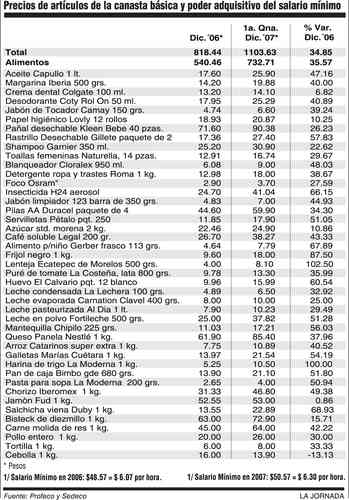
(click to enlarge)
There’s probably no way to undo the damage to the Mexican agricultural industry (the tomato scare isn’t helping any), but it’s not that Mexican consumers can switch to Spam. They don’t eat. The administation in Los Pinos has announced a price freeze on 150 basic food items through the end of the year. At best, it’s a temporary measure (and supposedly voluntary, which means it may only hold for a couple of months). As it says in today’s Milenio, “There are conditions”.
Concamin (Confederación de Cámeras Industriales de los Estados Unidos Mexicanos — basically the National Association of Manufacturers) President, Ismael Plascencia, told journalist Ciro Gómez Leyva the price of tortillas and cooking oil would only remain stable IF (and it’s a very big IF) wholesale corn prices remain below 3, 340 pesos per ton. In other words, if the dollar falls… or the U.S. wholesalers raise the price, then the deal is off.
I can’t exactly blame Concamin… they’re looking out for their own interests, and can’t fault FeCal for trying to hold off the price rises, but they are going to hurt, and it could get ugly in the next few months. Besides, the culprits are obvious.
Take the long way home…
The mysterious hijacking last week of a busload of Cuban “illegals” near Tapachula apparently wasn’t all that mysterious. James G. McKinney, in the New York Times (not an Associated Press story) reported last Saturday:
Thirty-three Cubans who fled Cuba this month in motorboats were still missing the day after a Mexican government bus transporting them was stopped by armed men Thursday night. A half-dozen armed men in ski masks hijacked the bus, which also carried four Central Americans, and forced officials away at gunpoint in Chiapas. The Cubans had been detained in motorboats near Cancún on June 5. Immigration officials were transporting them to a detention center in Tapachula, on Mexico’s southern border.
At the time, the Cuban Embassy in Mexico suspected “Miami Mafia” involvement. Cuban Ambassador Manuel Aguilera de la Paz was quoted in El Universal (also not an Associated Press report) as saying that while his country and Mexico were working out an agreement to stop the flow of Cuban immigrants going through Mexico to the United States, the “Miami Cartel” was being encouraged to traffic in humans by prominent anti-Castro Cuban-American politicians.
Ambassador Aguilera opined at the time that the “hijacked” Cubans were probably already in Miami. He was wrong. They showed up around McAllen Texas this morning. From what Deutsch Presse-Agentur (decidedly not the Associated Press!) has been able to figure out (and the AP hasn’t) it looks like the Ambassador may have been right.
… a wide range of intermediaries allowed them to escape from Mexican authorities and then to travel to the United States seemingly legally, with documents that were or at least looked real and with money in their pockets.
…
The Cubans had been picked up by Mexican officials on June 6 …
…
Following the armed rescue in Chiapas – in which at least six masked men armed with rifles took part – the migrants said they were taken to a safe-house in the eastern Mexican state of Veracruz.
There, ‘they had photographs taken that were stuck on individual sheets of paper bearing the seal of (Mexico’s) National Migration Institute.’
With these documents, which ordered their exit from the country, they were then taken to the Veracruz central bus station, divided into groups and given enough money to travel to the United States.
‘With the documents handed to them, one of the groups of immigrants who arrived in the United States said they went through two military checkpoints and two migratory filters without trouble, on the way from Veracruz to Reynosa by road on a passenger bus,’ the Public Prosecutor’s Office said.
Swift justice? Sorta
Everyone seems a little confused by the changes to the constitution guaranteeing open trials. This does not change the legal system (a few states already have made these changes), but only means an accused will appear before a judge, where before the accused made a deposition (and often their trial was in front of a clerk sitting in the hallway outside their cell). In theory, this will speed up the system, and unclog the jails, but it’s going to take time.
Even the efficient Swiss, whose court system is very similar to what the Mexican system will look like, take their own sweet time. Mexico has been attempting since 1995 to get back from Swiss banks the money the Salinas family stole. Raul Salinas’ accounts were frozen in November of that year, when Swiss investigators had enough suspicion that the money came from narcotics trafficking to freeze the funds. The Mexican request to return the 110 million U.S. dollars wasn’t even filed in Swiss courts until December 2007.
As of yesterday, Swiss Federal Examining Magistrate Paul Perraudin, ordered 74 million dollars turned over to the Mexican government, and considered the matter closed.
As Forbes reported:
The statement said the government was retaining 3.3 million Swiss francs ($3.2 million) from the frozen sums to cover the costs of the Swiss investigation since 1995.
In 2002 Switzerland gave Mexico its extensive files from its money-laundering investigation. The Mexican attorney general’s office said it would analyze the documents for its investigation into how Raul Salinas amassed millions of dollars while his brother was president.
Raul Salinas, now 66, was released from prison in 2005 after the overturning of his murder conviction for killing his former brother in law, Jose Francisco Ruiz Massieu.
He said at the time that his actions in keeping more than $100 million under false names in Swiss bank accounts were “very unfortunate” and “unforgivable.”
But he repeated his longstanding assertion that the money represented legitimate funds given him by business associates as part of an investment fund.
Carlos Salinas, Mexico’s president from 1988 to 1994, has not been charged with wrongdoing in the financial case. The former president denied any knowledge of the money.
El Túnel… Mexican justice (reform)
At times the Mexican justice system seems to owe more by Franz Kafka than Napoleon Bonaparte or Benito Juarez. There is nothing inherently wrong with the legal theory, but the delivery leaves a lot to be desired.
This amazing short (just under 20 minutes) documentary was produced by Roberto Hernadez for CIDE (
Centro de Investigación y Docencia Económicas) in 2006. Since then, oral trials (such as those in Chile) have been introduced, at least in Federal Courts, and in some states, but it is going to take time to implement them throughout the system. Prison and police reforms are going to take more time — and money.
It’s interesting that while in the United States, many are complaining that prisoners might actually get a trial after waiting only five years, in Mexico, the complaint is that trials take so damn long. My fear is that the “war on drugs” and putting the Army in charge of prosecuting this war short-circuits an already troubled justice system, and will delay the necessary reforms.
(Sombrero tip to El Sentir de Coahuila)
Moving experiences….
From The LatinAmericanist:
Traveler’s diarrhea, known by many names, has long been considered a rite of passage for visitors to places like Mexico and Central America. Yet a new vaccine being developed by Iomai Vaccines, of Gaithersburg, MD, may prove to be the best prophylaxis yet for the painful malady – if not the cure.
Speaking of moving experiences … I’m moving over the next few days, and between running back and forth for my stuff, I expect my internet connection to be crapped out for a few days. That too, shall pass.
A good time was had by all
Sounds like some frat parties I’ve been to. El Debate, 14-June-08 . Whoever edited the story is really good. All the juicy details and interesting word choices, but none of the usual padding (police car numbers, the officer’s names and badge numbers, etc.) you see in most Nota Rojas. (my translation):
A party at a house in colonia Anáhuac colony ended in a bloody confrontation between citizens and preventive police.
As a result 13 youngsters were arrested on various charges, including damage to a police car.
Preventive police had been called to a house at the corner of Belisario Domínguez Netzahualcóyotl streets, after a complaint of a public scandal. A group of young people in front of the house were drinking intoxicating beverages and playing music at a loud volume.
The agents noticed one guy had a pistol stuck in his waist-band, and attempted to take it away from him.
That was not possible because the crowd of young people grabbed it out of the policemen’s hands and begin beating them.
The police managed to get out of this jam, but a hail of beer bottles and rocks came down on them, breaking their patrol car’s windshield.
The agents requested backup, and more police arrived.
The officers kept their distance until the the youths ran out of ammunition, then arrestedAtrio Marroquín, José Manuel Carlón, Antonio Llanes, José Manuel Soto, Antonio Cervantes, Gabriel Humberto León, Carlos Ramón Amaral, Carlos Fernando Bejarano, Antonio Pérez, Fernando Becerra and three minors.
Dang, almost forgot
Sunday would have been Che Guevara’s eightieth birthday. Yeah, he’s an historical figure and all … he held a number of bureaucratic posts in the Cuban government after the 1959 Revolution (including “supreme prosecutor” in revolutionary tribunals — and, in what was probably a way of cutting overhead — serving as executioner too. But what did his revolutionary road show ever accomplish?
Ah well… live fast, die young, and get your face on a tee-shirt.
Good music, crappy lyrics… We will go foreward/as we did by your side/and we say to you, as did Fidel/”Until Always, Commandate!”… ugg!
Sunday readings — 15 June 2008
How is the Monroe Doctrine like a vampire? (it’s undead).
Losing Latin America, Greg Grandin (Mother Jones):
Most interestingly, in [the Ecuadorian-Colombian] conflict, an overwhelming majority of Latin American and Caribbean countries sided with Venezuela and Ecuador, categorically condemning the Colombian raid and reaffirming the sovereignty of individual nations recognized by Franklin Roosevelt long ago. Not Obama, however. He essentially endorsed the Bush administration’s drive to transform Colombia’s relations with its Andean neighbors into the one Israel has with most of the Middle East. In his Miami speech, he swore that he would “support Colombia’s right to strike terrorists who seek safe-havens across its borders.”
Equally troublesome has been Obama’s endorsement of the controversial Merida Initiative, which human rights groups like Amnesty International have condemned as an application of the “Colombian solution” to Mexico and Central America, providing their militaries and police with a massive infusion of money to combat drugs and gangs. Crime is indeed a serious problem in these countries, and deserves considered attention. It’s chilling, however, to have Colombia—where death-squads now have infiltrated every level of government, and where union and other political activists are executed on a regular basis—held up as a model for other parts of Latin America.
Obama, however, not only supports the initiative, but wants to expand it beyond Mexico and Central America. “We must press further south as well,” he said in Miami.
James Joyce in Oaxaca?
Anti-Ulises: A Day In the Life of a Simmering City, Ramor Ryan (Upside Down World):
Walking away from the sanitized Zocalo, we chance upon a moribund vista. Shuffling around in the half shadows of a street corner, about a hundred tooled-up riot cops loiter with menace – as if itching for something to happen. The phalanx of troops, an ominous dark mass of helmets, riot shields and shiny black boots, clank their long metal sticks on the somewhat medieval flagstones. It is an incongruous sight at this time of night, amidst this placid ambiance, without the slightest disturbance to be ascertained of any kind anywhere.
Paradoxically, their presence signifies a welcome sign – where there are riot police there is generally trouble, and trouble in the Oaxaca context, means…resistance.
I have followed the movements of police riot squads with close interest for many years. So I approach the last cop in the line – a young indigenous man clad in state-of-the-art modern armor – and with all the sweet innocence of a visiting tourist ask him as to why they are here.
“Is there a problem, officer?” I ask.
He tenses up, grips his metal baton and stares at the distant wall, not at me.
“We are here for your protection” he says sternly – and somewhat comically.
We have heard that one before. Back in the day, during the war in Ireland, this is how the occupying British troops behaved – nervous, uncertain and trigger-happy. So this is it – as people had forewarned – this tremulous peace in the city is one overseen by riot cops lingering in the shadows. Oaxaca is a city under stealthy occupation.
Neighborhood clean-up projects can be a bit more complicated when the neighbors are on both sides of an international border. Enrique Gili on neighborhood projects in the Tijuana River Valley, writes for IPS News:
Pollution doesn’t respect the border. Each time it rains, a portion of Tijuana’s waste flows through the estuary and into the Pacific Ocean, shutting down local beaches for days at a time and affecting the quality of life for residents. Local residents are seeking common ground to combat the problem.
“To comprehensively deal with the Tijuana River, we need to involve everyone impacted from ranchers to surfers to boarder patrol agents,” said Paloma Aguirre, president of the Tijuana River Citizens Council.
Postcard pretty wetlands hide hidden trash. Beneath beds of wildflowers and lush vegetation, the preserve is a catchall for all manner of debris, tires, bottles, and plastic. By mid-morning, volunteers have accumulated enough garbage to fill a shipping container to haul to the municipal dump.
Even as clean-up efforts get underway, certain border realities are difficult to ignore or downplay. Border patrol agents are actively pursuing migrants hiding in the vegetation, leading more than one volunteer to quip it’s doubtful “illegals” are slipping across the border to pick up trash.
Hold the celebrations… those new auto plants may not be such a great deal for Mexico.
Laura Carlsen on the downside of globalization (Americas Mexico Blog):
General Motors announced a $1.3 billion dollar investment in its Coahuila, Mexico plant and the creation some 875 jobs (note the low job-to-investment ratio). It also announced the eventual closure of plants in Janesville, Wisconsin and Morraine, Ohio. The Mexican press noted that the company first hinted at the closure of its plant in Toluca, which elicited an immediate promise from the union leadership to accept wage reductions. It soon after announced it will remain open but cut back on operations and lay off some of the workers. Although the new contract terms were unavailable at the time of this writing, the trend is written on the wall.
The companies justified further gouging into the fragile economy of working families by pointing the finger at global competition. As long as China offers wages of as little as $2.00 an hour, Mexico has no choice but to follow suit if it wants to attract investment.
It seems the same conspiracy theory is once again making those rounds again. One of the approaches xenophobic conservative pundits use to stir up fear so people are willing to support tough immigration policies is race baiting. Given the history of race relations in the US, history has shown repeatedly that this nation is willingly to act aggressively in punishing minorities.The same right-wing populist fears that fueled the Cold War anti-communism, rallied against the Civil Rights Movement and brought about the armed citizens militia movement in the 1990s have reappeared with an elaborate conspiracy theory about the reconquering of America – La Reconquista – the idea that Mexicans are invading America to reclaim it for Mexico.
When World War I began, the republics of Latin America as well as the United States hoped to stay out of it and to leave Canada as the only American nation involved on either side. In Aug-1914 most of those nations cut off international cable messages in either code or cipher and declared their neutrality. Wars disrupt trade and regular international financial transactions and this was the case for several of these countries – Brazil lost a British loan opportunity, Chilean industries were hard hit and unemployment rose, Bolivia had to borrow from an American bank to ride out the rupture of trade and all of Central America experienced trade losses. As time went on these nations began to benefit from the war. It is macabre but true that great wars in distant places can be good for business and these nations had resources which were now in demand by the belligerents.…In Jun-1918 a number of Mexican editors visited the United States and were met by President Wilson. The President assured them that the U.S. had no intention of intervening in Mexican internal affairs and that the Monroe Doctrine, long seen by Latin Americans as a blank check for Yanqui intervention, was meant to protect rather than exploit Latin America. This was cooly received by Carranza who issued a statement that as long as the Covenant of the League of Nations contained a recognition of the Monroe Doctrine, Mexico would never sign it. Under another President, Mexico eventually joined the League in 1922.
Carranza was not so much pro-German as he was an anti-U.S. Mexican nationalist. Another was Argentina’s President Hipolyto Irigoyen. Irigoyen detested the Anglophile cattle barons and the Francophile intellectuals and despised the many Argentines who looked to Italy as their mother country. He saw no reason to have his country do anything but profit from the sale of her war materials, which she was doing on an enormous scale, without bothering about the balance of power or international moral issues of questionable validity. German submarines and poison gas did not strike him as particularly odious. Probably the majority of the population supported him but there were great pressures on him to join the Allies. To Irigoyen, the entrance of the United States into the war was merely another good reason for Argentina to stay out.
Oaxaca… “Totally partial” — say what?
I know some people assume the source (Al Jazeera) would be de facto unreliable, but I’m not sure why a news organization owned by Arab oil money would be any more biased than one owned by any other corporatation. Besides, not having a dog in this hunt, I can’t see why they’d want to spin anything. Anyway… the U.S. press seems to have forgotten about Oaxaca, even though protests still go on.
Tens of thousands of protesters have converged on the southern city of Oaxaca in Mexico to protest against the regional government.
The protests on Saturday also mark the second anniversary of a violent crackdown on a teachers’ protest, that left more than two dozens dead.
Florentino Lopex Martinez, a protester, said: “This is a policy of oppression, the most fascist type of oppression in the whole of Oaxaca’s history. The methods of repression have worsened considerably.”
In 2006, protesting teachers had siezed the main plaza demanding better working conditions.
They complained that Ortiz was corrupt and came to office through a stolen election.
The protest developed into a broad demonstration against social and economic conditions in the poor Mexican state.
Violent crackdown
State and federal police violently cracked down on the protest leaving at least 27 people dead.
Witnesses claim gunmen supporting the governor fired into a crowd. There have been no convictions for the killings as yet.
His opponents say Ortiz uses violence to suppress his political opponents.
Amnesty International has said that his administration has been behind the murders of dozens of opposition members.
National and international human rights organisations say most of the violence now takes place in remote villages of Oaxaca.
Talking to Al Jazeera, Ortiz said: “There is no documentation to implicate any government official. Amnesty International’s report is totally partial.”
Ortiz’s Institutional Revolutionary Party (PRI) has ruled Oaxaca for nearly 80 consecutive years.


 mexfiles.net