Savage Capitalism
¡Viva los capitalistas!
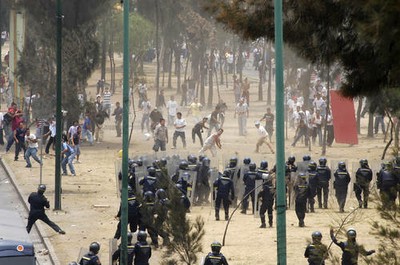
The small shopkeeper is the kind of guy who will fight for his right to vend his wares. As they did yesterday in Itzapalapa, turning over a police car and requiring 200 coppers to close them down in the process.
This always seems to happen when cities spruce up their downtowns. “Cleaning up the city’s image” forces shoppers to hit the ‘burbs for some essentials and favorites. Most of the Central Mexico City informal merchants agreed to a relocation deal earlier this year, but there were a few holdouts and dealers in … uh… specialty products … who didn’t take up the city’s offer, but did manage to find new outlets in the suburbs.
I gather these merchants put some thought into their new location. With San Martha Acatitla prison looming in the background, maybe Acatitla Metro Station brings in a good walk-in trade for these businessmen, specializing in counterfeit jeans and pirate DVDs, and a few specialty goods like narcotics and handguns.
I guess this is what “free trade” means…
The corporations are free of pesky union regulations, and can trade off basic human rights for profits…
Less than 24 hours after President Bush met with Guatemalan President Alvaro Colom at the White House on Monday, a worker from a union that filed a trade complaint with Washington against the Guatemalan government was murdered.
Carlos Enrique Cruz Hernández, a banana worker, was assassinated while working at a farm owned by a subsidiary of Del Monte. Cruz Hernández’s Union of Izabal Banana Workers (SITRABI), was one of six Guatemalan unions who, along with the AFL-CIO, filed a complaint allowed through labor provisions of the Central America Free Trade Agreement (CAFTA) on April 23, charging that the Guatemalan government was not upholding its labor laws and was failing to investigate and prosecute crimes against union members–which include rape and murder. The complaint states that violence against trade unionists has increased over the past two years (since CAFTA was ratified) and that the Guatemalan government may be responsible for some of the violence. The violence from this year alone includes 8 murders, 1 attempted murder, 2 drive-by shootings, and the kidnapping and gang rape of a top union official’s daughter who was targeted because of her father’s union work.
(Full article, “Bullets and Bananas: The Violence of Free Trade in Guatemala” by Cyril Mychalejko at Upsidedownworld.org)
Would you buy a new book from this man?
Burro Hall reviews “La decada perdita” and its’ author very nicely, I think.

Reporters attacked in Cuilicán… by POLICE
It’s harsh, I know, but a lot of fortunes have been made in the past by those who profited from human misery or dirty businesses. And, with time, those fortunes were laundered into more legitimate enterprises. Think of all the Carnegie Libraries around the United States. Or the fortunes made in the slave trade or opium trade (where do you think Barbara Bush’s family got their money?). For that matter, think of Duke University (founded by tobacco money).
Mexico does not have a particularly serious drug problem… and if the narcotics money is going to roll in, it could be put to a lot better use here in Sinaloa. In Mazatlán, a lot of our 19th century architecture is thanks to earlier smuggler’s civic generosity, and no one — even hard-care Alcoholics’ Anonymous types — are going to complain that our local brewer left his fortune (and his home) to an orphanage. Maybe an “Biblioteca Arellano Felix” wouldn’t be such a bad idea.
However, we say that narcotics is somehow different, that the narcotics trade corrupts the democratic state, and the people. OK, if that is true, why is it that the fight against it takes the form of attacking those of us who ARE the people, and the institutions on which a democratic state depends?
Border Reporter posts this morning on the police attack on El Debate, the Cuilicán daily:
Three reporters for the Culiacán daily, El Debate, were attacked by federal preventive police yesterday. One of the reporters was forced into a police car and held for ten minutes with a gun to his head. The attack tops off a deadly week of murder in Sinaloa, with six cops killed, gunfights exploding outside the state capital and cops running scared.
“They told me, you don’t know who you’re fucking with; we’re not cops from here. Go complain with whomever you want,” says one of the El Debate reporters, a young man I’ve known for several years, Torivio Bueno Leon.
The incident started when the two reporters and a photographer were taking photos of the federal cops’ checkpoint. The cops didn’t want them shooting the checkpoint, a common wish most of them seem to have, and an argument started. The photographer told his own paper they used a knife to slice the camera strap but he still managed to retain the camera.
The federáles chased them into the newspaper building where a guard shut the steel cage door and the photographer snapped them pounding on the bars outside the building.
What’s interesting is that the PFP commander called the newspaper to apologize, saying his officers were nervous because of the number of cop murders in the past two weeks.
El Debate’s coverage adds that the Federal Police were “locked and loaded” and where threatening to shoot into the newspaper’s offices.
The reporters — Torivio Bueno, Leo Espinoza and Geovanny Elizalde — all say they were physically injured for doing their jobs. Espinoza has 28 years experience as a photojournalist, and the others were clearly identified as members of the press. Putting a guy to someone’s head for ten minutes is considered “psychological torture” in Mexican criminal law.
El Debate and Border Reporter have conflicting information on who offered the “official explanation”. El Debate says Eduardo Cano Camacho, who is “Social Communications Chief” for the Federal Secretaría de Seguridad Pública made the statement. Despite his imposing title, Cano is only a press liaison, not the police chief. A minor matter, but it suggests the SSP is taking this as merely a public relations problem, not as an attack on Mexican civil society.
Border Reporter does a good job explaining why the police are nervous and likely to over-react, and why a lot of us here in Sinaloa are less than enthusiastic about the “War on (some) drugs”. But I would go further. For one thing, I’m not working as a reporter here, and am free to speculate.
Thankfully, it was the police, not the Army involved in this incident. While the Army is better disciplined (in theory), there are too many reasons to go into here (I’ve done that before, again and again) on why military forces should not be involved in civilian law enforcement. And, while the Army has traditionally enjoyed high levels of respect as a state institution, soldiers are trained to protect themselves at all costs. The results could have been a disaster, going far beyond the fallout from the apparent federal crackdown on a free press.
Incidentally, the policeman’s remark that “We’re not from here” is an excellent argument AGAINST using hired guns (aka “security contractors”, aka mercenaries) for things like border control or drug interdiction (as the U.S. does under “Plan Colombia,” and suggests doing under “Plan Merida”).
If there need to be confrontations between suspected narcos and the forces of the state, then the Federal Police are the people who should do the job. But, obviously, they need more training. My strongest objection to using the Army has been that soldiers MUST see all civilians in their “war zone” as potential enemies. The police are supposed to be on the same side as the civilians. Always.
And, police paramilitary operations should be the last resort. The problem with this “War on (some) drugs” has always been that we don’t see the kinds of police work that really destroys criminal enterprises — the old “follow the money” investigative technique that’s always worked since the days of Eliot Ness and Al Capone.
The Sinaloa growers and exporters provide a lot of local employment, and there isn’t the money locally to provide the resources they enjoy. I’m not the least concerned when some gangster gets his head chopped off, or a cop on the take gets a bullet in the back of the head… but I can understand how it happens. People do things they wouldn’t otherwise not just when they feel threatened, but when there is money involved as well. And… I don’t see much effort being expended to find the money source.
Other than some vague promises, I don’t see that expanding Mexican anti-narcotics efforts is at all directed at drying up the narco’s resources. The Mexican military budget increases were supposed to be to give the soldiers and sailors a well deserved raise. But “Plan Merida” funding is all about hardware. And intimidating the populace.

There is probably no need to say the photo was taken in Texas.
The war on drugs in Latin America is fought more by private-sector mercenaries and national armies trained by the U.S. military. Plan Mexico follows this strategy, for the above reasons [avoiding U.S. military casualties] and particularly to avoid riling Mexican sensitivities regarding national sovereignty. Militarization through building up national armies to fight within their own borders and sending in private companies such as Blackwater can be even more dangerous for Mexico than U.S. troop presence. Accountability mechanisms are weak or non-existent
Most of the $132.5 million allocated to Mexican law enforcement agencies also lines the pockets of defense companies for purchase of surveillance, inspection, and security equipment, and training. The Mexican Federal Police Force receives most of this funding, with Customs, Immigration, and Communications receiving the remainder.
Unless checks and balances appear that have so far not been revealed, Plan Mexico could contribute to the creation of a police state in Mexico.
As Laura Carlesen writes (A Primer on Plan Mexico, IRCAmerica’s Program, 5 May 2008 ), the “Plan Merida” initiative seems more about giving U.S. taxpayer dollars to favored contractors than any real attempt to stop drug dealers:
Over half of the packet would go to Mexican military and police forces accused of documented and yet legally unresolved human rights violations. At the same time, no money is allotted for drug treatment and harm reduction in either country, and the colossal “cooperation” package completely ignores the serious problems that exist within the United States, including the entry of illegal drugs, widespread sale and consumption, crossborder gun-running, and money laundering.
…
Under the rubric of “Counter Narcotics, Counter Terrorism, and Border Security” the initiative would allocate $205.5 million for the Mexican Armed Forces. Over 40% of the entire packet goes to defense companies for the purchase of eight Bell helicopters (at $13 million each, with training, maintenance, and special equipment) for the Mexican Army and two CASA 235 maritime patrol planes (at $50 million each, with maintenance) for the country’s Navy.
So… What is the rationale for “Plan Merida”?
The Bush administration’s concept of a joint security strategy for North America goes back at least as far as the creation of the Security and Prosperity Partnership (SPP) as an extension of the North American Free Trade Agreement (NAFTA).
…
Through the SPP, the Bush administration has sought to push its North American trade partners into a common front that would assume shared responsibility for protecting the United States from terrorist threats, promoting and protecting the free-trade economic model, and bolstering U.S. global control, especially in Latin America where the State Department sees a growing threat due to the election of center-left governments. While international cooperation to confront terrorism is a laudable and necessary aim, the Bush national security strategy5 entails serious violations of national sovereignty for its partner countries, increased risk of being targeted as U.S. military allies, and threats to civil liberties for citizens in all three countries. Moreover the counterterrorism model, exemplified by the invasion of Iraq, has by all accounts created a rise in instability and terrorist activity worldwide.Extending the concept of North American economic integration into national security matters through the closed-door SPP process raises grave questions about how security is defined and who does the defining.
In other words, the “war on drugs” is a weapon of mass distraction. This is about the Bushistas coveringtheir ass(ets). For Calderon, et. al, the temptation is to label dissent as “terrorism” or claim those who don’t buy the neo-liberal model are “drug dealers”. We’re all gonna be screwed.
Scarier than the Arellano Felix gang…
Forget Emos, Punketos, Gothicos… let alone the Sinaloa cartel. Though I’ve been around all of them, they never attempted to drag me into their perverted lifestyles. Not sure I can say that about the very scary “Gangs of San Miguel de Allende”
No one told me about the Gangs of San Miguel. You think you are going to visit a quaint, parochial Mexican town in the mountains. But sit for a few minutes in the Jardin and you are soon surrounding by middle aged American Gangs demanding your attention. Something bad happens in San Miguel when Americans come here. Some people call it ‘reinventing’ yourself. Some people call it ‘magic’. Some people call it ‘finding yourself’. Some people call it ‘opening your heart’. It doesn’t matter what it is called it is downright scary. They swarm the Jardin daily in their little Gangs trying to get you to join. They set up tables to recruit you. They try to get you to go on walks and house tours. They put on concerts and art shows. They corner you on park benches and at happy hours. They send their dogs after you. They have places called Bienes Raices where stretched women and pretty men entice you to see “gated communities” where some gang members live. I have been instructed to lock my bedroom door at nights because “they” will get you in the night. Be warned if you come.
The 1892 trip advisor
From Carl Lumholtz, “Unknown Mexico: A Record of Five Years’ Exploration Among the Tribes of the Western Sierra Madre; In the Tierra Caliente of Tepic and Jalisco; and Among the Tarascos of Michoacan (Vol 1). This is from a “Project Gutenburg” transcript and did not include the original publication data – I think the date was about 1894.
Lumholtz, a Norwegian explorer and archaeologist, is writing here about an 1892 expedition to Casas Grandes, Barancas del Cobre and the Tarahumare country in Chihuahua State. At the time, a few Apache bands had not given up their fight against the U.S. and Mexican governments, which was a concern for Lumholtz… and there were some transportation issues as well.
It is the custom with Mexican muleteers to select from among themselves a few, whose business throughout the journey it is to guard the animals at night. These men, immediately after having had their supper, drive the animals to a place where suitable pasture is found, never very far from the camp, and bring them back in the morning. They constitute what is called la sabana. Comparatively few men suffice for this duty, even with a large herd, as long as they have with them a leader of the mules, a mare, preferably a white one. She may be taken along solely for this purpose, as she is often too old for any other work. The mules not infrequently show something like a fanatic attachment for their yegua, and follow blindly where they hear the tinkling of the bell, which is invariably attached to her neck. She leads the pack-train, and where she stops the mules gather around her while waiting for the men to come and relieve them of their burdens. Sometimes a horse may serve as a leader, but a mare is surer of gaining the affection of all the mules in the train. This is an important fact for travellers to bear in mind if they use mules at all. In daytime the train will move smoothly, all the mules, of their own accord, following their leader, and at night keeping close to her. In this way she prevents them from scattering and becomes indispensable to the train.
But in spite of the vigilance of the sabana and the advantage of a good yegua, it may happen, under favourable topographical and weather conditions, that robbers succeed in driving animals away. While giving the pack-train a much-needed rest of a day in a grassy spot, we woke next morning to find five of our animals missing. As three of the lot were the property of my men, they were most eagerly looked for. The track led up a steep ridge, over very rough country, which the Mexicans followed, however, until it suddenly ran up against a mountain wall; and there the mules were found in something like a natural corral.
Not until then did our guide inform me that there lived at Calaveras (skulls), only three miles from where we were stopping, a band of seven robbers and their chief, Pedro Chaparro, who was at that time well-known throughout this part of the Tarahumare country. I had no further experience with him, but later heard much of this man, who was one of a type now rapidly disappearing in Mexico. He did not confine his exploits to the Mexicans, but victimised also the Indians whenever he got an opportunity, and there are many stories in circulation about him.
On one occasion he masqueraded as a padre, a black mackintosh serving as his priestly garb. Thus attired he went to the unsophisticated Tarahumares in the more remote valleys and made them send out messengers to advise the people that he had come to baptise them, and that they were all to gather at a certain place to receive his blessings. For each baptism he charged one goat, and by the time he thought it wise to retire he had quite a respectable herd to drive home. when the Indians found out that they had been swindled, they caught him and put him into jail, intending to kill him; but unfortunately some of his Mexican confreres heard of his plight and came to his rescue. However, a few years later, this notorious highwayman, who had several murders to answer for, was caught by the government authorities and shot.
An arsenal, yeah… but a Mega-arsenal”?
Yesterday’s El Noroeste has a lead story on the latest arrest of local gangsters.
What’s described as a “mega-arsenal” is ONLY 10 AK-47s, 2 AR-15s and one 9 mm pistol. In the photo, the cash (379,980 US dollars) was more impressive. To be fair, in the same raid, the police found at another location two 357 magnums and two 38 police specials. None of these are available on the civilian market in Mexico, but I can guess where they came from easily enough. And it’s really not that many guns. It still sounds like what any Texan might have sitting in his basement at any given time… Bob (who I know nothing about — but whose website came up first when I ran “my gun collection” through a Google search) isn’t even a Texan… and his personal collection looks to have a lot more firepower than the thirteen “sicaros” had to share between themselves outside Cuilicán.
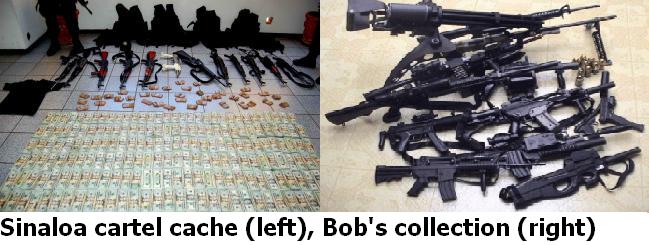
Besides, it’s not the guns that are the problem (with supply limited, the gangsters pretty well are limited to shooting each other and the cops… they just can’t afford to waste bullets on us civilians)… its the cash.
Narcotics purchases are pretty much recession-proof. The U.S. seems more interested in remittances going south than the 60 or 70 BILLION DOLLARS a year it spends on narcotics… Maybe they should take a look at what they spend on drugs… or at the money laundering… or the guns… NAH! It’s easier to print screaming headlines about shootouts in border towns and whine that “Mexico is out of control, blah, blah, blah…”
Thou shalt not… cast the first stone

I never even knew adultery ever was a criminal act. Wouldn’t you know it, the 31 deputies who voted to keep adultery a crime were all PANistas?
I don’t think anyone has ever actually be prosecuted for adultery, but Marisala Contreras, the PRD deputy who Equality and Gender Committee, said the real importance was not in getting rid of a legal “aberration”, but in closing a loophole.
Homicides are sometimes reduced to “justifiable homicide” when a smart lawyer claims his client was trying to prevent his compadre from committing a crime — and just “accidentally” offed his wife in the process.
Former Chief Border Patrol Agent, and now United States Congressman Silvestre Reyes has probably heard a lot of tall tales told by agents over the years. Zach Taylor, described as the head of something called the “National Association of Former Border Patrol Officers” — “an informal association of retired Border Patrol officers” was supposedly an “expert witness” who “claimed terrorists had entered the U.S. from Mexico at a congressional field hearing held Monday at the University of Texas at Brownsville (UTB).”
The only record I can find of Taylor’s connection with the “informal group” is his name on a list of about 100 names (only two of which were identifiably “Hispanic” names) who signed some petition the group drew up.
Taylor said — UNDER OATH — that:
“It is along our southern border that terrorists have entered the United States and have been apprehended,” Taylor said, under oath. “We do not know who, how many or where they are from because we only apprehend a relatively small fraction of all persons who cross our borders illegally.”
Congressman Reyes (who used to be Taylor’s boss, and noted that Taylor filed complaints against the now-congressman on several occasions, thought the claims were a little dubious. Taylor’s proof?
it was in the Nogales International, replied Taylor, referring to an Arizona newspaper. Taylor said the newspaper reported that two “aliens” from the Middle East were apprehended traveling from Sierra Vista to Nogales. “The newspaper article said they were coming to pick up one of their associates who had crossed the border illegally,” Taylor said.
However, as the Congressman noticed, no one said the two Middle Eastern “aliens” (for all we know, they were Israelis) were “illegal” or were “terrorists”. I’ll give Taylor the benefit of the doubt, and assume they were somewhere around Nogales.
OK, that one didn’t go so well.. how about Zach’s claim that he
… personally interviewed three Syrian citizens who had entered the U.S. illegally. One of the three had told him he was a terrorist, Taylor said, so he “turned him over” to the FBI.
OOPS! Zach can’t remember when this happened, nor does the FBI nor Homeland Security have any substantiated account of any “terrorist” crossing the U.S. Mexican border. Several have crossed the Canandian/U.S. border, something Reyes felt he had to emphasize:“I know this because I sit on the Intelligence Committee.”
Zach apparently sits on some committee too. But “intelligence” isn’t the first word that leaps to mind in connection with this bozo.
(Sombrero tip to Joey Gomez and Steve Taylor at Rio Grande Guardian)