Adios, Marías…
We tend to romanticize the Islas Marías prison colony as simply a place where prisoners could live out their sentences pretty much free from constraint (other than 110 Km of water between them and the mainland). Yes, low risk inmate were sent there, generally those serving long terms, but no longer thought to be a danger to society at large, but it was a political prison as well. There’s been talk for at least the last 20 years about closing it… prison colonies being a thing of the past… although the Calederón Administration expanded the colony during the “drug war” and considered turning it into a U.S: style “super-max” prison for the worst of the worst.
But… it was what it always was… a dumping ground for the politically and socially inconvenient… a place to send those who the state wanted to forget.
¡Día de San Patricio!
Can’t resist:
God and man in the Palacio Nacional
As one might expect, the punditocracy has been weighing in on AMLO’s first hundred days in office… making the point, as if it was a point, that he isn’t exactly a “liberal”, in either the Anglo-American English sense of the word, or in the historical Mexican tradition.
Andrés Bello, in the Economist calls AMLO a “reluctant liberal”, on the premise that while many in his cabinet have been supportive of the standards of a “liberal agends” in the northern countries (things like same-sex marriage, expanded abortion rights, clean energy, marijuana legalization), the President himself has shown little interest in these issues. While it is true that people supporting economic justice generally support social justice as well, but they are different things, and what is meant by “justice” (social or economic) is not always something we agree on. And, at least in Mexico, “liberalism” has a specific historical meaning, one explored (at perhaps with too much erudition) by long time politician and historian Agustín Basave in Proceso (“tweak-lated”… that is, translated, but I was… uh… liberal in making changes and adding words for readability in English… below). Basave (no AMLO-fan, he) makes several interesting observations, beyond the obvious one that AMLO’s ideology is “eclectic”, and… he suggests… anti-liberal.
First, he notes one of the more controversial, or at least, talked about initiatives — ending funding for day care centers in favor of direct payments to parents to use for child care is a neo-liberal concept, first proposed by that hero of conservative economics, Milton Friedman (a scaled down version of the negative income tax Friedman discussed with William F. Buckely in 1968). In itself, with northern liberals now discussing a guaranteed income, one might see AMLO’s plan as “liberal” in the sense that Mexican liberalism was all about personal autonomy.
It’s the fashion right now to reference the Italian political philosopher, Norberto Bobbio, which Basave does in differentiating between leftism and liberalism: at its simplest, that while liberals and leftist both seek social equality, liberals want to preserve personal autonomy where the left is more willing to turn to authoritarian measures to achieve economic equality. But, at the same time, Basave recognizes that a legal framework providing autonomy for the person does little to provide social equality. The 19th century liberals may have extended the vote to all male citizens regardless of their “race” or economic condition, but one could hardly say they were equal. Or, as another writer once put it, in a Liberal state, “the rich and the poor are equally punished for sleeping under a bridge”. Basasve goes so far as to call the victims of the inequality that resulted from legal equality “collateral damage”.
So, AMLO’s push for “affirmative action” type programs, that would provide guaranteed incomes to those that have been left behind by the last 25 years of “neoliberal” administrations, would be anti-liberal. As would the fact that those payments would be targeted to make payments in specific communities.
And, when you come down to it, AMLO’s first 100 days might be summed up by quoting Ronald Reagan (about as far from a “liberal” as one can get) in fighting “waste, fraud, and abuse” of federal funds. On the other hand, Reagan’s administration was infamous for its ostentation, while AMLO’s call for “republican austerity” has gone to the extreme of selling off the minor perks of high office, the presidential airplane, and the fleet of luxury vehicles meant to cart around officials, and disposing of the presidential compound, and so on.
Does this mean riding rough-shod over independent agencies and state governments… absolutely. Something that Basave sees as “authoritarian”, and putting AMLO squarely in the leftist, not liberal, camp per Bobbio. Does that, then, make AMLO an authoritarian leftist?
AND… the classic Mexican liberals were “Jacobins”… resolute in separating religion and statecraft. Basave merely notes that AMLO is not anti-religion, but I would look beyond his essay and AMLO’s reverence for Benito Juarez to find the historical lineage for his ideology.
But, then again, at least in private, Juarez was a practicing, believing Catholic. AMLO has just been more open about his beliefs (whether strictly Catholic, or Evangelical, about which there seems to be some question, though it’s of little import), his almost puritanical personal life and his social conservatism. His surprising proposal to open television channels to religious organizations, with the understanding that they would provide “moral guidance” to the public, is not in the Juarez “Liberal” tradition, but perhaps is in the Mexican tradition after all.
Not for nothing was AMLO’s first presidential coalition officially names “For the Good of all, but first the poor”. The phrase, if I’m not wrong, comes straight from Liberation Theology, but the search for a MORAL justice goes back to the earliest days of the New Spain, and has been a thread in Mexican political and social thought for the last five centuries. Vasco de Quiroga, the first bishop of Michaocán adopted the “commnist manifesto” of Thomas More, “Utopia” as a rough guide to organizing the Purepechas into an economically and socially nation able to hold its own (relatively) against the outside world. Bartolome de las Casas, was the “protector of the Indians”. Hidalgo, Morelos, Matamoros… men of the cloth who in the name of traditional values took up arms against the oppresive “one percent”. As did so many others, interpreting tradition values through the lens of the prevailing ideologies of their era: anarchists like the Flores Magon brothers, and Emiliano Zapata; Marists like Luis Cabanas, Lazaro Cardenas, the Ayotzinapa students … none “pure” to their interpretation of the ideology, nor particularly interested in the nuances of the terms… but as much in the traditions of Mexican political thought as any.
Deciphering AMLO’s liberalism
Agustín Basave, Proceso (Edition 2210, 10 March 2019)
MEXICO CITY (Process) .- Although many see President Andrés Manuel López Obrador as a populist or as a revolutionary nationalist, he identifies himself as a liberal, although he does not go beyond defining his ideology as an opposition to conservatism, and as an impulse to change. His observation that the people have always been divided between liberalism and conservative is not a risky given the introspective inclination of the Mexican people to consider their history, it’s not a risky position to take. With the introspective habit of Mexicans to consider their history, there have been several ways to be a liberal, depending on the circumstances of that 19th century Mexican political movement.
Our first liberals emphasized republicanism and the equality before the law, principals enshrined in the Constitution of 1824. Their successors completed the work in the Magna Carta of 1857, separating Church and State and guaranteeing religious freedom. Under the leadership of AMLO’s favored historical touchstone, Benito Juarez, public were secularized. But in achieving these ends, the indigenous people were adversely affected. The abstract ideals of egalitarianism, wielded against special rights and privileges, led to the closing of schools and hospitals for indigenous people, and later because the lands of their communities were expropriated along with ecclesiastical properties. However, beyond this serious but unintended collateral damage, liberalization was the progressive thread of our nineteenth-century evolution.
Despite his Juarista devotion, however, the leader of the fourth transformation does not seem to be coming from this tradition of liberalism. AMLO rejects abstract equality, which treated the unequal as if they were equal, and, although I do not know if he has participated in Freemasonry, he is certainly far from being anticlerical; in short, he is NOT a liberal in the Mexican tradition. Those old liberal principals are by no means an anachronism; even today there are numerous political and intellectual Jacobins — in fact some have criticized AMLO precisely because they consider that he does not clearly draw a line between his religious beliefs and hisrole as a statesman. But, when it comes to the broadly ideological traits identified by scholars of nineteenth-century liberalism, AMLO shares those with which practically no Mexican, left or right, disagrees at present.
But then again, we are all ideologically eclectic, starting with those of us who are social democrats. AMLO’s ideology combines utopian socialism, Marxist binarism, an instinct for populism, the atavism of revolutionary nationalism and ,yes, liberalism, but of a different kind from that found in 19th century Mexican intellectual history. To find wht he really professes, one must turn to Bobbio: “[liberalism] means individualism; and individualism is not only understood to be the radical defense of the individual as the one and only protagonist of the ethical and economic life against the State and society, but also an aversion to the existence of any intermediary between the individual and the State, so that, both in the political and economic markets, man must act on his own “(Norberto Bobbio and Nicola Matteucci, Political Dictionary, Siglo XXI Editores, Mexico, 1988, p.908). To argue that this definition describes AMLO will surely displease not a few liberals and himself, but does not individualized and direct money transfers to citizens and aversion to civil society fit this definition?
AMLO is a doctrinal jumble, a fascinating mixture of statism and economic neoliberalism: he abhors privatizations and vindicates the State, but at the same time repudiates the bureaucracy that characterizes the state — a paradox that I applaud and for intiatives that support this, I’ll vote. And in practice, athough perhaps unconsciously, he uses certain neoliberal concepts: the simplicity of the redistributive schemes — the negative income tax orignally proposed by Milton Friedman, the comparison of bureaucracy and corruption and the reluctance to incur debt, use deficit budget and, above all, to increase taxes. In this sense, AMLO is an unusual follower of the Washington Consensus, which he not unreasonably blames for all the ills in Mexico.
Ideologically, AMLO is impossible to pigeonhole. His speech is more or less homogeneous, but from the decisions and actions of his first 100 days of government, show a variegated ideological amalgam practiced with a dose of improvisation. Perhaps the only thing in which he does not show eclecticism is in his preferred governing style, omnipotent presidentialism. It is clear that he does not like counterweights, even if they are promoted from relatively powerless groups. Therefore, given his insistence on declaring himself a disciple of Mexican liberalism, I must say that the similarities that I find between AMLO and Juarez are two, one good and one bad: austere honesty, and the dangerous concentration of power. The first is not intrinsic to a liberal, but the second is the negation of any liberalism.
Apples and Oranges? AMLO and Maduro
Shannon O’Neil, is someone whose opinion matters, being the Latin American expert for the Council on Foreign Relations. Steve Ellner (Universidad de Universidad de Oriente, Puerto La Cruz, Venezuela), who SHOULD be listened to in the halls of power, but, alas, I know only from Democracy Now and his excellent blog (steveellnersblog.blogspot.com) has, better than I ever could, responded to Ms. O’Neil’s recent article for Bloomberg, which suggests the same “mainstream” logic used to justify intervention in Venezuela could be applied to Mexico… and the reason I’ve been so obsessed lately with US media coverage of the Bolivarian Republic.
THE PLAYBOOK USED AGAINST CHAVEZ NOW APPLIED TO LOPEZ OBRADOR
Shannon O’Neil kicks off her article for Bloomberg titled “López Obrador is Dismantling Democracy in Mexico” with the astounding statement that between AMLO (López Obrador) and Jair Bolsonaro “it is Mexico’s democracy that is under greater threat.” Never mind that Brazil is rapidly degenerating into the repressive state that Bolsonaro’s neo-fascist rhetoric and glorification of the 1964 coup signaled. And never mind that AMLO is really being called out because he has implemented nothing more than timid, but much needed, changes in Mexico.
The article goes on to point to AMLO’s “power grab” in the form of strengthening the executive branch at the expense of the legislative branch, even though his Morena party controls congress. He is also rebuked for going beyond the established system of electoral democracy by calling referendums which are allegedly tantamount to demagoguery. These are the same accusations made by Jorge Castaneda in his co-authored Leftovers in 2006 which called AMLO a “populist” (in the bad sense of the word) and a member of the “bad left.” Nowhere does Castañeda or O’Neil explain why referendums are inherently undemocratic.
The article also claims that AMLO is riding roughshod over established institutions such as the judicial branch. Nowhere is mention made, however, of what Trump calls the “deep state” which will obstruct any meaningful change in Mexico and eventually sabotage AMLO’s rule.
O’Neil also warns that AMLO “is building a parallel labor confederation to challenge the Mexican Workers Confederation, long allied to the once-dominant Institutional Revolutionary Party (PRI).” The implication is that any attempt to alter established institutions is tantamount to demagoguery. Nowhere is mention made, however, of the fact that the Mexican Workers Confederation is notoriously corrupt and part of the populist (also in the bad sense of the word) network which was institutionalized in Mexico over half a century ago.
O’Neil ends the article saying that the system of checks and balances, which AMLO is allegedly dismantling, is “much harder to build than to break.” I am also a firm believer in the system of checks and balances, but not when who is doing the checking and balancing is corrupt and closely tied to the nation’s elites.
O’Neil’s accusations against AMLO bare an uncanny similarity with the narrative used against Chávez from the very outset of his rule in 1999. The real playbook which has been revealed by so many experiences of progressive governments in third world countries over the years consists of Washington playing back seat and maintaining a low profile while it encourages the local elite consisting of business interests, traditional parties and politicians, the church hierarchy, and the international and local media to promote destabilization in the name of resisting demagoguery, caudillismo and authoritarianism. If that doesn’t work, and if AMLO holds his ground, then Washington will shift into second gear by playing an increasingly activist role. That’s what Venezuela has taught and that’s what we can expect in the case of Mexico. O’Neil’s article sheds light on the future scenario.
Killer nun
This being International Women’s Month, maybe it’s time to look at some of the more important, but neglected, historical figures in Mexico, written out of the official history (or at least rather obscured) for no reason other than their gender. Like “Madre Conchita”, Concepción Acevedo de la Llata, nun, terrorist, political prisoner, and philanthopist.
Born in Queretaro in 1891,she entered a convent at 19, and was mother superior of her convent at 24. With the passage of the “Calles Laws” which took the Constitutional restrictions on religious activities to an extreme, her convent was closed, and she moved to Mexico City where, with the Churchs closed by the Priest’s stike of 1928, she began preaching her own unofficial services, and — under the guise of private religious discussions — was active in plotting Cristero strikes against the government. One of her proteges, Juan Torral, a cartoonist and free-lance journalist, would assassinate president-elect Obregón in 1928.
 Obregón’s assassination has left a number of “what-ifs” to Mexican historians. His first term had started with a counter-revolution (Carranza had prevented the Obregón, the overwhelming favorite of the electorate, a chance to run, and had tried to hang on to power when his term ended, leading to a coup, followed by the short interim presidency of Adolfo de la Huerta), and ended with one, when de la Huerta became the figure-head of a counter revolution when Obregón had selected Calles as his candidate to succeed him. Although his fame came as the self-taught general who’d consolidated the Revolution, Obregón had openly questioned the country’s dependence on military rule, and — perhaps raising more questions about the direction Mexico might have taken had he served a second term (the rationale being that he’d never had a full first term) — was that the self-made millionaire was a Socialist. Moreover, having seen the violence that grew out of the overly-strict interpretations of limits on religious activity and clerics, he was openly negotiating with Father John Burke and United States Ambassador Dwight Morrow, the unofficial go-betweens for the Vatican and the Mexican clergy in an attempt to work out an peaceful settlement. Had Obregón lived, Calles might not have taken control of the party for the next several years, and the Mexican economy may have moved in a different direction.
But, all that is speculation. Madre Conchita was the “intellectual author” of an event which did change the course of Mexican history for better or worse. In the aftermath of the assassination, justice was, well… rough. She was arrested, tortured (how much is hard to say) and sentenced to 20 years. Sent to Islas Marias, the recently closed prison colony off the coast of Nayarit, she married a fellow prisoner, and, was paroled in 1940.
In an attempt to rehabitate her image, she became the head of a foundation meant to improve the social conditions of Otomí people, raising money for an orphanage and making a show of donating her car to be used by Otomí mothers needing to visit local heath clinics. From time to time, she would lecture, or allow herself to be interviewed, or write (or at least have appear under her name) defenses of the more conservative views of the Catholic Church, and of the right to religious dissent. She never, however, spoke of her role in the Cristeros, going so far as to deny even having even met with them.
By special permission of Pope Paul VI, she was buried in her nun’s habit in 1978.
Surveillance and the soccer-mom
Forwarded, and to be forwarded:
Many of you know that I have been helping out for the last few months at the Benedictine Monastery, the site that Catholic Social Service’s Casa Alitas (DONATE HERE... my note), which has had the opportunity to operate out of in its mission to receive asylum seekers, provide them a safe space to land, food, clothes, supports, etc. until they can get to the sponsors who are receiving them in various cities across the country. This hospitality process, I might add, costs the government and US taxpayer $0, and is funded by the love, sweat, tears and good hearts of the Tucson community and beyond.
The other night, I was leaving later in the evening, having spent hours after the intake process to updates room assignments, travel information, reset the room for the next day, etc. I was tired. I was headed home about two hours later than I had promised my family, and I was feeling stressed and guilty about the fact that it was yet another night that I had to lean on my partner to do dinner, homework, and the nighttime routine of getting our kiddos down for the night and ready for the next day.
As I stepped down the long hall toward the exit, I heard loud raised voices and quickly realized a makeshift soccer game was in progress between three boys. They were about 8 or 9 years old, laughing and lost in their game. For a second, I nearly pulled on my mom voice to scold them about kicking a ball in the hallway, the realized that a) there was nothing they could harm in said hallway and b) they were probably having the first bit of fun they had had since being in detention. I continued down the hall through their game and said nothing, smiling at them instead.
As I got further down the hall, I heard them kick the ball- not a real soccer ball, but a smaller rubber ball- and knew it was headed my way. I saw movement as the person up ahead of me moved to intercept it, and realized that it was their mother. She was laughing and smiling, as lost in the game as they were, and I realized that she was experiencing freedom along with them. How many of us mothers hear the constant “mommy, play with me!”? She was playing with them, and happy to be doing so.
I could hear the ball getting closer to me, and she sped up, sticking her leg out to shift the ball’s course. We both glanced down together at her leg- her to direct it where she wanted the ball to go, me to make sure that I wasn’t going to trip over it (though it wasn’t going very fast).
That’s when I saw it. The ankle monitor, hanging off of her delicate, capri-clad leg. It looked so foreign, so out of place, that I couldn’t wrap my head around its presence. We both stared at it, and it looked like she was also having trouble understanding why it was there, as if she had forgotten about it, if only for the length of a hallway soccer game.
Then she seemed to remember, and she jerked her leg back. The ball went past me, out of her reach, and she stumbled over to to it. I could tell she was embarrassed.
But I was also embarrassed. I wish I could explain to this young soccer mom why or how she was so dangerous as to require 24-hour ankle monitoring. There is no good answer for that, and I think we both knew it.
I kept the smile on my face, seeking out her eyes to let her know that she had no reason to be ashamed. But she never looked up, never looked back my way, determined not to meet eyes. I was the one who sat there, ashamed.
That shame followed me to my car, on the drive home, and all the way to the my home, where my own children greeted me with, “Mommy! Come play with us!” as they sought to evade bedtime.
It sits with me still, and I really can’t figure out a way to expel it. So I hope that my efforts, and all the efforts of those who are working to confront this shameful reality, these murderous and deadly border policies, will move us to a world where soccer moms don’t wear ankle monitors, and we stop pretending that refugees are the ones who should be ashamed.
Who are they?
For International Women’s Day, the Government websites have switched the usual logo, featuring Morelos, Juárez, Madero, and Lazaro Cardenas with a few other heroes of Mexico’s transformative history:
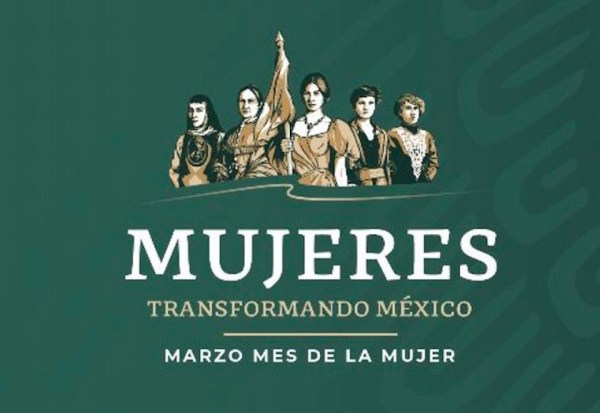
Left to right:
Sor Juana… 17th century poet, scientist, and theologian who argued for the right to an education for women.
Josefa Ortiz de Domínguez: one of the original conspirators in the Independence underground of 1810, who risked her life to warn Padre Hildago that their plot had been uncovered-
Leona Vicardo: a romantic favorite. A criollo heiress to a mining fortune, she flirted with Spanish officers to gather intelligence during the war of independence, was active in disseminating pro-independence propaganda through underground publications, ran guns to Morelos and helped draft the first Mexican constitution.
Elvia Carrillo Puerto: radical feminist active in the 1910-20 Revolution, responsible for women’s suffrage in the Yucatan.
Carmen Serdan: She and her brothers took up arms against the Porfirian dictatorship, holding off a police and army siege until she was the last person standing.
The Painter, the Peso… and the saint.
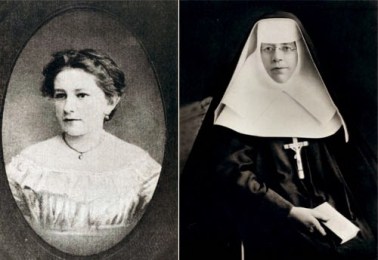
My friend, Deacon John Donaghy posted the other day that it was the Feast of St. Katherine Drexel… I knew that she’d been from a wealthy family, but was kind of curious where that wealth came from. The Mexican peso, among other things.
A high-society heiress giving it all up to become a nun is, in a way, a romantic story, but those millions (or today’s billions) she turned her back on to serve the Indigenous and African-American communties for 60+ years, comes with an even more romantic back story… involving art, revolution, Texas and money.
 The future saint’s grand-father was Francis Martin Drexel … artist, rogue, adventurer… and the George Soros of 19th century America. Born in the Austrian Alps, on the borders of Lichtenstein and Switzerland, he somehow managed as a teenager to get mixed up in an anti-Napoleonic underground, and had to flee to Switzerland when he was 17. So far, the typical romantic background for a 19th century artist. Perhaps, though, being in Switzerland, he learned a few banking tricks, or at least knew some bankers (after all, he was a portrait painter).
Like so many 19th century failed revolutionaries, he emigrated to the United States. He married into a prominent Philidelphia family, and immediately… like any good romantic figure… to get himself in all kinds of trouble with his conventional in-laws. A murky lawsuit over a slander by his brother-in-law about his wife forced Drexel to pay out a large settlement, and to go on the road to recover the sizable (for an artist.. in other words, respectable but moderate) fortune he’d made as a successful painter of Philadelphia’s elites.
He managed to return from a tour of South America (painting, among others, Simon Bolivar) with a sizable (for the time) $12,500 nest-egg (about $350,000 in today’s dollars), by no means a “starving artist” income, though for a man with growing family (he’d father six children in all) and married into “respectablablity” not enough to just sit back and indulge his artistic whims.

Portrait of a South American Official (1829). Drexel University Collection
So… in 1835, it was time for another foray into Latin America, this time, Mexico. Which perhaps was as good as any time for a painter to be there, but with a government falling apart, no real banking system to speak of, and rampant speculation in recently seized church properties and land in Texas (especially after the war for Texas independence broke out the next year) created a bouncing peso on the currency market, and… perhaps having picked up more than just art techniques during his time in Switzerland… currency speculation, for Drexel, became an art in itself.. One he’d perfect upon his return to the United States in 1837, just as Andrew Jackson had forced the closure of the Bank of the United States (then headquartered in Philadelphia).
Jackson may have been the hero of the “common man”, but the growing U.S. economy needed money … and Drexel knew how to make it. Besides, while he was out of the country, his clients had turned to the growing number of other Philidephia area protraitists… Thomas Sully (1783- 1872) and the “ubiquitous Peale family”. WIth no national bank, and local banks issuing their own currency, Drexel turned what he’d learned from dealing in a peso that changed value by the day (and depending on where one was in Mexico) to the confused currency situation in the United States, quickly becoming the go-to source for western expansionist projects. Including the railroads. Which killed him: he fell getting off a train and got run over in 1863,
The bank still exists, and the Drexel family are still filthy rich, though some… like Catherine (her religious name was Katherine) paint a different picture of the very rich and portrait of American wealth, and taking advantage of Mexico.
Consistency is the hobgoblin of little minds
Is AMLO really a leftist, or is he a traditionalist, an authoritarian, or … something else?
A few days ago, MexFiles posted on the sausage-making that went into the National Guard bill… initially attacked (not without merit) not just by the various opposition parties, but by some on the broad leftist Morena front as well. The oppostion on the left felt betrayed that AMLO campaigned on a “Hugs not drugs” response to rampant criminality but proposed, and pushed mightily, for a military controlled National Guard. Did he change his mind, or have the realities of governance in a complex country faced with new challenges change his mind?
Vanni Pattiná(a research professor at the Colegio de México´s Centro de Estudios Históricos looks delves deeper into the seeming condundrum of a utopian leftist campaign, and the hard realities of governance.
Originally published as “López Obrador y la cuarta transformación: más allá de lo caricaturesco” (El País Edición América, 26 February 2019). My translation.
That Andrés Manuel López Obrador is a polarizing figure is a given. Even before winning the 2018 Presidential election, and even moreso now, his statements and addresses are not always translated into policy. In these first few months as leader of the nation, with some justification, the twists and turns and abrupt turn-around from his speeches, have led to heated debate in this country.
During the electoral campaign, within the framework of a left-wing program, the president had appealed for the demilitarization of the fight against drug trafficking, but in the first few months of his administration has resolved to create a National Guard under military operational command as one of the cornerstone of his security policy. While announcing the establishment of a true participatory democracy, the president, making use of his constitutional powers, appoints so called “super-delegates” for each state: for the President, a coordinator between state and federal powers, but for his critics, a distortion of the constitutional autonomy of the different levels of government.
Civil rights were substantially expanded during his tenure as head of the Mexico City government but have seemed to have disappeared from his agenda. More importantly, his recent statements about the central role of the traditional family as a brake on the expansion of crime seem to suggest the adoption of a rather conservative social agenda. These are just some of the examples of the abrupt changes of direction or of the apparent incongruity that have marked both the electoral campaign and the first months of López Obrador’s tenure as Chief Executive.
A good part of the Mexican commentocracy seems to attribute these incongruities to the new President’s personality, saying he is incoherent or erratic or even authoritarian with a scant appreciation of democratic values or practices. However, there are two factors, related to structural causes, that would help understand this problem in a somewhat deeper way. In the first place, it is necessary to take into account the different ideas of what is the “left” as conceived by the president, party activists, members of the cabinet and Morena voters . Secondly, it is necessary to understand how applying campaign promises collides with the operational the Mexican state and its institutions.
As to the differing definitions of the left, we can take the classic definition of Norberto Bobbio* as a reference, López Obrador would be defined as being on the left, since the redistribution of wealth is indisputably at the center of his program. . However, as various observers have claimed, he is a socially conservative leftist leader: not a particularly surprising position in Mexico, where movements that could be defined as leftist, such as that led Emiliano Zapata during the Mexican Revolution, allowed for the ideological coexistence between a radical egalitarianism and a conservative vision of society. John Womack**, probably one of the deepest scholars of Zapatismo, began his famous book about the revolutionary leader stating it was just a story about peasants who didn’t want to move (literally) and that’s why they revolted. As Héctor Aguilar Camín points out, in his commentary on the new translation of the book, not wanting to physically move in the face of the expanding modernizing Porfirian hacienda system, also implied cultural and social resistance to the process of modernization. In that sense, López Obrador is in a tradition where left and political modernity can be split without apparent contradiction.
Coupled with this, among the president’s supporters and the voters, redistribution of wealth is not the only factor defining the left. A core part of López Obrador’s movement is identified with a broader progressive agenda, which includes civil rights, a less hierarchical value system and less paternalistic political practices. The tension between these concepts of the left, united by the question of inequality and separated by different visions of society, generates unresolved and continuous tensions. Far from trying to reduce them, the leader of Morena seems on the contrary to accentuate at times his social conservatism, speaking with some success in some regions of the country, which seem to communicate a more moderate cultural perspective.
The second thing to consider is that inconsistencies in the discussion and policy proposals of the fourth transformation*** are related to the limits the state’s institutional weakness imposes on realizing certain campaign proposals. I don’t think there any doubt that López Obrador has a different vision of the relationship between State and society than that of his predecessors, a perspective that also affects the security problem. If the images are worth something, and in politics they are, one should not underestimate the fact that one of his first acts as constitutional president has been to meet the parents of the 43 students of the Ayotzinapa normal school, murdered by organized crime in collusion with the municipal authorities of the State of Guerrero in circumstances still to be clarified. It is a strong signal, which marks a different sensitivity to the problem of violence in the country and its harmful effects on society and its most vulnerable sectors.
The problem is that despite his good intentions, López Obrador is confronted with institutions whose level of weakness and decomposition it seems even he was unaware of when taking the reins of the state machine. In fact, if we look at Mexico beyond its capital [where he headed the government], we can not avoid seeing the difficulty with which state, federal and local institutions operate in vast regions of the country. Here, far from the capital, a dysfunctional federalism — encouraged during the democratic stage undertaken by the country after the year 2000 , in conjunction with the disappearance of the party-State — the persistence of patronage and caciques [local political/economic bosses] have systematically eroded the consolidation of a functional state. If we add to this the presence of organized crime, which over the last decade has increasingly undermined the ability of the state to exercise its functions in the territory, we can see that, in terms of institutional consolidation, the situation is much more complicated.
It is probable that some of the recent decisions, such as the creation of a National Guard, apparently inconsistent with the electoral campaign proposals, or the decision to create super-delegates, showing scant sensitivity to the existing federal institutional framework, respond, in reality, to the need to reinforce the political coordination capacity of the center over the regions and to regain control of the territory lost during the last six years. It is true that López Obrador’s obstinate demand that the National Guard be under military supervision, in a country in which there have been multiple proven violations of human rights by the Army while performing internal security tasks, generates legitimate befuddlement. However, whether López Obrador is correct or not, it is undeniable that these public policy proposals aim at recovering some basic functions of any modern state, such as the control of the territory and the coordination between federal entities and central power, in a context of great complexity, and confronting the challenges that low institutionality and the pervasive presence of organized crime pose. Political movements on the left have a more utopian outlook than those on the right: therefore, the impact of reality, when they become the government always generates rumblings, criticism and disenchantment.
As can be seen, the problems described here are knotty ones, difficult to resolve, which will continue to exert an important influence on the speeches and policies of the current government. I think it is legitimate that observers, journalists or citizens underline, even with vehemence, the cacophony that sometimes marks the discourse and the implementation of the policies of the new executive. This is a crucial task in any system that is defined as democratic. Yet, if as Albert Camus said, “banality is the worst enemy of information”, we have to demand a more rigous analysis of the causes of our problems. The challenges facing this Administration and the country itself require attempts to reflect on the situation and, above all, knee-jerk reactions.
*Italian political theorist and socialist (1909 -2004) who argued that the “left”believes in attempting to eradicate social inequality, while at the same time arguing for separation of powers and limits on state power
. **English language edition Zapata and the Mexican Revolution, Vintage Paperback 1970. New Spanish language translation by Francisco González Aramburo, Fondo de Cultural Económica, 2017.
*** The implication is that Mexico had three previous transformations in its political structure: Independence, the Juarez era reforms, and the Revolution. López Obrador’s program is said to the the fourth.
Mike Pence: resistance is futile. Mexico: oh yeah?
Mexico and Uruguay have been at odds with the United States government in their non-recognition of the self-proclaimed Guaidó Administration as opposed to the elected, constitution (de facto and de jure) Maduro Administration. While both countries have left-leaning governments, neither is claiming the present administration in Caracas is perfect, or even moderately competent… only that, given deep rifts in Venezuelan political culture, it would not be remiss to negotiate a solution. Not being a student of Uruguayan foreign policy, MexFiles cannot comment on the rationale for that country’s position, but when it comes to Mexican policy, the official line is that we are following the Estrada Doctrine.
 As developed in the early 1930s by then Foreign Secretary Genaro Estrada, Mexican foreign policy has been based on three simple principals: non-intervention in the domestic affairs of other nations, the peaceful resolution of disputes between nations, and the inviolability of state sovereignty. These three principals were the first applied in the League of Nations, when Mexico faced off the “Great Powers” as the lonely defender of the rights of Ethiopia against Italian aggression, of Austria against the German anschloss and … when the European slaughter-house went into full operation in 1939, demanding respect for its own rights under that third principal (inviolability of state sovereignty) to protect their diplomatic corps as they silently rescued tens of thousands of civilians they were willing to take under the Mexican wing.
Following the war, in the United Nations, Mexico was a leader in the “non-aligned movement” … taking no sides in the East-West “cold war” although continuing to provide refuge for victims of both U.S. and Soviet aggression. The Civil Wars in the Central American Republics were largely settled through Mexican diplomatic efforts at negotiations… imperfect solutions, but well in the Estrada tradition.
Even though the Fox Administration, under Foreign Secretary Jorge Castañeda, in a craven attempt to mollify the United States over their “immigration crisis” panic, repudiated the doctrine, Mexico still proclaimed its neutrality in 2002 when, having a seat on the United Nations Security Council, it refused to back the U.S. led invasion of Iraq, despite both U.S. and British attempts to subvert the Mexican U.N. Mission, and to sway public opinion in Mexico. President Fox was forced to give a national televised address… from his hospital bed (he was recovering from back surgery) … assuring the nation that Mexico would not be involved in Iraq. But it did accept refugees from that country.
And, now, Venezuela. Yes, Mexico is accepting refugees from that country, in quite large numbers. Without full statistics on the economic status of these Venezuelans, from observation, it appears most are middle-class or upper-middle class people (not the rich people in Miami), who may hate the present government, but are less political exiles than victims of the changing economy and the hard times imposed by US led economic sanctions. Full disclosure: being mobility limited. I informally employ a Venezuelan émigré plant manager who has extremely right-wing politics, which may color my own perceptions of the large Venezuelan community here).
At least here, we are not unaware of conditions “on the ground” of that Venezuelan middle-class. But, we are a country that, like Venezuela, despite abundant natural resources (including oil… Venezuela, like Mexico, also is a major mineral producer, especially gold) but suffers from appalling levels of inequality. Naturally, our left is sympathetic to what the Bolivarian Republic has attempted, with more than some success, to do to foster equality, but more importantly, Mexico… having suffered more than its share of “interventions” and having gone through seven years of civil war following a botched U.S. attempt to impose a leader more aligned with their policy (the Revolution following the imposition of Victoriano Huerta cannot be described as anything other than fratricide)… has no more reason to listen to Mike Pence than Venustiano Carranza had to listen to Woodrow Wilson when he insisted it was his duty to “Teach [us] to elect good men.
So… Pence is resorting to implied threats:
(Rafael Croda, “EU a México: no puede haber espectadores, hay que reconocer a Guaidó” Proceso, 25 February 2019). My translation:
Nice little country you got here… be a shame if anything happened to it…
United States Vice-president Mike Pence, called on Monday for Mexico to recognize Juan Guaidó, the self-proclaimed president of Venezuela, as the legitimate president of that country, and asked Mexico to join the struggle of the Venezuelan people “To recover their freedom”.
Speaking at the meeting of the Lima Group in Bogota, Pence said that in the face of the political, economic and social crisis that Venezuela is experiencing, “there can be no spectators.”
The United States, he added, “urges every nation in the hemisphere that loves freedom, including Mexico, Uruguay and the nations of the eastern Caribbean, to join us in recognizing the interim president Juan Guaidó and his government and to join the struggle of the Venezuelan people to recover their freedom “.
Mexico and Uruguay have defended a position of neutrality during the Venezuelan crisis and have launched an initiative to promote a dialogue between the political opposition led by Guaidó and the Maduro regime, only to be rebuffed by the self-proclaimed interim president.
Pence said in the meeting of the Lima Group that world leaders should know that “the time has come” to stand up for Venezuela in its “fight for freedom.”
He added that nations backing the Maduro administration (including Bolivia, Cuba and Nicaragua) should “reconsider” that position, in light of last weekend’s violence when the Caracas government prevented humanitarian aid from entering the country.
“Reconsider your support for the tyrant, unite with the nations of the world that are close to the Venezuelan people,” said the US vice president, adding that, otherwise, the pro-government nations would be further isolated from the world.

That last quote sure sounds like a threat…
Greater profit through “segregation technology”
Venezuelan coup … what “rule of law”?
Abby Martin’s “Empire FIles” is about the best independent resource for anyone following the coup attempt (and ham-handed US intervention) in Venezuela. Martin has worked with non-US media sources in the past, but to maintain independence, is part of the “patreon” collective of independent media and blogs.
This clip, from a much longer discussion with UN Rapporteur for Human Rights, Alfred De Zayas, looks at the foreign media (i.e. US corporate media) and its acceptance of factually untrue narratives about Venezuela… meant to rationalize not just a change in administration in that country, but a return to foreign control of its natural resources and markets.
So… why is this posted on MexFiles? If you think for a moment that the United States and US corporate interests would not welcome a return to the corrupt previous governments here, in return for more “privatization” and a reduction in the so far mild suggestions of a return to Mexican control of Mexican resources, think again.


 mexfiles.net