To see ourselves as others see us
The only thing I miss about the old Mexico City Herald is Kelly Arthur Garrett’s clear writing on Mexican politics and culture. On his own blog (Mexicalpan: Not the News), he takes a look at how north of the border political concerns are playing at home:
Given its unprecedented relevance for Mexico, Mexican citizens on both sides of the border will be involved as never before, scrutinizing the candidates’ positions, analyzing policy proposals’ implications for Mexico, and influencing their much-coveted ethnic brethren, the Mexican-American voters.
What’s interesting about the paragraph you just read is that almost none of it is true. It seems true. Maybe it should be true. And it will undoubtedly be presented as true by a breathless Mexican media.
But if you talk to pollsters — that is, folks who actually measure how the population thinks rather than cling to set assumptions about it — you get a different picture. The average Mexican citizen, like the average citizen anywhere, has enough to think about without dissecting the details of another nation’s political battles.
That same average citizen can also be forgiven for believing that from Mexico’s point of view, it won’t matter much who wins.
“There’s a fatalism at work but it’s a sophisticated fatalism,” says Dan Lund, president of the Mund Americas public opinion research firm in Mexico City. “It’s not a bad way to look at the world.”
Tabasco souse…

PHOTO: APF, via BBC
This aerial shot is of Villahermosa yesterday, not New Orleans in 2005. Tabasco is, in some ways the Louisiana of Mexico — with low-lying rivers, a lot of oil and crooked politics (all of which may be a factor in this disaster).
Rivers ususally rise this time of year, but the devastation has been catastrophic: 70 percent of the state is underwater, and crop losses are estimated at 100 percent. With Rio Grijalva showing no indication of returning to its banks any time soon (it’s still raining), it’s only going to get worse. The Associated Press is reporting that 300,000 people have been affected, and tens of thousands left homeless.
Tabasco is THE oil state, and this is going to affect world oil prices somewhat. Just because this year the U.S. “only” had some major fires, we have been told that Global Warming means more flooding in wet parts of the world and drought in dry ones — so far, the unprecedented floods in Tabasco haven’t sunk in with us, as we go through drought in the south, and fires in the west.
NarcoNews blames the Calderón Administration — and the “War on Drugs” (aka, “NOT Plan Colombia, Plan Mérida” ). In a roundabout way, there is a connection. Globalization and it’s discontents have something to do with making conditions worse. The Mexican Army — as they were in New Orleans — has been sent to coordinate disaster relief efforts.
That’s what the Mexican Army does — disaster relief. NarcoNews’ contention is that by diverting military resources to the U.S. backs “War on Drugs” they’re not able to take on the task. Think of the shortage of National Guard troops available in disasters in the U.S. recently (and remember that Mexico is not fighting a foreign war — and except for World War II, never has — and that responding to natural disasters is their primary mission):
Tabasco Governor Andres Granier made the rounds of TV and radio outlets lamenting the lack of manpower to help in evacuation, rescue and assistance efforts. Specifically, he decried the fact that only 5,000 soldiers have been sent to the state (which is now 80 percent covered in water) whereas in 1999 when the last flooding event occurred, 20,000 troops were sent in, although the crisis was much less severe. Why isn’t the federal government deploying troops to Tabasco? Because they are far flung throughout the countryside, away from their barracks, on a wild goose chase to catch the drug kingpins that cynical President Calderon knows they will never find – since in many cases they are protected by the politicians and military officers supposedly trying to catch them.
There is money in Tabasco — though a lot of it has been pissed away over the years by crooked politicians (when Roberto Madrazo ran for Governor in 1994, he spent $70 million on his campaign. Bill Clinton and Al Gore only spent $62.5 million two years earlier in what was then considered an excessively expensive campaign — and for a much larger prize). Andres Manuel Lopez Obradór got his start as a “Mr. Clean” figure as the states Indigenous Affairs Commissioner (and even there money had a way of disappearing). Blame will be flying around on misspent funds and misdirected priorities when — if — the waters recede, but in the meantime expect conditions to get worse, not better.
(Sombrero tip to RJ_1 at ThornTree)
Happy Day of the Dead

Photo of Santa Muerte (and compa) by David AgrenThe Low Rent Correspondent”)
Doesn’t she know that smoking is bad for one’s health?
… oh well, none of us get out of here alive…
My 2003 Mexico City “Dead Tour” here.
Lyn’s creepy report on Mayan Day of the Dead customs here.
No hurry… but make your reservations now

I take it the congress will not be chowing down on tacos, tamales, tortillas and tortas.
Alfredo Narváez has more (in Spanish, Italian and English) about the slow food movement at Citius64
Funny
I don’t think I can. But, if you read Spanish, El Sentir’s little essay is one of the best I’ve seen on a neglected subject. El Sentir’s site is always worth looking at, and my apologies for not giving it the recognition it deserves.
I always thought Saltillo was a better tourist destination than near-by Monterrey, but until recently, it never dawned on my that Coahuila more than holds its own against economic and political powerhouses like the Distrito Federal and Nuevo Leon. And — in the interesting blog department — for their size, more than compete.
¡Buen trabajo!
Bush league Ivy Leaguers and Plan Mérida
A e-mail sent to the Oaxaca Study Action Group about the U.S. funded expansion of the “War on Drugs” — the so-called “Plan Mexico” now being marketed under the more palatable name of “Plan Mérida” reads:
Plan Mexico has its roots in a pre-NAFTA concept born in rightwing think tanks. …
The concept dates back to Reagan’s time. Basically it was focused on economic concept coming out of Harvard. After years of conquest based on the theory of “Control the politics and you control the economy” of 18th and 19th century expansion the Harvardians turned the theory around: “Control the economy and you control the politics,”The grand idea was to create a U.S. hemisphere with economic control from Alaska to Tierra de Fuego. NAFTA was advertised as a trade agreement but it was more than that: It was a measure to gain economic control over Latin America by indebting them to the U.S. through loans,extracting raw materials, creating a cheap labor pool and making the economies of the Latin American countries totally dependent. It worked with Mexico but along the way South America pulled out, Brazil and Argentina refusing to stay debt dependent and Venezuela developing a booming oil economy.
Plan Puebla-Panama fits into this plan of economic domination. So does the woeful condition of Pemex, which has to have outside investment just to maintain its equipment. (Thirty years of failing to put any money in infrastructure has totally depleted its capacity to continue to produce.) The U.S. already controls the banking system and through NAFTA both retail and commercial markets. (WalMart, McDonalds, etc.).
In 2006, shortly before the July presidential elections, I attended a forum in La Paz at which Davidow, the former U.S. ambassador to Mexico, was the featuredspeaker. I commented to the guy sitting next to me (suit and tie, shaved so closely his chin gleamed) that things might not work out the way Davidow was saying if López Obrador won the election.
He smiled and told me, very quietly, “The U.S. will never permit López Obrador to become president of Mexico.”
Plan Mexico gives Calderón a few millions bucks worth of equipment to repress leftists like APPO, of course. The U.S. government will pay U.S. manufacturers for all of the goodies they produce and send.
True or not, I’ve always felt that the very narrow (and statistically improbable) Calderón “victory” was a little too much like some of our “improbable” election results lately (Bush-Gore; Bush-Kerry) to be dismiss U.S. involvement entirely. And — given that I was loudly complaining about Republican Party operatives working for the Calderón campaign, it isn’t just a paranoid fantasy to suggest — as the PRD has maintained — that “they wuz robbed” .
I’ve also been suggesting (hell… I’ve been saying) that Calderón’s own “War on Drugs” was more a way of establishing his credibility than any real attempt to put down the narcotics trade. And, like the OSAG poster, I’ve wondered if the military actions weren’t ALSO designed to intimidate the opposition.
I happen to agree with the writers’ analysis of what has happened to the Mexican economy, though I’m less likely than he is to credit (or blame) some Harvard professors and right-wing think tank papers. Right and left, all country’s elites largely bought off on the globalization fad of the last few years.
While even some of the authors of globalization (like Joseph Steiglitz) have come to recognize ithe very real shortfalls of — oh — “neo-internationalism” or “neo-liberalism” (especially in middle-class countries like Mexico and Brazil), the Bush Administration seems to still be enamored of what’s more and more seen as a “retro” theory, and one that didn’t take into account OTHER factos like climate change, limits to growth and growing class disparaty in the wealthy nations (like the United States).
That’s what worries me most about “Plan Mérida”… not that a couple of billion U.S. dollars are going to the Mexican military to purchase U.S. made goods and equipment, but that it opens the door to some even more retro ideas. John Negroponte was in Mexico City the other day to talk to Felipe Calderón about “Plan Mérida”.
But what does anti-narcotics military/legal action have to do with “the economy and immigration”, which were the subject of these talks. Negroponte, speaking of fascists, scares the hell out of me. Besides the mess he made as U.S. Ambassador to Iraq, his record in Latin America is fightening
As ambassador to Honduras from 1981 to 1985, Negroponte played a key role in US aid to the Contra death squads in Nicaragua and shoring up the brutal military dictatorship of General Gustavo Alvarez MartÃnez in Honduras. Between 1980 and 1994 U.S. military aid to Honduras jumped from $3.9 million to $77.4 million. Much of this went to ensure the Honduran army’s loyalty in the battle against popular movements throughout Central America.
…According to the New York Times, Negroponte was responsible for “carrying out the covert strategy of the Reagan administration to crush the Sandinistas government in Nicaragua.”
…n early 1984, two American mercenaries, Thomas Posey and Dana Parker, contacted Negroponte, stating they wanted to supply arms to the Contras after the U.S. Congress had banned further military aid. Documents show that Negroponte brought the two with a contact in the Honduran armed forces.
The operation was exposed nine months later, at which point the Reagan administration denied any US involvement, despite Negroponte’s participation in the scheme. Other documents uncovered a plan of Negroponte and then-Vice President George H.W. Bush to funnel Contra aid money through the Honduran government.
The son of a Greek-British shipping magnate, John Negroponte attended Philips Exeter Academy and Yale University, attaching himself to William H.T. Bush (Bush I’s brother, and Bush II’s uncle). I’m not one for conspiracy theories, but there is more than a whiff of cronyism about Negroponte and the Bush clan. Given his record in Honduras (he was later U.S. Ambassador to Mexico (Unsourced in Wikipedia’s biography is the statement “During Negroponte’s tour as US Ambassador to Mexico (1989-1993), he officiated at the block-long, fortified embassy and directed, among other things, U.S. intelligence services to assist the war against the Zapatista rebels of Chiapas.” — probably true, but unproven).
Carlos Salinas de Gortari (with a Harvard PhD in Economics) was President of Mexico during Negroponte’s tenure at the corner of Reforma and Danubo. This was precisely the time when NAFTA was developed — and when “neo-liberalism” became state policy in Mexico (and when the PEMEX collapse started… and when McDonalds and WalMart first made their appearance in the Republic)… and when the narcotics trade became economically and politically important.
I draw no conclusions at this point, but connecting the dots doesn’t paint a pretty picture.
How’s your Peterbuilt?
I’d much rather work on the Mex Files, but without donations, I need to put in 50 or more hours a week driving a van. I drive to El Paso three or four times a week, taking I-10 (posted at 80 mph for autos — which includes vans — and only 70 for trucks). I breeze by a lot of U.S. and Mexican trucks between Van Horn and El Paso… and can’t tell the difference. From this morning’s Houston Chronicle:
Lisa J Adams, Associated Press
MEXICO CITY — The American truckers, environmentalists and politicians who are sounding the alarm about the potential dangers of allowing Mexican tractor-trailers onto U.S. interstate highways rarely mention an important fact: Hundreds of Mexican-plated trucks already deliver cargo all over the United States, and have done so for years.
Teamsters union members have waged angry protests at the border and on Capitol Hill, waving signs saying “NAFTA Kills” and “Unsafe Mexican Trucks.”
But more than 1,000 south-of-the-border companies are already allowed to drive cargo beyond the border zone under a long-standing exemption to the U.S. moratorium on Mexican long-haul trucking.
And these Mexican drivers and trucks have had better driver and vehicle safety records than their U.S. counterparts
…
“We are the same as they are. They think that we drink beer, use drugs and drive without sleeping, but this is not true,” said Luis Gonzalez, a trucker based in Monterrey, Mexico, between long-haul trips north of the border.
Gonzalez, 38, has spent seven years hauling cargo direct from Mexico to hundreds of destinations in about 30 U.S. states.
“We have respected the laws here for many years,” Gonzalez said, yelling into a handsfree cell phone over the roar of the road while driving a load of construction steel to Virginia in his American-made 2007 Freightliner.
…
U.S. companies have invested millions of dollars in the business of transferring these goods, and U.S. haulers fear companies will replace them with less-expensive Mexican carriers.
…
Mexico has 1,309 trucking companies that are exempt from the 1982 moratorium — some because they have sister companies north of the border. …
Of the exempted companies, 859 were active from 2003 to 2006, and their drivers and trucks were subject to U.S. inspections for violations that would put them out of service until corrected. The “out-of-service” rates for long-haul Mexican trucks was 21.3 percent, compared to 23.5 percent for U.S. trucks, and the rate for Mexican drivers was 1.2 percent compared to 7 percent for U.S. drivers, said FMCSA communications chief Melissa Mazzella DeLaney.
In case you missed it, let’s be clear what the “controversy” is really about:
U.S. companies have invested millions of dollars in the business of transferring these goods, and U.S. haulers fear companies will replace them with less-expensive Mexican carriers.
That, and… oh yeah…people who should know better (or have no excuse not to know better) would rather resort to racist stereotypes than check their facts.
(Incidentally, the author of that racist drivel was reduced to whining about “satire” two weeks later. Sorry Bubba — that brand of “satire” isn’t usually found outside the pages of of Klan literature or maybe Vdare.com. My main complaint was that the newspaper’s editors seemed unwilling or unable to do even the minimum of fact-checking — and — unable or unwilling to look at Spanish-language reports, or hire people who can talk to Spanish speakers, cannot even remotely claim to provide comprehensive journalistic coverage of their community, or adequately cover local events. Bizarrely enough, the Avalanche ran as an “exclusive” a press release [confirmed by the “exclusive’s author] on their front page authored by a well-known local figure, who does speak Spanish, and has a “Hispanic” surname. Co-incidence?)
For those into the hard-bodied big-boys, “el Guapo” the Mexico Trucker has a nice photospread on the Freuhaufs and Peterbuilts of Juarez. Whooo-hooo!
So, build the damn fence already… no, THAT fence…
About 5,681 people were apprehended entering the U.S. illegally from Canada in the year ended Aug. 31, the Border Patrol said. That compared with more than 800,000 caught along the U.S.-Mexico border in the same period.
Workers, farmers, and those scary OTMs that turn out not to be the enemy agents of right-wing fantasies cross the Mexican border… watched by 10,664 (and climbing) Border Patrol Agents, shitloads of county sheriffs, spy-cams, the Hindeburg of Texas [for real… run by Lockheed-Martin, and the smallest U.S. Air Force base in the United States, the Marfa blimp base, on US 90 between Marfa and Valentine, is only slightly less absurd than other intrusions on the desert landscape] and assorted crazy people. Who are bound to see people crossing.
But whose watching the other border?
The CANADIAN border is …
“…so long, frankly, the security on that border has really not increased too much since the French and Indian War,” John Cooney, the GAO’s assistant director for forensic audits and special investigations, said Sept. 27 during testimony in Washington before the Senate Finance Committee.
At the same hearing, Border Patrol Deputy Chief Ronald Colburn didn’t question the accuracy of the GAO report. “I’m satisfied that they were accurate in finding that there are still vulnerabilities along our border,” Colburn said.
Who knows how many — or what’s — crossing over from Quebec?
Sacre bleu! FRENCH CANADIANS may be planning La reconquête right under our noses. After all, the FRENCH and ENGLISH have invaded the United States from Canada several times (French and Indian Wars, The War of Independence, War of 1812, even the American Civil War … don’t think any Mexicans ever attacked from Canada — ever).
 Say adieu to the American Way of Life as THEY infiltrate down into the Great Lakes, the Mississippi and Missouri River Valleys and force their poutine and gravy and french-fries on us. And, if we’re not careful, they’ll even make us buy universal health insurance. BUILD THE WALL NOW!
Long-term island accomodations available…
Newcomers to this stunning Pacific island won’t get an umbrella drink or the keys to an open-air Jeep for sightseeing. Instead, they’re more likely to be handed a shovel, a list of rules and a housing assignment – with few early checkouts.
This island paradise – about 70 miles off the coast of Nayarit, between Puerto Vallarta and Mazatlán – is no resort. It’s a minimum-security prison where inmates, called “colonists,” are expected to work hard, be at roll call daily and stay out of trouble.
Tres Marias was scheduled for closure a few years ago (to be turned into a bird sanctuary… jail bird to birds… hmmm, gotta be something tthere I could use). But, prison overcrowding and the Mexican recognition that housing non-violent offenders with violent criminals defeats the whole purpose of “Centers of Social Readaption (the rather nice bureaucratic euphemism used in Mexico). So, unlike backwards places (oh, like Texas), Mexican prisons actually do try to rehabilitate people, not just lock ’em up. Alas, like everywhere else, prisoners are too often just locked up.
“Retro” Tres Marias (the last in a notorious line of island prisons in the Americas, including Devil’s Island and Alcatraz) became something of a model prison over the last couple of years. The prisoners — and their families — want the place to stay open:
Slated for closure a few years ago, the colony is being repopulated thanks, in part, to a testimonial video.
In it, colonists encourage prisoners around the country – with the exception of violent offenders, rapists and child molesters – to consider the island environment.
Prisoners on the island are not crammed six to a cell, and they’re not subject to abuse by prison gangs or shakedowns by guards or exposed to the constant temptation of readily available drugs.
During free time, colonists can roam on their bikes, shop and visit with their families, who are encouraged to move onto the island.
Roberto Castañeda Bravo, 49, and one of those on the video, arrived here three months ago from a federal prison in Los Mochis, Sinaloa. He was convicted of transporting drugs, which carries a mandatory minimum sentence of 10 years.
“It’s so different here. When you can move freely, it changes you. It gives you your life back,” said Mr. Castañeda as he painted an open-air reception room last week a few yards from the deep blue sea. “There are dangerous people here, but they change 100 percent when they are given some freedom.”
Several hundred new colonists have been recruited through the video. As new housing is built on the island, the population is expected to rise from the current 1,066 inmates (plus 275 noninmate relatives and 100 employees) to more than 5,000 inmates in 2012.
Inmates work in agriculture, ranching, carpentry and construction. They are divided into 11 “encampments” around the island, which is 14 miles long and 8 miles wide. The proposed narco island on María Magdalena is about half that size. The third island in the chain, María Cleofas, is tiny and largely uninhabitable.
The 150 children on the island attend one of three schools on María Madre – from kindergarten to middle school. At age 14, they must go back to the mainland to live with relatives or in orphanages.
The island’s baker, an inmate who gave his name as Manuel, said he married his wife in a church ceremony here, and she lives with him in modest housing with their newborn baby.
“Me, personally, I’m very happy here with my wife, with my family,” he said, adding that “love convinced her” to move to the penal colony.
Families like Manuel’s get groceries, up to $280 a month from relatives for purchases on the island, and are allowed to run small businesses.
“It’s cool here,” said Phillip Smith, 42, of Tennessee, one of two Americans on the island. “You work three or four hours and then you have some time for yourself.”
Maria Madre did, at one time, have female convicts (or “colonists”). Back when the colony was for “maximum security” inmates, there wasn’t any other place to lock up women like Madre Conchita, the 1920s terrorist leader (and nun) or Lola la Chata, the illiterate Tepito street vendor who master-minded (mistress-minded?) heroin smuggling to the U.S. back in the late 1940s.
I don’t know of any female colonists today, though mothers, wives, girlfriends and children come to stay in the colony (one original reason for closing it was the cost of keeping teachers on the Island.
But, there’s trouble in penal paradise… Federal authorities are looking to build a “new, improved” second facility on smaller Maria Magdelena as a maximum security “narco prison” The thinking is that the “narcos” will be locked up with only limited access to their lawyers (ok, so their lawyers often act as their go-betweens to the outside world … still, there’s something a little creepy about seeing limited access as a positive step) and be — out of sight, out of mind — of the rest of Mexico.
And, with the U.S. pressuring Mexico to extradite these guys on some — any — charge, a Mexican “Gitmo” is in the works. I don’t THINK Mexico is going to contract out the prison to Corrections Corporation of America, though with funding in part by what’s NOT being called “Plan Mexico”, there’s U.S. taxpayer money involved, which is an open invitation to those REAL criminals. It crosses my mind that the super narco island isn’t really needed, but that the funding is there, and bureaucrats are just acting like… well… bureaucrats. If we spend it, they will come.
Since there has to be prisons for non-violent offenders, I hope someone looks out for their welfare, and protects them from the crooks on the next island. Maybe they can surround the place with time-share salesmen… sharks are passive and cuddly by comparison.
California Fire Relief…
As soon as I have a address/bank account number for Mexican donations (the fires did not stop at the border), I’ll post it here…
URGENT HELP NEEDED I just received word that requests for supplies for fire victims (especially food, water, & clothing) are growing throughout the county as the amount of donations has dropped off significantly. Hundreds of people who were too afraid or unable to evacuate earlier in the week have now begun to ask for help, as the situation in our rural areas is dire.
At this point, the Chicano Park collection site has almost nothing, and they are receiving calls from Pala, Valley Center, Potrero, and other communities where the “mainstream” relief efforts have been slow or nonexistent.
PLEASE FORWARD THIS FAR & WIDE, and drop off a donation if you can (see
details below). Thank you so very much for ALL your help and kindness!
Contact re: Donations-Joni K. Craig, (619) 549-8082 (English)
Contact re: Displaced Farm Workers-Enrique Morones, (619) 269-7865 (English & Spanish)
P.S. Many people have not been able to change clothes since Tuesday, so there is a specific need right now for clean socks & new underwear-for men, women, and children in all sizes. Thanks again.
Cheese and crackers…
Forget that little bit of smoke and flame out in California, this is the REAL threat (as covered by the hard-hitting, tell-it-like-it-is Central Valley Business Times— Stockton, Ca):
Floribel Hernandez Cuenca, 29, and Manuel Martin Sanchez Garrido, 44, of Montclair, were arrested for selling a variety of unlicensed cheeses to the public. Ms. Cuenca was also arrested on felony cheese making charges.
The 375 pounds of seized illegal cheese included panela, queso fresco and queso oxaca varieties, the CDFA says. It was a significant find, the department says.
“Felony cheese making charges?” The “spin” being put out by the Caifornia Department of Food and Agriculture is that home-made cheese COULD carry e. coli… so could a lot of things — mostly coming out of industrial food processing plants, not people’s kitchens.
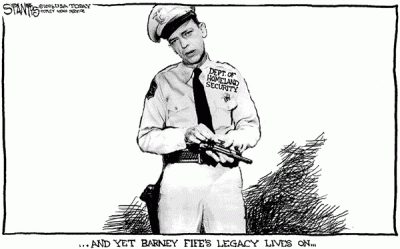
A couple of months ago Homeland Security had a big anti-cheese operation around Laredo and El Paso, and managed to haul in a few Mennonite farmers.
Hell, I ate a lot of panula, queso fresco and queso oaxaca in Mexico. . So what if it wasn’t pasturized, cheese is supposed to carry bacterium, and I’ve always recommended eating home-made cheese to people new in a country as a way of avoiding Montezuma’s Revenge.
The sign of a good cheese is that stuff does grow on it… heck, it’s supposed to be a living thing… not that embalmed crapola sold by Montsanto or Kraft or Nestlé and called “Queso Panula” … which I suspect is the REAL danger. It’s made by people like Floribel Hernandez Cuenca, and Manuel Martin Sanchez Garrido — who don’t make substantial “corporate donations” to anybody.
FREE THE CALIFORNIA QUESO TWO!
What if they gave a fire, and nobody came?
Maggie Drake, an “old radical surfer from the 60’s” living in Baja Caifornia Norte mentions that this is the SECOND time in the last few years that Mexican emergency service workers have been dispatched to the United States.
From the New York Times (via Suburban Guerrilla) comes word of our funny way of saying “thank you”…
Terri Trujillo, who helps the immigrants, checked on those in the canyons, urging them to leave, too, when she left her house in Rancho Peñasquitos ahead of the fires.
Ms. Trujillo and others who help the immigrants said they saw several out in the fields as the fires approached and ash fell on them. She said many were afraid to lose their jobs.
“There were Mercedeses and Jaguars pulling out, people evacuating, and the migrants were still working,” said Enrique Morones, who takes food and blankets to the immigrants’ camps. “It’s outrageous.”
Some of the illegal workers who sought help from the authorities were arrested and deported. Opponents of illegal immigration, including civilian border watch groups, seized on news that immigrants had been detained at the Qualcomm Stadium evacuation center as evidence of trouble that illegal immigrants cause.
The Border Patrol also arrested scores of illegal immigrants made visible by the fires. Agent Fisher of the Border Patrol said 100 had been arrested since the fires started Sunday.
That fire, by the way, is no respecter of border… The Unapologetic Mexican unearthed this tidbit on Tijuana’s support for neighboring San Diego…
TIJUANA, Mexico: About 60 Mexican firefighters crossed the border to help fight the California wildfires — then returned home as a separate blaze roared up on the Mexican side.
About 30 firefighters each from the Mexican cities of Tijuana and Tecate headed north Sunday when the wildfires started in San Diego County, said Capt. Marco Antonio Garambullo, Tecate’s Fire Department director. One of the California blazes burned more than 200 buildings just north of Tecate.
The Mexican firefighters returned home on Monday, however, as flames kicked up south of the border as well, Garambullo said.
“If we didn’t have so much work, we would be over there helping them,” Garambullo said, adding that soldiers had joined the firefighters battling the blaze near Tecate, Mexico, which scorched hills and consumed four cabins of the “Rancho La Puerta,” a luxury spa popular with San Diego tourists.
We can’t all four cabins of a “luxury spa popular with San Diego tourists” to go up in flames, now can we. As to migrant workers… oh well…


