We have nothing to fear but … ourselves
The Republic of Granjeno?
In the name of “protecting America” we’re abandoning Americans... heck of a job, Cherney! Homeland Security means securely isolated from the homeland — or something. This is FUBAR!
GRANJENO, Texas—Founded 240 years ago, this sleepy Texas town along the Rio Grande has outlasted the Spanish, then the Mexicans and then the short-lived independent Republic of Texas. But it may not survive the U.S. government’s effort to secure the Mexican border with a steel fence.<!–font>
 A map obtained by The Associated Press shows that the double- or triple-layer fence may be built as much as two miles from the river on the U.S. side of the Rio Grande, leaving parts of Granjeno and other nearby communities in a potential no-man’s-land between the barrier and the water’s edge.
Well, DUH!!!!
According to World Nutz Daily, “10% of illegals caught already have serious felony histories in U.S.… which should be alarming, til you read through the link for some Pittsburg, PA television station’s web site. Well, of course, when you go hunting for felons, you find … surprise… felons! Anybody remember Operation Falcon?
We’ve opened up a new front on the war on terror. It’s an attack on the unique, the unorthodox, the unexpected; it’s a war on different. If you act different, you might find yourself investigated, questioned, and even arrested — even if you did nothing wrong, and had no intention of doing anything wrong. The problem is a combination of citizen informants and a CYA attitude among police that results in a knee-jerk escalation of reported threats.
“Unintended consequences”
I disagree with Senator Sanders of Vermont (somewhat) that NAFTA’s results were unintentional … I tend to blame a too eagar reliance on neo-liberal economic theories promulgated by Yale and Harvard (where Salinas and Bush I both sprang from), and the naive belief that — even though there is no unfettered captialist system in the United States or Canada, somehow sticking Mexican farmers and workers into a capitalist jungle was going to make us all rich.
There’s a sucker born every minute(man)
Alleged child molester, Chris Simcox — the failed cowboy movie extra turned anti-immigrant entrepreneur — claims there’s a “smear campaign” out to discredit him. You might think that I am participating, but I could never do such a thing…
I might however, note that even Norwegians (a people not noted for their sense of the absurd) , are finding the bruhaha very, very funny. Dealing with the factually challenged and easily frightened people who donated to his cause, Simcox might have been better off selling something less tangible and photogenic — eternal salvation or the like — not something you can actually see and measure.
The Minuteman’s bally-hooed 14 foot fence (topped with razor wire) was supposedly going to run the entire U.S.-Mexican border. Simcox has been happily taking donations from folks who seem to be unable to even look at a map… most of that border is the middle of a river, and other stretches run through cañons and bluffs and other kinda difficult places. And, yeah, maybe on a map you can draw a straight line, but anyone with an ounce of common sense would have realized it’s not easy to draw a straight line — in the right place — even in the desert.
And… don’t these morons read the prospectus before they invest? Uh, did they bother to figure in the price of land acquisition?
 No, I’m not part of the smear campaign against Chris Simcox. But promising a fence that can be photographed — and that even the rubes are going to recognize as a cheap cattle fence when they see one — wasn’t real smart. Hell, the Minutemen donors were too stupid to keep their money, and they — and Simcox — deserved each other. Fuck ’em all.
Hey, Migra… leave them kids alone!

Arizona Daily Star photo by Mamta Popat
Dozens of immigrant students took to Tucson streets with a peaceful message Tuesday.
“We’re students, not criminals,” said Erick Quintero, a 15-year-old sophomore at Catalina Magnet High School and one of the marchers.
About 100 bold young people marched some five miles from Midtown’s Catalina Magnet High School to police headquarters Downtown.
Reminiscent of the mass protests last year over immigration reform, the students Tuesday hoped to convey unified opposition to the recent deporting of a classmate and his family.
…
In last week’s incident, immigration agents were called to Catalina High when a 17-year-old student was found with a small amount of pot. His parents were called, as they should be.
But when they couldn’t produce a driver’s license, they admitted they were undocumented. Should legal status matter in what is a rather routine occurrence at our high schools? No.
Yet police summoned federal immigration agents who apprehended the parents and child, then went to nearby Doolen Middle School to round up a younger sibling.
Human rights be damned.
(Ernesto Portillo Jr., Arizona Daily Star, 7 November 2007)
We want Taft! Human rights and border security in 1910
From Mexico Trucker:
WASHINGTON – Pablo Rosario, a former U.S. Border Patrol Agent stationed in El Paso, Texas, was sentenced today in federal court in El Paso to 24 months imprisonment for violating the civil rights of two illegal aliens. After release from prison, Rosario will be on federal supervised release for one year.
Rosario worked as a Border Patrol agent from 2000 to 2006. On July 26, 2007, Rosario pleaded guilty to two counts of violating the civil rights of two female undocumented aliens, a mother and her 15-year-old daughter. Specifically, Rosario admitted that he apprehended the two women on March 7, 2004, and fondled the victims’ breasts and genitals during the course of a search incident to their arrests. After the assaults, Rosario released the aliens without processing them.
Where’s William Howard Taft when we need him? In the course of writing God, Gachupines and Gringos (my editor is now madly trying to straighten out my baroque sentences, and we’re already looking at cover art), I’ve become somewhat fond of President Taft.
Taft looms large over Mexican history — hell, the poor man weighed about 340 pounds during his presidency and loomed large everywhere — having served in office at the start of the Mexican Revolution. Taft, the first president of the United States to visit Mexico (he had lunch — presumably a very large lunch — with Porfirio Diaz in Ciudad Juarez, then returned to El Paso for dinner) was quite the cabellero when he dealt with women. He once quipped that, riding to work on the streetcar, he would always stand up — giving his seat to three ladies!
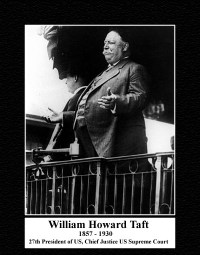 In Taft’s day, the border issue was gun running to revolutionaries. Gun running is less noble today, but — given that our favorite narcotics aren’t going to get in without our guns, the Bush administration doesn’t seem much interested. Taft’s motives (protecting U.S. corporate interests in Mexico) weren’t all that different from what’s done now, but at least Taft’s version of “Homeland Security” gave some thought to practical matters — and to keeping jerks like Pablo Rosario out of the loop.
From Gods, Gachupines and Gringos:
Where Mexican women had always accompanied the army, and in the Revolution were to serve as soldiers and officers, the United States had always reserved uniformed service for men. In the thinking of the time, women were afforded special protection, and it was improper for a man to touch a woman. Women in those times did not seem to have legs—at least they were never mentioned in polite conversation. Women, both in the United States and in México, wore long skirts. The customs service was unable to stop the arms traffic by 1910, and they knew that Mexican, and Mexican-American women were crossing the border with rifles, pistols, and even hand grenades tied to their unmentionable legs. President Taft, with great reluctance, and some uncomfortable discussions with his advisors, authorized training and hiring the first female uniformed service personnel in the United States—female customs agents.
With our new “border security” up and running, it’s Homeland Security’s Border Patrol agents we run across today. I think I have only been stopped by ONE female agent (at the Comstock, Texas checkpoint outside Del Rio). Incidentally, I was pulled over by a Border Patrol agent about two weeks ago at two in the morning — smugglers and I both make our livings by driving around the border region in white Ford vans at weird hours of the night
The BP stop wasn’t what was odd. It was being pulled over by an Anglo agent. Since BP agents have to be able to speak Spanish — and U.S. language education is so piss-poor — most agents are Hispanics. Which makes me wonder what we’re going to do to fill all those new positions the rest of the country is demanding… hire illegals?
Flood waters now in the spin cycle…
Lila Saúl, in this morning’s El Universal, reports that the Fox Administration had set up El Proyecto Integral contra Inundaciones (Pici) for flood control in Tabasco, with 2.6 billion pesos set aside for the project. Obviously, the 2003 project was never carried through. The Calderón administration is now projecting rebuilding costs at 7 billion… There’s no guarantee that Pici would have prevented the disaster,but it looks like the finger-pointing has already begun.
Andres Manuel Lopez Obradór, who hails from Tabasco and — having started his career as a rural social worker in that state — and who lived in Villahermosa for many years — blames the Federal Electric Commission (CFE) for dam-building done on behalf of foreign multinationals.
Nancy Davis, and others of the Oaxaca Action Study Group, want to use flood relief to further “their” cause:
However, it did cross my mind that if trucks are taking Oaxaca supplies, with Oaxaca drivers and other personnel along, it sure presents an opportunity. I would be afraid, John, that if the APPO presents itself as APPO they would be arrested on the road.
Of course, it crosses my mind that Nancy and her fellow foreigners would complain bitterly if other poltiical organizations sent supplies (and, if I’m reading her suggestion right) used the tragedy in Tabasco to further some other cause in another state.
There are a few who worry that Cruz Roja is “corrupt” — or, like the American Red Cross after the New Orleans flood — will spend the money on everything BUT the disaster. I have respect for Cruz Roja, and think they do a good job (as does the Mexican Army, which OSAG folks don’t like to hear), but if people DO have doubts about Cruz Roja, then give to one of the other established charities, like Catholic Relief Services, which has a very good record for keeping overhead and administrative expenses low, and which already is on the ground in Villahermosa through Caritas.
As far as I can tell, APPO and Nancy Davis have done diddly-squat. At least the Catholic Relief Services (Caritas in Mexico) in Monterrey sent 16 tons of supplies under the care of a dozen local firemen this morning.
Tabasco Flood Relief bank accounts…
From the United States or elsewhere (payable in U.S. funds) you can make a donation through a direct deposit to:
“Ayuda Tabasco” Wells Fargo Bank account number: 599253401
“Ayuda Tabasco 2007“, BBV Bancomer USA account number 2280300127. Outside California, use ABA routing number 1-2222-05-06.
“Ayuda Tabasco 2007” Fomento Social Banamex A.C. Swift: BNMXMXMM, account number: 002180010000001205
The State of Tabasco Official Site has many links to donation sites and account numbers for monetary donations: http://www.tabasco.gob.mx
American Red Cross International Response Fund, Make a secure online donation to the Tabasco Flood relief fund here: http://american.redcross.org/site/PageServer?pagename=ntld_mexico_1107&s….
UNICEF USA has opened an account for Tabasco’s displaced children, UNICEF’s donation page is here: http://www.unicefusa.org/site/c.duLRI8O0H/b.25933/k.8DDD/US_Fund_for_UNI…
Caritas Mexicana and Caritas Tabasco provide food, water, blankets and other basic emergency supplies to thousands of affected families.CARITAS Mexico are taking donations here: https://secure2.convio.net/crs/site/Donation?ACTION=SHOW_DONATION_OPTION…
more as I find them…
Cheap, cheap, cheap!
I know as a people, we are extremely generous, and people in the U.S. have been giving to Tabasco flood relief …
But, as citizens, we should be ashamed of this…
(sombrero tip to “brownfeministpower”):
Via Narco News: The U.S. Pledges $300,000 to aid refugees. (yes, you read that right, that’s *thousands* not *millions*.)
the *millions* of dollars went into another program called “Plan Mexico”.
(full post at Women of Color Blog)

Photo: Jaime Valos / EPA
Al Gore, Sitting Bull, and the Yale art department
Dan Bischoff, a staff writer for the Newark (New Jersey) Star-Ledger, reviewing El Maestro Francisco Toledo: Art from Oaxaca, 1959-2006, now showing at the Princeton University Art Museum, describes the Zapotec artist as
…a towering personality, esteemed as “El Maestro” not only for his art but for his leadership in the protection of Oaxaca’s political autonomy, cultural heritage and environment. In Mexico, he’s sort of Al Gore, Sitting Bull, and the Yale art department, all rolled into one.
We don’t think of Toledo as a Zapotec, though he’s probably the best  known member of that Oxacacan indigeneous group since Benito Juárez. When I was writing my Mexican history for foreigners (good news … it looks like pre-publication review copies will be available as early as January), I always had to mention the “race” of prominent Mexicans who were from minorities. Juárez’ “Zapotec-itude” is of less concern to Mexican historians than the fact that he overcame a non-Spanish speaking, dirt-poor backcountry childhood. Or that Juan Alvardo or Vicente Guerrero were Afro-Mexicans.
At first, I thought Biskoff might be using the Sitting Bull (Tatanka Iyotaka) reference simply because it was the first “Indian” that came to mind. But it makes sense. The wise Hunkpapa leader
… was not impressed by white society and their version of civilization… He counseled his people to be wary of what they accept from white culture. He saw some things which might benefit his people; but cautioned Indian people to accept only those things that were useful to us, and to leave everything else alone. Tatanka Iyotaka was a man of clear vision and pure motivation.
Maybe it fits. Francisco Toledo — as a world-renowned artist — has traded on his name-recognition to fight cultural hegonomy. Sitting Bull, during his tours with the Buffalo Bill Wild-West Show used to give food and money to poor whites. Toledo, protesting the imposition of a McDonalds’ on Oaxaca City’s main Zocalo, also fed the “whites” — though in Oaxaca, foreign tourists weren’t so much in need of immediate assistance as consciousness-raising.
Since the 2002 “Food Fight” Toledo has been connected with numerous actions to protect his state (and his people — or people in general) from those that would impose foreign values (or plain old fashioned home-grown repression. Sitting Bull isn’t such a bad comparison.

Rabbit Beheading Bean
2002, oil on canvas (Arts Central)
Hey kids… let’s put on a show!
Having once had a bit part in a Telenovela (actually, I was scenery… playing one of several foreign tourists crossing the street behind a character arriving in a taxi to meet another character in front of the Palacio de Bellas Artes), I can see why film-makers like Mexico… everybody’s willing to cooperate just for the fun of it — well, almost everyone…
I found this (accidentally) in the Savannah Georgia Sunday Morning News., written by Rexanna Lexter. Congratulations not just to the film-makers, but to Ms. Lexter — and the copy editors at the Morning News — for getting everyone’s name property accented (something I very seldom see in U.S. newspapers):
“Si Tú No Estás” (“If You’re Gone”) won Best Student Film from the Savannah Film Commission and a Panavision award for cinematography Saturday night at the film festival awards ceremony.
On Friday, three of the primary forces behind the project were running on adrenaline and little sleep. They’re funny, sarcastic and caught up in a short-film project they hope will become a full-length feature.
Noé Santillán-López, 23, wrote the screenplay based on the poem “Por Qué Me Quité del Vicio” (roughly “Why I Left the Vice”) by Carlos Rivas Larráuri.
Santillán-López met producer Cayman Eby, 27, in a SCAD preproduction class.
“Cayman sounded like the only guy who knew what he was doing,” Santillán-López said, with a grin.
He found Rodrigo Zozaya, 21, in a fiction-writing class. They liked each other’s writing. They were on the same page when they evaluated others’ work: “That story sucked. That one was long and boring,” Zozaya said, barely containing a laugh.
Santillán-López knew Zozaya was booked with other editing duties but still asked him to take a look at the script. He saw a winner and signed on.
The film just won the Silver Screen Society’s best student short film and $1,000. The society is a group of residents from The Landings who pro- mote filmmaking at SCAD. Group member Dean Ayers said a panel voted for “Si Tú No Estás” and praised its high production value and emotional content. Ayers said the movie was so good they questioned whether it really was a student production.
It also took the top undergraduate narrative award at the recent SCADemy awards.
Both co-writer Francisco Papini and first assistant director José Barrera José Barrera grew up in Mexico City. Jon Spicola was the second assistant director, and Lauren Stewart was production manager.
The crew was in Mexico for six days and shot the movie in four. After ruling out Mexico City, they filmed in Guadalajara where Santillán-López grew up. “It is very colonial, dirty and full of folklore.”
“And very Mexican,” Zozaya added.
Santillán-López nodded agreement: “Yes, very Mexican, with street musicians who will serenade my girlfriend and play music in graveyards.”
In the movie, the musicians look the part because they are the part, he said.
In Mexico City, an owner wanted $10,000 for a location to shoot. In Guadalajara, a restaurant owner said they could shoot for free and asked, “Do you want me to make something to eat?” The free food was a definite bonus.
There were other advantages to going home. Santillán-López’s . high school art teacher worked with the set design. A child- hood friend worked with the music.
Only once did they feel extorted. Midway through shooting, a woman asked for twice what she had originally requested for the use of her house.
“But she was very beautiful,” Zozaya said.
Eby added, “With steel in her eyes.”
The filmmakers describe their story as an exploration of a man’s pain as he makes a living playing romantic songs while haunted by the absence of love. After the death of his wife, his passion for his music and the future of his band is uncertain. He drinks to ease his pain. His self-destruction affects his lonely son, Sebastian, who visits his mother’s grave daily to try to recapture a sense of family.
Santillán-López had e-mailed Mexican film star Bruno Bichir to describe the part made for him. Bichir eventually agreed to do the film for the price of a ticket to the set. He asked to fly in the first day of shooting so he could walk directly into the set with little sleep and the look and feel of a man in self-destruction.
Iván Arriaga, the boy who played Sebastian, made himself cry by thinking of his hamster dying.
Eby said it’s easy to look at movies and think that’s a way to have fun, not work too hard and make a lot of money. By the time you figure out it’s a lot of work and a long time before you make any money, it’s too late. You’re hooked.
For “Si Tú No Estás,” they shot in about seven locations in four days, 18-20 hours a day with 36 people. They asked a cemetery manager to open a grave. They closed a street and set up a huge set with lights on top of buildings. When the police came, they hired them as security.
The ending is not happy, but hopeful, the filmmakers said. As the father cleans his house, maybe he can clean up his life.
The dirty little secret is out: The T. Don Hutto Family Residential Center, a detention facility for immigrant families in Taylor, has employed undocumented workers, as well as contractors with criminal records. The revelation has put Williamson County, which administers the center for owner-operator Corrections Corporation of America, in an embarrassing legal bind. The infractions, ironic as they are, were cited in an official reprimand of CCA by the U.S. Immigration and Customs Enforcement and addressed to County Judge Dan Gattis on May 23. The reprimand only came to light in October, when WilCo commissioners began airing concerns about mounting liability. But it was an alleged sexual assault of a detainee by a guard on May 19 that was the most likely source of the county’s jitters over liability. WilCo and CCA were to “ensure that such an incident not occur again,” the reprimand stated.
…overheated water scalded children at times. To punish children deemed unruly, guards “would turn up the air conditioning so that the room became very cold” and would turn off hot water for bathing, the report states. But the worst offense was that so-called errant parents and their children lived under the threat of being separated.
Full article, by Patricia J. Rutland in the Austin Chronicle
County Judge (the county’s presiding elected official) Dan Gaddis “… serves on the Board of Directors of Children at Heart Ministries, which includes the Baptist Children’s Home of Round Rock and serves on the board of Miracle Farm, a boys home in Brenham, Texas,” as he brags on his website. I take it the Baptist children and the boys in Brenham aren’t as abused as the children at Hutto. The judge’s service at the Baptist Children’s Home and at the Miracle Farm are — I take it — voluntary, and I’m sure he does care about children.
Which makes his utter failure to uphold his duty as “Constitutional Court Judge of Williamson County” and protect these children unfathomable.
Judge Gaddis’ office (901 S.E. Inner Loop, Georgetown Texas 79626 — telephone number 512-943-1550; FAX: 512 943-1662) has an “open door” policy. We welcome anyone who has a question…”
I’ve got a few.
ONE MILLION PEOPLE displaced by floods in Tabasco
RJ_1 posted:
And the worst is yet to come because the water is still rising, and a representative from the Comision Nacional del Agua said it might take one month for the water to go back to normal levels. That´s a long time to live on your rooftop or in a shelter. Next try to imagine all the mosquitos and “chaquistes” that will result later.
In the US monetary donations can be sent:
American Red Cross 1-800-HELPNOW
or write American Red Cross, P.O. Box 37243, Washington, D.C. 20013
Catholic Relief Services (which is providing assistance through the Mexican charity, Caritas) which also has a good reputation for disaster relief is sending $1.5 million U.S. to Tabasco, as well as Cuba, Haiti and the Dominican Republic which sustained servere damage from Hurricane Noel. .
In Mexico, money OR specific items are requested:


