Neo-braceros without tears…
On all sides of the farm industry, the administration’s behind-the-scenes initiative to revamp H-2A farmworker visas is fraught with anxiety. Advocates for immigrants fear the changes will come at the expense of worker protections because the administration has received and is reportedly acting on extensive input from farm lobbyists. And farmers in areas such as the San Joaquin Valley, which is experiencing a 20% labor shortfall, worry the administration’s changes will not happen soon enough for the 2008 growing season.”It’s like a ticking time bomb that’s going to go off,” said Luawanna Hallstrom, chief operating officer of Harry Singh & Sons, a third-generation family farm in Oceanside that grows tomatoes. “I’m looking at my fellow farmers and saying, ‘Oh my God, what’s going on?’ “
(LA Times, “U.S. lets in more immigrants for farms” 8-October-2007)
In the absence of any real immigration policy, I guess making the rules up as we go along is what we can expect. But I’d point out that this is even less than a “neo-bracero program” — there’s no mention of even minimal protections for these farmworkers (I’ve suggested letting farm worker unions handle hiring through contracts within Mexico. I recognize that there are a lot of scumbags in the contract labor business, but between “word of mouth” among workers and complaints by the companies contracting the labor, the worst won’t last very long — and at least the workers would have some kind of contract that could be enforced. If not legally, then extralegally — shall we say pressure could be applied by an aggrieved laborer’s nearest and dearest in some creative way?)
Make no mistake. This is not going to benefit old McDonald, either. Our subsidized corporate agriculture is what is driving Mexican immigration (if Mexican farmers can’t make a living, they’re going to go somewhere — and a good percentage are going to go North).
I suppose the political bloggers will all hope this blows up in Bush and company’s face (which it likely will). I’m more concerned about the effect on the workers. Want to bet there’s “exemptions” next for food and commercial workers… construction workers… lawn maintenance and janitorial service workers?
BushCo want the workers — but it don’t want workers with rights. So, keeping them in a semi-illegal status — or rather on a visa program they claim doesn’t really work very well — is the next best thing to peonage there is.
I’ll try to revise these thoughts later. But at 3:45 in the A.M. and working 7 days a week (I haven’t had a full day off since 19 September AND am working on my book), I just can’t always do much more than write some notes.
Mexico… land of (healthy) smiles
“Now there are some things that could sound ironic: while Mexican patients try to come here, cross the border looking for advanced medical treatment for tuberculosis, HIV/AIDS, malaria, obesity and diabetes and liver disease, a lot of American citizens cross the border every single day, in groups, to get in Mexico basic medical care like dentists or even, in recent years, laser eye surgery,” said Manuel de la Rosa, vice dean at the School of Medicine at the Texas Tech University in El Paso.
Quoted by Agence France Press in an article on the Juarez dental clinics that thrive on the lack of affordable health care in the United States.
Fred Reed — and a lot of other observers since Bernardo Diaz de Castillo first mentioned it — that even poor Mexicans generally have good teeth. Even General Santa Ana, who basically never gave a shit about the health and care of the poor Mexican, did his part for good dental hygiene (he introduced chicle chewing to the world — though his New York landlord, Mr. Adams, dumped a lot of sugar into what was just a cheap way to keep your teeth and gums clean, and invented Chicklets).
Diet and genetics are partially responsible, but then, so is making basic health care (including dentistry) available to the poor. Heck, if you look at the day laborers and mojados, the ones with crappy teeth you see are usually Guatemalans or Hondurans… from countries that follow U.S. models when it comes to public services… or just don’t bother with them.
With Bush and Co. reluctant to give even minimal health care to poor children, and making nothing available to us poor adults, I guess I guess they expect us poor adults to gum our food (or miss work because of absesses, impacted wisdom teeth and other common ailments).
I got to admit that the arguments against public health care make no sense. Geeze, what’s different about providing health clinics than providing gas or wi-fi or a fire department or parks? And we’re not even talking about the “high dollar” items — AIDS and malaria and liver transplants but basics like condoms and mosquito control and general checkups — and filling cavities.

Gold Hat, before visiting the orthodontist…

… and after. And it didn’t take the Treasure of the Sierra Madre to pay for it, either. Smile!
Return of the Friday Night Video… and Lorena
Lorena had some family problems to keep her occupied over the last few months, so has been laying low. She managed to catch “The Best Mariachi in the World” performing in Chicago. The video was posted on youtube by 16-year old San Antonio filmmaker, “Neff” back in December 2006.
This past weekend I had the opportunity to see the Mariachi Vargas de Tecalitlán at the Chicago Symphony Center celebrate their 110th anniversary at this special concert. This mariachi group began in 1848 by pioneer, Gaspar Vargas and has flourished to its present-day ranking as the best mariachi group in the world. It was more than an auditory treat; it was a delicate expression of musical greatness, one so rare that it allowed the audience to not only hear the music dance in their ears, but feel every note as if they were devouring a never-ending supply of flan topped with cajeta.
At the beginning of the concert the mariachi geniuses played their violins, and through this harmony, the notes exploded through the air and with every transition it carried everyone closer to querido Mexico! From notes C to D, an audience was transformed and Mexico was found in the strings and voices of the charro-clad mariachi.
As the song Guadalajara twirled in the air and caused an outbreak of song and dance amongst the audience, I was home—it didn’t matter that the song is about the beautiful state of Guadalajara, and not my beloved song of Acuarela Potosina, which praises the wonders of San Luis Potosi—the place was Chicago but I felt like I was sitting on a bench in front of the cathedral in the Plaza de Armas.
Inexplicably, Mariachis have this mysterious power. The music is transcendental, and those away from Mexico need only hear the lyrics “Guadalajara, Guadalajara; Guadalajara, Guadalajara. Tienes el alma de provinciana…”, and one is pining for their hometowns in Mexico. Ay, Ay, Ay!
Send in the clowns…
Victor Trujillo, KGBT Channel 4, (Harlingen,Texas) reports:
Minuteman Civil Defense Corps believe the construction of a border fence will help deter illegal activity along the border region.
As Minuteman volunteers arrive in the Valley from different parts of the country, they are setting up posts at undisclosed locations to monitor and report suspicious activity along the border.
It’s the official start for Operation Secure America by the Minuteman Civil Defense Corps, a border watch operation scheduled throughout the month of October with intentions to monitor suspicious activity, report illegal crossings and support border patrol agents.
Connie Foust, their national operations director, told Action 4 News they have men and women volunteering for this fall operation.
“Hopefully we will be turning in illegal alien entrance into our country and securing our nation’s border,” Foust said.
She said the group is in favor of the border fence planned by federal government.
“I’m sorry that we have to do that, but we have to do that. We have to enforce our borders for the security and prosperity of our country,” she said.
She doesn’t believe farmers will have to struggle to get access to the water as some private land owners and farmers have said.
OK, Connie. The farmers don’t know about water access, but you do?
“What I’d like to know is those that are worried about the habitat, all right, they need to look at the plastics and the clothing and everything that is left out here in this habitat that animals and birds eat and die from,” she said.
When was the last time you saw a jackrabbit, let alone an ocelot, eating a plastic bottle?
Just on their first visit to the several high traffic areas along the Rio Grande, they’ve spotted trails and landing areas commonly used by undocumented immigrants. Inflatable tubes and wet clothing were found near one of their posts.
The Minuteman’s National Operations Director wants to make one thing clear to the border communities.
“I have the opportunity to have interaction with many thousands of Minuteman. What I found them to be in reality are patriotic Americans; they are not racists; this is not a race issue, and I really want people to understand that,” Foust said.
We should take Connie’s word for it, not folks that monitor racist groups. I guess by the definition the Minutemen use of “non-racism” (kinda long and convoluted — though basically it boils down to they have the political right to act like idiots. Geeze, so did the Klan), Connie would be right. But — in another context — Pam Spaulding wonders why people feel compelled to say “I’m not a racist” (usually when they’re busted for doing something so boneheaded we can’t label it any other way) .
The Minuteman’s National Operations Director, who spoke exclusively to Action 4 News, said Operation Secure America will run through October 28.
Oh goody…
If you see Connie, say “HOLA” for me — though I might not have as favorable an impression of her that The Age (Australia) did…
Mexican President Vincente Fox calls them ruthless and dangerous migrant hunters; George Bush has called them vigilantes. …
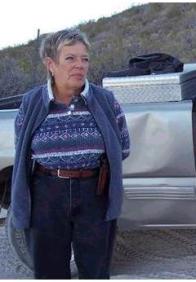
…Connie Foust favours a more discreet Ladysmith .38, which she wears high up on her waist. Ms Foust lives in a small town near the border. She arrived from Montana five years ago for the climate, which she hoped would make her arthritis more bearable.
Great… arthritic old ladies with guns. I guess Connie could prove she’s not a racist and plug a white guy. Harlingen isn’t far from where Dick Cheney shot one not too long ago. This should be … uh… interesting.
Welcome Mexican Invaders!
The Town and Country gas station/truck stop in Sanderson, Texas is a regular stop of mine. A few railroadmen still live in what until the 1990s was the transfer point for railcrews between Del Rio and El Paso (after a train accident was laid to human error – the engineer apparently nodded off and killed himself, his brakeman and the crew of the oncoming train), who like the small-town atmosphere. The older guys tell me it was quite the place, full of cantinas, bars, restaurants and … loose women. You know, a modern wild west town.
Well, the transfer point was moved 90 miles west to Alpine (just about half-way between the two major cities, and supposedly, a more reasonable distance for engineers coming from El Paso), and Sanderson has become sleepy and semi-respectable. The trainmen who still live there are getting older and one of the wilder cantinas is now a Baptist Church.
Every time I read some breathless right-wing conspiracy nut (or watch Lou Dobbs) about Mexican Army units crossing into the U.S., I think of Sanderson. Yeah, the Mexican Army used to “invade” regularly. Poor Juan Lopez, stationed up on the lonely northern border, needed somewhere to go on a Saturday night for a beer, and to shoot pool and meet girls. And, unlike our sailors and marines who invade Tijuana on weekends, unlikely to end up in the local jailhouse.
It wasn’t that long ago that there was a “live and let live” attitude along the border, and town like Sanderson, and Presidio and Del Rio… and Boquillas del Carmen, and Ojinaga and Acuña… thrived by seeing the border as an opportunity and not as an inconvenience at best (and a threat at worst). And, at times, the Mexican Army was welcome in border towns – and not just on Saturday nights.
Thanks to a mention in Bender’s Immigration Daily, I downloaded a wonderful history book from an unlikely source – The Combat Studies Institute at Fort Leavenworth, Kansas. You don’t have to be a military historian to enjoy Matt M. Matthews’ The US Army on the Mexican Border: A Historical Perspective.
Downloading the entire book as a PDF file will take a while, but when was the last time the Mex Files recommending a Rand Corporation document be read for enjoyment?
Here is Matthews on one welcome Mexican invasion:
Cortina’s War
By the summer of 1859, relations between Mexican-Americans and Anglos in border towns like Brownsville, Texas, were exceedingly strained. According to Utley, “Mexicans of every station on both sides of the border hated the gringos for the Mexican War and for the oppression that followed.”28 Clendenen, on the other hand, wrote that “many Americans, with their point of view warped by the memories and myths of the recent war and the Texas rebellion, were fully convinced that all Mexicans were treacherous, undependable and cruel.”
This volatile state of affairs ignited on 13 July 1859 when Juan Nepomuceno Cortina shot and wounded the Brownsville city marshal who had beaten one of Cortina’s former employees. A well-known Mexican whose mother owned a large ranch north of Brownsville, Cortina had long resented the intolerance and injustice displayed by whites toward his Mexican brethren. After gunning down the marshal, Cortina fled to Matamoros. By the time he arrived in Mexico, his violent encounter with the Anglo establishment had transformed him into a champion of oppressed Mexicans. While many Mexicans lauded his actions, Cortina was considered by many Anglos to be nothing more than a trifling bandit.
Cortina remained in seclusion for more than 2 months, but on 28 September, he raided Brownsville, murdering four men and liberating the Mexicans held in the local jail. After running roughshod over the terrified Anglo population for nearly 24 hours, prominent citizens in Matamoros, perhaps fearing American reprisals, persuaded Cortina to leave Brownsville. Late in the afternoon, Cortina, accompanied by approximately 80 men, headed north. To ensure the protection of American citizens in Brownsville, a Mexican militia force from Matamoros crossed the Rio Grande and occupied the vacant Fort Brown. It was a surprising turn of events indeed. A Mexican military force crossed over onto US soil and occupied a fort abandoned by the US Army to protect xenophobic American citizens from a vengeful Mexican insurgent. A letter written at Point Isabel, Texas, and reprinted in The Charleston Mercury exposed perhaps the true nature of the events in Brownsville:
The facts are simply these: There are a lot of bad characters who have been imposing upon, murdering, robbing and maltreating the Mexicans. It got to such a pass that the rancheros thought it high time to strike a blow in self-defence, and exterminate these American evil doers at one blow. . . . If there had been a garrison at Fort Brown the thing would not have happened, as the Mexicans have a great awe of the ‘soldados.’ There is no doubt but that the Government has displayed a most wanton disregard for the interests of this frontier, in withdrawing every soldier for a line of over 400 or 500 miles in extent, on the borders of a country infested with thieves, murderers and wild Indians.
The political fallout from Cortina’s Brownsville raid was swift. With investors and politicians clamoring for protection, President James Buchanan directed the Secretary of War to order the US Army to return to the lower Rio Grande. General Twiggs, who was in San Antonio, promptly ordered two companies from Fort Clark back to Fort Brown. As the companies marched south to Fort Brown, Twiggs was bombarded with troublesome stories of a new massacre at Brownsville and the burning of the town by Cortina. Twiggs also received news that Cortina was marching on the Nueces River with an army of 800 men. Twiggs immediately ordered a company from the 2d Cavalry Regiment, four companies of infantry, and two artillery companies to the Nueces, under the command of Major Samuel P. Heintzelman. In Washington, the Secretary of War alerted US Army commands in Kansas and Louisiana of a possible movement to the lower Rio Grande. To his great embarrassment, Twiggs was informed that the latest intelligence regarding Cortina and the burning of Brownsville was false. While Washington halted the troop movements from Kansas and Louisiana, Twiggs ordered Heintzelman to continue on to Fort Brown. According to Clendenen, Twiggs ordered Major Heintzelman to “spare no effort to bring Cortina to battle and use every means at his disposal to destroy Cortina’s band. Marauders would be pursued to the Rio Grande, but the United States troops would not cross the river unless in ‘hot pursuit.’”
The citizens of Brownsville were disappointed to hear that not all the soldiers were coming to their rescue. A correspondent in Brownsville reported:
We in Brownsville have learned with much regret that the American government have countermanded the order given to troops that were ordered to Fort Brown. God knows what they mean. Are we to be considered as belonging to the United States, or are we not? It is really too scandalous. We have now been more than two months on guard, and are just as badly off as at the commencement of the disturbance; I may say, indeed, more so, for the bandit Cortinas [sic] is daily increasing his force, and the United States will find to their cost, that no 200 or 300 troops will put a stop to this invasion and mutiny, unless something is done promptly.
Meanwhile in Brownsville, Cortina demanded the release of Tomas Cabrera, one of his officers who had been captured and locked in the town jail. When authorities refused his request, Cortina moved several hundred of his men across the Rio Grande, taking up a defensive position on his mother’s ranch north of Brownsville. On 25 October, a small force of Brownsville volunteers, Mexican militia from Matamoros, and approximately 40 apathetic Mexican civilians marched on Cortina’s position. The heterogeneous posse also brought along two small cannons. In the attack that followed, Cortina and his men quickly routed the confused rabble, driving them back into Brownsville and, in the process, captured both artillery pieces. One local newspaper reported the thrashing was so complete that it was too “painful for us to chronicle.”35 When Heintzelman learned of the battle, he filed a report noting that, not long after the first shots were fired, each man in the posse seemed “anxious to be the first to reach Brownsville.”
By the time Heintzelman arrived at Fort Brown on 5 December, the Texas Rangers who had been ordered to Brownsville by Texas Governor Hardin R. Runnels had already ignited an even larger firestorm. On 13 November, the Rangers, under the command of Captain William G. Tobin, dragged Cabrera from the Brownsville jail and lynched him. The provocative action served to further infuriate Cortina and persuaded even more Mexicans to flock to his banner. Toward the end of November, the Rangers and volunteers from Brownsville attacked Cortina again. They, too, were quickly routed. As word spread rapidly that Cortina intended to drive the Americans out of Texas, more recruits rushed to join him.
Heintzelman wasted little time in attacking Cortina. Early on the morning of 14 December, Heintzelman marched north out of Brownsville with his force of Regulars and Tobin’s Texas Rangers. At sunup, Heintzelman found Cortina’s ranch empty and ordered his men to continue moving north. After marching about 3 miles, Heintzelman discovered a small command of Cortinistas. With the US Army soldiers and artillery providing the backbone for Tobin’s apprehensive Rangers, Heintzelman quickly overpowered the Mexicans, scattering them in all directions. Heintzelman was not impressed with Tobin and his men. “We would undoubtedly have done better without the Rangers,” he concluded in his report. That night, however, Major John Salmon Ford’s company of Texas Rangers arrived to reinforce Heintzelman. Ford and his Rangers far surpassed Tobin’s men in discipline and fighting capabilities. A substantial rainstorm overnight ruined most of the gunpowder, causing Heintzelman and his command to abandon their pursuit of Cortina and return to Brownsville.
Determined to either destroy Cortina or drive him out of Texas, Heintzelman and 150 soldiers, two companies of Rangers, and two large howitzers left Brownsville once again on 21 December. On 26 December, Ford’s intrepid scouts informed Heintzelman that Cortina and most of his command were at Rio Grande City. Heintzelman also learned that some of Cortina’s command was occupying the abandoned US Army post at Fort Ringgold. About 2200 that night, Cortina changed camp sites, pulling his men out of Rio Grande City and leaving only a few pickets around Fort Ringgold. A little after midnight on 27 December, in an almost impenetrable fog, the soldiers and Rangers moved silently toward Rio Grande City. Ford’s Ranger command was to infiltrate past the Mexican forward outposts and take up blocking positions in their rear while Tobin’s Rangers assaulted Cortina’s right flank. Heintzelman planned to attack Cortina’s center 30 minutes after Tobin launched his attack.
Ford soon found that he could not work his way past the Mexican sentries without being detected. He, therefore, decided to charge directly into Cortina’s camp. The Mexicans fired blindly into the fog with the two artillery pieces they had previously seized and managed to launch a small countercharge against Ford’s Rangers. It was to no avail. Although more than a dozen of his men were wounded, Ford drove home his attack. While Cortina managed to save his guns, his men abandoned nearly all their equipment on the field as they fled north toward the town of Roma or into the river. By the time Heintzelman and Tobin reached the field, the fog had lifted, and Cortina’s artillery could be seen moving rapidly north toward Roma. Heintzelman ordered Ford to pursue the guns. While Ford and his Rangers rode north, Heintzelman’s cavalry killed a number of the Cortinistas running toward the Rio Grande. Once at the river, the US cavalry troops dismounted and, using their new Sharps carbines, shot and killed many of the Mexicans trying to swim the river.40 “We had fourteen Rangers wounded,” Heintzelman wrote in his official report. “We killed some sixty of his [Cortina’s] men. Persons who counted his men in town yesterday say that he had with him over five hundred and fifty men. He retreated so rapidly that at no time was more than a small portion of the command engaged.”41 Cortina managed to escape the melee by swimming the Rio Grande. Although he continued his raids for another 20 years, the combined efforts of the US Army and Texas Rangers had at least forced him out of Texas.
2 Octubre 1968… 2007
This is the anniversary of the Tlatelolco Massacre. Since I am finishing up Gods, Gachupines and Gringos now — and happen to be working on the chapter dealing with Tlatelolco and its aftermath — the violent repression of the student protests in 1968 and the subsequent massacre of students (and let’s not forget a lot of them were high school kids) and others, including residents of the complex, have been on my mind. I still haven’t figured out quite what I want to say about it.
In 1968 the Diaz Ordaz administration — despite economic success and popular domestic programs — resorted to violence to control events outside their understanding: basically, the era of sex-drugs-n-rocknroll and the world-wide student protests of 1968 made no sense to the Institutional Revolutionaries. Needing, at all costs, to preserve “stability” during the Olympics, a police crackdown on a fight after a high school pickup soccer game escalated into street protests. When the students were joined by the intellectuals and the workers, repression followed, and the repression lasted for years. It was the fight against repression that led to change within Mexico, and Tlatelolco’s martyrs should be remembered.
El longhorn, who is a perceptive commentator, noted on another matter that the Calderón administration is doing very well, and generally supports the measures taken to bring “stability” to the country. I’ve taken the Aztec view of history: it runs in cycles (though never exactly the same), and see troubling signs of a return to the some of the same conditions that existed in 1968.
It looks as if the Calderón administration — despite some economic growth and growing acceptance — is tolerating violence in the name of “stability”. What Diaz Ordaz saw as the “International Communist Conspiracy” hasn’t changed all that much. Anyone rejecting the prevailing economic model is suspected of belonging to whatever that nebulous threat is today.
But there is hope. It isn’t only the ghosts who remember. The students take to the streets every 2 October, and good on them.
The latest wave of repression is more subtle than in 1968, in large part thanks to those “old hippies” of the PRD and brave and lonely fighters like Rosario Ibarra — the feisty Monterrey housewife (now Senator of the Republic) — who never gave up the search for justice and freedom.
Jay Root write on Tlatelolco and today’s dangers in the Fort Worth Star-Telegram:
OAXACA, Mexico — The first time Gabriel Cruz Sanchez vanished, Mexican police ransacked the suspected guerrilla leader’s house and threatened to kill his entire family unless they coughed up clues about his activities and whereabouts, a sister recalled.
That was more than 30 years ago.
When Cruz Sanchez disappeared a second time, in May of this year, all hell broke loose: Pipelines got bombed, Fortune 500 companies were shut down and the federal government was forced to acknowledge embarrassing intelligence failures.
Cruz Sanchez and another missing man, Edmundo Reyes, still are nowhere to be found, but their Marxist guerrilla group — known by its Spanish initials as the EPR — promises more attacks until they’re returned alive. In the meantime, their disappearance has revived talk of human rights abuses, government kidnappings and torture, all of which were prevalent in Mexico in the late 1960s and 1970s.
No two periods in history are identical, and Mexico has come a long way economically and politically since those days of unchallenged one-party rule and widespread police brutality. But 39 years after the Oct. 2 massacre at Tlatelolco Square, when government troops opened fire on unarmed demonstrators during the 1968 Olympic Games in Mexico City, Mexico is awash in the echoes of past conflict.
“People are still disappearing,’’ said Rosario Ibarra, a senator and liberal political activist whose son disappeared in 1974. “It is very similar, almost identical, to what we experienced under the worst regimes.”
The EPR — the People’s Revolutionary Army, in English — insists authorities secretly “disappeared” both men and are holding them in Mexico City’s notorious Campo Militar No. 1 (Military Camp No. 1). That’s where scores of student leaders and leftist insurgents were believed to have been interrogated and tortured, to death in some cases, during Mexico’s old “dirty war” against political dissidents.
A government report in 2006 on that “dirty war” found that during the 1960s and 1970s, Mexican authorities used “massacres, forced disappearance, systematic torture, and genocide” against dissidents. As many as 300 people were gunned down in the 1968 Tlaltelolco Square massacre alone, human rights organizations say, though the official toll remains 25.
The current government of President Felipe Calderon, who’s impressed the Bush administration with its muscular war on drug traffickers, denies any role in or knowledge of the disappearances. Calderon’s attorney general, Eduardo Medina Mora, also rejected any talk of a new dirty war, though he acknowledged that the EPR is “a severe worry” for the government.
“Obviously, the task of combating (the EPR) won’t be like that,’’ Medina Mora said. “It will have to be a task based in a legal framework, with complete respect for human and civil rights.’’
Relatives of the two missing men aren’t so sure.
Nadin Reyes, whose father disappeared along with Cruz Sanchez, is convinced that her father and Cruz Sanchez were seen and tortured at Campo Militar No. 1, even though human rights investigators couldn’t confirm that on a brief visit there.
“It’s a place that’s known for a series of atrocities,’’ Reyes said. “I have a hard time believing they’re not in that camp.’’
A kindergarten teacher, Reyes, 25, said she and her family had no knowledge of her father’s apparent rebel ties. She described her father as a respected, hard-working owner of a convenience store on the outskirts of Mexico City. She last saw him on May 22, when he said he was going to visit his parents in his native Oaxaca.
“This situation of supposed militancy, well, it’s taken us all by surprise,’’ she said. “This is something he’ll have to explain when he reappears.’’
Margarita Cruz Sanchez said she wasn’t aware at first that her brother Gabriel was missing. She hadn’t seen him since he left home in the mid-1970s.
But the news coverage of the recent bombings and demands for her brother’s release have brought back painful memories.
Years ago, after Gabriel left home without a trace, police came and took all of his belongings and threatened to kill his family if they didn’t provide information, Margarita Cruz Sanchez recalled.
“Imagine being a kid and they put a pistol against your head and say, ‘Where’s your brother?’ ’’ she said.
Three decades later, she said, the police used similar tactics, threatening to torture another brother — a veteran bank employee in Oaxaca — unless he gave them something useful.
Gabriel Cruz Sanchez isn’t just any guerrilla. His brother is Tiburcio Cruz Sanchez, nicknamed “the professor” and widely known as the EPR’s “maximo leader.’’
The ferocity and effectiveness of the group’s bombings in July and September have caught authorities off guard. Mexico hasn’t had a serious gun-toting left since famed revolutionary Lucio Cabanas, a Che Guevara-esque figure, was killed in a shootout with police in 1974.
But the Cruz Sanchez brothers, on the lam for three decades, apparently picked up where Cabanas left off. Since 2001, EPR adherents claim to have bombed banks and other targets in the name of Marxist revolution and an end to Mexico’s “oligarchy.’’
The recent pipeline attacks, which were coordinated to explode simultaneously with timing devices, show an unexpected sophistication.
It’s all eerily familiar to Clemente Avila Godoy, an ex-guerrilla leader who spent four and half years in jail for conspiracy to incite rebellion and other charges. He can still describe his tortures in detail — electrical wires attached to his genitals and tongue, a simulated execution before a firing squad and head-below-water games, among others.
A founding member of the Party of the Democratic Revolution, or PRD, Avila said the same grinding poverty and corruption that nourished his anger decades ago are what’s fueling the current crop of guerrillas. But Avila, a doctor and now chief of police in the upscale Coyoacan district of Mexico City, renounced violence and kidnapping when he was freed from prison in 1976.
“We are proposing the same thing: social transformation,’’ he said. “But confronting the state with violent, armed struggle inflicts a high social cost. Our road may be longer, but the cost is lower. And after all of the death that we saw during the guerrilla movement, we believe violence is not the right path.’’
Then, like now, personal score-settling and family ties seem to have as much to do with the attacks as anything else. One of Avila’s first goals when he took up arms in 1971 was to free his brother, accused of inciting his own rebellions, from jail in Sonora.
The EPR has notoriously tight blood ties. Besides his missing brother, leader Tiburcio Cruz Sanchez is married to Emiliana Contreras, considered a guerrilla leader in her own right, and other EPR members are said to have family bonds.
News stories and EPR communiques suggest that state authorities, after receiving a tip about the presence of armed men at a Oaxaca hotel, fell upon the two EPR members by chance on May 25. They haven’t been seen since.
“Alive you took them,’’ the EPR wrote in a message investigators found after the Sept. 10 bombing in Veracruz. “Alive we want them back.’’
Idjut!
“Homeland Security Secretary Michael Chertoff on Monday defended the construction of a fence along the southwest border, saying it’s actually better for the environment than what happens when people illegally cross the U.S.-Mexico line.”
Gee, I guess Chertoff is a real environmentalist…. just look at what he accomplished in the way of restoring wetlands…

Quote of the week
“This is a horrible reaction by interior America and their legislators. They want to see a fence. Well, put a freaking fence in their back yard. Why should we pay the price because they’re overreacting?”
Brownsville Mayor Patricio Ahumada, quoted in the Austin American-Statesman on plans to build 70 miles of 16-foot high “aesthetically pleasing” fence along the Rio Grande. “Freaking” might not have been the word I’d use, though my word would sound close.
“Say No to Plan Mexico, Expanding NAFTA” (Joy Truskowski)
Joy Truskowski lives part of the year in San Cristobal, and part in the U.S. This was posted on the Oaxaca Action Study Group, which is sometimes worth reading. She publishes her own website, Chee Chen and produces political videos, mostly about Mexico.
Are you tired of the U.S. economy getting worse? Are you tired of hearing about well-paid U.S. jobs moving overseas? Are you concerned with the immigration problem? Do you want to do something about it?
President Bush recently had talks with the presidents of Canada and Mexico to expand the North American Free Trade Agreement (NAFTA). This is the agreement passed by Clinton in 1994 that allowed transnational corporations to receive subsidies for closing manufacturing plants in the U.S. and setting up sweatshops in Mexico. This act pushed down wages in both the U.S. and Mexico. It also flooded Mexico with cheap subsidized U.S. crops, which put small Mexican farmers out of business and made record profits for only the biggest agribusiness corporations. These things increased the already huge flow of immigrants entering the U.S., since many of them are displaced Mexican farmers.
In addition, President Bush and President Calderón of Mexico are discussing pushing their new “Plan Mexico.” This is a plan to give billions in subsidies to defense contractors to provide helicopters, guns, and training to the Mexican military which they say will fight narco-trafficking.
This is what Clinton’s Plan Colombia proposed to do in 2000. But it was a dismal failure. Colombia has been entrenched in a civil war for decades, and its military has a history of corrupt ties to narco-trafficking paramilitary groups, which terrorize and massacre rural villages with impunity. The U.S. gave this corrupt government 4.8 billion of our tax dollars without forcing it to meet human rights requirements that would protect innocent civilians. In addition, the alternative crop development that received only eight percent of the program funding left poor farmers (which make up about 70% of the population) without crops and resources that they were promised, while their food crops were fumigated along with coca crops. As a result, the aid package displaced more poor Colombian farmers, the modest decrease in coca production has simply moved to Peru, and the availability and price of cocaine in the States has remained constant. Paramilitaries also continue to threaten and murder people in the rural areas. The U.S. is still sending military aid to Colombia.
The Colombia military aid also protects oil pipelines owned by transnational corporations, and defense contractors and big agribusiness companies who produce fumigation chemicals are profiting, which is why the plan wins so much support from politicians. These companies give large campaign donations and can send lobbyists to Washington to push their policies.
Now President Bush and other elected officials want to give billions of your tax dollars to defense contractors to enable Plan Mexico. The Mexican government is also known for having corrupt ties with narco-trafficking paramilitary groups, and is recently responsible for hundreds of human rights violations against its own people (some of which I have witnessed firsthand while living down there). Some examples include soldiers raiding indigenous communities, destroying their homes, robbing their possessions, raping the women, and arresting and torturing people without cause or evidence of wrong-doing. These are the same soldiers who will receive U.S. military equipment and training under Plan Mexico.
Are you alarmed with the immigration problems we already have in the U.S.? With Plan Mexico giving military equipment to a corrupt police force and displacing more poor farmers who are caught in the middle of this “drug war,” it will get worse.
Mexico’s conflict is not a drug war. It is a war over land rights and economic rights that needs to be resolved by respecting Mexico’s huge population of poor farmers, who want to grow food crops and be allowed to live on their land in their country. The Mexican government and transnational corporations have been trying to push them off of their resource-rich land, which is part of what exacerbates the immigration problem. NAFTA is part of what has made it harder for these farmers to sell their crops, because they can’t compete with the heavily subsidized U.S. agribusinesses.
We can more effectively decrease drug consumption and crime in the U.S. by funding treatment programs at home instead of military programs overseas. More than half of those incarcerated in the U.S. who complete treatment programs and aftercare don’t commit new crimes. Many other drug addicts are turned away from treatment centers because the resources aren’t available, so they return to their drug habit.
Expanding NAFTA and passing Plan Mexico will further terrorize poor Mexicans who want to stay on their land – many of them good people who I have met. It will also further increase the immigration problem and damage our already worsening economy.
Congress is expected to discuss and vote on Plan Mexico this September. Please contact your representative, senators, and President Bush. Tell them not to expand NAFTA and to vote against Plan Mexico. Let them know the American people are watching so that they stop selling out American and Mexican workers.
Find your elected officials:
http://www.house.gov
http://www.senate.gov
Switchboard: 202-456-1414
President Bush
The White House
1600 Pennsylvania Avenue NW
Washington, DC 20500
White House comments: 202-456-1111
Sources:
LaFranci, Howard. “Mexico Seeks Antidrug Aid from the US.” Christian Science Monitor. August 8, 2007. http://www.csmonitor.com/2007/0808/p01s01-usfp.html
Leech, Garry M. “Killing Peace: Colombia’s Conflict and the Failure of U.S. Intervention.” New York, 2002.
“Plan Mexico.” The Economist. August 16, 2007. http://www.economist.com/displaystory.cfm?story_id=9660095
“’Plan Mexico’ Pricetag: $1 Billion-Plus.” Join Together web page.
http://www.jointogether.org/news/headlines/inthenews/2007/plan-mexico-pricetag.html
Join Together is a group that supports effective alcohol and drug policy, prevention, and treatment.
http://www.drugfree.org/join-together
Roig-Franzia, Manuel and Juan Forero. “U.S. Anti-Drug Aid Would Target Mexican Cartels” Washington Post Foreign Service. August 8, 2007. http://www.washingtonpost.com/wp-dyn/content/article/2007/08/07/AR2007080702114.html
Wall, Allan. “Will a ‘Plan Mexico’ be the New ‘Plan Colombia’?” Mexidata website. August 13, 2007. http://www.mexidata.info/id1476.html
Adios, La Loma
Mexico Trucker (the best border-specific site I’ve found yet — though meant for long-distance haulers, it’s much more broad-based than the name might suggest ) picked up the story from the Laredo Morning News (another fine border news source) on the demise of a Nuevo Laredo landmark most tourists were lucky enough never to visit —
… La Loma, Nuevo Laredo’s municipal jail, became known to the general public as some kind of landmark for no good reason. La Loma, nevertheless, is no more.
The four-story jail compound, glorified in verse, song and film through time, was demolished Friday, crumbling to the ground in the middle of a residential area from the blasts of 75 kilos of well-placed dynamite.
…La Loma had a capacity of 250 inmates, but the jail population stood at more than 1,000 for decades. A La Loma official at the scene said the facility held 2006 prisoners in 2006.
“You didn’t want to end up there,” he said. “If some youngster was sent there, you generally had the parents or some friend doing everything possible to get the kid out the place. Some notorious criminals were locked in there. The place was the scene of countless breaks, riots, killings and all kinds of abuse.”
A Nuevo Laredo police commandant, who asked not to be identified, said hundreds of U.S. citizens did time in La Loma through the years. He said a well-known U.S. merchandise smuggler killed an inmate with a knife and got sent to solitary confinement.
“After a series of beatings, the man bribed his way out and went to a downtown restaurant, where he was picked up by a friend from Laredo,” the officer said. “Inmates that could afford it, would pay up front for an individual room. Some paid as much as $5,000 or more for a furnished area with telephone, television, toilet and shower. They would send runners for food from restaurants. If they wanted company, that could be arranged, too.”
A Nuevo Laredo historian, Raymundo Rios Mayo, said La Loma inspired the lyrics for several ballads as well as a motion picture, where actor Rodolfo de Anda played the leading character.
A benefit bullfight, staged in a recreational area in 1979, earned a mention in Ripley’s Believe It or Not. The matadors were Raul Salinas Capetillo and Lorenzo Serratos. Capetillo took on the bulls in Mexico under the professional name of El Capete. Serrato performed under the name of El Canario (The Canary). As a result of this event, the two subsequently appeared at a bullring located off Colossio Boulevard immediately east of Juarez-Lincoln International Bridge. Captello and Serratos shared a ‘suite’ at La Loma where they had their bullfighting gear and suits of bright lights (trajes de luz)….
I wonder what El Capete and El Canario were in for… probably not cruelty to animals. It’s not that off the wall for a couple of matadors to have their equipment with them. You can usually bring your work tools with you to prison. I know someone who — as a guest of the state — shared accommodations with a guy in for stabbing somebody. The stabber was also a chef, with a nice collection of knives to work with (the two of them went into business catering dinners for gangsters. Ah, Mexico! — the capitalist paradise!)
A nail in the coffin…
Some good news… very good news… from El Universal:
The Torre Bicentenario will NOT be built, or at least not on the original proposed site. Besides being butt ugly, the proposed 1000-meter coffin (er, office tower/shopping complex) would have intruded on Chapultepec Park, cast a shadow over Los Pinos, interfered with the flight path to Benito Juarez airport and just have been a giant eyesore.

 But, the reason it’s been canceled — at least for now — is that an historic MEXICAN architectural gem — the 1948 Vladimir Kaspé designed Super Servicio Lomas would have been destroyed.
Besides, who needs some Dutch architect telling Mexicans how to build?
Alas, Torre Bicentenario isn’t buried yet. The city is considering a different site, in Tlaxcoaque.