Girls gone wild
MEXICO CITY, Sept 28 (Reuters) – Mexican police have captured Sandra Avila, known as the “Queen of the Pacific,” one of Mexico’s highest profile woman drug smugglers, the government said on Friday.
Avila, 45, helped build up the Sinaloa cartel on Mexico’s Pacific Coast in the 1990s via her friendships with the gang’s leaders including Joaquin “Shorty” Guzman, Mexico’s most wanted man.
She was caught alone driving a BMW sport utility vehicle near her house in the Mexican capital, intelligence officials told a news conference.
Police also captured Avila’s boyfriend Colombian trafficker Juan Diego “The Tiger” Espinosa, who is considered to be a key link between Colombian and Mexican smugglers and is wanted in the United States. Police did not give details of his capture.
Where do we get the silly idea that Mexico is traditionally sexist? From La Malanche to Sandra Avila, crime has always been an equal opportunity employer.
La Malanche, the turncoat Aztec “princess” (or slave, depending on whose version of history you read) sold out the entire Aztec Empire to Cortes. She set a high standard for female criminals in Mexico.
Caterina de Erazu, a run-away Spanish nun turned hitwoman in the early 1600s ended her career as an almost respectable Mexican mule train driver, after being personally pardoned by the Pope (Clerics and religious were tried by clerical courts, and no one could figure out what to do with a badass nun, so kept kicking the case to a higher court. The Pope just found the whole thing fascinating). Caterina, who died following a duel with the husband of a lady whose affections she sought, also seems to have been America’s first bulldyke independent teamster. Her life story was — as far as we know — the subject of the first novel published in the Americas, back in 1641.
History might have been very different if Carlota de Habsburgo, instead of her idiotic husband had run the Mexican occupation regime. That was the opinion of Marschal Bazaine, the head of the French occupation force that had to prop up her husband’s ditzy “Empire.” Thankfully, Maximiliano gave Carlota the clap and she went totally bonkers. Otherwise, she might have had the balls to put in place a regime similar to the one her brother, King Leopold II of Belgium, put on the Congo. Nice family: the legal term “crimes against humanity” was coined to cover their excesses.
Lola la Chata, an illiterate indigenous woman living in Tepito in the 1930s and 40s, pioneering modern heroin smuggling into the United States. Lola was quite the (ahem) heroine in her hood, providing employment, scholarships and annual expense-paid pilgrimages to the Virgin of Guadalupe to her neighbors and associates. William S. Burroughs, who never met Lola, wrote an appreciation of her in his Mexico City book, Junkie.
In our own time, we have had Ma Bakker who ran a murder for hire operation, “Señora Hoffa”, aka Ester Elba Gordilla and Marta Sahugun de Fox to keep the bad girl tradition alive.
You go, girrrrrls!
Border security… hah!
“Couldbetrue” at the always on-target South Texas Chisme, cuts through the crap…
Red meat and appeasement for the bigoted remains of the Republican base. A Democratic senator points out that the Canadian border is not secure. Republicans don’t care about securing the border. They just don’t want those Mexicans coming into our country. Except to work for low wages in dangerous conditions doing filthy jobs.
Weak peso helps one Mexican export
Reuters:
VANCOUVER, British Columbia (Reuters) – The strong Canadian dollar has hit the illegal marijuana sector just as it has other industries that export to the United States, one of Canada’s best known legalization advocates said on Thursday.
But western marijuana growers have also benefited from Canada’s strong economy, especially the booming Alberta oil patch, which has increased domestic consumption, according to Marc Emery, a founder of the British Columbia Marijuana Party.
…A study in 2004 estimated the street value of British Columbia’s annual marijuana crop at more than C$7 billion, which would make it one of the western Canadian province’s largest industries.
Simon Fraser University economics professor Stephen Easton, who authored the 2004 report, said there has been no specific study of the impact of currency on drug exports but it should be the same as with legal exports.
… Canadian marijuana is also facing price competition in the United States from Mexican-grown pot, which has benefited from a relatively weak peso, as well as increased domestic production in the Western U.S.
The U.S. anti-drug agency said in its 2007 report that large scale cultivation of marijuana by Mexican criminal groups was expanding beyond California, and into the Pacific Northwest, and that the potency of the pot available was rising.
So, uh… can we expect British Colombian farmworkers to flood into Sinaloa now too?
Boycott the Dallas Cowboys?
What do the Boy Scouts of America, Chuck E. Cheese, ExxonMobil, Kimberley-Clark, Michaels Stores,Zale Corporation and the Dallas Cowboys all have in common?
They’re all headquartered in the sprawling Dallas suburb of Irving Texas. Maybe I should — like the New York Times does when covering large suburban expanses around Mexico City — refer to the otherwise unremarkable place as a “teeming slum”, but having spent time in Bedford (next door), it’s just another sprawling office/housing complex, no different than Bedford — or Euliss, or Hurst, or Plano.
OK, so Irving is the home of Chuck E, Cheese, Kleenex and the Cowboys. I guess there are a few things you might need to go there for… unless, of course, you’re that third of the local population that is considered “Hispanic.” Or you’re “visiting while brown.” Or a Mexican citizen. In that case, you better check your roadmap, and watch what street you go down around the west end of Dallas…
Isabel C. Morales and Brandon Formby filed the story on the Mexican Consular Warning in last Friday (21 September)’s Al Dia/Dallas Morning News.
Mexican Consul Enrique Hubbard Urrea has issued an unusual warning to immigrants from his country: Avoid the city of Irving.
Deportations in this city have skyrocketed in the last several months – from 262 in all of 2006 to 1,338 through mid-September.

“In this city, one has to be extra careful,” he told Al Día . “And if possible, avoid going through there, because we suspect, and with good reason, that people are being detained simply because of their appearance.”
At least 1,600 people have been turned over to Immigration and Customs Enforcement since June 2006 as part of the Criminal Alien Program, which provides for round-the-clock communication with federal authorities and is designed to detain illegal immigrants who have been accused of a crime.
The program is the latest tool being used by local governments – in the absence of a federal overhaul of immigration laws – as they struggle with problems created by illegal immigration. Some residents in Irving have complained that illegal immigrants have transformed the city in negative ways – with too many people crammed into dilapidated homes, and neighbors parking too many cars in their yards.
We have nothing to fear…
…
Though George W. Bush and Felipe Calderón – both presidents thanks to some shady mathematical votecounting – think otherwise.
The U.S. Administration managed to bamboozle the New York Times with tales of “Weapons of Mass Destruction” to provide mass distraction for their misdirected attack on Iraq (sort of like Woodrow Wilson attacking Colombia because Pancho Villa attacked Columbus, New Mexico. And, just as an aside, Pancho’s raid killed a much higher percentage of New Mexicans than Osama bin Ladin did of New Yorkers). It’s just too damn convenient for the probably unelected U.S. President though, NOT to have some kind of external enemy to justify stifling dissent.
Mexico, not having the luxury of external threats, but with a similarly dubious president, needs to look internally for threats. They too, appear to be bamboozling the New York Times.
James C. Mckinley Jr. and Antonio Betancourt write at length in the 26 Sepember Times about
The shadowy Marxist rebel group that has rattled Mexico three times in recent months by bombing natural gas pipelines has a long history of financing its operations with the kidnappings of businessmen, prosecutors say.
For different reasons, Robert Canasco (in a posting on the Oaxaca Study Action Group site) and I have problems with the whole “shadowy Marxist rebel group” claim. Canasco writes:
I found the choice of the word ‘motive’ strange in the last passage of the article. Mr. Canseco – guerilla-turned-lefty-politician – uses it in a strange way. Was ‘pretext’ what he was saying?
Mr. Canseco said he worried that the government would use the bombings as an excuse to harass peaceful left-wing organizations, like his group, the Democratic Popular Left, a collection of former guerrillas trying to participate as a political party.
“These bombings make it clear that after 40 years the military insurgents continue to exist and that they have become strong,” he said.. “More than anything else, this gives the government a motive to start up the dirty war again.”‘
These bombings – in early July (around july 4th?) and on spt. 10th (hmm just a day before 9/11) – seem ill-timed as the u.s. congress considers whether or not to send much counter-narcotics and law enforcement resources to the mexican police and, even, the military.
Is this ‘shadowy leftist group’ for real? Is anyone working against u.s.g. providing unconditioned military/police aid to a very brutal, corrupt Mexican govt.?
I had some of the same thoughts. I’d written before that I didn’t think the EPR was that serious a threat (by my reckoning, it’s a couple cranky geezers back in the hills), Despite the recent publicity (and I still haven’t seen anything to convince me that the alleged bombings of oil pipelines were anything but accidents – there had been a series of pipeline explosions just before the supposed bombings), EPR has not been taken seriously in years.
And, I question how seriously to take the New York Times. McKinnley writes that
… the rebels’ main base of operations is not in the mountains of southern Mexico, but in the teeming slums of Xochimilco and Tláhuac in Mexico City. Active members are believed to number no more than 100, officials say.
What? If Xochimilco and Tláhuac are “teeming slums” a hundred people is not a huge threat. I suspect McKinnley has never been in either place. I have. Both are semi-rural “delegaciones” of the Federal District… i.e., suburbia. Both have some rough urban neighborhoods, but they also include farms and ejitals. I once watched a cattle roundup in Xochimilco. Admittedly, the cowboys were living in high-rise apartments across from their farms (on chinapas), but if I”ve learned anything in far west Texas, it is to recognize real cowboys when I see ’em. I worked in Tláhuac (teaching English in a CD jewel case factory) and used to go there twice a week. Yeah, there are some very poor neighborhoods (there was a ciudad perdida — a shanty-town) behind the factory, like you find in other semi-rural communities, and some highly built up working class areas, but no “teaming slums.”
Sounds like the Times is depending on press releases again, and the copy editors are asleep (or lazy).
So, I believe is Austin Reed – a wargamer website operator who has some following as a military analyst in right wing circles – makes the “threat” into something more palatable for fear-mongering gringos: Lopez Obrador (the mild-mannered leftist sold to us as “a fiery leftist” — and the probably winner in the last presidential election) and Hugo Chavez of Venezuela.
Mexican media claimed that a shadowy organization called “Mexican Movement Bolivariano” (MMB) helps finance, train and arm the Revolutionary Popular Army (EPR). The MMB is allegedly tied to Venezuela. Follow the dots and that leads to Hugo Chavez. Allegations like this are common in the media; a conspiracy involving big personalities (celebrities, leaders) thrills almost everyone and Mexico is especially fertile ground for political conspiracy theories. Current President Felipe Calderon made political hay out of contacts between PRD candidate Andres Manuel Lopez-Obrador and Chavez. Mexico is in the middle of a huge counter-insurgency operation — attacking drug gangs and corruption simultaneously. The Mexican government has had some success in its battle. Sidetracking Calderon’s Mexican government would be an attractive operation to a leftist caudillo like Chavez. In a recent statement following the September 10 bombing attack, the EPR called the Calderon government “illegitimate” and “fascist.” The illegitimate accusation certainly echoes the claims of Lopez-Obrador and his supporters, but these are common propaganda themes from the left and can be read as a pitch for internal support in Mexico. The EPR’s targeting has improved dramatically, but an alternative explanation for this improvement (and one far more likely) is that drug cartels are giving the EPR money and intelligence. The cartelistas certainly have contacts in PEMEX and could acquire very detailed information on Mexican pipelines. For a character like Chavez, riling Mexico is probably a bad move in the long term. Mexican intelligence can return the favor—they play dirty. Chavez isn’t stupid, but he is bombastic and at times believes his own bombast. Chavez just might take the risk. That’s why this is an interesting rumor, though currently it’s a rumor without real facts.
What all this comes down to is that the weak Calderón Administration is desperately trying to increase the internal security budget. They’ve managed to keep Lopez Obrador out of this media, but now they want to create a climate where dissent is equated with treason (as the Bush Administration almost did).
The “counter-insurgency” that Reed so lovingly fumulates over was supposed to be a war on narcos (no real objections from anyone), but — like our “War on Terror” — can be stretched to cover any dissenter you want. Living on the border, you almost come to accept the “security checks” on the highway as normal.
Fabiola Martínez, Roberto Garduño and Enrique Méndez in Jornada wrote about congressional opposition to increasing the CISEN (the Mexican equivalent of the CIA) budget, and using more CISEN operatives internally, as have all the Mexican dailies. But, then, I don’t think Austin Reed or James McKinnley bother to read Mexican papers.
Hugo Chavez, please. While some backers of Lopez Obrador also support Hugo Chavez (and why not?), the only evidence of any connection between the two was from the spin-machine of Dick Morris and other propagandists (er, “political advertisers”) for PAN in the last Presidential election. What? Hugo’s backing a bunch of old farts to bomb gas lines so that he can up the price of Chevron in the U.S.?
I smell bullshit — and for a change think the Oaxaca Study Action Group guys are on to something.
Hail Lenin!
Unless you follow the fashion of picking Aztec names for your children, Mexican kids usually end up with the saint’s name they happen to be born on. Kids don’t get teased much about their names … unless you’ve got a cool name like Cuauhtemoc and Xochititl, you’re either stuck with some variation of all the San Juans and Santa Marias scattered around the liturgical calendar, or you’ll be stuck with an obscure saint like Hilario or Porfirio.
Unless, of course, your family is from Mexico’s other traditional religion … anti-clerical politics, of course.
Jay Johnson-Castro profiled Lenin Peréz for the Rio Grande Guardian:
At the age of 40, Evaristo Lenin Pérez is completing his first year as the mayor of one of the fastest growing cities in Mexico, Ciudad Acuña, in Coahuila. He’s a grassroots native of Acuña who has never lost his sense of being a common person.
Evaristo Lenin Pérez in not your typical elected official. He’s just a local guy who cares. Most officials, once they attain their position of authority, tend to view themselves as superior to those who elected them. They embrace their prominence and like to be called by their titles. They are seldom accessible to anyone other than their favored friends and family or other prominent or influential figures. Often is that case that such political formalities disenfranchise the very ones who elected them. Not the case with Mayor Pérez, better know affectionately by the Acuña populace as simply “Lenin.” He is respected not only by the prominent members of his city of 400,000, but he is also revered and loved by the poor and lowly of his city.
I guess your name doesn’t have all that much affect on your future (in the U.S. could you imagine Learned Hand being other than a judge? Or Moonunit Zappa ever becoming a state governor?) that it seems to have any affect on your future career. If Stalin (Perez) can run the Mexico City subway, and Jesus (Ortega) the police department, why can’t Lenin run Ciudad Acuña?
Some catching up to do…
Pink Dome on the tragic Mexican cocaine problem… er…
Cocaine! It’s back up in a big way
The U.S. says that nearly 90 percent of all cocaine entering the U.S. comes through Mexico. First, is this number based on cocaine seized? Estimated cocaine in the U.S. or just a number some government official pulled out of his ass before doing a booty bump?
Every time I read a story about the drug trafficking in Mexico to the United States, the report paints a picture of lawlessness, corruption and incompetence. What I don’t understand is why the feds are turning a blind eye to our drug addicted neighbor. Maybe it’s time for an intervention.
Surreal Oaxaca is in a mud-wrestling match with the Democratic Party (or something like that — the Democratic Party is surreal at times, but I don’t think they’re on the ballot in Oaxaca. Also in Oaxaca, I see Jennifer Rogers has her mojo back.
The Unapologetic Mexican is unapologetically “guest-blogging” at ¡Para Justicia y Libertad! Manegee from Migra Matters also fills in, while Edmundo takes care of some family business.
The low-rent correspondent is moving to a high-rent district on some new, top-secret mission. He also reports on the worst barbarism to have occurred in Mexico in many years — Taco Bell opening in Monterrey.
And, the Third World Shopkeeper is becoming a Mexican. For real.
March of the penguins…
Lalo Alcaraz’ “La Cucaracha” was dropped by the Houston Chronicle for supposedly not being “family friendly” …
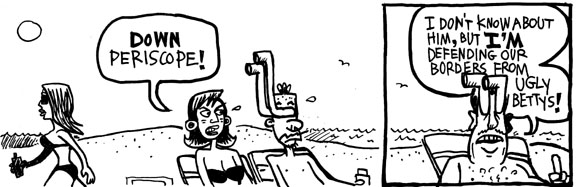
… I donno, I know a lot of families like this, especially around Houston. And Houston is over 50 percent “Hispanic,” while the percentage of New Zealanders (“La Cucaracha” has been replaced by a cartoon from New Zealand about penguins) is… uh… uh… dang, I’m not sure, somewhere in the low 0.0001s at least.
Somehow, I don’t think it was demographics that drove the Chron’s decision, but I could be wrong ….
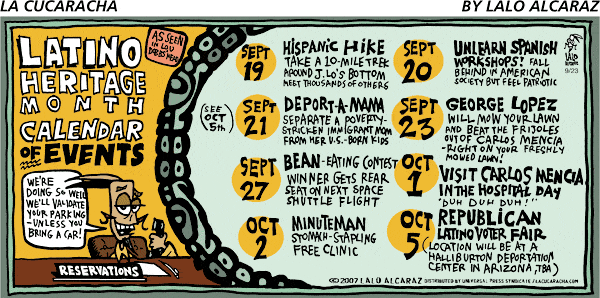
The Chronicle’s James T. Campbell suggests sending your comments to comics@chron.com or calling 713-362-3222.
Like they care…
Does anyone really believe Homeland Security was going to listen to us along the border when it came to building the Great Wall of Texas?
HOUSTON, 25 (UPI) — The first details of fences to stop illegal immigrants entering the United States from Mexico have appeared on the U.S. Federal Register Web site.
U.S. President George Bush signed the Border Fence Act in 2006, which calls for 700 miles of fencing from California to Texas.
The details that appeared Monday address 21 segments as part of a proposed Environmental Impact Statement being prepared, and not all fence areas were described, the Houston Chronicle reported.
Specifications outlined for the Rio Grande Valley in Texas call for a 16-foot-high structure that is ”aesthetically pleasing,” but strong enough to withstand a crash by a 10,000-pound vehicle traveling 40 mph, the newspaper said.
David Benn, a volunteer birding guide at a private Brownsville, Texas, wildlife refuge that would be fenced, told the Chronicle he believed local input opposing the plan would be futile.
”But I’m not surprised because I think the federal government knew what they were going to do and all this public input is nothing but window dressing,” he said.
The Brownsville Herald has a rough map:
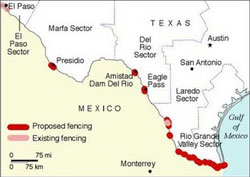
Before the whiners start spouting off about the sections that aren’t fenced, here’s the river down in my neck of the woods…
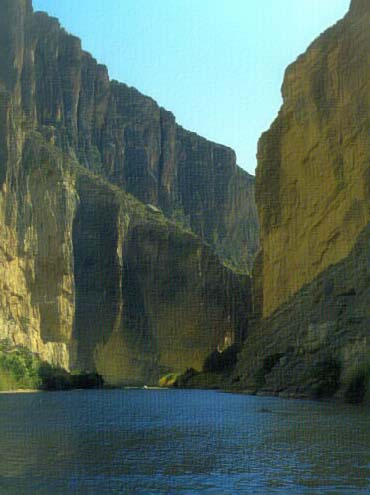
OK, where exactly is that fence gonna go?
What I did over my “summer vacation”
Many thanks to those that have stuck by the Mex Files during our enforced hiatus.
Even with donations, there is no way to make The Mex Files a full-time commitment — not if I want to eat, let alone keep the phone connected and my car on the road (alas, a necessity out here in the boonies). Small-town reporting wasn’t paying the bills (one late paycheck was enough to get my phone — and internet service — shut off) and I had to do something.
For the last month, I really haven’t been following the news and have some catching up to do. I’ve just been driving a van for the railroad (and grossly underpaid, but what can you do in Alpine, Texas?) between El Paso to the west, and Del Rio to the east. Other than collecting some border folklore (I’ll have to post on this, but it looks as if both the chupacabra and la llorena crossed the border hereabouts), and taking some photos, not much in the way of Mex Files research.
I did manage to get out my short book on Gilberto Bosques, which should now be available from Mazatlan Books and Coffee. I’m trying to set up distribution here in the U.S. I’ll make Mazatlan’s books available through the U.S. Postal Service, as soon as we can work out a distribution system across the border (in other words, my 20-year old Volvo is going to have to drive back and forth across the border). As a sort of PBS-style come-on, I’ll give away a free copy with a $30 donation (as soon as I get my copies… hopefully later this week).
I’ve also been working on my Mexican History, Gods, Gachupines and Gringos, which should be published by early 2008. I’ll leave it up to the publisher to send out excerpts to reviewers. The enforced time off was good for editing, and I’ve still got a bit to finish up (I was writing about Tlatelolco and the 1968 Olympics when I was so rudely interrupted).
I don’t work for the railroad, but for a contractor to the railroad. In other words, no union benefits (or health insurance), and a really low wage (though better than I’d make writing for the local newspapers). However, I have to work by the railroad’s crazy schedule, which sometimes means driving the 8-hours to and from El Paso at an inconvenient time like 2 AM. None of that materially affects writing on the internet (which can be done at odd hours), but sometimes I’m just too tired to think, let alone type.
The “new” phone bill will be about $80.00 US a month (this includes internet service and flat rate calls to Mexico). My CD drive has finally given up the ghost and needs replaced and there are a few miscellenous Mex Files expenses that are on-going, even as I try to whittle down the expenses. I’m trying to balance the Mex Files with making a living (and paying off a year’s accumulation of unpaid bills), so bear with me — and scarf up a free book.

Returing this week!
The phone bills are paid, but having to work a bizarro schedule (and editing a book for January release date) has put everything on hold for longer than I expected.
DSL service is STILL not working out here in Alpine, but I’m promised service by Tuesday (tomorrow).
Back soon….
Crash test dummies
From our friends at Mexico Trucker:
A truck crash in the desert of northern Mexico killed dozens last weekend when a cargo of explosives blew up, creating a huge fireball and crater in the road.
That helped influence the U.S. Senate when it voted on Tuesday to block funding for a test program to let Mexican long-haul trucks operate in the United States under 1994’s North American Free Trade Agreement.
But Mexican truckers and the Bush administration say that kind of accident would not happen to Mexican trucks in the United States under the program.
The 600 rigs that were due to take part in the one-year plan were new vehicles and safety checks on the U.S-Mexico border were tougher than for U.S. truck drivers.
Checks are so tight that only one truck, from Mexico’s northern city of Monterrey made it deep into the United States in the five days the project lasted.


