The eagle has flown the coop
I hadn’t noticed, but Blogotitlan did. They took the eagle off the 20-peso bill and substituted a dove. Blogotitlan smells a rat…
In the 75 years that followed the first, war-time (and war themed) bank notes of the Revolution – that is, until 1992 — Mexico had only THREE changes to the basic design currency notes. This was the epoch of a stable economy and a strong peso.
But of 1992 to date –that is, in the 15 years of neoliberalism – there have been FIVE changes: in design, denomination and bill size. That is nearly one change per sexenio (presidential administration), including the dark years of Salinas de Gortari, when the “New Peso” were put into circulation.
Today an equally illegitimate government, even more dubious than that of Salinas de Gortari, the epitome of transcendent technocracy, has an aversion to any new incarnation of the devil (whose name is Lopez Obrador) and all his works. This spurious government rejects everything that might be related to him.
Preoccupied with erasing all traces of their electoral fraud (which, according to the Catholic Church, “no one saw”), and the symbols and signs of the civil resistance to that fraud, the supposedly independent Banco de México and the Casa de Monada have been pressured to change the20-peso bill, which, along with the 50, was recently redesigned and released as a polymer-based note which was more durable and resistant than conventional paper money.
They did away with the juarista republican eagle, adopted as a shield by the Legitimate Government of Andrés Manuel Lopez Obrador, Juarez’ thoughts being the basis for the resistance to the ultrareactionary technocrats. But, . But they left Juarez’ portrait untouched (though it also gives them the chills), making their phobias less evident.
However, the wide-spread media campaign that accompanies the new monetary roll-out only emphasizes the overt intentions of the illegitimate government to crudely erase all vestiges of resistance. Once again, supposedly “national independent institutions” (like Banco de México) are pressed into service for the benefits of particular factions.
The redesign of the twenty-peso bill, as in the case of the Revolutionary era banknotes, is tailored to regional factions, not to the nation as a whole. Re-design feeds an image of instability. It adds momentum to the perception of a cause and effect for the change.
Issuing new currency is constant in this world. Old bills naturally wear out through circultation. But issuing new bills is one thing, changing the design quite another, especially when the changes are done over such a short time frame. The dollar, for example, with small and imperceptible differences from the original design, projects an image of stability and strength over time. And, so do most currencies of countries with stable economies.
Since 1992, however, Mexico has been changing the bills with each sexenial dictatorship. It used to be that people complained that the PRI printed currency without anything to back it, but now they print currency (with who knows what backing) just to please whoever is the head of the spurious operation. The difference is that the same ones who complained before are now the ones in charge of the printing press.
Indocumentatos…
Arnoldo Kraus in last Friday’s Jornada.
(Sorry, about all I’ve had time for this last week has been a translation or two for the Mex Files. I’ve been driving back and forth most nights to El Paso — 440 miles round trip — and am a little wiped out for any sustained work. More as soon as I can get the phone bills caught up and get back on line).
Look up “indocumantado” in the dictionary. You will be surprised at what you know and don’t know. “1. Said of a person who has not received, or lacks, an official idenification documents. 2. Those who have no proof or valid affidavit of residence. 3. Said of a person without an opinion of value. 4. Ignorant and uneducated.”
Based on the evidence, it appears that the last one is the one governments have agreed is the most convenient to use. The indications are that the last two definitions listed by the Diccionario de la lengua española agree with the dictionary of tacit understanding between Mexico (The “back yard” of the United States, as the late Adolfo Aguilar Zinser said) is provided by the treatment of our “indocumentados.”
The recent deportation of Mexican activist Elvira Arellano (from the United States) exemplifies not just the imprecision of the Spanish language, but also the double morality of our neighbors and the ineptitude of the entire Mexican governent to humanize these people – and making it impossible to deal with the phenomenon of migration.
At the same time that Arellano is awaiting deportation, the Mexican consuls in Brownsville Texas and Tucson Arizona announced that in the last year “more than” 224 Mexican nations died in those two states. It is the inexactitude of “more than” that is abominable, though, regrettably, understandable. What do we mean when we say “more than”? A hundred? A thousand?
From a moral point of view, it seems difficult to decide which of the two governments are more responsible for migrant deaths. The Mexican government is coninually and perpetually incapable of creating employment. The country continues to force out workers who maintain families despite being ill, malnourished, uneducated or from the poorest in the country. It makes no sense that these workers generate the country’s third largest source of income.
The United States, for its part, much as they hate to admit it, requires the workers who head for that country. They are allowed to work, with the tacit complicity of the authorities, as long as the Latin Americans accept low salaries. They are desperately needed, and green cards offered, to work … in Iraq and Afghanistan. Is it absurd to think the two countries have a secret agreement on the number of undocumented workers permitted each year? Perhaps not.
Immigration reform will not be easy. Here, we prostitute “reform” to fit the economic needs and times. During the marches that protested Elvira Arellano’s deportatation, Jesús Sánchez del Villa, whose undocumented son was killed in the War in Iraq, summed up the morality of the Bush government nicely: “It’s said that when we want to join the army to fight the enemies, no one will do anything, but at the same time they want to deport the three million fathers of children born here. It’s inhuman.”
The same thing can be said of our government. We know millions of dollars come into Mexico from undocumented aliens, but no one knows the exact number of Mexican killed on their way to assume the status of “illegals.” So, it’s best to accept the dictionary definition “without value… uneducated.”
The Rio Bravo and the desert are realities, but Iraq is worse, and much more real. Facing the deportation of more of our conationals, the question is which definition will be used by George W. Bush and which accepted by Felipe Calderón when they make an agreement.
Peons v fast food… peons win round one!
With all due respect to Lucas Benítez, the most amazing — and troubling — part of this story is that peonage is still fairly common in the U.S., and taken as a given.
Arturo Cano, the U.S. reporter for Jornada, interviewd Benitez in last Friday’s Jornada.
Two days after graduating from Junior High School, Lucas Benitez left his homehown and headed for the Rio Bravo. He knew no one. Fourteen years later, he directs an organization of tomato pickers which has won victories over the giants of fast food, like Taco Bell and McDonalds.
“We’ve set a precedent: never before has a large corporation given money directly to the to the workers at the bottom. Now, we’re going for Burger King,” says the Coalition of Immokalee Workers director.
When he arrived in Immokalee, in the heart of south Florida’s agricultural zone, Lucas was floored: “It was a city without law. The bosses carried pistols in their belts, would make like they were shooting you with their fingers and lie on their mother’s grave. The people took the low salaries and mistreatment as normal.
“Well, I’d come to this country for a better life, and ran into this… I know, I know. Why wasn’t there a strike?”
A first meeting, at a local parish house in 1993 only attracting four workers. The organization faced a problem. Most of the Immokalee workers were temporary. They picked tomatos in Florida before moving on to tobacco in North Carolina and apples in New York.
For the first two years, the coalition was off the radar. But in 1994, one of the larger compaines decided to reduce salaries below the minimum wage, from 4.25 dollars per hour to 3.85, arguing that farm workers would equal or surpass the minimum based on the amount of tomatos they picked.
“We could eat crow and keep working, or go out,” Lucas recalled. “We walked out.”It was the coalition’s first strike.
Three thousand workers walked off the harvest. The company recalculated the wage structure, to proved between 4.50 and 4.75 an hour. In the coalition’s offices today, there is a relic of what happened next: a bloody shirt. A Guatemalan laborer had asked permission to get a drink of water, and the boss said no. When he disobeyed the boss, he was hit in the face.One hundred seventy workers surrounded the boss’ house, shouting “Hit one, and you hit all.”
“That was the start of our first boycott, in 1996. The next morning, like all days, the farmers showed up in their trucks to find workers. No one got in.”
In the closing days of 1997 and the start of 1998, six coalition members staged a hunger strike to demand the farmers sit down and negotiate. “We thought that being so close to Christmas, we might reach the hearts of the farmers – but nada.”
The local bishop, other religious leaders and ex-president James Carter gave support.
“Out of repect for them, we ended the strike after 30 days, but it helped us raise the bar of our local action.” This was followed by a 370 kilometer march, and various labor actions on the farms that would not accept contracts. “Those that said they had no interest in guarding their image didn’t have one to protect anway,” Lucas said.
While this was going on, Benítez read an article in a specialty journal that was called to his attention. Taco Bell announced that they had signed a contract with two of the largest growers in the area to sell tomatos at below market prices. “We knew what price they were paying.”
The Immokalee workers (half Mexican, 30 per cent Guatemalan, 10 percent Haitian and the rest from other countries) then launched a boycott against Taco Bell. Along the way, they obtained help form students, churches, film stars and politicans.
At first, the company would not budge. Taco Bell is part of Yum! Brands Inc, one of the 500 largest corporations in the world, according to Fortune magazine, with almost 900,000 employees in 100 countries. Among other restaurant chains, it owns KFC, Long John Silver’s, All American Food and Pizza Hut.
It took nearly four years for Taco Bell to feel the effects on its image as a “philanthropic” and “socially responsible” company. “They agreed to pay an extra cent for each pound of tomatoes, and to pay that penny directly to the workers.”
Two other achievements were by no means minor. The company and CIW developed a “Code of Conduct” which in essense obligated Taco Bell to encourage farmers to repect labor rights for their workers. Furthermore, the company promised to stop buying from those farmers who had committed “extreme violations” of these rights, such as forcing workers into involuntary servitude or slavery.
Filling the baskets
Tomato plants are picked three or four time, Lucas explained. “the first time there is a low yield, and filling a basket is dificult. Other times go faster, and it takes five to eight minues to fill one. During the last harvest, you can pick 20 to 30 baskets per day.
After the agreement, the harvesters receive 45 cents for every 32 pound, which presently sell for 77 cents. Now, every week Taco Bell sends the coalition a list of those workers who picked tomatos for their restaurants. They receive one check from the farmer and another for the corporation, for amounts between 18 and 40 dollars.
Following this triumph, the coalition directed its guns at another powerful mulinational. The victory over McDonald’s only took half as long, two years. This past April 9, the corporation accepted the same conditions as their competiors at Yum! Brands. In retrospect, Lucas says, “six of the largest food chains in the world now work with us.”
From wetback to prizewinner
Lucas Benítez is certain that if he had stayed in Mexico he would have ended up as a “impoverished campesino or a delinquent.” In the United States, however, he has become a multi-prize winning personality.
In 1998, CIW received a prize from the Episopal Conference of the United States for their work in eliminating poverty and injustice. In 1999, they were awared a grant sponsored by Rolling Stone magazine. In 2003, together with two of his co-workers, Benítez was awarded a prize named for Robert Kennedy for their human rights work.
On the latter occasion, in the U.S. Capitol, Lucas said, “It’s a strange thing: life is like a dream. Two days ago my compadres were protesting the Free Trade of the Americas in Florida, and we faced three thousand police. Now, I’m in Washington receiving a prize. Lucas and his co-workers were being recognized for their assistance in liberating more than a thousand agricultural workers kept by force in camps in Florida and South Carolina.
These days, he is invited to dinner at the Kennedy mansion. “I never had eaten a meal like that. When Ethel said to start eating, I said to her ‘you first’ because I didn’t know where to start,” he said smiling. This anecdote recalled another, about his first time in the United States. He had gone to a town north of Immokalee (“our house” in the Seminole language). He didn’t know a word of English, but was hungry. Standing in line at the restaurant, he didn’t know how to ask for the food. The peson ahead of him ordered several items, so he said “give me the same.” For 15 days, the only thing I ate was ‘give me the same!'”“
Guest Workers” = legal slavery
Married to a Mexican from Chalco, Estado de Mexico, Lucas Benítez has only been back three times to his native Arcelia, Guerrero since he left at the age of 14. His life, and his battle on el otro lado has kept him busy, and nearly all his family have moved near by since then.
Based on his experience, and his long struggle for agricultural workers, he is conviced that a guest worker program is not a solution to immigration problems. “It’s bracerismo – legalized slavery. Employers can complain to Immigration, and have you black listed. There’s no way to change jobs, or move somewhere where the pay and conditions are better.
“There is talk of a treaty, but in practice, Mexico is selling cheap manual labor for the worst paid jobs in the United States, in agriculture.”
Middle class values — back to school and double parking
It’s the start of the school year in Mexico City, so time for the annual parents cause traffic snarl story. El Universal reports that 107 parents were ticketed for double parking or using reserved handicapped spaces as they dropped their kids off for the day. This probably reflects a media obsession with the new traffic code (and, unnoticed in the “green referendum” a few weeks ago was support for more public school buses), but it indicates something else going on. More parents have cars to double-park when they drop the kids off at those private schools all over la Capital.
A few years ago, I noticed this when a guy who would claim the sun sets in the east if I said it said it set in the west was jabbering on and on about high crime in Mexico City (it was declining at the time, as much for demographic reasons – the Mexican baby boomers are getting too old to make good criminals), citing the growing number of car thefts as one example. True, but then, there are a lot more cars to be stolen and those that are tend to be older cars without alarms or decent locks (think VW bugs) in poor neighborhoods.
There’s more of everything available – not just in Mexico, but throughout Latin America == according to the 16 August Economist . The Economist sees it as a booming “middle class,” but I’m not so sure.
When Oscar Lewis, back in the 1940s, began his exhausive studies of Mexican families, carefully noted every item in family homes. Looking at families like the Children of Sanchez and their neighbors, he took note of which families owned forks in the poorest apartment blocks, and who in the working poor neighborhoods owned radios (usually the landlord). By the late 1950s, Lewis was not counting the family silver, nor paying much attention to radios. The families that owned a TV sometimes indicated a more entrepreneural bent than anything else– one of the “Five Families” he studied in the late 50s set up a snack bar in their living room, and rented TV viewing time to the neighbors.
The Economist is defining “middle class” as having the income to spend on stuff. I suppose they know more about official definitions than I do, but I don’t think just owning stuff is any sign of anything. Everybody wants stuff.
One reason I don’t have a knee-jerk anti-rich guy bias uber-richest guy in the world Carlos Slim is that I don’t see anything weird about people who have a little money to spend wanting to spend it. It wasn’t rocket science that made Slim rich… it was selling things people with a little money to spend want: cigarettes (Citam), telephones (Telemex, SBC, etc., etc., etc.), internet connections and computers (Prodigy and CompUSA) and other stuff (Sandborns, Sears, etc., etc., etc.). Slim reconginzed that even poor people want to have things – one reason he supported the Lopez Obradór administration in the Federal District (and helped Lopez Obradór’s Presidential campaign) was his recognition that if the poor had some money to spend, they’d be spending it with him. And that people with enough to eat can think about buying a computer, or a telephone.
I’d expect The Economist to focus just on income, but there are other signs that Mexico (and by extention – or at least statistically – Latin America in general) is wealthier. People eat more. During the Fox administration (something of a golden age of government propaganda), I was always amused when I’d see back commercials from the Department of Rural Development advertising the free turkey program followed by Secretaria de Salud anti-obesity commercials. The turkeys, in case you were wondering, were live – since the 1950s, the government (then, the PRI) was giving away turkeys, and the commericals were extolling the Fox administration for making it non-partisan. The idea was to provide a small flock to provide more protein (eggs and an occasional turkey dinner) in the campo. In a Tabasco ejital one time, I posters on a community center bulletin board advertising goth the subsidized food program and a weekly meeting of Weight Watchers. I assume the Weight Watchers attendees were eating more than a few turkey eggs a week.
The problem I had with The Economist were the twin suggestions that being able to purchase telephones or jeans or dog food somehow made you “middle class” and that all this was somehow due to “free markets”. Consumer spending is also skyrocketing in the Bolivarian Republic of Venezuela. The Economist, given its biases, also defines “middle class” based on consumer spending and income.
My point is that owning stuff – or being able to buy stuff — isn’t the same as “middle class” in Latin America, or elsewhere. The “middle class,” to my thinking anyway, are the people who invest in their future (like the family going into debt to buy a TV, but turning it into a small profit center), think in terms of community (think of the shopkeepers who know everyone who belongs on their street – and who clean the sidewalk every morning) and see the value in education for its own sake. As the Economist’s countryman, George Orwell made clear, “middle class” doesn’t have anything to do with the ability to spend. Orwell talked about the English “lower upper middle class” of depression England – clergymen, retired officers on inadequate military pensions, and others who might have the values – and aesthetic tastes – of the upper middle class, but not the purchasing power.
In the anti-class conscious U.S., we label almost everyone “middle class,” but – as the Economist does – use consumer goods as the marker. Nearly everyone in the U.S. can afford a telephone, and a computer and televisions and cars. So, by U.S. thinking, everyone is middle class.
Not so in Europe and Latin America, where values and esthetic choices have more to do with one’s class. In Mexico, nacos – the lower class – are not necessarily poor. “Rich Nacos” are almost hip – or rather the naco style is hip. But values like education, thrift, propriety, and a desire to avoid social conflict, are not naco values. Managers, doctors, engineers, professors, civil servants – the traditional Mexican middle class – is often more like Orwell’s “lower upper middle=class” than otherwise. I knew a lawyer who made ends meet selling tacos at night (his wife, a psychologist, sold baby clothing), and I’ve talked about the TV cameraman/reporter who drives a cab. The Economist did note that some street vendors earn more than some university graduates – but that’s true in the U.S. as well. Ask anyone with a humanities degree. Some of us have Masters’ degrees and drive trucks.
Street vendors are entrepreneural, earn a decent living (and work hard for it), and – one hopes – are investing in their kids futures. Which is what makes this story, published last Sunday by the AP, so noteworthy. We have two visions of entrepreneurship, and of citizenship, at odds here. We just can’t fit this into our nice little divisions of “class”:
Mexico tries to reform its street economics, collect more taxes
Sunday, August 19, 2007
MEXICO CITY: Tens of thousands of vendors sell everything from school supplies to pirated pornography videos on the teeming streets radiating from Mexico City’s main plaza, the Zocalo.
Mexico City‘s leftist mayor, working from a building all but engulfed by the makeshift market, is now seeking to move the vendors from the capital’s historic downtown by Oct. 12 and free up streets lined with colonial treasures ranging from cathedrals to museums.
If Mayor Marcelo Ebrard succeeds in his plan to relocate the vendors to government-subsidized properties nearby, he will have done what many other administrations have failed to do. Attempts in other neighborhoods have sparked all-out street battles with police.
Removing the vendors is one of the few issues the capital’s leftist government has in common with President Felipe Calderon’s conservative administration, which views them as tax evaders it wants to reel into the formal workplace.
But relocating them promises to be difficult.The vendors are represented by large and occasionally violent unions, and are campaigning against the relocation plan. They argue that the designated properties offered by the city will fail to attract customers and have asked for the deadline to be extended until Jan. 7.
“The people can’t support themselves on some property if there are no sales,” said Alejandra Barrios, president of a high-profile vendors union recently at a conference of city and business leaders. “And the new areas need to develop a reputation, and that takes time.”
“We have to defend ourselves somehow, and Marcelo (Ebrard) has to understand that.”
The Mexico City Chamber of Commerce estimates there are 35,000 vendors in the downtown area.
Vendors say they can often make more money selling in street stalls than they can earn with jobs in the formal sector, where the minimum wage is just US$5 (€3.70) a day.
Ebrard says he does not want to use force to meet his goal of eradicating the huge market, and he is trying to negotiate a deal with business leaders and vendors. But the market provides thousands of jobs for the vendors, who pay no taxes and receive few social services.
Previous eviction plans have only succeeded briefly, as vendors promptly swarmed back to the downtown area after relocation sites proved fruitless.The city’s campaign comes as Calderon, as well, grapples with an underground economy that the World Bank estimates employs as much as 60 percent of Mexico’s work force and equals nearly 30 percent of the country’s gross domestic product.“The country can not prosper on a base of illegality, and the greater the illegal economy, the more society will suffer and fall victim to crime,” Calderon said recently.
So far, Calderon says his government has created 500,000 new jobs and has set aside US$300 million (€222 million) to cover the social security for first-time job holders for one year, an effort to encourage people to join the formal work force. He has called on his Cabinet to encourage small and medium businesses.Mexico’s notoriously low tax revenues are part of the reason that its social protection programs are too weak to discourage informal labor, said Bill Maloney, chief economist for Latin America and the Caribbean at the World Bank.
Poor workers often drift in and out of the formal job market, sometimes earning more selling designer sneakers on the street than working as an accountant.
“This is a status rise, going from being a salaried employee somewhere to being informal, self-employed,” Maloney said.
Victor Gutierrez, a 48-year-old father of two who is blind, said he began selling goods in the streets after the 1994 peso devaluation.“In a company, unfortunately, it’s rare for them to pay even a little bit more than the minimum wage,” he said.
Gutierrez said he made about US$3 (€2.20) a day working at the textile plant. Now, he can earn as much as $20 (€15) a day selling board games and beauty products on the street.But Gutierrez said if the city government moves him to a government-sanctioned location, business will likely suffer since his stand will no longer be in the line of daily foot traffic.Many vendors, he added, will then simply join the millions of Mexicans who have migrated illegally to the United States in search of work.
In a nutshell, this is the problem we have we think about Mexico. We expect things to be different, and when they are (like the informal economy) begin with the assumption that it’s bad, even though the results – what the Economist calls “middle class” are good.
(With some enforced time off from the Mex Files, I’ve been working on getting that book I never really got finished put together. There is a publisher seriously interested – not that I expect a best seller – who I’ve been putting off for much too long. Since I’ve been working on a short booklet on Gilberto Bosques, too, I guess it’s worth presenting some more on Mexico and the Second World War)
Although the Cardenas government had briefly flirted with the Axis countries (Germany, Italy and Japan) during the oil crisis, even before World War Two started in 1939, Mexico had agreed to support the Allies (Great Britain, France, the Soviet Union, China and the United States). All recognized the importance of Mexican oil in the coming war, and agreed to put aside their disagreement until the fascists were defeated.
The Mexicans and the United States governments were both realistic, recognizing neither could afford an enemy for a next door neighbor. Japan threatened the United States colony of the Phillipines. Pro-Filipino sentiment among traditonal Catholics in Mexico created anti-Japanese sentiment. Mexican culture is largely a mixture of Spanish and Indigenous influence. Filipino culture adds an Asian layer on top.
Although the Philipines have ethnic ties to the Japanese, the the Filipinos had been converted to Catholism by Mexican missionaries in the 1500s. The Asian archipelego was part of Mexico until 1814. After nearly 300 years of the Acapulco-Manilla fleet there were many Mexicans (and Filipinos) with social, family and business connections. Acquired by the United States in 1898 (during the Spanish-American War), the Spanish-speaking Roman Catholic majority Philipines had their own government, and had been promised full independence by 1945.
Japan openly planned to invade the Philipines, and began a brutal attack in 1941. Germany and Italy, both as allies of Japan (unpopular with traditional Catholics) and of Spain (unpopular with the leftists) lost still more support among the Mexican people, even among the German and Italian immigrant communities.After the United States declared war in December 1941, the Axis forces tried to cut off oil shipments. After two Mexican oil tankers were sunk by German submarines, Avilla Camacho declared war, joining the Allies in May 1942.
The United States was providing most of the Allied weapons and food, and much of the fighting men. Mexico had never been in a foreign war, but had resources vital to the Allies, besides oil and minerals. In the end, it would supply 40 percent of the raw materials and food the United States required to fight the war. The United States was only able to turn out weapons by converting factories that normally made consumer products (things like refrigerators, washing machines and radios) to weapons production. Even though there was not much consumer demand in the United States, Mexican industries suddenly found they had a huge new export market. Some US factories simply moved their regular equipment to Mexico, where they could continue to do normal business.
And Donald Duck learned Spanish. In return for cooperating with the allies in providing oil, President Franklin Roosevelt had promised technology transfers to Mexico as part of the war effort. While Roosevelt was unable to convince Congress to approve these transfers, he was able to convince Walt Disney and Howard Hughes that Mexico needed help in countering Fascist propaganda. Both Disney and Hughes’ RKO Studios sent sent film stock and equipment to Mexico, and the technical expertise to set up Churobosco Studios.
The early 1940s was the start of the golden age of Mexican cinema. Nelson Rockefeller, the son of Rivera’s one-time patron John D Rockfeller, Jr. and the future New York Governor and United States Vice President, was at that time a wealthy young man with a serious interest in Latin America. President Roosevelt sent young Rockefeller on a top-secret mission to research Latin American attitudes toward the United States and the war.
Rockefeller’s report was worrisome. Nearly every Latin American country, including Mexico, resented the United States, and there was still widespread support for the fascists. However, throughout Latin America, Rockefeller found two gringos were extremely popular. Micky Mouse and Donald Duck. Disney turned out Latin-flavored cartoons, and Donald Duck learned to do the Mexican Hat Dance as part of the war effort.
Cans of film were useful, but cans of vegetables would win the war. Farming had nearly come to a stop in the counties where there was fighting, which left the United States and Mexico feeding the allies. Vegetable farmers especially made money during the war.The huge numbers of soldiers and sailors from the United States also created another problem for the Allies, one that benefited Mexico. The United States was desperately short of workers.
The “bracero” program recruited workers willing to go north. Volunteering to work for the gringos was not only profitable for individual Mexicans (the US salaries were significantly higher than at home), but it was patriotic as well. If the United States would provide the soldiers, Mexicans could do anything else that was needed. The “bracero” program was so popular (everyone from poor farmers to teachers and lawyers volunteered to work in US factories, farm fields and to run the railroads), that the Republic itself faced a new situation — there was more work for everyone, and not enough workers.
Women have always worked in Mexico, but now they were asked to do the jobs always considered “men’s work”. In the United States, the symbolic women worker was “Rosie the Riveter”, clean-cut, feminine and able to handle heavy equipment. The “Women Workers Corp” poster girl was a bit earthier – she carried a baby under one arm and a wrench in the other. Rosie and the Women Workers’ Corps poster sent the same message — a female factory worker was still a woman, but was a patriot fighting a hard battle at the same time.
Veterans of the “Women Workers’ Corps” (with their own distinctive uniforms) led the push for women’s voting rights after the war. It should be noted that Mexican women won the right to vote in 1954, earlier than in several European and Latin American countries.
Snow White’s Wicked Queen, the Border and the Mex Files
(11 July 2013… having mentioned this post elsewhere, don’t worry, the temporary crisis passes. Still, if people WANT to donate to this site, by all means do… I’m not going to stop you. I also found Salt of the Earth on youtube: much too large for me to embed here: http://www.youtube.com/watch?v=G7ZoomADDOI)
Being at least temporarily flat-ass broke as a result of disseminating what one person called “Pravda’s Mexico Bureau,” I’ve developed a real appreciation of Gayle Sondergaard.
Who?
Sondergaard was a big-time Hollywood star of the 1930s and 40s, mostly forgotten now, though she’s instantantly recognizable.Her “exotic” looks (though, in reality, she was a Minnesota farm girl) were the basis for the wicked queen in Walt Disney’s Snow White – and no wonder.As the one biographer put it, “Swift, manipulative, dangerously cunning and sinister, these were the key words that best described the roles that Gale Sondergaard played in motion pictures.”
 Sondergaard figures into my own interest in Mexico, in an extremely round-about way.I’d had a slight interest in Latin America, both because I had a neighbor who wrote a biography on the esoteric subject of 19th century U.S.-Brazilian relations and because in graduate school, I’d done extensive research on Elizabeth Bishop, the Canadian-born U.S. poet who also wrote extensively about Brazil, where she spent most of her adult life.
And, when I was 14, I played tennis for a local city league.It didn’t dawn on me at the time, but there was a girl on our team who was chronologically a few years older, but had some developmental challenges that matched her with us early adolescents.She mentioned that she lived in a local residential school and that her mother was a movie actress.It only dawned on me a few years later that the movie actress was Bette Davis.
I’d already developed a guilty pleasure in Davis movies, and hung out with the kind of people where a REAL connection to a STAR– if nothing else – at least opened up some… uhhhh…. conversational possiblities.Bette Davis and Gayle Sondergaard were in two movies together.In The Letter, Sondergaard never says a word on-screen, but still manages the nearly impossible feat of dominating Davis in their scenes together (she pays the Chinese widow who blackmails – and later murders – Davis in revenge for killing her English husband).In the 1939 MGM costume drame Juarez, she plays Emperess Eugenia of France to Davis’ Carlotta.
Bette Davis… Juarez… a vague interest in Latin America.That’s where it all started.
So, how does Gayle Sondergaard fit into that?Other than costaring in a Zorro movie, once doing a turn as the reactionary and sinister Empress who propelled Maximiliano and Carlota on their destructive couse in Mexico isn’t a likely background for fostering U.S.-Mexican understanding. Sondergaard’s career came to a crashing halt in 1948 because she was a loyal wife.Her husband, director Herbert Biberman had been a Communist, and – in the late 1940s –we went through a particuarly nasty reactionary period, where even the wives of suspected disloyal Americans were smeared.Sondergaard stood by her man, and was blacklisted, along with several others.Actors, directors, cameramen, technicians – anyone who’d had any ties to left-wing movements in the 1930s (when it was perfectly respectable to do so) was unemployable.Many, incdentally, went to Mexico, where they could work during the golden age of Mexican cinema and where they helped launch Churubosco Studios, and later Televisa.
Up until 1948, Sondergaard had been a big star, and had earned a hefty paycheck.I guess it was the old Marxist saw, “From each according to his ability, to each according to his need,” that led Sondergaard to put up the funds for one of the strangest – and best – films every made about Mexicans in the U.S. and about the border.Salt of the Earth, based on a real 1951 miners’ strike in Arizona.Will Geer (who in his 80s found new respectability as Grandpa Walton), with two stikes against him – he’d been blacklisted as a Communist, and thrown out of the Communist Party because he was gay – at least got a paycheck, and Biberman had a movie to direct.
 Salt of the Earth is shameless propaganda, but very good propaganda.The story centers on the growing class consciousness of Esperanza Quintero, a humble Mexican immigrant housewife who has to take a lead role in the strike when the workers are legally enjoined from picketing.What made the film the classic it later became was that it dealt with the border realistically.Anglos and Latinos misunderstand each other, and have different cultural needs.Mexican immigrants and Mexican-Americans have their own subtily differing perspectives and wants.And – very unusual in any American film – people speak their own language.As far as I know, this is the first film to use English, Spanish and Spanglish.
I’ve had my phone cut off. Salt of the Earth had their star deported.While the major Anglo roles were played by blacklisted Hollywood actors, and the supporting cast was made up of United Mine Workers’ members (several acting out their own words and actions taken during the actual 1951 strike), taking on the part of the housewife turned leader requried hiring a real pro.
Originally Sondergaard herself was going to play Esparanza, but even her loyal husband realized the glamourous dragon lady wasn’t right for the role.Neither were any of the few Mexican actresses working in Hollywood – not that Katy Jurado (who might have carried it off) or Delores del Rio (definitely wrong for the part) would have taken the risk of working for known “subversives.”RosarioRevueltas, who had performed in a number of earthy roles, had her only U.S. performance in Salt of the Earth.
The vaguaries of Microsoft Millenium (and a duct-taped old Dell system), and utility bills aside, the worst the Mex Files has to endure is the occasional spam attack, and a few snotty “comments” (by the way, I’m more bemused than bothered by the guy who signed himself “grumpy” and complained that asking for money indicated there was no market for something he obviously reads regularly… meaning, he’s unwilling to contribute, not unable to do so).
During filming, Salt of the Earth was attacked by the film industry publications, denounced on the floor of the U.S. House of Representatives and shots were fired at the set.A little harder to take was Revultas’ arrest and deportation (she had a legitimate work permit) allegedly for being a “Communist sympathizer” (in those days, the Taft-Hartley Act – not rescinded until the Clinton presidency – allowed the State Department to deport “dangerous”– which including left-wing political sympathies).Revultas, who later did work in Communist East Germany and later in Cuba, but was never a Communist, later wrote:
[Since the U.S. authorities] had no evidence to present of my “subversive” character, I can only conclude that I was “dangerous” because I had been playing a role that gave status and dignity to the character of a Mexican-American woman.
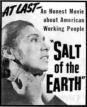 Somehow, the film was finished (and processed secretly), opening in New York in 1954 – and then disappearing from American theaters.Despite showings in union halls across the southwest, and winning awards in Europe, the U.S. government actually banned the film after it had opened in all of twelve theaters.Sondergaard – and this is why I appreciate her – went bankrupt attempting what seems impossible:bringing Mexico and Mexicanismo to an Anglo audience.
The Mex Files tries in its own small way to work in the spirt of Salt of the Earth.Sondergaard and Bieberman did it was grace and style.The film is now recognized as the classic it is (and shown regularly on Mexican television, as well as to American labor, feminist and student groups).Money ain’t everything,but it sure makes work easier.
Ignore the grumps and give if you can.The phone (and internet service) can’t go back on until the nearly $400 in back charges are caught up.

Out of order…

Cartoon by Pedro, El Sentir de Coahuila
Much as I might hope that people think enough of the Mex Files to consider making a donation similar to what they’d pay for a monthy magazine subscription, not enough people are able, or willing to do so to make dontions a viable source of support.
There seems to be an assumption that free-lance writers can carry over expenses for several months. They can’t. Late checks (in one case a day late) meant there was no way to even meet the minimum on my telephone bill.
I’ll try to post something (I’m posting from the local public library) at least weekly, but between taking another job and working on a short book, I don’t expect to be back on-line regulary until September.
Coming soon to the incredibly sinking city…
On the other hand, subsidence has had a few positives lately, uncovering Ahuizotl‘s tomb (one of my fave’s among Aztec notables — he banged his head swimming out of a flooded bathroom and spent his last few years in a coma… alas, allowing the not to swift Moctozuma II to take over) and the Temple at Iztapalapa recently.
Xinhuanet— An vast offshore tectonic plate that has reversed course and is sliding backward has geologists worried that a devastating earthquake may strike Mexico City.
The tectonic plate had been sliding toward Mexico City at a rate of 1 inch per year, as recorded by Global Positioning System measuring stations near Acapulco and Guerrero, which is about 175 miles southwest of Mexico City. That movement was normal, as predicted by theories of how Earth’s crustal plates should move.
At subduction zones, like this one, an oceanic plate usually slides beneath a continental plate, and now and then major temblors occur. Suddenly, in the latter half of 2006, the plate began moving the other way and quadrupled its speed, scientists announced today.
Tequila – it’s health food
Not really, but David Agren (who like fellow reporter, Clark Kent, masquerades as a mild-mannered reporter to continue his fight for tequila, justice and the Canadian way of life) publishes the informative, encyclopedic Tequila blog, Otro Tequila:
…researchers at the University of Guadalajara are finding the most useful compounds in the agave plant. (Tequila is made from the roasted agave hearts.) Agave is full of inulin, and miel de agave (agave syrup) supposedly contains a sugar profile that’s okay for diabetics. Now agave apparently could help deliver drugs into the intestine. Agave compounds can apparently survive stomach acids that destroy most drugs.
Look for more agave products to appear on health food store shelves in the meantime. As for miel de agave, it doesn’t do anything for me, but that’s a personal preference. I’ll certainly keep drinking tequila, though – Cazadores reposado straight up is a favorite.

Make tortillas, not war…
Marc Becker traveled to Oaxaca and Chiapas with the Marin Interfaith Task Force on the Americas. I wish all reports from the “indigenous revolution” realized that the while Marxism is “only” mired in its 19th century ethos (not much different when it comes to sexuality than the other great 19th century movement, Mormonism), “indigenismo” has ossified gender roles going back milenia. Gender and Power in Indigenous Communities in Mexico was published 7 August 2007 in Upsidedown World:
For many leftist academics and solidarity activists, the 1994 Zapatista uprising in Mexico was seen as opening important political spaces for Indigenous women in a broader male-dominated machista society.
… But ten years on, has any real progress been made? Is gender equality even a goal? Does equality extend any farther than trite tokenism?
Within Zapatista communities and more broadly in Maya society, there appears to be a gap between what leadership projects and what communities experience. For example, the Zapatista Junta de Buen Gobierno that governs the Caracol of Morelia is comprised of three men and three women. Plenaries at the Zapatista Encounter with the Peoples of the World in July at the Caracol of Oventic were heavily dominated by women. But during a short visit to the autonomous Zapatista community of Olga Isabel, we only met with three men and it appears that women played an insignificant role in community governance.
…
But rather than blaming Indigenous cultures, it was the Bad Government that treated women as if they served no purpose except to have kids and take care of animals. … The Zapatista General Command has declared that women have equal rights, and if there are problems the Zapatista authorities in autonomous communities take care of them (although the presenters were very thin on how such problems would be dealt with). The presenters, however, did seem to concede how difficult it is to change cultural traditions when they acknowledged that while some men try to help out domestically very few of them make tortillas.
…
My disappointment in the lack of serious engagement of gendered issues was further reinforced during a short visit to the Isthmus of Tehuantepec. …
Ironically, we met with stronger women leaders in Oaxaca and in areas that had not gained a specific reputation for such leadership.
Estela Río González and Itandehuí Santiago Galicia from the Coordinadora de Mujeres Primero de Agosto (COMO) told us their history of taking over the state TV and radio station last year in the aftermath of the Asamblea Popular de los Pueblos de Oaxaca (APPO) protests against state governor Ulisis Ruiz. The Coordinadora emerged out of a group of women who decided to support the striking teachers, and realized that they needed to organize themselves to achieve their objectives. Copying protests in Argentina and Chile, they rejected their traditional domestic roles and instead carried out a cacerolazo, a march of banging on pots and pans. They expected a couple thousand women to join them, but 15,000 showed up for a march on government buildings. With this momentum, they seized 28 buses to travel from Oaxaca’s central Zocalo square to take over the state TV and radio stations.
Originally the women only demanded 30 minutes of air time to present their demands, arguing that as a state-run radio they had a right to have their voices heard. When the station refused this request, they took over the station. They decided that having men join them would be too provocative, so only women entered. Men remained outside as guards. The women deliberately chose to be respectful and not to destroy anything. No one knew how to use the equipment, so they had to coerce the technicians “with cariño” (with love) to show them how to run the station.
For the first day the women did not eat or sleep as they ran the station. Long lines of women wanted to go on the air to talk and express their demands. As the occupation drug on, people brought food to the station. Husbands asked when they were coming home to take care of their houses, but the women said that the men would need to learn how to take care of themselves. …
…
If acculturation translates into stronger female leadership this contradicts assumptions that Indigenous (ie, traditional) societies tend to be more egalitarian and place value on women’s participation. This perspective maintains that discrimination is a function of the imposition of hierarchies and state structures, and that machismo is an European import.
…
Relations of gender and power are more complex than what an outsider would observe during a brief visit, and these roles are contingent on many factors present in different cultural spheres at any historical moment. Even so, rather than reinforcing our assumptions regarding special spaces for the unique and positive construction of gendered relations in Indigenous communities, the Zapatista and APPO experiences would seem to indicate that more–not less–exposure to the dominant culture fosters the development of strong female leadership within a social movement.
.
“Plan Mexico” … and “Plan Mex Files”
The Foreign Affairs Secretariat is keeping quiet about it, but it looks as if Bush is going to promise Mexico “several hundreds of millions of dollars” to “fight narcotics traffickers.”
Bush is known to promise things he never delivers, and you have to wonder about the “emergency.” The Washington Post reports that
The plans are being discussed at a time when Mexico is struggling to contain a war among major drug cartels that has cost more than 3,000 lives in the past year and has horrified Mexicans with images of beheadings and videotaped assassinations.
Well, yeah… beheadings tend to be newsworthy events, but 3000 deaths in a country of 120,000,000 works out to 0.25 per 100,000 which doesn’t exactly translate into an overwhelming security or health problem. Narcotics smuggling is a dangerous occupation, so maybe the money would be better spent on health and safety (like reducing the number of firearms smuggled in from the United States).
But, then, I don’t think this has much to do with narcotics really.
[The] aid plan … would include telephone tapping equipment, radar to track traffickers’ shipments by air, aircraft to transport Mexican anti-drug teams and assorted training, sources said.
Calderón
has impressed U.S. officials by extraditing a record number of drug suspects to the United States and by dispatching more than 20,000 federal police officers and soldiers to fight the trafficking organizations, but that effort has failed to stop the violence.
Does anyone really believe more money for the military is going to do anything? And that it has anything to do with controlling the U.S. drug habit?
Somebody once said that invading Iraq after 9-11 was like invading Bolivia after Pearl Harbor. I don’t know what the metaphor is here — maybe not teaching evolution in Kansas to bring down the AIDS rate in Texas or some such… in other words, government contracts to finance solutions in search of a problem.
I’d be curious to know who is getting the contracts to provide phone intercepts (and why the dubiously elected governments of the United States and Mexico both think they’re necessary) and what that “other training” will be. Will Alberto Gonzales be giving Mexicans lessons in “enhanced interrogation techniques” or vice-versa?
Not that Mexico can’t use a few hundred million bucks. The Mex Files could use a few hundred to catch up the phone bill (I still have internet service, but no long distance today… slowly, slowly):
If you prefer to send a check, money order or make other arrangements, please write me at “richmx2 -AT- excite -DOT- com” and include “Mex Files” in the subject line.
Unsolved mystery — U.S. priest murdered in D.F.
24 October 2009: for some reason I’m getting several hits on this today. Some priest somewhere else was murdered. THIS priest’s death turned out NOT to be murder. The reason this death never was followed up was that the medical examiner, the Church and the priest’s order hired investigators — all of whom all agreed Rev. Sander’s death, and the way his body was discovered, was a weird and rather embarrassing accident.
Stratfor’s Mexico Security Memo, which is subscription only, and I can only access now and again, mentioned in their July 30 update a murder in Puebla state. Stratfor’s business, is after all, heightening concern about security, but the murder didn’t seem to have much to do with anything other than a private dispute. The ony unusual factor was that the victim was a Catholic priest.
Stratfor said that violence against the clergy was a rarity, and so is violence against American citizens. Normally, if a U.S. citizen is killed — even in an accident — it makes the news. When a priest is murdered, I’d expect more than just a few obscure references (from the Archdiocese of Mexico City, and from an American religious news site).
From what I can tell, 77-year-old Father Richard Sander was a long-time resident of Colonia San Rafael, which is not a “bad neighborhood” (quite the opposite). His body was discovered bound and gagged when the fire department responded to a blaze at the priest’s apartment.
What’s strange about this is that the few mentions of Father Sander’s murder are mostly in the context of complaining about Mexican press coverage of the event — which I didn’t see and apparently was not that extensive. The Church (and their defenders) are suggesting that Sander was killed in retaliation for complaining about underage drinking (or, reading between the lines a little, about an underground rave club). The complaints from the Church connected media has been that there is a suggestion that Fr. Sander’s interest in youth was more than pastoral, and he was another predatory priest.
However, the Mexican clergy complains that they are victims of media speculation on clerical sexual abuse — just as a scandal is brewing (Cardinal Norberto Rivera avoided charges in a Mexican court of covering up for pedophile priests, and was deposed in a U.S. lawsuit involving the same priest earlier this week)
Although I knew a lot of the U.S. residents in San Rafael, I don’t recall Father Sander, and if I met him, may not have realized he was a priest since clergymen in Mexico don’t wear their Roman collars. And, I didn’t exactly move in clerical circles.
There have been a couple of murders of older gay men and they don’t seem to be investigated — or followed up by the Mexican press (or our press for that matter — it wasn’t too long ago that you’d once in a while read in U.S. news stories something like “Bachelor found stabbed in kitchen — police have no suspects”). Mexican attitudes are changing, but these sort of crimes are still just written off as ” homo-cide”.
I want to be careful here. Everyone in the U.S. hopefully learned their lesson from the 1976 murder of movie star Sal Mineo. Mineo was openly gay, and it was assumed back then that being gay had something to do with the murder. It didn’t. Mineo had walked in on a burglar who stabbed him. If Sander was murdered because he was an elderly foreigner, that should be newsworthy. Or, if he was killed because he was a priest.
The real lack of information, bothers me. And it’s the non-coverage that is the mystery.


