Luck of the (illegal) Irish
What happens when 32 African American and Latino Irish dancing kids hit Dublin…?
That’s the lead story in that well-known vanguard of La Reconquista… Irish Voice Abroad!
Faith and begorrah… how does a New York paper covering everyone’s favorite small European island somehow become an agent for the insidious Mexican plot to overrun the southwest?
My “favorite” insane anti-immigration site, Lone Wacko, reasons like this. The Irish Lobby for Immigration Reform is chaired by the Irish Voice Abroad editor, Niall O’Dowd. O’Dowd was interviewed by RTE, the Irish public radio station. Ergo, according to Lone Wacko, O’Dowd has ties to the Irish government.
Worse yet, being Irish and all, the group seems to possess a lot of native talent for political glad-handing and … surprising for a lobbying group … lobbying. O’Dowd managing to get his photo taken with the mayor of San Francisco and various United States senators (especially — again shocking for a immigration lobbying group — senators interested in immigration reform). All evidence, according to Lone Wacko that the Irish government is behind the whole thing.
But wait, there’s more… The lobbying group was one of the several sponsors of a Sunday Mass in San Francisco, and a subsequent immigration march, featuring those two historically despised groups of Catholic immigrants… the Irish and the Latinos.
For Lone Wacko, this is “proof” of the on-going foreign conspiracy. According to one of his commentators, Latins and Irish hate us for our freedoms.
The Irish illegals are still with us… some of us trace our ancestry back to them… and others to illegals a little further back.
Habeas corpus, Oaxaca style
… in other words, something that doesn’t exist. This is for those who are still in denial that there were disappearances after the crackdown in Oaxaca last fall…
(Translated from Milenio, 10 June, 2007)
Erick Sosa, younger brother of APPO (Asamblea Popular de los Pueblos de Oaxaca) director Flavio Sosa Villavicencio was released Saturday from a Matamoros, Tamaulipas, prison where he has been held for the last six months, after a local judge signed an order of absolution.
The fact that Sosa had been imprisoned was confirmed by his attorney, Gilberto López Jiménez. A judge in Ocotlán de Morelos signed the order when he could find no element of a crime under which to sentence Sosa.
“He was being held in advance of probes into accusations of kidnapping, assault, and robbery with violence, based on instructions from the Oaxacan prosecutor’s office.”
Erick Sosa was detained by State Police last November when he was charged and jailed, López Jiménez said.
According to defense testimony, Sosa was charged with crimes that occurred in Oaxaca’s centro histórico, while he was working as an airport fireman.
The lawyer said that the judicial decision assumes the local courts prefabricated the crimes to allow Governor Ulises Ruiz to punish those who publicly opposed his regime.
Sosa is probably lucky to be alive. It’s good news that people who were disappeared are being found alive, and released from imprisonment, but what’s troubling is I still run across foreigners who were positively giggly about the crackdown last November, arguing that inconvenience to the tourists is more important than people’s rights to redress their government… or live.
The Buzzard and the Artist: death in Cualicán
There is a widespread feeling in Mexico that it’s not such a bad thing for Mexico that the gangsters are bumping each other. Nobody particularly likes the situation, although Alejandro Almazán, found a few people that manage to turn the problem into an opportunity. My translation is from “Los buitres de Culiacán” appearing originally in yesterday’s Milenio (Derechos Reservados © Grupo Editorial Milenio 2007).
Cuernos de chivos, “goat horns” are short-barrelled high calibre rifles, or sawed-off shotguns — an essential tool of Mexican hitmen.
Funeral parlors make a killing from executions. The other day, half a family was wiped out at a small ranch in Salada, shot – so the detectives say – for crossing someone in the narcotics underworld. While forensic teams probed the massive impact of the high-calabre cuernos de chivo, three other teams of death specialists were arguing over the cadavers.
Each group made its own pitch to the crime’s survivors. A fat man from Emaús undertakers, pushed his company’s expertise. It was his firm that had buried Amado Carrillo, our Tony Soprano, and he had a portfolio of before and after photos of mangled gangsters the undertakers had reconstructed and buried.
Another, who wasn’t going to deal with them by Nextel (the cellular service), suggeted the departed would be taken by Saint Martin directly to heaven. He also recounted his exquisite funerals for various legendary hitmen. And the Moreh representative guaranteed dignity – price including a cedar casket with the image of Jesus Malverde carved in the wood, and perfect reconstruction of the bullet-destroyed faces.
In the end, the Emaús and Moreh were left empty-handed. The survivors chose another undertaker, who is called Buitre (the Buzzard) – because he is abhored by all, but so very necessary. I asked the luxury corpse hunter how he’d found out about the remains.
“I listen to the police radio,” he answered. “It never fails that they’re ratteled, and when I hear the word “dead,” it means I need to go to work. An execution means a shitload of money. When Amado Carrillo died, the family spent, not including the casket, flowers, tents and attendants, close to a million and a half pesos.
Everyone says the living in Sinaloa are devoted to their dead. And in Sinaloa, there are 1.9 deaths per day. Death is never-ending, the undertakers, never idle.
In Culiacán, on Zapata Boulevard, there are Moreah, San Martin and Emaús Funeral Parlors. At times, it seems that the owners have studied all the funeral homes of the Pacific. They built facades of smoked glass, in steel and concrete buildings, without a stone out of place, and palms that seem more at home in the entryway than on a each.
In each funeral parlor, I was shown caskets in varied colors and ornamentation. There are black, gray, maroon, gold, and silver caskets. There are small white caskets, for children. There are the traditional ones with brass fittings, the completely modular and the baroque. There is one in gold with an AK-47 sillouetted on the lid, and another with a marijuana leaf carved in the wood. Several has a spur, to represent sudden death. And, they tell me, the latest fashion – and the face of Malverde carved on the lid – comes from the Sierra de Mororito. Other styles are available by catalog.
I ask what all this will cost.
“The most expensive are in cedar with gold ornamentation. They run a half million pesos.”
Asked if many of these are sold, I’m told, “The buyers aren’t who you’d expect. One day a cabrón from the Sierras walked in, wearing huaraches and all stinky. ‘What caskets do you have,’ he asked. I showed him the cheapest, in stainless steel. ‘No, I want something more expensive for my departed.’ I showed him one that cost 30,000 dollars, and he took it. He paid cash, in sticky dollars he pulled out of his pocket.
Another undertaker had a full-color sample book of crucifixes. They have plastic ones without a Christ, and bronze Christs that speak. Wooden Christs being proclaimed King of the Jews. Silver Christs with a crown of thorns in gold and briliants; and a Christ of inspired suffering… raised on his rigid knees, but not yet with the lance thrust in his side… Christ asking his father to forgive the on-lookers.
The living are extravagant with the dead, a friend of mine said.
Buitre explained the business.
“A few years ago, we realized that there were a lot of poor sons of bitches left behind by the dead. You saw their pain, but we fortified ourselves to it. A Public Minister named Nelly was the one who made this thing take off. It’s crazy. He thought big funerals would calm things down. Now that there is a government forensic team, we’re no longer kidnapping the dead. It happened, ok? A gangster’s corpse would go from stretcher to stretcher from the various undertakers. It was fucked up.
“But now, we work to attract the mourners. And you see the results. Our basic operating equipment is radios. The undertakers pay a premium to the police to get us word and so they tip us off. And you have to have a good patter, and throw in something about salvation. And common sense. You can take a sales course, but there’s no way to learn feelings. We’re well paid because we get recommendations. We hustle. How do I say it? We run on adrenalen.”.
“You see a lot of really bad guys, and even wanted killers, so you keep your mouth shut. We live off them. If you or I are dead, we aren’t worth five or ten thousand dollars. You and I are not good business.”
Buitre, the managing samaritan, introduced me to an preparation specialist, who had no complaint about being called “el Artista.”
El Artista admires the work of Rogelio Casillas, according to his peers, the best preparation man in Sinaloa. They say that Rogelio returned to their original form faces that had been eaten by dogs. One was Camilo, a famous killer who used to bring his seven year old son with him when he was on a hit. El Artista wants nothing of his own biography made public, but agrees to reveal that the capos, hitmen and buchones – the metrosexuals of the narcos — pay him up to ten thousand dollars if the deceased is restored to the condition of a photograph provided to him.
“You do it, and you don’t argue. There’s always someone saying he doesn’t look like that. You say yes, but that he is very similar to the photo. Then they say, ‘no, the person looked different, and bring you more photos. are batos that say to you that it does not look like. And you allege yes to them that, that he is igualito to the photo. Then they say to you that no, that in person one was different and bring more photos and you do some more work, until they say ‘he looks almost alive.’” .
On the radio, we heard a “4-4”, police lingo for a shooting death. Buitre was out the door like a bullet. I wanted to know if he was successful, and tagged along.
On the way out the door, I heard Chalino Sanchez singing about leaving Tijuana on a plane for Culiacán, where death is waiting, and every morning there is a funeral.
Snark…
Membership in the Oaxaca Study Action Group soars: “Hey, I’m a vegan, lesbian Political Science major who can’t speak Spanish: How can I help in the struggle for justice?”
I figured Speed and the Doctor were just preserving their reputation as the curmudgeons of Sur Real Oaxaca, til I took a look at what’s posted on the Study Group site. I didn’t run across any vegan lesbians (which would give a whole new dimension to “My vegetable love should grow/ Vaster than empires, and more slow“), but they aren’t far off on the lack of study…
Posts like:
attached is a file in Spanish which I hope somebody will volunteer to translate. It is about the current dirty war in Oaxaca and was written by Robles Gil.
and
Does anyone know this writer? And does somebody want to translate? …
make me wonder what these people are studying. I can see if they had trouble with Zapotec, but shouldn’t a Oaxacan study group study, among other things, Spanish? .
I agree with the late Molly Ivins that “It’s racist for any Texas reporter south of Lubbock not to be able to speak Spanish.” … and Oaxaca, last I heard, was a tad south of Lubbock. Good hearted as the Oaxaca Study Group folks might be, I question their sincerity (and their motives) “studying” what they can’t even read.
Lawyers, guns and money… take two
The government of Mexican President Felipe Calderón has issued a formal request to the US Congress for a huge increase in military aid to combat narco-gangs. The request came in a recent US-Mexico Inter-Parliamentary Meeting held in Austin, TX, and was revealed to the Mexican daily La Jornada by Rep. Silvestre Reyes (D-TX), leader of the House Intelligence Committee. La Jornada called the request a “Plan Colombia” for Mexico, although without an actual US military troop presence. (La Jornada, June 8 )
The revelation comes amid growing concern about the militarization of Mexico since Calderón took office late last year. Miguel Alessio Robles, Gobernación Sub-secretary for Human Rights, accused Amnesty International of “exaggerating” in a new report about the lack of basic guarantees in Mexico, saying the situation is “ten times better than in any other period in the country.” (La Jornada, June 5 )
Ricardo Ravelo, who writes for Proceso, and knows more about the drug biz than anyone, does not think this is a good idea. He was interviewed in today’s Austin American-Statesman by Jeremy Schwartz:
What do you think of President Felipe Calderon’s strategy of sending in the military to confront the cartels?
What we’re seeing in Mexico is a faithful copy of what happened in Colombia during the 1980s and 1990s when there was a struggle to eliminate the cartels of Cali and Medellin. Even though this was accomplished, what’s also certain is that by mobilizing the army, the extraditions (of drug bosses to the United States) and all the deaths in Colombia, the fight against drug traffickers was a failure because Colombia currently has more drugs and more trafficking activity than it did in that era.
If I could give an image, it would be that the Mexican government is spraying with a shotgun instead of shooting with precision. The strategy is focused on the streets . . . but not against money laundering or arms trafficking.
Couch potatos of the world unite
Being an apologist for Mexico, an right-wing Houstonian once dubbed this site “Mexican Pravda”. Pravda is still not one of the world’s great newspaper, though I assume they pay their correspondents in cash now. Back when I was in grad school in Indiana, working for a teeny-tiny alternative paper, we were paid in Vodka for covering a Red Army tennis exhibition for them, Ok, so I
picked this up from Pravda , but the same exact story ran in Forbes.
Mexico’s Supreme Court has rejected a widely criticized media law, flexing its power to confront the monopolies that control everything from the television shows to the tortillas Mexicans eat.
Many major Mexican industries – telecommunications, corn and cement, to name a few – are dominated by monopolies or oligopolies that have survived unfavorable World Trade Organization rulings and repeated government promises to topple them.
The story is no different on television, where Grupo Televisa SA and rival TV Azteca dominate the small screen and have kept competitors at bay while building business empires that hold record labels, radio stations and professional soccer teams.
Now comes the “capitalist spin”
President Felipe Calderon took office Dec. 1 pledging to do what others before him did not: Open the economy to more competition, lower consumer prices and create more jobs. So far, he has done little to achieve that goal, but the Supreme Court decisions – ratified on Thursday – could give his administration the boost it needs to take action.
I don’t see any evidence that FeCal would have acted if it hadn’t been for opposition legislators challenging the law.
Mexicans were outraged when Congress approved legislation dubbed the “Televisa Law” last year, giving away bandwidth for new television, Internet and telephone services exclusively to the two media giants without bids or compensation to the government. It also automatically renewed their existing concessions for 20-year periods, blocking competition for decades.
Incidentally, the concessions enjoyed by Televisa and TV Azteca were the same kinds enjoyed by Radio Caracas TV (RCTV) in Venezuela. That RCTV was intimately involved in a coup attempt in 2002 against the elected government, had a lot to do with them losing THEIR special concession when it expired this year, but in Venezuela, the concession had ended, and there was no new law granting them additional “special rights” on the horizon.
But, then, opening a market to competition, if the government is “socialist” is apparently censorship. Had the Mexican election gone the other way, the Supreme Court would probably have ruled the same way in Mexico, but we’d be making noises about censorship and interference with the capitalist market, especially with the Court specifically mentioning community TV access rights.
Lawyers, guns and money…
I’ll have more to say about this later, but when Alberto Gonzales’ lips move, I assume he’s lying. When someone says George W. Bush is committed to something, it means he’ll say something, but nothing is being done.
ASSOCIATED PRESS
3:19 p.m. June 8, 2007
CUERNAVACA, Mexico – Attorney General Alberto Gonzales said Friday that Washington is taking steps to address Mexican concerns the U.S. is not doing enough to stop illegal weapons from being smuggled across the border and into the hands of brutal drug gangs.
A meeting here of attorneys general from the U.S., Mexico and six other Latin American countries focused on Mexican complaints weapons from the United States are fueling a wave of cartel-related executions and violent crime that is battering the nation.
“We are concerned about the number of weapons coming into Mexico and Central America illegally from the United States,” Gonzales said. “There is more that we can do, and we are looking to do, to try and stem the flow of illegal weapons into Mexico.”Gonzales, who is embroiled in a controversy over the Justice Department’s firing of eight federal prosecutors last year, said that officials engaged in “very frank, sometimes tough discussions.”
…
Mexican officials have repeatedly complained that the U.S. must do more to stop the flow of potent weapons – including assault rifles and even .50-caliber machine guns – that drug gangs often purchase in the United States.
“The firepower we are seeing here has to do with a lack of control on the (U.S.) side of the border,” Patricio Patino, Mexico’s top anti-drug intelligence official, said last month. “What we have asked the American government … is that they put clear controls on the shipments of weapons.”
…
Mexican Attorney General Eduardo Medina Mora argued that combatting violence was a cross-border issue, saying: “We recognize that we can’t confront this problem alone.”
Gonzales agreed, and said he and President Bush were “committed to collaborating in the development of a regional security and law enforcement strategy.”
A modest proposal
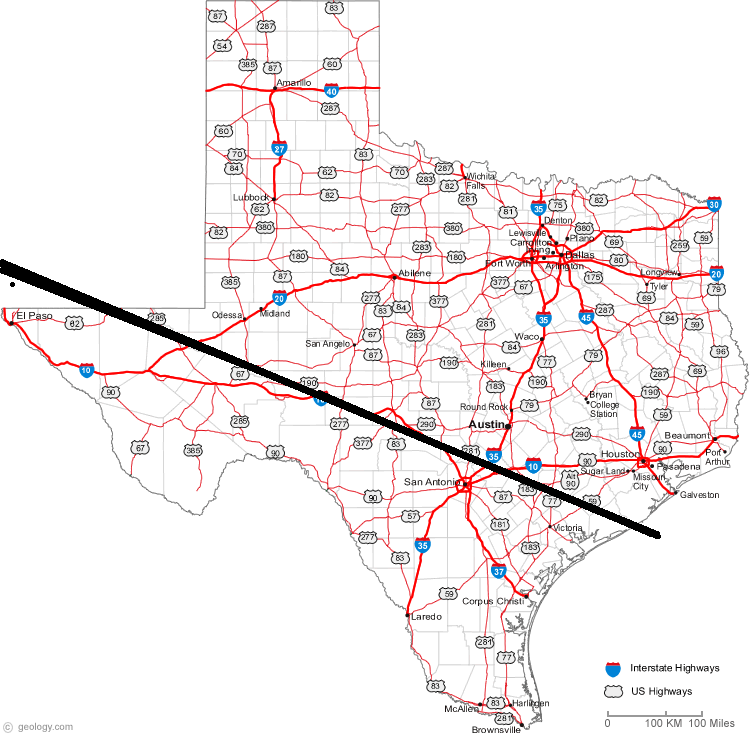
I can’t take credit for this, but someone at the Railroad Blues (World Famous Tourist Trap and local ice house) Friday seminar of the Society for the Betterment of Alpine Texas in Particular and Humanity in General, came up with a much better placement for THE GREAT WALL…It won’t interfere with the water flow from the Rio Grande, it gives plenty of work to Halliburton and Boeing, and it’ll keep the “browns” out of Farmers’ Branch and Crawford… better yet, it’ll keep the yahoos out of Corpus Christi and Alpine and Brownsville and San Antonio and other civilized places
Immigrants aren’t so taxing
The Valley Morning Star (Harlingen, Brownsville and McAllen, TX), isn’t by any means the biggest media source around, but when it comes to immigration issues, reporters like Melissa McIver, do a great job.
Undocumented immigrants aren’t taxing the health care system as much as people think, according to a report released Thursday from the liberal Center for American Progress.
The public believes many “myths” about the impact of illegal immigration on health care availability, says the report, which cites studies in medical journals, reports from the Center for Budget and Policy Priorities and U.S. Department of Labor statistics as sources.
These misconceptions include beliefs that immigrants are “overburdening” public health programs like Medicaid, that immigrants are crossing the border solely to access health care and that immigrants are “free riders” in the system, the report says.
…
Another “myth,” according to the report, is that immigrants are voracious health care consumers, clogging doctor’s offices and clinics. Actually, because immigrants are likely to be uninsured, they’re more likely to hold off on accessing health care until the problem is severe, the report says.
…
Health experts and local officials said that although undocumented immigrants pose “some burden” on Texas’ health-care system, the bigger burden is the growing uninsured population.
“The fundamental problem is that 25 percent (of Texans) are uninsured,” said Ernie Schmid, director of policy analysis for Texas Hospital Association. “Of that, only a small portion are immigrants.”
…
The solution is to make sure that all residents, including immigrants, have access to primary care, said one local health official.
Smile!
09 September 2008: Wow — over a hundred hits per hour on this post… was there some mention of Axolotls on U.S. television? By the way, this website puts out information on Mexican culture, politics, ecology, history 365 days a year, and so far has been ad free… but that can only happen if it receives regular donations. Even in Mexico we have to pay the electric bills…


Photo: National Geographic Society (not the English gits who threatened to sue me*)
Meet Ambystoma mexicanum, aka the Axolotl. Their only natural habitat is Lake Texcoco, which means they are nearly extinct in the wild. They still live in the canals around Xochimilco, and are still occasionally eaten, but are better known for their importance to scientific research these days.
Scientists like them because they have a huge embryo which is easy to work with, and they can regrow their limbs. They annoy the “intelligent design” folks. They are amphibians, but only rarely develop lungs, and tend to remain aquatic… the link between the two.
The condition is called neonaty… they just never grow up. They’re kids all their lives, but can have sex. No wonder he looks happy.
* Yup… though I liked the original photo better, but some “picture researcher” (probably means “intern”) has been sending silly e-mails about “receiving stolen goods,” (meaning the photo was on a lot of other sites too, but mine popped up first under “axolotl” under google image search) and U.K. copyright law. Good luck in your future career, Giles. The National Geographic Society has better things to do, I’m sure.
From TV Azteca to Aztec TV?
The U.S. television companies, especially those like Telemundo and Univision, have been complaining for years that Mexican TV is too limited. It is, but then, how many telenovelas and game shows do you need. Breaking up Televisa into two networks a few years back was considered a “great leap forward” at the time. It doubled the number of stories about poor but honest country girls overcoming the obstacles to win the hearts of the tall, dark and handsome rich guy.
Oh, but the argument is that Mexican TV news is controlled. Which is true. But, then, how much alternative TV news do we get in the U.S. or Canada or anywhere else.
Not that Televisa doesn’t sometimes do a good job. During the Iraq/ Afghanistan War, they did an excellent job, mostly because they were from a neutral country, and because they had to get creative in some coverage… using Cuban, Colombian and other outside media, or finding correspondents you normally wouldn’t have on our networks (I remember at one point they had a Russian who taught Spanish in Uzbekistan — an strategic player in the Iraq/Afganistan occupation, but one not even the U.S. networks ever talked about at the time).
And, in a shining moment, during the attempted 2002 coup in Venezuela, which the Venezuelan private channel supported, and refused to cover, Televisa’s Caracas bureau simply stuck cameras out the window and fed the signal live
But, for the most part, Televisa and the “competing” TV Azteca” and Galavision are the same network… and the news is obviously shaped. A lot of reporting on whatever the President (the one in Los Pinos) is doing, a studied non-reporting on the other President (and anything else that contradicts the official line. While mistakes in the “drug war” are reported, it’s mostly Felipe Calderón standing around in a uniform looking like he’s doing something worthwhile).
I used to watch Canal Onze (the Polytechnical Institute’s Mexico City channel… which was sort of the PBS style McNeil-Leher report, especially after veteran news anchor Adriana Perez-Canaño was reporting on looting in Bagdad after the U.S./British/Spanish occupation, and was reading a script quoting Donald Rumsfelt who said there was no looting, threw the script in the air, and said “I’m not going to report this bullshit!”) or Canal 40 (which was so broke, they could get away with telling the truth… all their newsmen seemed to have second jobs).
CNN-Español is available on cable, but even pro-U.S. Mexicans question their integrity and independence. They’re anti-Venezuela biases and the way they reported the Mexican presidential elections made it clear they were not to be trusted.
MSNBC has been trying to get in, but so far, there is no El Fox (other than Los Simpsons, the most popular gringos in the country).
I don’t think the U.S. networks counted on this. Andrea Becerril and Jesus Aranda wrote in yesterday’s Jornada about the possibility of a whole new bunch of players (my translation):
A plenary session of the Supreme Court of National Justice (SCJN, the Mexican Supreme Court), criticized the federal congress for not fulfilling their consitutional mandate to establish legal norms that would give indigenous communities access to their own radio and television stations.
Concluding an analysis of the unconsitutionality of the existing so-called ley Televisa, a majority of eight justices voted that the present law did not meet the objectives of Article 2 of tla Constitution, and outlined actions to be taken by the the Legislature and the President. One possible action could be a complete replacement of the Federal Telecommunications Commission (Cofetel), which Justice Mariano Azuela specifically called upon President Felipe Calderon to do.
Because of a legal technicality, the judges did not throw out the ley Televisa on constitutional grounds at this point, but did clearly signal the deputies and senators that the existing law violates the 2002 addition to the Constitution.
Justice Genaro David Góngora Pimente said, “We clearly find that the legislature has beenviolating the consitution for the last six years, inflicting new wounds to the rights of the the Indigenous communities, which the Constitutional change was supposed to correct.”
By way of remedy,Sergio Salvador Aguirre Anguiano proposed that Article 18 of the Federal Radio and Telecommunication Law (LFRT, in Spanish) be abolished, since it does not establish conditions under which an indigenous town or community can acquire, operate or administer communications media.
Aguirre Anguiano explained at yesterday’s court session that when the 2002 Constitutional changes relating to Indigenous peoples were implemented, the opportunity to correct the LFRT was rejected by the Legislature.
Discusssion yesterday centered on the narrow technical question of whether or not the Supreme Court could declare a law unconstitional for what was NOT included.
The majority considered the law unconstitional, but Chief Justice Guillermo I. Ortiz Mayagoitia warned that by ordering changes, the court was taking an action reserved to the Legislature.
OK, they’ll slant the news their way, but wow… woudln’t it be neat to see the Mayan Channel’s remake of “Apocolipto” (Mel Gibson is sarcrifed to Chac Mol). And what’s the Nahuatl word for telenovela?
xxx
Stalin wannabes…
I’m cleaning up my old bookmarks… and found a bunch of sites I’d marked but just never got the time to explore. If there’s a common theme, maybe it’s just Mexico v. Control Freaks… some wins, some losses.
We’re from the government and we’re here to help
From Raw Story, May 25:
According to a front page article in Friday’s LA Times, “Mexico is expanding its ability to tap telephone calls and e-mail using money from the U.S. government, a move that underlines how the country’s conservative government is increasingly willing to cooperate with the United States on law enforcement.”
Gone in a minute(man)
A post from the Minutemen on Libertypost.org (sort of the less sane version of Free Republic.com):
Dear State Leaders, Chapter Leaders and fellow Minutemen, By now you have probably heard rumors or received an email about a massive purge of your National and State Leaders. These rumors are true. The numbers are staggering and to any one who is capable of reason, the devastating effect on your MCDC is inescapable. As you review the documents attached you will recognize many of the names of those leaders. Maybe one is your state leader, or the leader of a State in which you served on the border. Others you will recognize by their reputations as long time, completely dedicated Minutemen and Leaders.
Do cows need passports?
Fernando del Valle in the Valley Morning Star (Brownsville, Tx)
BROWNSVILLE — Like some farmers along the Rio Grande, Edward Mathers is counting on a series of gates to open the fence that will cut across his land.
But others warn that the federal government is likely to restrict access to keys or remote control devices that would open such gates.
“I’m not happy, but I can live with the inconvenience,” said Mathers, who farms about 1,000 acres along the river.
U.S. Border Patrol agents told him that 50-foot-long gates would open along a 10-foot-high fence to let him tend to land on each side of the fence, Mathers said.
But in San Pedro, farmer Fermin Leal said he was told farmers will have to contact Border Patrol agents to open the fence’s remote-controlled gates.
At the U.S. Department of Homeland Security in Washington, D.C., spokesman Russ Knocke declined to confirm plans to install gates along the fence that’s part of a project to cut the flow of illegal immigration.
Don’t drink the water… and don’t get baptized in it
From Journal Chretien (France):
More than five weeks after town bosses in Chiapas state, Mexico, signed an agreement to restore water lines cut off from Christians since January, the Protestants still rely on dirty, distant wells and puddles for washing and drinking.
The April 23 agreement calls for the autocratic rulers or caciques of Los Pozos, 29 kilometers (18 miles) from San Cristobal de las Casas, to withdraw a threat to expel 65 Christians and restore the electricity and water services of several Protestant families. Another of the pact’s central aims is to keep “traditionalist Catholics,” who practice a mixture of indigenous ritual and Roman Catholicism, from forcing the evangelicals to help pay for drunken religious festivals that they consider idolatrous.
Evangelical pastor and attorney Esdras Alonso Gonzalez told Compass that the Protestants were glad the traditionalist Catholic caciques have ceased forcing the Protestants of Alas de Aguila church to participate in the saints’ day festivals, but that water lines cut since January 30 had not been restored.
“Everyone in the municipality is respecting the agreement, except in the matter of water – it’s horrible,” Alonso said. “We don’t know when they’re going to restore the water ; the brethren have not been able to get good information.”
Chiapas state officials brokered the agreement between the evangelicals and the traditionalist Catholics of Los Pozos. Alonso said state officials are responsible for ensuring that local town bosses fulfill terms of the pact.