Ermo’s Television — Consumerism and Remittances
In the course of cinematic history, there have been many great quests: searches for the Holy Grail, the Ark of the Covenant, the true nature of Humankind, the essence of God, and, during this film from Chinese director Zhou Xiaowen, a 29-inch television. In Ermo… we follow the obsessive struggle of one woman (Alia) to earn the money to buy the biggest television in her village.
From a College of Wooster (Massachusetts) Chinese Course Description
Ermo is no different than a lot of poor and ambitious campesinas. As the IMDB.com plot summary says:
The independent Ermo supports her son and disabled husband, rising early to make noodles she sells as a street vendor. A snooty neighbor has a TV, so Ermo wants a huge one.
She takes a job in the city, has an affair, sells blood and eventually, she and her elderly impotent husband end up with a TV too big for their house.. and a living room full of neighbors trying to make sense of American football. A cautionary tale perhaps, but is there anything strange about the quest for consumer goods… or a better life? And, Ermo’s justification is that she wants the best for her son who spends way too much time at the neighbor’s watching cartoons.
Wait a minute. What does a Chinese movie have to do with the MexFiles?
Not much other than it’s a great movie I first saw on Mexican television and it has everything to do with remittances. Ermo has a lot of Mexican sisters, who come from Chiapas or Veracruz or Oaxaca to sell their goods in the streets. Perhaps they’re just planning to buy a television (or a computer — TVs having reached even the remotest parts of Mexico long ago), or perhaps she has other goals in mind.
Ermo was not poor in her own village, and the ladies who come to the city to sell a little of everything, aren’t necessarily either. And Mexico is a wealthier country than China. But people are people, and they want better lives… and better stuff.
As Oscar Lewis noticed with Mexico City’s working class in the 1950s and 60s, many country dwellers stay, seeing the benefits of urban life. There’s nothing new in that. When the obsessively curious Lewis began his studies just after World War II, he could sort the wealth of families in given vecinidades by who owned a wrist-watch and who had THE radio in the complex. By the end, he’d stopped counting watches and radios and started counting TVs. Today he’d be counting I-pods, but not cell phones.
I lived for a several months in a cuarto ambulado (rooming house) where the big excitement on my floor was the day one of my neighbors got his own giant TV… and, like Ermo’s, it was too big to fit comfortably in his cramped living space (though — unlike Ermo’s neighbors — we didn’t watch foreign sports. We watched futbol and luche libre).
Ermo herself worked for her TV, but would her desires have been much different if her brother, or husband was working abroad and sending her money? She might still want to buy a TV. The grumps at the International Monetary Fund try arguing that remittances are a “moral hazard” for the recipient, which seems to mean they’ll be tempted to buy a big TV, but who are international bankers to lecture others on morals?
There’s some indication that remittances are a mixed blessing for rural economies. The folks who have them can invest in goods (like Ermo’s 29-inch color TV), but it raises prices for folks who don’t receive remittances. Much of the early criticism of remittances in the U.S. media took the form of collective head-shaking over new pickup trucks and satellite dishes in rural areas. “Why didn’t those people spend their money on schools or better houses?”
They did, but people — poor or otherwise — don’t always make the best consumer choices, and, besides, it could be argued that new trucks meant better transportation, and a satellite dish meant better educational opportunities. Remittance money is invested in the local community, and — according to most studies — at least doubles in value (My brother sends home a thousand dollars, and I buy bricks to build an addition on the house and hire local laborers. The laborers and the brick makers buy groceries and their own TVs. The grocer…and appliance store…).
As I’ve noted before, and as “credible” sources like the Inter-American Development Bank’s Manuel Orozco (“Worker Remittances in an International Scope” 1993, PDF file)
The benefits of migration are significant for both sending and receiving countries. Remittances are one important benefit for immigrant-sending countries.
…
Although there is no direct relationship between remittances and human development, they have an important impact on the economies of receiving countries. Migration and remittances do not necessarily relate to the level of development in a country (not only the poor migrate, nor is migration only from poorer to wealthier countries). Countries receiving remittances come from low, medium and even high human development
cohorts. The connection of remittances to development is related rather to a) the receiving country’s regional economic position and its relationship to a more economically salient country and b) the macroeconomic impact remittances have on the receiving country.
In other words, even a “middle income country” like Mexico benefits from remittances. The U.S. enjoys two benefits — by leaving the country, the money is effectively “banked,” and the “interest” comes back indirectly through Mexican purchases that benefit the U.S. (something I don’t pretend to comprehend), but the U.S. gains lower cost labor at home, and consumers who, being elsewhere, are at no cost (or low cost) to the seller (in other words, grand-dad back in Zacatecas buys his satellite dish from WalMex. And it’s not U.S. taxpayers financing the road that grand-dad drives down to the store, nor your local power plant that is providing the electricity, nor your local hospital that picks up the tab for the uninsured WalMart worker who falls off a ladder getting the dish out of the stock room).
More importantly, remittances aren’t only spent on consumer goods, though sometimes in themselves, they improve people’s lives. A refrigerator means better food — and presumably better health. A computer is … one hopes… educational. Bricks provide jobs for brickmakers and masons. Indoor plumbing benefits a family’s overall health. And remittance funding provides for education, or the chance for higher education.
Better educated, healthier people will earn more and have fewer — and healthier, better educated — children. A win-win-win for remittances.
One of the stupider anti-immigration measures you hear from time to time is a tax on remittances. While there are some costs to immigration, remittances seem to be a benefit. It certainly is for Western Union, which recongizes that remittance investments in Mexico are in their own best interests:
ENGLEWOOD, Colo.–(BUSINESS WIRE)–The Western Union Company (NYSE:WU), a worldwide leader in money transfer services, is expanding its ties to Mexico, meeting with government officials who play a vital role in Mexico’s remittance industry and economic development.
Later this month, company officials will participate in high-level discussions in Mexico City on corporate initiatives and social responsibility. During these meetings, Western Union representatives also plan to announce the expansion of the 4+1 program, an economic and social development initiative in conjunction with Mexican Home Town Associations in the United States (HTAs) and the federal, state and municipal governments in Mexico.
…“Western Union has committed more than a million dollars to the 4+1 program, matching the contributions the HTAs and the three Mexican government levels have provided to support much-needed initiatives in key states in Mexico affected by high levels of poverty and migration. We will continue to set the industry standard, not only for products and services, but for social responsibility and good corporate citizenship.”
Earlier this year and during the initial stages of the program, Western Union helped fund eight projects in communities throughout the State of Zacatecas. These projects included an eco-tourism park, fruit and vegetable processing, nopal farming, agribusiness equipment, a pork farm and a computer assembly plant. In all, Western Union will contribute $1.25 million to these and other projects in five states. During an upcoming trip to Mexico, the company will announce the expansion of the program to the State of Mexico.
It’s a secondary, unexpected benefit. Immigrants are creating their own foreign aid programs. And if some campesino’s kid watches too much TV, so be it.
More than you’d ever want to read about remittances as microfinancing
Speaking of remittances — and added value –we depend on them for essentials like the phone, rent, electricity — to provide you the direct and indirect benefits of reading the Mex Files.

OUR terrorist (who isn’t just accused of blowing up airliners… he brags about it, not to mention having killed an Italian tourist and other nasty deeds) walks free. Posada Carriles DID enter the U.S. from Mexico illegally (though with the judge throwing out the case, I guess I don’t understand that part of “illegal”), so, in a sense, YES, a terrorist has indeed crossed into Texas from Mexico.
ATTN: Dog the Bounty Hunter fans and defenders. Given that mass murder ranks up there somewhere with serial rape, and the “logic” of the Dog pack is that “justice” required breaking the law, and that bounty hunting IS legal in the U.S., is there any reason Cuban, Venezuelan or Panamanian bounty hunters (Posada Carriles faces serious charges in all three countries, and can be tried in Italy for murder as well) shouldn’t grab the guy, toss him on a plane and take him back?
HOUSTON, May 8 (Reuters) – A U.S. judge threw out all charges against anti-Castro Cuban exile and former CIA operative Luis Posada Carriles on Tuesday, allowing him to go free days before he was set to be tried for immigration fraud.
The surprise decision by U.S. District Judge Kathleen Cardone in El Paso, Texas, left uncertain the fate of Posada, who has a long history of violent opposition to Cuban leader Fidel Castro, and is viewed by many Castro opponents as a hero.
He is wanted in Cuba and Venezuela, where is accused of masterminding the 1976 bombing of a Cuban airliner that killed 73 people.
Cardone dismissed the immigration charges on grounds that the U.S. government case was based on statements it got from Posada Carriles, 79, under false pretenses.
He thought he was in an immigration interview that was actually a criminal interrogation, his lawyers said, and the judge agreed.
“The government’s tactics in this case are so grossly shocking and so outrageous as to violate the universal sense of justice,” Cardone wrote.
“This court will not set aside such rights nor overlook government misconduct because defendant is a political hot potato,” she said in the 38-page ruling.
Her decision provoked an angry response from Cuba, which says the Bush administration has coddled Posada Carriles because of his CIA past and his support in the U.S. Cuban exile community.
“If the well-known terrorist Posada Carriles is free without charges it is the full responsibility of the White House,” Dagoberto Rodriguez, Cuba’s top diplomat in Washington, said in a statement.
The Bush administration, he said, “has done all it can to protect the bin Laden of this hemisphere, for fear that he can talk about the connection between the U.S. government and his terrorist activities.”
Dead man driving… across the border
It’s us border dwellers that have to put up with the fall-out from the narcotic trade. It sounds like either Colorado “ahem”… agricultural produce exporters… ran into some difficulties with the suppliers, or the suppliers are trying out a novel way of sending goods across the border. Either way… yuck!
A shot-up car with a dead man in the driver seat raced to through the Columbus, N.M., port of entry this morning, the second such violent episode in the area in less than a month, Customs and Border Protection officials said.
The incident started in Downtown Palomas, Columbus’ sister city in Mexico, when a gunman opened fire on a red Suburban that was pulling up to a restaurant, Luna County Sheriff Raymond Cobos said.
CBP officers heard automatic gun fire at about 9:30 a.m. and a few minutes later saw the SUV with Colorado plates, riddled with bullets, careening toward the port of entry, seeking protection.
The driver, José Carreon, 43, was dead, his facial structure destroyed by the bullets. The front seat passenger, Nestor Acosta Saenz, 41, had been reaching over the body to drive and steer, officials said.
A third passenger, Jose Guerrero Peña, 46, was dead, and a fourth, José Joaquin Saenz, 50, was hit in the leg and transported to Thomason Hospital in El Paso, Cobos said.
…
Based on the investigation of the wreck and an interview of the uninjured survivor, Sheriff Cobos pieced together what happened in Palomas this morning.
“It appeared that the gunman was shooting at the windshield and along the driver side with an assault rifle. When the shooting started, the front passenger crawled over to the back, trying to get away from the bullets,” Cobos said.
That man was fatally wounded. A back seat passenger crawled to the front and drove the vehicle to the port of entry over the corpse of the driver.
“Nobody seems to want to tell us anything about the gunman,” Cobos said.
Uh…he’s dead, Jim.
In and out, and in again … Carlos Ahumada
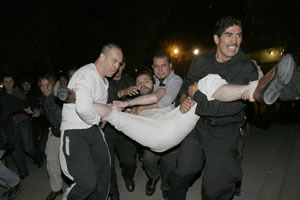
(El Universal photo: Valente Rojas)
He’s scum and probably deserves whatever happens to him, but I can’t help thinking that maybe Carlos Ahumada is a patsy for… Carlos Salinas? Vicente Fox? The “establishment”? El Junque (a shadowy pro-clerical far rich right-wing clique)? The FBI or Las Vegas Casino owners? (“Video-gate”, which was the starting point for the Ahumada follies, probably involved the FBI misusing the U.S. PATRIOT Act. How’s that for international intrigue?).
He’s at the center of one too many plots and intrigues to be the power behind the scenes. The guy was way over-extended … besides his construction business, he owned a futbol team, properties in places he shouldn’t have (like National Parks) and had just launched, to great fanfare, a new (and very good) national newspaper.
Not quite all Mexicans dislike rich arrogant assholes (which Ahumada was), but a rich, arrogant, ARGENTINE asshole is unredeemable. Who better for a fall guy?
AP under-reports:
MEXICO CITY, Mexico (AP) — A construction mogul at the center of a bribery scandal that tainted the image of Mexico City’s leftist government was detained immediately upon his release from three years in prison early Tuesday.
Television footage showed Carlos Ahumada leaving a Mexico City prison with his arms around his wife and children, only to be seized by city agents a few feet from the prison’s entrance, thrown into a waiting car and driven away as he and his family screamed in protest.
Ahumada’s lawyer Enrique Ostos said he didn’t know why his client had been detained after being acquitted of charges that had kept him in prison for about three years. Ostos protested the arrest and said Ahumada had signs of being beaten.
“I can’t say whether he is a political prisoner,” he told Televisa network.
City officials were not immediately available for comment.
The Argentine-born Ahumada filmed himself giving suitcases stuffed with dollars to several political allies of then-Mayor Andres Manuel Lopez Obrador, whose leftist Democratic Revolutionary Party still controls the Mexican capital.
He alleged the officials were extorting money from him in exchange for city contracts. The videos, shown on national television, brought political disgrace to several of the most prominent activists in Mexico’s main leftist party.
One of them, borough president Carlos Imaz, was later convicted of a campaign finance violation over Ahumada’s funds.
Ahumada’s long-standing personal relationship with former Mayor Rosario Robles — a rival of Lopez Obrador within Democratic Revolution — led to her ouster from the party.
Ahumada is at the center of so many scandals, intrigues and frauds I don’t haven any clue what exactly the changes might be this go around. When the bribery scheme fell apart, he fled to Havana (and stayed in ex-President Carlos Salinas’ villa there), which made Lopez Obradór’s claims that the whole scandal was a set-up all that more believable.
Especially when Ahumada confessed it was true.
He’s claimed “human rights abuses” before — semi-comically when it was about to come out that he’d ratted out Vicente Fox and other anti-Lopez Obradór plotters and he staged an “assassination attempt” against his own wife. Why she puts up with a guy who admitted to boning the fomer DF Jefa, Rosario Robles, for fun and profit (well… profit anyway), is a mystery to me.
What a peach of a guy.
Too polite a language?
(Sombrero tip to Unapologetic Mexican)
Egregious social breeches aside, our worst habit is forgetting to say, “Please” and “Thank you”. The Spaniards – considered the politest people in Europe – were struck by the extreme politeness of the indigenous Mexicans as they raped and pillaged their way to power here. Politeness still matters, even in this big, big, big city. Use ¡Por favor! and ¡Gracias! Even if you completely mangle your Spanish, those phrases are essential if you want service in a store or restaurant.One thing that always gets the English-speaker is the extreme politeness of the Spanish language.
(My 2004 guidebook to living in Mexico City)
Sometimes it’s too DAMN polite. In the national on-line El Diario/La Prensa Gerson Borrero quotes Rafael Olmeda of the National Hispanic Journalists association on LOU DOBBS becoming a life-time member (yup… you read that right!):
“No podemos pretender que la inmigración ilegal no es parte de esa historia. Lou Dobbs, en mi opinión, cuenta esa historia en una manera incompleta, no constructiva. Pero él tiene el derecho a no estar de acuerdo conmigo”, reafirmó por escrito Olmeda luego de una conversación de 36 minutos en la tarde del viernes.
Which, of course, translates as:

“We cannot pretend that illegal immigration is not part of the story. Lou Dobbs, in my opinion, tells this story in an incomplete, not constructive, way. But he has the right to disagree with me,” reaffirmed Olmeda in writing after a 36-minute conversation on Friday afternoon.
Those of you outside the U.S. are probably not familiar with Dobbs. He was a financial reporter for years on public television, who now has a one-hour “news” program on CNN. Dobbs includes a regular feature called “Broken Borders” — dealing with what he continues to call “illegal immigrants,” but his methods, and presentation, are far from news standards.
I pointed out once before that he’s used neo-nazi propaganda without batting an eyelash. Leslie Stahl, a real reporter, took Dobbs apart on CBS’ real news show, “60 Minutes”:
Dobbs’s reports are more than just “incomplete” and “not constructive.” They often contain inaccurate, biased, and misleading information.
Last night, CBS’s 60 Minutes caught Dobbs in one of these lies. Following “a report on illegals carrying diseases into the U.S.,” his show reported that there were 7,000 cases of leprosy in the United States in the last three years. CBS found out that there were actually 7,000 cases in the past 30 years, and “nobody knows how many of those cases involve illegal immigrants.” When host Lesley Stahl confronted him on this error, Dobbs simply replied, “If we reported it, it’s a fact.” Watch it:
Hey, it’s nice that Lou has a thousand bucks to blow on his “lifetime membership”, but some of us gabachos who really do cover Latin America and Mexican-American issues could use a little support too —
Cultural diversity…
Burrohall, a couple of damn yankees who post mostly from (and about) Queretero were rather amused to see that the Professional Bull Riding Tour was headed down their way. I’d started out to write a “serious” little piece on a couple of Texas matadors, but what the hey…
Tauromachia, like rodeo, is an acquired taste, but down my way, where we’ve been doing the Tex-Mex Mix forever (at least practicing cultural diversity since Alvar Nuñuz Cabeza de Vaca stopped by for a spell in 1532), this looks like a perfectly normal sporting event to me

NO BULL… Mex Files only survives on cash donations…
Beauty queens and bureaucrats
 Bicycles are already a regular part of Mexico City traffic, though it’s still rare to see people commuting to work that way. There was a lot of press about Marcelo Ebrarad’s executive order requring District employees to ride their bikes to work one day a month. I’m sure it sounded like just a PR campaign, but I guess they’re serious.
Think of it as a step towards telecommuting: Monica Archundia reported in El Grafíco that eight percent of District employees (16,000 people!) have already been reassigned to new new job sites to facilitate bike commutes, and that the unions have identified the 65% of city employees willing to be reassigned as part of the program.
HSBC (Mexico’s largest bank) and 15 other businesses are also reassigning employees. The District is investing in everything from bike lanes to racks on buses, and hopes to cut gasoline consumption by 15,000,000 liters per DAY.
Sure, but will it sell in Polanco? Biking bureacrats and executive orders are one thing. This is another:
Mexico City – Miss Universe – Zuleyka Rivera of Puerto Rico – rode a bicycle through the streets of Mexico City on Monday, as part of a campaign by municipal authorities to discourage the use of cars.
Rivera, set to hand over the crown to her successor who is to be chosen May 28 at a ceremony in Mexico City, was accompanied on her tour by municipal Tourism Secretary Alejandra Barrales.
Wonks or Miss Universe? Who would look better on a bicycle?

My brother-in-law is going north
The long-term consequences of the corrupt Ruiz administration in Oaxaca will be felt for years. Who benefits when a civil engineer has to become a house painter?
Original on Lonely Planet Thorn Tree Mexico Message Board
Another fence post
I migrated over to Firefox this weekend (which took care of some of my previous posting … uh… challenges), and am cleaning out the things I dumped into “Explorer” Favorites, meaning to bring to your attention, but never got back to.
Mariano Castillo of the San Antonio Express-News wrote about reaction to the proposals to build a “REAL” fence (we were promised it would be a high tech virtual one, if it was even built) down our way.
“Life is good on the border, and we don’t want anybody off the border jacking with our way of life,” Eagle Pass Mayor Chad Foster said. “All this spin (in favor of a fence) comes from those who have no concept of what the reality of the border is.”
In Hidalgo, a small city across the Rio Grande from Reynosa, Mexico, the border is a lush area of gardens filled with singing birds. It is the site of the Historic Old Pumphouse Museum and World Birding Center, one of the city’s proudest landmarks and a tourist draw.
Miles of snaking hike and bike trails are a stone’s throw from the international boundary, where dozens of second-graders on a field trip recently piled excitedly onto a trolley for a tour that would take them right to the riverbanks.
“This is not the image that people have of the border,” said John David Franz, the mayor. “They see it as some zone that is out of control, with traffickers and immigrants running rampant. That’s not the reality.”
President Bush last October signed the Secure Fence Act, approving the construction of 700 miles of double-layer fencing along the border.
Texas Sens. Kay Bailey Hutchison and John Cornyn both voted for the bill.
Any wonder that folks in the Valley, and the Big Bend DIDN’T vote for Hutchison or Cornyn? It’s crossed my mind that the reason Homeland Security didn’t tell anyone what they were up to, and just decided to foist it on us, is that these are solidly Democratic areas of Texas. Chicken or egg? Are the Valley and the Big Bend “D’s” because the idiots are “Rs”… or are the “Rs” idiots because they listen to Homeland Security wonks?
Leave no child behind, Mexican style
When I first returned to the U.S. I was staying on a friend’s couch outside Fort Worth, and had to do SOMETHING to bring in at least a little cash. I found a temp job within a reasonable walking distance (about 40 minutes) grading the new “No Child Left Behind” state-mandated tests. I had to take a test to get the job, and for some reason was assigned to grade seventh grade math tests from New Mexico.
I’m not sure the tests “proved” anything about New Mexico seventh grade math ability, other than a lot of kids don’t understand the Pythagorean Theorem. Or, maybe they do, but if the answer was in Spanish or Navajo and was given to the English-language graders, I couldn’t even give partial credit. And I did my best to leave no child behind.
I really think the whole point of standardized testing is to sell standardized tests. And test preparation material. And to let contracts to testing services to grade the tests (using underpaid temp labor). It doesn’t seem to have much to do with education. Or with teaching the Pythagorean Theorem.
I’m listening to a Mexico City all-hits radio station over the internet as I type this. There are plenty of ads, paid for by SNTE (the teachers’ union) for a national conference on Enlace, the Mexican version of the “No Child Left Behind” test program. Like our testing program, the critics (myself included, who — like others scoring tests — said our job was to “leave some children behind”) notice that teachers are forced to teach to the test, and to eliminate real educational experiences. And that the tests have nothing to do with learning.
I translated this from an article by Karina Aviles, in this morning’s Jornada.
Olac Fuentes Molinar, the former Undersecretary of Public Education, said yesterday that a careful analysis of the “National Evaluation of Academic Achievement 2007 (“Enlace,” for its Spanish acronym, “ Evaluación Nacional del Logro Académico en Centros Escolares 2007”) — a 125-question test given to sixth grade elementary students, and 138 questions for third year secondary student [equivalent to 9th graders in the U.S.] “have only a half-dozen questions that require students to think.” Fuentes Molinar said the Secretariat of Public Education should act responsibly by canceling the tests, which “have no validity.”
He explained that the tests reward memorization and following simple instructions, finding “irrelevant and banal” literal information, resolving unrealistic problems, and often conducted in the middle of bake sales.
Interviewed by La Jornada, the educational expert warned that “Enlace” represents a “risk of returning to an arid, regressive education,” and an “obstacle to reform and diversity” within the educational system.
For example, though mastering reading comprehension is a high priority goal for advanced educational systems, the long and “fatuous” test is reduced to a series of fragmentary and elementary tasks such as identifying paragraphs or finding the place where an action occurred in the text.
Math without reasoning
The texts included with the tests are “pretexts for learning exercises which do nothing to achieve an ability to comprehend the sense, to make inferences, anticipate action, compare and contrast, interpret or form an opinion.”
Along with Spanish, “Enlace” was intended to measure mathematics skills. “What’s missing is mathematical reasoning,” Fuentes Molinar said. “There are a lot of operations a nd applications of formulas, but no thematic hierarchy that indicates that the students can think mathematically.”
As an example, the educator pointed to a question on the sixth grade test which requires students to perform the unlikely test of calculating the volume of a hexagonal cylinder.
The former Sub-secretary for Basic Education noted that results of the test were “even more harmful and highly corrosive” in that they signal to schools, teachers, students and their families that what the authorities expect from them is learning to identify a paragraph or learn a series of formulas – and that this type of information will be tested.
As with other educational specialists and classroom teachers, Fuentes Molinas believes “Enlace” does not give priority to learning, but to test-taking ability, used as a single national standard. The content and form of the tests will determine what is considered “adequate” education and could be converted into an “obligatory under curriculum” in place of the required course of learning.
And, he adds, “I believe uniformity drives educational aspirations downwards.”
For them, the question now is whether to teach to the exam, and take time away from other activities: putting on a play or performing a science experiment. And how do teachers work with students who fall behind, or who have a different learning style?
Seen in this light, Mexico is swimming against the current of the most advanced educational systems, where the key word is “comprehension.” For Fuentes and other teachers, they see the best pedagogical alternative would be to consider “Enlace” irrelevant.
Only six questions imply critical thinking skills
In summation, the educational specialist said that educational authorities don’t need this type of test to know what help the schools need. They need 80 billion pesos to upgrade facilities, as well as better early education teacher and more attention paid to “at risk” students.
Having analyzed 263 questions, of which only six “could” require critical thinking skills, Fuentes insists that the best thing to do would be to get rid of the test which only retards real education.
Leave no Mex Files behind…
Exporting democracy… or Democrats?
From friends at the Fence Coalition (fencecoalitio@yahoogroups.com):
Below is a piece from an article in the Rio Grande Guardian about the wall that shows some of the real world impacts for cities along the border:
If DHS builds a border wall in Roma, as local landowners have been told, it would more than likely mean Rep. Ryan Guillen’s district office would end up on the Mexico side.
It is not something Guillen, D-Rio Grande City , is looking forward to. “I would hate to be fenced in like that,” he quipped. “Would Border Patrol give me a key?”
Guillen’s Roma office is located at 301 West Lincoln Avenue. An historic building which used to serve as a jail, the tiny office is situated on top of a bluff overlooking the Rio Grande.
Given that the Department of Homeland Security likes to build a road alongside its border fences, it appears unlikely there would be sufficient space to develop between the river and Guillen’s office.
“There’s not much room for a fence down on the riverbank because the riverbank is never the same. It all depends on how low the water is,” said Roma Alderman Noel Benavides.
“I cannot see how they could build a fence without blocking Representative Guillen’s office in. His office is high up on the bluff. He would be fenced in.”
In Texas, there’s always a way to deal with them danged liberals.
Atenco leaders sentenced for kidnapping
Bill Weinberg posted yesterday on the WW4 Report:
Three campesino leaders from San Salvador Atenco were each sentenced to 67 years and six months in prison on charges of kidnapping May 5. The sentences come almost exactly a year after a violent clash between Atenco residents and Mexican state and federal police troops. Ignacio del Valle, Felipe Alvarez and Héctor Galindo, leaders of the People’s Front in Defense of the Land (FPDT), have five days to appeal the verdict. The charges are related to incidents in February and April 2006, when FPDT members allegedly held State of Mexico officials captive. Although the leaders were arrested in the aftermath of the May 2006 violence, the judge said his decision was based solely upon “the kidnapping and illegal detention of the state officials.” (El Universal, May 6)
Campesinos from San Salvador Atenco organized the FPDT in 2002 to oppose the confiscation of village lands for construction of a new airport for Mexico City. The project was cancelled following a campaign of protests which sometimes included the detainment of officials the FPDT said were illegally on village lands.
(full article at WW4report.com)
Atenco was the proposed site for a new Mexico City airport. The locals were never consulted, and a buyout plan for the Ejito San Salvador Atenco led to very noisy and visable protests in the Capital and the creation of a “municipio libre” (basically, the township declared independence from the state… think of a tenants’ strike on a large scale… and you won’t find the municipio in your Guia Roji. It’s not part of the State of Mexico, so… on the Guia Roji map of Mexico City and the surrounding parts of the states, Plato 61, is blank.).
It’s perfectly legal to set up a municipio libre, and there is a whole body of Mexican and Spanish legal history behind them Cortés, as soon as he landed in Veracruz, organized a city council before they built any shelters. Cortés invaded Mexico with a couple of lawyers in tow… and had been to law school himself. As a free commune, the conquistadors could claim they were independent of the Cuban governor, and — conveniently — “elect” Cortés as head of the local militia. Venustiano Carranza, for all his faults, was not a bad scholar. He was a student of the Mexican constitution of 1857, and based the legitimacy of the Constitutionalist uprising against Huerta’s 1912 coup on the rights of municipio libres — the Constitutionalists claimed loyalty to the Mexican state, not the particular administration, which they claimed (rightly) was illegal.
So, San Salvador Atenco — in something of a “Mexican standoff” with the State of Mexico — went its own way until last May. It’s still confusing, but a “perfect storm” of election organizers, Zapatistas and attempts by local authorities to “punish” the non-conforming commune by dislodging flower sellers from Texcoco markets led to the uprising that finally led the feds, and the State, to crack down. The Supreme Court agreed to look into human rights and political abuses from stemming from the police over-reaction, but these particular kidnapping charges stem from incidents leading up to the May, 2006 “Flower War”.


