18,000 nekked Mexicans…
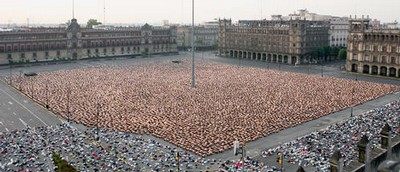
Photo: Jornada/José Carlo Gonzáles
… and well-mannered naked people they were (my translation):
México, DF. The Federal District Public Security Director (SSPDF, for its initials in Spanish) reported “satisfactory results” with the measures taken on the Capital’s Zócalo to accommodate Spencer Tunick’s mass nude photo shoot.
Joel Ortega, head of SSPDF, said that there were no traffic or civil infractions to the Civil Code connected with the event.
Ortega said that the department had arranged to make the Plaza de la Constitución available for the photograpsh, as well as planning for people leaving afterwards.
He said there were a few small incidents, mostly caused by a much larger number of particiants than was expected by either the organizers or the authorities.
Because of the huge turnout, people were forced to park on Paseo de la Reforma and Balderas, as well as the main streets in the Centro, but no tickets resulted.
It might be worth nothing this is a record. And, I know it’s a stereotype, but Mexicans tend to see art as part of life, so why wouldn’t they want to help out an artist, and bare more than their souls? The largest mass nude photo before this (also done by Stanley Tunick) was in the self-consciously hip and artsy Barcelona which only included about 7000 folks.
Part of Tunick’s agreement with the city was to avoid including the Cathedral (and thus implying the Church’s approval) in any of his shots. Which doesn’t mean Mexicans — and bloggers about Mexico — don’t ascribe to the cardinal acts of mercy — you know… visit the sick and shut-in, clothe the naked, feed the hungry and give to the Mex Files…

Do you solemnly swear?
For better or worse. “LO”, aka Laura (a different Laura than “Laura Fern”, whose husband can’t get a visa to join her in the U.S.) is moving to Mexico City to be with her boyfriend, who was deported from the U.S.
She has started writing about the experience in the LO Times, focusing less on the bureaucratic bullshit that propels such a move, as on what’s really important when you have to change your residence, your country, your language:
Up to this point I’ve avoided most of the administrative, picky details that need to be taken care of in favor of learning more about my new home-to-be. In the spirit of getting myself mentally in the “Mexico City Zone,” I recently rented the movie El Callejón de los Milagros, starring a young Salma Hayek. I randomly picked this movie out at the video rental place because it takes place in Mexico City, and because it’s so amusing to say “callejón.” No really, though, I wanted something that would allow me to practice my Spanish comprehension and to see more of Mexico City at the same time, and this movie delivered.

I watched the movie without subtitles. Luckily, the dialect was chilango (or at least that’s what I picked up with my limited understanding of Spanish), which made the movie much easier for me to understand, as most of the Spanish I’ve heard in my life has been spoken by chilangos.
I understood all of the swear words, and I even picked up a few new phrases to add to my repertoire.
There was some kind of swear word theme going on, because then I read, “The Sons of La Malinche,” an excerpt from an essay, “The Labyrinth of Solitude,” by Octavio Paz. Anyways, I picked up some delightful curse phrases from that essay as well, which I promptly tried out on my fiancé. Apparently a gringa cursing in English is off-putting, while a gringa cursing in Spanish is hands-down charming.
My favorite? “Vete a la chingada.” I might need that in the next 14 days when I finally start tackling those picky but oh-so-important details.
Indespensible for would-be Mexican potty-mouths is Armando Jimenez’ Pícardia Mexicana. Of course, Jimenez being a good scholar, includes historical swear words (if you ever need a rude 18th century term) and those wonderfully allusive language of the Mexican street.
Solemnly swear? FUCK NO! Do it joyfully!
¡No mames, güey! Necesita la lana para los pinche coyotes… y la renta, el telephono, la luz…
“NEIGH” to Mexican workers
A doff of the sombrero to Bender’s Immigration Daily, who found this latest example of our debt to Mexico in this week’s Seattle Weekly.
Visa Snafu Brings Immigration Debate to the Racetrack
By Mike Seely
At 5 p.m. two Fridays ago, while many Seattleites hoisted water bongs in celebration of the unofficial 4/20 holiday, a thirsty pack of rich old people gathered in the Triple Crown Suites on the sixth floor of the Emerald Downs grandstand in Auburn. One woman, wearing tinted gold bifocals with her hair dyed a peculiar shade of orange, guzzled bourbon and vocally celebrated the fact that the horse she owned was about to go off at 14-1 odds. Near the hosted bar, a molten chocolate-fondue fountain cascaded next to a faux palm tree, with bite-size pieces of fruit beckoning patrons to take a dip.
During the same hour, 30 Mexican nationals toted their belongings into spartan dormitories on the track’s backstretch, where trainers Howard Belvoir and Kay Cooper were readying their runners for opening night. The Mexicans, arriving two-and-a-half months later than usual to serve as hands-on caretakers for the horses (grooms, in racing parlance, who wash, feed, and walk horses, among other duties), “were sucked up like a dry sponge” by employers like herself, Cooper says.
The Mexican grooms were late because of an unprecedented holdup in the processing of their temporary work visas by the U.S. Department of Labor, a cataclysmic confluence of increased migrant demand, budget shortfalls, and bureaucratic speed bumps. The delay left trainers like Belvoir and Cooper breaking their backs and scrambling for help in the run-up to opening night—to the point where they couldn’t prep their normal volume of Thoroughbreds.
“[The Mexican grooms] were supposed to be here Feb. 1,” says the 62-year-old Belvoir, one of the track’s top trainers. “I was working 6 [a.m.] to 6 [p.m.] menial labor, which is tough for an old man. You would have had a much stronger field of horses had [the grooms] been here on Feb. 1.”
“A lot of horses didn’t get trained because there weren’t enough personnel to do it,” seconds Cooper, who reports that last weekend’s field was considerably thinner than in years past.
Who are these guys anyway?

Maria Hinojosa rips Chris Simcox a new one. Forget de la Hoya v. Mayweather. This is Hinojosa by a knockout. The 20 minute interview from PBS is brutal.
From about 4 minutes into the 21 minute interview onward, Hinojasa continues to batter Simcox with simple things like … statistical analysis, reports from the Texas State Comptroller, business documents and so on. Simcox seems to enjoy smashing himself in the face, too. Asked by Hinojosa if he’s ever met a Mexican immigrant who said he was coming to “reconquor” the United States, Simcox came up with something about college students… and some nonsense about criminals coming to prey on our society (maybe, because they’re criminals? And this is where the money is?).
Simcox really starts floundering when Hinojosa notes that the Texas Comptroller found that “illegal aliens” contribute more to the state than they take in benefits. Simcox has to somehow find it “bad” that the children of “illegals” even use less state resources. Somehow, it’s all part of the “globalist oligarchal” conspiracy run by the Council on Foreign Relations.
Simcox is, quite simply, nuts. In some small way, I owe a debt to his fellow pyschotic, “lonewacko” for leading me to the Hinojosa-Simcox smackdown.
Looking up more information on Simcox, I ran across this report from SPLC (which lonewacko claims is an agent of the Mexican government – more on that in a minute, man): Minuteman Leader has Troubled Past (). The authors, Susy Buchanan and David Holthouse used such dirty tricks as talking to people who know Simcox, looking at his court records and speaking with employers to paint a very troubling picture of a very troubled man.
In multiple interviews and public appearances, Simcox has dismissed the possibility that he’s personally racist by pointing out that he once married a black woman and by claiming that he once chaired the diversity committee at Wildwood School.
(Head of School Hope Boyd, who has been at Wildwood since 1992, told the Report she had no recollection of Simcox holding such a post. “I do not remember that he was chair of our diversity committee,” she said.)
“When I’m asked by reporters if I’m a racist, I tell them, ‘Why don’t you go ask my black ex-wife and my biracial children and the members of the racial diversity committee I chaired whether I’m a racist?'” he said at the October conference.
“When they ask me, ‘Well, what do you have to say to people who call you a racist?’ I come back at them with, ‘What do you have to say to people who call you a child molester?'”
That’s a strange rhetorical device given the accusations leveled at Simcox in the summer of 1998, when his 14-year-old daughter from his first marriage — prior to his union with Dunbar — came to live with him in Los Angeles.
In separate interviews with the Intelligence Report, two of Simcox’s former colleagues at Wildwood and his first ex-wife gave the same account. They said that Simcox helped his daughter get a job babysitting for a Wildwood School employee and that one night, Simcox’s daughter showed up unexpectedly at her employer’s house, visibly upset, alleging that her father had just attempted to sexually molest her.
“He tried to molest our daughter when he was intoxicated,” said Deborah Crews, Simcox’s first ex-wife and the girl’s mother. “When she ran out, he tried to say he was just giving her a leg massage and she got the wrong idea.”
Contacted by the Report, Simcox refused to answer four direct questions about the molestation allegations. “I would never answer those questions to you. You can’t ask those questions,” he said. “You’re on a witch hunt and you’re trying to discredit our movement, which is to secure the borders. … My personal life has nothing to do with anything that goes on here.”
No charges were filed against Simcox, but Crews said she and her daughter immediately broke off all contact with him.
“He’s a drastic, chaotic, very dangerous guy,” said Crews. “I’m surprised he hasn’t shot anybody yet. I see him on TV and I have to turn if off, because it makes me sick to see him getting all this attention.”

Lonewacko, who I have no information on, is a Southern Californian, who produces a well-read website on immigration and right-wing causes. He continually refers to various immigation rights workers and organizatins as “indirectly linked to the Mexican Government”, sometimes the indirection being very, very indirect. SPLC apparently received some donations from an attorney who was once hired by the Mexican consul to represent some Mexican nationals in a U.S. lawsuit… which means, I guess, that the first Mrs. Simcox is part of that international conspiracy foisted on us by the Council on Foreign Relations… or something like that.
Another Englishman out in the mid-day sun
 The English always were a “nation of shopkeepers”. Eddie — who is not shown at left –may be a grumpy conservative Englishman (is there any other kind?), but…
In an effort to escape to sunnier climes and freer lands, Eddie packs wife and household chattels for the Mexican port city of Tampico. After all, life as a third-world shopkeeper has to be better than as a first-world wage slave.
His Adventures of a Third-World Shopkeeper hails from the (hardly) third-world port of Tampico, which seems to have dropped out of our consciousness, though it was once an important city to us, and even more to the British (they financed a mercenary army during the Revolution to protect “their” oil… 90% of the British fleet ran on Mexican oil during the First World War). It was THE main oil port at one time, and its original housing was floated down from New England.
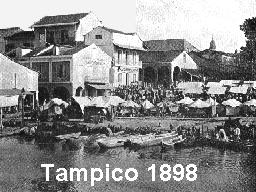 It’s a fairly “new” city (the Cathedral was financed by that great sinner, Edward Doheny). The Plaza de la Libertad bears some resemblance to the French Quarter … as a slightly run to seed Gulf port, it offers some of the same charms as used to be found in the late New Orleans. Much to the outrage of Eddie’s English sense of propriety, the local politics seems right out of Louisiana, too.
The early scenes in Treasure of the Sierra Madre take place here (there’s a plaque commemorating Humphrey Bogart’s “meeting” with B. Traven on the Plaza — Traven, staying incognito — simply sat in the same restaurant and never introduced himself. That’s the story anyway, and I’m stickin’ to it).
 I had to spend about 10 hours once in Tampico waiting for an overnight bus to Houston, and really was just too tired that trip to do any exploring. I rented what was allegedly a hotel room, but was treated quite well… given the “Vicente Fox suite”… which had, besides the basics I required (an unoccupied bed and a toilet) a plush velour high-backed arm chair in the middle of a room painted with what I assume was leftover boat paint (“portugese pink” — a mix of battleship gray, industrial green and rust-inhibiting red) and scratched with the names and dates (and various endowments) of previous tenants. The neighbors were quite considerate… or else I was very tired … keeping the moans to a quiet murmer.
Iin those days, 1970s Ford LTDs and Chevy Impalas served as collectivos. My driver to the bus station, despite the other 6 passengers, insisted that I see at least some of the wonders of the city. He was delighted to show me the Tampiquinos who pay no attention to the “no swimming” signs in the local lagoon. But then, maybe alligators can’t read Spanish.
Next trip, I’ll have to stop ‘n shop at Eddies’… in the meantime, I can always read his posts from the tropical outposts beyond the Empire.
Indians 1, Bureaucrats 0
(What’s even more fun about this the newspapers tried to write this without even the basic “Ñ” . C’mon, Ña-ñu is not THAT weird a language).
Ña-ñu speakers are said to pick up English by ear because it uses the same weird sentence structure and vowel sounds as English (we get around the accents by having incomprehensible spelling… but maybe a bunch of accent marks would make English easier). I had a student whose family still used the language in Hidalgo State. She really never had to study the language in order to speak relatively fluent English. Vicente, the diswasher at the all-night Chinese restaurant across from the PRI headquarters, was also a native Ña-ñu speaker who mastered English just from the few foreign reporters and lost tourists who’d wander by.
My guess is that the Otomi peoples (who speak Ña-ñu) have always been a minority everywhere they live, and it’s just that the speakers are used to being multilingual. Otomis, having been porters and market runners in Tenochtitlan, are still working in Tepito. I get the feeling a lot of the incomprehensible slang used in that district is Ña-ñu, or based in Ña-ñu… like their brethern in discount merchandizing, London’s Cocknies (who mix in Yiddish with their English, it’s not a bad strategy for preserving your independence and for group solidarity to develop your own private language.
Los Angeles Times May. 2, 2007
MEXICO CITY – The daughter born to Cesar Cruz Benitez and Marisela Rivas has no official name. Which is rather strange considering the girl is almost 2 years old.
Her parents live in Tepeji del Rio, a town in an arid corner of Hidalgo state north of Mexico City. Speakers of the indigenous language Hnahnu, they call their little girl Doni Zänä, or “flower of the world” in Hnahnu.
But Cruz’s attempts to register the baby name with the authorities have been rebuffed. The state’s computers, officials say, don’t accommodate the characters – including an underscore – that represent the distinctive sounds of the Hnahnu language.
For Cruz and other Hnahnu, the case has become a human rights issue highlighting what they say is discrimination against their people, an indigenous group of several thousand people in central Mexico. To some outsiders they are known as the Otomi, a name given to them by Spanish conquistadors five centuries ago.
“My daughter doesn’t have a name yet, but I’m not going to give up,” Cruz, an artisan, said in a telephone interview. “If necessary, I’ll go to the international organizations to help me.”
Like Cruz and his wife, three of their four other daughters have official names not from the Hnahnu language. The girls are Jocelyn, Perla and Antonia.
But in Hidalgo, as in other corners of Latin America, indigenous pride is growing. And the Cruz-Rivas family has been looking to embrace the language of their ancestors.
“This isn’t some whim of mine,” Cruz said. “This has become a struggle to preserve our traditions, our culture and our language. … I don’t know why it’s so hard for them to understand and respect our customs.”
Cruz said members of his community are often pressured to change the names of their children to Spanish names, or at least something that sounds more Spanish. Often, he said, the pressure comes with an ethnic slur.
When Cruz’s sister went to register her son’s indigenous name, she too was rejected, he said.
“They told her at the registry that those names weren’t allowed because they were Indian names,” Cruz said. “They recommended another name – Alfred. That’s a foreign name. So that boy is indigenous but he’s now called Alfred.”
Hidalgo officials said the problem is related to the computer system installed when the state retooled its information technology in 1999 to guard against the so-called millennium bug. The new system, used to produce identity cards, won’t accept characters outside the Spanish alphabet.
“The two dots over the A’s and the underscore … won’t go through the computer,” Jose Antonio Bulos, director of the State Family Registry in Hidalgo, told the Mexico City newspaper Reforma.
“That means the child won’t be able to get a Unique Population Registration Code,” the equivalent of a Social Security number, Bulos said. The code is derived, in part, from the first letters of a person’s given name and surname.
The case has been taken up by the Human Rights Commission of Hidalgo.
“We believe that it’s the right of the parents to give their daughter the name they want,” said commission spokesman Fernando Hidalgo Vergara.
The commission is pushing the state to update its computers.
Cruz has won one battle with state officials. He has a daughter called Yohoki, which means “rebirth.” At first, state officials rejected the name because they thought it was “Japanese.”
“They really are ignorant,” Cruz said.
State officials suggested to Cruz that he simply drop the two dots and the underscore from Doni Zänä ‘s name on official documents. But if he did so, the name would no longer mean “flower of the world” in Hnahnu, he said. Instead, it would be “stone of death.”
“Of course, we don’t want that,” Cruz said.
Meanwhile, Nahuatl, which has very few accents, and is much more widely spoken (I think the BBC underestimates the number of speakers. I’ve heard it used in the street… I couldn’t figure out why I was having trouble understanding the guys at a torta stand one afternoon outside the old Cituadela until I realized they were speaking Nahuatl. They were discussing a futbol game, and what threw me was that the names of the teams are going to be the same, no matter what language they spoke. “Cruz Azul” in Nahuatl is … Cruz Azul. A winner on one of the “You can be a star” shows a few years ago was a Nahuatl math teacher.
Nahuatl is an official language in Mexico, and there are at least 1.5 million speakers in the country, with more in the United States (it’s also related to several U.S. languages, being part of the Uto-Azeca linguistic family). By contrast, Welsh (an offical language in Great Britain) only has about 750,000 speakers world-wide. I’ve put up a few guides to Nahuatl on my “Resources/Recursos” page.
It’s a difficult language and it’s hard to find a teacher. I tried a self-taught course (which amused a parrot I had at the time no end), but never got very far. Anyway, I just wanted to be able to pronounce basic Mexican names and locations — Xochitl, Cuauhtémoc, Xola, Tezacatlapolcatl — with some semblance of comprehensibility.
Mexico City to teach Aztec tongue
By Emilio San Pedro
Americas Editor, BBC News
The official language of the ancient Aztec empire, Nahuatl thrived throughout Mexico until the Spanish conquistadores of the 16th Century.
Like many indigenous traditions, it persisted through the centuries.
Indigenous roots
The language continued even despite attempts by the continent’s European colonisers to erase it from the cultural landscape.
The decision, five centuries later, by the local authorities in the Mexican capital to make the teaching of Nahuatl compulsory is an attempt – to some extent symbolic – to recapture Mexico City’s indigenous roots.
The new law says teaching the language will become a compulsory part of the curriculum in the capital’s schools by the start of the 2008 academic year.
In the longer term, the authorities hope that it will also be taught in universities, as a way of increasing the number of Nahuatl speakers.
At the moment, it is estimated that the language of the once-mighty Aztecs is spoken by less than 1% of the more than 20 million people who inhabit the Mexican capital.
However, although we may not know it, many of us use words borrowed from Nahuatl, on a daily basis.
Words like avocado, chocolate, coyote, tomato, and even tequila, that most potent of Mexican alcoholic beverages, are all based on the Nahuatl language.
¡Palehoia nimanic!

“Thank You! – glyph by Blogotitlan
Tali-bama (reloaded)
(I had to rebuild this post from scrach. ¡Qué lastima!)
Sombrero tip to Dos Centavos…
AP, via Fox (yup, that network!):
BIRMINGHAM, Alabama — Five members of a self-styled Alabama militia were denied bond Tuesday after a federal agent testified they planned a machine-gun attack on Mexicans. A sixth man accused of having weapons and explosives components in his home was approved for release.
U.S. Magistrate Judge Robert Armstrong said he could not grant bond because of the agent’s testimony and the large number of weapons — including about 200 homemade hand grenades and a launcher — that were seized in raids last Friday.
“I’m going to be worried if I let these individuals go at this time,” the judge said.
The five are charged with conspiring to make a firearm.
Law enforcement authorities, meanwhile, continued to look for additional weapons that could be linked to the group, including in a local cave.
Adam Nesmith, an agent with the federal Bureau of Alcohol, Tobacco, Firearms and Explosives, testified that the five men planned an attack on Mexicans in a small town just north of Birmingham, and went there on a reconnaissance mission April 20.
HOLY SHIT!
I thought we were fighting them over there, so we didn’t have to fight them over here. The scary part is these are not the only armed crazies out there. There’s probably some near you.
I wish our Governor would spend less time worrying his pretty little head about the occasional Syrian who crosses from Tijuana into the U.S. to become a cab driver, and more on … well, the real terrorists. DAMN! Maybe we need a fence along the Louisiana/Texas border too.
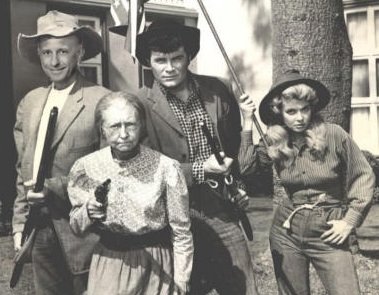
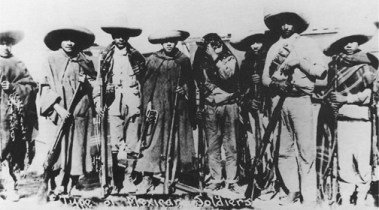
Down here in the Big Bend, Anglos and Mexi-billies agree… we don’t need no stinking Alabama-bin Ladins…
Bad news, good news…
For whatever reason, the edit functions are doing a “heck of a job” right now, and things are screwing up… posts not posting, or not letting me update or adding and subtracting coding. If I had a mind to lose, I’d have lost it by now. I am losing my cool.
Whether it’s a problem on my end, or WordPress isn’t clear yet. Hopefully, it’ll be resolved sooner, rather than later. In the meantime, I’ll just have to leave mistakes and my “sins of omission” out in the open. Apologies to “dos-centavos.blogspot.com” for not giving Stace Medallin the credit for tipping me off to the Alabama crazies (posted below).
BUT, this this is kinda cool. I thought I might hit 1000 posts a day this week. I didn’t but we’re getting pretty close … wordpress records the stats from 7 PM to 7 PM my time (Central US and Mexico — which is midnite to midnite GMT). Wednesday to Thursday, there were 991 hits. Normally, the hits drop over the weekend, but lento y lento the Mex Files overall numbers keep growing. I never thought my odd-ball English-language blog would be listed as one of the top 100 Mexican blogs by (Peruvian based) Blogalaxia — numero 83 and climbing.
On the beach, San Blas (Friday Nite Video)
The Wall …according to Los Miserables

Patricio’s cartoons have been appearing for years in Milenio. Los Miserables are rude, crude and always on target… and an educational two-fer: if you understand the politics, you can learn the slang. If you can figure out the slang, you’ll learn about politics. Or both.
Los Miserables, El Enchilada Competa, Hombre Man and other cartoons, jokes, stories and “political philosophy” from the heir to Ruis are on the web at Monos de Patricio .
Mexican’s population decline
For once, it’s good news, though at some time in the future, it’s going to dry up the U.S. supply of cheap labor, and force Mexico to consider more immigration.
The Mexican population crashed in the 1500s, mostly from diseases and sudden environmental changes (like introducing livestock) from about 25 million to about a million. This was, of course, unprecedented, and the population didn’t recover until the 20th century.
While there was another population decline in the 1910s during the Revolution (Europe’s dropped 25 percent in the same decade). It wasn’t so much the wars, which were pretty minor compared to what was going on in Europe at the time, but emigration and just plain stress (when there’s not enough to eat, and the whole country was FUBAR, making babies wasn’t always on people’s minds. Are wars caused by erectile dysfunction, or does war cause ED. Either way, in the pre-viagra days, the population fell).
After the Revolution, creating a more viable Mexico meant encouraging births. The government focused on better pre-natal care and food production, but — like every other country — no one thought about the limits to growth, or the potential downside of a huge population.
As a result, there was a HUGE increase in the population in the 1960s and 70s, but Mexico was one of the first countries to seriously consider the consequences of too many people. Agricultural self-sufficiency was (at least until very recently) a national security issue, and — for all its faults — the State really did try to meet the needs of the people. There were just too many people to meet the needs of.
“The Pill” was basically a Mexican invention (Dr. John Rock just synthisized a Huastaca folk remedy) and public health facilities in Mexico focused on birth control.
More importantly, the REAL birth control methods … jobs, education, a future.. mean Mexican women are chosing to have fewer — and healthier — children investing more care in smaller families.
Emigration may play some part… Fred Reed (I think it was Fred. If not, my apologies to that perceptive, good-writn’ old fart) pointed out that the folks who emigrate tend to be those who can’t make it at home… the poorest, and least educated who are the most likely to have a lot of babies. And sick babies. And, according to the Associated Press, the annual emigration rate is higher than the annual death rate:
Mexico’s demographics agency found that an average of 577,000 people migrated to the U.S. each year between 2000-2005, compared to 495,000 deaths a year in the same period. In 2006, 559,000 migrated and there were 501,000 deaths.
But given that these emigrants are earning more money, and sending money home, there’s a secondary effect. Besides taking “breeders” out of the population (in poor villages, you’re unlikely to find a lot of men of marriagable age) or just delaying childbearing because the potential fathers aren’t around, there’s more money to invest in things like education, and travelling to the rural health clinic and… spending on the few kids that are around (and hopefully, educating them so they can get a job at home, though THEY’LL have even fewer kids.
(Fewer children in Mexico, Jorge Rodriguez, El Gráfico, 30-April-2007. My translation)
The Mexican Cenus Bureau (El Consejo Nacional de Población, known as Conapo) estimates there are 31.7 million children under 15 years of age. 6.4 million live in communities “of high or very high maginalization” (what in the U.S. are called “at risk” or “disadvantaged”) which cannot count on satisfactory levels of health care , education or housing .
Every year for the last several decades, infant mortality has been dropping significantly in Mexico.
As a result of a declining birthrate over the last 30 years, the country can expect 412,000 less babies to be born this year as compared to 2006. The number of children is expected to continue to decline to 25.1 million in 2030 and 20.5 million by 2050.
Childhood death rates have also significantly diminished. In 1970, the infant mortality rate was 81 per thousand, now down to 16 per thousand.
Half of infant deaths are the result of prenatal condtions, though improving socioeconomic conditions have reduced the mortality rate. In Nuevo León and Baja Califonia, 6.5 boys and 5 girls per thousand die before their first birthday, while in Guerrero, Chiapas, Durango, Hidalgo and Puebla the rates are the same for both sexes.
Approximately one fourth of deaths in children between one and 15 years old are caused by accidents, 40 percent of those involving automobiles. Infectuous diseases and parasites are the second leading cause of death (12.6 percent), followed by tumors (11.8 percent) and congenital anomalies (10 percent).
Mother’s Day is May 10… and, while there may be fewer mothers, they’ve got a better chance of seeing their kids grow up, and — with fewer kids — a better opportunity to spoil em rotten so they do call mama on diez de mayo.
Geeze, don’t you guys read “The Mex Files”?
One more time…
BOUNTY HUNTING IS ILLEGAL IN MEXICO.
VIOLATORS WILL BE PROSECUTED.
From the Douglas (Arizona) Daily Dispatch:
NACO, Sonora, Mexico – Police here arrested five U.S. citizens Wednesday and accused them of bounty hunting, a criminal offense in Mexico.
Roberto Bejarano, chief of the Sonora state police investigative unit in Naco… said the suspects detained two Mexican citizens, Luis Perez Flores, 31, and Trinidad Vizcarra Garcia, 26, as they were walking down a street Wednesday morning in central Naco. After loading Perez and Vizcarra into a pickup truck at gunpoint, the suspects tied their feet together, told them they were U.S. officials, and drove toward the Naco Port of Entry, Bejarano said.
Perez and Vizcarra began to struggle with their captors, however, and were able to jump from the truck just before it crossed into Naco, Ariz. As they ran for help at a nearby police outpost, the truck continued on into the United States.
A short time later, Bejarano said, the five alleged bounty hunters returned to Naco, Sonora, wearing new sets of clothing but driving the same pickup. Police quickly spotted the vehicle and arrested the suspects.
Bejarano believes the men were hired to capture Perez and Vizcarra and recover a car that they had allegedly stolen.
“I don’t know if that kind of activity is legal in the United States,” Bejarano said, “but here in Mexico, if you think that someone stole your car, you go to the authorities and ask them to arrest the criminals and get the car back.”
The five suspects were transported Wednesday afternoon to Cananea, Sonora, to give statements to a public minister. A judge will rule within three days whether there is enough evidence to charge them with the crime of unlawful deprivation of freedom, Bejarano said.
Authorities in Naco contacted officials at the U.S. consulate in Nogales, Sonora, to notify them of the arrests, he added.
I especially like the part where these “Dog Chapman” wannabes changed their clothes. OK, so Mexican cops are a few rajas short of a fajita. They’re not THAT stupid).
I’ve posted at least six times about that idiot, Dog Chapman, before.
And, for those with a scholarly bent (not that I expect Dog, his admirers, nor his would-be imitators to bother with such details) Professor Russel Covey of the Whittier College of Law (California) wrote about the perils of international bounty hunting back in 2003 for FindLaw.
For those who DO have a scholarly bent, finding and presenting the information takes time (and electricity and telephone connections):