“White men don’t dance”
Jorge Zepeda Patterson on a visit to the strange country to the North:
(original in El Informador de Guadelajara, 7-abril-2007, my translation)
He was a taxi driver like any other in a North American city: brown-skinned, speaking only a little English, but knowing streets he could barely pronounce like the back of his hand. Our driver was Ethiopian, but immediately identified his Mexican passengers as compatriots, both citizens of somewhere other than the first world.
He was a philosopher-taxi driver. His first question confirmed our citizenship with the univerally displaced: “What did we find different in the United States from Mexico?”
The first thing that came to mind was that in our country people do not run alienated from one thing to another, stuffing in fast food , while stressed out in their search for something they never seem to find.
A big smile crossed the driver’s face. We had passed the test.
“Exactly,” he said. “I don’t understand rich people. They enjoy things and pleasures we never would dream of in Ethiopia, but they don’t seem happy. In my family, we often could only eat once a day, but I remember us laughing and dancing a lot.”. He added pensively, “People don’t dance here.”
He said it as if it were a scientific discovery, a critical indicator of human unhappiness. We got out of the cab, amazed by our philosophical cabbie, though amused by what we saw as another folk tale of life in the New York jungle.
A few days later, I learned that our Ethiopian taxi driver’s reflections were much more “scientific” than I’d first thought. Leafing through the April issue of “Mother Jones,” I ran across an article by Bill McKibben (http://www.motherjones.com/toc/2007/03/index.html), from a new book, “Deep Economy: The durable wealth of communities and the future.”
McKibben’s article is a notable confirmation of our taxi driver’s thesis. The author looks at various research which reveals the growing unhappiness of first-world inhabitants, individually and collectively.
Of course that the human beings are displeased if they cannot satisfy basic needs. But once the required food, shelter, clothing and education are met, all the indicators show that happiness has to do with factors unrelated to family or national income. In other worlds, the middle-class family should have equal or better chances of being happy than those from a wealthy family.
Starting in 1972, the Opinion Research Center of the United States has asked citizens about their level of happiness and satisfaction with their lives. The optimistic responses have decreased substantially over the years, even as per capita income and consumption levels have multiplied several times. And this is not just a subjective measurement. The responses cross-check against other indications like stress levels, work and family conflicts, willingness to help others, worries about personal security, etc. The unhappiness is not just individual, but agrees with indicators relative to society as a whole: family indebtedness, violence, suicides, drug dependency. A 2000 report showed that the average anxiety levels among young Americans was higher than among children in psychotherapy in the 1950s. The author reports that there are similar indicators from Japan, England and other first world countries.
Study after study shows that happiness has much more to do with a person’s relationship with their social network than with the number “satisfactors.” But modern man is going in exactly the wrong direction, turning his back on millenia of “human community” to search for a deeper individualism.
Instantaneous communication (by cellular and e-mail) have meant more communications, but the quality of conversation has diminished. A social psychology researcher, for example, found a correlation between the level of happiness reported by people and the number of intimates with whom the person was accustomed to speak of their problems. North American houses are increasingly larger, and give more opportunity for “members of the family to know the least possible about each other.”
Another writer, Benjamin R. Barber, has labelled the tendancies of modern society as a form of infantile regression and immaturity (in his book “Consumed: How markets corrupt children, infantilize adults, and swallow citizens whole”). We prioritize, Barber says, the image over the idea, pleasure over happiness, egoism over altruism, instant gratification in place of lasting satisfaction, sexual pleasure over erotic love, and dogmatism over doubt.
What we see from all the research, McKibben says, is that people who have friends and intimate family relations, and who are part of social networks are the happiest. While this is not a surprise, it does mean that social ties diminish individual liberties assumed to be the “maximum good.” Being a good friend imposes some sacrifices.
I never learned the name of our Ethiopian taxi driver. But I am sure he is happier than the harried passengers he drives around Manhattan. Most of them don’t dance.
Losing their heads over politics
Hugo Valdemar, spokesman for Mexico´s archdioces, threatened to take the head of Mexico City´s Human Rights Commission, Emilio Álvarez Icaza, before the National Human Rights Commission “for spreading hatred against the church.”
(Kenneth Edmonds, in the Mexico City Herald)
A Catholic fatwah?
The abortion issue, as both Edmonds and Fred Rosen write in the Herald is showing the Church in a very poor light. It is losing power — so much so, that on abortion, they had to join forces with the Orthodox and Anglican churches in Mexico… and even make nice to the Santa Muerte church.
Alternativa, the small Social-Democratic and Campesinos Party, which is not part of the Broad Progressive Alliance, but is broadly progressive (under it’s old label, “Mexico Possible”, it tried to appeal to feminists, protestants, the physically handicapped, indigenous peoples and gays), went to court yesterday to denounce the Cardinal of Mexico City for interfering in politics. He was, but I don’t think he’ll actually stand trial.
The abortion bill in the Federal District Assembly is going to pass (despite tonight’s announcement of a one-week delay on the vote) as will the “Death with dignity” bill now before the Senate.
I don’t know why we’re surprised.. PAN, the “pious” party barely won (if they did win) the last election. It’s the two anti-clerical parties that control the country, and with the “left-er” of the two, PRD, being the majority of the 2/3rds of the anti-clericals, PRI has been falling over itself to remain relevant (it sponsored both the Mexico City abortion decriminalization and gay marriage in Coahuila). This is a window of opportunity for the secular state to erode clerical control without resorting to the anti-clerical legislation of the past. They’d be fools not to take advantage of the situation.
As long as they don’t lose their heads over this.
There are alternatives…
I lost my shirt (and everything else) trying to get Mexican agriculture away from it’s “joined at the hip” relationship to the U.S. (in a small way: at least getting Michocán avocados into French supermarkets). I can’t say it was the primary intention of a new USDA and NAFTA regulation, but effectively small buyers, working on credit, were shut out of the market, unless they went through the largest U.S. avocado buyers — Calavo or Mission. Oh well, I’m over it. NOT.
I was happy to see (in a twisted way) the news that the U.S. rice growers were screaming bloody murder when Mexico rejected buying their rice — mostly because of Mexico’s own ban on genetically modified agricultural products.
Last month the U.S. Rice Federation was lobbying the U.S. Embassy to “do something”.
The Mexicans did:
| (Associated Press of Pakistan) | |
|
ISLAMABAD, Apr 12 (APP): Federal Minister for Food Agriculture and Livestock (MINFAL), Sikandar Hayat Khan Bosan said on Thursday that resumption of rice export to Mexico would be a great breakthrough for the country. He stated this after meeting with a Maxcian delegation, led by Maxcian Foreign Affairs Vice Minister, Maria De Lourdes Aranda Bezaury, which called on him here. Secretary MINFAL, Muhammad Ismail Qureshi and other senior officials of the ministry were also present on the occasion. Earlier Sikandar Hayat Khan Bosan briefed the Maxcian Vice Minister about the measures taken by the government for the promotion of agriculture sector in the country. Bosan said that the two-third population living in the rural areas is dependent on agriculture for their income. He added that 60 percent exports are related to agriculture sector. … Sikandar Hayat Khan Bosan said that Pakistan and Mexico enjoy cordial relations and stressed the need for further enhancing these relations specially in trade and investment sector between them. He said that Pakistan produces the best quality rice and wanted its exports to Mexico for mutual benefit. He thanked the visiting Mexican Vice Minister for her assurance in resolving the Pakistani rice export issue to Mexico. The Minister also thanked her for offering short-term and long-term scholarships to Pakistani agricultural scientists/experts adding that Pakistan wanted to take benefit from experience of Mexico in the field of agriculture. The Mexican Foreign Affairs Vice Minister assured Pakistan for resolving the rice export issue . She also called for exchange of visits among the agricultural experts between the two countries. She also called for exploring new avenues in the areas of agri business, rice, training and exchange of agro-businessmen between the two countries.
|
 People are sometimes surprised to hear this, but Mexicans consume huge amounts of rice. No, Mexicans do not serve “Spanish rice” (and neither do the Spaniards), but rice was an 18th century Spanish import, and is a basic part of the Mexican diet. The first course of a main meal is usually caldo — the “wet soup”, which often as not has some rice floating around. Usually, the second course at the main meal (sopa seca — “dry soup”) is a plate of rice — maybe with a sliced banana or a fried egg if you’re being fancy. The main course might be arroz con pollo. And for dessert? Arroz con leche… rice with cream and sugar, or a nice budin — what we’d call “rice pudding.” Despite being rice-a-holics (made more severe by the Chinese immigration of the late 19th century), Mexico has never been a huge rice producer. Pakistan is in the top ten rice-exporting countries.
Two things that are interesting here. First, Mexico is going around NAFTA, at least in agricultural imports. We always assumed — and apparently the U.S. Rice Board assumed — that Mexico would have to buy from the highly subsidized U.S./Canadian agricultural multinationals. You know what they say about the word “assume” — it makes an ASS of U and ME. We were shocked when the Mexican Navy bought Russian planes, but as far back as Porfirio Diaz, the Mexicans have bought advanced technology from a basket of foreign suppliers to avoid getting locked into dependence on any one country or system.
We might think of that when we start talking about PEMEX … It’s actually a larger oil company than Exxon-Mobil, and while it’s desperately in need of refinancing and restructuring, there ain’t no way it’s gonna be bought up by a U.S. or other multinational. It IS doing joint ventures with the Norweigan and Brazilian state oil companies, and Congress is looking at restructuring that will let the company keep more of its profits for technical upgrades.
The second interesting thing is that Pakistan is the partner in this deal. Vicente Fox did one good thing during his tenure — acting as a salesman for his country. But Fox was unimaginative in looking for customers … going to the same usual sources — the U.S., Europe, Japan (the only really new and exciting customer was New Zealand, which sells milk powder and luxury dairy products to Mexico). One of Lopez Obradór’s “50 point program” was to increase foreign trade outside the NAFTA region … specifically in Latin America and Asia.
What’s unusual is that Pakistan is the “poor country” (ranked near the bottom of “developing countries”) and Mexico the “rich” one (either near the bottom of the “developed world” or the top of the “developing world”) in this deal. Bypassing the usual suspect — China (one of the few countries that does not have good relations with Mexico) and both countries potentially benefitting.
And, besides, who wants Gringo rice?

Man does not blog by rice alone…or even tortillas and rice:

Movin’ on up…
I had a draft post of the Counterpunch article below, but never got around to posting it. Just as well, there’s an update from AFP that needs to be added:
A Mexican telecoms tycoon has become the second richest man in the world, pushing US investment guru Warren Buffett into third place and breathing down the neck of Microsoft founder Bill Gates.
Carlos Slim Helu quietly slipped past Buffett at the end of last month thanks to his rising stock, and was valued at the close of trade Wednesday at 53.1 billion dollars, 700 million dollars more than Buffett, Forbes.com reported Wednesday.
Now only Gates, valued as the richest man in the world for the last 13 years, is ahead of Slim.
He did it the old fashioned way, according to James Petrus in “Meet the Global Ruling Class” (Counterpunch 21-March-2007) — with a few minor updates:
The principal cause of poverty in Latin American is the very conditions that facilitate the growth of billionaires. In the case of Mexico, the privatization of the telecommunication sector at rock bottom prices, resulted in the quadrupling of wealth for Carlos Slim Helu, the third second richest man in the world (just behind Bill Gates and Warren Buffet) with a net worth of $49 53.1 billion . Two fellow Mexican billionaires, Alfredo Harp Helu and Roberto Hernandez Ramirez benefited from the privatization of banks and their subsequent de-nationalization, selling Banamex to Citicorp.
Privatization, financial de-regulation and de-nationalization were the key operating principles of US foreign economic policies implemented in Latin America by the IMF and the World Bank. These principles dictated the fundamental conditions shaping any loans or debt re-negotiations in Latin America.The billionaires-in-the-making, came from old and new money. Some began to raise their fortunes by securing government contracts during the earlier state-led development model (1930’s to 1970’s) and others through inherited wealth. Half of Mexican billionaires inherited their original multi-million dollar fortunes on their way up to the top. The other half benefited from political ties and the subsequent big payola from buying public enterprises cheap and then selling them off to US multi-nationals at great profit. The great bulk of the 12 million Mexican immigrants who crossed the border into the US have fled from the onerous conditions, which allowed Mexico’s traditional and nouveaux riche millionaires to join the global billionaires’ club.
Buffett, of course, has given a lot of his fortune away. And his money comes mostly from buying and selling companies, not creating new stuff, or selling stuff. Slim — outside of TelMex — has poured money into roads, real estate, computer businesses (including the U.S. brand name “CompUSA”) and prefers to keep his loot, arguing that “Poverty isn’t solved with donations,” and — besides — “Building businesses does more for society than going around playing Santa Claus.”
I’ve met Santa Claus. I’ve met Carlos Slim. Slim is fat and bearded, but he ain’t no Santa Claus. Unless Santa’s elves are all about 2 meters tall and carrying machine guns.
Oh well… he has made some sizable charitable donations to Mexico, and INVESTED in social change (infrastructure and urban revitalization in Mexico City, especially). And, his business activities probably do bring more money into Mexico than they send abroad.
Migrant rights worker killed
I put off posting this until today, hoping to find out a little more. All U.S. and Mexican sources are basically repreating the same information that was first put out by the AP Mexico City office yesterday just before 2 PM:
MEXICO CITY — A Mexican employee at an organization that fought for the rights of Mexican migrant guest workers in North Carolina and other states in the U.S. was found beaten to death in the northern city of Monterrey, officials said Tuesday.
The body of Santiago Rafael Cruz was found early Monday at the Monterrey, Mexico, office of the Farm Labor Organizing Committee, Leticia Zavala, international vice president for the organization, said in a telephone interview from North Carolina.
The Ohio-based arm of the AFL-CIO represents the rights of migrant farm workers, she said.
Officials believe Cruz was killed late Sunday or early Monday. He had been hired recently as the Monterrey office manager and was staying at the office while he looked for a place to live.
Police had made no arrests in the case, Zavala said. On its Web site, the Farm Labor Organizing Committee said it believed the killing was related to the group’s work defending the rights of migrant workers.
“We have put up with constant attacks in both the U.S. and Mexico, including having our staff harassed, our office burglarized and broken into several times, and a number of other attempted break-ins,” it said. “Now the attacks have come to this.”
Zavala said the killing did not appear to be a burglary because nothing was missing.
Jornada and the Monterrey daily, Porvenir, both of which had early stories when Cruz was thought to have been a night watchman, reported that he’d been bound hand and foot. The Toledo (OH) Blade (Cruz was a Toledo resident, and the AFL-CIO affiliate he worked for is headquarted there) added that Cruz’ work specficially involved obtaining temporary worker visas for Mexican workers in a North Carolina pickle factory. And that FLOC organizers have been harassed in both the United States and Mexico. FLOC’s website adds the interesting detail that the recruiting office where Cruz’ body was found is right next door to the United States Embassy in Monterrey.
My first thought was that this might have something to do with “illegal immigration”, but that makes no sense. Admittedly, in the long run, a program like FLOC’s — which gives Mexican workers legal protection and a way to protect their rights in the United States — might put some polleros out of business, but other legal hiring halls haven’t been targets for criminals. The pollero style is more highway banditry, robbing migrants, than going after union organizers (especially those next door to the United States Embassy).
Forgive my suspicous mind, but FLOC makes powerful enemies in corporate agribusiness . Unionized farm labor is not a popular idea with that bunch, and FLOC has an “agenda” beyond just guaranteeing that legal workers receive a living wage.
The Farm Labor Organizing Committee, AFL-CIO, (FLOC) is both a social movement and a labor union. Our immediate constituency is migrant workers in the agricultural industry, but we are also involved with immigrant workers, Latinos, our local communities, and national and international coalitions concerned with justice. The FLOC vision emphasizes human rights as the standard and self-determination as the process for achieving these rights. We struggle for full justice for those who have been marginalized and exploited for the benefit of others, and we have sought to change the structures of society to enable these people a direct voice in their own conditions.
It is involved in international groups like the Grassroots Global Justice Forum and is active in the “Social Justice movement”:
We believe that as a US based organizations, we must be committed to building a strong enough movement to prevent the US government and US corporations from suppressing popular movements and interfering in the internal affairs of other countries.
We believe in creating opportunities for convergence that facilitate resource sharing, popular and political education, skill sharing and dialogue between organizations.
We believe in joint action, that acting together in the U.S. and globally we have more power to create social change.
Both Mt. Olive Pickles and Smithfield Packing (the two North Carolina food companies FLOC is involved with) have an unsavory history of labor abuses, and this wouldn’t be the first time a U.S. company was using hitmen to take care of pesky union organizers and globalists.
I don’t think I’m completely nuts on this — I’d expect U.S. Ambassador Tony Garza to be making his usual “U.S. residents are in danger” speech, but so far nothing. Why gangsters or gun-runners would merit the Ambassador’s attention, but not labor organizers (and people working FOR legal immigration) is a question I’ll leave for the Ambassador.
We poets in our youth…
Miami, Buenos Aires, Madrid, Barcelona… all hip in their separate ways, but none of them even close to being the center of the Hispanic world, that Mexico City was (and I think still is) from the 1930s until at least the 1980s. As the center of a “revolutionary, modernist” society in the 1920s, la Capital was an alternative for the international avante-garde who found Paris too pretentious and Berlin too sinister.
With Franco taking power in Spain, the center of Hispanic culture moved to Mexico by default. It was already the largest Spanish-speaking city in the Americas, and there was no future for artists on the Peninsula (One of Federico García Lorca’s murderers allegedly told the poet’s family, “Of course we had to kill him. He was a poet, and deserved to die.”). Mexico was relatively free, and broadly tolerant in cultural matters. It became a magnet for all-Spanish speaking artists, and was immensely enriched in the 1970s by the South American exiles.
One of those South Americans loose in Mexico City was the Chilean poet and comic novelist, Roberto Bolaños, who died in Barcelona at age 50 in 2003. Mexican poet and novelist Carmen Boullosa wrote an elegant memoir of the radical poet for The Nation, and — incidentally — a hilarious look at Mexico’s literati during the golden age:
When I stepped into the literary scene in Mexico City, clutching my first sheaf of poems and hoping to write many more, it was clear in a flash that the young poets had drawn their battle lines. It was 1974; the city’s golden years were drawing to a close.
… poets of my generation … aligned themselves with pre-existing enemy camps. One camp admired the demotic poet Efraín Huerta, famous for his “minipoems” packed with humor and nerve. The other looked to an exquisite magazine, Plural, published by the cosmopolitan intellectual and future Nobel laureate Octavio Paz…
It was the street-smart types versus the aesthetes: Not that either camp corresponded exactly to its label. Paz and Huerta were descended from the same Mexican literary tradition. Both were born in 1914; they were of Juan Rulfo’s generation. As young men, at the end of the 1930s, they had co-edited the magazine Taller (Workshop). But over the years they had drifted apart. Literary and political differences had arisen between them. Paz had denounced Communism and broken with the Cuban Revolution. Efraín had not. Paz’s people said the Efrainites were Stalinists. The Efrainites called the Octavians reactionaries. Neither tag was entirely accurate. Their hostilities and affinities were both more and less complex than the insults implied.
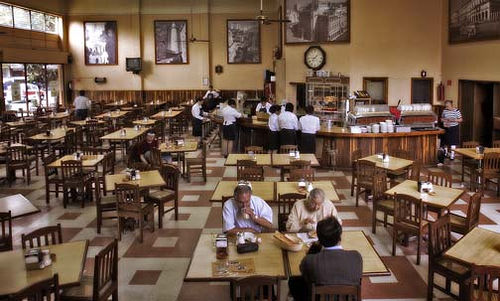
The young Efrainite poets got around the city on foot, or by bus; they were iconoclastic and attended workshops; in bookstores they scrutinized, read and stole the merchandise; they carried satchels, had long hair and wore huarache sandals with soles made from car tires; they published here and there and spent hours in the downtown cafes, especially Café La Habana, and various seedy bars. The young Octavian poets criticized one another’s poems fiercely, in the same cafes as the Efrainites, at neighboring tables; they bought or stole books from the stores, carried satchels, had long hair and almost always wore sandals; they got around the city on foot, or by bus, or in their friends’ cars; and they published in the Octavian magazines and literary supplements.
…
The literary world was small and close-knit, and we lived from party to party, if you count all the readings, lectures, openings and gatherings in cafes. We saw each other all the time. I’m going to recall five such parties, between 1973 and 1976:
The first was the launch of a book by Efraín Huerta, published by Juan Pascoe. Pascoe’s big house in the Mixcoac neighborhood was full of people. The Efrainites sang, or rather bawled, rancheras and boleros. The Infrarealists stood firm beside “the barrel of pulque we had brought, and a twenty-five-kilo Mennonite cheese we had lugged from the market at La Merced.” …
The second was the launch of a book by Octavio Paz, also published by Pascoe, with a host of Octavians in attendance. Pascoe’s house buzzed with conversation. Instead of pulque, there were toritos to drink: ninety-six-proof alcohol with rice milk or (for the suicidal) peanut milk. With my own eyes I saw a group of Infrarealists (mission: sabotage) throw the contents of a glass over Paz (very smartly dressed, in an elegant blazer), who shook out his tie and continued the conversation with a smile, as if nothing had happened.
Huerta died in 1982, Paz in 1998. Café la Habana at the corner of Morelos and Bucarelli, isn’t quite the place it once was. The food and coffee are still great, but it attracts more newsmen — and tourists –than full-time starving poets these days. Like everyone — and everything — else these days, it has its own blog: http://cafelahabana.blogspot.com/
If I could roll back time…
It’s frustrating to write Mexico history, because so much of it was purposely destroyed. Not just by the Spanish, though they did their fair share, but — so it would seem — by every dominant culture. Tlacael, the “Snake-woman” — who was a man, that’s just the title — was the power behind the Aztec throne from about 1420 til his death in 1492 (he was about 100) rewrote history, and burned all the records (though he missed a few) in the 1460s. The Spanish.. and Pancho Villa for that matter, burned property records to make land distribution simpler.
The upshot is we really have no clue as to how far back Mexican civilization goes. It seems that the whole country is one giant pyramid, built on top of whatever was there originally. Everywhere you dig, you come up with something (an entirely unknown civilization was discovered a few years ago when the water company was laying lines in Aguascalientes). And we keep pushing back the timeline.
Oh well, what’s another millenium or so?
TALLAHASSEE, Fla., April 10 U.S. anthropologists have found evidence of ancient maize farming in the Gulf Coast region near Tabasco, Mexico.
Florida State University anthropology Professor Mary Pohl and colleagues discovered farmers in Mexico were cultivating an early form of maize, the forerunner of modern corn, about 7,300 years ago — 1,200 years earlier than scholars previously thought.
Pohl conducted an analysis of sediments in the region and concluded people were planting crops in the “New World” of the Americas around 5,300 B.C. “These are significant new findings that fill out knowledge of the patterns of early farming,” said Pohl. “It expands on research that demonstrates that maize spread quickly from its hearth of domestication in southwest Mexico to southeast Mexico and other tropical areas in the New World, including Panama and South America.” The results of Pohl’s study — conducted with Dolores Piperno of the National Museum of Natural History in Washington; Kevin Pope of Geo Arc Research; and John Jones of Washington State University — appears in the Proceedings of the National Academy of Sciences.
Copyright 2007 by UPI
xxx
Oaxaca — the news is not the reporters
I don’t think Rebecca Romero is quite the story the Narco News thinks. John Gibler’s report is factually correct:
The Associated Press fired Oaxaca state correspondent Rebeca Romero due to pro-government bias in her coverage of a six-month-long protest movement that sought to oust the state governor, Ulises Ruiz Ortiz, according to AP reporters familiar with the agency’s work in Mexico.
…
Ms. Romero, a former press secretary for the Mexican federal attorney general, also owns an electronic news agency, ADN Sureste (Southeast Digital News Agency). ADN Sureste ran paid advertisements for the Oaxaca state government while Ms. Romero was reporting on the government’s involvement in the conflict, in violation of the AP’s Code of Ethics
According to AP reporters familiar with the agency’s work in Mexico, however, the AP fired Ms. Romero as a result of her coverage of the Oaxaca conflict.
Ms. Romero confirmed that she is no longer writing for the AP.
The Narco News went, it seemed, on a crusade to have Romero removed from her post based on a “technicality”:
At the time of her reporting, Ms. Romero received payments from the state government for advertisements on her website.
The AP may have a contractual rule against this, but I can’t think of a single small paper that doesn’t take government advertising, anywhere. If it wasn’t for the County legal notices, there probably wouldn’t be any newspapers out where I live. And, in Mexico, where the government is usually the only secure source of ad revenue, there’s not much choice. What Narco News did catch on to (and what a lot of OTHER people – including some astute foreign journalists in Oaxaca caught on to) was the real problem
Throughout the six-month conflict Ms. Romero’s reporting evidenced disdain for the protest movement, sensationalizing and misreporting acts of protester property destruction and violence, while failing to report on the state government’s involvement in the killing of protesters, which was widely reported on in the national press.
Unconfirmed rumors (nothing more) had Ms. Romero taking payments in return for flattering, or at least non-damaging, stories about the State government during the Oaxaca crisis, but from the sound of them, it is more likely people just took her continued advertising revenue as a bribe.
Blessed are the not-for-profits, for they can afford the luxury of absolutist regulations … ADN Sureste, and the Associated Press are profit-making businesses. Heck, I’ve had to trim my reporting… and be very cautious in my wording … on things written for the Big Bend Sentinel (a story too sensitive for the Alpine Avalanche, since it could conceivably damage reputations or cause problems for local worthies).
Oscar Wilde said “the truth is never pure, and seldom simple.” And that’s especially true with the news biz… and doubly-true with Oaxaca. The low-rent correspondent, who like me and Oscar depends on writing to eke out a living (though I think that’s the only time all three of us will appear in the same sentence), writes for the very conservative Canadian press, but manages to get a good point in his own take on Romero’s firing (or, “termination of services”):
…everything is being presented as good vs. evil. APPO = good and Ruiz = bad. How about seeing some shades of gray? Ruiz is bad. (Perhaps evil is a better word.) But does that make APPO the good guy?
I’m checking out of this mess. It’s just bizarre. Teachers go on strike for the 25th consecutive year – and are lauded as heroes. APPO protests cripple the state’s tourism-based economy, but they’re supposedly the good guys. Ruiz acts like a troglodyte and … he deserves all of his bad press.
EXACTLY.
Brad Will’s murder aside, the reporters are not the story. Sometimes it’s the gifted amateurs who are hitting on the nuances. Barbara Lopez, a community organizer from San Francisco, wrote for the alternative weekly Beyond the Chron after her return from her native Oaxaca:
Oaxacans are critical of APPO (the Popular Assembly of the Peoples of Oaxaca) or the coalition of groups seeking change, as the last eight months have been painful.
…
Currently, APPO is having reflective meetings to make decisions on its agenda and membership. These meetings are extremely critical. While there are very positive elements to APPO such as the Indigenous rights group and NGO’s, APPO has also included very violent elements such as anarchists from the U.S., Mexico City, and Puebla and many street children and drug users who are rightfully angry, but whose actions have hurt the movement.
…
Indymedia reporter Brad Will’s death had a huge impact on many people. It is also seen by the pro and anti-APPO elements as a turning point where Governor Ruiz could now bring the Federal Preventive Police as an excuse to repress. An American death has more value than thirty Mexican ones, even in Mexico. Some of our APPO-involved family friends fled for a few months.
Huge sweeps took place where innocent people were taken to a prison in Nayarit. The repression is still very strong, with police at every corner of downtown. Regardless of their opinion of APPO, Oaxacans don’t like the Governor – Ruiz or Ortiz. Ruiz and his predecessor – Murat – have taken corruption to new lengths, stealing million and millions of pesos from the Oaxacan people.
However, Ruiz’s ouster will be complicated because even though he is a member of PRISTA [sic – PRI], he is aligned with PAN – President Felipe Calderon’s party – so the federal government doesn’t want him out. Those who do want him out include the PRD and even his own PRI party – in the shape of the former governor, Jose Murat Casab, who are thought to be partially funding APPO.
Obviously, the situation is much more complex than Romero, Narco News, the AP, IndyMedia and Brad Will (and — in this case — needlessly cruel detractors of APPO’s foreign supporters) think.
Or, maybe simpler. Prensa Latina, which I know very well is the mouthpiece for the Cuban Communist Party, actually manages to print “straight news” when it fits their overall needs (same as the capitalist press). Something they picked up last week suggests what’s at the root of all this is just that Ruiz is — as the Low Rent Correspondent said — a “troglodyte”:
Mexico, Apr 5 (Prensa Latina) Aimed at improving his image to the media, the governor of Oaxaca state in Mexico, Ulises Ruiz, has spent millions in a self-advertising campaign, it was denounced here.
According to a recent report by the state Executive Power Public Account Office, the Ruiz administration paid out nearly 8.1 million dollars in 2006 only to advertise his public image.
That campaign has been considered the most ostentatious in local history ever, as it represents nearly 2.3 million dollars over the budget authorized by the state Congress.
Lenin Lopez, representative of the Democratic Revolution Party, called the amount granted by the local government to publicity stunt offensive and humiliating, when the Secretariat for Indigenous Affairs only received 4.2 million dollars in a region where most of the population is of native origin.
The advertising move through local media aims to give an image of governability in Oaxaca, after the political, social conflict from May 2006 to January.
Between Barbara Lopez and Prensa Latina, I think we’re getting closer to the truth. Lopez noted that the APPO was capable of violence, and that there were some violent elements, but that the violence was more anarcho-punks or personal vendettas. It doesn’t make sense that Brad Will was killed by the APPO (and the evidence strongly suggests otherwise), but there are credible — and very disturbing — reports of violence from the Governor’s backers.
I suppose a Massachusetts priest and physics professor could write fiction, but I don’t see why he, an architect (torture victims don’t usually invent their wounds), the InterAmerican Commission on Human Rights, a wounded Milenio reporter, and other reliable sources , both foreigners and Mexicans and the Mexican Senate would be in cahoots. Or why disappeared people haven’t reappeared. (A report in today’s Noticias de Oaxaca suggests the Calderón administration is using techniques meant for fighting narcos and “terrorists” in Colombia against protesters in Oaxaca. Those techniques are said to include death squads.
Yes, there is still that pesky teacher’s union issue (today, the Oaxaca state government said they won’t recognize the dissident SNTE 59, only the official local 22… which is guaranteed to bring more trouble) and the little matter of the governor’s outright mismanagement of the State budget… and… what everyone has ignored, and what I only ran across by accident… the never resolved issue of resource control.
I found this buried in a French-Canadian business news wire report…
VANCOUVER, BC, March 20 /CNW Telbec/ – Continuum Resources Ltd
(TSX-V: CNU) is pleased to announce that it has significantly increased it’s already large land package covering the historically-important Natividad gold district in the southern Mexico state of Oaxaca.
A total of 5,300 hectares of additional lands have been acquired by staking, bringing Continuum’s total contiguous landholdings in the district to 54,653 hectares.
If we’d all stop worrying about the existential meaning of Journalism, or the type of tourists who are showing up in Oaxaca these days, and start paying attention to facts, and witnesses and doing a little digging, we might find the story is the same one it was last summer — an administration, using violence to maintain control while selling out its citizens and selling off its patrimony.
For the good of your country… let’s boogie!
Kelly Arthur Garrett reviews The Development of Mexico’s Tourism Industry: Pyramids by Day, Martinis by Night (Dina Berger, Palgrave McMillian, 2006), which ONLY costs 70 bucks (50 used… ouch!), a history of the Mexican tourism industry:
Berger points out that the tourism industry was a creation of the Revolution. I’ve been saying for years that the Revolution was not anti-foreign, but rather anti-foreign control. As nationalists and as socialsits, the Revolutionary government had no problem with a Mexican controlled business catering to foreigners. Besides, from each (the gringos with money) according to his means, to each according to his needs:
When President Lázaro Cárdenas nationalized petroleum in 1938, the same U.S. oil companies that had promoted car travel to Mexico now warned against vacationing in “that dangerous country.”
But Cárdenas was a big believer in tourism development, and the industry grew slowly (very slowly) during his term from 1934 to 1940.
It was not to pay off until the post-war era. One key breakthrough was the promotion of Mexico City as a modern, cosmopolitan city with a teeming nightlife. That meant creating a teeming nightlife in the capital, where there was none before.
Once that was accomplished, a Mexico vacation offered U.S. tourists the complete package they demanded — sophisticated nighttime entertainment after a day of exploring historical or natural sites.
As Communist Emma Goldberg put it, “What good’s the Revolution if I can’t dance?”
“The endless, futile work of the Border Patrol”
Filmmaker Malia Politizer recently spent time with the Border Patrol’s Tuscon Sector. She argues in the conservative (libertarian) magazine, Reason, (April 2007) that more stringent border controls will only increase immigration.
In 2005 a Tucson-based activist group, the Coalición de Derechos Humanos (Coalition for Human Rights), recorded 282 bodies recovered in Arizona alone. The 2006 GAO report recorded 472 bodies found across the entire U.S.-Mexico border. Wayne Cornelius, an immigration expert at the University of California at San Diego, says the U.S.-Mexico border has been about 10 times deadlier to immigrants in the last 10 years than the Berlin Wall was to East Berliners in its entire 28-year existence.
Besides making crossings deadlier, the increased risk of entry and higher coyote prices are keeping people from going back to Mexico even if they’d like to. Massey, the Princeton sociologist, finds that “illegal immigrants are less likely to return to their home country, causing an increase in the number of illegal immigrants remaining in the United States.” In “Backfire at the Border,” a study published by the Cato Institute in 2005, Massey reports that before the current enforcement policies return migration was highly likely and predictable.
Massey’s research finds that if 1,000 migrants were to enter the U.S. each year with the former rate of return, 45 percent annually, then 950 (95 percent) would return home within five years, staying an average of 1.7 years. But now, of 1,000 entrants, only 760 or so will return home in five years. In addition to the decrease in the rate of the return (from 45 percent to 25 percent), the average stay per person has increased to 3.5 years.
More people are now staying permanently as well. Before, migrants from Mexico tended to be young male seasonal workers who would return to their families after the work season was over. As the risk of crossing increased, more chose to bring their families along and settle permanently in the United States.
A larger permanent illegal population leads to greater anxiety from an increasingly xenophobic native population, leading to more attempts to beef up security at the border, leading more illegals to stay here permanently. Which brings us back here, to the desert, searching for people who don’t want to be found but whose lives might depend on it.
A seemingly unrelated story from the Raleigh North Carolina News & Observer, contends that drunk driving is part of “Hispanic” culture. The obvious weakness in the data presented is that the “hispanics” under consideration are young men, away from home without family responsiblities and with money in their pocket. And who normally haven’t been driving before.
Fraternity boys come to mind as fitting the same demographic, but they’re not being compared to that group. Or soldiers. Maybe the News and Observer should have made their comparison to those demographics instead of the general driving public.
There’s a relationship between the two stories. Both show that stricter immigration regulations are causing more problems, and not cutting immigration. If anyting, they’re leading to more immigration, and more social problems.
Until recently, migrant workers mostly intended to return, and saw their stay in the U.S. pretty much like doing Army service, or some other short-term, not too pleasant task. But, by making it impossible to retain family ties (the real social control of Mexico and Latin America), we want to PUNISH the worker for taking a job, and keep him from having a normal life.
Our choice: a better worker’s program (I don’t want a return to the Bracero days, but I do think we’ll have to look at some kind of formalized temporary worker program… which is what NAFTA was supposed to do in the first place), or more drunks, and more dead bodies in the desert.
The show must go on
These Holy Saturday “Judas Plays” don’t really have an equivalent in Anglo-American culture. They’re something of the medieval “Mystery Play” mixed with a “Punch n’ Judy” show and vaudeville. They are a form of morality play, in which the Judases — representing various evils in the world — are punished. I saw one performed in Nahuatl, where the Judases were AIDS, alcoholism and multinational corporations. This year, legalized abortion is often one of the “Judases” of the world.
After the play, the Judases are burned… in effigy of course. Those effigies tend to take on the personality of whatever politician has pissed off the organizers that year. Whether people are cheering the damnation of “War”… or it’s personification in a George W. Bush is an open question.
They’re a people’s entertainment… not to be taken TOO seriously, but then, I guess some folks just get caught up in the … ahem… spirit of the thing:
A ruckus broke out at the Holy Saturday Passion Play in Cuajimalpa, resulting in injuries to four actors.
As is traditional, one of the Judas characters was being whipped in the vestibule of the Church of San Juan, when the crowd got into a brawl with the “Romans” and their assistants. Some members of the audience were drinking. Punches and beer were thrown. Secretariat of Public Security officers were called to remove three people, who were not accused of any crime.
A few minutes later, however, the three returned to start trouble again. According to witnesses, the three were under the influence of spirits. Civil Defense units were called to treat the wounded, and two actors were taken to the Public Ministry to make a declaration.
(Johana Robles in El Universal. My translation)
Louis Flores Ruiz, co-founder and Chairman Emeritus of Ruiz Foods, died Sunday morning at his home in Dinuba, CA.
Flores Ruiz was born in Chihuahua on October 30, 1918 and came to the United States as a small child.. A pioneer in producing machine-made tortillas, he and his son formed Ruiz Foods in 1964 to produce and sell frozen enchiladas, tamales and burritos. Under the “El Monterrey” brand name, his products are said to resemble Mexican food.
He was inducted into the Tortilla Industry Association Hall of Fame in 2004.
Ok… microwavable crunchitos (whatever the hell they are) aside… maybe he did benefit the human race somewhat:

… though I can guarantee hers tasted a lot better.


