¡Viva el Santo! Friday video special
While his father only had to fight Martians, Vampires, Frankensteins’s daughter, a evil giant brain, the Mummies of Guanajuanto, Zacatecana werewolves, mad scientists, mafiosi, headhunters and various space alien invaders…nothing that out of the ordinary in Mexico City… el Hijo del Santo has taken on a host of new threats — raw sewage in Tijuana, turtle egg robbers and… the scariest of them all…El hijo del Santo faces a the Federal District Tax office in this slick parody of his father’s classic films.
‘Tis the season…
El Santo contra los burocratas
Since you’re contibuting to Tio Sam anyway…

Like Coals to Newcastle — or chilies to Naculapan
Just what the border needs… a Dallas based Tex-Mex chain restaurant. What do them damn yankee gringos know about Tex-Mex anyway? Don’t they know that “ir a Dallas, Texas” is good Mexican jerga for “to completely fuck-up”?
DALLAS — Brinker International, Inc. said March 5 it has signed an agreement with Moussa Haidar to develop five On The Border Mexican Grill & Cantina restaurants in south Texas.The five restaurants will be developed in the following areas: San Antonio, Corpus Christi, Harlingen and Laredo.
… Haidar’s company currently operates 10 family style restaurants throughout South Texas, including some IHOP Restaurants.
The new locations are the first On The Border franchises to be set close to the actual border with Mexico.
“El Dallas” on Rio Finley (or is it Tamesis? … across from Parque Sullivan) in la Capital claims it’s Tex-Mex but it’s Mex-Tex-Mex . … no margaritas or 10 dollar burritos … besides… in Mexico, THIS IS A BURRITO…

Much to cute to eat.
Redneck sin barreras
“When you’re in a hole, stop digging” (Molly Ivins)
A virus? Bacteria? Drugs? Nun of the above

Mexican school girls seem to take to military formations much better than the boys. At least that was my impression from my short stint teaching in a Junior High, and from living across from a grade school (and from watching a few small town parades). The girls were always in step, and the ones carrying the flags and beating the drums with some precision. The boys… well, they just didn’t seem to be into the discipline thing. This photo is from a Swedish manufacuter’s website, detailing their social contributions… in this case to La Villa de las Niñas in Chalco, Estado de Mexico. Where something very strange has been going on.
La Villa is one of several boarding school run by Korean missionary nuns, las Hermanas de María. Who’d have thought there were missionary nuns (from Korea, yet) in Mexico… but then, it’s not as Catholic a Catholic country as we think. These school are for poor kids, and generally had a very good reputation. They were a favorite of Martha Fox (she praised the nuns in a 2002 International Women’s Day speech at the Chalco school as “a model of civic committment” and commended their contributions to the betterment of poor Mexican’s lives). In 2004, during celebrations marking the 100th anniversary of the beginning of mass Korean immigration to Mexico, the schools received positive press, as an example of Korean contributions to Mexican society.
They are apparently good schools, though there’s something a little retrograde about a poor girls’ boarding school specializing in teaching sewing, stenography and word processing (though it is practical — my own Catholic high school, also founded for working class kids, made us learn typing and bookkeeping). And Mexican girls seem to do ok with a semi-military regime. Maybe.
The news that 600 of the 3000 girls at the Chalco school came down with a mystery illness — headaches, joint pains, nausea and vomiting — suggested something was going on. Worried parents and guardians wanted to see their kids. No way. These very strict schools only allow the girls to see their families twice a year.
600 sick girls, locked in a convent, cut off from the world… Edmundo Velázquez, of La Quinta Columna (Puebla), was met at the gate by a nun in a golf cart, assuring him everything was fine, and there was nothing to worry about. Velázquez reported that parents finally had to go to DIF (the state agency responsible for the welfare of children and dependent persons) and a state prosecutor before they gained entry.
There are some weird things going on. Nuevo Excelsior reported that a girl said she was forced to run barefoot around the campus, and sleep with a flock of sheep. Others reported they were made parts of “families” within the school, and forced to rat each other out for minor offenses. All media are reporting on Mother Superior Margie Cheong’s press conference yesterday, where she said that the school had made some mistakes, but that it had done nothing wrong.
And the mystery illness? Maybe not such a mystery at all:
The Mexican health authorities on Thursday ruled out the spread of any bacteria or viruses at a girl’s boarding school that has witnessed a spate of serious illnesses.
…
But a report published by health authorities showed that no bacteria or virus had been found, said Cheong.
The report also called for a psychological evaluation for the school’s students. On hearing the news, about 130 students who felt sick immediately recovered.
Cheong said the nuns pressure their students to study hard but ruled out any abuse at the school.
Victor Manuel Torres, assistant director of epidemiology at the Mexico State Health Institute, told the media that the teenage girls appear to have suffered from “psychosomatic symptoms… probably from being in a state of isolation.”
The girls were just sick of the nuns. I can see that. But what’s weirder is that this has happened before. While looking up this story, I ran across a listing for Margaret Chowning’s Rebellious Nuns: The Troubled History of a Mexican Convent, 1752-1863 (Oxford University Press, 2005).
La Purisma convent in San Miguel was split into two factions over the question of religious austerity:
Would the community adopt as austere a lifestyle as they could endure, doing manual labor, suffering hunger and physical discomfort, deprived of the society of family and friends? Or would these women be allowed to lead comfortable and private lives when not at prayer? Accusations and counteraccusations flew. First one side and then the other seemed to have the upper hand. For a time, a mysterious and dramatic illness broke out among the rebellious nuns, capturing the limelight. Were they faking? Were they unconsciously influenced by their ringleader, the charismatic and manipulative young women who first experienced the “mal”?
Sound familiar?
I’m sick of begging… but if I got really sick, it wouldn’t be psychosomatic… and without insurance, it could get dicey:
Life’s a beach
“The rich are different than you and I”
… they can afford to go la playa for Semana Santa.
Dang, this is such a simple idea. Now, if they can just bring water back to the city. Ione Grillo of the AP reports that the rich, as expected are whining about the thing:
The Mexico City mayor’s plan to build four beaches in this smoggy mountain capital has been lampooned as a joke and a waste of money by Mexico’s elite, who vacation at ocean resorts. But the mayor’s supporters welcome the sand as a city getaway for millions of poor people who have never seen a beach.
But folks are having a good time… and there’s a heck of a lot more voters who CAN’T go to Cancun (heck, I know rich Mexicans that find it cheaper go to Paris in the off-season than Cancun in season):
From Reuters (via The Age, Australia)
Forget Acapulco and Cancun. Mexico’s latest beach attraction is a splatter of sand near a noisy road junction in the capital that has raised eyebrows about the spending priorities of the city’s new mayor.
Sandwiched between a traffic-choked ring road and a busy main avenue, the inner-city beach is missing some of the chic that made an instant fashion hit of its inspiration, the Paris Plage beach on the banks of the Seine that opened in the summer of 2001.
Even so, Mexico City’s first beach was already buzzing by mid-afternoon on Tuesday, the official launch day, with paddling pools and volleyball to entertain the throngs.
This week is the Easter holiday in Mexico, when cities empty as middle-class residents flee to distant beaches. The capital’s poor, normally forgotten in the exodus, this year get to recreate the experience within city limits.
Critics of the project — built on sports fields surrounded by grimy high rise housing projects — say the cash-strapped metropolis, plagued by water shortages and crime, has more urgent uses for the $200,000 spent to ship in palm trees and hundreds of tons of sand.
But Mayor Marcelo Ebrard brushed off such criticism.
“There are those upset by the artificial beaches. Perhaps they can get to other beaches, but this was built for the majority, and it’s free,” he said...
The beaches will stay in place indefinitely and if popular the city government promised to build more.
Now… if they can just bring back the water and the canals…

xxx
Many Mexicos … Many Christs
My friend Lee (whom I’ve known since grade school) publishes a “traditional Catholic” blog, View From the Choir. He seems somewhat bemused to find himself part of a “living Stations of the Cross”… something even the very untraditional (and not necessarily Catholic) residents of Mexico take as the normal course of things.
The “Stations of the Cross,” according to the Catholic Encyclopedia are
either a series of pictures or tableaux representing certain scenes in the Passion of Christ, each corresponding to a particular incident, or the special form of devotion connected with such representations. …
The object of the Stations is to help the faithful to make in spirit, as it were, a pilgrimage to the chief scenes of Christ’s suffering and death and this has become one of the most popular of Catholic devotions. It is carried out by passing from Station to Station, with certain prayers at each and devout meditation on the various incidents in turn.
Normally, there are fourteen “stations”… recalling various stops on the route to Jesus Christ’s execution:
-
Jesus is condemned to death
-
Jesus receives the cross
-
Jesus falls the first time
-
Jesus meetsHis Mother
-
Simon of Cyrene carries the cross
-
Veronica wipes Jesus’ face with her veil
-
Jesus falls the second time
- Jesus meets the women of Jerusalem
-
Jesus falls the Third time
-
Jesus is stripped of His garments
-
Jesus is nailed to the cross
-
Jesus dies on the cross
-
Jesus’ body removed from the cross (Pieta)
- Jesus is laid in the tomb
You know, the plot of the notorious Mel Gibson movie that was rated “C” (restricted to adults — just like porn) in Mexico because of its violence. The “Stations” as a ritual only dates to the late 15th century (not that long in terms of the Catholic Church) — a sort of virtual tour of Jerusalem to replace the real one, that was hard even for the wealthiest West Europeans to reach after Constantanople fell to the Ottomans.
In Northern churches, the “stations” are usually just kitsch art along the church walls, and a series of prayers during Lent. In Spain, and even more so in Latin America, the stations were ritualized. The Spanish, arriving in the Americas in 1492, and in Mexico in 1524, already had a custom of public self-humiliation to expiate their sins… still seen in the brotherhoods that whip themselves through the streets.
When I lived in Gertrudis Sanchez, in a “modern” development on the outskirts of Mexico City, I admit I was shocked seeing young college age guys whipped through the streets on Good Friday, by guys in Azteco-Roman costumes (or at least Aztec looking guys in sort-of Roman legionaire outfits) with spears and drums. Before you spin some deep theory of sado-mascochism into that, I’d add that the whipping was ritual, and I didn’t see any welts or bleeding… it was a show, like any good ritual, meant to suggest something.
The Aztecs — and the other peoples of Mexico — who converted to Catholicism in the early 16th century, often merged their own rituals and practices with Catholicism and public rituals featuring sacrifice on behalf of the community were already a common religious practice. So… the two rituals made perfect sense. And maybe still do, even in the 21st century.
I translated this piece from the Diaro de Coahuila. It is not great journalism, and it is not a great translation, but it is a great story on a very real Mexican tradition that lives on, changing to fit the times, and not the sensibilities of some foreigners, nor to fit someone’s pre-conceived notion of what “the real Mexico” is.
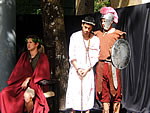
I prefer to use the Spanish word, viacrusis, for the very different “living stations” which are not at all bizarre to Latin thinking. I wrote on one modern student preparing for the Itzapalapa viacrusis (which attracts about a million people every year) and the photos in the article are from the University of Guadalajara’s annual production. The photo immediately below if from Zacatecas.

The Unacknowledged Christs, by Karla Itzel Ruiz and Maricela Jimenez
Fourteen stops on a route of suffering and penance, a wooden cross and death at the end of the road… these are the basic elements of the Good Friday services.
Remembrance of Jesus Christ’s journey to his execution gives hope to thousands of Catholics. But the Viacrusis is not just the way Jesus Christ spent his last hours, but the way many of us live today.
Migrants, prisoners, abused women and homosexuals are some of today’s Christs who few recognize.
For them, translating the remembrance into reality is a way of making Jesus’ life and suffering relevent to their own lives.
VIACRUCIS OF THE MIGRANTS
Every step and every wound, the tears shed, the injuries, the separation from the family and falls along the road, are not Stations of the Cross in a church, but the calvary of many migrants on their road of destiny, the United States.
Saltillo, the Coahuilense capital, has become a place to rest and recuperate from the mishaps of the journey, and to replentish the energy needed before heading off towards American territory. Deportation, denouncements, arrest, physical and sexual abuse by authorities, are some of the problems confronted by migrants. They search for a temporary shelter to rest before continuing their trek to the United States.
The Casa del Migrante refuge sees between 100 and 130 persons daily, the majority from Central America, anxious to begin as a marginized working class in the United States. They have left their home, their family, their work and their motherland to take on this project, their own Viacrucis.
As they near the border, the migrants face a long trek on foot, enduring the blazing sun by day, the freezing nights and risk attacks from wild animals.
Luck may smile on those that make it to the other side, but some will be less fortunate – caught by the Border Patrol and deported to their own country, or ending as carrion for the wild animals, another on the long list of deaths of those who sought the American Dream.
Father Pedro Pantoja, director of la Casa del Migrante, holds weekly services during Lent. Each Friday, he uses both Bible readings and the experiences of his guests to give meaning to the Stations of the Cross, drawing parallels between the accidents and savage attacks on the migrants and the suffering and final journey of Jesus.
Although a Catholic priest, Pantoja respects the diversity of religions of those entering the Casa. However, he does invite the youths at la Casa to participate in the Mass, the prayers, the Lenten services and preparations for the Viacrusis.
He is trying to make the Viacrusis of the past into a social reality. For those accustomed to the plaster representations in the churches, he hopes to have them live it, and see it in the present, in the experiences and challenges faced by real people.
GAY JESUS CHRIST
Homosexuals are another Christ of our time, suffering daily rejection and discrimination from conservatives, denied acceptance by the religious, alienated from the people, institutions and moralistic norms – and, it seems, from God.
According to official reports, 295 murders (275 men and 15 women) between 1995 and 2003 can be officially labeled as caused by discrimination or homophobia.
Deputies, senators, political parties, Mexican machos, housewives, businessmen, priests… the ranks of homophobes include all those who overlook or close their eyes and chose not to see the obvious reality to the pain inflicted on a minority of great importance to the country’s future. 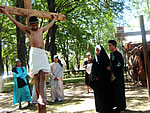
Four year ago, the Bishop of Satillo appointed Father Robert Coogan to the Comunidad San Elredo, named for the Abbot of Rievaulx, an historian and writer of homilies, whose homophilic writings show he was a homosexual.
Coordinated by Noé, Eduardo and Gaby, San Elredo brings together gays, lesbians, bisexuals, transexuals, transgenders, transvestites and heterosexuals, as well as politicians, doctors, business owners, teachers, priests, religious, family members and opinion leaders who participate in religious and other activities.
One of the most important is a homosexual Viacrusis, held Good Friday every year for the last three years.
Contrary to popular opinion, this Viacrusis is not a drama, nor an eccentric production. It respects the traditions of the Catholic Church and seeks to avoid appealing to the morbid curiousity of those expecting a flamboyant display of some kind. The fourteen stations of the Cross are represented in banners, where homosexuals, their families and friends read a reflection based on the experiences they have had with suffering, rejection, discrimination and even deaths caused by homophobia. This year’s Viacrusis will be held on Good Friday at Plaza Nueva Tlaxcala in the Centro.
CALVARY AMONG THE CELLBLOCKS
A darkened room, far from any people or noise, with only the rats running down the hallway for company, is a unique place to meditate and reflect on the meaning of Good Friday.
The Men’s Center for Social Readaption in Saltillo has close to 800 inmates, about five percent of whom are membery of the Penitentiary Parish, also coordinated by Father Coogan.
The group conducts different spiritual activities, including retreats, prayer meetings, baptisms and weekly or monthly masses, and assisting convicts in integrating religion into their daily lives after they compete their sentences.
One of the most important activities the group undertakes is a Convicts’ Viacrusis. The Parish selects the people who will incarnate the personages in the production and prepares the necessary staging. While the traditional Viacrusis only includes fourteen stations representing different points on the route to Jesus’ Crucification, the Convicts’ Viacrusis also includes Jesus’ imprisonment, with reflections on heart-felt repentance. The original service, prepared years ago by members of a religious order, the Missionary Servants of the Word, it has been revised continually over the years by the convicts to reflect their own needs and sensibilities.
Prisoner’s families and some members of the Diocese of Saltillo also participate in preparation and the Viacrusis. Costumes and makeup come from the outside, and – being a Men’s prison – outsiders take the role of the Virgin Mary and the other women who accompanied Christ during his Passion.
While the whole thing might be seen as a game designed to touch the conscience of the inmates, everyone can relate to someone – whether Judas, the traitor who repents or Peter who wouldn’t squeal.
For “Jesus”, the identification with his role has been so strong, he asked to be put into solitary confinement to reflect on his part. He wants the dramatization of the whipping to be true, and hopes to truly repent of his sins and to feel as Christ felt that day.
THE INNER CHRIST
Migrants, homosexuals, convicts, single mothers, beaten women, abandoned children, each person lives their own Viacrusis.
Failure, rejection, mistreatment and regret are a daily battle, and everyone hopes to see an end to their own pain.
No one can judge a person based on first impressions, because no one knows what another person has been through, or what they must go through. They can only reflect on their own experience. It is up to each person to live their life, and to bear their own cross. It is enough that everyone relates and understands that many years ago, Jesus Christ did the same.
It won’t expiate your sins, but you’ll feel better if you donate:
Gangster’s raps…
It was a dark day indeed when spin-doctors entered Mexico… has anyone heard from Dick Morris or Rob Allyn since Felipe Calderón’s “election”?
(El Universal story by Francisco Gómez. My translation):
The organized crime syndicates have opened a new front in their fight for control of the market – a media war – according to specialists from the National Institute of Penal Sciences (Inacipe, for its acronym in Spanish).
Israel Alvarado and Ricardo Gluyas, specialists at the Institute, agree that the reason narcotics traffickers have turned to video threats and warnings posted in blogs and on the Internet, is not only to send a message to rival organizations, but to create a perception of global insecurity and governmental weakness.
Clear examples of the narcos use of media techniques was the poster with photographs of rival Juaquin “el Chapo”Joaquin Guzmán Loera, and deseminating a video of a Zeta’s execution. Other videos have also recently appeared on the Internet. One shows a Zeta denouncing police officers who double as hit men, and a web page recently went up justifying one of these hit-men’s murder.
There is also “the Family”, a self-appointed group that came to public attention last year when someone went door to door in Michoacán leaving recruiting literature for the group, and paid for inserted advertising supplements in two Morelia newspapers, assuing the public that its mission was to wipe out “ice” sales, kidnapping, telephone extortion and murder-for-hire. In addition, “the Family” ads included a “reflection” directed at parents, urging them to cooperate with the group.
Federal prosecutors assume “the Family” is a media strategy of the Zetas, who work for the Gulf Cartel. That cartel is directed from prison by Osiel Cárdenas.
Israel Alvarado, an Inacipe researcher, said the drug cartels are not only looking to dominate their rivals within their market, but are using technology to create an image of insecurity in the press, and among the general public.
Alvarado, an attorney, said that drug trafficers are always updating and moderizing their methods, and have turned to the Internet because “they quickly learned that sending messages this way not only frightens their adversaries, but also has a social impact.”
Sending out videos, leaving messages on their victim’s bodies, and creating blogs are all ways the traffickers are meeting their objective of creating a perception of generalized violence.
This does not mean that threats of violence should be taken lightly, nor that criminal on criminal violence is ignored, but that the purpose is to create a climate where authority is ignored.
The specialist emphasized that this is a “low intensity war” in which the narcotics traffickers are taking account of all of society, and using mass media to reach those not part of the violence and delinquency.
Inacipe is an academic research and training service for specialists and agents of the Federal Public Ministry specializing in justice and public security issues.
DON’T MAKE ME FIND NEW SPONSORS! —
Monkeying around with the news…
OK, so I like to go off on historical riffs sometimes. Yesterday, I wrote about a contract between Mexico City and a Chinese telecom company. Some guy from Maryland left a comment on the “digg.com” spot complaining that the story DID NOT deal with financial inequality in Mexico or with immigration to the United States. Sorry, but not everything in Mexico somehow relates to some concern of some guy somewhere in the U.S.
When I replied to that effect, and questioned what immigration had to do with WiFi, he started complaining that my article went off on that historical riff on Vasco de Quiroga. Fair enough, but then, what would a riff on immigration have to do with it.
Ah well, I can’t make everyone happy. And, sorry, but the Mex Files doesn’t just confirm pre-existing prejudices, or make claims based on nothing (the guy insisted Mexico doesn’t have indoor toilets. I’ve actually shit… many, many times… in Mexican indoor bathrooms. And showered in them, and used some very, very, very high-tech bathrooms too. OOPS… there I go again).
Besides, if you want bullshit, and irrelevency, that’s what the wire services are for (not fair, but c’mon… every time you read an article from Mexico, somehow they manage to mention either drugs or immigration. Unless you’re talking about Canadian papers, in which case they mention dead Canucks).
And… what my correspondent thought was REAL Mexico was the report on a monkey escaping from a zoo and biting a woman on a bus.
Which may — or may not — be factually accurate.
Was it a spider monkey (as reported by the AP) or a kinkajou (as other reports have it) ? Or maybe it was a plain old comandreja (cotamundi), which is a fairly common pet
Kinkajous are nocturnal, and I can’t see one getting on a bus… or was it a mini-bus? The foreign reports aren’t clear on the story of the “monkey escapes from zoo, bites woman on bus” story making the rounds this morning.
The story says the critter curled up with the driver. That sounds more like a coati to me… but who knows. Kinajous don’t like to be disturbed when they’re sleeping and get a might testy. Coatis are social animals, active during the day, but don’t react well to authority.
And neither of them look much like spider monkeys. I don’t think the AP reporter (or anyone else) even bothered to ask.

And, now for the historical riff:
It’s not as good as the great 1954 Santa Maria de la Ribera elephant stampede… when Ringling Brothers elephants, transferring trains at Buenavista Station — and tired of working for peanuts — liberated themselves. They managed to take out a few cars, and stomped on the PRI’s press secretary (probably the only political figure in the history of the Americas killed by an elephant), a few cars and trucks and tore up the Parque Popular at the corner of Jaime Torres Bodet and San Cosme before they were surrounded. Leader Judy refused to surrender, and after taking out a police car, was machine gunned to death.
It was hard to cover up the police shooting, even in 1954 Mexico. Judy was dragged off by a tow truck and fed to the lions at the Chapultepec Park.
Anyway… I heard this story yesterday. My post about WiFi was picked up by some guy in Maryland, who complained I didn’t mention economic inequity in Mexico, or deal with U.S. immigration when I was talking about a contract with a Chinese wireless company.
Back to the main point…
I suppose I could stick to “bad Mexicans — drugs, poverty and immigrants”, but what would be the point? The AP and other wire services all write the same old shit every time they write anything, and… when they have a weird story (like the escaped … whatever… riding a bus… or van … or whatever) aren’t sure how to deal with it.
I try to write — at least once in a while — about Mexico as a normal country. OK, it’s not, but it’s weirdness is not necessarily always OUR weirdness.
Geeze, I’d hate to lose a reader, but folks who just want confirmation of their prejudices are better off elsewhere. Besides, I don’t think that guy from Maryland ever gave me a dime (or a peso, for that matter):
I really need photoshop…

“I don’t like it when people call me a racist or xenophobe”
Gee, I wonder why anyone would have said that about Tom Tancredo… uh, maybe this?
In 2002, The Denver Post ran a human-interest story about a high-school honors student who couldn’t get college financial aid because he was in the United States illegally. Tancredo tried to have the boy and his family deported.
And that was from a sympathetic article on Tancredo in Newsweek!
Anyone interested, Tom’s website is up… and it’s a hoot. The editorial support comes from Alan Keyes “Renew America” and some guy I never heard of… Mike Madden. Think it’s this scholar?
about that photoshop… and my phone bill, and my overdue dental work…ahem…
The “Real Mexico” is high-tech Mexico
Sorry to disappoint those who think “the real Mexico” is some colorful, backwards peasant society, but…
The Federal District has signed a contract with the main Chinese telecommunications company, ZTE, with the goal of making wireless internet communication available free of charge from anywhere in the District by 2008.
District Governor, Marcelo Ebrard, said the system will also operate 4,000 videocameras within Mexico City.
The Chinese firm will have a Mexico City partner, generating additional employment.
At the signing, Ebrard and the Chinese exchanged gifts: a replica of the Angel of Independence from the Federal District, and a traditional Chinese fan from ZTE.
Alejandra Martínez, El Universal, 02-April-2007 (my translation)
This really shouldn’t be that huge a surprise, except maybe to those U.S. companies that just overlooked the Mexican market. For some reason, this article made me think of Al Gore… not “inventor of the internet” Gore, or “global warming Gore” but the Gore-Shrub debates of 2000. I don’t know if anyone else caught it, but Gore said something about growing the U.S. manufacturing economy by meeting the growing middle class demand in other countries for energy-efficient, or at least, reasonably priced, goods and services. Nobody seems to have listened, except maybe the Chinese.
 Santa Fe is not just corporate headquarters and funky office buildings (with the canyons, you have highrises that are pretty much upside down… I worked in one building where the “ground floor” was the 10th floor on the street side). It’s also a very old “commune.” Vasco de Quiroga, who started the tradition of activist retirees in Mexico, founded the community back in 1535.
Quiroga was about to retire as a judge when he arrived in Mexico in January 1531. He was 60, elderly for the time, and planned to hear the cases, then retire to a monastery (which functioned as the retirement communities and assisted living centers of their time). Hearing minor criminal cases, he was probably one of the first people anywhere to recognize alcoholism as a disease. He blew his retirement nest egg on a hospital… San Hipplito (which still stands today)… the first alcoholism rehab in the world.
 A true renaissance man (to be expected of a guy living during the Renaissance), he was one of those geezers who gets excited about new ways of doing things, and new things to do. Having read the recent best-seller, Thomas More’s Utopia (which envisioned self-governing republics without lawyers), Qurioga had himself ordained and later became a Bishop, so he could put More’s theories into practice, setting up communes (especially among the Tarascans in Michoacan) that preserved indigenous culture under a new form of self-governance.
One of the first communes was Santa Fe, now home to Mexico City corporate headquarters and neo-post-post modern architecture (along the barancas and canyons, you’ll find upside-down high-rises, a giant Tequila bottle — naturally, it’s Jose Cuervo’s headquarters — and some of the hippest housing on the planet). The traditional community is still there, living cheek by jowl with los yupis. No surprise then, that one morning, taking a bus out that way, my seat mate was an older indigenous woman, complete with braids and bangles… and her laptop. We had a nice conversation about DSL connectivity.
Bishop Quiroga probably would have said “COOL!” (or whatever the 16th century Spanish equivalent of that would be) and — as Judge Quiroga, started writing contracts to provide computers for the communes. Think of it… this means José Lopez will be able to check not just his email and send e-priapos to girlfriends and wish-they-were girlfriends, small time merchants will be able to shop on-line… or send out delivery orders, or do banking or…
Just think of the energy savings: Mexico does a lot of business face to face, and always will, but if you’re not running all over town looking for a part or a specific item, that’s one less body on the Metro, or one less car, or one less wasted trip (if my students had emailed me that they were blowing off their lessons, it would have saved me at least four or five hours a week on the Metro).
As it is now, Mexico is a lot better “wired” than people realize. Any small village has an internet cafe. Sometimes it’s a little funky (one in my Mexico City neighborhood was in a neighbor’s living room… the 11-year old was a pretty good tech support guy, and the four year old chasing after his pet pigeon was good for comic relief), but you can usually find a computer SOMEWHERE. With wireless, this means you’ll be able to find them ANYWHERE.
Oscar Lewis wrote about families that rented out their living room to watch TV in the late 1950s, when TV was still new and exciting (and one family added a snack bar), so I’d fully expect you’ll have some family every neighborhood to start renting out their hardware to make ends meet. Besides the entreprenuers who’ll set up on every urban corner with a laptop and a table, I wouldn’t be at all surprised to find ambulantes with laptops
The thing that gets me about Mexico City going wireless isn’t that it’s a radical idea. Sure, it’ll be one of the biggest wireless communities in the world, but what’s unusual is who is sponsoring this. Not us capitalists — who missed it when Al Gore talked in 2000 about the need for U.S. businesses to focus on goods and technology in less-wealthy countries if they wanted to expand — but the Chinese and the Mexican socialists.
When Latin Americans talk about the U.S. losing influence in the region, it’s not just the big ticket items like oil and minerals they’re talking about. Mexico is not a poor country, poorer than the U.S., of course, but as a whole, it has money to spend and invest. On a per capita income basis, think Poland or the Czech Republic. For Mexico City, think Italy. But, we’re trying to buy, not sell… and Pemex isn’t for sale.
So, the Mexican military has been buying Polish tanks and Russian jets... a week or two ago, Calderón inaguarated a new wind-generating plant in Oaxaca (which will provide 20% of the City’s power), deals between Pemex and the Norwegan and Brazilian state oil companies are in the works… and Mexico City is buying Chinese wireless services. While we’re still trying to force them to buy rice they don’t want. That’s nuts. And Vasco de Quiroga would agree.
Monday… back to work
El Universal’s Luis Olivares took this photo of Jefe de Goberinero Marcelo Ebrard coming to work this morning. It’s the first monday of the month, mandatory bike-to-work day for Mexico City bureacrats.

At least he didn’t roll into his office at 6 AM for a press confererce, like AMLO used to do… and the reporters had it easy, travelling by motorcycle. Still, a little less traffic can’t hurt.
A Republican (who else who think of something this stupid?) plan:
The estimated 12 million illegal immigrants in the U.S. would be allowed to apply for a “Z Visa” that would be renewable every three years. Applicants would have to pay $3,500 with each renewal, some of which would be shared with localities as an “impact fee.” Z Visa holders would be eligible for emergency social services, and primary and secondary education.
If illegal immigrants wanted to begin the process of applying for citizenship, they would receive no special preference, and would have to pay $2,000 when they applied for a legal permanent resident visa, or green card, and $8,000 when they were approved. The standard fee for citizenship applications is set to rise from $400 to $675 in June.
Household heads would have to leave the country and reenter to complete the process, with their reentry guaranteed by their Z Visa.
What planet are these guys from? 10,000 bucks to get a green card? And you wonder why people just come illegally. Who the hell is emigrating with that kind of money (OK, besides Cuauhtémoc — below)? The polleros are gonna love this.
A sombrero tip to Laura Fern, at One Step Closer. Laura has been living and working in Mexico, dealing with the absurdities of life in general, and the idiocy surrounding her husband, Fermin’s, immigration to the United States, in particular. Recommended reading for anyone who thinks immigration is just a simple matter of waiting in line and filling out some forms.


