Cuauhtémoc Blanco — doing the job Americans can’t…
First David Beckham, now Cuauhtémoc Blanco:
Mexican soccer legend Cuauhtemoc Blanco will put pen to paper Tuesday on a deal with the Chicago Fire, the club has announced. …
Like David Beckham, who agreed to a five-year deal with the Los Angeles Galaxy in January, Blanco won’t join his new club until the summer. His contract with his current team, Mexican powerhouse Club America, expires June 30, and Blanco will be eligible to join the Fire immediately thereafter.
The guy’s got talent. He was on the 1998 and 2002 Tricolor teams, and scored 9 goals in the 1999 FIFA cup tournament, which featured “la Cuauhtémiña” — a down the field bunny-hop with the ball between his feet. Yeah, that’s legal.
There are probably some in Mexico who aren’t sorry to see him leave. He once complained to the press about National team coach Ricardo LaVolpe’s selections, telling the reporters “I don’t like some of the players, and I would have picked other guys.”
LaVolpe picked some other guys. Blanco’s fans picketed — but, then, in Mexico, manifestaciones are the OTHER national sport.
Blanco started a brawl at Estadio Azteca (not a usual occurance at a Mexican futbol game) and ended up with a one-year international suspension. He refused to play an away game in Dallas for Americas. It seems he’d punched out an autograph seeker in a Houston bar and process servers were standing by. Dissing a referee — ok, Mexico’s first female referee — didn’t go over real well with the Mexican sportscasters (or fans, which is kind of suprising).
Described as “part-Dennis Rodman, part Alex Rodriguez, part-Kobe Bryant,” the 34-year old Tepito native should fit right into the word of American pro-sports.
On the field…
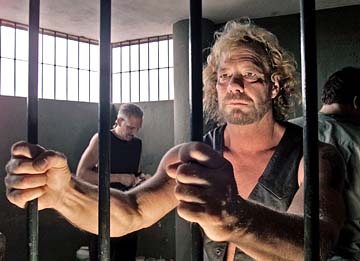
 An obscure bureaucrat in the first Bush adminstration’s State Department, Alan J. Kreczko, is somehow connected to Dog the Bounty Hunter, Tom Tancredo, Immigration, Mexican-American relations, the war on drugs and… all hell… let’s just hope the whole thing is an April Fool’s Day joke.
The Hawaii State House of Representatives wasted their time last week praising Dog and Mrs. Dog Chapman for their “hard work and dedication to catching more than 6,000 bail-jumping crooks.”
Dog, the last we heard, was still wanted for deprivation of liberty in Mexico… having “captured” (i.e., kidnapped) a fugitive who Dog’s fans say was protected by his (financial) status, Dog wants to be protected by his celebrity status from standing trial for his crimes:
Dog’s most notable capture was undoubtedly the collaring of Max Factor heir Andrew Luster in 2003. The snare subsequently landed him his own A&E TV show, which is currently the cable channel’s most-watched program.
Last month, that particular case led a Mexican court to rule in favor of having Chapman shipped south of the border to face trial on one count of “deprivation of liberty” in violation of the country’s anti-bounty-hunting law. That decision was roundly condemned by Hawaiian lawmakers, fans and even members of Congress, who said the reality star was only carrying out justice when he apprehended Luster, who was hiding out in Puerta Vallarta after he was convicted of sexually assaulting three women in California.
Tuesday’s declaration praised Chapman for never using a gun while doing his job
Well, gee… I sure HOPE nobody would give a gun to a convicted murderer. I’ve written on the Dog’s background, and the Andrew Luster incident before. Dog’s defenders always complain that Luster enjoyed special protection for extradition… the same thing “Dog” now is seeking, using celebrity where Luster used money… if indeed Luster was even protected.
Lee Catrell of the Honolulu Star-Bulletin has done an excellent job of following the more serious aspects of the case… and the effect this has on extradition in general.
Chapman is seen by many Americans as a true hero who brought to justice a despicable serial rapist who had been on the run. Luster was in the habit of incapacitating women with the date-rape drug gamma hydroxybutyrate, or GHB, and was on trial in California when he fled the United States. He was convicted in absentia and now, thanks to Chapman, is serving a 124-year prison sentence.
The perspective from south of the border is somewhat different. Mexican law enforcement still might be smoldering about a 15-year-old U.S. Supreme Court ruling that essentially made American bail-jumpers in Mexico fair game to be caught and hauled back across the Rio Grande. U.S. administrations since then have tried to reduce the friction.
The legal issues concerning extradition are controversial. Although bounty hunting is legal in Hawaii, “that doesn’t mean that a bounty hunter can go anywhere in the world to gather up his quarry,” said Russell Covey, an assistant professor at the Whittier Law School in Costa Mesa, Calif. “A police officer is authorized to make an arrest in Hawaii but can’t go to another country or even another state and arrest people. That would be considered a criminal offense.”
The law on extradition is a bit murky:
The United States and Mexico collided over a capture stemming from the 1985 torture and bludgeoning to death of Enrique “Kiki” Camarena Salazar, a U.S. Drug Enforcement Administration agent, in Guadalajara, Mexico. The DEA hired several Mexicans five years later to kidnap Humberto Alvarez-Machain, a Guadalajara physician accused of prolonging Camarena’s life so others could further torture and interrogate him. Alvarez challenged the charge against him, maintaining that his abduction in Mexico violated the 1978 extradition treaty between the United States and Mexico.
The Supreme Court rejected Alvarez’s argument. In its 1992 ruling, then-Chief Justice William Rehnquist wrote that the treaty “says nothing about the obligations of the United States and Mexico to refrain from forcible abductions of people from the territory of the other nation, or the consequences under the treaty if such an abduction occurs.”
Mexican officials were angered by the ruling, and the White House tried to mollify them. President George H.W. Bush quickly gave his assurance in a letter to Mexican President Carlos Salinas that his administration would “neither conduct, encourage nor condone” such transborder abductions from Mexico in the future.
Alan J. Kreczko, then deputy legal adviser to Secretary of State James Baker, said in congressional testimony less than three weeks later that his boss and Mexican Foreign Secretary Fernando Solana exchanged letters “recognizing that transborder abductions by so-called ‘bounty hunters’ and other private individuals will be considered extraditable offenses by both nations.”
Two years later, the two countries’ administrations agreed upon such a Treaty to Prohibit Transborder Abductions. However, it defines such abductions as those “by federal, state or local government officials” from the country where the person is wanted “or by private individuals acting under the direction” of government officials. Not only are bounty hunters unaffected by such an agreement, it never was sent to the Senate for ratification.
While post-Bush I administrations might have honored the agreement between Baker and Solana, a judge might ignore it.
As it turns out, “Dog” — who is definitely not a police official, claims to have had a Mexican cop along (something that would have made the incident a little less problematic). One problem: taxi drivers are not policemen. Hey, the guy had a badge (he had once been a hotel security guard), so “Dog” — that upholder of law n’ order — is pleading… what… that he’s a dumb gringo?
Stupid, racist, a media whore and prayerful for the cameras — and somehow all related to Mexico — it’s time to ratchet up the weirdness and bring in Tom Tancredo.
President of the Confederate States of America not being available, and Führer not a title we use, Tancredo is settling for a run for the Republican nomination for President of the United States.
Tancredo has started out with a bang, calling for deportation of aliens, but that’s not enough. To be a good candidate, he’s got to show some foreign policy experience: so, as Chris Good reports on The Hill (Washington, DC):
Rep. Tom Tancredo (R-Colo.) is questioning the legality of the ongoing extradition of bounty hunter and cable TV personality Duane “Dog” Chapman to Mexico. The lawmaker Wednesday contacted Secretary of State Condoleezza Rice about the case.
“News reports have come to light showing that the extradition agreement between the U.S. and Mexico may be nothing more than a wink and a nod between governments,” said Tancredo, who is running for president. “I hope that Secretary Rice looks into whether this agreement has the legal force before extraditing a man who put away a serial rapist.”
…
Tancredo based his inquiry on the congressional testimony of Alan J. Kreczko, deputy legal adviser to then-Secretary of State James Baker, who said the U.S. and Mexico had “exchanged letters” approving the extradition of bounty hunters for trans-border captures.
So… Congressvarmit Tancredo who makes an issue of extraditing criminals — wants to end Mexico cooperation with the U.S. “War on Drugs” and extradition agreements, based solely on the fallout from kidnapping a Mexican doctor who was acquitted in the murder of an American agent in our on-going “Drug War” which led to Mr. Kreczko’s legal opinion (and subsequent legal and executive policy) — to benefit a TV star.
This being April Fools Day, maybe we should all go out an “Savage” the Tancredo campagin… as in Dan Savage’s “help” for Gary Bauer in 2000. Savage had a bad case of the flu, and if he couldn’t get Bauer sick, maybe he could bring down the Republicans by supporting a lunatic .
I’d be saner and simpler to start a new reality show: “Dog the Bail Jumper”
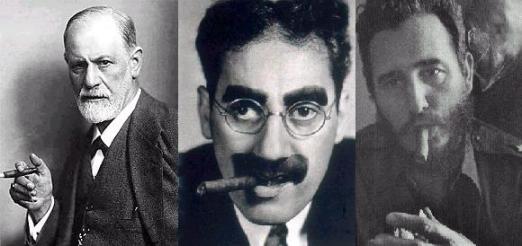
Light up a cohiba and enjoy the Friday night video
 A
A
A discoverer of hidden motives who pointed people in the direction they needed to go to resolve their conflict, a witty commentator on the worlds’ absurdity and a Latin American icon… and somebody you always think of when you say “cigar:…
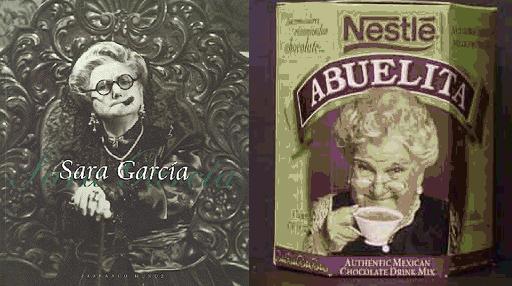
Of course, I mean Sara García (hey… this is the MEX files, remember?)
García’s very long film career begin in 1917 with Alma de sacrificio, Azteca Studios first production. She was a 22 year old convent school teacher, looking to make a little money on the side. She’d go on making films until her death in 1980… playing in 146 in all, as well as appearing in television productions, writing, producing and directing films… and becoming a staple in Mexican pantries.
In 1940, when she was only 45, García took out her front plate, put on her glasses and… created a Mexican icon. In every movie she was in — and it didn’t matter whether she was playing a historical figure, a peasant or a dutchess — she was wearing those tortise-shell glasses and smoking her cigar. Whether really necessarily for the script or not (and Mexican scripts usually did call for it), a place was found for “Abuelita”
The 1946-47 “García” films … Los Tres García and Vuelven los García, were a vehicle for Pedro Infante — as usual — the charro, macho, and slacker. Sara is the matriarch of the Garcías in a melodramatic tale of the family’s feud with the Lopez family… “granny” controls the family, even (by the end of Vuelven los Garcia) from beyond the grave — with psychology, humor and sheer Latin American orneryness… and with a cigar always in hand.
From the 1947 Vuelven los Garcia, Pedro Infante sings Maldita sea mi suerte.
xxx
The horror! The horror!
A real post from the batshit crazies at freerepublic.com:
No, this is not in Mexico. This is in Southern California. It is 36 acres of Mexico. Perhaps it is no big deal. It is surrounded by about a million acres of Mexico.
I can understand the historic buildings in Los Angeles that celebrate the founding of the city. That’s fine to celebrate history. But this is an in your face example of Mexico’s conquest. I wonder when they take over the Alamo?
As I was driving back to Upland from lovely Inglewood a few weeks ago, I shot a few photos from my car of Plaza Mexico. This was taken from the 105 Freeway in Lynwood, CA.
Someday our grandchildren are going to ask how we were able to defeat the Nazis and Imperial Japanese, how we were able to collapse the Soviet Union, but how we let Mexico take our country without firing a shot. That appears to be the legacy we are going to leave them.


Uh… it’s a shopping mall. In Southern California. With Mexican theme restaurants (and pretentious home furnishings stores). Think of the children…. what will the future hold for them?

¡GOL!
There were two important futbol games last night played in the U.S. last night: Mexico bested Ecuador (4-2) at McAufee Coliseum in Oakland CA, before a sell-out crowd of 47,416.
The United States tied Guatemala (0-0) at Pizza Hut Park in Frisco, TX… a much smaller stadium, with a crowd of about 10,000.
Grahame Jones, who covered the Mexico-Ecuador game for the Los Angles Times noted:
All the tickets were snapped up two weeks before the opening kickoff, and organizers said they could easily have sold twice as many.
It was the third consecutive sellout for Mexico on American soil this year, following the 62,462 that saw the Tricolores lose to the U.S. in Phoenix and the 63,328 that watched them defeat Venezuela in San Diego.
I had to go through three screens on the Dallas Morning News webpage (starting from the Sports page), before I found — buried down below high school reports — “U.S. Coach Upset With Tie in Frisco“. It was the only report from Dallas I could find.
Geeze, even the local paper didn’t much cover the game. Goal.com — from INDIA — has some coverage, though they weren’t very nice:
The U.S. and Guatemala played to a boring nil-nil draw at Pizza Hut Park. Both teams were clearly more interested in the post-game spread than the game at hand.
Michael David Smith weighed in at AOL Sports:
It says a lot about the state of soccer fandom in this country that the Mexican team always draws many more fans than the American team. …
Major League Soccer thinks its signing of David Beckham is the way to gain a foothold in the United States, but I just don’t see it…. If [soccer] really wants to become popular in this country, it needs to reach the passionate fans who fill the stadiums to watch the Mexican national team, not the people who know Beckham because his name was in a movie title and his wife is a Spice Girl.
And, face it, the Mexican play better soccer. So do the Guatemalans… and even the English (but they’re so uncivilized!).
The U.S. plays in some rinky-dink suburban Dallas stadium trying to market to suburbanites who might remember the Spice Girl’s name (I don’t… and whatever happened to the Spice Girls anyway?). And nobody in the U.S. really likes the British.
For Mexicans, FUTBOL — and the insanity surrounding futbol — IS life. Who would you rather go watch The team supported by the Virgin of Guadalupe … and 100,000,000 lesser beings, or one that gets (and maybe merits) about the same media coverage as Junior High School Girl’s Volleyball?
Abortion will be non-issue
Decriminalizing abortion is pretty much a done deal in the Federal District. All the U.S. based reports mention that “Mexico is a Catholic country”, which while culturally true, isn’t a particualarly enlighting statement. According to the Archdiocese of Mexico City’s own figures, only about 10% of people attend Sunday Mass. And how many of them are just there to keep granny happy isn’t clear.
What’s interesting is that it’s the PRI — struggling to remain relevent — and the smaller parties that introduce the progressive ideas. It was PRI initiatives that led to gay marriage in Coahuila and the decriminalization of abortion in the Federal District was proposed in the Assembly by the PRI. The tiny PT introduced a stronger hate crimes bill the other day, which probably won’t muster a lot of opposition either.
We’ve gotten so locked into the idea that it’s the “conservatives v. liberals” in the U.S. that we forget other country’s politics aren’t always so cut and dried. PRD is the “left”, but that includes a lot of tradtionalists (and, if you ever want to blow your politically-bifurcated mind, consider this — fundamentalists usually vote for the far left, including Communist parties — basically because they want to preserve their minority rights against the Catholic majority. That, and most fundamentalists are poor, rural folks). It ain’t. And that’s what makes the abortion protests all that more interesting.
The Cardinal of Guadalajara came up with the odd argument that legal abortions will lead to maternal deaths. While there’s plenty of evidence that the abortion rate will drop with decriminalization (and maternal health will improve), the Cardinal’s spin is that abortion clinics, being regulated by the state, will pay bribes to health inspectors — and bribery isn’t exactly unknown — the clinics will be unsafe. Interesting, but what’s the situation now (OK, everybody who missed “Padre Amaro” go out and rent the video)?
The anti-abortion forces seem to be depending on foreigners (from both the Vatican and the United States), at least for campaign advice. They seem to be borrowing from the U.S. playbook, and it’s not working.
Not surprising, the Church is up-front in their opposition, but that’s expected. What’s suprising is that the Mexican version of a “Christian right” — or, I guess, in Mexico, the “Catholic Coalition” is Pro-Vida. They had some influence in the Fox Administration, something like Jerry Falwell’s in Reagan’s administration, or any number of Protestant fundamentalist groups in the Republican Party. And, like in the United States, the conservatives pay them lip service, but ignored them when it came to divvying up real power and money. Marta Fox had ties to Pro-Vida, and, to no one’s surprise, both got caught up in bizarro scandals — Marta’s “charity” was shaking down businesses in return for “access” (a la Tom Delay), and channelling government funds to Provida, which was — even for their own funds — spending it rather oddly. The old farts who run the group don’t need designer tangas. Not with money meant for birth control education, anyway.
Provida is back in trouble. This is more or less comparable to something U.S. Republicans would do, too. Keeping the military (and the Church) out of politics has been seen as a necessity, and military officers — in uniform — at a Provida sponsored anti-abortion rally did not sit well with… anyone. This just pissed off the PRD deputies in the Federal District, making them more likely to pass the decriminalization bill in April.
And, as to the Cardinal. This is really interesting. The Secretary of Health, José Ángel Córdova Villalobos, who has some wacky ideas about public health himself (like suggesting condoms cause sexually-transmitted diseases) stated that the Federal heath care facilities can, with no trouble, provide legal abortions.
WHAT’S GOING ON?
My thinking… the July 2006 elections really did shake the country up. While the “left” supposedly lost, the three main left-wing and socialist parties (FAP coalition, PRI and Alternativa) at least control the social agenda. What the “right” really is interested in is business. And, even there, the right depends on some left-wing support to get anything through. I’d watch how the new pension law shakes out (which is very much a conservative “win” — semi-privatizing state pensions, and folding the separate social security system for civil servants into the general system) is the issue to watch.
Another point: traditionally, Mexican administrations make their mark in the first year. They start out strong, then spend a year or two screwing around, then lose steam in the last two years. Fox unfortunately, never got anything through Congress, and made a strategic error (he only won with support from the Greens, then didn’t give them any Cabinet seats, sending the Greens into a coalition with the PRI) at the get-go.
I think what Calderón’s administration is looking at doing is getting the contentious minor issues out of the way… and then they’ll fight over the next year about the “real” business of PEMEX (I’ll bet some sleight-of-hand method is found to bring in Petrobras, as a Mexican investors), immigration and gun running/money laundering.
Mexico just doesn’t have the luxury to get worked up over side-shows like its neighbor to the north does.
Buried treasure
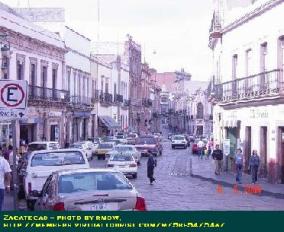 It was silver mining that made a few Mexicans, like Conde Borda very, very rich in the 18th century, and why there are those “colonial gems” scattered around Northern Mexico. Zacatecas and Guanajuanto both had their reign as “richest city in the Americas” for a time. Touring the worked-out Zacatecas mine is always an experience, and Zacatecas’ “Disco Inferno” is a brilliant reuse of an old facility (the neighbors can’t hear the noise from what’s the only club I’ve ever been in that can honestly call itself “underground”… you pay your cover charge, and go in by tram).
Mexican silver is also the reason the U.S. uses the dollar. Spain could throw its weight around in the late 18th century superpower game, and financing George Washington’s insurgents was kind of a low cost way of keeping the British from getting any more power than they aleady had.
Mexican reales (pieces of eight) were the original dollar. It’s why the Mexican Peso and the Dollar both use $ — and why a quarter is “two bits” (two-eights of a piece of eight = 2/8 = 1/4 = one quarter).

In 1828, Joel Poinsett engineered an anti-Spanish uprising in Mexico City that convinced the Mexican government to expell the Spaniards who’d stayed on after independence (So much for the canard that “Spaniards rule Mexico” that you still see in right-wing publications and cranky letters to the editor and comments sections).
Poinsett (and his British rival H.G. Ward) both assumed THEIR country’s financiers would be able to pick up the mines cheaply. Poinsett was wrong. The Spanish mining engineers were mostly replaced by Brits and French engineers and capital, but the British, seeking a quick return, generally abandoned mines rather than put in capital improvements.
The French invasion in the 1860s was largely based on Napoleón III’s expectation that he could gain control of silver mines in Sonora (Napoleón somehow got into his head that Sonora was a particularly rich silver-mining region. It isn’t, though there’s some there too).
With the revolution, mines, like othe mineral deposits became property of the nation, but the mines themselves have remained in corporate — mostly foreign hands. Mexican owned Peñasco is one of the largest gold and silver exporters in the world , though there are huge Canadian investments too (far outweighing whatever Canadian tourists spend).
Silver mining is still very important, but not really thought much about… it’s a basic commodity, but unlike oil, the source is fairly stable. And, perhaps there’s a lot more than we thought.
According to Lawrence Williams, in the South African on-line mining journal Mineweb, those old, traditional mining towns may be in for a new boom:
At the MCL 20:20 Silver Day held in London this week it was perhaps significant that of the seven companies making presentations to the audience of brokers, analysts, fund managers, press and fellow miners, four (First Majestic, Arian, Excellon and Scorpio) were focusing almost entirely on Mexico and were already producing silver or had late stage projects in progress, while two others, Hecla and Sterling, were looking to Mexico as a route for expanding silver output additional to their existing North American projects and operations.
Historically Mexico has always been one of the world’s top silver producers, primarily from the country’s silver belt trending mainly northwest/southeast and centred on the city of Zacatecas in the centre of the country. But much of the mining has been relatively small scale on some of the extremely high grade material which has been found along this silver trend which runs for hundreds of miles. Now with the recent runup in the price of silver, North American companies in particular have been attracted to this area which has the advantage of boasting good local infrastructure, a potential workforce with good mining experience and a relatively stable political environment.
Tacos de ojo… para llevar?
Next time I see one of those posts on something like Lonely Planet from someone who doesn’t speak Spanish, and expects to find a job on the beach in Mexico, here’s one to recommend…
I’m not one normally to follow the gosspip columns (I really didn’t catch the news the first time I heard mention of Paris Hilton, and wondered what happened at a French hotel that was so interesting — apparently, Joe Francis is one of Ms. Hilton’s plethora of ex-boy friends, with as distinguished a pedigree as any, I guess)
I hope he knows you have to be a natural born Mexican citizen to run a whorehouse. Somehow “dining experience” doesn’t sound like what this is all about… unless you’re maybe Bluto and Otter on Spring Break.
‘Girls Gone Wild’ Creator Plans Topless Restaurants
Girls Gone Wild creator Joe Francis is turning his soft porn DVD empire into a new restaurant business. Francis, a former boyfriend of Paris Hilton, plans to open diners in Cancun and Cabo San Lucas, Mexico by the end of 2007.
The “sex sells” entrepreneur insists the dining experience will be fun and sexy. He tells the Los Angeles Business Journal, “You’ll be comfortable going in there, but you’re gonna get a Girls Gone Wild experience.”
(source: Starpulse News Blog)
What to see in Matamoros (besides the dentist)…
David Agren, the “Low Rent Correspondent” has been covering “the real Mexico” (whatever that is) for a number of years now. Like most people who live here, he recognizes that “real Mexicans” live along the border too… and that there are things to see, even in Matamoros:
He writes in today’s Mexico City Herald:
MATAMOROS, Tamps. – Cab driver Mario Hinojosa and his sidekick Don Enrique operate from a two-car taxi stand in Matamoros´ Historic Center. They normally shuttle locals and tourists around the border city in a new compact sedan and an aging, yellow 1976 Ford with so many miles that Don Enrique can´t remember how many times the odometer has turned over.
Most of the tourists they serve are daytrippers, who cross the Rio Bravo from neighboring Brownsville, Texas, in search of low-rent diversions like cheap boozing and poring over trinkets.
But a few of the visitors, curious about the dark side of the border, inquire about narcoturismo (drug-trafficking tourism) – which involves visiting the sites where traffickers carried out their dirty deeds and eventually flamed out in battles with law enforcement officials.
“People come here asking about tours all the time,” Hinojosa said on a quiet Monday morning, adding that he charges US$60 for narco-inspired excursions.
…
They´ve also taken passengers to Santa Elena, the site of a ranch that was home to a group of narcosatánicos (narco-Satanists) under the sway of Cuban-American drug kingpin Adolfo de Jesús Constanza – people that Hinojosa says “had a screw loose.” (The narcosatánicos carried out ritual sacrifices and smuggled marijuana until they were busted in 1989.)
Oh, there’s a historical fort there (I can’t be the only foreigner who has actually gone and toured it), and the usual bordertown trinkets, cut-rate plastic surgeons, liquor stores, etc. when you’re not cruising for narco-satanicos (said, by some HIGHLY UNRELIABLE sources, to have included George W. Bush).
xx
“But it’s only a game…”
From WRAL (Raleigh, NC):
Ubisoft-owned Red Storm Entertainment, which is located here in the Triangle, made a killing last year with “Tom Clancy’s Ghost Recon Advanced Warfighter,” which was one of the top-selling games of the year. The just-launched sequel, “Tom Clancy’s Ghost Recon Advanced Warfighter 2,” has now been banned in part of Mexico.
Both games are set in the not-so-distant future of 2014 and involve Ghosts, elite U.S. soldiers, taking on missions south of the border. The first game involves the kidnapping of the U.S. President, and it drew ire from Mexican officials who didn’t like the fact that gamers were blowing away Mexican soldiers throughout the game. The sequel involves Central and South American rebels and nuclear weapons, and the U.S./Mexican border figures into the plot. Like in the original game, the plots are worthy of a Tom Clancy novel and make for riveting Hollywood-style interactive storytelling.
The governor of Chihuahua (the town, not the dog) has banned “GRAW2” from being sold and has ordered all copies confiscated. This comes on the heels of the mayor of Juarez, a city on the Mexican border of the U.S., blasting the game for instilling poor values and portraying his townspeople as violent.
Every videogame, movie or novel has to have good guys and bad guys. It’s quite a simple concept. In “Halo” and “Gears of War,” it’s aliens. In “Call of Duty” and “Medal of Honor,” it’s the NAZIs. In “GRAW” and “GRAW2,” it involves Mexicans, as well as other Central and South American rebels. It’s just a videogame. I don’t think this game is going to have any more negative impact on U.S.-Mexican relations than already exist with the problem of illegal aliens in this country. It’s just a form of entertainment. And it’s a gripping story…
Copyright 2007 by WRAL.com. All rights reserved.
… almost as “gripping a story” as the gunrunners and money launderers who are now financing narco-terrorism in Mexico? And gee… why would anyone be offended by being compared to space aliens or Nazis? I mean, c’mon.
And do you think the Governor of a state that was invaded by the United States might be a bit touchy about games suggesting this was a good idea? And, incidentally, it’s violence that gets movies and entertainment banned in Mexico. Mel Gibson’s “Last Passion of Christ” received a “C” rating (adults over 18 only)

Red Storm Entertainment, for those interested, is run by Tom Clancy and is headquartered in Morrisville, North Carolina. 3200 Gateway Ctr. Blvd.
Suite 100
Morrisville, NC 27560
Phone: (919) 460-1776
Fax: (919) 468-3305
Streets of Poets (Sor Juana)
The Unapologetic Mexican was kind of happy to see I’d written on the Mexican slaves – and ex-slaves (and I’m happy to point people to Dr. Ted Vincent’s Black Indian Mexican for even more information), so I guess it’s my turn to bounce off one of his posts:
IT’S NOT OFTEN that you’ll hear me say “I sure wish I were in Houston!” But this is an exception.
Concerts, exhibitions and performances are only part of the National Sor Juana Festival: A Tribute to Mexican Women, which begins Sunday and continues at venues across the city through April.
The festival celebrates Mexican-born Sor Juana Inés de la Cruz (1648-1695), a poet, playwright, rebel nun — and the first feminist of the Americas. […]
What a woman! Come on. Poet, playwright, rebel nun? Damn.
 Nun. Yup. Mexican-born. Yup. Also Mexican lived and died. I had the advantage of having lived in Santa Maria de la Ribera, where the streets are named for Mexican writers and poets. Specifically, I lived next to the fruit vendor (it was a farmacia while I was there) behind the Jehovah’s Witnesses’ empanda stand on Dr. Enrique Gonzales Martinez (who is best know… if known at all… in English for translating T.S. Eliot’s “The Waste Land” into Spanish) and calle Sor Juana Inés de la Cruz.
I don’t understand why Sor Juana isn’t better known in the United States… other than she was Spanish-speaking and Mexican. She was the continent’s first real feminist (what got her in trouble with the Church was defending women’s education), writing philosophy, theology, drama and… when she had the time… poetry.
Her English contemporaries, Donne, Marvell, John Milton, also speculated on God and man and mixed the erotic and sacred in their writing. Though the English think their “metaphysical poetry” is unique, it is all part of the same Baroque mindset. In Spanish literature, she’s at the top of most lists, somewhere between Cervantes and Garcia Lorca. Octavio Paz (who knew something about poetry, and about world literature) once said, the first, and best, American poet.
While I’ve focused my own Mexican history on the foreigners, Sor Juana is one of the people, like Benito Juarez or Santa Ana, just can’t overlook…
The greatest of Mexico’s colonial intellectuals produced mystical and erotic poetry, feminist tracts and philosophical studies. If that wasn’t enough, she defended scientific education in a religious age. This was an unusual combination of talents, especially for a nun.
 Juana Inés María del Carmen Martínez de Zaragoza Gaxiola de Asbaje y Ramírez de Santillana Odonoju was a child prodigy. Born in 1651, she could read and write by the time she was three. The only place for a prodigy like Juana was Mexico City. She was sent to live with relatives. She was a talented writer and musician by the time she was a teenager, and was a beauty on top of everything else. The Viceroy’s wife heard about this amazing country girl, and moved her into the palace. The girl could hold her own with scholars and fended off would-be boyfriends with witty verses. Some of her most erotic poetry was addressed to the Viceroy’s wife, which some people take to mean she was a lesbian.
She may have been, but the only career paths for respectable women were as wives or nuns. A housewife wouldn’t be able to pursue intellectual interests, so she joined the Carmelite nuns, taking the religious name Sor Juana Inés de la Cruz. The Carmelites practiced strict discipline with no personal comforts – they would only sleep for an hour of two on cold floors between religious services, and never ate hot meals. Sometimes they whipped themselves as a religious practice. This nearly killed Juana, and the Viceroy’s wife rescued her once again, sending her to the Jeronomytes, whom the Carmelites probably considered slackers. The Jeronomyte convents were more women’s residential hotels with religious obligations. Juana collected books, wrote and, shocking the entire Mexican clergy, wrote theology and defended science studies, and women’s education in general.
When the Viceroy and his wife returned to Spain, Juana lost her powerful defenders. Visitors dropped off and the Jeronomyte superiors were suspicious of the radical nun. Cut off from her friends, she either became depressed, or developed serious religious ideas. She gave up her studies, put away her papers and books, moved into an isolated room in the convent and took up the Carmelite practices. In her own blood, she wrote out religious vows, signing them “Juana, the worst of all”. Two years later, at age 43, she died in a cholera epidemic, one of the major intellectuals and writers of the 17th Century1.
Rosa divina II (translated by B. Limosneros)
Rose, heaven’s flower versed in grace,
from your subtle censers you dispense
on beauty, scarlet homilies,
snowy lessons in loveliness.
Frail emblem of our human framing,
prophetess of cultivation’s ruin,
in whose chambers nature beds
the cradle’s joys in sepulchral gloom.
So haughty in your youth, presumptuous bloom,
so archly death’s approaches you disdained.
Yet even as blossoms soon fade and fray
to the tattered copes of our noon’s collapse –
so through life’s low masquerades and death’s high craft,
your living veils all your dying unmasks.

1 Sor Juana is probably the only pre-Independence woman (other than the Virgin of Guadalupe) who’s name you see on street signs. Her portrait is on the 200-peso note. Fittingly, the convent where she lived is now Universidad del Claustro de Sor Juana.


