In the footstep of Santa Anna
That wasn’t a typo. A year and a half ago, I hit a pothole riding a bicycle, got flipped in the air and came down on my right leg at about 40 Km per hour, shattering my tibia and fibula just above the ankle, as well as a second break in my tibia further up. Between the two surgeries to install a metal plate, I picked up a antibiotic resistant infection that has gotten into the bone. I am going back in the hospital this coming week to have the leg amputated before the infection spreads, which means posting will be even lighter than usual, at least for the next few weeks.
From the apparently non-existent medical records available, and from what historians have written about it, my own leg seemed to be in the same shape as General Santa Anna’s after he was hit by a cannonball during the attempted French siege of Veracruz in 1938: shattering both the tibia and fibula just above the ankle. Of course, that cannonball also killed Santa Anna’s horse, leaving chucks of horseflesh mixed in with shattered leg. And medical practice was… shall we say… rather primitive at the time. So… while I discussed Santa Anna with my orthopedist, it was more of a philosophical discussion than of a model for my own recovery.
The General was, in one way, more fortunate than I am. His unnamed field surgeon performed a transtibial amputation… that is, below the knee. Had a transfemoral ampuation been required the prosthesis available at the time would have been even more uncomfortable than what the General would have to use the rest of his life. He at least still had his own knees. Although artificial knee joints dated back to the 1500s, and a prosthetic knee had been invented by an Englishman, James Potts, in 1800, Pott’s knee was nothing more than an iron hinge with a cat-gut string fastened to the heel of the artificial foot… but provided very little stability when standing or trying to walk. However, one had to be in London to take advantage of Pott’s knee, the first artificial knee joint not appearing n the Americas until 1839 (too late for Santa Anna) introduced in the United States by WIlliam Selpho.
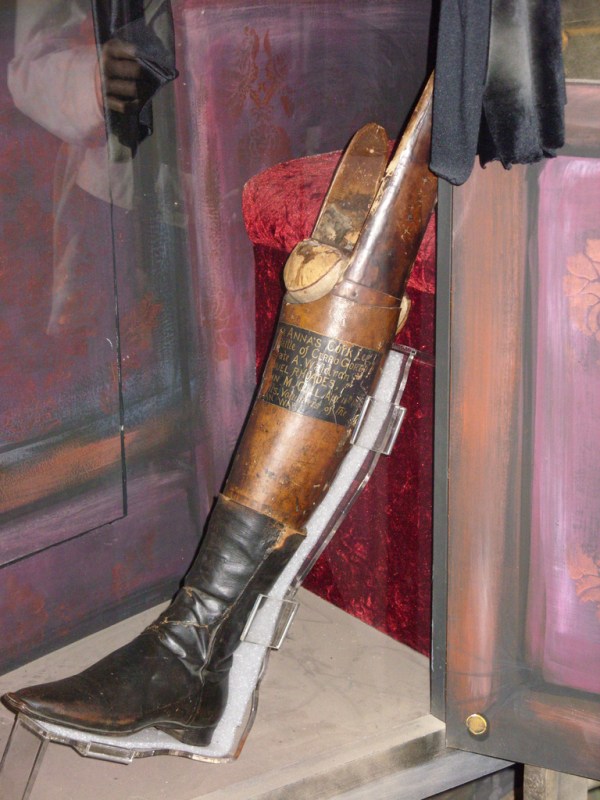 Selpho’s knee was made of steel, in short supply and almost non-existent in pre-industrial Mexico. However, with prosthesis for transtibial amputees having been around since at least 300 BCE, Santa Anna’s prosthesis (and we have no idea who fitted it, or who made it) was made of local materials… wood and leather. He had at least three artificial legs he wore at different times. Two ended up in Illinois, as “trophies of war” taken during the US Intervention of 1846-48, the other now in the Banamex museum. All are rather simple affairs. Unlike modern prosthesis which are molded plastic that will fit the user’s “stump” and eliminate the very real problem of the artificial limb separating from the residual one, the leather socket that fitted over his stump had to be laced to his thigh… in other words, his leg would be wrapped in a leather corset, packed with cotton or even rags to keep it tight, but not cutting off his circulation.
Or, as appears to be the case with the Illinois leg (in the photo), it was simply strapped to Santa Anna’s stump, and likely come loose and make him lose his balance. The socket itself held the artificial leg in place, but … with fittings being hit or miss… it would have put additional pressure on the stump (which, with the battlefield amputation, never healed correctly, leaving a piece of bone exposed.
We know that Santa Anna was carried to the front during the U.S. Intervention in a litter, or by carriage. One leg in Illinois was pulled out of a carriage after the battle of Cerro Gordo, indicating either Santa Anna was wearing a different leg (and would transfer the off during the day), or … as I think likely… only wore one when absolutely necessary. That leg, incidentally, was cork, probably the lightest weight material that could be found but was strong enough to hold the general’s weight. He still would have walked with a pronounced limp, and rather awkwardly, with no way to articulate the foot (try walking without rolling your ankle, and you’ll get the idea). The prosthesis now owned by Banamex, probably worn when the General had to walk in public, would have given him a slightly more normal gait, having a ball bearing in the heel to act as an artificial ankle.
He still would have had that uncomfortable leather girdle around his leg, and the pressure on that exposed bone. Santa Anna’s use of laudanum… opium syrup… has always been brought up as “evidence” of his supposed decadence, but was he an “addict” or simply dependent on what was the most common pain reliever of the time (and probably the most effective available) to get through the day? Did he use laudanum all the time, or only when he had to wear his prosthesis… and how long did he wear any prosthesis at any one time: all day? a few hours?
And what effect did the laudanum .. or his pain… have on his decision making? Did his prosthesis impact history, or is it simply an odd artifact of his past? History with a capital H usually assumes major event X was a result of, or reaction to, major event N. But the frustrating part about understanding history is that major event N might need to be understood in light of minor events a, b, c, and d. None of which anyone considered worth a mention, or would have noticed. Perhaps if Santa Anna’s leg had fit better, or if he was pain-free a certain day… perhaps the United States would have been defeated at Cerro Gordo and the whole history of the world different. Or maybe not?
Tlatelolco, a soldier’s story
We forget that while it was the old men like Díaz Ordaz and middle-aged bureaucrats like Luis Echiveirra who called the shots when the students were attacked, it was their own age peers who thrown into the fray. Mostly rural kids, convinced “communists” were about to take over the country. Kids like Francisco Moisés Salcido Beltrán, in 1968 a 19 year old soldier, who later emigrated to Texas, but was willing to be interviewed by Emir Olivares Alonso for Jornada (3 October 2018, page 4). My translation.
The officers were nervous. It was almost six in the afternoon and the Army surrounded the Plaza de las Tres Culturas in Tlatelolco. The troop was ordered into formation. The commanders watched the clock. Suddenly, some flares illuminated the sky and a voice shouted: “Quick step”. The trot started towards the crowd. The thumping of the boots against the pavement was loud. The soldiers advanced with the rifle at the ready. When the vanguard was about to arrive at the square, the first shots were heard. “Combat ready!”the commander shouted. Then the chaos.
Baffled soldiers tried to locate where the shots came from. Some took shelter on the ground floor of the Chihuahua building, others threw themselves to the ground and some hid behind the pre-Hispanic ruins.
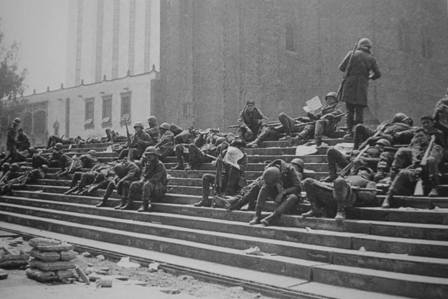 It was October 2, 1968, Francisco Moisés Salcido Beltrán was 19 years old. In February, he had been transferred to the army paratrooper rifle battalion and was among the first to enter the plaza; 50 years later, in an interview with La Jornada, he recalled what he experienced and reflected on that tragic episode. “I saw a comrade shoot at the crowd. I stopped him: ‘Why are you firing, if they are not criminals?’ The shots came from above. It was hell. ”
Salcido believes that Operation Galeana was a concerted plan conceived at the highest levels of power to disrupt the student movement, taking advantage of the confusion of the troops. The greatest culprit, he says, was President Gustavo Díaz Ordaz.
Originally from Caborca, Sonora, Moisés considers himself as a right-wing person who in those years was hearing about the “Communist danger” to the country. “The kids were behaving badly” and the rector of the National Autonomous University of Mexico, Javier Barros Sierra, “should not have been on their side, giving a boost to the movement. In the massacre of Tlatelolco “there were not as many dead as the left presumes, they wanted their martyrs to found their doctrine”.
– How was that year?
– I entered the battalion in February of 68. Back then it was simple: you only needed the high school diploma and be taller than 1.7 meters. During the movement they touched me from the first moments. The bazucaso1, the University City (CU) and Tlatelolco.
-What do you remember about that?
-The day of the bazucaso students, children from 13 to 17 years old, were screaming nonsense at us from the roof. Our orders were to occupy the building. They did not want to open the doors. The colonel asked for a bazooka and warned them that he would use it. He made a countdown and when he got to four, several young people came out on the balcony, but they were not from high school, they were troublemakers, older. One complained to the colonel that he could not blow the door. And he answered that he would, that if there was someone behind, it was better that he take off. He ordered fire. I saw an orange light come on and a straight jet shot out the door.
“I was among the first to enter, looking for students in the dark, I saw at least two people killed by the explosion, and there were others killed that day as well, but the government never said a thing.“
– How was the taking of CU2?
-We arrived at Copilco and waited an hour for thousands to come out. When we entered some were reluctant to leave CU. The general wanted to stop demonstrations, and climbed into a tank. I chased several people and cornered them against a wall. One one didn’t run. He was frozen with fear (laughs when he remembers it). The general told him to get the fuck out. He tried to run but could not, he moved his arms but his legs did not respond.
-October 2?
-We were in quarters and the officers were very nervous. We climbed the vehicles and went to Tlatelolco. The general did not looking at his watch; we waited on San Juan de Letrán (today Eje Central). General José Hernández Toledo – who was wounded in the shooting – was very tense. We saw the flares. We marched foreward at a rapid pace. Suddenly shots were heard from the balcony of the building (Chihuahua). We kept running and there were more shot. The commander shouted: “Combate ready!”
“I came to the foot of the building, looking for where the shots came from. And suddenly, behind me, I heard a bullet, I turned around and saw a colleague who was desperate firing into the crowd. I grabbed his gun, picked it up and yelled, ‘Why are you killing them if they’re not criminals?’ The students were about twenty feet away from us. ”
Salcido went up to the building, looked for the snipers without success. He found several students hiding in service rooms. He says he told them not to leave.
Over the years, the former soldier – who, according to files of the Ministry of National Defense, was discharged on November 16, 1969 “for not showing zeal in fulfilling his military obligations” – has its own hypothesis of the facts.
“There were too many shots and very few that fell, they were not machine gun bursts, they threw some shots to warm us up and then with loudspeakers they created confusion, as if we were at war.” Do you think a sniper was going to show up to receive a bullet? they created chaos, the soldiers came in shooting, but not all of them fired against the crowd. ”
— Yes, they fired?
-I stopped one. How many did he kill? I do not know. I did not see more. It’s a lie that there have been hundreds of deaths. I saw about 17. We talked about fallen soldiers, it was said that 12, I did not see any. There were wounded and many detained. It’s a lie that we picked up the dead and threw them into trucks. The Green Cross took them to the dead. The military trucks were only used to take the detainees.
Legal abortion nationally?
According to an article posted on “Breaking”… a site I am not familiar with… the Morena majority in the Chamber of Deputies is expected to introduce a bill legalizing abortion at a national level (30 September: also covered by Forbes). While legal (in the first trimester) in Mexico City, and although technically in most state legal under stringent conditions (rape, incest, to save the mothers’ life), and in a few states for economic reasons, the reality is that abortions … while as common here as in most of Latin America… most are “clandestine” with the expected result: botched abortions being one of the more common causes of death among women of child-bearing age.
According to the article, the Morena proposal is grounded on the health and safety argument, rather than on empowering women, and control over their own bodies. Even though the party has pushed for gender equality, this is probably a smart move, given that in good conscience, even socially conservative Morenistas (including the incoming president) can back legalization on these grounds. In addition, given the party’s deification of Benito Juarez, and its “profession of faith” in the ideals of Juarez, those holding religious scruples can justify the separation of their duties as elected representatives of a secular state (whose constitution guarantees equality regardless of “belief or non-belief”) from those as a member of any particular religious body.
That includes the largest of those religious bodies, one that still counts in Mexican politics and policy. While the “Catholic party”, PAN, naturally will oppose any reforms, and in a few states, when under PAN control, state constitutions were amended to include a “life begins at conception” clause, the possibility that the feminist argument for free choice, could convince some legislators. The mere fact that defining conception as the starting point has had less effect on curtailing clandestine abortions as it has on criminalizing women who can’t afford to travel to Mexico City. The State of Guanajuato in particular has been jailing indigenous women for seeking or having abortions.
The Church will mount noisy protests, as it did in Mexico City when the abortion was decriminalize in 2007, and one can expect, as with same-sex marriage, court challenges and bureaucratic foot-dragging, but … considering abortion has only been illegal in Mexico since the 1930s and even after that abortions were always available to the well-heeled (at last as the early 2000s, one could read advertisements in the newspapers offering to “cure” what was euphemistically referred to as “late menstruation”), one suspects the opposition to reform is more based on legislator’s fears of backlash, than on any powerful voting bloc. So far, the demonstrations have been overwhelmingly in favor of reform.
Morena ya prepara la legalización del aborto en todo México, Alberto Saaveda, Breaking (29 September 2018)
La marea verde en la CDMX: mujeres marchan por la legalización del aborto en México, Animal Politica (29 September 2018)
Morena apoyará despenalización del aborto a nivel nacional Forbes, 30 September 2018
Abortion in Mexico, Wikpedia
Mexican snowflakes… or just flakes?
Lord Maestro Limpio and Lady Bat… the hottest new couple on the viral video circuit are now complaining that their performance… i.e. beating the crap out of an ice cream vendor outside their bar… are whining to the press that while they’re sorry they attacked Bruno the vendor, was just an over-reaction to a provocation. After all, Lord Maestro Limpio (aka Ricardo Barradas Coubert), Bruno “dissed” him and made a joke about copying an idea from Barradas’ sister-in-law. Lady Bat meanwhile, points out she never hit Bruno with her baseball bat… she merely brandished it while Ricardo punched Bruno and chased him around the stands outside the Lord and Lady’s bar.
Gee… after getting off an assault charge by paying Bruno’s 48,200 peso medical bills… they feel they’re being treated unfairly, that the videos of the hulking Ricardo and his bat-wielding wife attacking a little guy are “defamatory” and leading to ridicule of the couple, as well as threats to boycott their Pacífico Terraza bar (which has been closed by the health inspector… maybe bat wielding crazy owners are considered a health hazard).
So unfair!
Here’s the video in all its gory… er, glory.
Another thing to worry about
Recalling the 19 September earthquakes of 1985 and 2018, the Mexican Institute of Social Security (IMSS) has issued a warning to those who sleep in their underwear,
In a public service message, IMSS warns us that seismic alarms only give citizens 50 seconds of warning, “so you should not waste time on your clothing selections”.
The IMSS message notes you should evacuate in the clothes you have on, but that that it’s best to have something “comfortable to cover the whole body to keep you warm and avoid injuries”.
“If you sleep in your underwear or with little clothes, have a comfortable robe on hand if you want to cover your body and do not forget your emergency backpack”.
As to footwear, the PSA suggests opting for something that will allow you to “move without risk of tripping or sliding (closed, comfortable, easy to put on and with thick soles)”.
It was suggested to avoid the use of slippers and flip-flops, since these do not hold well to the body, “if it is within reach, use them and do not delay the evacuation”.
And if you’re in the shower? 50 seconds… I’ll go nekked!
Tlatelolco, Verano de 68
My review, for the Internet Movie Database:
Although there are the improbables (the same five secret policemen, etc.) and the unlikely Romeo and Juliet story line, as a Mexican historian (not a film critic) I was struck by how much work went into the historicity of this film.
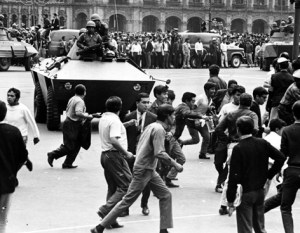 I found Juan Carlos Colombo, as the elderly general, to be an extremely “true to life” character. Old revolutionaries were sympathetic to the student movement (which — for those not familiar with Mexican history — was like similar movements in Czechoslovakia and France at the same time, seeking to open the political system to reflect the social and economic progress the country had made. In Mexico’s case, expanding the gains of the 1910-20 revolution to those, like Felix (Cristian Vasquez) the provincial “Romeo” of the tale, whose families had benefited from material progress, but were still held back by the limited political system).
It’s nonsensical to say that, although improbable, a romance between Felix and Ana Maria wasn’t possible. While class consciousness was (and still is) a factor in Mexican relationships, young Mexican women (especially those from the elites) were not under nearly the parental control that the first reviewer seems to think. Cross-class romances are the staple of our popular entertainment anyway, and this was meant to be a pop version of a particularly painful moment in our history.
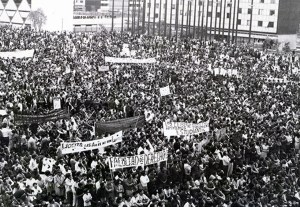 As to the history, while the roots of the student movement are slighted (and only incidentally do we hear of its growing popularity among the middle-class and workers), it is meticulously researched when it comes to the government’s reactions, and to the often overlooked concern the state had in preserving a facade of “peace” during the Summer Games. The interspersing of Olympic preparation footage, and both photographic and film records of the student protests (and the government crackdown) are particularly effective… especially considering that much of the documentary evidence was hidden from public view for 30+ years. Roberto Sosa’s chilling portrayal of President Díaz Ordaz, and Ricardo Kleinbaum as the oily “Secretary” (the still living … and thus unnamed…Luis Echiverría) are, to most of us, historically accurate portrayals of the men who ruled us not that long ago.
The face behind the voice
Mexico City has always been the trend setter for Latin America. While we have yet to adopt the latest in the trash recycling trade, we were the first to adopt the international Call of the Junkman:
An essential tool of the recycling entrepreneur, tapes of that voice a sold for about 5 US dollars. Almost anywhere Spanish is spoken, you will hear this voice when the trash-man cometh, whether by truck or more ecologically sound transport. Unfortunately, the diva of the dumpsters, María del Mar Terrón, never has received any royalties. She recorded the hit single, “¡Se compren colchones! at her home in Chimalhuacán, State of México, about 2010, which has since gone viral throughout Latin America. When Christina Pacheco interviewed her for her long running Canal Onze program, “Aquí nos tocó viveir” back in August 2013, María del Mar was 19 years old. She has since worked as a waitress, no doubt never having to repeat the special of the day more than once.
Once a year, anyway…
“Un soldado en cada hijo te dio”… or at least 18,000 hijos and hijas … along with a few hundred horses, a handful of eagles and lots of trucks, airplanes and helicopters.

Tupper-war! Or, the great Senatorial snack-down
MORENA, having won a majority in both houses of the Mexican Congress, got right to work on the opening day of the session (1 September) pushing through major budget cuts, including the ridiculous perks enjoyed by their own members. Just today, for example, only two weeks into the legislative session, the lower house voted 433 to 9 in favor of cutting all salaries to less than that of the President (and the President elect cut his own salary almost in half). Even opposition members are willing to go along with yet more cuts: 70 percent of their travel budgets, less money for fewer legislative aides, paying their own health insurance, giving up their government paid chauffeurs and cars, but there is a limit…a line in the sand when it comes to Senatorial privilege. The Senate opposition (PAN, PRI, PRD, MC, Greens) is united in saving… the Senate snack bar.
 The minority originally argued that the snack bar was a “job creator”… while in the U.S. Senate one is used to seeing teenage pages on the Senate floor, on the floor of the Mexican senate, those people running around doing errands were the waitresses. While the majority was willing to allow the waitresses on the floor… if a session lasted more than four hours and the minority senators complained if they left the floor, they might have to wait in line for a cup of coffee… like they do at Starbucks. Still, somehow, even without the Senate snack bar, I don’t think the fate of the nation hangs on a Senator (or his or her aide) running over to Oxxo… the one next door, and the two just down the street are all open 24 hours — and there’s a taco stand outside the Senate building gate).
With the electorate in a mood for cutting government payrolls, the “job creation” argument failed to gain traction, and I suppose there is a danger that various Senators will be urged to change votes by the side that says “we’ve got cookies!”, and I imagine there are those (maybe among the Greens) who have some valid reasons for eschewing Oxxo, and maybe some PANistas would never, ever stoop to street tacos.
In response to the pressing political split majority leader , Marti Batres has issued a challenge: “el Tupper Challenge”.
I read the news today, oh boy…

Richard Caton Woodville, “The News From Mexico”, 1848
The Mexican-American War of 1846-48 was the first in which “embedded reporters” covered the action. While the news was often weeks old by the time it appeared, it was avidly devoured … except perhaps by the slaves (right foreground) for whom “Mr. Polk’s War” had a very different meaning than the “Manifest Destiny” of expanding U.S. territory. Or, casualty reports (10 percent of the Army perished, mostly from disease), or perhaps, they are reading about Winfield Scott’s bombardment of Veracruz and its aftermath:
The journalists also reported that U.S. troops rioted immediately after entering Veracruz, setting fire to a nearby settlement, Boca Rio, after robbing and raping the inhabitants. Scott resorted to the public hanging of a rapist and issued an order establishing military courts to try Americans for crimes against Mexicans. His actions restored order, but not before the American people realized that American atrocities would not be limited to northern Mexico. Veracruz was the most widely reported battle
Greenberg, Amy S.. A Wicked War: Polk, Clay, Lincoln, and the 1846 U.S
Invasion of Mexico (p. 172). Knopf Doubleday Publishing Group.
AMLO and the Drug War: what is to be done?
Epigmenio Ibarra, a photojournalist who has covered wars in Central America and Colombia, in Serbia and Bosnia, in the Persian Gulf with the U.S Army, with the Shiite insurgents in southern Iraq and with Saddam Hussein’s troops in Baghdad, has seen enough wars close-up to speak on what does, and doesn’t work. In his piece for SinEmbargo (translated by Reed Brundage for his Mexico Voices blog*) Ibarra looks at how we got into this useless “drug war” and the challenges the new administration faces in extricating ourselves from the slaughter.
Calderón’s megalomaniac urgency to seek legitimacy [because of his close and possibly fraudulent victory over López Obrador], the pressure he put on the commanders to obtain results, stop capos, and dismantle organizations, as well as the frustration of pursuing an elusive enemy, and the enormous firepower in the hands of untrained soldiers sent to execute tasks that belong to the police and to move among the civilian population, ended up creating the tragedy.
AMLO has declared that his objective is to pacify the country. He is determined to achieve this by deploying all kinds of resources, even though some of his proposals scandalize those who—knowing very little about the war—grossly simplify them with the purpose of attacking him. Achieving that goal will not be easy or quick.
On December 1, we will enter a complex period of transition, in which we will have to rebuild practically all the police forces, from the federal to those of the smallest municipalities, as well as the federal and state public ministries [agencies including prosecutors, investigative police and forensic experts]. López Obrador will have to reconcile between what he dreamed and what he can do, without losing the goal of getting what he dreamed as soon as possible.
I do not like the idea of the military remaining in the streets at all. I fight it and I will continue to do so, so the soldiers return to their barracks, but I understand that the immediate withdrawal of the Army and Marines can be dangerous. However, it would be more dangerous to maintain the doctrine that has prevailed for the past 12 years and continue waging a war of extermination. I am confident that the new President will not order the military or the police to engage in acts of repression. Peace, as he says, is the fruit of justice and neither are achieved at gunpoint.
López Obrador’s challenge, as Supreme Commander of the Armed Forces, will be to contain the Army and the Navy, to make them follow strict protocols for the use of force, to submit to the civilian justice system those commanders who have been involved in human rights violations, and change their orders radically.
It is no longer a matter, as Felipe Calderón and Enrique Peña Nieto did, of waging a war against the cartels, but of providing security to the population. Using force to fight will have to be changed to using force for dissuasion. Fire is not extinguished with gasoline.
* If you don’t have Mexico Voices on your reader, you should. Brundage (a retired Foreign Service officer) has for several years now either translated, or overseen translations, from the Mexican media. He seems to read everything, and provides an excellent resource to both the Spanish-challenged and to those who, while they can read Spanish, do not have the resources to delve into the broad spectrum of Mexican political issues that aren’t picked up by the foreign press.


 mexfiles.net