An unexpectedly early visit from a wise man
I wasn’t expecting Gaspar, Melichor and Balthazar until January. But some wise man made a sizable donation to the Mex Files, that is certainly appreciated.
Lyn has family obligations that take priority right now, and I’m trying to keep this site going. I was updating at least two or three times a week, but right now, without a phone, it’s a challenge. No phone, no internet access. And, seeing I’ve been supporting the Mex Files (and myself) off what I earn writing on Mexican businesses for some on-line business publications, and some freelance work for a couple local newspapers, it’s harder and harder.
My checking account is still overdrawn about $250 and I owe about $300 on the phone bill. I’m using the public library to update the Mex Files (at least once a week – thank you Bill Gates), but there’s no way I can put in the twenty or thirty hours the site deserves with an hour’s internet time. Right now, I write from home, save the data on disk (I’m using a very old computer with Microsoft Millennium … #$%^!!! you, Bill Gates!) which at some point will need to be replaced with another used computer.
The North Chihuahua Desert, or at least the Big Bend, where I live, is a good place to write: right on the border, not a lot of distractions and if being an eccentric semi-recluse is not quite mandatory, it’s certainly socially accepted behavior. The only downside of “Alaska with cactus” is… well, it’s
Alaska with cactus. Even though I walk just about everywhere in Alpine, I have to keep my 18-year old car running (I really should have it insured and properly registered if I want to get to the dentist on the Mexican side of the border), buy groceries and pay the higher utility bills charged rural customers in the U.S. (my “normal” phone bill, with unlimited long distance – in Alpine I can walk over and see anyone I need locally – and broadband access is $80). There’s not much out here, but I’m looking for a “regular job” (as in a regular paycheck and maybe something weird like insurance) and trying to keep up with my “REAL” job at the Mex Files.
It takes a real man…
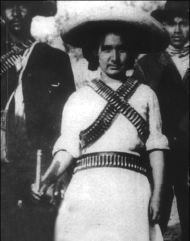
I don’t remember where I found this photo, but couldn’t resist downloading it… then forgot about it.
Lyn’s article on Mexican Revolutionary women, and the Poniatowska book reminded me. Well, the Revolution was everyone against everyone…. which army this otherwise unknown travesti was fighting for I have no idea.
I believe I found the photo on Jornada’s website, but if anyone knows anything about this person, please pass it along:
And thank you, Elena Poniatowska!
The Alpine Public Library isn’t a very big place, but, like any public library, it has its discoveries. I’d never read Poniatowska’s classic, “Hasta no verte Jesús mío” until I stumbled across the English translation (“Here’s to You, Jesusa!”, Farrar Strauss, 2001) looking for something else entirely.
Lyn has written elegantly, and movingly on the soldadaras of the Revolution. “Jesusa” — in reality Josefina Bórquez – was one of those tough, pistol-packin’ mamas. Pistol-packin’ anyway. Given her … uhhh… brutal lifestyle, it was just as well she wasn’t a mother in anything but name.
In 1964, Bórquez was an irrasible, anti-social tough old lady in the Penitenteria (not in prison, but the Mexico City neighborhood near Leucumberri – then the city prison, now the National Archives) living in a single room with cats, canaries and chickens. She claimed she had no friends, and to hate children. It was her pride and dignity. So many of her friends had left her or died horribly (one grusomely when she was hit by a train). The foster son who called her “mama” broke her heart.
By the time she was 11, Bórquez been a peddler, a fisherwoman and a cook in the Oaxaca woman’s prison (her stepmother was warden) when her feckless father joined the revolution and brought her along. It got her out ofOaxaca anway…
“Jesusa” spent her adolescence tramping the length and breadth of Mexico… and buried her 18 year old husband (who regularly beat her, convincing her never to tie herself to any man) in Marfa Texas. The Revolution was the highlight of her irregular and violent life: despite losing not only her husband, but the two men she truly loved – her father and her older brother — “…if there ever was another revolution, and I had the opportunity to go to war, I’d be there in a second. I want to travel again.”
A captain’s widow at 16, and for a short time a capitana herself, the Tehuana Zapotec ended up – like so many rootless young Mexicans – in the Capital. She got by – somehow. In this country, if we need a job, we figure out what we already know how to do. Not Mexicans. If there’s a job – or you can make a job – they’ll do it. But Jesusa’s resume was a little more varied than most. Besides soldiering, Bórquez was variously a maid, a nurse, a dance hall “hostess”, a factory worker, a barber, a professional drinker, a furniture maker, an ambulanta, a butcher, an “apache dancer” in a circus and a medium. And a grumpy old lady who managed to keep going into her late 80s.
Sometimes homeless, but never completely alone, though she’d argue otherwise, “Jesusa” was a hell-raiser prone to getting into fist-fights with strangers until she got got religion: in her case, becoming a devout member of the Obra Espiritual, professing a belief in God the Father, Son and Holy Ghost, the Virgin Mary, AND… Anton Mesmer the hypnotist, 19th Century French psychologist Pierre Charcot, reincarnation, karma and the teachings of Roque Rojas, who was reborn as the Messiah in his backyard ditch in Mexico City in 1866. In some ways, it was the knowledge that she was working off some bad karma that kept her going until 1987. She asked Poniatoska, the day before she died, to throw her body to the dogs (she found it comforting that her father’s unburied corpse was picked clean by vultures), but the author, more conventional than otherwise, paid for Josefina Bórquez’ conventional burial
It was an unlikely friendship… the former Princessa Helena de Poniatoska and a tiny old woman who made her living scrubbing down printing presses with gasoline by day and scrubbing grease out of workers’ coveralls on the roof and feeding her chickens by night… but somehow the two remained friends for 20 years. Borquez was still alive when Poniatoska published her book in 1968. At the time it was called a “novel” … but like Norman Mailer’s “Armies of the Night” or Tom Wolfe’s “new journalism” whether we are reading journalism by an artist, or an artist’s attempts at journalism. In the end, as Josefina – or Jesusa — would say, “pues, who the fuck cares?”
Jesusa on her military career:
A lot of people got killed out of stupidity. I think it was a misunderstood war because people simply killed each other, fathers against sons, brother against brother: Carrancistas, Villastas, Zapatistas, we were all the same ragged people, starving to dealth. But that’s somethat that, as they say, you keep to yourself.
On herself – a Zapotec in Mexico City:
If I had money and property, I’d be Mexican, but since I’m worse than garbage, I’m nothing. I’m trash that the dog pees on and then walks away from. A strong wind comes along, blows it all down the street and it’s gone… I’m garbage because I can’t be anything else. I’ve never been good for anything. My whole life I’ve been this very same germ you see right in front of you… When I was left alone I intended to go back to my homeland. I’d have a better life in Salina Cruz or in Tehuantepec…”
Maybe so, “Jesusa…” but what would Mexico City have been without you? You were not the stereotypical Chilango I like to write about, nor one I hung around with. But so very real… tough enough to get through anything, resourceful beyond all reason, and a survivor. In that, Jesusa you were not garbage… but a real Chilanga.
Thank you Jesusa! Thank you Elena Poniatoska!
The spy who came in from the cold… for Christmas
The good news is that my book on Mexican history is nearly finished. Rather than go stark raving bonkers during my “internet challenged” period, I’ve been working on what started life back when I needed some rationale for chucking everything and moving to Mexico. 75000 words, and five years later (silly things like life kept getting in the way) what was intended as an overview of Mexican History for business people and students planning to function in history-obsessed Mexico is nearing completion.
I finally got through the DAMN Revolution, have most of the chapter on the “Creative Revolution” finished, and just have about 50 years to go… another 10,000 or so words. Given his ties to his role in how we celebrate Christmas in the
United States, here’s the draft of my section on Joel Poinsett…
The Masons jar Mexico
Poinsett would be the first United States ambassador to meddle in Mexican politics, but certainly not the last. Born in 1791 into a wealthy slave-owning South Carolina family, Poinsett is a major historical figure in Mexico – and in Latin America generally — but practically unknown in his own country. As a young man, he was educated in a British military academy, traveled widely though Europe and
Central Asia (he was the first American citizen in what is now Kygerzia). He spoke English,  Spanish, French and Russian fluently, had served as a congressman and Senator, all before he began his diplomatic career in Latin America. At the time the United States was a “radical” government (nearly every other nation was a monarchy, and a republic of the people – excluding slaves and “Indians”, of course – was a danger to the civilized world). Diplomats from radical revolutionary nations before and since have been suspected of plotting against their host countries. In Poinsett’s case, it was true. He was America’s first spymaster, a one-man (he answered only to Secretary of State John Quincy Adams) C.I.A. In Buenos Aires (still a Spanish colony), he financed several plots to overthow the government. Run out of Argentina, he crossed the Andes into Chile (another Spanish colony), where he enjoyed more success. Thanks to Poinsett’s plotting, the Chilean revolution started on July 4, 1821 and the Chilean flag is modeled on that of the United States.
As the first United States representative to the new Mexican government, Poinsett found several un-American ideas to fight. Irtubide was Emperor, Poinsett and
Adams favored a Republic. Mexico was Catholic, and Poinsett was a Protestant representing a secular state. And Mexico would soon outlaw slavery. Poinsett, whose personal fortune rested on slavery, was far-sighted enough to realize slavery was doomed in the United States unless the country expanded and more states where the “peculiar institution” was legal could be added to the Union. Irtubide was the easiest problem to settle. Almost as soon as Poinsett arrived in Mexico, he began making contact with Republican plotters like Guerrero and Santa Ana[1]. President Guadalupe Victoria may have listened to everyone, but Poinsett talked to him more than most. Convincing the eccentric president that Mexico needed a navy was easy. Convincing him to appoint an out of work United States admiral took some work, but David L. Porter became father of the Mexican Navy.
To further his aims of acquiring Mexican territory for the United States, Poinsett worked through the Yorkistas. As an international organization, the Masonic Lodges were also a counterweight to the other major international organization of the time – the Catholic Church. He had originally intended a counterweight to the British-backed “Escossas” (the British had two strikes against them – they were a monarchy and they were trying to replace the business they lost when the United States became independent with business in the former Spanish colonies). The United States saw itself as the dominant power in theAmericas. And, with Poinsett as leader of one Masonic Lodge, where better to find support for expanding gringo influence – including slavery – than through the Yorkistas? The Yorkistas included most important Mexican liberals, including Vincente Guerrero and Lorenzo Zavilla. The liberals wanted a less centralized government. In return for his – and United States – support, Poinsett wanted a Liberal government that would sell Texas.
In 1828, the last great surviving Insurgent leader, Vincente Guerrero, was the liberal (and Yorkista) candidate. With some truth, the Conservatives could claim Guerrero’s “Yorkista” backing was proof of Masonic and gringo interference. The Conservatives distrusted Guerrero and the Liberals to begin with, so they ignored their own “Escosista” Masonic connections, and played up the Liberal’s Yorkista connections as “proof” of an anti-church conspiracy. The Church and the Conservatives had a less “radical” general as their candidate. State Legislatures elected presidents, and the Conservatives could bring in enough army troops to threaten enough legislatures to throw the election to their candidate. Guerrero accepted the results, but not the “liberal” General Santa Ana, who had overthrown Iturbide.
Santa Ana’s attempted rebellion was quickly put down (trickster that he was, the General escaped by dressing as a nun and slipping into a convent), but there were enough Liberal rebellions in the states to finally force the Congress to accept Guerrero as President. As a “consolation prize” to the Conservatives, an ultra-conservative, General Anastasio Bustamante, became Vice-president. Poinsett was practically a member of the Guerrero cabinet. But he went too far. Hoping to increase United States business influence in Mexico, Poinsett and the Yorkistas pushed Guerrero to expel the remaining Spanish citizens in Mexico. The old gaucpachines “gachupines” not been popular. Rich Spaniards controlled big businesses and banking. But most of Mexico’s remaining Spaniards were middle class people with Mexican wives and families– shopkeepers, blacksmiths, mule-route managers, inn-keepers, teachers, priests, doctors and engineers – including mining engineers. Neither Mexico nor the United States had enough engineers to fill the void (nor the money to buy the mines from deported Spaniards): the British ended up controlling the Mexican mines, just the opposite of what Poinsett intended.
The only way the United States could expand slavery was to expand its territory. And the only way to expand was into Mexican territory – specifically Texas. The Yorkistas had always been open to gringo – or other — settlers in Texas. Yorkistas favored a looser federal government anyway. And they saw little harm in Protestant settlers. But Poinsett went too far – compromising himself and the Yorkista cause. On no authority but his own, he tried to buy Texas for the United States. Guerrero may have been a Yorkista, and an admirer of the United States, and a personal friend of Poinsett, and he may have taken bribes from Poinsett … but in the end, he was a Mexican patriot. In an unusual move for the time, he leaked Poinsett’s letters (including veiled threats of United States military action) to the newspapers. It was another first for Joel Poinsett: he was the first United States Ambassador attacked by the Mexican press, and the first American spy to have his cover blown by a foreign newspaper. The Yorkistas still exist, and are still a powerful force in Mexican politics. With international connections and pro-United States biases, they are now seen as conservatives (and are prominent in conservative parties, despite traditional mistrust by the Church, the other main conservative force). In 2003, when Mexico sat on the United Nations Security Council, and was pressured to back the United States invasion of Iraq, nearly every sector of Mexican society opposed the war, and Mexican support for the United States. Yorkistas were the only group to favor supporting the United States. Respected journalists openly speculated on President Fox’s Yorkista membership as a factor in the decision
Mexico would take in the Security Council.
Poinsett, for his own part, left Mexico disappointed. If he is known at all in the
United States, it’s not as the first Latin American specialist, a world traveler or our first international spy. In December, Mexican gardens bloom with the red and green leafed flor de nochebuena. Poinsett first saw the plant gracing a nacimiento in a
Cuernavaca area church. He swiped the plants from the Baby Jesus and brought home – not Texas – but the Poinsettia.
Like the future CIA, Poinsett recruited and paid future enemies. Manuel Noriega (the Panamanian dictator and drug lord), Osama bin Ladin, the Taliban guerrillas in Afghanistan and Saddam Hussain of Iraq were all paid by the CIA at one time in their careers. Some in the Mexican media worried that George Bush, the former United States President, and father of the sitting president of the United States was also a York Rite Mason. As it turned out, Mexico voted against the United States.
There’s a new resident in Hell…

The right hates culture… (what else is new?)
The right have no cultural interests, says Navarette
Jornada (8 December 2006) Andrea Becerril , Georgina Saldierna
(my translation)
PRD Senators deplored cuts in cultural and educational programs in the proposed federal buget . “This isn’t just a matter of problems with economic variables and lack of recourses, it’s an expression of the phobias of the right, who have neither an interest nor a matter of phobias, because those on the right have neither the interest nor the imagination to deal with cultural matters, combined with their insecure governance. Felipe Calderón is only interested in investing in public security and the armed forces,” charged the party’s floor leader, Carlos Navarrete.
“It’s terrible! Instead of resources for culture and education, we’re investing in repression,” commented budget committee member, Rosario Ibarra.
Interviewed later, Narvarrete said that “Calderón’s proccupations aren’t just political, but economic,” caused by a drop in international petroleum prices, lower crude exports and growing concern about the state of the U.S. economy, coupled with defiencies in revenue collection. Given the concern, Narvarrete expected a tight buget for 2007. He added that he wasn’t taken by surpise by the right’s specific proposals. “We need to work within constraits, but the right undoubtedly was looking for some way to deal with their own obsessions and used their old standard recipes for dealing with the problem.”
“I know how a weak administration acts. They zero in on their own senstivities.” Calderón’s proposed budget cuts funding for culture and education in real terms. “The budget calls for belt-tightening for the people with the least resources, while reinforcing the areas to which the right has always given priority: national security, including the Public Prosecutor’s Office (Procuraduría General de la República) and the Defence Department (Secretaría de la Defensa).For her part, Senator Ibarra, the budget request reflects “the attitude of an illegitimate government, which wants an ignorant people, unable to defend themselves.”
Rosario Ibarra, by the way, ran for president in 1988 as a Trotskyite. She isn’t, but it was the only way to bring up the topic of the “dirty war.” Her son, Dr. Jesus Ibarra, was disappeared by Luis Echivierra’s administration in 1972, and she’s been fighting for social justice (and her family) ever since. If I had a Mexican mom, I’d want Senator Ibarra.
How much to the Minutemen spend?
Illegal immigrants $18 bln boost to Texas: report
Fri Dec 8, 2006 1:36 PM ET
By Ed Stoddard
DALLAS (Reuters) – The Texan economy would have been almost $18 billion poorer in the last fiscal year without illegal immigrants who added to state coffers but were a drain on local government, says a report by the state comptroller.
The report — billed as the first detailed look by a state at the impact of undocumented immigrants on its budget — is likely to stir further debate on the emotional issue of illegal immigration in the United States.
The Pew Hispanic Center estimates that the United States had 11.1 million undocumented immigrants in 2005. Of these it said Texas accounted for between 1.4 million and 1.6 million.
Many Americans say illegal aliens — mostly from Mexico — take jobs from locals, depress wages and commit crimes. But many businesses say they fill a much needed gap in the labor market.
“The absence of the estimated 1.4 million undocumented immigrants in Texas in fiscal 2005 would have been a loss to our gross state product of $17.7 billion,” said Texas Comptroller Carole Keeton Strayhorn.
What’s your hurry?
n Mexico City, rush hour now lasts 15 hours, from 7 a.m. to 10 p.m., according to a study carried out by the Mario Molina Center for Strategic Studies on Energy and the Environment and several other organizations.
(more at Mexico City Herald)
Like a thief in the night…
In a surprising midnight ceremony at the presidential residence of Los Pinos, outgoing Mexican President Vicente Fox handed over the green, white and red presidential sash to incoming president elect Felipe Calderón. Fearing that the inauguration would be blocked, Calderón – a 44- year-old conservative, pro-business politician who is close to the Catholic Church – decided to get a head start on opponents. Calderón follows fellow National Action Party (PAN) member Vicente Fox, who broke the once-dominant Institutional Revolutionary Party (PRI) seven-decade grip on Mexico in 2000.
(Full story at ¡Para justicia y libertad!)
One small quibble — Vincente Fox’s 2000 election wasn’t the end of the PRI. It was the PRD’s creation after the 1988 election was stolen from the left by the PRI that led to the democratization — at the cost of many PRD leader’s lives. FOX was the first non-PRI president elected since the party was created in 1948, but he did not end that party’s hegonomy. There was an opposition congress throughout Zedillo’s sexeninal and Fox was not elected as the PAN candidate, but as the candidate for a coalition of Conservatives, Social Democrats and Greens. Without the 5% vote for the Greens, the PRI would have won. And, Fox’s selling point was that a vote for him was a “voto util”… PRD candidate Cuauhtemóc Cardenas having no chance of winning in 2000 (at least according to Fox’s U.S. spin-meisters).
Calderón’s cabinet is somewhat worrisome… mostly U.S. educated economists (it’s a bit of trivia, but every financial crisis in Latin America in the last 30 years occurred when the President or Finance Minister was a graduate of the Harvard Business School). Augustin Carstens, the new Economics Minister, is a former World Bank official. While he’s made some statements suggesting he’d be open to a “New Deal” iniatives like those pushed by AMLO and the “alternative presidency”, he is also enamoured with the idea of privatizing the energy sector. That won’t happen without a fight.
I’m worried that outgoing Jalisco governor, Francisco Ramírez Acuña for Secretaría de Gobernacion. As Xicanopwr writes in his ¡Para justicia y libertad! article:
As Jalisco governor, Ramírez Acuña allegedly authorized the use of excessive force against anti-globalization protesters during a summit of Latin American and European leaders in Guadalajara in 2004. Both national and international human rights organizations, including Amnesty International and Human Rights Watch, denounced what they said were arbitrary detentions and even torture of suspects.“The blatant and prolonged nature of the alleged police abuses strongly suggests that they were carried out with the approval of some level of command within the security forces,” said José Miguel Vivanco, executive director of Human Rights Watch´s Americas Division after a probe into the incidents.
Meanwhile… the World Bank is agreeing with AMLO that the monopolistic practices of the larger Mexican businesses need to be controlled.
This is gonna get interesting.
Ana Maria Salazar’s English-language blog, Mexico Today, has better analysis and updates than anything I can do on the fly.
Update on the updates… parte III
I’ve run into a computer problem (compounded with an outstanding telephone bill and limited service), and hope to have updates on Luis Echiverria’s arrest by Monday.
Oh, and by the way, the Mex Files is apparently being sued… apparently some local newspaper considers us a threat to their business (I don’t see how… no one here is particuarly interested in our local city council or water board meetings), which is more a hassle than a real threat.
Let’s get physical…

MEXICO CITY — Lawmakers wrestled, slapped each other and tumbled across the floor of Mexico’s Congress after opposition legislators threatened to block the inauguration of the incoming president, whom they accuse of stealing the election.
By late Tuesday, the brawl had turned into a tense standoff between congressmen of President-elect Felipe Calderon’s conservative party — who want him to take the oath of office in Congress — and opposition leftists who have vowed to block the swearing-in ceremony.
Wired times in Oaxaca…
Call it the convergence of good journalism and the internet. Jornada is, of course, a newspaper, but lately they’ve been more than generous — and particularly creative — in filling out their complex stories with Youtube videos. Jornada TV has been uploading the “Batalla en el cento histórico” as the videos come in. This is “Parte 4”:
The second video is an interview with Flavio Sosa.
Mark-in-Mexico, convinced former PAN organizer Flavio Sosa (and, to be fair, PRD organizer, and a lot of other things … it’s a profession like any other) is the “brains” behind the troubles in Oaxaca.


