No wimps in Mexican politics
The Mexico City Herald is a much better paper than I sometimes give it credit for being. Kelly Arthur Garrett’s take on the desafeuro threat is much better than anything I could write. Not that I think AMLO will be stripped of his immunity. Even the wildest-eyed PANista doesn’t want to see a general strike in Mexico City. The only ones “hoping” for that seem to be Agence France-Presse, which recently invested in gas masks for its reporters and photographers… the better to cover the mediagenic uprising…
BY KELLY ARTHUR GARRETT
The Herald Mexico
March 15, 2005
Presidential politics is a vicious business . . . and anybody who gets into it should be prepared to grapple with the meanest of the mean. Hunter S. Thompson, (1937-2005).
The late inventor of gonzo journalism had the 2000 White House race in mind when he wrote those words. He could just as easily have been writing about the 2004 version, a boiling cauldron of meanness if there ever was one.
What’s of interest here, however, is that Hunter Thompson was also unintentionally prescient about the way the current campaign is unfolding in Mexico. The meanest of the mean are in full attack mode. And they’re very good at it.
This first post-“Change” presidential election in a fully democratic Mexico is hardly the Jeffersonian exercise in gentlemanly debate some may have hoped for. It’s turning out to be even uglier than the time-honored tradition of character assassination though there’s plenty of that. Mudslinging, aimed at discouraging votes for your opponent, seems a positively quaint strategy in today’s brutal atmosphere, where the name of the game is to erase your opponent from the face of the political map before votes ever matter.
That’s what we’re seeing in the present effort to strip Mexico City Mayor Andrés Manuel López Obrador of his legal immunity. It would be the first step in prosecuting him for allegedly failing to obey in a timely fashion a judicial order to halt work on a public road project.
Being prosecuted would almost surely bar López Obrador from running for president. This, despite vehement denials from President Fox, appointer of the Attorney General who set the legal process in motion, is what’s perceived as the point of the whole thing. Whatever side you come down on in the immunity debate “the law is the law” vs “legal coup d’etat” the upshot would be the elimination of the front-running candidate based on what’s essentially a minor administrative dispute.
And not just any candidate. Rightly or wrongly, the nation’s poor and disaffected regard López Obrador as their best and only hope. He’s also the sole viable alternative to the hardline neoliberalism that has dominated national politics for nearly a quarter century. Eliminating López Obrador is tantamount to telling a major segment of the population that they can’t play in this game.
Why would López Obrador’s opponents the PAN and the PRI do such a thing? See the Hunter Thompson quote above.
Keep in mind that López Obrador is not only increasing his lead in opinion polls, he’s also polling well ahead of his own PRD party, as The Herald Mexicocolumnist Fred Rosen pointed out recently. The PAN and PRI are confident they can handle the PRD, a party with an image problem, to say the least. But the fear is that López Obrador himself, who’s indicated his run will be as much outside the PRD as in it, may be unbeatable in a fair race.
There are, to be sure, non-reactionary arguments against a López Obrador presidency. Isabel Turrent and Ricardo Alemán have put forth those arguments forcefully in Reforma and El Universal, respectively. But for the PRI and the PAN, depending on the persuasive power of ideas in the heat of a campaign is a shaky proposition at best. Better to simply get rid of the problem at the outset.
The elimination option is hardly new in Mexican presidential politics. It’s just more out in the open than before. Now we can see how the sausages are made, and it’s not a pretty sight.
For most of the 20th century, the reigning PRI permitted no meaningful opposition at the polls. The breach in the stonewall finally came in 1988, when a fledgling prodemocracy movement led by Cuauhtémoc Cárdenas put together a left-of-center coalition that raged like a prairie fire. The movement, predecessor to today’s PRD, looked like it might actually win. At the last minute, though, helped by a convenient and suspicious computer failure, the PRI’s Carlos Salinas de Gortari eked out a victory with less than 50 percent of the vote.
Intentional fraud? Let’s put it this way: Cárdenas was running ahead in the count when the computer system crashed. When it came back up, he was behind. And there he stayed. Later, the ballots were destroyed.
We report. You decide.
But clearly, neither the PRI nor the PAN plan on letting themselves get caught by surprise again by a movement candidate. Hence the effort to remove López Obrador from the race before it begins.
The knockout strategy has its imprecise analog in U.S. presidential politics. For example, the Republicans couldn’t beat BIll Clinton at the polls, so they abused the legal process to get him impeached on grounds as dubious and petty as the planned prosecution of López Obrador.
Clinton wasn’t eliminated, but the impeachment was a spectacular success. Not only was his presidency crippled, but all the unpleasantness convinced Al Gore in 2000 to play down his involvement in the Clinton administration, thus running away from (rather than on) his role in eight years of peace and prosperity. The entire world is still living with the consequences.
Similarly, even if López Obrador survives the immunitystripping a possibility, with the PRI holding the swing votes on the Chamber of Deputies panel that will decide the matter soon the damage may have been done. López Obrador, though he’d be more popular than ever with his core supporters, would have to run as the candidate with “legal problems.” That tag won’t help him garner the middle-class, non-PRD votes he needs to win.
The threat this preemptory ploy holds out to the spirit of democracy is obvious. But tactics like this aren’t going to go away. There’s simply too much at stake for ambitious politicians to bother with the niceties of fair competition.
Like the man said, it’s a vicious business.
kellyg@prodigy.net.mx
I’ve made the crime pages! Whoo-hoo!
… but wait a minute… I’m a middle-aged gringo!
… and I’m connected with this absolutely brilliant crime caper… in which the crook, with the healthy assistance of the State Department’s “Tourist Warnings” manages to keep the urban legend of taxi-driver robbers alive and well… and profit from the same.
Legend of capital’s ‘scammer’ grows
BY JONATHAN CLARK/The Herald Mexico
March 01, 2005
In a recent post to a traveler’s internet discussion group on Mexico, a contributor named Cole recounted a tale that rang familiar with a number of other readers.
He said that he and his friend had been in Mexico City shortly after Christmas when they were approached by a tall, well-dressed, middle-aged American man near the Alameda Park. The man, who identified himself as a lawyer from the Price Waterhouse Coopers accounting firm, said that he was in town on business and had just been robbed of all his belongings by a taxi driver. And he wondered if Cole and his friend might be willing to lend him a hand.
After appearing to call his wife and child back in New York, the man, who identified himself by the name of David Weinstein, articulated his request: he wanted the two travelers to loan him US1,500 for his return flight to New York later that day. He would pay them back immediately upon arriving home, he assured.
“We agreed because his ‘line up’ until this point was so good,” said Cole. “He was so smooth that when he called his ‘wife’ collect, he greeted his ‘son’ and asked him to get his mother on the phone.”
But just as the two friends were about to hand over the money, Cole began to feel uneasy. He suggested that they accompany Weinstein to the airport and buy the ticket for him, and then the man himself started to appear flustered.
“If it wasn’t clear earlier, it was obvious at this point that he was a shady character,” said Cole. “My friend and I left him with our money, thankfully as soon as possible.”
They had made a wise decision. The man the two travelers had met matched both the physical description and the modus operandi of the legendary “Mexico City scammer,” a con artist who has taken on the proportions of an urban legend in the capital in recent years. Like the killer hiding in the back seat of a car or the alligator living in a city’s sewer system, his is a tale that reappears with regularity and conviction. But the volume of first-hand testimonials, the consistency of detail in reported encounters, and a widespread reputation suggest that the scammer is more fact than fiction.
Cole’s discussion group post sparked a flurry of corroborating accounts. One contributor named Anthony described how in December of 2002, he too had met a reputed Price Waterhouse Coopers lawyer who claimed to have just been victimized by a taxi robbery. He was hoping that Anthony might loan him money for a flight back to New York.
In this case, the scammer had added an especially tear-jerking element to his con: if he couldn’t fly back home that day, he said, he would have to miss his son’s football game the following morning. Luckily for Anthony, he didn’t fall for it and left the man alone.
Richard Grabman, a resident of Mexico City, says that he has been hearing tales of the scammer for several years now, both on the bulletin boards and in person. “I had to translate once for a slightly distraught German tourist trying to tell his story to one of the charro cops (the cowboy-outfitted officers who patrol the Alameda on horseback),” he says. “And I’ve heard other people tell about the same guy. But I don’t think this is a particularly new scam; the only twist is that the guy uses the perception of Mexico City as a place full of criminals to make his tale more plausible.”
A SMOOTH OPERATOR
He also seems to have a particular gift for storytelling that makes him effective even with the most experienced travelers.
“This guy was so smooth!” said one anonymous near-victim. “I am the most cynical and untrusting person of all time, but I can easily see how anyone with even an ounce of compassion would fall for his elaborate story.”
The scammer is so consistent in his story that any particular detail of his profile is likely to spark a response of “Yes, I met that guy once!” or, “Oh my God, I think my friend got conned by him two years back!” from members of Mexico City’s ex-pat community. The same is true for members of the city’s tourist information crew.
For Lesley Ordoñez, a staffer at the information module near the Templo Mayor, it is the Price Waterhouse Coopers name that triggers a response.
“Yes, now I know who you’re talking about!” she exclaims. “I met him when I was working at the tourist module in the Zona Rosa, and he gave me a business card with that name on it. He was very friendly and very talkative. He had these long, detailed stories. But there was something about him that seemed kind of weird.”
At the Price Waterhouse Coopers office in New York, however, there is no familiar response to either the scammer’s name or his exploits. According to David Nestor, the company’s director of public relations, no one by the name of David Weinstein has ever worked for the firm. And he says that their General Council’s office the logical place for a complaint to be referred has not been contacted by anyone alleging to have been victimized by a company employee in Mexico City.
At the tourist module at the Catedral Metropolitan, Alejandra Luna recalls hearing about the scammer when she was working in the Zona Rosa three years ago. But Luna expresses surprise to hear that the man is still in operation. She says she recalls hearing of an incident where he tried to con the same tourist for a second time or perhaps it was that he tried to scam a tourist while a previous victim was within earshot. Regardless, she says, the end result of the story was that he got roughed up a bit.
It would appear that getting roughed up by a reluctant victim is really the only punishment the scammer has to fear. Officer Laura Herrera at the municipal police outpost across from the Alameda says that her agency would have little interest in pursuing a case like this. “If people are willfully depositing money into his account and not getting it back, well, that’s more of an act of bad faith,” she says. “Really, we’ve got our hands full with other more blatant crimes.”
So with little chance of the local police chasing him down, expect the legend of the middle-aged lawyer from New York who has just been assaulted by a taxi driver to continue to grow. And if you happen to cross his path, or the path of someone with a similar story, keep your wallet tucked away and remind the person that consulates exist for just their very situation.
Going to the dogs… Lake Texcocobegone…
09 de Marzo de 2005It hasn’t been so quiet here in Lake Tezcoco-be-gone. Like Rick, who moved to Casablanca for the waters, “I was misinformed”… here I thought I moved to Mexico City to be a semi-retired semi-scholar. “Gerente de desarrollo” seems to mean I do a little of everything…. I had to throw together a “PowerPoint presentation” for a big client, which only took about 150 hours to do (it was a short, 15-minute presentation), then work on giving the presentation, then interviewing about 60 people to determine their English comprehension level… and, somewhere in there, finding out one of our foreign teachers had gone AWOL (which meant replacing the teacher, moving classes around, and going out and talking to the “Advanced English” – i.e., executives – people whose classes were being switched around)… and then – just when it looked like I’d have a weekend to myself, getting a 3000 word translation over the transom (well, through the Windows anyway – this IS the 21st century, after all), picked up the project from Purgatory (I haven’t decided if it’s from Hell or not)… telephone screening people who are applying for jobs as English-speaking operators. The latter takes three of us several hours a week just to sit in a conference room and dial up the folks who sent in their resumes. It takes about four hours just to get ahold of 30 people, talk to them and try to figure out if they understand English well enough for the client to bother interviewing them. I need to find some down-and-out grammarians for that job… I donno, either look under a bridge, or in a Youth Hostel, I guess.Hopefully, it’s all going to pay off. The business is in that weird state where its growing faster than the resources… like we’re fighting for the one computer and all getting a bit cranky from lack of time for little things like … lunch somewhere in the middle of a very long day. We finally have to invest in things like an administrative assistant, which we found very, very close to home. In the home, to be exact. We use two rooms in Araceli’s garage for an office. Araceli is working every bit as much as I am, plus she’s got those two kids to raise. So, she needs a cleaning lady. And Hermilla is no ordinary cleaning lady… we can never find stuff after she’s been through, mostly because she puts it where it belongs. AND… when a delivery man stopped by, and needed our taxpayer number, Hermilla, unlike a normal cleaning lady, simply opened the checkbook, copied down the tax number, wrote the guy an invoice and sent him on his way…
Hermilla had been trained as a secretary, but stayed home to raise her kids, then at 35 was “too old”. So, she’s been cleaning houses. Happy ending? Hermilla surprised herself… she’s pregnant. Oh well, so we’ll add a baby to the two cats that wander through the office and Araceli’s kid and his buddies kicking futbals around the garage.
Yeah, yeah… I know… yesterday was International Woman’s Day. But Hermilla can make phone calls and the coffee. It’s still expected to have a female make the calls, and Araceli, who is an owner, has been doing it.
This is a big change. We actually have to make capital investments… like a real desk (we’ve been getting by on an old dining room table up to now) and another computer. Darn… that means I actually have to show up in that office now.
I haven’t even had time to read the newspaper. If there was “great tension” in Mexico City, I just didn’t have time to feel it. The “powers that be”, i.e., the Foxistas and the PRI, were hunkering down, expecting trouble when Congress voted to impeach our PRD “mayor” (Jefe de gobernacíon) for the serious crime of not answering his mail.
The attacks on AMLO, the jefe, have always been politically motivated. You can’t run for office if you’ve been convicted of a crime, and can’t be dragged into court if you’re a sitting office-holder, which is the reason for impeaching the guy. And only Congress can do that. None of the other parties likes to read that he’s polls about 2/3rds of all choices for the next president. And, it doesn’t make the U.S. government comfortable that he’s the head of a socialist party. The other parties found a contempt of court citation (based on not opening his mail) and started braying about how the “law is the law” – overlooking various peccadilloes of their own, naturally.
Congress hasn’t voted, and doesn’t look like they’re going to, so all the behind the scenes preparations – the PRI expected angry mobs of grannies (one reason for AMLO’s popularity has been giving 600 pesos a month in food stamps and cash assistance to senior citizens – not a huge amount of money, but enough to turn every geezer into a militant socialist) and hired their own private security force (the city police union backs AMLO). Agence France-Presse, who aren’t known as nervous nellies, expected lots of tear-gas canisters to be flying and bought gas masks for all their reporters. Darn… I haven’t seen a good riot around here in some time, either.
Besides all the pro-AMLO posters (everywhere… on buses, on peoples houses, on cars, on overpasses), advertising has temporary disappeared in a lot of places. The city fathers and the biggest outdoor advertising agency in Mexico had a little disagreement, and the city cancelled their contract. So, our buses look kind of naked right now. Silly me, I thought it was because the buses are coming off my main street (Insurgentes) supposedly the first of May. They’re going to be replaced by double-length buses running opposite traffic in special bus lanes, and stopping at their own stations. The stations have gone up as far as where I live, but Insurgentes is the longest city street in the world, and I don’t know if work will be finished on time. It’s Mexico, and nothing ever is.
What little personal life I have is going to the dogs. Poor Eva Peron was home alone all day, lucky to get out for a walk early in the AM, and late in the PM. Good thing she’s got a good bladder. Naming a dog for a politician was not a good idea, I’ve decided. I just named her that because she was a streetwise blonde of uncertain parentage and… this is Latin America. She’s also taken to building an entourage of poor dogs (Canello, the street mutt goes for walks with us), DEMANDS attention and is not above a little larceny… AND, — though I can’t completely blame her name for it – she’s developed a crush on German Shepherds… especially the one named Fuhrer. Fuhrer, naturally, raises his front paw when you say “Heil!” Scary in a park in a neighborhood where everybody seems to have a grandfather or great-grandfather who fled Europe in the 40s.
So… the little starving pup I found is going to have a good non-partisan name. I’m trying to find a home for the pup, but she’s keeping Eva company for now (though they fight for attention – I get licked to death when I get home, and the little one is able to climb. It thinks its half-parrot, and tries to sit on my shoulder). The little thing was a mess, and I thought it was a brown male poodle. It was too scared to let me close, and I had to muzzle it to get it home. It really stunk. After it calmed down enough to eat and let me close, it turned out – not to be gross – that a nasty boil was causing some gender confusion. After lancing the boil, and bathing the dog, and then bathing the little stinker again, there was another identity issue. This was not a brown male poodle. This is a white female ragmop dog. “White Female”… I’ve got to remember that. And, since it may not be a keeper-dog, “White Female” should work… except that in Nahuatl, that’s “Iztaccíhuatl”… more name than dog, though she’ll answer to Iztac.
Anybody want a cute little dog, recovering nicely from skin infections?
And that’s all the news from Lake Texcoco-be-gone, where all the men are overworked and underpaid, all the women are threatening to launch tear gas at French reporters and all the dogs are good looking.
Pancho and Woodrow… and Lyn and Luz and Ramon Novarro
Pancho Villa is STILL causing problems for us foreigners. Nah… not the “Frente Pancho Villa” marxist groups here in Mexico City… just thinking about the guy. I’d set out to write Mexican history years ago, but bumping into folks like Pancho can lead to some strange detours into folklore and modern legends, Masonic conspiracy theories, Woodrow Wilson’s family tree and… Hollywood!
And to think all I had to do was translate an obituary about an old Zapatista. Zapata – Villa… can’t talk about one without someone bringing up the other. Lynn Keelan send along her remininces of an encounter with Luz Corral, Villa’s “official” widow (probating the will of a man with 23 wives, 320 children and seveal mistresses must have taken some doing). James B. Baker’s 1967 account of his adventures as a hacienda manager for the Hearsts, and his own encounters with Villa and Luz Corral are the source for the photo of young Luz. Luz in 1974 is from “Calfornia Native Newsletter”, a link included in Lynn’s original piece for Lonely Planet Thorn Tree.
The Mexican Robin Hood
(from “Mexican History for Gringos”)

Pancho Villa by Jose Clemente Orozco (oil on canvas, 1931)
It wasn’t so much the intellectuals, but the Romantics who tried to “claim” Pancho Villa. Villa was an astute businessman – of sorts – who understood the value of good public relations. For good or bad, he was the public face of the Revolution in the United States. He operated closest to the United States border, was willing to cooperate with foreign reporters, and “looked” like a Mexican revolutionary. Never mind that he normally wore a standard army cap, or sometimes a British Indian Army style solar topee. North Americans expected someone like Zapata, with a sombrero and a big mustache. But Zapata operated in the south, far from California. Pancho Villa was much more available. Villa had the big mustache, and he was willing to wear a sombrero for the cameras.
Not all Villa’s press in the United States was favorable. William Randolph Hearst, the media mogul of his day, also owned extensive cattle ranches in Chihuahua and Sonora. Villa financed his army through cattle sales – the cattle belonged to Hearst. Driven across the border into Arizona, the cattle were sold to small ranchers who didn’t ask questions, and didn’t like rich California newspaper owners either. In Hearst’s newspapers, Villa was nothing but a bloodthirsty bandit[1].
Hearst’s greatest rival was the New York Times. To the Times, Villa was a Mexican Robin Hood. George Carrothers, the Times reporter, was treated more as a foreign ambassador than a war correspondent. With good reason: Carrothers had a cousin named Woodrow Wilson: Villa was hardly the simple bandit chief he sometimes seemed. His staff included social reformers, anxious to try out new theories in Villa controlled territories, politically astute civilians, competent financial advisors, adventurers, military men (Villa paid his army regularly, and attracted willing soldiers and professional officers to his side), and more than a few cold-blooded killers.
But what impressed Carrothers’ cousin Woodrow about Villa was that he was winning, and Wilson concluded someone – anyone – would run Mexico better than Huerta. And Wilson had seen the pictures of Villa in action. There had been battle photographers before 1910, but cameras were too bulky to carry. Most war photos were staged after the battle. Portable cameras, and movie cameras were available by the time the Mexican Revolution started. Also, there had been advances in printing, so photographs could now be printed in the newspapers. Finally, people had begun going to the movies. People were still amazed to see films of President Wilson taking a walk. A real battle was something only soldiers (and a few adventurous tourists – or unfortunate bystanders, like those in El Paso) ever saw. Raoul Walsh, a pioneering Hollywood film director, claimed he only wanted to bring the reality of war to the people. The closest battlefield to Hollywood was just across the border from Arizona, where Pancho Villa was attacking the Federal Army. Walsh found a cooperative Pancho Villa ready to help. Walsh’s The Life of Pancho Villa was one of Hollywood’s first international hit. Who used who is an open question, but Villa did become the world’s first film star[2].
When the light at dawn wasn’t good for Walsh’s cameraman, executions would be rescheduled for later in the morning. When Walsh wanted to film a battle scene, Villa was willing to oblige. Furthermore, he added that the Federal Army would cooperate, so they could stage a battle. Unfortunately, Villa just didn’t have enough ammunition to make the thing look real. If Walsh could just buy the ammunition, they would have a great newsreel.
Villa, of course, hadn’t told the Federal Army a thing about the “staged” battle. With the cameras rolling, the Division of the North overran the Federal positions. It was an unimportant battle, and as bloody as any in the Revolution, but notable for being the first battle ever captured on film and, the first battle most moviegoers ever saw. Villa’s staff showed real creativity on several occasions, not just when the cameras were rolling. They employed a “Trojan Horse” strategy when they captured Ciudad Juarez.
Taking over a telegraph station, they convinced the Federal garrison in the city that they were Federal reinforcements. It was imperative to keep the tracks clear. The Army cleared the tracks, and Villa’s forces arrived in record time.
Villa fought brilliantly, but what exactly he fought for was not always clear. “Exterminating justice” is what Villa told John Reed. Social and economic reforms introduced in Villaista-controlled territories were usually successful, but did not seem to follow any particular plan or philosophy. The reforms in Villista territory seemed to have as much to do with whether the person in charge read socialist or communist or capitalist literature as anything. Or if they even read. In some places, “justice” meant destroying the debt records in the local hacienda office and lynching unpopular businessmen and priests.
Originally, Villa had rebelled to avenge Madero. But, as the Revolution dragged on, he ignored his putative leader, Carrenza, and joined forces with Zapata. The Zapatistas had some social program and it looked, for a time, that either Zapata or Villa would become President. Zapata didn’t want the job. There is a famous photograph of the two, and their aides, gathered around the “throne” Porfirio Diaz used in the Palacio Nacional. Villa is sitting in the chair, laughing at the joke. The unsmiling Zapata was asked to also sit in the chair, but suggested instead that the burn it.
For Zapata, “justice” worked from the bottom up. To Villa, “justice” came from the man in charge. A few years later, the Russian Revolution ran into the same conflicting visions in the fights between the “soviets” (village units) and the Communist Party. Foreigners have always expected Mexico to follow European models, and forget that Europeans sometimes follow Mexican ones. John Reed, the American Communist, saw the Villa-Zapata forces as Communists. So did a lot of American businessmen. Villa certainly attracted Communist supporters, and is still seen as a Communist revolutionary[3].
More important than the political labels was the simple fact that the Constitutionalists were winning. The United States began shifting support to Carrenza. Zapata was eventually murdered, and his rebellion collapsed. Obregón turned his attention to destroying Villa, reducing his armies to guerrilla bands. Villa eventually launched attacks on the United States, which ended his foreign support. Eventually, he was persuaded to end his rebellion and retire to a hacienda. Psychologists have speculated on Villa’s mental condition. He could kill people without a second thought, even civilians. How many he personally murdered is still unknown[4].
Perhaps hundreds. On the other hand, the man betrayed very real emotional depth. At a memorial service for Madero, he broke down and wept. His admiration and love for the little landowner was genuine. He loved women – all too much. The stories of him raping rich men’s daughters and wives are exaggerated, but he was sexually hyperactive. He married again and again and again. He went to the trouble to obtain marriage certificates for at least 23 wives, making him one of the champion bigamists of all times. None of his wives ever spoke of him as anything but loving and gentle. His many children, both by his wives, by several girlfriends, and one-night stands, all remember a particularly fond and doting father.Villa loved children. It wasn’t unusual for wealthy Mexicans then – and to some extent now – to shelter and educate homeless children. Melichor Ocampo, who was abandoned as a baby on the local hacienda’s doorstep, was unusual only in inheriting his foster mother’s fortune. Madero had 12 orphans living on his hacienda. Part of Villa’s “retirement package” when he agreed to surrender to the new Constitutional government included a hacienda. He brought a trainload of street children from Mexico City – 300 of them – to the hacienda to be given a decent home and the Villa name. And, most importantly to Villa, an education: never having a chance to go to school, the “Mexican Robin Hood” took to education with a vengeance. Adult literacy was Pancho Villa’s last campaign. He had always understood the value of propaganda. Photographs of the ex-guerrilla leader taking classes along with the children, or reading to them, were used across Mexico to advertise educational programs.
Villa’s life is largely a mystery, and so is his death. He had made his hacienda a model farm along the lines of Madero’s visions. It had the schools, clinics, decent housing, its own electrical plant, and telegraph office. Like the old haciendas, it had a company store, but with a twist. The hacienda was too far from Parral for the workers to go shopping, so the hacienda bought wholesale and sold items below retail to workers and neighboring villages – a sort of Revolutionary “Sam’s Club”. Obregón’s last surviving important rival was regularly featured in the press, and was hardly forgotten. When the government, hoping to revive the economy, offered to lease some old haciendas to American companies, Villa’s loud and public objections to the anti-revolutionary idea forced the government to change its mind. And, Obregón’s government hoped to re-establish diplomatic relations with the United States: one minor issue with the United States was lingering resentment of Pancho Villa. His attack on New Mexico, and a few raids into Texas, could not be forgiven. After all, he had successfully attacked the gringos, and might still cause problems.
So, what happened in Parral on July 20, 1923 isn’t a complete mystery. Villa was driving home from a christening when an unknown group of men – in a house rented the day before, then barricaded – opened fire on the car, killing all 8 occupants. The men rode out of town on horseback, and were never seen again. What happened three years later is even stranger. Someone dug up Villa’s body and cut off the head. Who, or why? Theories range from probable (old enemies still out for revenge – and their own ideas about “justice — or ghoulish souvenir hunters), to implausible (a favorite with American newspapers of the time had Villa’s head stolen by California gangsters in the pay of an Oklahoma spinster with an unrequited love for the ex “movie star”). There are other gringo suspects: Yale University and Laurel and Hardy.
A story that has taken on popularity since the 1990s is that the head was taken by members of Yale’s ultra-secret “Skull and Bones” society, which uses a human skull in its rituals. The society is connected with the York Rite Masons (Poinsett’s “Yorkistas”) and both George Bushes are members of the organization. Prescott Bush, father of the first George Bush, was also a member, and was inducted a few weeks after the head disappeared. How anyone would have known that the student joining the organization in 1926 would have a son who ran the CIA and later would be President of the United States, and a grandson who would also be President, is never quite explained. It is known that Villa fascinated, among many others, Stan Laurel, the early film comedian. Periodically, Laurel went to Mexico to get drunk, away from public scrutiny. According to one legend, Laurel looked up from his gin bottle in a Parral hotel room just in time to witness Villa’s murder. That implausible story leads to the even stranger rumor that Laurel — with or without Oliver Hardy’s assistance – took the head. Woodrow Wilson would seem a likely culprit, but he was a bed-ridden invalid by this time.
[1] It didn’t help Villa’s reputation any when Ambrose Bierce, a respected North American author, Civil War veteran and Hearst reporter, disappeared while searching for Villa’s army. Bierce was elderly and depressed. He may have committed suicide, he may have simply died, he may have gotten lost in the desert, or he may have been killed after joining the revolution – the possibility Carlos Fuentes used for his novel, “The Old Gringo”.
[2] Early films tended to “bleach out” the actors, and dark haired, dark-skinned men like Villa had an advantage. The first major Hollywood stars were the south Italian, Rudolph Valentino and the Mexican, Ramon Novarro. Valentino died before sound was added to films, and Novarro’s thick accent made it hard for him to continue working. He became a civil rights activist, fighting for Mexican-American rights in the 1940s, and gay rights in the late 1960s.
 Ramon Novarro
[3] Communist banners in Mexico often show Marx, Lenin, Stalin and Pancho Villa. Unidad Habitacional Allepetlalli in Xochimilco includes streets named for Marx, Engels, Stalin and Villa.
[4] One story, possibly exaggerated, has Villa calmly gunning down an off-key singer who interrupted him during a newspaper interview.
… and now, the REST OF THE STORY…
(courtesy of Lynn Keegan)
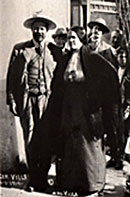
Pancho and “official” wife, Luz Corral (E. Bryant Holman, ca. 1920)
In 1971, I was at a party in Boulder, Colorado. One of the asst. professors at CU was dancing with me and he mentioned that he had just returned from a short trip to Mexico. He went there to interview Pancho Villa’s widow. The following summer, Jim and I were in Durango and I kept noticing so many old women (dressed in long black dresses and veils) begging for alms outside the churches. Jim told me that they were the widows of the revolution. It occured to me that that era was coming to a close and I asked him if we could stop off in Chihuahua to visit the Villa Museo on our way home. I recalled watching an interview with Anthony Quinn on TV (Dick Cavett Show). He was telling stories about watching his father riding atop a train in northern Mexico with a bunch of other Villa soldiers as they headed into battle. At this time, I didn’t know diddly or squat about much Mexican history, but the Revolutionary War era sounded very romantic to me. I wanted to follow up.
We arrived in Chihuahua by bus, walked past a large prison, and finally located the Villa Museo. We walked inside, couldn’t find anyone around. So I continued to try to find a person to pay or to ask permission from. That’s when I saw a very old woman sitting in a rocking chair in a dimly lit room of the house. She didn’t speak English and I didn’t speak Spanish, so I got my husband to translate for us. That’s when he told me that she was “the lady of the house”…. the widow Villa.
I asked her if she would speak to us for a little bit. She was in no condition to be the “hostess with the mostess”, but she was agreeable. She was feeble and kind. She looked like all the other widows (dressed in total black, shawl, veil, dress and stockings). Her eyesight was nearly gone and that probably explained the darkened room. After looking up on the internet for some info about Villa’s widow, I should note that I found an article and photo of Luz Corral. She doesn’t appear to be blind at all. Perhaps she wasn’t feeling well on the day we met. In this photo taken in 1974, she appears to be healthy and alert. I also noticed that she’s wearing a print blouse (not black).
Here’s the rub….. understand that we were very young and very inexperienced. My questions to her were very superficial, and I was dealing with a translator (hubby) who was feeling very embarrassed about my nerve. He felt like a trespasser and didn’t feel comfortable about doing this at all. I didn’t take any notes and can’t remember a thing she told us. We spent about 20 min. with her. In the back of my head I kept thinking about the fact that Villa was a womanizer and that he had several wives (about 8 I think), so I wanted to be very careful about what I asked. To this day, I don’t know where she fit into the time-line. All I knew was that she got the house and she was the only widow still around. 🙂 Anybody who knows me, knows that I always travel with my camera. Problem was that it wasn’t the same one I have today. It was a cheapo kodak camera with cube flash on the top. Therein lies the second rub….. I asked her if I could take a pic of her. She said “that would be fine”. My cube was used up and there was no light in the room. So I have no notes… and two completely blackened photos to show for it.
The Museo is still in Chihuahua, but as far as I know, all the Revolutionary widows are deceased. The bullet riddled car that Pancho Villa was riding in when he was assassinated is still parked in the patio of his former home.
The article says that Dona Luz Corral de Villa was awarded the great sum of 10 pesos per day for her military pension. That’s approx. 75 cents.
“Ill be a Zapatista til the day I die”
Translated from 11-Feb-2005 Jornada article by Arturo Garcia Hernandez.
One of the last survivors of the Ejército Libertador del Sur (Southern Liberation Army), Mauricio Ramirez Cerón, 100, passed away Wednesday night at his home in Tilzapote, Morelos.
Ramirez Cerón was 14 when he became a spy for Emiliano Zapata’s army. In an interview with la Jornada three years ago, Ramirez Cerón maintained he felt “proud to have served a man like General Zapata, the purest man of the Revolution. I will be a Zapatista until the day I die”.
Ramirez Cerón has been in noticeably deteriorating health for the last year. His remains were buried yesterday afternoon in Tilzapote’s municipal cemetery.
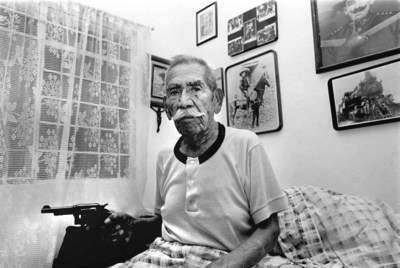
“A harmless kid” Mauricio Ramirez Cerón (1904 -2005)
It was in this small town, on the Morelos- Guerrero state line, where the then adolescent first met the rebel leader during a village dance.
As Ramirez Cerón explained in 2002 , he approached the caudillo and asked him for a gun, begging to “fight by his side “. Zapata responded that he was a small boy, but seeing how serious he was, sent the boy to see one of the Zapatista Generals, Lorenzo Velásquez. .
“Velázquez said I looked like any harmless kid, so he sent me out with a commission as a spy. I was commanded to report on the Carrencistas, finding out who the local chiefs were, who were volunteers, what arms they had, and if they had sufficient supplies,” Ramirez Cerón recalled.
He always lived in Tilzapote, in a house located in a place framed by a small and calm pond, surrounded by hills. From his terrace, drawing a finger across the landscape, the revolutionary recalled the past for his interviewer:
“I was born here in 1904. I was seven when the Revolution exploded. Although small for my age, I’d been to school, and, let’s say my betters, talked to me. They told me there was going to be a Revolution, and explained the principles of Madero’s uprising. At the time, it was tyranny. A cane-cutter or a poor farm worker only earned 37 centavos working from sunup to sun-down. When General Zapata came this way, I already had my revolutionary schooling.”
Armed with only a machete for killing snakes, Mauricio went to battle in trousers, a serape, a palm-leaf hat, a water bottle, a napkin for his tortillas.
If somebody stopped him, he had only the napkin for protection, claiming he on his way to pick up tortillas: “I didn’t say anything until I was a day out of Buenavista, in the shadow of the Carrancistas. I was serving in the Southern Liberation Army with will. I knew if they caught me, I couldn’t say anything, even if they killed me.”
Mauricio Ramirez Cerón shared his experiences as a Southern Liberation Army soldier with historians over the years, and were recorded in Francesco Taboada and Sarah Perrig’s documentary film: Los últimos zapatistas. Héroes olvidados.
In the memory of the revolutionary Ramirez Cerón there has always been the image of Emiliano Zapata – “a good man, a benevolent man, a whole man. He was not a bandit. Since there were shortages, he bought clothes and he gave them away; he gave beans and rice”.
But when he died, “many that were Zapatistas turned Carrancistas for the every 15 day payment. I informed, they said. I was a Zapatista and had to go. An uncle told me ‘ get lost, you’re making life dangerous for us all’. I went to Jojutla, Tlalpuyeca, Xochitepec. Then walked back”.
Asked about the recent rise of another Zapatista movement, the Ejército Zapatista de Liberación Nacional (EZLN), the old Revolutionary said: “I am in agreement with them: they are men of our own race, defending their own. They have a rough life, those compatriots of ours, getting pushed around by the caciques (political bosses) in Chiapas.
‘”Those men are absolutely right. Like Zapata. Today, seated in this wheelchair, I am still responsible for the name of Zapata, because whoever defends the undefended poor man is a hero.”
Right-wing loons, even in “leftist Mexico”…
we have our right-wing loons
The radio campaign to combat homophobia that the government plans to launch in March has come under fire from conservative groups, which say it promotes homosexuality.
UNPF (Unión Nacional de Padres de Familia) sent the health secretary a letter saying that though it agrees on the need to combat homophobia, it believes the health department should also offer services to “cure” homosexual deviation, Health Secretariat and the National Center for the Prevention and Control of HIV/AIDS (Censida) chief Jorge Saavedra told EFE.
Mexican wingnuts have it tough… they have to fight “the Jacoban threat” along with the normal fights Talibaptists north of the border fight against “the threat to traditional values” and the dreaded Darwin (at least in theory). I think they’ve lost the “condoms in the schools” issue. I admit I was shocked — but then I remembered that Mexico has the lowest HIV transmission rate in Latin America, and a rapidly declining birthrate — when I had to take one of my colleague’s 11-year old to the farmacia to buy something he needed for a school project — condoms. And this kid goes to a Catholic school.
OK, so Mexico isn’t paradise. But, at least our conservatives ignore the right-wing loons rather than bringing them into the government.
Whose drug problem?
What’s behind the drug-violence flap?
BY FRED ROSEN/The Herald MexicoFebruary 06, 2005
Many Mexicans have become fatalistic about the burgeoning transnational drug trade based in their country and even about its attendant violence. A recent Parametria poll reports that 54 percent of those questioned believe there is no way to bring the major drug traffickers under control, and a surprising 9 percent feel the illicit trade actually benefits the country for the hard currency it brings in.
But that fatalism vanishes when it comes to perceived U.S. criticism and interference in the country’s internal affairs, even when that criticism is directed at the universally acknowledged violence emanating from the illicit drug trade.
Mexicans across the entire political spectrum react strongly against any implied criticism of their domestic affairs, especially when it comes from north of the border. Among other things, they worry about the hidden intentions that may (or may not) lie beneath the criticisms.
(snip)
The latest round of perceived interference took place last month as U.S. officials publicly took Mexican authorities to task for their inability to bring drug-related violence under control. The criticism followed wire service reports of a number of U.S. citizens who had disappeared presumably having been kidnapped in Nuevo Laredo and Piedras Negras, Mexican cities on the U.S.-Mexico border.
(snip)
The U.S. press has responded with story after story of how neither Mexican police nor Mexican prisons have been able (nor, perhaps, willing) to contain the drug violence. Tony Garza, the U.S. ambassador to Mexico, opined last week in a public letter that the violence “…could have a chilling effect on the crossborder exchange, tourism and commerce so vital to the region’s prosperity.” Mexican police, he said, seem incapable of dealing with it.
On the face of it, Garza’s letter was not unreasonable, but Vicente Fox, a decidedly pro-U.S. president, reacted strongly to it. “Mexico’s fight against drug trafficking is firm,” said Fox in a public statement. “The Mexican government does not admit judgment from any foreign government about political actions taken to confront its problems.”
Secretary of Government Santiago Creel, a likely PAN presidential candidate, reacted even more strongly. In response to U.S. criticism that imprisoned drug lords were able to orchestrate the escalating violence from behind bars, Creel responded that at least Mexico was putting the capos in jail. “I would like to see more drug lords in United States prisons,” he remarked.
The Mexican press has by and large backed Creel. The principal illicit drug market is in the United States, goes the Mexican version of the story: The cartels, much like the undocumented workers who cross the border illegally, are only responding to market signals emanating from an outof-control U.S. drug culture.
(snip)
The Bush Administration has no apparent interest in improving bilateral relations anywhere except on its own terms. That makes bargaining difficult and raises the suspicion that the latest round of mild criticism from the U.S. ambassador may be meant to soften up the Mexicans for some stillunnamed concessions. Historical paranoia, that is, may in this case be reasonable wariness.
BY THE WAY…
Courtesy of the Central Intelligence Agency:
The US is the major consumer of cocaine , heroin, marijuana, and increasingly methamphetamine from Mexico; consumer of high-quality Southeast Asian heroin; illicit producer of cannabis, marijuana, depressants, stimulants, hallucinogens, and methamphetamine; money-laundering center .
Mexican opium poppy cultivation (2001 figures): 4,400 hectares; cannabis (2001 figures) 4,100 hectares); government eradication efforts have been key in keeping illicit crop levels low; major supplier of heroin and largest foreign supplier of marijuana and methamphetamine to the US market.
la ultima vez…Consuelo Velazquez
Consuelo Velázquez died Saturday night. She was 88, though claimed to be a mere 84. Velázquez, a native of Ciudad Guzmán, Jalisco despite her career as a concert pianist, singer and recording star, was a very, very proper Mexican Señorita, indeed. In 1941, when she was 25 she had never been kissed…Which maybe has something to do with the poinancy and staying power of one of the greatest pop songs of the last century, recorded by everyone from Pedro Infante to Placido Domingez to the Beatles to those incurable romantics, the Soviet Army Chorus.
Besame Mucho
Besame, besame mucho,Como si fuera esta noche la ultima vez
Besame, besame mucho,Que tengo miedo perderte, perderte despues.
Quiero mirarme en tus ojos,Tenerte muy cerca, verte junto a mi.
Piensa que tal vez mañanaYo ya estare lejos, Muy lejos de aqui.
Besame, besame mucho,Como si fuera esta noche la ultima vez.
Besame, besame mucho, Que tengo miedo perderte, perderte despues.
January 26, 2005 SANTA CATARINA JUQUILA, Oaxaca (El Universal (English Edition) )
Four robbers stole offerings of money and jewels from one of the state’s most important Catholic shrines and left a 67-year-old priest tied to a tree overnight, church officials said Tuesday.
The robbers entered the church of the Purisima Concepcion Sunday afternoon, surprised the Rev. Bonanciano Alberto Pacheco and stole jewels and cash stored in the church safe, said local vicar Fidel Vásquez Ortiz…
Pacheco was discovered at about 9 a.m. Monday in a field several kilometers away in San Pedro Juchatengo. He had been blindfolded, gagged and tied hand and foot and was bound to a tree over an ant hill.
The priest, who is diabetic, was being treated at a church hospital in the state capital, Oaxaca city, on Tuesday.
The bishop and the condoms
Chiapacaños are an ornery bunch. Never mind the Zapatistas, they’re the new kids on the block. The folks down in Chiapas have been battling with outsiders, and squabbling among themselves for the last 1500 years or so. Even the Spanish overlords down there have been more feisty than your normal imperalist oppressors. Crisobel Olid set the stage when he rebelled against Cortés, and Pedro de Alvarado attached the place to his own fiefdom of Guatemala.
The Spanish annoyed the local Mayans. The Spanish clergy annoyed the Spanish. Early on they started complaining about decent colonial practices (like rape and pillage) and, on one famous occasion, excommunicated slave owners (and burned a few at the stake as a lesson to the others). The emeritus bishop of Chiapas, Samuel Ruiz used to keep military maps in his office, making no secret of his pro-Zapatista sympathies. He was forced into retirement and the Vatican installed the Conservative, Felipe Arizmendi.
Bishop Arizmendi once called Starbucks the agent of Satan (Starbucks screws the local coffee growers… and the Bishop is right, anyway). It looks like now he’s taking on the Vatican:
Bishop backs condom use in war against HIV
Bishop Felipe Arizmendi calls for toleration concerning contraceptives.
BY LAURENCE ILIFF/Dallas Morning NewsJanuary 21, 2005
A Mexican Catholic bishop this week joined a Spanish counterpart in endorsing the use of condoms to prevent HIV infection, in what one analyst called a fresh challenge to Pope John Paul II.
Bishop Felipe Arizmendi said at a news conference that under some circumstances the use of a condom to prevent the spread of AIDS should be tolerated as a “lesser evil.”
That directly contradicts the official position of the Roman Catholic Church against all artificial birth control.
Arizmendi, whose diocese is in San Cristobal de las Casas, Chiapas, said his comments did not contradict church policy in favor of abstinence and fidelity.
“But we know how to respect the decisions of people, in such a way that if someone is incapable of controlling their instincts, is not developed in their personality, then they should use whatever is necessary in order not to infect others and not to infect themselves, because for these types of people there is no other alternative,” Arizmendi said.
However the Mexican Catholic Church contended Thursday that condom use is a false solution to the AIDS pandemic, adding its voice to the discussion opened up by the Spanish Bishops’ Conference spokesman’s statements on the matter earlier in the week.
The Mexican Bishops’ Conference (CEM) said Thursday in a communiqué that “AIDS has profound repercussions of a moral, social, economic, juridical and organizational nature, not only for families and local groups, but also for nations and all peoples.”
The CEM said that “people with AIDS are not distant, unknown persons, nor are they the object of our mix of pity and repulsion. Consciously, we must keep them in mind as individuals and as a community take them in with unconditional love.”
“We must reject the false doctrine that HIV-AIDS is a punishment from God; it is ra ther a call to work together in the education and sensitizing of humanity to reduce new infections and discrimination against those who are the carriers of this virus,” the CEM said.
Still, one Mexican church analyst said that the debate over condoms is likely to get more intense, not less, given the infirmity of Pope John Paul II and the apparent challenge to his policies by even conservative bishops.
“I think most bishops know that the practice of total prohibition of condoms is absurd,” said Roberto Blancarte, a professor of sociology and religion at El Colegio de Mexico.
“These bishops in general are quite conservative, but they live within an overall society, and Spanish society is much more liberal than they are,” he said. Likewise, Mexican priests see the ravages of HIV infection in communities and question the ban on condoms, he said.
The latest debate, Blancarte said, comes at a time when the pope is ailing and his grip on power at the Vatican might be weakening.
EFE contributed to this report
Pablo O’Higgins… another gringo who stuck around
I don’t know if this artist is even known outside of Mexico. He’s not much known even in Mexico. Pablo O’Higgins (1904-1983), born in Salt Lake City, arrived in Mexico City in 1926. It might make a good story if I could claim he was a Mormon missionary led astray… which sounds like something the master muralist (and serial liar), Diego Rivera would have made up. But Diego never thought of that story, and it wasn’t true anyway. No… O’Higgins actually came here to study with Diego… and José Clemente Orozco and that other Mexico “O” muralist, Juan O’Gorman (I’m always confusing the two.)
As committed to THE Revolution (international or simply Mexican) as the masters, but much less a publicity hound than Diego, O’Higgins suffered the fate of being the second generation of Mexican muralists (he took out Mexican citizenship). He wasn’t new, and Mexico was out of fashion from the 40s until very recently when everybody decided Frieda Kahlo was interesting. Everybody but the Mexicans that is.
For Mexicans, Kahlo is a European “artiste” wannabe whose self-indulgence and morbid self-absorbsion is very un-Mexican. Mexican artists, especially Revolutionary ones are “jest folks”… one with the people… and one of the people. Frieda may have a Communist, and she married Diego (who is forgiven his outsized ego… and outsized SIZE… the guy was HUGE!… because he really did start a revolution — artistic, not the workers’ one), but, she looks like someone just starved for attention and living in her own universe. But her life is interesting. Entire books (and a crappy Hollywood movie) are dedicated to her. Pablo O’Higgins’ biography is only sixty words at “Biografias y Vidas . com”. Rather than draw himself and talk endlessly about himself, he painted the people he respected… the ordinary, hard-working Mexican campesinos and workers.
Mercado Abelardo Rodriguez, off calle del Carmen between c. Rep. de Venezuela and c. Rep. de Colombia is, in some ways the pefect setting to see his works. Although the murals need restoration, the Mercado is not on any tourist trail. It’s decidedly an everyday blue collar, traditional working class market… the hard working campesinos and workers O’Higgins respected as the “Real Mexicans”. His subject is the struggle of the common person for dignity, and where better to witness the artistic representation than in the midst of the real thing… among those working class heros at their neighborhood mercado, in the heart of Tepito, the barrio bravo?

Detail from La lucha obrera, mural by Pablo O’Higgins (1904-1983) Antiguo Colegio de San Ildefonso
The Evil Empire (yup, them again)
Wal-Mart ‘Duped’ Locals to Build on Holy Site
A Mexican co-operative say they were tricked into helping the retail giant defuse a row over its new store being built right beside ancient pyramids
January 16, 2005 by The Sunday Herald (Scotland)
by Elizabeth Mistry

For the small group of women entrepreneurs, it was a dream come true. One of the world’s biggest super market chains – as part of its much-vaunted community initiative – wanted to sell the co-operative’s collection of natural beauty products, made from nopal and xoconostle or prickly pear, cacti that grow in abundance around one of Mexico’s most important ancient pilgrimage sites – the pyramids of Teotihuacan.But now the women believe they have been duped by Wal-Mart, the US-based retailing giant which, they say, desperately needed to portray itself as a good citizen after it caused national outrage by building a new store within the boundaries of the Teotihuacan archeological zone, a 2000-year-old UNESCO World Heritage site whose name means “The Place Where Gods Were Made” and which receives more than two million visitors a year.
“Before the store opened, Wal-Mart asked us to start making the products – 200 a month – as soon as possible,” a member of the cooperative told the Sunday Herald. “We are only a small outfit and this was an important deal for us, we had to take out a loan to get it all done on time. When we finished, we tried to contact them to arrange delivery but they never answer our calls and have never paid us. We have tried to contact them for months but nobody wants to help us. Wal-Mart said that it would promote regional producers in the new store. We realize now that they were just using us so they can say on their website that they are working with the community.”
Wal-Mart has been the subject of a string of lawsuits in the US ranging from bullying to discrimination. Its new Mexican store, which operates under the Bodega Aurrera brand, has prompted heated debate over convenience versus culture.
Some argue that inhabitants of the nearby town of San Juan Teotihuacan should not face a 15-mile journey to their nearest supermarket and that the 180 jobs Wal-Mart says it has brought are vital for local families. But protesters claim the building damages the integrity of the 2000-year-old site and that both local government officials and representatives from the National Institute of Archaeology and History (NIAH), the state body charged with safeguarding Mexico’s archeological sites, colluded with Wal-Mart to fast-track the store, located at a strategic point just off the highway bringing visitors to the site.
Emma Ortega, a longtime resident of Teotihuacan, approximately 40 miles north of Mexico City, describes herself as one of the ruined city’s spiritual guardians. She is one of the most vociferous members of the campaign to close the store. Now recovered following a three-week hunger strike she and other members of the Civic Front for the Defense of Teotihuacan undertook to try and stop the opening of the 20-aisle store which local market traders fear will put them out of business, she says that by allowing the construction within zone C of the protected archeological zone, NIAH is breaking the law.
She listed a number of irregularities that “in other circumstances would automatically mean the end of the project” and cannot understand why, after a number of remains were found on the site, the project was not shelved.
“Without a doubt this store has been built on land that was once part of the ancient city. Recent excavations have found tombs, part of a plaza, ceramic shards and an altar which was dated at 450AD. This proves that this is an important site and yet the authorities who originally said that all such findings were important seem to have changed their minds.
“What is the point of having an exclusion zone if you are going to ignore it when someone with enough money comes along? It is clear that the government is turning a blind eye and selling the country’s heritage to whoever is prepared to pay the most. NIAH’s director should resign.”
The decision to allow Wal-Mart – owners of the Asda supermarket chain in the UK – to build the store is shrouded in secrecy. Even though the site is listed by UNESCO and the World Monuments Fund as being of international importance, the original go-ahead was apparently taken by the local head of NIAH without being referred to a senior federal authority. Then, in a still unexplained twist, it emerged that the official responsible resigned a few days later, only for her replacement to be murdered shortly afterwards.
Bizarrely, the NIAH and the local authorities each claim that the other is responsible for issuing permits. The matter has been complicated by an apparently fluid interpretation of the law which has allowed a rash of building – including shops, a luxurious gated residential compound and a hotel – to go unchallenged within the protected zone in recent years. This, argue those in favor of the new store, means that one more building will not be a cause for concern.
Wal-Mart declined to comment. But its website highlights its work with local communities. It prides itself on being a socially responsible company, pointing to the fact that for three years running it has been recognized as such by the Mexican Center for Philanthropy. This national organization was established by the millionaire Mexican businessman Manuel Arango who has devoted himself to good works – since selling the Bodega Aurrera chain to Wal-Mart.
To the protesters’ dismay, UNESCO has accepted NIAH’s assessment that the store is not likely to damage the archeological site. But several NIAH staff contacted by the Sunday Herald say they feel betrayed by the institute and some of Mexico’s best known writers and artists including Carlos Fuentes, Elena Poniatowska and British painter Leonora Carrington have signed a petition against the development.
Sergio Raul Arroyo, NIAH’s director, admitted that the store has a bad reputation, but he could not explain how, in spite of such opposition, the government has apparently failed to intervene.
He told the Sunday Herald: “We cannot take into account moral or sentimental issues. We are dealing with a tremendously powerful company here. We don’t have the money to fight this.”


