Save the worms!
“By the time you get to the bottom, it wouldn’t matter if there was a dime at the bottom,”
Jan. 16, 2005, 12:12AM
Is mescal’s worth all about the worm?
Makers will soon find out, as Mexico bans the liquor’s legendary addition
By JENALIA MORENO
Copyright 2005 Houston Chronicle (registration required)
…(snip)…
Hoping to upgrade mescal’s image, the Mexican government drafted new standards for the smoky-flavored liquor more than 10 years ago. And beginning Feb. 10, bottlers will no longer be allowed to add worms, fruit or herbs to their mescal.
As might be expected, the new standards don’t sit well with its brewers and distributors.
“The worm draws your attention,” said Celia Villanueva, the founder of Houston-based Mexcor, which distributes the Lajita brand. “It’s popular with young people.”
Jose Villanueva, one of the industry leaders who participated in earlier stages of developing the regulations, hopes Mexico’s secretary of economy intervenes before the new rules take effect.
“The standards were badly done,” he said
.If they stand, he said, abandoning the worm would hurt mescal sales.
“What we’ve seen from the export market is that the market asks for it,” said Oralia Aragon, a manager at the Mexican Regulatory Commission for the Quality of Mescal
….(snip)…
Mescal is often made by mom-and-pop producers, primarily in the southern state of Oaxaca, where small distilleries line rugged roads. Some of the smallest producers sell mescal in plastic containers.In addition to selling bottles, these vendors deal in mescal and worm folklore.
They say the worm has aphrodisiac qualities or that consuming the worm is good luck.
But some consumers simply drink mescal-based cocktails for their flavor.
“By the time you get to the bottom, it wouldn’t matter if there was a dime at the bottom,” said Steve Wiley, who sipped a Oaxaca Rita, a margarita made with mescal rather than tequila, at Hugo’s, a Mexican restaurant, on a recent night.
…(snip)…
The worm found its way into bottles of mescal more than five decades ago when producers wanted to create a smoother flavor for the potent libation, said Jose Villanueva, whose company makes both tequila and mescal.
…(snip)…
Native to the heart of the agave, the bug comes out when it rains, allowing worm wranglers an easy harvest.
Loaded with protein, these critters are part of the regional cuisine in southern Mexico, where cooks often fry them and add spices.
Worms are so popular that they cost several cents each. There’s even a shortage of the crawly creatures in Mexico, Villanueva said.
So if the mescal industry loses its fight against the government, worm eaters may find the delicacy more abundant — and cheaper.But the industry would find itself without its classic icon.”It would be absurd if the government doesn’t intervene,” Villanueva said.

Man bites dog, and other news of the month
Mexico don’t get no respectAccording to the C.I.A., Mexico isn’t going to be a world power any time soon. Oh well, with all that oil, and a second-rate army, I’m surprised the Bushistas went half a world away… It’s just as well they don’t know about the tacos sold by the two brothers from Jalisco outside Tacubaya Metro… Mexico’s top-secret weapons of mass destruction.But they bribe gringo copsThe MEXICAN Organized Crime Special Prosecutor, José Luis Santiago Vasconcelos, is expecting to hand down indictments soon against crooked cops in cahoots with narcotics smugglers. And where are these cops on the take to be found? In the U.S. Border Patrol!U.S. Drug Tsar, Barry McCaffrey say’s DUH!.
And an important anniversary
Today is the 413th birthday of Parque Alameda. We owe a debt of gratitude to Conde Velasco, the far-seeing Viceroy who hit on the happy idea of nice benches and a bit of shade to relax under while watching the Inquistion burn the heretics. That particular pasttime ended a few centuries ago (on Sundays, some of the best cheap entertainment around are the musical groups pushing various heresies). John Greenleaf Whittier, despite his Quaker and Abolitionist principles, served with the U.S. Occupation Forces here in 1847-48. He spent the remainder of his long life pushing New York to provide an urban park… today’s Central Park. Other U.S. cities think they got the idea from New York, but New York got the idea from that 16th century viceroy.

Justice at last in the dirty war?
Reuters still claims Vincente Fox’s election was the “71 years of single-party rule ” (which is a bit naive). Not quite true, but Mexico was close to a right-wing dictatorship in the 60s and 70s (Carlos Fuentes — who was a high-level government bureaucrat at the time — called the Mexican System “the perfect dictatorship”). The imperfections in the system, made worse by educational budget cuts when preparing for the 1968 Olympics, led to protest and repression. The worst was the 2 October 1968 Tlatelolco Massacre (this is from a Marxist paper, but it’s accessible in English) — which was ignored by the foreign press, and never fully acknowedged by the Mexican government. People never forgot, and maybe now, we’ll finally find out what really happened…
Mexico to Charge Two Dozen in ‘Dirty War’ Massacre
Thu Jan 13, 2005 03:52 PM ET By Lorraine Orlandi
MEXICO CITY (Reuters) – Mexico will bring genocide charges in March against two dozen former officials for a 1968 student massacre, the bloodiest moment in a brutal campaign against leftist dissidents by previous governments.
Special Prosecutor Ignacio Carrillo said on Thursday the long-awaited case will be brought against former high-ranking civilian and military officials. They are among 70 people he plans to charge during the next year in President Vicente Fox’s drive to punish past atrocities, he told reporters.
Officials say about 30 people died in the Oct. 2, 1968, blood bath at Mexico City’s Tlatelolco Plaza, when troops fired on a huge protest days before the Olympic Games opened here. Rights groups say that based on witness reports the number of dead was closer to 300.Ex-President Luis Echeverria, who was interior minister at the time, is under investigation for his role in the tragedy and is widely expected to be charged, though Carrillo would not confirm that.In July, the prosecutor sought to bring genocide charges against Echeverria and 12 others in a different case, a 1971 attack on students that left at least a dozen dead. The charges were dismissed based on the statute of limitations, and the Supreme Court is reviewing Carrillo’s appeal.On Thursday, Carrillo said he aims to bring charges in the 1968 massacre against some of the same former officials he named in the 1971 case.
He pledged to file charges in the Tlatelolco case even if the Supreme Court has not yet ruled in the 1971 killings, though the high court’s decision is seen as crucial to establishing a framework for prosecuting similar cases.
“I would prefer to follow the court, but I can no longer say to the complainants and family members we’re still waiting,” he said.
Fox took office in 2000, ending 71 years of single-party rule and pledging to expose Mexico’s repressive, secret past. Hundreds or more Mexicans died or disappeared at the hands of government security forces from the 1960s to the 1980s in a so-called dirty war against dissidents.
Of 11 dirty war arrest warrants issued, just three suspects have been arrested and face trial. In Mexico, genocide charges can apply if victims were targeted as members of a group, such as the student movement.
(Thanks to “katydid” for finding this)
The kid was alright — Covarrubias at 100
Mauricio, our Bagdad correspondent at the Thorn Tree Mexico Branch (working with the elections folks) brought to mind Miguel Covarrubias, who… among many, many other things… was an expert on Indonesia. I’ve been meaning to post something about the artist, but haven’t gotten around to it. Gee, we’ll just have to settle for Susannah Glusker’s article about him for now…
100 years of Covarrubias
BY SUSANNAH GLUSKER/The Herald Mexico El Universal Martes 14 de diciembre de 2004 Nuestro mundo, página 4
Miguel Covarrubias, one of Mexico’s most versatile artists living in the 1920s, is being honored on the 100th anniversary of his birth. Three art exhibits are being launched to feature his work, and there is an unconfirmed rumor that his ballets will be produced.
Covarrubias was known as “El Chamaco,” which basically means the “Kid.” His nickname came from the fact that he was “just a kid” amidst an impressive older group of artists that included the muralists Diego Rivera, José Clemente Orozco and David Alfaro Siqueiros as well the photographers Edward Weston and Tina Modotti among others.
El Chamaco dropped out of school at the age of 16 and went to work for the Communications Ministry as a draftsman for maps. He won a prize for his work and received a scholarship to go to New York. It is in New York that his career as a cartoonist and an illustrator takes off. The editor of Vanity Fair recognized Covarrubias’ talent as a master caricaturist and bought his work, including many covers.
Covarrubias’ subjects were as timely and amusing as his drawings. He captured the mood and flavor of Harlem, the jazz singers and the nightclubs later published in the book Negro Drawings. “Impossible Interviews” was among the most successful of his series of caricatures. Here Chamaco juxtaposed figures such as the baseball player Babe Ruth with the Ethiopian Emperor Haile Selase, or the psychiatrist Sigmund Freud with actress Mae West.

For Vanity Fair, the artist imagined Emily Post, the “Miss Manners” of the 1920s,
relaxing after a hard day of excruciatingly correct behavior.
Covarrubias was also successful as an illustrator during this same period. He did marvelous drawings for books by U.S writer Pearl Buck and others.
Covarrubias married the U.S. dancer Rose Rolland and they embarked on a honeymoon to Bali financed by a Guggenheim fellowship. His drawings of the people of Bali, especially the women, are colorful, cheerful and beautiful.
Chamaco painted what he saw and is credited with being the first visual anthropologist. He took courses at Columbia University in New York with Franz Boas and used his talent to document people and their customs. He took this talent one step further and wrote about the people and places that he observed. Interestingly, he wrote and published only in English, not in Spanish, his native tongue. Some of his work has since been translated into Spanish.
Covarrubias returned to Mexico to document the people of Tehuantepec in his book Mexico South. It was meant to be a first of three volumes but unfortunately the other two were not completed or published. He did not limit his activity to books, but branched out into the field of dance and museography.
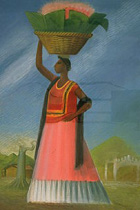
From the Istmo de Tehuanatepec
His interest in dance was intimately bound with the new love of his life, the young dancer Rocío Sagaon. He designed sets and costumes that made the stage come alive as if it were a moving mural.
The Mexican government recognized Covarrubias’ talent and put him in charge of the newly created department of museography. This was the beginning of the Mexican tradition of creating exciting exhibition spaces such as the Museum of Anthropology.
There are wonderful Covarrubias murals still standing in Mexico City; one is downtown at a coffee shop on Madero Avenue next door to the Ritz Hotel. Another that was in the Hotel Del Prado, demolished after the 1985 earthquake is being restored, one at the National Museum of Anthropology and a fourth, the folklore and costumes of Mexico will be transferred to the new Museum of Folk Art once it’s opened.
The versatile Chamaco will be honored for his books, caricatures, illustrations, costumes and murals in Mexico. The Museo Soumaya in the south of Mexico City leads with an exhibit of the drawings and caricatures owned by the distinguished intellectual Carlos Monsivais. The Museo Mural Diego Rivera follows with “Impossible Interviews,” Negro drawings, scenes from Bali, markets and illustrations. It is a good sampler of his work as an artist in the United States and Mexico. The Museo Estudio Diego Rivera- Frida Kahlo in San Angel will feature Covarrubias’ work in ethnology and as a caricaturist at the end of January.
Covarrubias’ unusual spirit of transmitting the beauty and color of many parts of the world is refreshing. You can enjoy it here or if you happen to be in the environs of Austin, Texas, step into the Harry Ransom Research Center and view some great work on exhibit there.
Dr. Susannah Glusker teaches Mexican Art of the Twentieth Century and Women of Mexico at the Universidad Iberoamericana. She is the author of “Anita Brenner: A Mind of Her Own.”
http://www.eluniversal.com.mx/pls/impreso/version_imprimir?id_nota=8331&tabla=miami_H
Talking trash
In theory we separate organic and inorganic trash (though the pependores throw it all in the same truck. We’re TOLD it gets separated at the landfill, but I have my doubts). At least we have regular garbage pickup. One truck comes through early in the morning, picking up whatever is piled in the streets (some of my neighbors don’t seem to have caught on to the idea of garbage cans yet… oh well, rats need to eat too). Around 10 in the A.M. a guy walks down the street with a clapper bell… I half-expect him to be yelling “bring out your dead, bring out your dead”… and the morning garbage parade starts down the street. Regular trash pickup doesn’t mean door-to-door service. The guys stop in the middle of the block, and you lug down the stuff (a good reason to take the trash out regularly). About 5 we’ll have the afternoon trash parade.
Not suprisingly, we’re running out of landfill space. The pependores themselves do a lot of recycling . Dumpster diving is practically unknown here… I managed to snag a ratty old sofa (a temporary acquision) only by happening on it in the short interval between the time my neighbors tossed it in the street (a rarity, most people sell their crapped out furniture to guys going by with a horse and cart, who resell it to upholsterers who resell it back to whomever tossed it in the first place). It’s semi-reupholstered and one leg is a construction brick, but it’s only temporary… it’ll go to the guy with the pony one of these days.
The pepindores re-cycle a lot of your trash on the spot… the good stuff is pulled aside and neatly piled on the truck, or hung from the side (last week, one truck had three almost complete bicycles and a VW front seat tied to the front grille) while the rest… organic and inorganic… gets unceremoniously tossed in the hopper. Recycled at the landfill? Who knows? There are rumors that all garbage men are rich… I don’t believe it, but they aren’t exactly the poor dump-dwellers of everyone’s Latin American tragic photomontage either. Mexico City’s garbage-men have an excellent union, thanks to a semi-gangster organizer about 30 years ago who only stole enough to support his three wives in palacial style, while negotiating good contracts for these guys that included the rights to recycle, along with decent housing and futbal fields. They may live AT the dump… but they don’t live IN a dump.
And… this is probably the only place in the world where the big national parade highlights the finest equipment of the Army, the Navy, the Marines, the Air Force, the Police and the Garbage Men… who are cheered and applauded wildly. Everybody knows their garbage men, and likes them a lot better than the neighborhood cop.
So… what are our popular garbage men picking up these days? DISPOSABLE DIAPERS! 13 % of all Mexico City trash is disposable diapers… 46% is organic waste, that can be composted, 6.4% is plastic (recyclable, at least in theory), 5% is glass (easily recyclable) and 2% is plastic bottles… also recyclable. But what do you do with poopy diapers? Good thing the birth rate is dropping!
Sounds reasonable (the infamous border crossing comic book)
From that pamphlet for would-be border crossers that has everyone in a tizzy north of the border. (New York Times translation by James C. McKinley, Jr.)
Avoid loud parties; the neighbors might be bothered and call the police and you could be arrested.Avoid getting into fights. If you go to a bar or nightclub and a fight breaks out, leave, for in the confusion you could be arrested even though you did nothing.Avoid family or domestic violence. In the United States, as in Mexico, it is a crime. Domestic violence is not only blows, but also threats, shouts and mistreatment.If you are accused of domestic violence against your children, partner or some other person you live with, you could go to jail.
Do not carry firearms, knives or other dangerous objects. Keep in mind that many Mexicans are dead or in prison for this reason.

And don’t throw rocks at 12 foot tall cops either!
Historietas have an esthetic all their own… the migras I’ve met are dumpy guys without a lot upstairs. Once coming into Texas on the bus, a migra wanted to know what my U.S. passport was. A U.S. passport. Why was I carrying a U.S. passport. Uh…. because I’m a U.S. citizen? He then looked under my bus seat, presumably searching for illegal midgets.
Spanish bankers … nyuck, nyuck, nyuck!
Galicians are not the folks Saint Paul sent an Epistle to. They are the dumb — fill in your favorite ethnic slur here –of the Spanish-speaking world. Saint Paul was writing to folks in Turkey. Galicians aren’t exactly renouned for being the sharpest tools in the Iberian shed. Their neighbors, those sharp businessmen, the Basques, claim the Galicians are a bunch of Irish fishermen who washed up on the Bay of Biscay after getting drunk. Santander-Serfin S.A…. one of the larger banks in Mexico, isn’t QUITE a Galician bank ( Santander is actually in Cantabria) but its management and staff might as well be. Our regular bill quite clearly told us to make the check out to SANDANDER, S.A. write the account number on the front of the check and deposit the check on 6 January 2005. SO… today being 6 January 2005, we made a check out to SANDANDER, S.A. , wrote the account number on the front and… This is one of the larger banking institutions in Latin America, and in the world. You’d think SOMEONE might have noticed that when they sent out their bills they’d be changing their name on 1 January… and might have communicated that information to the accounts receivable people… or, at least kept accounts open in the Santander, S.A. name… or something half-way intelligent?So, despite what the bill says, the bank can’t accept a loan payment to itself. It costs money to write a check, not to mention the hassle of standing in line while you wait for the next available teller to finish her siesta. No wonder people hate the banks. Even the ones run by gringos are really run by…

Galician Bankers
“We can’t help it… we’re morons!”
I don’t know why but I’d saved this article, then “sparks” at Thorn Tree published a photo of an ulama game wondering what these guys were doing… and somebody else found a whole website dedicated to the sport. OK, if I can publish translations of articles on gay luchadores, I can publish something about one of our other weird sports.
Nov. 14, 2004,
Mexico’s ‘original’ sport faces threat of extinction
Outside forces, lack of supplies speed its demise
By JO TUCKMAN Copyright 2004 Houston Chronicle Foreign Service
LOS LLANITOS, MEXICO – Luis Lizarraga ran toward a large, rubber ball hurtling toward him from the other end of the field.Dressed in a leather loincloth, his face contorted in concentration, the young sportsman let the ball bounce once and then leaped into the air. With a powerful flick of his hip, he sent the dense, black sphere spinning back toward the opposing team.
The subsequent volleys of shots, always with the hip, sparked a loud cheer from spectators watching a recent match of ulama de cadera, or hip ulama, in this tiny village in northwestern Mexico.Among the most attentive fans was Manuel Aguilar, an art history professor from California State University, and a handful of graduate students who had come to study the game.
An ancient tradition
“Ballgames like ulama were played all over Mesoamerica before the Spanish conquistadors came,” explained Aguilar, who is overseeing a book about the sport that will include articles by his students. “Now they only play them here.”
“Here” is Los Llanitos and a handful of other villages scattered around the Pacific port city of Mazatlan, where a few dozen players, almost all of them men, keep the ancient game from dying out.

Ulama… then… notice the goalposts
The human sacrifices that often accompanied ulama (a word derived from the Nahuatl, or Aztec, word for ballgame) before the Spanish arrived were dropped long ago.
“They say it is the original Mexican sport, and I’m very proud of that,” said Fito Lizarraga, 57, Luis Lizarraga’s uncle and a mentor of most of the players in Los Llanitos, a village of 151 people.
Still, he is pessimistic about the future of the sport played long ago by the Aztecs, Toltecs, Maya and other pre-conquest civilizations.
Until recently, teams from villages around Mazatlan played one another from fall through spring in weekend matches. Now, there are not enough players to keep such a schedule. During the ulama season, there is usually an informal game on Sundays.”People prefer baseball, volleyball or soccer,” said Gerardo Rodriguez, 47, whose father was a well-known ulama player half a century ago. “Nobody plays ulama anymore here.”
A major problem facing the game is the cost of replacing the natural rubber balls, which weigh about 9 pounds. Drug traffickers now control the region where people traditionally bled rubber trees for sap, and expert ball-makers are getting scarce. Aguilar said the price of a single ball has soared to about $1,000 — far more than the ulama teams can afford.
‘Double threat’
Attempts by the Mazatlan historical society to make balls from cheaper, synthetic rubber have had little success. Players complain they are too hard and lack the proper bounce.
Today, many of the game’s enthusiasts are concerned about its purity.
A Maya theme park about 1,400 miles away in the Caribbean resort city of Cancun hires ulama players from the Mazatlan area.
Park managers deck them out in feather headdresses and body paint for exhibition games that shamelessly flout traditional rules. Some of the players are bringing the new way of playing back home.”Ulama is facing a double threat,” local historian Jorge Macias said. “If it doesn’t die out because there are no players left, the trips to Cancun will corrupt it forever.”
Still, ulama is a survivor. The original point of the games was to attain equilibrium, said Aguilar, the art historian. Because death was believed necessary for life to continue, losers frequently were decapitated, ensuring the sun would rise the next day and the corn would grow tall.

Ulama now: These games can go on for days. The loser
buys dinner. In the good old days, the losers WERE dinner.
(photo: ¡Gracias a “sparks”!)
Echo of history
The Spanish conquerors stamped out the game in most of Mexico after defeating the Aztecs in 1521. But ulama survived in the country’s Pacific northwest — minus the bloodletting and overt religious references that once characterized the sport.
Today, many of the players around Mazatlan have little knowledge of the game’s roots.
Aguilar insists, however, that the echo of the ancients is audible.
He noted that a 2,000-year-old clay model of an ulama court shows men dressed in knotted loincloths similar to those worn by players today. Animal bones buried under parts of the field in Los Llanitos hark back to the time of the Aztecs, who used skulls to mark the court’s central line.
But Aguilar pointed to the game’s scoring system as the clearest evidence of its “life-and-death” quality.
The purpose of the game is to win points by getting the ball to the opponents’ end of the field, with the first team to score eight points winning. Under a complex set of rules, however, a team can lose all of its points if the game becomes tied.”Let’s say my team is winning 4-3 and the other team reaches us in the score. We automatically lose all our points and drop to zero, and the score would then be 0-4,” Aguilar said.The result is a match that can last for days with the specter of sacrificial victims and an oscillating score that mimics the constantly changing forces of the cosmos.
The Mole Men of Tlatlelolco…
After the 26 December 2004 Asian Tsunami, bloggers and regular internet users everywhere in the world did what they could. In Mexico, we found ourselves surprisingly useful when the volume of internet traffic between Europe (especially Sweden) and the affected nations (especially Thailand) overwhelmed servers. People turned to the U.S., but traffic in the U.S. was as heavy as always. It was our holiday season, and there isn’t a lot of normal internet traffic between Mexico and Indonesia, Thailand, etc. at any time. To find one’s self an American in Mexico City, helping a Swedish pastor contact a Thai coroner’s office (as one example) kept a lot of us busy.
There isn’t much one can do in a not-wealthy country like Mexico. We could post the account numbers for the Cruz Roja and the religous charities. We could also drum up support for guys nobody ever thinks about, but no one should ever forget.
The Brigada de Rescate Tlatelolco, the “Tlatelolco Moles” are headed for Indonesia to begin the heart-breaking work of recovering the dead… and maybe, just maybe… finding the living. These are the amazing and very brave ordinary Mexico City men who volunteer to dig through rubble after an earthquake, crawling through damaged buildings where even rescue dogs refuse to go. They were a sponteneous citizen response to the 1985 disaster here, which has never sought government sponsorship, nor do they accept public funding.
Comandanta Rafael López López, Subcomandate José Luis Bravo González, Mario Norberto Luna, Isaac Luna, Rodolfo Márquez, Salvador Hernández, Antonio Alvarez and Daniel Flores have families to support, and jobs here in Mexico City, but are risking their lives for strangers in Indonesia. Lufthansa has given them free transportation. Their families are going to do without them until their return. That includes their regular income and support. And they will be paying for their own expenses in Indonesia. You can make a direct deposit to Banamex account # 1267856296.

Brigada de Rescate Tlatelolco in Indonesia. Direct deposits to cover their expenses can be made at any Banamex branch: account # 1267856296
The Australians have been generous to us in Mexican … my favorite Brigada has pulled out of Indonesia (Mauricio was right — the Indonesians, for political reasons, want the foreigners out. The Brigada is totally apolitical … their last big job was in Bam, even though Iran and Mexico were not on particularly good diplomatic terms at the time). They’re heading for Thailand… courtesy of the Australian Air Force:

¡Gracias, señores!
Santa Claus, or his elves, paid a visit to my bank north of the border, leaving enough goodies in there to buy a crock-pot … AND… an electric oil heater. I appreciate thick concrete walls about June, but in December, it gets just a tad chilly. And, I’ve lived here so long, my fingers and toes go numb when it’s only 5° at night (Celsius, of course… 40° to those of you in Gringolandia). WHOO… HOO… Eva Perra was enjoying herself roasing by a Portuguese radiator (don’t know why it was Portuguese… but it said “Product of Portugal” and the manual was in Portuguese, which I don’t read, but can figure out)… until…my nice, cheap, subsidized electricity went out.OK, maybe running the washing machine, the computer, the electric coffee pot and a couple of lamps at the same time had a little something to do with it, but I didn’t just blow a fuse. The fuse… maybe just completely stressed out… turned suicide bomber. It literally blew out… taking a chunk of the switch with it. In Mexico, this is why you have an extended family – you keep someone around to fix stuff.Not being exactly Señor Fix-it, and being a little leery of playing with live wires, I do the next best thing… go to the neighborhood hole-in-the-wall Comida Economico for my household needs. Santa left more than enough for a new fuse box and fuses, and the electrician only charged me a few pesos over his lunch. And, the Señora threw in some bones for Eva Perra.
I’ve learned my lesson… I’ll take down the Christmas lights… manaña.
Christmas Dinner included New Zealanders, Canadians and cranberries. The latter are something of an obsession for foreigners this time of year. Until a couple of years ago, people had cans (costing, what… 50 cents?) mailed in (running, oh… 100 pesos or so in postage) or trekked out to the pretentious Polanco specialty food store (they wrap your packages and deliver them to the chauffeur. I think even the clerks arrive by chauffeur… they know such strange, exotic foods as Cambell’s Cream of Mushroom Soup, but they don’t know how to get to the Metro). Nowadays, for a hefty price, and if you’re willing to make a special trip to the gringo ghetto, you can find them in the exotic foods aisle at the supermercado. Or… have them smuggled in by a Canadian with extra room in his suitcase (he also brought in the once-forbidden smoked salmon… a few years ago Congress, to get Socialist and Green support for some tax bill, lumped decadent capitalist and environmentally suspicious goods together and slapped an exorbitant luxury tax on them: Rolls-Royces and canned salmon are still rarities here).
I’m starting to see the (non-Christmassy) light at the end of the Guadelupe-Reyes tunnel. I’ve actually started having to do some real work… putting together test material, figuring out where we’re going to find teachers and start thinking about fruit (the other bidness… is fruit exporting) for next year. And about finishing the paint job in my bedroom: it still looks like a badly-done knock-off of a de Kooning abstract: abruptly going from slate to blood-red with a pink and yellow border around the top. I’m going to have to rethink that project.
We’re all set for the New Year… including divine assistance. San Judeo Tadeo — patron saint of collecting our 30,000 pesos from Abbot Laboratories and other lost causes, was joined by Santa Muerte in her blue dress (nothing to do with Mitch Ryder and the Detroit Wheels — but our consulting witch doctor recommends a blue Santa Muerte for business success) and our LUCKY SHEEP.
I’ve lived here going on four years, and never did understand why all the farmers come into town selling toy sheep. I thought they were Naciamento accessories for the shepherds. Noooooooo! DUH! Lana … wool… is slang for money. SO… naturally, if you want lana, you need a borrego. We’ve got the students, we’re getting the teachers (most are still around, though one quit in a dramatic huff… and tried to sue us. We said “thank you”… she doesn’t have anything to sue us for, and besides… we would have paid her to go away, and still will pay here. But there’s no hurry now. At some point… the manaña after manaña we’ll get a demanda, and pay it then. In the meantime, it’s an interest-free loan), and things are looking up. We’re a standard, normal Mexican company with our standard, normal consultants… the accountant, the lawyer, the computer geek, the witch doctor. And — standard and normal — not much got done in the way of planned Holiday time-fillers. I worked a little on my Mexican history book (it’ll be done when it’s done), wrote some letters, did a little translating, and otherwise wasted time. But, that’s what I’m here to do, ¿verdad?
Wrestling with (and for) Human Rights
I’ve said it once, and I’ll say it again… in a lot of ways, Mexico is a much more liberal — and libertarian — country than we give it credit for. Take this story from today’s La Jornada sports and entertainment section:
Win or lose, it doesn’t matter as long as we get respect, Mexican gladiators say.
ARTURO CROSS BARCENAS
©2004, La Jornada en Medio
(Friday, 24 December 2004)
“My Flowers” and “Polvo de Estrellas” (Star Dust) — Florencio Diaz Volinos of Torreón, Coahuila and Felipe Alvarado Diaz of Acapulco, Guerrero – both have 18 years experience as Mexican Triple A “Luche libre” wrestlers. Billed as “exóticos” they appear mostly in Nuevo León and Coahuila venues, wearing their pistachio colored tights and wigs. They say “our style is universal”.
The pair rejects the “exotic” label. Says My Flowers, “We are complete fighters, but bring diversity to the ring. To put on a show, we go through the same preparation as any heterosexual wrestler”.
– Are they homosexuals?
Yes.
– Are fighting for sexual diversity?
“I’m not,” says Polvo. “I don’t have any cause. We only ask to be accepted and respected for what we are.”
– Has it been difficult to work with their image?
Polvo, who grew up watching Santo and Blue Demon films and was always a wrestling fan, said “In the beginning, yes. For the first eight years, there were guys who didn’t want to face me, a homosexual, a fag, a queer. Then, they realized their opponent was a prepared fighter. Some of them had a problem with it.”

My Flowers and Polvo de Estrellas
Photo by Jesus Villasca (La Jornada)
My Flowers, a drag queen before turning pro wrestler, added, “For me it has never been difficult to work with heterosexuals or exotics. I’ve defined myself as homosexual since I was 18 years old. For a homosexual, we either do things well, or we don’t do them.”
– Do they have a homosexual following?
According to Polvo, “No. Our fans include everyone – men and women, but especially, children.” And My Flowers adds “we can’t say if homosexuals come to see us. Maybe they come to see a Latin Lover. People like all kinds of fighters. We’re a little edgier than some”.
Or, maybe, as Polvo opines, “they like our style. I wave my fingers at my rivals and kiss my opponents, caress them. They get angry, but most guys know I can defend myself.”
For My Flowers the important thing is to give a good show. “It doesn’t matter to us whether we win or lose.
There are other “exotic” wresters, in Mexico, as well as the United States and Japan. “In Japan there is one with dog name”. In Triple A, there are only three: the other being Pimpinella, also from Torreón.
– Who are the better fighters?
“That’s up to the fans,” says Polvo. “We’ve both won and lost against gringos “.
Polvo said his most humiliating defeat was when he lost his hair. “I am a little vain, like all people”. My Flowers adds, “We all have our vanity. I’m not just a pretty face.”
My Flowers is married, the other wrester single. Asked about legislation on the matter, Polvo indicated “it doesn’t interest me. One makes a life with or without papers, with or without rights. I have not been discriminated against. People who complain are assholes. Everyone lives as they want. My world is my world “.
– What about discrimination outside the ring?
For Polvo, “that’s calling me a puto, when people keep quiet. Let other people get excited about it.”
For both Luche libre is a sport and spectacle in evolution. “There have been criticisms of Triple A. It would be beneficial if Triple A worked with the other fighter’s organizations,” said Polvo, adding that it’s not a question of machismo.
It comes down to women. “They want to fight. For me, it’s unimportant. I give them credit. Woman are more independent now.” Says My Flowers, “my advice … given more to men than women…” “Love me all night,” Polvo finishes.
– What would they be doing, if not Luche libre?
Polvo answered. “Prostitution.”
– Have many offers?
My Flowers says “No”; Polvo: “I yes”.
My Flowers explains: “People imagine that we must be very robust lovers. But, in my case, I’m very docile. I like to be a bottom”. Polvo however, says “I take the lead.”
My Flowers does not have a favorite wrestling hold. But for Polvo, “I grab the first thing I can, but what pisses off an opponent is when I grab them by their testicles. They get angry and yell”.
“HELP! A homosexual has me by the balls!” My Flowers mimicked.
He added, more seriously that there are always going to be homosexual fighters. Polvo knowingly adds that “time is the only thing that will stop us. We’re doing what we want to do, and I’ll keep going as long as the public lasts.”
For My Flowers “Luche libre is my life. I don’t know what I’ll do in the future. My only fear is old age,” says My Flowers. “And death,” adds Polvo.
Says Polvo: “I am neither proud nor ashamed of being a homosexual. Accept it.”