866,593
866,593 valid signatures are required for an independent presidential candidacy.
Jamie Rodriguez, “El Bronco”… the wealthy businessman and long time PRI politician, who won the governorship in Nuevo Leon in 2015 running as an independent, is so far the closest to garnering 866,593 petition signatures among the five people seeking to be included on the Presidential ballot in the July national election. The deadline for submiting petitions is in mid-February, and, having already gained over 50% of the signatures required, is more likely than any of the other five independents to be included on the presidential ballot.
In second place in the scramble for signatures is Margarita Zavala, with almost 30% of the needed signatures. The other three… former PRD Deputy Armando Ríos Piter, newscaster Pedro Ferriz de Con, and human rights activist and traditional nahua healer María de Jesús Patricio Martinéz, are all far behind.
“El Bronco” and Zavala have advantages that make me question how “independent” the leading independents really are. El Bronco’s not all that surprising victory in the Nuevo Leon election came at a time when his own party was held in odium by the voters, and his main PAN opponent was a non-entity. Other than a splashy “tough on crime” (at least street crime, like auto theft), he hasn’t governed any differently than any other PRI governor. Zavala … the wife of former president Felipe Calderón and a former senator herself… was considered a shoo-in for the PAN nomination Unlike the situation in the United States, where one party did have a candidate with a similar background, Zavala’s ambitions were blind-sided both by party insurgents, and … PAN recognizing it has no chance of recapturing the presidency, and fearing the likely victory of the leftist Morena party of Andres Manuel López Obrador, has opted to join a coalition with PRD and the smaller Citizen’s Movement Party. Zavala, being absolutely unacceptable to the other coalition parties, has struck out on her own.
Rodriguez … with his own personal wealth, not to mention the relatively intact client base he built up during his 33 years in various offices as a PRI politician… and Zavala, with at least a faction of the well-oiled PAN machine to chip in… of course have a huge advantage over the others. It seems that the Nuevo Leon governor has also benefited from having control of his state’s bureaucracy. More than one Nuevo Leon official and office-holder has “volunteered” to coordinate the petition drives.
This is the problem I always expected to arise with “independent” candidates. How independent are they, really? Either the candidate has a lot of money behind them (making the elections as corrupt as those in the United States, dependent on campaign “donations), is a ringer for a party or party faction… or both. The payoff, of course, is the public financing for a campaign, beyond making a point and possibly actually winning office.
“Marichuy”… Patricio Martinéz… while she is the choice of a congress of indigenous organizations and the Zapatistas, is probably the only real “independent” in the race. And, of course, has the least amount of signatures.
Reporte Indigo (4 December 2017) A paso veloz en la carrera independiente; ‘Bronco’ reúne más de mil firmas por hora
More of the same, but less corruption
That’s what the one “official” presidential candidate — José Antonio Meade for the PRI — is promising. Widely touted as “Mr. Clean”, mostly for not being the member of any political party (he served in the PANista Calderón Administration as well as the present PRI one), Meade had been, until last week, Secretary of the Treasury. As such, he will be credited, or blamed, for state of the economy when the formal campaign season officially gets underway (AMLO has not formally announced his candidacy, although that is scheduled … with an eye towards symbolism… for 12 December, the Feast of the Virgin of Guadalupe).
Having to sell the PRI brand, when at least a dozen former governors and other party leaders are either in prison, under indictment and at large, or skirting by on technicalities, creating the impression of a “new and improved” PRI will be only the first challenge he faces.
How much real support there is for continuity is the big question. The “reforms” over the last two administrations may have improved Mexico’s economic situation, but the cost seen by individual voters, coupled with the on-going “drug war” have worn down the public. And, economic issues have never proven all that important in Mexican elections.
I don’t remember where I saw it, but the PRI strategy for this election seems to come down to just hanging on. Given that the first past the post candidate wins the presidency (even if, like Peña Nieto, that only accounts for less than a third of the popular vote), a bland candidate in a crowded field makes sense. AMLO is certainly “controversial” and everyone can find at least one or two of his proposals they disagree with. There may, or may not, be two or three independents running this year (they need to gather 866,000 signatures to even qualify for the ballot, and time is starting to run out) and given the problems the coalition PAN-PRD-MC “Citizens Front” has been having on finding a compromise candidate, there may be as many as seven or eight names on the ballot. The PRI can probably count safely on 20 to 25% of the electorate, no matter who the candidate is, and the majority parties have a history of supporting (surreptitiously or otherwise), minor party candidates in order to split the opposition vote.
In other words, PRI’s best bet is winning over enough of the anyone but the PRI vote to squeak out a victory at about 30 percent. If not, at least to become the largest of the opposition (which, with a third of Congress chosen by proportional representation) would position them to deal with the presumably smaller opposition parties and thwart AMLO’s more radical propositions, and preserve the status quo.
From Animal Politica:
In his first speech after registering as PRI presidential candidate for the presidency, José Antonio Meade promised continuity with the government of Enrique Peña Nieto, whom he praised as “the architect of change”, although he also said that his party should self-criticism.
“…Let’s finish once and for all with the idea that this country has to be reinvented every six years. We must not demolish everything, we must not change everything,” Meade said this Sunday at the PRI national headquarters.
“We bet on experience …on knowledge and not on confrontation; on preparation and not on improvisation, on programs, not on whims; on institutions and the law, and not on prophecies. The revelations can not replace effort, preparation and work, “he added.
In his 30 minute, Meade continued praising Peña Nieto, for his “talent and sensitivity” in transforming the country in areas such as energy, and creating more than 3 million jobs in his administration.
“The real change was under the leadership of a Mexican with courage, courage, and love for Mexico,” said Meade. “We are going to strengthen what has already been done.”
[…]
Without referring specifically to [several recent scandals], Meade said that his party should strengthen the areas in which it has done well, and identify those “realities that hurt us.”
Among the promises that he launched, is that his government, in case of winning, will launch a “frontal and definitive fight against corruption…
Go forth and sin no more
Ballsy!
Speaking in Quechultenango Guerrero — a stronghold of the “Los Ardillos” cartel — MORENA president Andrés Manuel López Obrador, did not rule out the possibility of offering amnesty to cartel leaders as a means to ending violence and guaranteeing peace in the country.
Although speaking in a community where no one from his own party is willing to run for the municipal presidency for fear of meeting the same fate as Armando López Solano, the Citizens’ Movement candidate for that position assassinated two weeks ago, AMLO said he is willing to convince his party’s militants to discuss amnesty, criticizing the previous and present federal governments’ security strategies. He added that, if he wins the Presidency next year, he will he will explore all possibilities to ensure peace and tranquility in the country.
Among those strategies, he said, he does not rule out offering amnesty, even to the the cartel leaders, along with demanding that the United States government implement programs to reduce consumption by its own people.
“We have to talk with Mexicans, with everyone, and we have to ask everyone to help to bring peace to the country (…). We are going to explore all the possibilities, from decreeing an amnesty while listening also to the victims, to demanding the government of the United States to carry out campaigns to reduce drug consumption, “he said.
El Imparcial (Nogales, Sonora): AMLO plantea analizar amnistía a líderes del narco para garantizar la paz, 2 December 2017
El Universal (Mexico City): AMLO analiza amnistía a líderes del narco para garatizar la paz, 2 December 2017
While this made me think of the fictional president Diego Nava’s undelivered speech in the recent Mexican political thriller “Ingobernable”*, what at this point is a vague outline of a suggested discussion point, rather than a policy initiative, is still something that has until now been a taboo among the political class. Lópéz Obrador has occasionally been compared to Donald Trump in his ability to make outrageous, headline-grabbing pronouncements, but — unlike Trump — the “out of the box” comments are not off the cuff, but are calculated statements, details of which are usually not as “radical” as they first seem.
AMLO earlier proposed an amnesty for corrupt officials. As one might expect, the commentarati were of the “no.. lock em up and throw away the key” mentality, but given the obvious difficulty (or reluctance) the government has been having in even attempting to implement a rather mild anti-corruption policy and program, some sort of amnesty is likely to be seen as a step forward. No one expects corruption to disappear, only to be curbed. What seems to be suggested by the MORENA candidate is some sort of “truth and justice” commission that would probably let the smaller crooks go, and seek reparations from the bigger offenders.
When it comes to the gangsters, it may be hard to understand, but there often seems to be more empathy for them as “honest criminals” than for “corruptos”. The gangsters are seen (not by everyone, not by a long shot) as people who had to find some way to survive in a depressed rural economy, and who are as much victims of U.S. policy and consumer demand as anyone else here. It’s not that people like the gangsters, it’s that they accept that, absent an economic policy that depresses rural wages and opportunity, and an all-too-tempting market next door that offers huge financial rewards, the problem would not affect them.
And, given the mood of the Mexican electorate towards the United States, the suggestion that “our” drug war is “their” problem is good politics…
* SPOILER ALERT! SPOILER ALERT! SPOILER ALERT!
… that is, assuming AMLO doesn’t end up like Diego Nava, murdered in an elaborate plot involving the CIA and Mexican elites for planning to end the drug war (among other things) to bring peace to the country.
A coup in Mexico?
While we knew this was coming, after years of “regularizing” the site of soldiers in the streets (at least in some places, like Mazatlan, where I lived for several years) and the constant propaganda turned out to discredit all opposition, from dissident unions to blaming all social unrest on “drug cartels” or other organized crime groups (as opposed to, say, desperate people looking for a way to survive), in a way, I’m surprised this has only come up now. With the presidential elections only seven months out… and a growing assumption that the next president will be from the dissident left… unless they expect the military to necessarily side with the old establishment and not whomever controls Los Pinos by this time next year, either the establishment hopes to push this through now in order to prevent the left from assuming power, or they’re about to hand over to the very people the mainstream parties claim is a “danger to Mexico” a tool to quash any dissent from the left’s agenda.
John Ackerman in this week’s Proceso (my translation)
MEXICO CITY (Process) .- The intrusion of military forces into the political and social life of the country has reached intolerable extremes that put at risk both institutional democracy and national sovereignty. Today we witnessed the equivalent of a surreptitious and silent coup d’état. If society does not stop the rampant militarization, Los Pinos could soon be occupied by a general.
The Institutional Revolutionary Party (PRI) has presented in the Chamber of Deputies an initiative for a new Internal Security Law, which aims to normalize the unconstitutional participation of the Armed Forces in public security and internal social control.
The approval of this project would imply a radical transformation of the role of the military in national affairs. Normally, soldiers can only participate in matters related to “national security”. Article 129 of the Constitution is absolutely clear: “In times of peace, no military authority can exercise more functions than those that have an direct connection with military discipline.”
However, the proposal submitted by Deputy César Camacho Quiroz, drawn up to comply with those of Enrique Peña Nieto and the Secretary of National Defense, Salvador Cienfuegos, would enable the military to be directly involved in matters of “internal security”. And this concept is defined in the most abstract and general way: as any issue that “endangers stability, security or public peace”.
With the new law, the military will no longer be exclusively limited to defending the homeland and providing support to civil authorities in cases of emergency, but would become permanently responsible for the internal “order” and, therefore, a multi-faceted and autonomous political force capable of imposing their own will at almost any moment. That is, the military persecution of the political opposition and social movements throughout the country would be formally authorized.
Ever since Felipe Calderón sent massive numbers of soldiers massively into the streets in 2006, supposedly to combat drug trafficking, the federal government has said that militarization of public security was necessary as a strictly temporary measure, while purging and professionalizing municipal, state and federal police forces.
Today, 10 years later, we see that Calderón lied from the first. The police were never professionalized and the parties in the “Pact for Mexico” have simply decided to replace the police with the military.
A few months ago, PRIANRD* reformed both the Code of Military Justice and the Military Code of Criminal Procedures, in order to allow public ministries (criminal investigators) and military courts to indiscriminately intervene in civil matters, with searches of private homes, offices and government buildings, as well as conducting direct espionage on personal communications.
With the Internal Security Law, this would consolidate and expand the scope of the law. The military would be able to completely displace the public prosecutor in the investigation of crimes committed by civilians. It would also open the door for a system of generalized political-military espionage, allowing soldiers to use any means of information gathering they chose.
Even more worrying is that this new law seeks to reverse procedures set forth in Article 29 of the Constitution related to a declaration that suspends basic civil rights in cases of “serious disturbance of the public peace”. That constitutional procedure obliges the president to receive authorization from the Congress of the Union to issue said declaration and requires that the suspension be “for a limited time” specified in the declaration.
In contrast, the new law would allow the president to unilaterally declare, and for an indefinite time such a state of exception. That is to say, the military presence on our streets would be eternalized, with all that this implies regarding the systematic violation of human rights and the freedoms of transit, expression and assembly.
The most serious danger, however, is the damage that this new law would have on our national sovereignty. It is no secret that the Mexican armed forces today not only follow the orders of the Mexican authorities, but also obey the mandates of Washington. It was the government of Vicente Fox who accommodated the Mexican militia within the framework of the North Command of the United States (Northcom) in 2002. And a growing percentage of generals, commanders and Mexican military cadets receive an mportant part of their training in U.S.
The Secretary of the Navy, Vidal Soberón, was recently named commander of the Legion of Merit of the United States government and has been in constant communication with the military high command of that country. A few months ago Soberón personally handed Northcom’s chief, William Gortney, Mexico’s Medal of Naval Distinction and Military Merit First Class.
In other words, if PRIANRD is able to get approval for their new Internal Security Law, the Mexican people will not only be subject to the constant meddling of the military forces in our lives, but our information and our freedoms would also be placed under the direct control of Donald Trump.
Instead of augmenting the intrusion of a fascist in our internal affairs, today is a good time to recover our long tradition of national dignity and Latin American solidarity. We have to turn our eyes towards the south.
*The majority parties making up the so-called “Pact for Mexico”: PRI, PAN, and PRD. Although in foreign publications the three parties are respectively labeled “Centerist”, “Right of Center” and “Left of Center”, their ideological differences were smoothed over in suppport of a neo-liberal economic policy, and a consensus domestic agenda.
False prophets … for fun and profit?
(via El Diario, 22 November 2017):
Crime or not? Just weird.
Social networks and signs outside Catholic churches are warning of false priests and bishops serving the Diocese of SanJuan Teotihuacán.
“Some people who practice some celebrations and rites of the Catholic Church, are not appointed ministers,” said Rafael Mendoza, a parish priest in Acuexcomac.

Photo: Excelsior
A parishioners named Joaquin Reyes said he heard about these false priests allegedly sacraments on behalf of the Catholic Church.
“We have already heard something, both through social networks and during Mass, and those of us in the community have been warned about these people. We need to be careful and not surprised by these false priests. They say there is even a false bishop working, giving the sacraments without any validity or support from the Church.”
Parishioners have begun to distribute photographs of the false priests to their neighbors and asked them to take precautions, fearing the fake clerics may be part of a criminal gang.
“As a Catholic-Christian community it affects us because we do not know if the documents they carry are false. Above all, there is a risk of, for example, having them officiate masses in private homes that will let them see how people live, so they can rob the house,” added parishioner Angel García Pichardo.
At the same time, the local Catholic community recognizes that these false priests take advantage of people’s haste and desperation to have a service performed.
“They are people who play with the faith of others, because sometimes we Catholics are a little impatient with our priests- We do not like to wait, and want the fast service to marry our daughter baptize our child, have a first communion service, and these false people take advantage of this situation, “said Joaquín.
The Catholic Church warned that the sacraments provided by false priests have no validity, so they urged the population to denounce these people before the authorities.
I wonder if there is any legal change that can be brought for impersonating a priest. I suppose if they’ve charged for their services, it might be fraud, but a marriage service performed by a cleric has no legal validity anyway, so I assume the “crimes” are theological and out of the hands of the state. I don’t know if a believer attends a false service in good faith, he or she is expected to have a “do-over” or not. That is, do you need to make up the masses you missed, hold another funeral for granny, or go back to confession and do your penance again.
What’s up with NAFTA?
Apparently, not a lot. Mexican (and Canadian) proposals are being shunted aside, although so far, negotiators have avoided getting bogged down in politics.
EU deja sin respuesta propuestas mexicanas sobre TLCAN (Susana González G., La Jornada, 20 November 2017)… my translation
The United States has not responded, and has been unwilling to respond to counter-proposals presented by Mexico in the fifth round of the renegotiation of the North American Free Trade Agreement (NAFTA). In particular, the United States negotiators have no response to Mexican proposals for a regular review and revision of the treaty every five years, according to Moisés Kalach, coordinator of the Strategic Consultative Council of International Negotiations (CCENI).
“The Mexican team is putting forth proposals and counter- proposals, but the United States is not responding. There are some chapters where apparently there had been progres, but we have not seen any willingness [to discuss the matter] on the part of the American team. That is one of the important things that the Mexican team reports to us, “he said.
On the eve of the conclusion of the fifth round, Kalach said that three chapters could be closed, those related to telecommunications, regulatory improvement and sanitary and phytosanitary measures.
With two outstanding issues – those related to automotive content and the U.S. trade deficit – there is strong disagreement. There is no counter-proposal” on the part of Mexico, because the Mexican automotive industry considers it unacceptable to increase the U.S. content [on automobiles sold in the United States] to 50 percent, so [the negotiators] can only continue to exchange information for analysis.
“As of today there is no possibility of changing or moving the rules of origin in the automotive sector,” he said, nor can the United States proposal to have agricultural products regulated by the seasonal calendar of the United States acceptable. “It simply can not be done,” he remarked.
Matches between Canada and Mexico
He said that for the time being, two more rounds are foreseen for the renegotiation: in December in the United States and in January in Canada, but these rounds will need to be ratified by ministries in all three countries. .
He stressed that the proposal to build in a “setset clause”, which would imply a “sudden death” to the treaty, as was proposed by the United States was rejected by both Mexican and Canadian negotiators.
The chapter relating to energy production has also found agreement between the Mexicans and Canadians, although when it comes to labor issues, the agreement is not on wage levels but on labor standards.
Even so, the businessman said that the process “is flowing relatively well” and attributed it to the fact that negotiations have been at a technical level and, therefore, “has been less politicized”.
The Mexican business sector remains calm, Kalach said, because Donald Trump has been occupied with discussions of domestic tax reform, taking the political pressure off the NAFTA negotiating teams.
Nonetheless, Kalach maintained that there is always the risk of obstructions in the negotiations or that the whole treaty will be scrapped. On the other hand, he points to continued support for NAFTA on the part of businessmen and legislators of that United States, even within Trump’s Republican Party.
While the proposals, he said, have turned out to be much more complex and may perhaps require an intermediate or mini-rounds of talks, it is difficult to determine if the renegotiation will end before March. “It is difficult to speculate”, he said, “the important thing being quality, not speed, even if it was initially believed that a rapid process was possible”.
Kalach explained that if there is no progress on the technical issues, then the heads of the negotiating teams will intervene, bumping up the talks to the ministerial level.
I scream, you scream, we all scream for ice cream!

Pancho Villa and Pascual Orozco at the Elite Confectionary (211 Mesa Street, El Paso, Texas), in May 1911. The two were still allies at the time in the battle for Juarez. Madero had ordered the two to hold off on attacking Juarez, but the two comandantes had gone ahead anyway, directing the battle from the ice cream store where Madero couldn’t contact them.
The ice-cream store was Villa’s home turf… he neither smoked nor drank, and forbade his troops to drink. Ice cream, however, was something different. He was known to wash down a baseball sized scoop of vanilla covered in chocolate with an extra-large order of strawberry soda.
(source: El Paso Public Library; David Dorado Roma, Ringside Seat To A Revolution (El Paso: Cinco Puentos Press, 2004)
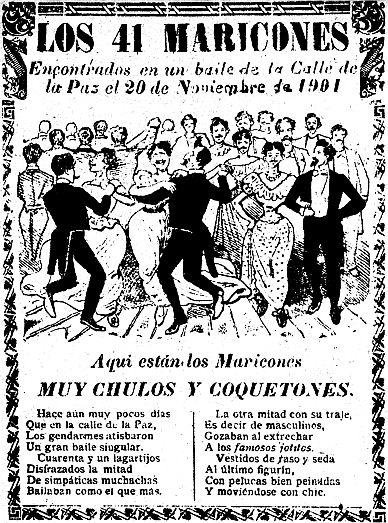
Cuarenta y uno ( y uno más)
I either knew, or forgot,that yesterday was the anniversary of the “Baile de los cuarenta y uno”… the 41 Dance of 18 November 1901. This was the raid on a drag ball (about half the men were in women’s clothing), that ended with the men … who were mostly from prominent Mexican City families… were arrested and “sold” as convict laborers for Oaxacan tobacco farms or into labor battalions for the army.
41 is a odd number, and if it was a formal ball (drag or otherwise), someone was missing a dance partner. The missing person was said to have been Ignacio de la Torre… just coincidentally Porfirio Diaz’ son-in-law, and uncle by marriage to the then Mexico City police chief, Felix Diaz. While Ignacio’s sexual preferences were well known, he kept a relatively low profile the rest of his life, though he showed a particular interest in a handsome, well-dressed horse trainer he later hired. A fellow named Emiliano Zapata. No evidence that Zapata had much in common with de la Torre beyond an interest in horses, but still, Zapata was thin, neat, and a snappy dresser. Not that there’s anything wrong with that.
Cuarenta y uno, more than a century later, is still Mexico City slang for a gay man.
Is this what it’s said to be?
This is a 1914 photo of Victoriano Huerta, sitting in the back of a car. But I’m not sure, as has been claimed, that he’s smoking a joint.

La Raza and race
Officially, since Independence, Mexico has done everything it can to erase the differences between “race” in favor of creating “la raza” — the people. But, with ethnic identity movements gaining momentum in recent years, there is more awareness by people of their own “race”… for good or ill. I tend to think the recent interest in racial identity — as evidenced by the inclusion of “Afrodescendiente” (of African descent) in the latest census — has much to do with U.S. influence.
 Given that, historically, the Bourbon “casta” system of racial classification was used to prevent people from rising above their assigned station in life, and such classification was considered inherently unfair… and most people, regardless of what their casta was — as long as they couldn’t claim to be pure European — claimed to be mestizo. And, the Afrodescendientes, as a separate community, were forgotten. That much of the Afrodesceniente community* has been historically neglected may have as much to do with geographical and cultural isolation as racism, but the new ethnic awareness does have positive results, at least identifying areas where more resources are required.
No one believes that racism has disappeared from Mexico, or anywhere else in the Americas (or on planet Earth). But, “race” being a cultural construct in the first place, how do we write about it, when trying to interpret one culture’s constructs for another culture?
Gods, Gachupines and Gringos was written for a U.S. audience. The U.S. concept of “race” not being exactly the same as the Mexican (or general “Latin American”) sense of raza has presented something of a conundrum. U.S. critics have noted that I “brown-wash” the whole question of race in the first edition, in accepting the prevailing theory that Mexicans have largely assimilated into the mestizo majority.
Although mestizo simply means “mixed”, it’s usually understood to mean a person of European and Indigenous American ancestry. It’s not a 50-50 proposition. Is a person of 90% indigenous and 10 percent European “mestizo”? I’d argue yes, if the person’s culture was that of the Mexican mainstream, and no if the person’s culture was indigenous . But, it’s much more complicated than that… depending on what part of Mexico one comes from, people likely to also have some Sub-Saharan African, Arab, or East Asian ancestry as well.
Writing for a U.S. audience, what race a historical figure is matters a little more to me while working on GGGV2.0 While I mention that this or that figure was “Afro-Mexican” or that non-European communities like the Chinese and Koreans have played a significant role in various developments, records aren’t always clear as to how the person in question considered him or herself. Sometimes it’s a toss-up. The 19th century novelist Guillermo Preito was, or wasn’t, Afro-Mexican. It’s interesting that he was the grandson of Padre Morelos (who was described as mestizo, but was at least partially Afro-Mexican) and… having modeled much of his own writing on the Afro-French novelist, Alexandre Dumas, perhaps his ethnicity (or mixed ethnicity) is of some significance.
This video, from “Masaman” deals with the same problem, from the U.S. side of the border:
*Surprisingly, while the Costa Chica (in Guerrero State) and Oaxacan Afro-Mexico community has below average educational and earning levels for their state, Afro-Mexicans in Veracruz and Tabasco have higher educational and earning levels than average. (Mexico’s Black Population)
One way ticket, please
The Metro is still the best way to get around town. And, yes, there is a station at a cemetery. (Actually, the family said they were just too poor to rent a hearse).

Such a mean old man
15 year old Kayla America Fuentes tracks down a story most of us would never touch with a ten-foot pole. The Old Man Who Calls The Border Patrol on Immigrants (Splinter 16 October 2017). Sombrero tip to Debbie Nathan of
I’d known about Rusty for a long time before I saw those Jeeps. The first time I heard of him was when I was about seven years old, when my family and I were coming back from Matamoros, Mexico—that’s where a lot of my family members live. My mom was talking about what a mean guy Rusty was, how he would call the Border Patrol every time he thought an immigrant was near his house. I actually saw Rusty not long after, at the neighborhood gas station. He was a huge white man with icy blue eyes.
…
Rusty—also known as Cuban Alfredo Monsees, Jr.—is 69 years old. When he began talking about his family history, I was amazed that it was all connected to Mexico. The most impressive thing was that he said his father was Pancho Villa’s personal servant during the Mexican Revolution. He claimed to have pictures (I didn’t see them). He even told me about his step-brother who was born in Mexico and still living there now.
How can someone with Mexican roots like this be so angry with Mexicans? I wondered. He kept talking.
…
Now I just think of him as pathetic, and someone to feel sorry for. Still, he’s a dangerous person in my neighborhood.


 mexfiles.net