Our annual Day of the Dead favorite
Street-walking wonking
Mexico City has always had a tolerant, or perhaps, negligent, attitude towards sex workers.
With the exception of a short period just following the Revolution, when the sex workers could (and did) successfully argue that as workers they were entitled to the same rights as any other worker (prostitutes in brothels were successful in arguing that they were entitled to paid days off, and overtime), when decisions have been made to regulate the trade, the most affected — the sex workers themselves — are almost never heard from. And even with the rulings from the Labor Board back in the 1920s, the rules were always made by the city fathers.
Note I said “fathers.” While it is true that not all prostitutes are women, the regulations over the last few centuries have always been argued on the assumption that they are to protect women … if not from themselves and their depraved nature (as Archbishop Aguilar y Seixas argued in the 1690s, much to the amusement of those “depraved” workers), then from diseases (the justification for the “yellow card” of the 1890s and later) or in our day from lingering gender inequality. How this actually affects the mostly women sex workers has been, at most, an afterthought.
A strategic mistake, and one that often leads not to more equality, but less, which we may be able to avoid, according to attorney Claudia Torres, writing in Animal Politico.
On October 12, Mexico City Legislative Deputy Victor Hugo Romo announced he would hold public hearings to discuss sex-worker regulations1 . In light of the hearings, I am taking the opportunity to discuss the politics and law regarding prostitution.
First the politics. Generally, at the global level, when it comes to prostitution, there are two feminist groups seeking to advance regulatory schemes2. On the one hand, there are the neo-reglulators, feminists and organized groups of sex workers, who believe that voluntary prostitution should be regulated as work. Within this group, there are different views on what controls the state can impose on the exercise of prostitution. And these controls can range from registration of sex workers or certification authorities, to compulsory medical supervision. Overall, the underlying ideology in this position is liberal: it seeks to balance the rights of workers and society.
On the other hand, there are the abolitionist feminists, joined with more or less legitimacy by conservative Christian groups. For this group, prostitution necessarily involves exploitation and violates human rights. Therefore, this group argues that the state should abolish the practice3. Towards that end, the abolitionists support a range of measures whose ultimate goal is to eradicate prostitution: criminalize the client and third parties that obtain economic benefit from prostitution; increase criminal penalties for sexual exploitation and trafficking; or even take a more statist action: criminalizing the prostitutes. Overall, the ideology is materialistic. It assumes gender inequality is foundational and, in that sense, inescapable.
Typically, those involved in debates over prostitution are not explicit in their political and ideological biases. Rather than make arguments based on facts, they posture. In my opinion, creating rational and progressive standards in a the context of a democratic political system requires that one (1) articulate the goals and (2) explain the reasons for seeking those goals. To simply rely on tradition, human rights in the abstract, or trends in other countries in creating rules and policies leaves the foundation of our moral judgments in the realm of the unconscious. One must be skeptical about the assumptions underlying different regulatory schemes that deliberately call for a possible reconsideration of the utilitarian value of the proposal. Moral skepticism is the first step towards betterer design standards and public policies on prostitution. In light of new voices and needs, we should open the door to a complete review.
What about perpetuating the status quo? Some feminists argue that gender inequality is the structural basis of prostitution. To regulate prostitution, then, the States’ norms and policies legitimize and reinforce inequality. But, as noted by some post-structuralist theorists, the structures of inequality do not exist prior to social action4. That is, a small deviation in our daily interactions has the ability to alter structures. These deviations can be encouraged or inspired through different mechanisms, including state regulation. If we open ourselves to the possibility of people changing, and giving new meaning to new social structures, regulations can be a powerful tool for social change.
Then, there is the law. As noted by Janet Halley and other authors, contemporary feminism focuses on governance (ie, the most popular and institutionalized form of feminism which I described above as the neo-reglamentarism/abolitionism duo). It generally omits a pragmatic and distributional analysis of the consequences of legal regimes5 . That is, generally, feminist groups have limited legislative discussions to the abstract realm of what should be moral, at the expense of any analysis of how the law would operate, or does operate in the real world.
Sociologist Elizabeth Bernstein explains what happens when we stop paying attention to the effects of legal reform6. Bernstein looks at two cities taken as models of regulatory reform: Stockholm and Amsterdam. In Stockholm, the criminalizing demand was justified as promoting gender equality. However, Bernstein finds that, after the reform, prostitution went simply went underground. underground. According to some respondents, the reform could not have generated more different effects than expected: it encouraged women to move to Stockholm and, given the new clandestine nature of the market, led to increased trafficking.
Meanwhile, in Amsterdam, which opted to legalize and regulate the administration of brothels, the logic was to convert the black market into regulated one. The results were as follows. Prices fell sexual services, which led to those unable to meet the costs of regulation (mostly migrants) to migrate to countries where prostitution was deregulated and was better paid. Simultaneously, those who could absorb other operating costs (typically, native workers and large businesses) centralized the market.
For both Stockholm and Amsterdam, reforms ended up affecting the interests of those who were promised protection: particularly migrant women. Even today, many people still advocate these regulatory schemes as if they were unambiguous and indisputable successes. They are not. Deficiencies of these and other regimes are evident when analyzing its effects. In the cases that I described, at least some of the adverse effects generated by the reforms were predictable. However, the collateral damage of the reforms were not analyzed enough, not made explicit or not taken seriously either before or after the reform.
The obliteration of this damage could be caused by the fantasy that the legal requirements are automatically reflected in society. However, legal realism suggests that this is impossible7. Legal norms and public policies operate in an intricate network of social practices, existing norms, and market structures. The realists believe that in any attempt to create norms and policies, we need to caluculate both the cost-benefit, and more importantly, monitor the effects of the legal reforms. This also assumes transparency in calculating the costs faced by different social actors.
I believe that the Mexico City Legislature should side with the legal realists, taking into consideration the consequences of any reform, and being open to self-criticism. Where to begin? So far, the ALCM has done well: involving different groups — including sex workers themselves — in crafting legal reform.
1 Call to Open Sessions Parliament on regulation of sex work, Victor Hugo Romo deputy Claudia Torres (October 14, 2016) (on file with author). Hearings will be held on 19 and 26 October and 9 and 16 November in the legislative building located in Ghent # 15, Colonia Centro. Respectively, the issues to be addressed are sex work, trafficking, discrimination and health policy in relation to prostitution.
2 See Prabha Kotiswaran, Burn daub Brothels: Toward a Legal Ethnography of Sex Work in an Indian Red-Light Area, 33 (3) Law & Social Inquiry 579 (2008): 581 (describing the two feminist positions involved in debates on prostitution).
3 See, for example, Teresa Ulloa, Formas veladas de legilzar la prostitution, CIMAC News, October 4, 2016, http://www.cimacnoticias.com.mx/noticia/formas-veladas-de-legalizar-la- prostitution-n
4 An example in the field of sociology in the law is Patricia Ewick and Susan Silbey, The Common Place of Law: Stories From Everyday Life (The University of Chicago Press, 1998) (quoting Stuart Henry about structures as emergent property)
5Janet Halley et al, From the International to the Local in Feminist Legal Responses to Rape, Prostitution / Sex Work and Sex Trafficking: Four Studies in Contemporary Governance Feminism, 29 Harvard Journal of Law and Gender 335 (2006): 361 , 368.
6 Elizabeth Bernstein, Temporarily Yours: Inthimacy, Authenticity and the Comerce of Sex (The University of Chicago Press, 2007), 142 et seq.
7 For example, see Robert Hale, Coercion and Distribution in a Noncoercive Supposedly State, 38 Quart Political Science. 470 (1923); Karl Llewellyn, Some Realism Realism About -Responding to Dean Pound, 44 Harvard Law Review
A Cardinal points in a new direction
(translated from “El Papa nombra a un cardenal mexicano contra la radicalización de la Iglesia“, Elena Reina (El País [Madrid], 10 October 2016
The Vatican has sent a message to the Mexican Church and, in the process, provided a little oxygen to embattled president Enrique Peña Nieto. Pope Francis has made a Cardinal of Bishop Carlos Aguiar Retes, a key figure in the hierarchy, with not only a national reputation as an opponent of the ultraconservative Cardinal Norberto Rivera, who spearheaded the war against the government’s proposed constitutional endorsement of same-sex marriage. Aguilar Retes is one of 12 new cardinals who will be tasked with selecting the next pope. t
Everything points to Aguiar Retes succeeding Rivera, who will retire next year, as Primate of Mexico. But nothing is guaranteed. Presently, Archbishop of Tlalnepantla (Mexico State), Aguilar represents the opposite of the image of Mexico’s clerical leaders. Pope Francis is betting the discreet, prudent and sophisticated Aguilar will curb the elitist ultraconservative wing, which flaunts their access to power, their wealth, and their distance from the people. .
Although from a small suburban diocese, Aguilar has been an important religious actor in the country. He was president of both the Mexican and Latin American Episcopate. “When he was president of the episcopate his relations with Rivera were very bad. Rivera comes from a crudely triumphalist Church , which wants to aggressively influence public debate, resorting to strong statements and even blackmail. [Aguilar] Retes is more sophisticated in political terms, is not [he and Rivera] are so different ideologically, but that he is more audacious in the use of politics, “says Bernardo Barranco, the Mexican sociologist specializing in religious matters.
 While this appointment involves Norberto Rivera’s direct succession, it is mainly a message from the Vatican to the local hierarchy. “The Pope is saying that he holds all the cards when it comes to replacing Rivera, who has proven to be unliked in the Mexican capital, controversial both politically and within the Church” Barranco adds.
During his visit to Mexico in February this year, Pope Francis made clear his dissatisfaction with such behavior of bishops. Francis openly critized Rivera in his own Mexico City Cathedral, saying “what are not needed princes “and that” if they must fight, fight as men, face-to-face!”. At the time, [Aguilar] Retes said of the Pope’s criticism: “It was not a scolding, but a motivation to work”.
Close to Enrique Peña Nieto, Aguilar Rete’s archdiocese is in the state of Mexico, governed for six years by the now President. As a then candidate, the Archbishop accompanied Peña Nieto to Rome when he presented his future wife, Angelica Rivera, to Pope Benedict XVI.
Despite not resembling the typical elite Mexican Catholic cleric, Aguilar Retes is also an aristocrat. “He is not known for his work as a pastor, but rather as a prince of the Church” qualifies Barranco. But his ability to reach agreements between political rivals, make him a key figure in de-radicalizing the Mexican Church.
¿Mi migrante es su migrante?
Most readers of this site are aware of the fact that undocumented immigration into Mexico is an administrative offense at best, and the idea of “illegal immigration” just doesn’t occur to us. After all, about half of all “illegal aliens” in the United States are Mexicans.
But, those “illegals” tend to be people who have settled into new lives north of the border, and have been there for several years, reflecting a huge decline in the last few years of Mexicans crossing into the United States without authorization, and about a million Mexicans who had been living in the United States without authorization having decided to return home.
None of which has changed the dynamic of “illegal entry”… most land crossings by migrants still being from places along the Mexico/US border. That many cannot cross means our border cities have seen an influx of foreigners in irregular situations. While our geographical neighbors to the south (and recently further south) have some cultural similarities, and are at least likely to speak the same language as the local citizenry, our new migrants are not so fortunate.
From yesterday’s (9 October 2016) La Jornada (As always, not a literal translation, having made a few changes for clarity and to conform more to English-language writing conventions):
New Migrants Among Us.
 For many decades legal foreign migration to Mexico’s northern border [seeking to enter the United States] had a well-defined profile. The numbers of those who tried to gain entry this way were mainly from Central America and later included South Americans — people facing different different political or economic circumstances, but responded to a geographical logic that only occasionally showed significant alteration. Involvement by Mexican authorities in the process was limited to the routine administrative exercises required at any border, mostly issuing authorizations, permits, and the like.
In recent years, however, that quiet dynamic (developed more or less independent of the complex issues raised by irregular migration) have been affected by the arrival of people from places on the map that are not geographically “natural” for our country. Of course, these are not simple tourists passing through Mexico, but migrants with little or no resources, expelled from their countries by natural disasters, economic deprevation, social conflicts, and in some cases, political issues.
Most are transported clandestinely and deposited without guidance on a Mexican coast, deprived of livelihoods and perhaps with closely guarded minimal guidance to obtaining by legal means the mythical “American Dream”. Thousands of men, women and children from Haiti and African countries huddle on this side of the northern border (especially in Tijuana and Mexicali) waiting to be admitted into US territory.
Thus, the always sticky problem for Mexican migrants crossing to the “other side” without papers is shared by those foreign migrants lacking papers, and short of resources.
The result is that the national government here is facing a situation that at least at the moment it does not know how to solve. The number of foreign migrants here has not dropped, but the demographic has changed. According to data from the National Institute of Migration, the number of Africans in the country increased over the last year by 500 percent. And although several agencies show different figures, in all cases they far exceed 10,000.
Of course, there is no guarantee that the US authorities permit these people to enter theri country, regardless of the skills and knowledge that they possess; in fact, it does not seem likely to do so for even with a substantial percentage. The social situation in the north of the Republic, and particularly in the cities mentioned, is in danger of becoming contentious.
Immigration authorities have decided to extend to new migrants a permit valid for 20 days in which to regularize their stay here or to abandon Mexico. But given that many of them manifestly express their intention to enter the neighboring country, the extension does not resolve the situation, but only temporarily freezes the need for any action.
The fact that migrant shelter staffers have been denouncing the harassment and discrimination faced by Africans and Haitians making their way through Mexico highlights the need to quickly resolve not only the visa issue, but also our own need to critically reaffirm our traditional solidarity with migrants.
Also read:
Solis, Gustavo “Thousands of African migrants coming to U.S. through Mexico” [Palm Springs] Desert Sun, 23 September 2016.
“500% Rise in African Migrants Crossing Through Mexico in 2016” Telesur, 9 October 2016
“Mexico issuing transit visas to African migrants flocking to U.S.-Mexico border” Fox News Latino 3 September 2016
Above it all…
… now, if I had some reason to go to Ecatepec. Six peso fare.
Ye Gon: Where have all the millions gone?
Nine years ago, “Operation Dragon” resulted in the largest cash seizure in Mexican history. More than a few Mexican would like to know what happened to the 205 million dollars (in US dollars, Euros and Mexican pesos) seized from Mexican-Chinese businessman Zhenli Ye Gon.
“Hold, or hang, ” the explanation Ye Gon used with an AP reporter when he claimed he’d been holding the money for a political operator, who threatened him if he didn’t cache the cash in his home was repeated everywhere in Mexico, in political cartoons, in comedy routines, printed on tee-shirts, as a refrain in satircal song lyrics and even appropirated by narco-gangsters in their taunting messages.
The cash was found in Ye Gon’s mansion in March 2007. The images of massive piles of dollar bills that filled a room of the Attorney General’s Office (PGR, for its initials in Spanish) was seen around the world. The government of Mexico presented Operation Dragon as the most devastating blow ever to the coffers of drug trafficking.
.
So… where’s the money?
Under present Mexican law, the government can only appropriate the goods of someone accused of drug trafficking when he has been found guilty. Ye Gon has not yet been sentenced either in Mexico, nor in the United States (where he fled, only losing his bid to avoid extradition back to Mexico last week). However, in 2007, when the money was transferred to the Mexican government under then existing regulations that gave the owner of confiscated money 90 days after notification to claim his or her money. After 90 days, seized goods were considered abandoned property and could be transferred to the government.
Neither Ye Gon, nor his legal representatives claimed the seized assents, according to the Servicio de Administración y Enajenación de Bienes (SAE), which has authority over abandoned and seized property.
That does not mean that the cash sat in a vault for three months, waiting for the owner to claim it. A few days after showing off the loot for the media, the PGR deposited the hundreds of thousands of individual bills in the military bank, Banejército, as the only facility able to store that amount of cash. Banejército later transferred the money to the headquarters of Banco Santander in Mexico, this in order to certify and count the money again.
Sandander transferred the physical cash to an undisclosed Bank of America location in the United States, reportint to SAE that about $21,000 was counterfeit. The Mexican government used about a half-million of the seized cash to pay Bank of America for their services, including transportation expenses and taxes.
 The SAE report indicates that BofA did not physically return the money but made an equivalent digital transfer back to Santander. In late April 2007, Santander made their own digital transfer, returing the money to Banjército. Mexican authorities explained in the report that for security resons, no Mexican bank can have $ 205 million sitting around in cash.
Although at this juncture, Ye Gon still had two months to claim his assets, the most intriguing part of the SAE report, is an enigmatic note that says the “did not constitute proof” of Ye Gon doing anything illegal. Although both the US Drug Enforcement Agency and the PGR concluded that the 200+ millions were probably drug profits, the PGR felt it was unnecessary to keep the cash as physical evidence in their investigation of Ye Gon. So far no one has offered an explanation.
Ninety days passed since the raid on the Ye Gon mansion in las Lomas. SAE published the required legal notice in the major Mexican newspapers, but no one stepped forward. So, the next step, under the then-extent law holding that contraband seized in the course of a narcotics investigation should be used to combat drug trafficking, the money was split with a third each for the PGR, the Ministry of Health and a Judicial board overseeing court modifications. In theory, the PGR pursues drug traffickers, the judiciary sanctions them, and the Ministry of Health serves victims of drug trafficking, including and especially people with addiction problems.
Each institution received about 68 million dollars. The PGR balance sheet indicates that the procuratorate invested about eight million dollars in equipment for operations and research and around 20 million in remodeling and purchase of office buildings and about same amount in security systems for buildings. Another million dollars was spent on vehicles and the rest was used to cover property amd sales taxes from the new purchases. To date, the PGR has not revealed their buying criteria let alone the benefits of these in the war on drugs.
According to their reports, the Ministry of Health used the money to build 240 rehabilitation centers throughout the country and distributed the rest to the states for anti-addictiion progams. There are no reports to indicate whether the centers and the budget increase had any impact on addiction rates in the country.
The Council of the Judiciary deposited its part in an investment fund used to renovate courts, provide training to the judiciary and generally “improve services”. In a memorandum delivered to Univision the Council said it was not possible to know specifically which money they have spent came from the Ye Gon haul, or to separate it from other funds.
The original seizure also included about 5,700 articles of values, including furniture, jewelry and automobiles. Also unclaimed, there auctioned by SAE, netting about 63 million pesos or US$ 6 million US at the time.
Additional Ye Gon properties, including his mansion in Las Lomas, remain in custody of the agency. Ye Gon’s former neighbors say the Mexican government has tried to use the place for PGR offices, but the neighborhood association has thwarted all their efforts.
Today, the ostentatious mansion is abandoned as Mexican judicial authorities continue to look into the origin of the fortune.
(Translated, with changes for clarity, from “Que Paso con el dinero decomisado al chino Zhenli Ye Gon, los 205 millions de dólares”, Narcoviolencia.com.mx)
Our “Triangle Shirtwaist Factory”
Everyone has seen the photos of the destroyed Regis Hotel, and Tlatelolco taken the morning of the 19th of September 1985. The first — a luxury hotel — and the middle class housing project, were the locus of attempts to save lives, while in San Antonio Abad, filled with small factories and sweatshops, the media and public were kept away. There, rescue efforts, such as they were, focused on recovering property rather than saving lives. Small gold-working shops in the neighborhood (which weren’t labor-intensive) were the center of official attention in San Antonio Abad.
Over 300 seamstresses and other workers would die and most of their bodies never recovered in the disaster. Employees who survived (or were working other shifts) were particularly outraged that not only had the owners, with the help of the army, spent their time retrieving sewing machines and fabric, but these workers were denied a full week’s pay for circumstances beyond their control… this even though workers like 22-year old presser Daniel Ramírez and seamstress Concepcíon Guerrero — both on the 8 AM shift — showed up for work, and stayed. They, like other textile workers from around the city came to dig out the bodies and recover what they could. The workers got a small measure of vengeance when they found and brought out a company safe. Unable to crack it, they sold it as is for scrap metal!
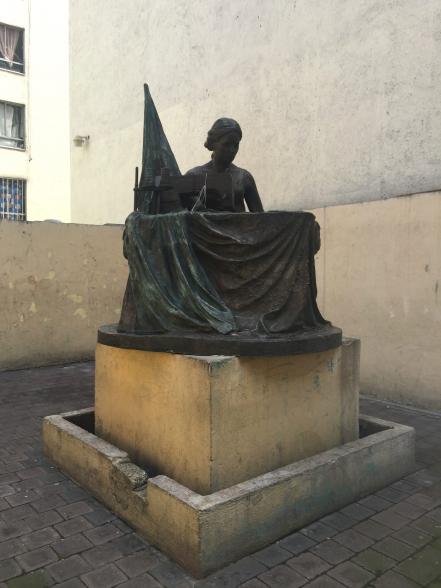 More practically, and more long lasting, the workers discovered their union, either unable or unwilling to provide practical assistance (and help the workers receive compensation for their own losses) organized a separate union, the short-lived 19th of September Seamstresses and Tailors Syndicate, which fought for better working conditions and compensation for textile workers, forcing the government to crack down on hiring underage workers, and enforce safety regulations, as well as a number of “lunch-bucket” demands for better pay and hours.
Although Daniel and Concepcíon would be black-listed by the owners, and the union crushed, the unlikely heroes are still leaders in the workers’ movement, through the 19th of September Seamstresses Civil Association, which provides legal assistance, as well as training, educational, recreational, and self-improvement programs for the textile worker community and their families.
While throughout the Capital, there are special masses said at 7:19 in the morning every 19th of September, in San Antonio Abad, there is an additional ceremony, laying wreathes at the monument dedicated to all textile workers in general, and to the 300 or more who lost their lives because the machinery and cloth was considered more valuable than those who made it into clothing.
206 years on…
Catholic Nazis?
Although it’s not as much talked about as it should be, the Cristero War was one of the great tragedies of the 20th century. Certainly the carnage was nowhere on the scale of that unleashed by the Fascist and Nazi movements in Europe (and exported to Latin America), but both rested on a clash between modernity and what was perceived — or better said, propagated — as “traditional values.” While I am the first to say that my own monograph on the Cristeros (Gorostieta and the Cristiada: Mexico’s Catholic Insurgency 1926-1929) was written much too fast, and was rushed into print before it was edited correctly, I did try to put the Cristeros into the context of other movements, and — unlike apologists for the Catholic insurgents — saw in them their close affinity to Fascism, and their role in the founding of both the Mexican fascist parties (Synarchism) and PAN.
That the state’s provocations of the Catholic Church, and the reaction by the Hierarchy played an essential role in fomenting the insurgency is indisputable. While the “Calles Laws” were meant to break the Church and were an open assault on the Hierarchy, the same cannot be said about the proposed reforms to marriage laws today. No one is threatening to take any rights AWAY from Catholic believers, or from the Church. However, it is the Church … or rather the Hierarchy… that wants to take away rights from other citizens. Moreover, what rights the Church ceded to the state long ago (in education and in defining marriage for non-believers) are those the hierarchy seeks to claw back. In the 1920s, the Cristeros turned to the conservative business class for financial support under the claim that they were defending private enterprise from state interference, while simultaneously presenting themselves to the lower and middle class as protecting the nation from a foreign ideology. Mixing nationalism, capitalism, religion, and militarism (i.e., the basic ingredients of a Fascist state) the Cristeros were a threat to the state that had to be crushed. The hierarchy then had the sense to realize it was in over its head, and negotiate a face-saving truce with the state. While so far, there is no evidence of the Church’s attempt at a military response, whether they are making a bargain with the devil, or simply channeled the devil that was always there is a question I don’t want to answer. But Sanjuana Martínez — a believing Catholic — has been willing to ask, in SinEmbargo, Are Catholics Nazis? (my rough translation):
“I am convinced that I act as an agent of our Creator. To fight the Jews is doing the Lord’s will”,said Adolf Hitler to justify the extermination of 6 million Jews.
Hitler was born Catholic as were right-wing dictators Francisco Franco in Spain, Antonio de Oliveira Salazar in Portugal, Benito Mussolini in Italy, Rafael Leonidas Trujillo in the Dominican Republic, Jorge Rafael Videla in Argentina, and Augusto Pinochet in Chile. They invoked the name of God to commit all kinds of atrocities. And the Vatican welcomed them in their time. The relationship of the Catholic hierarchy with these men is part of religious history. There are pictures of the Popes receiving these fascist criminals, giving them communion, blessing, sanctifying. This type of Catholicism is the ultimate expression of “Nacionalcatolicismo”.
To our surprise, Nacionalcatolicismo remains a force in Mexico. What in European history was the mix of nationalism and Catholicism to launch Crusades against Muslims, Slavs, Jews, Greek and Russian Orthodox Christians, Mongols, Cathars, Hussites, Waldensian, Prussians … continues here against gays.
A call to a national crusade is what drives the National Front for the Family (FNF), an ultraconservative organization promoted by the National Action Party and its armed wing the Yunque and financially underwritten by the Church hierarchy’s business allies.
FNF Catholic crusade against equal marriage is shameful and violates the most basic human rights. Its nacionalcatolicismo, ie, its fascist ideology, contravenes important national and international legal norms.
Saturday’s demonstrations against the initiative to legalize same-sex marriage in Mexico united under the slogan “Deus lo vult” (God wills it), the same that was used in the past to justify the gallows, the fire and the extermination of millions of people. Not since the 30s of the last century have there been such mass marches here, as those held in 16 cities in eight states, all with a PAN majority government.
Fortunately the call to nationalcatolicismo did not resonated everywhere. In Nezahualcoyotl only 300 peoople showed up, only 1500 in Toluca. But there are the sordid examples of Puebla, Querétaro, Guadalajara and Monterrey — traditionally conservative places, with a long history of “doble moral” and hypocrisy.
I wonder how many of those who showed up to defend the traditional concept of family have a real family, not only when out in public. Or how many of those parents who shouted slogans against homosexuals do not lead a double life: are unfaithul, hide their sexual preference away in the closet, or simply do not love their partner.
It remains unclear what are defending. Is the traditional family? Perhaps the family as defined by the Legionaries of Christ, the order founded by the pederast priest Marcial Maciel. Or that of Opus Dei, the work of misogynistic and elitest Spaniard Escriva. Or perhaps the family as defended by the great protectors of pedophile priests, cardinals Norberto Rivera and Juan Sandoval Iniguez, directors of clinics that supposedly “cure” genuine sexual predators like Nicolas Aguilar or Carlos Lopez Valdez1.
Were all who attended these Nazi marches Catholics? I doubt it. Surely most Catholics know that the majority of the arguments used by the FNF are lies and the rest are based on a lack of information about sexuality, still a taboo topic for many Mexican Catholics.
The images of people demanding the elimination of others’ rights is truely sad. Of course they have the right to demonstrate freely. That’s not the point. The question is, why they demand the right ot harm other human beings. How does the legitimate marriage between same-sex couples affect them?
One of the arguments repeated ad nauseam by the leaders of this front is that they do it for the children. Lie. That is a fallacy. How many mass demonstrations were organized by these people to protest the thousands of pedophile priests in Mexico and damaged thousands of children; priests protected by the hierarchy? None.
In Guadalajara, where the Cristero War is still a matter of pride to some Catholics, it is regrettable that all these people who marched against gays, remained silent and never condemned the existence of the largest clinic for pedophile priests led by their own Cardinal Sandoval Iniguez in Tlaquepaque, Jalisco, even when an Interpol investigation found the clinic sheltering cassocked predators wanted in over 16 countries.
Why the National Front for the Family does not organize demonstrations against pedophile priests? Because they are not congruent. This organization is made up of real nacionalcatólicos —fundamentalist fanatics: people without understanding, dedicated to intoxicate, manipulate, lie about human sexuality.
That well-known expert on the anus2, Cardinal Norberto Rivera, now be added to the other Front leaders — Juan Giacoman Dabdoub, president of ConFamilia; Luz Maria Ortiz Quintos of the Nuevo Leon Parents Union; Marcial Padilla and Enrique Guzman, who, along with Marcial Maciel’s defender, Carolina Lopez Garza hold themselves out as specialists in sexuality and “gender ideology”.
The Front’s lies are laughable. They ensure us that contraceptives cause infertility, that the Peña Nieto reform in favor of marriage equality would lead to men using women’s restrooms; that pre-school children will be dressed alternately as a boy and a girl to decide which they want to be; that children of same-sex couples suffer irreversible psychological disorders, that homosexuality is curable …
In short, they have convinced thousands of Catholics to support their movement with lies and by preying on the ignorance of people who consider sex education a sin.
The Mexican Catholic hierarchy throwing the stone while hiding the hand, has said they did not summon thse hate and disrimination marches, but made it clear that they support them. It was clear who was in control with marches with the ranks filled out with priests, nuns, and consecrated, pure people.
It would be nice to know if those people so quick to take to the street to demand taking away others’ rights consider themselves “Nazis”: Catholic Nazis, fervent admirers of nacionalcatolicismo, the religion practiced by Hitler and many others criminals against humanity.
The Catholic Church is happy. It has achieved what it has always done, turning back the clock a few centuries. Every time Mexico and its people, progress the Catholic hierarchy, is responsible for bringing the Mexicans back into the past. The Catholic hierarchy does not advance, preferring to keep its adherants subdued, ignorant and obedient. New enemies are gays and their legitimate rights.
As a practicing Catholic, I am ashamed to live in a country of Catholic fundamentalists. I belong to the segment of decent Catholics, those who defend human rights for all without distinction of race, creed or sexual preference. Those who did not remain stuck considering the traditional family as the “natural” family. That which sustains a family is not a man and a woman, but love. There are many types of family and all deserve respect and the same rights. As in the time of the Crusades, it is necessary to speak up. I refuse to be part of this new onslaught of irrational hatred.
The Nazi crusade mounted by the National Front for the Family seeks to perpetuate the sanctity of marriage, the purity of the family … The others are heretics … Prepare the fires! … Erect the gallows! … Catholic Nazis are already on the street.
My reading of Videgaray’s “resignation”

They eat their own
If there is one thing you learn from watching Mexican politics, it’s that conspiracy theories sometimes make sense. I can’t vouch for this: I’m not familiar with the website I found it on, and it seems to have been cut and pasted from one of the political columnists without attribution. Still, what it says about the connections between political families that cross party lines, and the in-fighting among factions within the parties gives an insight into the murky world of Mexican politics.
Anything is possible, and Peña Nieto having been “set up” by his Secretary of the Treasury (Hacienda y Credito Publico), Luis Videgaray, has been suggested by the major media (Proceso, etc.). That the diplomatic corps and Sec. of Foreign Relations, Claudia Ruiz Masseu, was cut out of the loop when it came to the controversial Trump visit, starts to make sense IF even half of this story is true.
The Atlacomulco Group, and their plans to install PAN in the Presidency in 2018 (Atlacomulco y su plan para entregarle al PAN la Presidencia en 2018)
Taking its name from a State of Mexico municipality, Atlacomulco Group originated with Isidro Fabela, who acquired the power, money, and influence needed for a political machine during his career as a diplomat during the Mexican Revolution.
Governor Alfredo Mazo Vélez, (uncle of future state governors, Alfredo del Mazo Gonzalez, Arturo Montiel, and Enrique Peña Nieto) inherited his power from Fabela, and extended the reach of the dynasty through awarding public concessions, especially in transportation. Carlos Hank Gonzalez and Emilio Chuayfett, both now deceased, were also members of the inner circle,although not blood relatives.
Not family, but within the inner circle, is Luis Videgaray, currently Mexico’s Secretary of the Treasury, and evidently, the group’s financial brain. He is presently seeking to be the next state governor, as are two of Peña Nieto’s relations, Alfredo del Mazo and Carolina Monroy.
All that aside, my hypothesis is that there is an alleged pact between the Atlacomulco Group and PAN to impose the illusion of democratic transition in 2018 with an approved backroom deal by the Mexican oligarchy.
To support this theory it is important to point out there is another family tie — between Felipe Calderon and Luis Videgaray Caso. PAN’s presidential candidate, Margarita Zavala is the cousin of Vidagaray’s wife. In short, the Calderon’s and the Secretary of the Treasury are cousins.
The reality is that Peña Nieto’s rise to the Presidency in 2012 was manufactured by the Calderón administration’s media policy, that gave an overwhelming monopoly in news and information to Televisa. The outgoing regime had needed to promote the structural reforms that foreign capital demanded to make way for foreign oil and for AT & T to enter the telecommunications sector dominated by Carlos Slim.
This explains how 12 years of looting of PEMEX under the Fox and Calderon administration. Despite obvious theft and mismanagement, the current administration by the rival party had never audited the accounts. The only exception was the Oceanography scandal, which is only a small samle of the PRI-PAN pact when it comes to the federal government.
The PRI is being destroyed from within. The arrival of Fox in 2000, with the backing of the Americans could not destroy PRI from the outside, so, US backers turned to figures in the old regime, and PRI — was the largest and most organized political institution in the country — has been sabotaged by disguised PAN technocrats and managers.
PRI never lost the reins of power despite the Ernesto Zedillo, handing over power to Fox and PAN on a silver platter by orders of US interests. The workers and agricultural confederations and unions and state governments remained in the political muscle of the Institutional Revolutionary Party (PRI), which allowed them to negotiate with the PAN governments and thus preserve survive with its power intact.
Meanwhile the teachers’ union became a real power in the hands of Elba Esther Gordillo who took advantage of the transition in 2000 to create her own party. The power vacuum generated by the feud between Vicente Fox and Felipe Calderon, added to Gordillo’s power as payment for the political debt owed by PAN for her part in the electoral fraud perpetrated in 2006 that snatched the presidency from Andres Manuel Lopez Obrador. “Peje” did not have the stomach to take airports, highways and oil wells and demand the victory he had won for the people of Mexico.
To balance this hypothesis (that PAN and the Atlamolco Group are colluding in a PAN victory in 2018) it is necessary to follow the media strategy denegrating Peña Nieto step by step (or, error by error). The firm aim is to boost the political transition in 2018, but one that will involve an “impunity pact” that ignores the corruption in the Peña Nieto administration, just as Peña Nieto ignored that of the Fox and Calderón regimes.
The visit of Donald Trump is the cherry on the cake of media manipulation. PAN would return to Los Pinos on the behest of the United States in order to accelerate the pan-Latin agend for integrating “development” across the region.
In Mexico, US interests have managed to implode the PRI from within. The President himself bartered away his party’s control of the states of Veracruz, Michoacan, Tamaulipas, Quintana Roo and Chihuahua for adoption of the Pact for Mexico, who managed to coerce the main political forces to promote U.S. Supported structural reforms in the legislative chambers.
Structural reforms will be safe in 2018 with a rightist government in Mexico. PAN, as the capitalist party, will give continuity to the multi-administration projects that began with Miguel de la Madrid, was accelerated by Carlos Salinas de Gortari and finalized in the presidency of Enrique Peña Nieto. PAN will be able to simply rule by Yankee mandate, as it did from 2000 to 2012 where he was responsible for delivering the mineral wealth of the country to the British empire through Canadian mining and promote an agenda of terror through the alleged fight against drug trafficking it has paramilitarized entire regions of the country to supply drugs to the US market.
Mexico is a country that ignores its contemporary history and social trends. It is allowed international interests to pounce on the resources of a people who still remembers their revolutionary origins. This generates resistance to the accelerated integration of Mexico into the development model of the United States and for this reason, it needs PAN.
And PAN need the Atlacomulco Group, which own interests (always in public works contracts) will be well served, with business contracts for the new Mexico City airport project and the Toluca-Mexico City train to repay their investments.
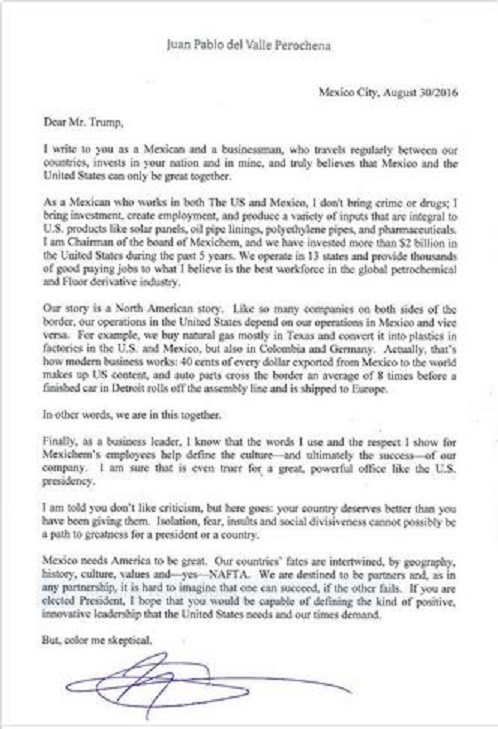
Dear Mr. Trump


 mexfiles.net