Bribery gets the boot
Who says you can’t fight City Hall… or at least beat a traffic ticket?
While, OK, it’s illegal for a taxi driver refuse service to a person in a wheelchair (and dickish, besides… though I expect Uber gets away with it… but then you expect them to be dicks), and Mexico City could use more (a lot more) wheel-chair accessible taxis, for now, we have to work with what he have. A wheelchair just won’t fit easily into a Tsuru, and if a nonogenerian wants a ride to the supermarket, what’s a taxista to do?
Getting from here to there isn’t the problem, getting the chair in and out of the trunk, in traffic, is. Awkward, but not impossible… and not, by any stretch of the imagination, illegal.
I suppose it’s within the realm of plausibility that Officer R. Ramírez G. THOUGHT there was some sort of traffic infraction involved… but hard to believe he thought he could have the taxi booted for it. Officer Ramírez sought to have a “private word” with the driver, though citizens like Alfredo Díaz (who uploaded this video) and others … shall we say… insisted on a public discussion of the issue at hand. Officer Ramírez and the boot-guy went away empty-handed, without even a parking ticket to show for their … ah… fine work.
What’s in a word?
One decent reform (that really is a reform) in Mexico lately has been the citizens’ initiative: I forget the exact number of petition signatures required, but citizens can write their own legislative bills, that MUST be taken up by the Chamber of Deputies and the Senate. The first, now under consideration by the Chamber, is the “3×3 Law”… meant to curb both Mexican style corruption, and the “new improved” kind seen in the United States, where former office-holders immediately cash in by becoming lobbyists, or taking advantage of loopholes they wrote into legislation or regulations once they leave office.

Cartoon: Times of India
The “3×3 Law” is a masterpiece of simplicity, complete with enforcement mechanisms already built in. It requires office holders and candidates for elected office to publish their, and their close relatives, financial data and disclose potential conflicts of interest, for the three years prior to holding office, and for three years after leaving office. All the Chamber had to do was say “Yea” or “Nay” and move on. Given the popularity of the measure, saying “Nay” is not really a option, but… there is a way.
The “3×3” is, for the most part, being incorporated into a new Ley General de Responsabilidades Administrativas (General Law on Administrative Responsibility)… with the wee change of making the word “must” (deber) into “may” (podrá) when it comes to disclosures.
No biggie… right?
SinEmbargo, 28 April 2016: “PRI y PVEM dejan fuera #3de3 y meten una palabra (“podrá”) que permite declarar bienes a medias“
Opiates for the masses?
Why is it that opium poppies are a legitimate crop in Australia and India, but not in Mexico? Why is the first world so dependent on opioids (synthetic opium) when the real thing is available… and probably much less harmful?
This makes sense to me:

Poppy field in Guerrero. Rodrigo Cruz for The New York Times
Mexico’s government has explored regulating poppy production to make pharmaceutical opiates like morphine in an effort to weaken heroin-smuggling gangs, according to two sources with knowledge of the government’s thinking.
Amid a government review of drugs policy, Interior Minister Miguel Angel Osorio Chong asked policy experts late last year whether Mexico could win authorization from the International Narcotics Control Board (INCB), a United Nations body, to grow and export opium poppies for painkillers.
“It’s a legitimate question,” said one of the sources with direct knowledge of the talks, who was not authorized to speak publicly. “States have to ask themselves questions and have to discuss their policies.”
It is not clear how seriously the government is considering the regulation of poppy production and it has not yet approached the INCB directly but the discussion illustrates how concerned it is about heroin-related violence.
(full story from Reuters here)
While the first world gets pain relief, the restrictions on commercial opium production keeps the rest of the world from low-cost access to necessary pharmacueticals. And, as it is, opium poppies were, and still are, a traditional crop that would be fairly simple to bring under commercial control. No doubt there still would be some heroin production, and diversion of raw opium to the underground trade, but it that any worse than what happens now with Oxicontin and other opioids?
Dilma: will she really go?
While the corporate press seems to be looking forward to Brazilian President Dilma Rouseff’s impeachment — perhaps, as some argue, because they assume a pro-corporate regime would replace the present government — my “Brazilian connection”, Flávio Américo Dos Reis, points out it is by no means a done deal.
Dilma Rousseff has not been implicated in any corruption–that’s a fact! The motion to impeach still has to be voted on in the Senate. And even if the motion to impeach is given the approval of the Senate, it still has to go to an “impeachment trial” before the Supreme Court. Then, at that point, the Attorney General for the Union can bring so much dirty laundry out into the open…implicating many, if not most, of those frothing at the mouth, they may call the whole thing off.
“A large proportion of the deputies (representatives) used family and God as justifications for Dilma’s impeachment,” the Carta Capital article mentioned. Just as in the U.S. House of Reps, there are a ton of Evangelicals in the Brazilian Congress–and they’re just as insane, if not more so, than their counterparts in the U.S.
They’re basically Wahabbi Christians–they’re not Catholics. They hate women. They would rather they were in the kitchen, barefoot and pregnant and cooking something for them. They would bring back the death penalty. They want to lower the age of majority–because that would affect mostly poor blacks and mixed-race kids in the slums.
They make jokes about rape and jokes about openly gay representatives in the Congress. You can Google this. It’s a fact.
And they hate the lady president perhaps as much, if not more, than they hate the black president in the U.S.
I hate to admit it, but Brazil is still very much in the 13th century as far as equal rights and human rights. It’s really sad.
The right-wing is very strong in Brazil–very, very strong.
The other thing that is undeniable is that when the progressives had the power, they did not invest as much in education and counter-propaganda as they could/should have. Too many of the kids now protesting were not born during those heavy years, so they have no idea what a thoroughgoing, right-wing dictatorship is–even as they protest for the return of the Lieutenant Colonels. I forgive them. They don’t know.
There’s a very famous saying from the dictatorship years in Brazil–it goes something like “You don’t poke the panther with a short stick!” Portuguese: “Não se cutuca a onça com vara curta.”
So yeah, Dilma is somewhat to blame, and so is Lula. More should have been invested in civic education–and wasn’t. Not by a long shot.
Who will rid us of this meddlesome priest?
It is probably an oversimplification to say (as I did in Gods, Gachupines and Gringos) that Pope John-Paul II’s anti-communism was the main reason why liberation theology, let alone the more progressive currents in the Catholic Church, have not prospered in Mexico.
Much of the credit or blame rests with Girolamo Prigione… originally appointed by Paul VI as Apostolic Delegate to Mexico (Mexico and the Vatican had no diplomatic relations at the time) whose crack-down on bishops and clerics sympathetic to liberation theology was a “bargaining chip” in Mexico’s loosening the restrictions on the Church, and the eventual diplomatic recognition of the Vatican. The quid pro quo for recognition being Church support for the Carlos Salinas administration.
Where John-Paul II went terribly wrong was in relying on the highly corrupt, pedophile and junkie, Marcial Maciel, for advise on Mexico. Although Maciel was of the generation after the Cristeros (although his uncle, Rafael Guízar y Valencia — the Bishop of Veracruz during the Cristero era — was canonized as a Saint) he was of the same militant stamp as the Cristeros, a throw-back in an era when the Church and State had learned to warily co-exist with neither seeking power over the other, but free to criticize each others’ positions.
Where John-Paul II (ironically, like Leon Trotsky) saw the Church as a possible ally of anti-totalitarianism in eastern Europe, the Pope’s narrow focus of anti-Marxism in Europe, made him the sworn enemy of liberation theology, due to its reliance on Marxist analysis of economics and social class. Prigione was willing to buy into support for the new neo-liberal administrations in return for legitimacy, which Maciel — unreconstructed Cristero that he was — sought to restore the Church to its primacy within the state, something lost long before: 1854.
With the unholy “trinity” of Televisa, the Salinas Administration, and — so it seems — the narcotics cartels … an ambitious, pro-government clique of clerics have dominated the Church in Mexico since the 1990s. The result has been a hierarchy no better than the political leadership… leading to one scandal after another — everything from covering up pedophile, to bribery and dubious self-enrichment, to assassinations (as with Cardinal Posadas in 1993)… and a Church hierarchy about as well-respected as our politicians.
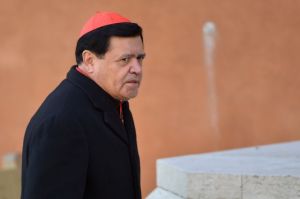 Although Mexicans have never been church-goers in the numbers one assumes, it has been since the 90s that religous believers have been flocking to other denominations. My sense is that the reported percentage of Roman Catholics (86% in the last census… the first to list religious affliliation) is probably — like other official data — fudged. As it was, the clergy objected to listing so-called “heretical” movements like Santa Muerte, or break-away Catholic movements (like the Apostolic Church of Mexico) separately from those considered Roman Catholic. Even among the baptized and relatively faithful, church attendance is very low… especially in Mexico City.
The problem in the Capital, and in the country in general, is the Primate, Norberto Rivera. The Church has changed, and with a Latin American at the helm, who — although not a Liberationist – is open to accepting a new role for the church as an alternative to the state, not an adjunct to its power — the old guard, and Norberto Rivera are the odd men out.
When Pope Francis spoke to the hierarchy here, he all but named Rivera as the biggest impediment to Catholicism in Mexico. Francis’ statement that the Church required a community of the faithful, not princes, coupled with his very public snubs of Rivera, led the Archdiocesan official paper, Desde de Fe, to come out with an editorial attacking the Pope. Not the way to win friends, nor to influence Popes.
If Rivera was reluctantly tolerated in Rome before (although it is alleged he was denied a vote in the last Papal conclave), now he is persona non grata in the Vatican Stories of his protection of for pedophile priests and his apparent simony — taking money in return for ecclesiastical benefits, specifically First Lady Angelica Rivera’s annulment — have been leaking out as he nears his 75th birthday a year from now.
As Bernardo Barranco Villafán (the best known Latin American religion writer, and probably one of the top non-clerical experts on the Roman Catholic Church) writes in this week’s Progreso:
Since the controversial editorial in Desde la Fe refuting the Pope’s message in Mexico became an international scandal , Norberto Rivera has been side-lined and is on his way out. In June 2017 he is canonically required to submit his resignation, which will surely be accepted. He is a survivor of the so-called “Club of Rome” [the clerics fostered by ], whose members all fell into disrepute and most of whom have died. […] Their positions are anachronistic, dragging behind them serious allegations of pedophile priests cover-ups. Their accounts are in deficit, the average loss of the Catholics in Mexico City is twice the national average. […] The image of the cardinal, according to various surveys, is bad; he is perceived more as a political actor as a spiritual leader. Retirement and solitude are imminent, his only comfort an odd group of priests and courtiers and powerful millionaires friends like Carlos Slim and Olegario Vazquez Raña.
While Rivera will probably hang on another year, with the “princes” of whom Francis complained unlikely to change their ways dramatically, who follows is the question. As Barranco warns:
Worse, [Rivera’s impending] retirement has unleashed the urgent ambitions of prelates as predatory as he was in the nineties.
“Arquidiócesis de México se lanza contra el Papa Francisco: Demeritó a obispos”, Proceso, 7 March 2016
Barranca V., Bernardo. “El llamado Club de Roma y el ocaso del cardenal Rivera” Proceso, 17 April 2016
—————- . Bernardo Barranco Blog
Servitje, Lucila. “Quién 50: `Bernardo es un hombre de fe que su tarea primordial el interpelar´” Quién, 13 Novembeer 2014
Earthquake in Ecuador… you know the drill
Time to call in the Topos… the “mole men (and women) of Tlatelolco”. Twenty five of the biggest brass-balls in Mexico are already on their way.
In Mexico:
Cuenta Santander 92-00070929-4
CLABE: 014180920007092942
I always found it strange that the most “liberal” of foreigners live in the most reactionary place in Mexico, Guanajuato. While the charms of San Miguel, and the state’s capital city are undeniable, little noted by foreigners is the overt racism of its leaders. Case in point: Luz Elena Govea López, the president of the state legislature’s Commission on Human Rights and Vulnerable Groups told an indigenous leader’s group meeting that, as indigenous people, they should stick to making handicrafts and growing nopales.
She added she could no more see herself cleaning toilets than she could see “them” working in a factory or in an office. “I imagine them on the field, I believe the belong at home making crafts, I think of them and I visualize them doing the work of their indigenous communities.”
Her rationale? The indigenous would lose their culture! Their culture apparently meaning hard work, poverty, and a short life-span.
While I shouldn’t have been surprised (this is the state where the head of the state commission on women said women with tattoos could be denied public services, and where the municipal president of the state’s capital tried to outlaw public displays of affection) that Ms. Govea couches her argument for what amounts to racial segregation in terms of “protecting culture”, I am a bit surprised to find she is a PRI office-holder.
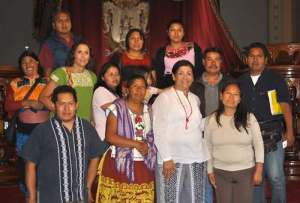
Govea (center in white blouse) with the people she seems to think shouldn’t even be in town except to sell trinkets.
Guanajuato was the center of the Cristero movement of the late 1920s, the “traditional values” counter-revolutionary uprising, that defined itself as defending the Catholic Church against the secularist revolution. With the collapse of the Cristeros, the counter-revolutionaries turned to “Synarchism”, which in Mexico — like the Falangists in Spain — combined conservative Catholicism with fascism. While not as hung up on “race” as other fascist movements, the Synarchists oddly enough believed in ballot-box democracy and in rule by a traditional elite. One should be able to vote, but one should be bound to the place reserved to you by tradition. Odder still, the Synarchists inherited from the Cristeros a commitment to women’s suffrage. The Cristeros saw women voters (presuming women were naturally more devout and traditional than men) as a means to create more Catholic voters; for the Synarchists, there was the added assumption that a women from the elites was still a better leader than any commoner of whatever gender.
Although the Synarchists have pretty much disappeared as a political force since their zenith during and after the Second World War (spoiler alert: they backed the wrong side), their ideology lived on, both through church groups like the Legionaries of Christ and in the PAN party. That’s why Ms. Govea’s political label somewhat surprised me. The ideology she embodies is that of a group that was born out of resistance to the policies of PRI’s founder, Plutaro Elías Calles, and today is represented in the party said to offer an alternative to PRI.
With PRI and PAN (and, for that matter, PRD) all having ameliorated their differences in recent years, perhaps the original ideological rationales for the major parties no longer matter. What does matter, however, is the much older ideological split between tradition and modernity.
SinEmbargo, 6 April 2016: “Diputada de Guanajuato pide a indígenas que “no busquen otros espacios” y se dediquen al campo y las artesanías“)
Don Goyo speaks
I’ve gotten used to the old fellow and his cranky ways.
So it begins…
El Universal (English edition) reports that
Arostóteles Nuñez, director of the Tax Administration System (SAT), said the office will start reviewing the information about the Mexicans involved in the “Panama Papers”.
Those Mexicans including Ricardo Salinas Pliego (CEO of TV Azteca) and Alfonso de Angoitia (CFO of Televisa), I don’t expect we’ll get much coverage of the scandal on the TV news. With the most prominent name to show up (so far) being Peña Nieto crony (and financier of the notorious “white house” owned (or at least in the name of) Peña Nieto’s wife, Angelica Rivera, somehow I expect the “review” is going to quietly do it’s work, and discover nothing worth reporting.
Unless, of course, some opposition figure shows up… in which case, expect endless reportage on the scandalous behavior and decadent lifestyle of the sacrificial victim. Or… like TV Azteca is doing now… talking about something inconsequential: the coming out of afternoon variety show presenter Pedro Solas as a gay man much more important a news item than their CEO’s entanglement in an international scandal.
Do you recognize me?
Know who this is? Some call this lad a danger to Mexico…


 mexfiles.net