As it happens: committing journalism
The “real Mexico” of journalists, courtesy of Carlos Léon Palacio, a free-lance reporter (and editor of an you-tube video news site, “Pensar Ético”):
What Léon was covering was a protest by Chontel Mayan women who have been staging a hunger strike in Villahermosa, Tabasco, seeking promised support from the state’s governor, for assistance in purchasing farm machinery. The women, and campesinos were trying to deliver a petition to the Governor and to meet with him face-to-face. Léon was trying to do his job.
On the other side of the Republic, the farm workers’ strikes in Baja California are being sort-of reported on outside Mexico… but mostly just because the peones (and there has been evidence that workers are being held in debt slavery, which is what peonage is) are a threat to the low, low prices U.S. consumers pay for their produce.
Military assault
Another MUST READ for anyone interested in U.S. military activity in Latin America. Congratulations to Adriaan Alsema on breaking this story, now making the rounds of the Latin American press, and seriously discomforting the Pentagon,
US soldiers and military contractors sexually abused more than 54 children in Colombia between 2003 and 2007, according to a recently released historic document on the country’s conflict. The suspects have allegedly not been prosecuted due to immunity clauses in bilateral agreements.
The 800-page independent historic report was commissioned by the Colombian government and rebel group FARC to establish the causes and violence aggravators of the 50-year-long conflict they are negotiating to end.
The document is to help negotiators determine who is responsible for the 7 million victims or the armed conflict between leftist rebels and the state while they are negotiating peace.
At least 54 Colombian girls sexually abused by immune US military: Report
With U.S. military (and paramilitary) personnel here in Mexico (where sexual abuse by our own soldiers is all too common) and more U.S. personnel headed to Peru, people in the United States need to understand that there could, and likely will be, blowback as stories like the Colombian experience become better known.
Shop til you drop
Mexico has been on a buying spree for U.S. military equipment, especially helicopters and armored vehicles, with purchases amounting to more than a billion dollars in the last 12 months. U.S. Northern Command chief Admiral William Gortney said the combined deals represent “a 100-fold increase from prior years.” For a military supposedly proud of its independence from the United States, it is a dependent client.
John Lindsay-Poland, on “The Mexican Military’s Buying Binge” (NACLA 23 March 2015)
I haven’t been keeping up with Mexican military spending, but do recall that as a portion of the national budget, “security” has been taking a bigger and bigger chunk over the last few years. I also know that much of the spending has been that “Plan Merida” funding, which was not so much Mexican spending, as US taxpayer funds being given to Mexico to buy US equipment, supposedly to fight narcos who are selling drugs (and buying arms) to willing buyers (and willing sellers) in the US.
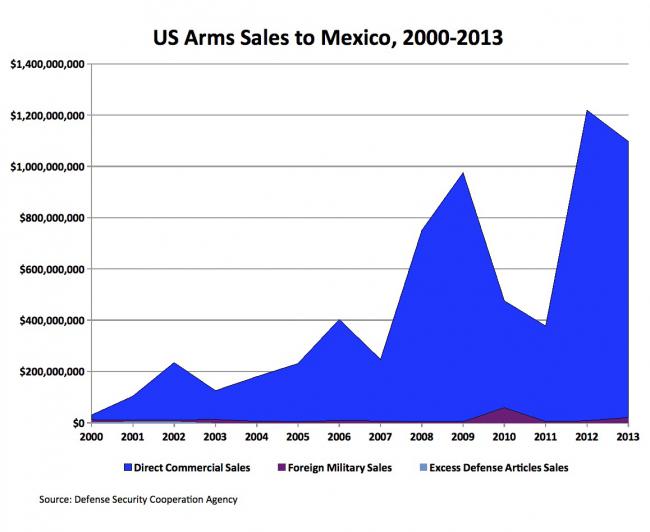
Lindsay-Poland’s article on WHAT is being bought is a must read. Where the money is coming from (us.. or the U.S.?) and — ultimately — cui bono from these sales is something I just don’t know.
UBER-mensch
It appears the tweet heard round the internet has finally opened the expected taxi v uber wars here.
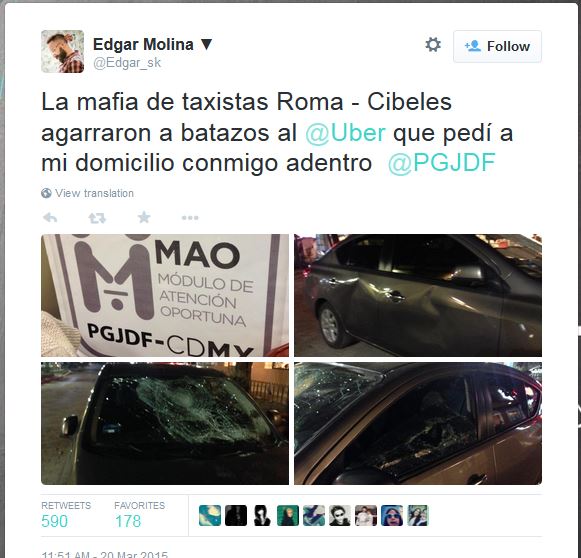
For those not intimate with la Capital, “Cybeles” is a roundabout in Roma Norte, a few blocks from the Zona Rosa), home to a number of high-priced “artisanal” type restaurants and cafes… haute bourgeois hipster territory. Not that there’s anything wrong with that.
Uber is not the only “app based personal transit service” in Mexico, but is the best known. Taxi drivers have been protesting, notably in late October, when they staged a demonstration on the Zocalo. At that time, the drivers complained that Uber, and similar services, are acting as a taxi service, while not paying either the licenses required for such services, nor obtaining the permits required for “derecho de cajones y asenso” (pulling out of traffic into parking spaces or loading zones for passengers). At the demonstration, Ignacio Rodríguez, the director of ATR, the Taxi Drivers’ association, warned that “we are looking for regularization [of the app-based businesses]. We have petitioned the authorities on several occasions, and we will take stronger action”.
Which, if Sr. Molina is to be believed (and no reason to doubt him), the taxi drivers did.
Uber’s response to the alleged attack was to say that “The last thing Mexico needs is more violence, and we vehemently condemn any violence or intimidation,” meaning…what exactly?
Everyone is opposed to violence or intimidation, but, from what Uber is claiming, this is not any violence or intimidation against them… not really. Responding to the driver’s protests, Uber defended itself by saying that the drivers were “personas morales” and that the autos were those of the drivers. In other words, Uber is simply providing a forum for arranging a meeting… no different than a dating service like OK Cupid, or Match.com or Grindr… although one, presumably, is not looking for true love, but only a ride, and the mystery date is charging for the service. I suppose there are escorts on the dating sites (well, I know there are!) and, of course, the dating services charge a fee for narrowing your search (as far as the software is concerned there is no difference between putting a person in contact with any given parameter or set of parameters and another — whether a blonde, blue-eyed female between 18 and 25 — or a Passant or similar car, going to the airport on Friday afternoon. It’s all just data fields.
Given the taxi union arguments, while I am supposed to deplore the attack on a driver and his car (assuming it was the taxi union), it’s to be expected.
Not that Uber doesn’t have it’s defenders. From the “facebook” page Foreigners in DF(Mexico City) I read this from a Uber user:
The Uber cars are excellent, clean, seat belts works, pleasant drivers that knows their way around, you don’t need cash, you order the type of car you like on your smartphone and get a confirmation with photo of the driver, plates etc. …. Should I keep going?
When using on-line dating services (and, no I won’t say which ones) I never had any trouble, but then, I never would meet with a complete stranger except in a public place, and never get into their car. And, it wasn’t the kind of thing I’d be paying money for. While a taxi driver is a complete stranger, they are in the business of driving a car between point A and point B, vetted by a business that has to follow certain regulations, and from whom a certain standard of conduct is to be expected. I’m sure the Uber drivers are above board, but as private individuals, and not as quasi-public service employees, I am taking an unnecessary risk and AM getting into a car with a blind date… who maybe does have a nice clean car, and is a nice, clean person. But can I be in any way certain of that, or even expect it within the rules of probability, like I can with a taxi?
There are some more esoteric arguments one might make about these “app-based ride-shares”… beyond just the legal questions of liability (as a “persona moral” the driver is the only one responsible for whatever happens in his or her car — not some fiscal person like Uber, or the Taxi company).
Uber, located in San Francisco, California, was financed by hedge funds and venture capital, mostly from the United States, although the Quatar Sovereign Wealth Fund was a major underwriter as well. In other words, the money going to Uber for those blind dates (er… escort service), other than that actually going to the persona moral who happens to be the driver (and who has overhead like gas and maintenance and … one hopes and prays… insurance) is not going to anyone in Mexico, but is being expatriated abroad. To, among other places, Quatar. Why, given that as a Mexican taxpayer, I’m helping underwrite our own public transportation system (including taxis) and our roads, would I want to send money abroad for that service? And what does Uber really contribute to the local economy other than the driver’s percentage? Nothing that I can see.
And, consider where Uber works within the Metropolitan area. From Uber itself, this map (14 April 2015) shows the routes Uber drivers have taken:

As noted by Rodrigo Díaz, an urban planner with a degree in architecture from the Universidad Católica de Chile, and a Masters’ in Urban Planning from MIT, on his website Pedestre, entire areas of the city… coincidentally, the less wealthy areas, simply don’t exist.
On this map there is no Iztapalapa, none of the barrancas, Ajusco, nor the State of Mexico in general. There are no poor. Even the Periferico disappears at the edge of Xochimilco (to be clear, this is not a criticism of Uber, merely a description of how this shows the city as a stratified society). The only reason we found any images on the west side of the city is that is the way to the airport, and some spots highway exits to Toluca.
What you see is that downtown Mexico City is not the center.
Roma-Condessa-Polanco is the center. The Uber-mensch are those in the wealthier parts of the city, traveling to other wealthy parts of the city. For the benefit of wealthy people outside the city.
Sources:
Gabriela Chávez, Uber vs taxis: los argumentos en la disputa por el transporte en el DF (CNNMéxico, 01 de noviembre de 2014)
FOTOS: Taxistas destrozan a batazos un Uber en el DF (Publimetro)
Uber asegura que taxistas vandalizaron uno de sus vehículos en el DF (CNNMéxico, 21 Marzo 2015)
Uber y el mapa de la desigualdad en la ciudad de México (Pedestre, 24 abril 2014)
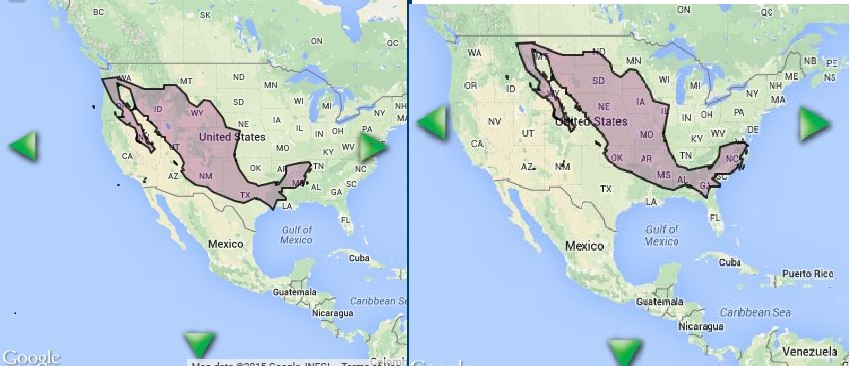
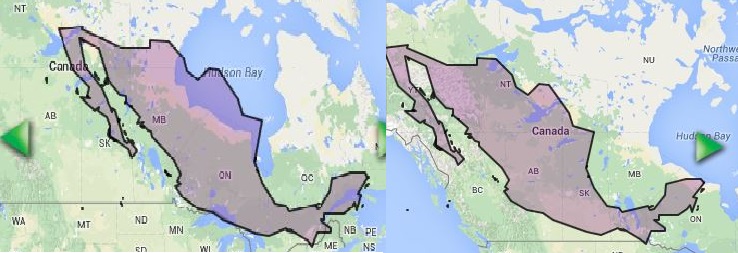
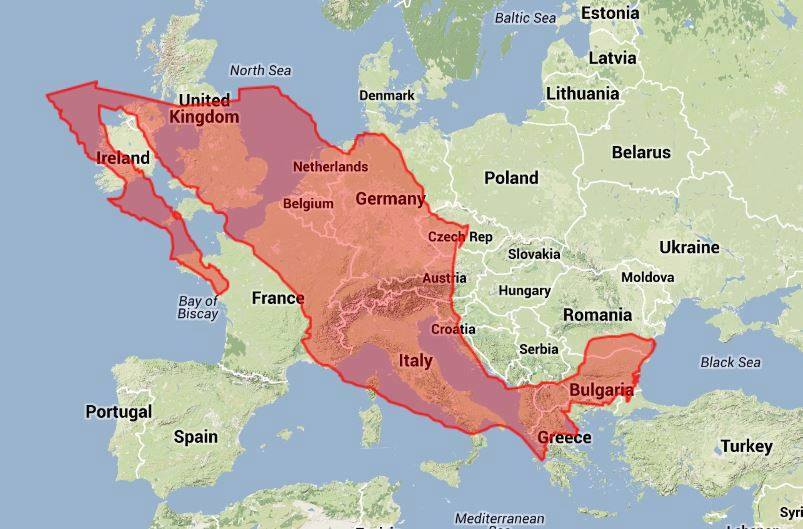
No, you can’t see all Mexico in a week…
I’ve had to gently let down enthusiastic visitors who think they can see Mexico City (in its entirety?), the Mayan Riviera, and the Copper Canyon in a week. Perhaps these would help:
USA:
CANADA:
EUROPE:
The San Patricios
Liam Neeson joins author Michael Hogan and musician Tim O’Brien to honor the Irish heroes of St. Patrick’s Battalion which fought in the Mexican-American War. From the BBC:
To die for
I meant to post this the other day, but was occupied (among other things, ironically, discussing with my lawyer whether or not I needed to update my will).
Spencer Richard Mc Mullen is a licensed attorney and court translator in the State of Jalisco. While Mexico, like the United States, is a federal republic, and the laws differ between states, his site is often a good source for basic information on immigration and family law in Mexico.
The issue of same sex marriages has been controversial around the world and no more so than here in Mexico. While the Mexican Supreme Court has stated that people of the same sex have the right to marry, and certain states have eliminated verbiage in their civil codes that would impede same sex marriages, the reality is that it still remains very difficult.
Many civil registries will not perform same sex marriages and when a death occurs, many refuse to place the same sex spouse´s name on the death certificate as the surviving spouse.
I filed an intestate probate case in the Civil Court in Chapala on May 27, 2014 presenting the Mexican death certificate and the apostilled and translated marriage certificate from California.
The court accepted the filing and jurisdiction on June 4, 2014 and ordered notifications and requests be sent to the US consulate, Ministerio Publico in Guadalajara, National Will Registry, local Public Property Registry, State Archive of Public Instruments as well as to the Agente Social who is the watchdog over the courts in family law cases. The judge also ordered notices to be published in newspapers of major circulation for 30 days.
Over the next few months the requests came back answered that there existed no will and no heirs came forward. The local Agente Social said it was the first case of its type that he has seen and asked me for a copy of my pleadings so he could study all the international treaties and caselaw I used. He also said good work and that he would sign off on the case.
Then we asked the court to rule and designate my client as sole and universal heir and executor over the estate of his deceased husband on February 10, 2015. We again reiterated and listed all the international treaties to which Mexico was a signatory as well as caselaw.
Today, March 10, 2015 I received a notification from the Chapala civil court that they granted our request for my client to be the sole and universal heir and executor over the estate of his deceased husband.
This was the first time the court had a request for an intestate probate recognizing a same sex marriage performed in California and recognized it in Mexico granting the surviving same sex spouse their fair share of the decedent’s assets.
I told the court to get used to it as this might have been the first time but certainly not the last. Now we have to prepare the inventories and appraisals and then present the division plan to the court for its approval.
The Buenos Aires bungle
While exactly what happened to Alberto Nisman is still a mystery, it looks less and less as if the present government was involved in his death, and more and more like the “plots” are all in the mind of the opposition and the U.S. media (and those that believe them):
Graciela Mochkofsky, in Jewish Daily Forward (via Portside):
I don’t know of anyone in Argentina who considered Nisman a hero before he was found dead in his apartment on January 18…
[…]
In 1997, when he first became involved in the case — known in Argentina by the JCC’s acronym, AMIA — Nisman was a young and ambitious prosecutor making a career in the newly inaugurated system of open trials.
His task was to make presentable the fabrication concocted by Judge Juan José Galeano. With forged evidence, Galeano and other authorities had accused a ring of corrupt police officers of being the “local connection” in the bombing.
The open trial began in 2001 and ended in disaster in 2004. The forgery was so apparent that it didn’t survive scrutiny. The policemen were exonerated. The judge, the prosecutors, the head of the intelligence service, a high-ranking police officer, former president Carlos Menem and the leader of the main political Jewish organization were eventually indicted for the cover-up (and are going to trial in a few months). Nisman somehow survived…
[…]
 … according to numerous testimonies, he feared the government was going to remove him from his post, as part of a larger judicial reform. (Several of those reforms were introduced December 31, and that same day, Nisman changed his return ticket from Spain.)
The first judge who received Nisman’s accusation rejected it as baseless. The Jewish leadership refused to stand by him in parliament (they started supporting him post-mortem). The victim’s relatives’ associations rejected not only the accusation, but also Nisman himself: They had been asking for his removal from the case all along.
[…]
Several of the country’s most prominent jurists agreed that there was no evidence to prove that a crime of any kind had been committed. But with demonstrators in the streets paying homage to Nisman, federal prosecutor Gerardo Pollicita picked up the case and filed the accusation again.
On February 26, [Judge Daniel] Rafecas demolished it.
His 63-page dismissal is devastating: Not only was there “not even circumstantial evidence” of the alleged cover-up or obstruction of justice in Nisman’s last document, the judge wrote, but the evidence gathered by Nisman himself openly contradicted his accusations.
I believe the entire incident has been blown out of proportion, and the “internationalization” of the story has less to do with the murder mystery aspects than the more obvious motive that birds of a feather flock together… corporate media organizations and “vulture fund” managers being in the same flock, and the present Argentine administration … whatever its other faults, has been too aggressive in fighting against the assumption that it should take on debts run up by discredited previous regimes, and should be left to get its own economic house in order, than Wall Street would like.
With Cristina a “lame duck” president, and the possibility (which is probably remote) of a more corporate-compliant president to follow, it seems the U.S. (and its corporate media) has less incentive to create an image of a nation on the brink of collapse (as they did with Honduras before the coup, or Bolivia before the attempted “media luna” coup, or Paraguay before its “constitutional” coup… or…) and any domestic dispute will do.
If you pick it up, put it back…
Ejido El Bajio, in Caborca, Sonora, was robbed!
For several years, the ejido has “hosted” (in the sense of being the source of sustenance for a parasite) a Minera Penmont operation which somehow “neglected” to ever get permission to mine.
The ejidarios sued in Agrarian courts in 2010, and — in a partial victory — won their suit in June 2014, which only called for the restoration of damages between the commencement of the suit and the court ruling.
 However, the court (Tribunal Unitario Agrario, Distrito 28) an injunction (amparo) on restitution, under the argument that the company needed to assess the mine, and recover their own equipment. Although the injunction was lifted on December, to date, the company has yet to publish the ruling … mostly because of the likely impact on its stock prices.
And, apparently, is still mining.
And, the Ejido El Bajio is waiting for not just land reclamation… the company owes them nine tons of gold and four tons of silver… though the Ejido will probably take a check made out for $350,000,000 (US)… as long as its good.
The problems of the political class
Film director and novelist Guillermo del Toro recently put his finger on the problem with the present leadership in this country. During a recent press conference at the Guadalajara International Film Festival, he rattled a few cages, and raised a few eyebrows when he remarked “I would love to sit down with the political class and light a fire under them so they might have a sense of history, rather than just a desire to steal… Many of us will be forgotten, but the bullshit they do will be remembered by history.”
The political class too often tries to emulate their counter-parts north of the border (a country with a notorious sense of amnesia when it comes to national history) in pushing “new” proposals that aren’t really new, or in introducing bills that undo standing rules (like the strict separation of church and state in education) that came about through long historical processes. However, the people are not north-of-the-border people … it’s nothing to find taxi drivers who can map out Pancho Villa’s battle plans, or street vendors who know where the Emperor Montezuma once walked, or farmers who can quote Benito Juárez. The people don’t forget… whether they will continue to forgive I can’t say.
The unquiet ghost of Benito Juárez
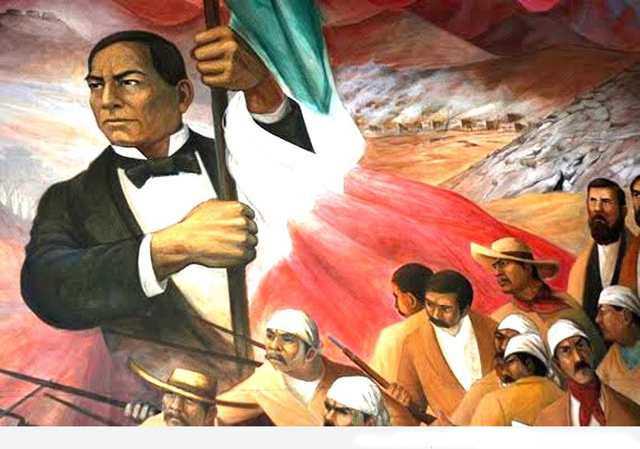 As if undoing the acts that defined the Mexican Revolution (rolling back labor rights, not-quite privatizing mineral and oil resources, giving up on public education other than as technical schooling, etc.) has not been enough, it appears the present government is now attempting to roll back the legacy of Don Benito.
Juárez (whose birthday we celebrate here on Monday, for the convenience of the tourism industry and corporate employers, rather than his actual birthday, 21 March), while imposing international standards on Mexico (the metric system, the Napoleonic Code, decimal currency), understood that the nation needed some protection from the outside, or … perhaps… that Mexico’s political culture depended on remaining aloof of the standards of others in some respects.
The hard-won battle for separating Church and State was a particularly bloody affair, culminating in the lynching of Melicor Ocampo (3 June 1861), who more than anyone is responsible for Mexico’s unique success among the American nations in keeping religion separate from politics.
While our constitutions (both the 1854 one and the much-amended 1916-17 one) were perhaps unfair to the Church, and perhaps went too far in denying civil rights to clerics, it has always been understood that one cannot serve both God and Caesar in this country. But, without even a peep, Father Iván Bernal Zamora has registered as a pre-candidate for municipal president of Agua Prieta, Sonora, on the PAN ticket. PAN, of course, is as close as we get to a clerical party in this country, but even they have always been careful to avoid claiming that they are the party of God… or the Church. Admittedly, Padre Bernal has been suspended by his Bishop, but that is under Canon law, there being no restrictions (other than custom) on a clergyman holding public office. (Proceso)
Juárez, like George Washington, warned against being involved in the affairs of other nations. But, unlike the United States, Mexico has kept out of world conflicts, by design, though the simple expedient of taking Juárez at his word when he said, “Peace among neighbors, as among nations, is respect for the rights of others”, which has been taken to mean to stay out of their business. And, more importantly, to keep our military out of foreign affairs, and only for defensive purposes. Now, Mexico is getting into their neighbor’s business… specifically in Haiti and the Western Sahara. For the first time ever, Mexican troops will be serving in a U.N. “Peacekeeping Mission”. Leaving aside the question of what the UN troops are doing in Haiti, besides propping up an unwanted political system in the name of “stability”, Mexico has never had a dog in the hunt when it comes to Haiti… let alone the Western Sahara… nor any other nation’s internal affairs. Who exactly the Mexicans are expected to prop up in the Sahara (other than foreign mining corporations) and whose interest they are protecting in Haiti is beside the point. Why should Mexico have to take sides, when they would resent Haitians or Western Saharans taking up sides in our own internal disputes? (CNN México)
Neither of these are particularly “earth-shattering” changes, nor do they presage a roll-back of Mexican politics to the days of Santa Anna… but are small reminders that Mexico, like it or not, is erasing its cultural markers as it is absorbed into the borg of 21st century political hegemony, becoming not a Revolutionary model for the world (it hasn’t been one in years), nor an exception to the rule, but “just another country”.
Who you gonna believe, me or your lyin’ history books?
I knew the U.S. was going to cause trouble down our way when Obama said he looked forward, not backwards (in relation to another issue where a little historical analysis was in order). U.S. policy in Latin America especially depends on understanding the history of the region, and the role the United States has played in that history. The first U.S. sponsored Latin American coup was probably the the support given to General Antonio Santa Anna in overthrowing the Iturbide monarchy in 1823. Dr. Tinker Salas doesn’t go back quite far enough, but at least had a longer view than most, and the problem isn’t so much that the State Department mouthpiece just flat out lied, but that she seemed clueless to the fact that even the most superficial view of “current events”, let alone “history with a capital H” proves her wrong.


 mexfiles.net