Yesterday’s non-ruling: U.S. Supreme Court
No, not the one on same-sex marrriage (but not taking cases from appeals courts, the Supremes basically upheld the lower courts in their rulings on sae-sex marriage, immediately creating them in five states, and making leaving five states having no recourse but to change their own marriage laws). That was good. I have mixed feelings on the one nobody mentioned north of the border:
The United States Supreme Court on Monday rejected the appeal of 10 people who tried to sue former Mexican President Ernesto Zedillo on the grounds that he was partially responsible for a slaughter committed in 1997 in Mexico, claiming the president then tried to cover it up.
The high court gave no reason for refusing to admit the case. A federal judge in Connecticut and the Court of Appeals for the 2nd Circuit in New York had dismissed the lawsuit on the grounds that Zedillo has immunity as a former head of state.
The plaintiffs claim that they are survivors of the slaughter of 45 people in the village of Acteal, in the southern state of Chiapas, perpetrated by paramilitaries allegedly linked to the government.
Zedillo called the allegations as baseless. He was president of Mexico from 1994 to 2000 currently teaches at Yale University in Connecticut.
(La Jornada, “Corte Suprema de EU bloquea demanda contra Zedillo por Acteal“, 7 October 2014)
I have mixed feelings about the U.S. assuming it has the right to try cases for crimes in other countries (and its people scream when their own citizens are tried here for crimes committed in this country … see any rightwing site talking about gun-runner and general fuck-up Andrew Tamorresi for the latest example), but the plaintiffs had standing in U.S. courts, and Zedillo is, by his own choice, a resident of the United States.
And, while I understand the historical reasons for prostecutorial immunity for officials in this country (in the badder old days, there was a tendency to arrest dissident congressmen and governors, or judges who ruled the wrong way) Zedillo is not a sitting office holder and I was hoping to at least get the facts on the record in a court of law… a Mexican court, not some Connecticut one.
For a change, good news for indigenous students
It isn’t much, but with the news filled with reports on the massacre of the innocents in Iguala, while overlooking and downplaying the on-going violence against indigenous people here from all sides… stealing water from the Yaquis, and land from just about everyone, on behalf of corporate interests…. there is a bit of good news from the world of business.
Notimex (via Siglo de Torreón)… my rough translation:
Mozilla’s Mexican representative, Jusai Palma Prieto, has annouced that Firebox browsers are now available in 32 Mexican languages or dialects, the idea being that the technology th “should not only look to the future of the people, but look back at their honorable past. “
In an interview with Notimex, Palma said that 90 percent of the design for these navigation services were created by university committed to their own cultures.
“One of the benefits of these projects, is that once they have been completed they are validated by the National Institute of Indigenous Languages, which gives assurance that this product is real,” he said.
This can he achieved, he added, because we are not a company or a corporatation that generates profits and has to be accountable to its investors, but a group of people who care about others.
The work today he compared to that being done with Wikipedia, which is adding content in Nahuatl, with the idea that speakers of that language will not give up because of the social stigma [of using a minority language], but will use it, thus preserving their culture.
October risings
Much as I try, I’m not always able to update this site as I’d like, and am lucky that there are other competent independent sources and those that mine the news when I can’t. . Although I might interpret some reported information slightly differently, this “Special Report” by Frontera Norte-Sur is a comprehensive overview of the recent events surrounding student movements. It was written, though, before reports on the mass graves found in Iguala.
Special Report
A Sleeping Giant Stirs: Mexico’s October Risings
Largely downplayed in the U.S. media, ground-shaking events are rattling Mexico. On one key front, Mexican Interior Minister Miguel Angel Osorio Chong announced October 3 the Pena Nieto administration’s acceptance of many of the demands issued by striking students of the National Polytechnic Institute (IPN). IPN Director Yoloxichitl Bustamante, whose ouster had been demanded by the students, handed in her resignation.
Osorio Chong’s words were delivered to thousands of students from an improvised stage outside Interior Ministry headquarters in Mexico City. In addition to Bustamante’s departure, the senior Pena Nieto cabinet official pledged greater resources for the IPN, the cancellation of administrative and academic changes opposed by the students, the prohibition of lifetime pensions for IPN directors, the replacement of a much-criticized campus police force, and no retaliations against the strikers.
Osorio Chong shared the students’ concerns that IPN policies were turning a professional education into an assembly-line diploma mill and reducing “the excellence of schools of higher education.” Education Secretary Emilio Chuayfett was noticeably absent for Osorio Chong’s presentation, which was held at the conclusion of a Friday afternoon march through the Mexican capital that attracted in upwards of 20,000 students.
Distrustful of the government, the students are reacting cautiously to the Pena Nieto administration’s response to their 10-point petition, insisting among other things that Yolo Bustamante be held accountable for alleged transgressions before leaving her job. Student activists said that acceptance of the government’s response will be democratically debated and resolved at upcoming meetings of the 44 schools that form the IPN.
“In each school we are going to organize (university) assemblies to analyze the proposal that the Interior Ministry delivered,” said activist Ivan Garcia. “This was a gain but not victory.”
Under the slogan “We are All the Polytechnic,” the IPN students’ strike has drawn enthusiastic support from students of the National Autonomous University of Mexico and other public and private universities, as well as unions and popular organizations. Additionally, the students support the embattled and repressed students of the Ayotzinapa rural teachers’ college in Guerrero state.
Erupting on the eve of the anniversary of the October 2, 1968 Tlatelolco Massacre, when hundreds of students were slaughtered by Mexican security forces, the new student movement is drawing comparisons with an earlier landmark event in the nation’s political history.
“The giant has awoken,” wrote journalist and political analyst Jenaro Villamil. “(IPN students) aren’t the same young people with the same demands as during the era of (President) Diaz Ordaz or even #YoSoy132 of 2012, but they share the same impetus for criticism of the federal government and attempts at media censorship or distortion, especially by Televisa.”
Villamil continued: “Many of the young people under 20 years of age that are marching today are the grandchildren of the 68 Movement, and they interact with equal efficiency on social media networks and cyberspace as did the youth of #YoSoy132.”
Villamil’s mention of #YoSoy132 refers to the mass youth movement that arose against the commercial media’s promotion of Enrique Pena Nieto’s successful run for the presidency in 2012.
Inspired by their students, members of IPN’s faculty are now beginning to organize and advocate changes like democratizing the naming of directors and publicly disclosing the management of financial resources.
“We need transparency in the income and expenses of our schools,” said IPN Professor Gerardo Angeles. “This continues being a secret and we also don’t know how (staff) are contracted.”
Founded in the 1930s during the administration of President Lazaro Cardenas as an institution to prepare professionals for the operation of Mexico’s newly-expropriated oil industry, the IPN has undergone significant changes in recent decades, according to Erika Celestino, professor of economics at the 170,000-plus student school.
Driving student and faculty discontent are watered-down classes and diplomas; the imposition of “precarious” working conditions on instructors; the whittling away of student rights; and steps toward privatization, she said.
“There is a conflict in the IPN’s projects going back 15 years,” Celestino said. “On the one hand is the nationalist foundation; on the other, there is the neo-liberal restructuring.”
The IPN struggle was high on the agenda of this year’s October 2 anniversary commemoration in Mexico City, where an estimated 25,000 students, union activists, members of popular organization and veterans of the 1968 movement rallied not only to honor the martyrs of ’68 but to call to attention to contemporary struggles.
Representatives of Sonora’s indigenous Yaquis, who are embroiled in a water conflict with their state government, demanded freedom for imprisoned leaders Mario Luna, Fernando Jimenez and Tomas Rojo.
Residents of San Salvador Atenco, clutching machetes in their left hands and corn cobs in their right ones, reiterated opposition to renewed government intentions of building an airport on their land outside Mexico City.
A special homage was paid to Raul Alvarez Garin, a prominent leader of the ‘68 Committee that has kept alive the October 2 commemoration. The IPN representative on the 1968 student strike committee, Alvarez passed away only days before the event on September 26- ironically just as the 2014 IPN student strike was getting off the ground and on the very day another massacre of students was unfolding elsewhere in Mexico.
“You see it. You feel it. Raul is present!” thousands chanted.
Besides the Mexican capital, October 2 demonstrations- both large and small- were reported in at least 15 states. The events ranged from a demonstration of 5,000 in Morelia, Michoacan, and a 12,000-strong rally in Tuxtla Gutierrez, the state capital of southern Chiapas state, to much smaller protests in Tijuana and Ciudad Juarez on the U.S.-Mexico border.
More than 50 members of the Teachers Resistance Movement occupied a toll booth on the Tijuana-Tecate highway, allowing motorists to pass free of charge as they remembered October 2, denounced the repression against the Ayotzinapa students and protested the national education reform passed in 2012.
In Ciudad Juarez, about 50 students from the Alta Vista High School marched to the giant flag near Chamizal Park. “October 2 is not forgotten,” the students chanted. “If they do not allow us to dream, we won’t let them sleep!”
The students were following in the footsteps of a previous generation. Alta Vista was one of the schools that formed the old, city-wide Student Struggle Committee which emerged after the Tlatelolco Massacre and conducted various protests in the border city between 1968 and 1970.
The October 2 commemorations were especially intense in the state of Guerrero, where memories of an old government massacre merged with revulsion and anger over a new one.
For the first time in 10 years, students and their allies commemorated October 2 in the streets of Tlapa, where between 1,200- 2,000 people paraded in the streets. Other protests were reported in Zihuatanejo, Atoyac, Tecpan de Galeana, Acapulco, Ometepec, Chilapa, Iguala, and Huamuxtitlan.
In Mexico City, Guerrero and across the nation, the protests reverberated with a word that is now part of the October 2 vocabulary: Ayotzinapa.
Demonstrators called for the safe return of 43 missing students- all of them young men- from the Raul Isidro Burgos Teachers College of Ayotzinapa, Guerrero, who disappeared after they were attacked by September 26 by municipal policemen and civilian gunmen in the city of Iguala while they were collecting money to pay for a trip to Mexico City for the October 2 protests.
Six people were killed and 25 wounded in an attack now blamed on the Iguala municipal government working in conjunction with the Guerreros Unidos drug cartel. On October 2, in the Guerrero state capital of
Chilpancingo, about 20,000 people marched and then blockaded for six hours the Highway of the Sun connecting Mexico City with the tourist port of Acapulco.
Besides the return of the missing students, the protesters demanded punishment for the intellectual and material authors of the September 26 massacre; the sacking of Guerrero Gov. Angel Aguirre; and the arrests of Iguala Mayor Jose Luis Abarca Velasquez and Felipe Flores Velazquez, the city’s public safety chief.
Both Abarca and Flores are fugitives, and it is suspected they could have been tipped off that Mexican soldiers and police were looking for them before they vanished from sight last week.
According to Guerrero State Attorney General Inaky Blanco, more than 30 policemen and others have been arrested in connection with the Iguala killings and disappearances. More arrests will be forthcoming, he said. On this score, witnesses reported seeing some of the missing students detained and put into municipal police vehicles. In a swift action, the federal attorney general’s office took charge of the investigation into the attack on the students.
Guerrero activists and residents charged that government officials had ignored complaints for more than a year that Iguala was a virtual fiefdom under a reign of terror. They cited numerous murders, extortions, arbitrary detentions, tortures, police beatings, and forced disappearances of both activists and the everyday citizens allegedly committed by Mayor Abarca and his henchmen.
“The events of Iguala might not have happened if the Mexican state had duly investigated the previous violent events in the region,” wrote Abel Barrera, director of Guerrero’s Tlachinollan Human Rights Center.
“The disappearance and execution of the Popular Unity activists (2013), the penitentiary massacre, the armed incursions in Carrizalillo: all this was tolerated and remained submerged in the only state of law that really exists in Guerrero: the state of impunity.”
At an October 3 forum in Acapulco sponsored by the municipal government, the director of a National Autonomous University of Mexico cultural institute dedicated to the legacies of October 1968 called the Iguala slaughter a “state crime.” Esmeralda Reynoso Camacho assessed the differences that might exist between 1968 and now.
“Not much has changed,” Reynoso said. “Deaths, disappearances and repression continue, as the power elite does not understand that it has to listen to the people, that it’s not just about voting for (politicians) but also to see what can be done. As long as the power elite does not realize this, violence and social uprisings are latent.”
Reynoso’s words were echoed separately by acclaimed writer Elena Poniatowska, author of a celebrated chronicle of the Tlatelolco Massacre, during an October 4 ceremony at the Autonomous University of Guerrero where she was awarded an honorary doctorate.
“(Iguala) is a human tragedy and a disgrace in a country that presumes to be a democracy like ours,” Poniatowska said. “And besides, it is a tremendous blow to the regime…”
The Iguala events have captured international attention. The United Nations condemned the violence, urging an effective response from the Mexican government, while the Inter-American Commission on Human Rights ordered protective measures for the Ayotzinapa students. In England and Argentina, demonstrations were held in solidarity with the students.
In Mexico, students of all the country’s rural teacher training colleges have declared a strike until the Ayotzinapa students are returned. Relatives of the missing young men plan a national demonstration for Wednesday, October 8, which is expected to be accompanied by a nationwide work stoppage in schools and other protests organized by the National Coordinator of Education Workers. On Sunday, October 5, about 700 students and parents conducted another blockade of the Highway of the Sun in Guerrero.
Nearly 2,000 Mexican soldiers, police and Guerrero state employees scoured the vicinity of Iguala for the disappeared students. Authorities said they will check the identities of 28 burned bodies uncovered from a mass grave found in the area on October 4, to see if any of them matched the missing students.
Reportedly tipped off by some of the individuals detained for the Iguala violence, the clandestine burial ground was located in the same zone where 30 bodies were discovered last April and May. Local residents called the site, which offers a panoramic view of Iguala, a “narco-cemetery.”
One young girl remarked, “On many nights, stinking trucks pass by here. Really, they stink.”
If the bodies are confirmed as belonging to the Ayotzinapa students, the September 26 massacre could prove to be the worst such incident in the long and bloody political history of Guerrero. Previous massacres include Chilpancingo (1960), Iguala (1962), Atoyac (1967), Acapulco (1967), Aguas Blancas (1995), and El Charco (1998). In the both the 1960s and 1990s, the slaughter of unarmed civilians precipitated guerrilla uprisings.
Meanwhile, about 500 friends and family members of 23-year-old Ayotzinapa student Julio Cesar Chavez Ramirez Nava, murdered in Iguala on September 26, paid their last respects in Tixtla.
Friends recalled how the young man suspended his studies for some years in order to work as a construction laborer so he could support his family. Ramirez’s activities as a member of a local soccer club and as a musician in the Ayotzinapa school band were likewise remembered.
“Your place in the band will never be erased,” said the band leader about his murdered companion. “You will always be remembered by us.”
Sources: Milenio.com, October 4 and 5, 2014. Articles by Ignacio Alzaga, Liliana Padilla, Marco Campillo, Roberto Agustin Esteban, Pedro Dominguez, and EFE. El Universal, October 4 and 5, 2014. Articles by Adriadna Garcia, Natalia Gomez, Eduardo Hernandez, Vania Pigeonutt, and editorial staff.
La Jornada, October 2, 3, 4 and 5, 2014. Articles by Elena Poniatowska, Sergio Ocampo, Alfredo Valadez, Ernesto Martinez, Rubicela Morelos, Hector Briseno, Abel Barrera, Arturo Sanchez Jimenez, Gustavo Castillo, Fabiola Martinez, Arturo Cano, and Emir Olivares.
La Jornada (Guerrero edition), October 3, 4 and 5, 2014. Articles by Margena De La O, Citlal Giles Sanchez, Salvador Cisneros Silva, Rodolfo Valadez, Roberto Ramirez Bravo, and editorial staff.
El Sur, October 2, 3, 4 and 5, 2014. Articles by Zacarias Cervantes, Lourdes Chavez, Brenda Escobar, Aurora Harrison, Jacob Morales Antonio, Carmen Gonzalez Benicio, Alejandro Guerrero, Rosabla Ramirez Garcia, and Oscar Ricardo Munoz, El Diario de Juarez, October 2 and 5, 2014. Articles by Martin Coronado, Juan de Dios Olivas and Reforma.
Frontera.info, October 3, 2014. Article by Laura Duran. Proceso/Apro, September 30, 2014; October 2, 3, 4 and 5, 2014. Articles by Jenaro Villamil, Rosalia Vergara, Juan Carlos Cruz, Mathieu Tourlierre, Gloria Leticia Diaz, Ezequiel Flores Contreras, and editorial staff.
Frontera NorteSur: on-line, U.S.-Mexico border news
Center for Latin American and Border Studies
New Mexico State University
Las Cruces, New Mexico
Texas edition of the Friday Nite Video
Not everything about Texas education sucks…a few school districts are still enlightened enough to have music and cultural studies… which sometimes can be combined. From the 2014 Texas High School Mariachi Competition, here’s first place winner, MeAllen High School:
Modern Mexican history 101
The Tlatelolco Massacre was a seminal event in the history of this country and everyone who lives here, even as a “snowbird” should at least know about it. This changed the political and social landscape completely, marking for some the failure of the Revolution of 1910-20, and for others, the start of a more populist stuggle. This short video (I was looking for it yesterday) is one of the best overviews for the Spanish-challenged:
El 2 de Octubre no se olvio
The old generation passeth…
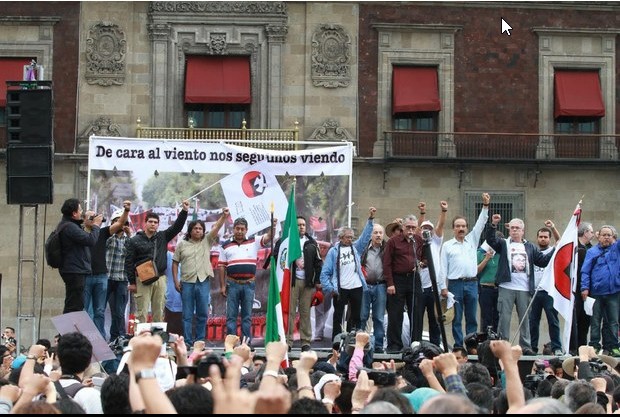
Veterans (or survivors) of the 1968 Student Movement, pass on a Mexican tradition to their grandchildren. As students today continue their actions, they also took time today to remember the Tlatelolco Massacre on the Second of October 1968.
(Photo: Roberto García, in La Jornada)
Is it happening? The student protests
Nothing happens in Mexico… until it happens.
(Porfirio Díaz)
In writing about the student movement of 1968 here in Mexico, and its tragic climax, I traced back the roots of that movement not to the world-wide movements of the late 60s, but to a seemingly unimportant …. and little noted… inident a decade earlier, when students took to the streets to demand the government lift a ban on showing “Jailhouse Rock” in movie theaters. In 1958, nothing happened (other than the Federal District arranged for more matinee showing of Elvis, with half-price tickets for those with a student ID card) until in 1968, IT happened. The IT was a growing middle class (one tends to forget that Mexican incomes and expectations rose dramatically in the late 50s and 60s, and that an unprecedented demand for higher education meant the majority of university students were not from the elite classes, or from intellectual families, but were only a generation removed from peasant or worker backgrounds). Mexico had changed, but to the ruling PRI, nothing had happened. Like Don Porfirio, the PRI ruling class saw itself as acting for the good of the nation, never noting that the material changes they introduced had changed the people in whose interests they supposedly made these changes, were changed by it. And, soon after Don Porfirio made his remark in 1910… something happened.
While I am in something of a minority in thinking the PRI of the 1950s and 60s was mostly beneficient, it — like Porfirio Díaz — never noticed that the people (who benefitted from these changes) had also changed. What made the Elvis protests seemingly unimportant in 1958 was that the number of students at the time was relatively small, and students were still overwhelmingly from priviliged backgrounds, not particularly representative of the people as a whole. By 1968, with economic growth leading to a larger pool of families that could afford to allow their children to engage in economically unproductive work like seeking a higher education, and with even rural campesinos having benefitted from rural electrification (and television), there were not only more students in 1968, but more and more campesinos and workers included in their family circle an educated “person of respect”. That is, whereas in the past, the state depended on an alliance of the elites and middle-class professionals (a formula that dated back to the theories of early Postitivist Juan José Mora), the professional class, and those vying to join the professional class… i.e., the ruling class… had grown exponentially. And, this new would-be ruling class demanded not just access to the levers of power, but more autonomy for those within their own peer group, those families back on the farm, or on the assembly line, as well.
October 1968 was one of those moments when something happened. There had been student protests over one and another issue throughout the country, mostly over local issues, that all converged in an orgy of violence at Tlatelolco… which would with time be channeled into largely cosmetic changes that while they seemingly broadened political access never really dealt with the economic and social issues (again, like Don Porfirio’s “reforms”).
Fast forward to 2014.
Public universities gained autonomy (free to operate under self-regulation, without direct state interference) and the political system opened up… to more of the same. And, with “neo-liberalism” the new theory, for both PRI and the main opposition, the new elites (even those of worker and campesino backgrounds) are again making “top down” decisions, that alter the lives and expectations of the people themselves, without giving them a say in how these changes occur, or what effect they will have on their lives.
Educational “reforms” have been imposed more at the behest of the neo-liberal elites than anyone else. While the schools are in desperate need of better funding, and the teachers in need of better training and resources, the state has chosen to listen to one “think tank” in Polanco in pushing for “teacher competency testing” while ignoring its own complicity in the problems teachers are having, thanks to the PRI and PAN’s tolerance for mismanagement and outright theft by the union bosses imposed on the teachers by themselves. Coupled with that is the imposition of curriculum changes meant not to create educated people, but workers. At IPN, removing humanities from the curriculum in favor of shortened classes meant to impart just the technical training needed for carrers is one of the students’ largest complaints. That, and as the nation’s main source for teacher training and school administration, a recognition that merely training a student to present facts in a classroom (and to adequately pass standarized tests) is not education, and is meant to thwart the expectations of a better life for the next generation.
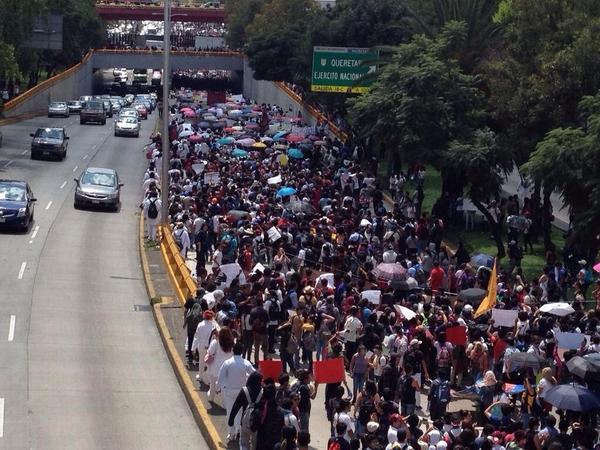
IPN students take over the Circuito Interior marching from the main campus to Casco San Tomás (the Superior Normal School Campus)
Add to that the attempts by IPN rector Yoloxóchitl Bustamante to prevent students and faculty from participating in political affairs, and this is not another protest against media censorship (as in 1958 and with the #yosoy132 movement), but may be one that… in retrospect… might trace its roots to. Student in that protest against Televisa’s monopoly on the news and the manipulation of the news did bring students from all universities, including some of the elite private universities, into the streets, but perhaps it wasn’t yet time for “something to happen”.
Teachers, especially from the dissident CNTE and some from the “official” SNTE have been protesting against the curriculum changes and the imposition of teacher tests (designed, one thinks, to denegrate public education, and soften up resistence to privatization, much as mismanagement at PEMEX and tolerance for incompetent and corrupt union leaders has been meant to justify de-nationalization), but outside of a small “permanent encampment” in Mexico City, the issue hasn’t caught on. There too, something happened.
In Guerrero, at what even by long-time Mexico hands like the Guardian’s Jo Tuckman as “a famously radical teacher training college”, it isn’t so much the “radicalism” that has sent the students off campus and into the streets, as another of the 1968 factors. The Guerrero students are nearly all indigenous… from families in which a village maestro is as close to “person of respect” that the forgotten campesinos of this country can strive to become. If these students seem radical, it is only in that they reject the state-imposed corrupted SNTE in favor of the autonomous CNTE, and they recognize that the “top-down” curriculum reforms do nothing for them, or theirs. If they are “radical” it is in the sense that indigenous people are always “radical” in fighting to preserve their traditions. These students reject a requirement to teach English, for example, less because of any (quite legitimate) sense that the requirement is for the benefit of foreign employers and foreign control of future workers, but because they recognize that their students are already at a disadvantge, often not speaking Spanish. And that they can’t get texts in their own languages. And, as the future “men and women of respect” in their traditional cultures, they are expected to lead the stuggle for their various people’s autonomy.
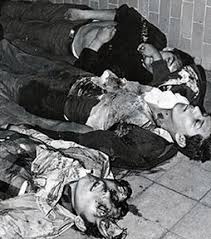
Tlatelolco 1968. Iguala, Guerrero 2014?
While I wanted to go off on a tangent about the militaziation of the police, comparing what happened in Guerrero where there are “scores” (up to 60) students being “disappeared” (i.e., in all likelihood dead, left to be found later with “signs of torture on their bodies”), with the sudden shock people have in the U.S. at discovering their own miliarized police are not there to “serve and protect” them, I will limit myself to pointing out that the police in Guerrero are suspected of acting in concert with either narcotics dealers or local business interests (often the same thing) in what was by all accounts, a massacre.
Tlatelolco was covered up by the state. But in 1968, there was no internet, no alternative media except word of mouth to tell what happened. It’s impossible now, and the Federal Government has been forced to respond. How successful they will be in spinning the story (just getting The Guardian to call these students “radical” is a good first step in creating a story that this was a “one off” moment somehow related to specific conditions in Guerrero that have nothing to do with class or social conditions throughout the country) is going to be crucial over the next few weeks and months. In October 1968, the state’s human sacrifices was to be the end of the student movement. With student standing up for education, here, in Chile, in Colorado and the young risking their lives for democracy and openness, whatever happened in Iguala may only be the opening salvo of IT HAPPENS.
Grabman, Richard, “Everybody, Let’s Rock!” (Gods, Gachupines and Gringos, pp. 385-388) and “The Ghosts of Tlatelolco” (GGG, pp. 394-401).
Igartúa, Santiago, “Estudiantes obligan a Osorio a dar la cara y logran cita para el viernes”, Proceso (30 September 2014)
Knoll, Andalusia and Marisol Wences, “Mexican Police Accused of Brazen Attacks on Buses Carrying Students and Soccer Players“, VICE (30 September 2914)
“Lo que se sabe de los 57 estudiantes desaparecidos en Guerrero, México“, Animal Politico (29 September 2014).
Tuckman, Jo. “Scores of students still missing after ambush by Mexican police and gunmen“, The Guardian (30 September 2014).
Televisa, La Jornada, Milenio and the usual suspects.
ANOTHER MASS GRAVE DISCOVERED
… though I don’t think it was any of the recent narco cartels or political violence that was responsible:
German and Mexican scientists have discovered world’s largest concentration of dinosaur remains in Mexico’s Chihuahuan Desert, Der Spiegel reports. Palaeontologists found the remains of 14 dinosaurs on a plot size of 50 to 200 meters.
Skeletons of 15 other animals were also discovered within a few kilometers of the spot – including crocodiles, turtles and early mammals.
“There is a huge delta here with several rivers flowing into the Gulf of Mexico,” palaeontologist Eberhard Frey from the natural history Museum in Karlsruhe, Germany, said. “There was a very active ecosystem. We have not only found dinosaur bones, but also four different species of turtles, remains of very small crocodiles and teeth of early mammals.”
more at Russia Today.

What if they had a cultural revolution and nobody freaked?
Back in 2012, when Mexico City passed the first same-sex marriage bill, the howls from the “traditional values” crowd… predicting the END OF CIVILIZATION AS WE KNOW IT were met throughout the country by the quick passage in state legislatures of “one man-one woman” marriage laws. Here in Sinaloa, where I gather things move even more slowly than in the rest of Mexico, the legislature basically ignored the issue, assuming that what happens in Mexico City stays in Mexico City. However, one the Supremes ruled that under Mexico’s equivalent of the U.S. Constitution’s “good faith and credit clause” that a legal marriage in one jurisdiction is valid everywhere in the Republic — meaning that state and federal benefits for married couples would be available to “THOSE PEOPLE” from Mexico City — the state legislature got around to passing a “one man-one woman” marriage bill in January 2013. Which was about the time the lawsuits, alleging discrimination on the basis of what our Constitution calls “affectional preference”as well as gender, began working their ways through the Federal courts to the Supreme Court.
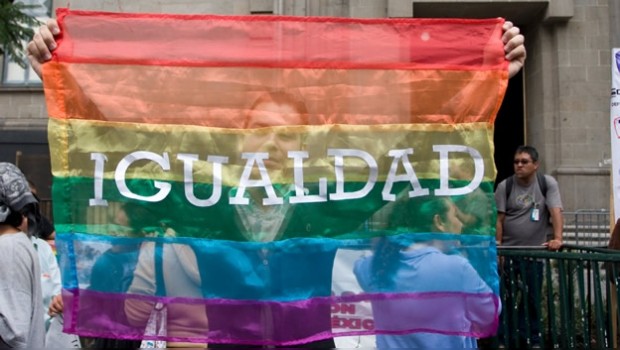
Photo: SDPNoticias
At this point, the Supremes, having ruled again and again and again that when the Constitution says there is equality before the law regardless of “affectional preference” it meant what it said, and a few states tried to weasel their way into creating a “separate but equal” form of marriage in some variation of in Colima they dubbed “Conjugal Bonds“. While basically these gave the same legal protections of what is known in Mexico under the lovely legal term “conubinage” (shacking up with rights of survivorship to joint property), Sinaloa’s marriage bill precluded even legal recognition for same sex concubines.
However, “separate but (almost) equal” was never a legal doctrine here, and civil unions, while still on the books in some places, are not considered the same thing. Coahuila, which surprised everyone by being the first state in Mexico to create any sort of legal recognition for same-sex couples, last month simply redefined the existing “Pacts of Civil Solidarity” as marriage, and did away with the whole charade.
With the Supreme Courts ruling in state after state that marriage must not be restricted by gender, Sinaloa was, for once, somewhat proactive. Given that the heavens did not open, and the sky did not fall as more and more state legislatures either voluntarily, or under Supreme Court order, did away with two-gender marriage requirements — and, with three separate challenges to Sinaloa’s “one man-one woman” marriage laws reaching the Supreme Court in early March, PRI legislator Sandra Lara introduced a bill that would redefine marriage … and concubinage too… as being between two persons. Period.
Naturally, PAN politicians were the loudest to object, but surprisingly, some were supportive, if for no other reason that such a change was inevitable. While the likely outcome of the Surpreme Court ruling was already known two weeks ago, support for a change started coming form not just the usual sources like women’s groups, but from some unexpected places like the Archdiocese of Culiacán. In a rather guarded statement, Archdiocesan spokesman Esteban Robles Sánchez said that it was “a positive law” although he added that “natural law” (supposedly meaning the way things are now) is better.
It should be pointed out that what the Supremes did not directly order the state to change the two sentences in two paragraphs in the Family Law code… but they certainly made it clear that the Legislature needs to make that change. The ruling came down Thursday, and by Friday, the legislatures were scheduling an all-party conference committee to write the new paragraphs. The same governor who signed the one man-one woman bill will be the one signing the two people bill… probably within a few weeks at most. And, with the Sinaloan ruling, it’s clear that same sex marriage is legal everywhere in Mexico, even if most state legislatures haven’t quite gotten around to undoing discriminatory codes.
As far to the left as the Constitution allows…
Today is the 45th anniversary of the death of Adolfo López Mateos, who presidency seeems so remarkable in retrospect, only because, as leader of the Party of the Institutional Revolution, he really did seek (and largely suceeded in) Institutionalizing so many of the goals of the Revolution.
Born in Atizapán de Zaragoza, State of Mexico shortly before the Revolution (26 May 1910), López Mateos was a true son of that revolution. His family, having come down somewhat in the world as a result of the Revolution, moved to Mexico City, where his mother… one of Mexico’s first “career women” found a position as an orphanage administrator. La Señora Mateos, a whole-hearted modernist, hosted literary salons, where people like Diego Rivera, young Salvador Novo and foreign residents like Katherine Anne Porter felt at home. Having been sent to the then prestigious Colegío Francais, young López Mateos would go on to study literture at the University of Toluca before, as befitted a future politician, earning a law degree at UNAM.
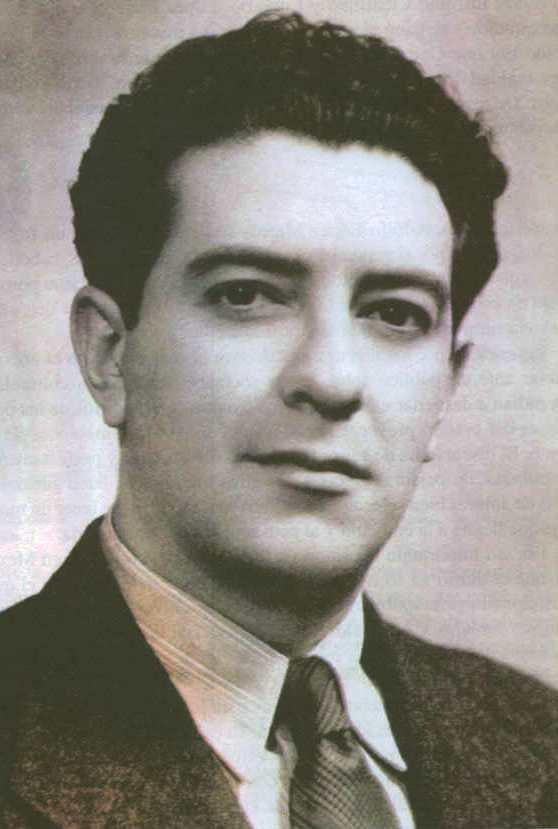
Adolfo Lopez Mateos, early 1930s
A gifted student from a family known for its intellectual gifts, and a jock (he was an accomplished mountain climber) as well as a prize-winning orator, he was well-positioned to join the cultural elites. It is only natural that López Mateos fell under the spell of José Vasconcelos, the philospher and educator whose defense of “Bolivarian” values (meaning, not — as in our time — a multicultural pan-Latin political culture, but a return to the “traditional” Iberian and Catholic cultural values that united the Latin American nations’ elites). A student activist in Vasconcelos’ 1929 Presidential election, proved his baptism into the rough and tumble of Mexican politics. The future president’s own activities were such that he moved to Guatemala for at least a few months, somehow talking himself into a job in the Guatemalan Presidential Palace… call it an internship in politics. Eschewing Vasconcelos and his increasingly right-wing opposition movement, López Mateos returned to Mexico, where he put his considerable gifts to work within the existing power structure, and moved further and further to the left, as Mexico itself was doing during the Lazaro Cárdenas administration of the 1934-1940.
Serving mostly in posts related to cultural affairs, López Mateos was elected to the Senate from the State of Mexico at the age of 36, serving one term, after which he worked as campaign manager to the relatively elderly (for a Mexican politician) and colorless (especially for a Mexican politician) Adolfo Ruiz Cortines. Ruiz Cortines may have had the persona of a “grumpy old man”, but he was a thorough progressive, and one who sought to clean up Mexican politics wherever possible. Himself scrupulously honest (again, an anamoly among Mexian pols), he expected no less from his cabinet, including his Secretary of Labor, López Mateos.
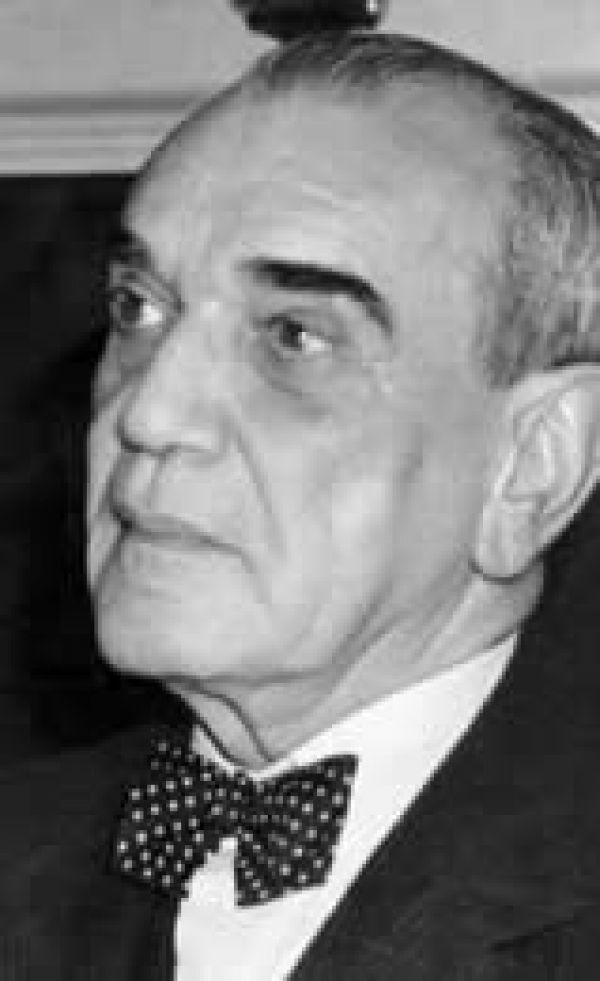
Ruiz Cortines… grumpy old progressive
An economist and statistician by training, Ruiz Cortones is best remembered not only for enfranchizing Mexican women, but also for his obsessive concern for the physical well-being of his people… fostering industries (like poulty raising) that would increase the protein intake of the average Mexican and for supporting policies that would make consumer goods more accessible to the average person. Recognizing his own bland personality and not particularly enjoying politics (he once said he’d sooner eat toads than campaign), Ruiz Cortones sought to continue his progressive policies when he chose the handsome, sophisticated López Mateos as his sucessor.
Progressive, sophisticated, but not without the toughness needed in an head of state. In the spring of 1958, railway workers went on stike, demanding a higher wage to keep up with inflation. As Secretary of Labor, López Mateos had the unenviable task of not only saying “no” to the stikers, which would have ended the discussion, if the railway workers had not been led by Demetrio Vallejo. With the strike speading to telegraph workers and other labor organizations, the government labeled Vallejo a “Communist”, claimed he was attempting to overthrow the government, clapped him (and other union leaders and Communists, including artist David Alfaro Siqueiros) in prison, and — calling out the army — broke the strike, and installed a tame leadership beholden to the PRI.
Still, with the PRI not facing any real opposition on the right, and the left either cowed, or “with the program”, López Mateos’ only campaign promise of note was to “move Mexico as far to the left as the Constitution allows”. Which he did. Nationalization of the elecrical industry, rural electricication, the Mexican national health and social security system (IMSS), and open access to the universities are his legacies.
With oil having already been nationalized during the Cárdenas Administration, López Mateos turned to other energy sources. With the last of the payments agreed to as compensation for the seized oil companies due in 1962, the money was available to buy out the mostlhy foreign owned electric companies, and to begin a long-overdue project of rural electricification. Which also meant the rural population for the first time had access to radio, and everyone in that era had access to a new news and entertainment medium, television. With good looks, and a suave personality, the President was a natural, and… besides… the new state owned television network was seen as an extension not of a public dialog, but of a showcase for the new Mexico, “as far to the left as the Constitution would allow” of the López Mateos vision.
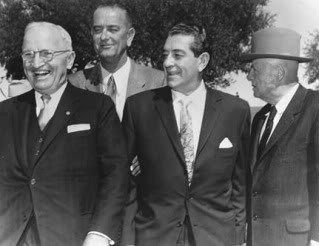
Harry Truman, Lyndon Johnson, ALM, Dwight Eisenhower
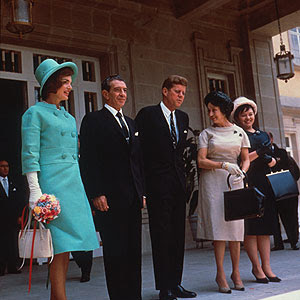
1962
In foreign policy, López Mateos´finest hour was during the Cuban Missile Crisis. While his government unofficially had supported the Cuban Revolution, domestically, he had to maintain a semblance of official neutrality. With the United States pressuring Latin American nations to boycott Cuba, Mexico’s independent stand was sold in the U.S. as necessary to Mexico’s own domestic tranquity, while in Havana it was seen as a quid pro quo… in return for not supporting U.S. efforts, the Cubans would not attempt to export their revolution to their main Latin benefactor, but would limit their push for regime changes to other nations in the hemisphere. When the Cuban Missile Crisis erupted, Mexico… having friendly relations with both Havana and Washington was the go-between. While the Mexican Ambassador, Gilberto Bosques Saldivar, was able to depend on his considerable diplomatic experience and his personal friendship with the Castro brothers, López Mateos worked round the clock to keep Washington and Havana talking to each other while the U.S. and Soviets worked out their understanding to remove the missiles. Mexico’s reward… and it seemed a small thing at the time, but of great symbolic importance, was Chamuzel, the small pocket of land formed by a change in the course of the Rio Bravo/Rio Grande that led to U.S. occupation of what had been, even after the 1848 cessesation of territory under the Treaty of Guadalupe Hidalgo, Mexico territory.
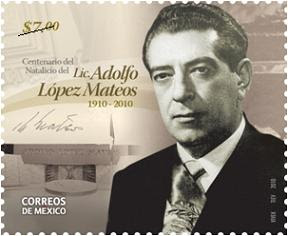
Commemorative 7 Peso stamp, 2010
Having come from an intellectual background, and something of an intellectual himself, the President not only encouraged mass university education and the arts, he turned to writers and artists for informal advise on policy, including, so it is rumored, the anarchist German exile novelist B. Traven. Traven’s Spanish-language editor being the President’s sister, its a believable rumor. Less believable, but certainly one fostered by López Mateos, was a string of affairs with glamourous film divas. While in some ways this was meant to distinguish him from his predecesor at Los Pinos (Ruiz Cortines, it was said, was so proper, even his mistress was respectable!), the playboy image was also a calculated attempt to hide from the public López Mateos’ own poor health and periods of enforced inactivity.
Suffering from undcontrolled high blood pressure, and having had an aneurysm in his early 20s, during his periods of illness, López Mateos came to depend more and more on his Interior Minister (Secretaría de Gobernación). Gustavo Díaz Ordaz. A completely different sort of man… ugly, where López Mateos was handsome; where López Mateos was a negotiator, only turning to violence when all else had failed, Díaz Ordaz brooked no opposition; where López Mateos walked a fine line between leftist policies at home, and suport for leftists aboard even if the United States government officialy disapproved, Díaz Ordaz was quick to put down any internal movement that might be seen by the United States as working against their interests in Latin America.
And, his health deteriorating and his term about to expire, López Mateos reluctantly chose Díaz Ordaz to run as his sucessor. Although appointed to head the committee organizing the 1968 Summer Olympics, López Mateos was perhaps
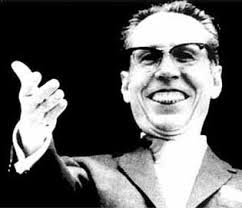
Díaz Ordaz
fortunate in having a massive stroke. He was spared the tragedy of seeing the students and intellectuals whose numbers and influence were growing thanks to his government, were being slaughtered by his sucessor. And that in reluctantly taming a union, he had opened the door to union leaders of the future who would see their role as protecting their position and currying favor with the party, and not with the working conditions of their members and the well-being of the State. And, that in bringing mass media to the people, he was moving Mexico not “as left as the constitution will allow”, but into constant bombardment of propaganda for neo-liberal consumerism and class envy.
SOURCES:
Aldolfo López Mateos, Instituto Nacional de Estudios Históricas de las Revoluciónes de México
Gods, Gachupines and Gringos: A People’s History of Mexico
Mexican railroad workers strike for wages and union rights, 1958-1959 (Global Non-violent Action Database, Swathmore College)
Think militarizing the police is still a good idea?
… here, the military have been used as pólice, and the pólice militarized, with the results one might expect. Via The Pan American Post
… When authorities announced that 22 people had been killed by army personnel in a June 30 shootout in the state of Mexico, the Associated Press noted with skepticism that all but one soldier had miraculously escaped injury, and that “the warehouse where many bodies were found showed little evidence of sustained fighting.”
Despite the questions over the incident, Mexican authorities have persistently stuck to the official version of events. On July 17, Mexico State Attorney General Jaime Gomez Sanchez assured reporters that there was “no evidence whatsoever” that the 21 victims were executed.
But this story became harder to defend this week, when Esquire Mexico published an investigation into the incident featuring exclusive testimony from a witness who offered a disturbing description of the events. According to alias “Julia,” who officials identified as a kidnapping victim freed in the operation, only one suspect was killed in a shootout, which broke out after soldiers opened fire first. The rest surrendered, but were then killed after being interrogated. A medical examiner who carried out an autopsy on one of the victims, a 15-year-old girl, told Esquire that her wounds were the result of a point-blank execution.
[…] the incident casts further suspicion on President Enrique Peña Nieto’s decision to continue the military-heavy security policies of his predecessor. Relying on the army for law enforcement, after all, was initially sold to the public as a necessary measure to compensate for the relative corruption among local police forces. But with the military potentially responsible for abuses like those described by the witnesses mentioned above, it’s worth questioning just how incorruptible the Mexican armed forces really are.
“Corruption, in the usual sense of the world, has Little to do with it. A military is designed to fight enemies, foreign and domestic. By turning the military into a pólice forcé, it has made the citizens of this country the “enemy” and this type of incident has probably been much more common than is admitted. Turning those meant to “serve and protect”, even when the service and protection has been traditonally those who prey upon the citizenry into a military unit has the same effect.


 mexfiles.net