It’s company policy
People in the United States are starting to discover that the police “serve and protect”… not citizens, but economic interest. In Cozumel, four local police officers, accompanied by a security guard for “Playa Mia Grand Beach and Water Park” (the name is in English, and so is their website), demanded Daniel Francisco Espinobarros and his family leave the beach on the grounds that it was “private property”. Espinobarros, quite rightly pointing out that besides the resort being closed and the family not using any of the Playa Mia facilities, they were within the “Zofemat” (Zona Federal de Maritima) which cannot be private property, but is open to the public (with a few exceptions like nesting areas for sea turtles).
Even when Espinobarros said he was a local resident, and a taxpayer, he was told to leave… “It’s company policy, and if you have a complaint take it up with the management”. He is…the “management” is the Mexican people, the video of the exchange (just under nine minutes) going viral on facebook, youtube, and other social media, and mentioned in the more traditional forms.
This is something that does happen, apparently more on the Caribbean side than over where I live (although the “all-inclusive” resorts have been blocking beach access, most of Mazatlan’s beach is not only public, but has pbulic access every few blocks) and seems to be more common where there are foreign hotels, and foreign guests.
Sources: El Informador, Proceso, Facebook (Araza Patita Espinobarros)
Going green? Or saving green-backs?
Via Solar Industry Magazine:
Mexico’s existing laws allow energy users to buy power from a private energy generating project or portfolio located on-site or hundreds of miles away, considerably reducing energy expenses. While Mexico’s constitution prohibits the private production and sale of energy, developers have legally side-stepped this by including the energy off-taker in the project. In this way, the energy is produced for self-consumption and not sold to a third party. (Recent reforms to Mexico’s energy laws may streamline this in the near future.)
In Mexico, solar developers are not selling “green,” as they have needed to do in markets of the past; instead, they are selling a better-priced product, an and customers are buying because it benefits their bottom line.
While large wind projects, such as the 250 MW Eurus project in Juchitan, Oaxaca, have been developed under this scheme as far back as 2009, the drastic decrease in the cost of solar power systems over the past few years has created an opportunity in Mexico. As such, a huge boom in power from solar generating facilities is predicted this year. Among other indicators, the world’s first spot market solar energy project was completed in the state of Baja Sur this past year – a 30 MW facility developed and constructed in less than 12 months.
While large wind projects, such as the 250 MW Eurus project in Juchitan, Oaxaca, have been developed under this scheme as far back as 2009, the drastic decrease in the cost of solar power systems over the past few years has created an opportunity in Mexico. As such, a huge boom in power from solar generating facilities is predicted this year. Among other indicators, the world’s first spot market solar energy project was completed in the state of Baja Sur this past year – a 30 MW facility developed and constructed in less than 12 months.
The Un-president …
While the lists of Mexican Presidents generally includes Pedro Lascuráin in 1913, lists generally leave off another short term President, Francisco Carvajal… who’s 28 days in office certainly was a much longer term than the 45 minutes (or less) served by Lascuráin, who only had the job to give a veneer of “constitutionality” to the U.S. sponsored coup against Francisco I. Madero. As Foreign Secretary, Lascuráin was only fourth in line of succession to the Presidency, but with Madero, Vice-President José Pino Suarez and third in line, Attorney General Adolfo Valles Baca forced to resign at gunpoint, Lascuráin was handed the top job. He understood, of course, that his job was to appoint Victoriano Huerta to the next job in the Presidential line of succession (Secretary of Governance… “Home Secretary”) and then make a hasty exit. Which he did.

Francisco Carvajal. Hail to the… whatever!
When Huerta had to make his own hasty exit from the Presidency in 1914, Huerta — with just the clothes on his back (and 50,000 gold German Marks in his suitcase… and pockets full of negotiable bonds and checks) — fled Mexico City for the coast on the 15th of July, 1914. With no Vice President or Attorney General, constitutionally, the presidency logically was assumed by foreign minister Francisco Carvajal. HOWEVER… Huerta was being chased out by the Constitutionalist Army led by Alvaro Obregon. The whole point of calling themselves “Constitutionalist” was that Huerta’s presidency was illegitimate. And, if so, then Carvajal was never a legitimate president either.
Which Carvajal more or less agreed with. He understood that his mandate was basically to hold off the Constitutionalists long enough for Huerta’s henchmen to skedaddle with as much of the national treasury as they could, and then hit the road himself. Which he did on 13 August. By which time, besides not much more than downtown Mexico City under the control of his “government” the only half-way respectable authority around was Mexico City’s appointed governor, Eduardo Iturbide… who had no claim on the Presidency in any way, shape or manner.
Irtubide and the few remaining Huertaistas still in town, however, did sign off on a cease fire, dissolving the Federal Army and admitting the previous government(s) were illegitimate. A rather ad hoc ending to an ad hoc fake government, the Treaty of Teoloyocan — with U.S. and French diplomats looking on — is also known as the Treaty of the Ford Fender.

They just don’t get it
Dutch journalist and Mexican resident Jan-Albert Hootsen (who tells me he’s NOT a lefty) on the financial media’s coverage of Latin American politics:
Election logic according to the Financial Times: there’s a recession in Brazil, which now supposedly threatens Dilma’s chances of being re-elected. Not because of the working class, amongst whom she is still popular, but because investors don’t like her. Because, in that weird, extra-dimensional universe which is FT’s editorial offices in London, investors are apparently a magical majority of voters who decide elections, and not the working or middle class.

Typical financial reporter
Ever wonder why media such as FT are so taken aback when folks like Ollanta Humala, Mauricio Funes, Evo Morales or Lula manage to get themselves elected? How it’s possible that economic growth does not automatically translate to winning elections? Why the vast majority of non-investing voters seems to enigmatically have different thoughts on how a country should be led than investors, banks and hedge funds? That they have other concerns than benchmark equity indexes and the yields of soon to mature bonds?
I’m not saying this because I like Dilma, Morales or Maduro, or because I dislike investors. Quite the contrary. But I just don’t understand why a newspaper like FT just doesn’t seem to get that their investor friends (whose interests they represent, which is perfectly respectable) aren’t even close to being a majority of voters anywhere in the world, and that it’s votes that determine the outcome of elections, not what investors think.
This also applies to Enrique Peña Nieto. FT seems to be completely flabbergasted by EPN’s low poll numbers. ‘But… reforms! But… transformative reforms! Historical reforms! REFORMS!’ – Sure, plenty of investors abroad like the idea of being able to establish a foothold in Mexico’s energy sector, but do those foreign investors constitute a majority in Mexico?
Stupid question, right? Well, apparently not stupid enough, because some newspapers seem to be completely in the dark as to how public opinion and elections in democratic countries actually work.
Coming this fall…
The eve of destruction… Mexico 1900-1910
Wonderful film produced by FilmtecaUNAM, uploaded to youtube by Jaime Rodriguez, unearthed by Sterling Bennett.
The twilight of Porfirio Diaz, when the “one percent” forgot (or only paid lip service) to their country and needs.
[youtube¨=”http://youtu.be/AT88_OeXfx8″%5D“La Dictadura Perfecta”… or art imitates life?
For some reason, Televisa is rather reluctant to even allow advertising for the Luis Estrada’s political drama, and is doing everything within its considerable power to prevent its showing at Mexican theaters.
I can’t imagine why a film about a television network being paid to remake the image of a mediocre state governor — said state governor’s relationship with one of the network’s female telenovela stars being of use to his image makeover — would upset the network.
“Any place we find peace and work”
From Fusion TV: Dan Lieberman on San Pedro Sula, which is the most exemplary of places sending migrants to the U.S.
Excellent coverage, although of course, one report can’t cover everything. What Lieberman couldn’t get into was that the same scenarios have been played out not just in urban areas but in rural ones as well… here in Sinaloa and throughout northern Mexico criminality, and the state response to criminality led to an internal refugee situation as well as mass migration. Unlike urban communities (like San Pedro Sula) where abandoned neighborhoods are identifiable, identifying emptied out rural hamlets is much harder, and it would be harder still to distinguish between the criminals and their victims (since neither are going to speak of the situation), or to find “disinterested parties” able to speak on the situation. Or even to get a camera crew in.
While there has been military/police repression throughout the region, in Honduras (again, somthing Lieberman couldn’t easily get into this story), there is a particularly repressive state with even less legitimacy than the Calderón administration had here in Mexico during our own “drug war”.
Petra Herrera, aka Pedro
Via “Whizpast.com“:
During the Mexican Revolution, female soldiers known as soldaderas went into combat along with the men although they often faced abuse. One of the most well-known of the soldaderas was Petra Herrera, who disguised her gender and went by the name “Pedro Herrera”. As Pedro, she established her reputation by demonstrating exemplary leadership (and blowing up bridges) and was able to reveal her gender in time. She participated in the second battle of Torreón on May 30, 1914 along with about 400 other women, even being named by some as being deserving of full credit for the battle. Unfortunately, Pancho Villa was likely unwilling to give credit to a woman and did not promote her to General. In response, Petra left Villa’s forces and formed her own all-woman brigade.

The Revolution is out there…
It is one of the strangest facts of a strange country that the Mexican Revolution was rooted in ghosts. Not in a metaphorical sense, but in the very real one. Or, so it would seem, if once considers that Francisco I. Madero — scion of one of the wealthiest, and most privileged, dynasties in 19th century Mexico — found the courage to rebel against the system, bucked up by ghostly visitations from the dead heroes of the past.
Madero was an unusually gifted man… not only extremely wealthy, but unusually well educated (he attended the Sorbonne, as well as the University of California. Like many of his peers among the Latin American elites, he looked to France for his intellectual inspiration, but not the France of the Positivists (with their mix of English Utilitarianism and French logic, with a dash of Social Darwinism and Eugenics tossed in for leavening), but the France of the “new agers” (or rather, very old agers)… who — in the very French way, rationalized — a mixture of Hindu thought and early explorations of the new science we today call “psychology”. And, a lot of seeming nonsense… like receiving messages from beyond the grave. But it did lead Madero to think of revolution, and to produce one of the most under-rated, and powerful books of the 20th century. Not for its literary style (as Justo Sierra — the most intellectual of Don Porfirio’s “cientificos” would note,the danger was precisely that the book was not “literary” and could be understood by the under-educated masses) but for leading to one of the great social revolutions of the modern era.
Spiritualists were not necessarily superstitious cranks — it was a respectable movement in the late 19th and early 20th century that had attracted serious thinkers especially in France and the United States. The spiritualists felt they had scientific proof that the long dead could communicate with the living. Madero’s wife would go into a trance and dictate what the ghosts told her. Madero, with his wife taking ghostly dictation, held long conversations about democracy ad government reform with his long dead brother Raúl. Raúl had died as in infant, but, apparently, the dead Raúl had landed a job as ghostly secretary to… Benito Juárez! Juárez had never shown any interest in Hinduism and had been dead for over thirty years. Why he chose Raúl Madero as his secretary in the afterlife (and why he was corresponding with Mrs. Madero) was something best left out of Madero’s book The Presidential Election of 1910.
(Gods, Gachupines and Gringos, page 224)
But, Madero DID write about his ghostly encounters in another book, Manual Espírita, published in 1911. Soon to be President of the Republic, and a revolutionary leader at that, the Manual Espírita was quietly published only for the esoteric community and under the pseudonym “Bhîma”.
While Madero’s “Spiritism” (not, as I wrote, “Spiritualism”, but more on that in a minute) was unknown, it was usually commented on in the snarky, half-apologetic terms I employed in Gods, Gachupines and Gringos, if it is mentioned at all. While Madero remains a national hero, conventional historians have tried to bury or at least minimize his “esoteric” beliefs, but, they were there, and scholarship demands we recognize them. Thanks to C.M. Mayo, the ghostly remains of Madero’s thoughts and beliefs are still with us today.
Mayo, an elegant writer with her own unusually broad interests (an economist of note, she also maintains a website on the Emperor Maximilian, wrote a fictional biography of Maximilian’s adopted — or kidnapped — heir, Agustín Iturbide Green, and a number of travel books and produces “podcasts” on subjects ranging from Marfa, Texas to how to promote one’s artistic bent) took it upon herself to translate Manual Espíritu, after running across a copy in the Madero papers in the Secretariat of the Treasury library. As a “forgotten” book, but of scholarly interest, Mayo took it upon herself to translate the “Spiritist Manual” for … shall we say… an audience of adepts (at Madero studies, that is).
 Interesting, in an odd way, as the 90 page “Spiritist Manual” is, it is Mayo’s own story of how she came to translate the book, that hold you. The strange paths of research and scholarship it led her into that makes up the bulk of her own “Metaphysical Odyssey into the Mexico Revolution”.
While we think of Madero in purely Mexican terms, as a Mexican hero, fomenting a nationalist revolution, Mayo delves into the internationalist roots of his Spiritism and its effect on his eventual emergence as a revolutionary. From the Finger Lakes of New York, to the banks of the Ganges, by way of Czarist Russia with stops in Paris and London, Madero’s philosophy … Spiritism (“Spiritualism” doesn’t necessarily presume the dead can still contact us, and Mayo is particularly good at sorting out the different and often warring new philosophies of the era) we are embarking on a journey into the — not unknown, but forgotten — intellectual past. Mayo — who after all is a travel writer, among her several talents — is our guide on what is as much her own “Metaphysical Odyssey” as a journey down roads less traveled, but with one heck of an unusual view.
Like any good travel guide, she takes herself, and the landscape, in stride and with good humor, not afraid to note the “yucky chunks of cognitive dissonance” along the way. High scholarship doesn’t preclude comedy: Krishnamurti — to this day a somewhat overly-revered figure — comes across as a “sad eyed and androgynous looking person who seems to have dreamwalked out of a Francis Hodgeson Burnett-meets-Rudyard-Kipling-on-mushrooms fantasy.

Photo © American Library Association
Madero’s martyrdom colors our perceptions of courageous little man from Coahuila. That he was human, and perhaps a bit guillible (aren’t we all?) is less a miracle than something of a reminder that any of us can do great things, with or without advise from the other side. As to those visitors,
What these spirits actually were, whether of Mexican heroes, disembodied poseurs from the astral real, parts of Madero’s own psyche, or fantasy, or something else, is another question.
As Mayo notes in writing about herself, and how she came to write her book, every one of us knows extraordinary people, and while her own social connections — made her research easier, all of us are connected to the past, and in ways we don’t think much about, are talking with ghosts all the time.
C.M. Mayo, Metaphysical Odyssey into the Mexican Revolution: Francisco I. Madero and His Secret Book, Spiritist Manual (ISBN-13 978-0-9887970-0-0) Palo Alto: Dancing Chiva, 2014.
Even some billionaires bazillionaires understand that what people need is just the ability to acquire the tools of survival. I always thought Slim got a raw deal in the media here in Mexico because he’s a rival to the powerful (and PRI-connected) Azucarraga clan that owns Televisa, and in the U.S. just because he has the temerity to be richer than the gringos, and beat them at their own game.
The Carlos Slim Foundation last week launched Acceso Latino, a free website in Spanish that provides readers with information on topics such as education, health care, job training and culture.
The site also has other pertinent features, such as English online-courses and information on the federal Dream Act.
“Acceso Latino will put valuable knowledge at the fingertips of everyone who wants to learn new skills and engage with their community. It is a simple but powerful resource that can potentially help millions of people improve their lives,” Slim Helú said in a written statement.
[…]
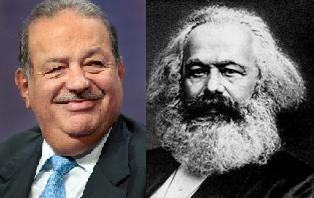
Los Dos Carlos
Slim Helú, taking into consideration the growing Hispanic population in the U.S. and being himself the son of Lebanese immigrants in México, visualized the idea of creating the site, said Dr. Roberto Tapia-Conyer, CEO of the Carlos Slim Foundation in México, D.F.
The Mexican telecommunications tycoon wanted to create an easy-access Spanish site and, at the same time, a tool of self-improvement, Tapia-Conyer added.
“The site was designed with everyone in mind, without taking into consideration a specific country of origin, age, education or immigration status,” he said.
After 18 months in the works, the site was launched a week ago with in an easy-to-use format on different topics that concern Hispanics living in the U.S. The site also has videos that walk users through a step-by-step process.
For instance, it has online job training courses for 22 in-demand occupations in the United States. Some of the courses include training in the areas of plumbing, construction, sales and computers.
(Full story at El Paso Times, via Dallas Morning News)
(More on why this commie like Carlos Slim here).
The Mexican auto industry and the U.S.
Friend or foe? Nathaniel Parrish Flannery, writing in Forbes, sees the growth in the Mexican auto industry as beneficial to the United States overall, but whether it benefits Mexico is another question.
“Mexico isn’t taking jobs from the U.S.[…] “Because of integrated supply chains, up to 40 percent of the content of the products Mexico exports comes from the U.S.”
[…] since NAFTA came into force in 1994, foreign direct investment (FDI) in North America has increased nearly sixfold from $110 billion per year in 1992 to $650 billion per year in 2010, and today more than $1 billion dollars of goods and services cross the U.S.-Mexico border every day.”
[…]
“The North American automobile industry is one of the most compelling cases of economic integration in the world,” Tony Payan, director of the Mexico Center at the Baker Institute for Public Policy at Rice University, told me.
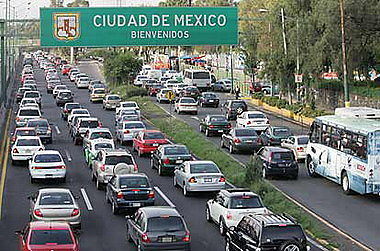 Flannery does buy the usual assumption that more personal consumption is an automatic benefit. While he does mention the low wages in this country, and even makes a passing non-snarky reference to Andres Manuel López Obrador (the first time I’ve ever seen that in a U.S. business publication)… in regard to the need for a boost to the internal market… I’m not convinced more automobiles are the way to go, or even desirable. I do have a car, and it is a convenience, but even in relatively new cities like Mazatlán, more and more autos on the streets are a problem, and in a resource scarce country like this one where climate change is a literally life or death issue, increased middle-class consumption should take a … ahem… back seat… to other things.


 mexfiles.net