Street legal
In the Federal District, selling goods and services in public is perfectly legal, but the government has the right to regulate goods and services, and those that offer them. Non-credentialed “independent non-salaried vendors” are likely to be fined and their wares seized. When the unlicensed vendor is selling candy, or C.D.s, or offering to unstop your drains or paint your living room there’s no real issue with vendors. But the one service industry which has always operated on the street… commerial sex… was, until now, a different story.

Australia Broadcasting Company photo
Recent court decisions have upheld the legality of commercial sex work and a recent court ruling held that the administrative fines against prostitutes were illegal. As a result, the Federal District has begun issuing credentials to street-walkers. The ruling also requires the District government to provide courses and training for sex workers on protecting their rights and providing access to specific programs designed to improve their living conditions.
In complying with the ruling, thirty-three women and 17 men (either transvestites or male-to-female trans* who have yet to be legally recognized as women) were recently issued to sex workers. Whether that is a representational sample of the commercial sex workers in Mexico City is not something I want to speculate on. But, while there are male street walkers (mostly catering to closeted gay men), that prostitution is overwelmingly “women’s work”, the credentialling program has become a polemical issue among feminists.
Since at least Revolution, prostitutes have been arguing that with the Constitution guaranteeing the right to take up any honest trade, and with no laws against consensual sex, they had every legal right to their profession. Katherine Elaine Bliss, in “Compromising Positions” details of a long struggle often waged by the “daughters of the night” themselves, or by Madames, (who argued that bordellos would provide not just a safe environment, but better working conditions — including the legal benefits like vacation pay due any other honest worker) to take control of the trade away from both the heavy hand of the authorities (who used the dangers of sexually-transmitted diseases, and 19th century assumptions about female sexuality to forcibly lock up prostitutes in “hospitals” that were, in reality, prisons) and pimps (whose business model, if it can be called that, was and is based on exploitation). Sucessfully, the laws were changed to classify pimping among serious crimes, and one that can earn a prison sentence about on par with those for murder or kidnapping (the latter being what pimping often enough involves). Public health concerns being very real, and the perceived nuisance factor caused by clients for street walkers, however, remained.
Most places in Mexico either have legal bordellos (there’s one down the street from my house in Mazatlán that one wouldn’t know was there… except for the door-man on the sidewalk, there’s no indication of what the place is) or “zonas de tolerencia” and require prostitutes to have regular medical examinations. How strictly the latter is enforced is a question, but even for prostitutes working under these conditions there are still the problem with police shake-downs and harrassment (by both police and organized crime, which goes in for extortion), and … especially important to street walkers … violent clients. In theory, the new credentialing system will provide some protection from the police. And, again in theory, the street-walker has the legal right to set the terms of her employment, and to go to the law if she needs to.
Prostitutes’ rights organizations are hailing the new regulations, as a liberation, as do some feminist groups. While the credentialling process takes up to 40 days to process, and is supposed to guarantee that the worker is engaging in the trade of her (or his) own free will, is not being pimped out, and is of legal age, concerns about sex trafficking — especially in a country where counterfeit documents are easily obtained, and where sex trafficking is a major problem — other feminists are conflicted. Although bribery is always a possibility, it’s not at all inconceivable that 14 year old girls would be given false IDs showing them to be 18 (the minimum age for credentialling) and/or for pimps to simply coach their victims into false information to investigators.
And, of course, there are those in the feminist community who see sex work as exploitation under any condition. Given that the vast majority of street-walkers are women (or present themselves as female) and the clients are male; and that the client has the power in the business relationship; there is a built-in sexist paradygm in legalized prostitution. The experience in other countries suggests that legal prostitution does not lessen the sex trade, but I’m not convinced that prohibition is the answer to the latter, nor that it would somehow magically change the way men (or some anyway) treat women.
I think the credentialling is, however, at least a step in the right direction.
Bliss, Katherine Elaine. Compromising Positions: Prostitution,Public Health, and Gender Politics in Revolutionary Mexico City (Penn State University Press, 2001)
, “Credencialización de trabajador@s sexuales: ¿avance o retroceso en combate a la trata?“, Animal Politico, 31 Julio 2014
Grabman, Richard. Life in the Fast Lane (Doesn’t Mean You Have to Lose Your Mind) Lulu.com eBook (2011).
Another for-profit detention center?
It’s kind of embarassing to have to do this, but without a subscription to the Houston Chronicle, I’m going to have to link to the odious “Free Republic” where someone downloaded the entire article about an unnamed “New York company” proposing to open a “3,500-bed shelter just outside the boundary of ” Clint, Texas, a town of under a thousand people.
While it may be a good faith offer, the sordid history of for-profit “detention centers” and jails scattered around rural Texas … and the even more sordid history of the Texas youth homes operated both by the State and those contracted to supposedly “responsible” organizations (one Lutheran run home was notorious for molestations and rape)… sends up some warning flares.
A supposedly “termporary” crisis does not call for a new 3,500 bed shelter (and they measure prison capacity by “beds” too, you know), nor does it seem that there is any way that 3,500 unescorted minors could be adequately cared for (or supervised) in a town the size of Clint. My bullshit detector suggests this is a prison in the making, and that there will be every incentive to incarcerate more minors there (assuming minors are the intended clients), at the lowest cost, and best return to the shareholders possible.
Give me your tired, your poor, your wretched refuse… and I’ll make a buck off them any way I can.
Moral force?

That Mexicans are speaking up in favor of the Palestinians, and calling for a break in relations with the State of Israel should be no suprise. This country has a honorable history of speaking up for the oppressed peoples of the world. In the League of Nations, it led a coalition of smaller and less powerful nations to, if nothing else, speak for the rights of nations like Ethiopia, Czechoslovakia and Austria which were being victimized by more powerful and militarility aggressive neighbors. Unable to respond with anything more than words to Nazi Germany or Fascist Italy, Mexico’s only weapon was “moral force”. If nothing else, it would… and did… break relations with the agressors, and offer to provide a safe haven for those threatened by the agressors.
Mexico, despite the historic anti-Semetism inherited from Spain*, has never been an “enemy” of Israel. Besides having provided the new nation of Israel with the artillery with which it defended itself in the 1948 War, a good number of Israelis owe their existence to Mexican generosity. This country accepted more Jewish refugees in the 1930s and 40s than the rest of the Allied Nations combined. And Mexican telenovelas are extremely popular in the Jewish state.
Opening its doors to the Jews in the 30s and 40s had been made easier by its acceptance of former subjects of the Ottoman Empire a decade or two earlier … refugees from today’s Lebanon, Syria and Palestine.. Jews and “Libanos” are prominent in business, politics and the arts. That the nation’s most famous newscaster for many years, Jacobo Zubulowski, and the most prominent historian, Enrique Krauze, are from Polish-Jewish families goes unremarked, as does the Arab roots of businessman Carlos Slim and actress Salma Hayak.
People in a nation that broke relations with Italy, Germany and Spain long before any of the wealthier nations would do so, that still has on its books the right to permanent residency for any person fleeing fascism, and never has forgotten that it lost half its territory to an aggressive foreign power (which wrapped its incursion in religious ideology and a “moral imperative” to expand its territory), are not likely to side with the bullies.
* The late Shep Lenchek (The Jews in Mexico: A Struggle For Survival, MexConect, 2000) notes that anti-Semetism was more in word than in deed in Mexico, even during the era of the Inqusition. While most Jews in New Spain were “conversos”, there were observant Jews who were largely left alone, as long as rituals were conducted privately.
But you can never leave…
In my 2008 “Gods, Gachupines and Gringos” I wrote:
One of the assumptions behind the NAFTA agreement was that Mexican wage earners would earn an inome more in line with those paid in the United states and would have no reason to emigrate. Along the border, the higher salaries paid in the United States had created a regular pool of workers who “commuted” to the United States for periods as short as a day to regular career positions. Though a high percentage of the Mexican workers on the U.S. side were not registered aliens, the practice was widely tolerated.
[… T]he assumption that industries depending on Mexican workers wold naturally move to Mexico proved untrue. […] spousal abandonment was becoming an issue at home, and Mexican men who missed thier families, or who saw more opportunity for their families in their new home, ased for their relations to join them in the United States
While I noted that after the 11 September 2001 crisis, and a politicized “immigration crisis” in the 2000s, that cross border migration became extremely difficult making it more sensible for migrants to remain in the United States,
Before 1986, when circular migration was in effect, 60% of unauthorized immigrants on their first trip here would eventually settle back in their home countries rather than in the United States, and 80% of undocumented immigrants who came back on a second trip eventually returned home.
Since 1986, the rate of return for first-time border crossers has fallen to almost zero. The return rate of second-time crossers has fallen to a mere 30%. What happened? In the mid-1980s, the government began spending massive resources to stop unauthorized immigrants from coming in the first place. By trying to keep them out, increases in border security locked them in.1986

Developing?
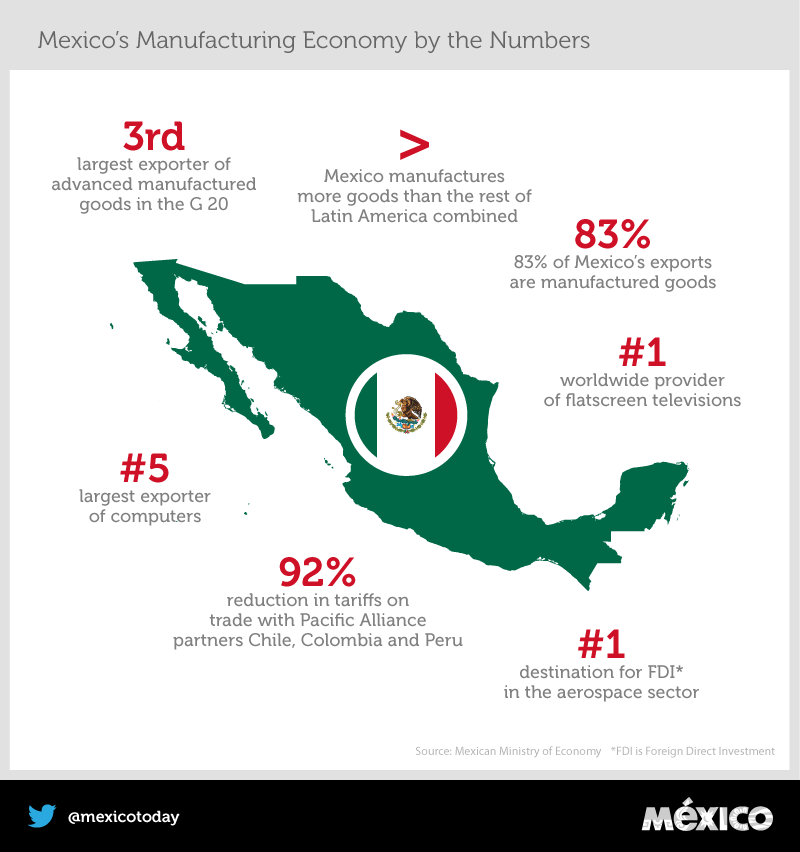
I still hear people call Mexico a “third world country” (which means it is neither in the Warsaw Pact or Nato alliance… something meaningless since the fall of the Berlin Wall) under the mistaken impression it means an “undeveloped” country. A few more sophisticated, uninformed types call it “developing”… which I suppose means I country that hasn’t bought into rampant consumerism completely, but is getting there.
While Mexico did walk a fine line between the pro-Soviet and pro-U.S. nations (rather gingerly, being far from God, and close to the United States), it’s hardly “developing” having had an urban consumer culture for a couple of millenia now, and has been manufacturing goods for export since the 18th century. OK, so there wasn’t a lot of heavy industry until the late 19th century, but isn’t it about time we retired those retro and misleading terms when talking about Mexico?
¡Cualli ilhuichihualli, Tenochtitlan!
… or, “Happy Birthday, Mexico City” for us Nahuatl-challenged folks.
Shamelessly lifted from “What you can do to help the the US’ 52,000 child migrants” Dara Lind, Vox.com
Most of these organizations are based in South Texas — the place where most children and families are entering the country, and where many of them are being held temporarily in short-term facilities. But as children and families get moved through the system, they’re being dispersed throughout the country: in long-term government-provided housing for unaccompanied children, in detention centers for families, and in homes with relatives. So no matter where you live, if you’re interested in lending a hand, you can probably find an opportunity.
This list should not be construed as an endorsement of any of these organizations or their missions; it is purely intended as a resource. This list will be updated with better information and options as the situation develops.
If you have questions, or want to help, please email the organizations listed.
Donating your money
Catholic Charities of the Rio Grande Valley. Some Catholic churches in South Texas have been operating as temporary shelters for migrant children and families, and the regional Catholic Charities office is providing on-the-ground support. You can donate online here.
Southern Baptist Convention Disaster Relief. Southern Baptist groups have also been providing emergency support to children and families, including coordinating supply drives for children in detention. You can donate online to their general disaster relief fund here. To donate specifically to their efforts in South Texas, write a check with the designation “Border Crisis” and mail it to the address listed here.
Kids In Need of Defense. KIND is a service and advocacy organization dedicated to protecting unaccompanied immigrant children. They’re working to get children representation and support in legal proceedings. You can donate here.
RAICES. RAICES is a Texas-based organization providing legal support to immigrants. They have been providing legal services to unaccompanied immigrant children for a long time, and are handling much of the front-line work now. You can donate here.
International Education Services of Texas. IES is a long-established organization that operates emergency shelters and long-term care facilities for immigrant children, and helps place children with foster families. Learn more about IES here.
Donating supplies
The best way to help charitable organizations — especially in a crisis — is to send cash. That allows them to put the resources to where they are most needed, and it saves on the transportation and logistical challenges that come with in-kind donations. So for most people, cash is the best way to help. (In addition to the organizations listed above, you can also send cash to the organizations in this section.)
But if you happen to live close to the border, then in-kind donations can be helpful too. Here’s where to send them.
Annunciation House in El Paso. Annunciation House has had to accommodate three different waves of immigrant families over the past six weeks — sometimes with only a few days’ notice. If you’re in the El Paso area, they’re accepting donations of supplies. They’re also accepting monetary donations, so you can help them even if you’re not in El Paso. Please see here for how to set up a donation.
Any others? Add to the comments, and I’ll try adding them to the list.
Ronald Reagan’s revenge… refugees
John Peeler in the L.A. Progressive:
What with all the Republican bloviation about the crisis on our Mexican border, about the hordes of brown children coming across and threatening our National Security, it is easy to lose sight of our own responsibility for this situation.
The three countries from which the vast majority of these kids come are just the three (Honduras, Guatemala, and El Salvador) on which Ronald Reagan spent billions in military aid during the 1980s, allegedly to block the Sandinistas of Nicaragua from imposing “Cuban-style communism” on Central America. What we got for our money was three countries with sham democracies dominated by the military establishments that we fostered.
Please note that refugees are not streaming in from either (mostly) Capitalist Costa Rica, nor from (mostly) Socialist Nicaragua, but from the countries where the U.S. has imposed its political and military “solutions” on problems of its own making.
Stop, you’re killing us…
Via Salon and Regeneración:
In the years after NAFTA, the pattern of food exchanges between Mexico and the United States changed significantly, as did the diet of Mexicans. American exports of sugar, high-fructose corn syrup, snack food, dairy products, and breakfast cereals to Mexico increased dramatically. In 1994, the United States exported about 50,000 metric tons of sugar and other sweeteners to Mexico; by 2007, this had climbed to almost 950,000 metric tons, a nineteen-fold increase. U.S. exports of corn and soybeans, the foundation of industrial processed food for both American and Mexican producers, also increased significantly. In this same period, exports of livestock and other meat products more than tripled. In the decade after NAFTA passed, sales of processed food in Mexico increased by 5 to 10 percent annually.
 U.S. foreign direct investment in Mexico also spiked after NAFTA. In just five years, from 1994 to 1998, U.S. direct investment in the Mexican food and beverage industries almost quadrupled, from $2.3 billion to $8.8 billion. Between 2002 and 2007, U.S. foreign direct investment in Mexican beverage companies increased by 35 percent to almost $6 billion. In 2012, grains, oils, and meat— products associated with obesity, diabetes, and other diet-related diseases— accounted for 75 percent of the U.S. agricultural exports to Mexico.
How corporate America exports disease to the rest of the world“
Pasale, pasale
Meetings this week between the Mexican Secretary of Foreign Relations and the Vatican Secretary of State… while partially meant to set ground rules for a papal visit (officially, Francis is only a foreign head of state, but with even the left falling all over themselves to show they are not anti-clerical any more, these things get complicated), as well as to attend a conference on dealing with the refugee crisis. The Vatican Secretary, Cardinal Pietro Parolin, released a letter from the Pope, calling for more action by the governments involved (and pointedly referring to recent events in the United States, condemning “racist attitudes” towards refugees) and for “development” in the Central American republics.
PAN Senator Gabriela Cuevas Barrón, who chairs the Senate Foreign Relations Committee, joined with Senator Adriana Dávila Fernández (who chairs a special committee on Human Trafficking) have called for some minor changes in immigration law here. This would not be anything spectular, but would allow temporary visitor visas to be issued for “Humanitarian visitors”… including unescorted minors… elminating the rationale now used by police and other officials to harrass and/or detain migrants who are not seeking asylum in Mexico.
In that “Humanitarian visits” are being considered, I am troubled by articles like “Is Mexico Doing Enough to Secure Its Southern Border?” posted on Fusion.com. The sense is that U.S. funds meant to “protect” the southern Mexican border (with Guatemala and Belize) are not being used to prevent refugees from entering Mexico en route to the United States. While it is a difficult border to cross (the author, Ted Hesson, leads with a story about a boy’s “five-hour hike across rough terrain and through sweltering heat to avoid Mexican border checkpoints,” crossing from Guatemala into Mexico), the funds were to prevent narcotics and arms smugglers, not child refugees. Although, when you come down to it, the U.S. is expecting Mexico to militarize their border with friendly countries (as the United States itself has done on the Mexican border) to prevent passage into the country of both things they want, but pretend they don’t (like narcotics) or have themselves caused, but won’t take responsiblity for (like preventing political and economic reforms in Central America) … or are in denial about: like the spiraling violence in those countries.
While there are some minor problems caused by these “humanitarian visitors” (the accident last week when one of the “la Bestía” trains tipped over), most of the trouble has been from those who prey ON the refugees. Between the Pope telling Catholics (and presumably that includes more than a few cops and local authorities) to stop acting like assholes, and simply providing a legal right of transit to the refugees, the solution is being shifted to the people who caused the problem in the first place… who have the financial, moral, and political obligations to resolve it.
To the palace!
I’ve been invited to the Palace this evening. Not the Palacio de Hierro (the famous department store), but the real deal… the Palacio Nacional … for a lecture on the Second Empire (Maximilian and Carlota’s “Phantom Crown”)… which makes it perfect to put up this rare photo by court photographer François Aubert… who stuck around after Max’s execution (15 May 1867) for at least a month, when he photographed the Zocalo, dolled up for the celebration of Benito Juarez’ formal return to the Capital.
The “Statue of Victory” in the foreground was a temporary installation. Its provenance… and eventual fate… is something I don’t know anything about. I do know the Zocalo looked a lot better back then… when it had trees.

Whatever it takes: the Bishops on the refugee crisis
An important aspect of the Declaration is the joint commitment to eradicate the structural causes who provoke the irregular migration of underage children, creating programs of social and economic development in the communities of origin…
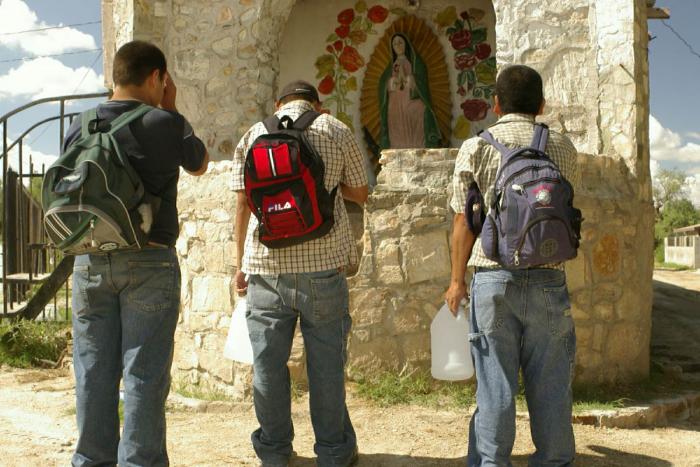
Photo: Dr. Juanita Sunberg, U of British Columbia
John Donaghy of Santa Rosa de Copán has posted an unofficial translation of the “Joint Delcaration of the Bishops of the United States, Mexico, El Salvador, Guatemala and Honduras on the Crisis of Child Migrants”.
The Bishops’ quote Pope Francis… “Inequality is the root of social ills.”… and ask the Virgin of Guadalupe for her intercession. Certainly, the refugees can use all the help they can get, but one certainly hopes that those of us here on Earth also respond to the Bishops’ “call upon business owners, especially Catholics, to investing [in] and contribut[ing] to the promotion of justice and equity…. but again, this depends on the governments, which are (and have been) have been remiss in putting foreign investment before the needs of their own peoples.
And, Your Excellencies… might you ask the Virgin (and the people) if they might not least consider tossing out the CIA, the School of the Americas, somehow convincing U.S. consumers not to buy narcotics (along with stolen timber and overusing fossil fuels), stopping arms exports, paying a fair price for agricultural commodities, and getting the Canadians to live up to their obligations in the mining industry … things that would be a miracle, but may require more than prayer, I’m afraid.


 mexfiles.net