NAFTA and narcos
My favorite political fiction
Today’s the 220th birthday of that model politician and political memoir writer, Antonio Lopez de Santa Ana. There are a few writers who defend the old scoundrel: Robert L. Scheina’s Santa Anna: A Curse Upon Mexico (Brassley’s Military Profiles, 2002) presents not the eleven times president not as a political figure, but a military officer who was brilliantly successful in campaigns against his own countrymen. When it came to fighting outsiders… not so much. Scots historian Will Fowler’s Santa Anna of Mexico (University of Nebraska, 2007) portrays the General as an exemplary country squire who honesty saw himself as an indispensable man simply forced to run a much larger hacienda than his beloved Manco de Clavo estate in Veracruz. And, as something of a country bumpkin, overwhelmed by Mexico City slicker intellectuals. Not a bad guy, just one in over his head.  Santa Ana himself (and… I still prefer the alternative spelling of his name), while in exile in Nassau, the Bahamas… an historic haven for pirates, scoundrels and money launderers… and where better to write about politics? The manuscript was inherited after his death by his grandson and namesake, Father Antonio Lopez de Santa Anna (who used the modern spelling), a Jesuit priest who perhaps was trying to redeem the family name through his own good works as a missionary in Haiti. Father Santa Anna hoped to write a biography of his rascally grandfather, but died before finishing the project. The “Memoirs” were finally translated into English by Texas scholar Anna Fears Crawford, as The Eagle (State House Press, Austin, TX 1988)… and what a great political memoir it is! There is a tradition in Spanish letters of the “fictional biography” going back to the 16th century La vida de Lazarillo de Tormes y de sus fortunas y adversidades, and continuing up to the present. Within the genre, The Eagle is unique in being not only readable, but something unusual in that it actually was written by its putative author (unlike, say Decision Points, supposedly by George W. Bush, Going Rogue allegedly by Sarah Palin, or Revolution of Hope, attributed to Vicente Fox) but can be read as a work of metafiction, in which the author is also the impossibly pure hero, who — in good mythological fashion — is betrayed by treasonous, lesser beings. In The Eagle, every act of Santa Ana… good, bad or atrocious… was for the good of his country… even losing a third of the country was a sacrifice only a true patriot would dare to undertake. In other words… like the memoirs of every politician … he was full of shit. But at least he wrote his own bullshit, and that’s more than we can say about politicians today. ¡Viva Santa Ana!
I’ve been waiting such a long time… Braceros
About 40 former Mexican laborers, or braceros, who worked in the U.S. in the 1940s, 50s and 60s, still want to know where their money went.
The men gathered in Juarez on Wednesday to ask the United States to open the Bracero Program’s files and make public how much of the stipend held in the immigrant workers’ paychecks were returned when they went back to México.
They hope the petition forces the Mexican government to reactivate the payments from a special fund set up by the U.S. in Mexico for former braceros. The payments stopped when Mexican President Enrique Peña Nieto took office in December 2012.
Loreno Figueroa, El Paso Times
Given that it became the exception, rather than the rule, to import foreign workers for U.S. agriculture, its understandable that people forget that this was only meant to be a temporary wartime measure. As a result of the 1910-20 Revolution, Mexico had a bloated and politicized military establishment. General Joaquín Amaro, who served as Secretary of War from 1924 to 1931, and as a military adviser to Presidents Cardenas and Ávila Camacho was rather unique in the annals of bureaucracy in that he spent most of his career trying to cut his budget, as he fostered a smaller, more professional military that met Mexico’s modest defense needs.
In 1942, when it became obvious that Mexico would become involved in what would be known in the histories here as the “War Against Nazis and Fascism”, Amaro’s success meant Mexico was in no real position to provide more than token military support to the war effort. Which did not mean it could not play a vital role. With the United States desperately short of workers, Mexico agreed to provide labor … and did, even after it entered the war itself (although it was only able to provice token air units to the Pacific Theater). 220,000 Mexicans volunteered for temporary exile, with the understanding that they would be paid the same wages as those U.S. workers who they were TEMPORARILY replacing, and that ten percent of their wages would be held in escrow for their return.
While some of the problems that developed (there were strikes as early as 1943 against employers who were paying Mexicans less than native workers, and throughout the war over unfair labor practices) were probably due to simple misunderstanding and the confusion inherent in any overnight emergency bureaucratic program (one can see how an “Anglo” farmer might mix up records for for Juan Sanchez Valdez and Juan Sanchez Suarez, for example) others were never resolved: the escrow payments in may instances were never set aside, lost, or stolen by either the employer, or the local banks that were supposedly handling the funds. Adding to the problem Mexican institutions that were equally unprepared to handle the accounts. And, to top things off, the workers themselves were poorly instructed (or never instructed) on how to record their earnings, let alone told what records they needed to keep.
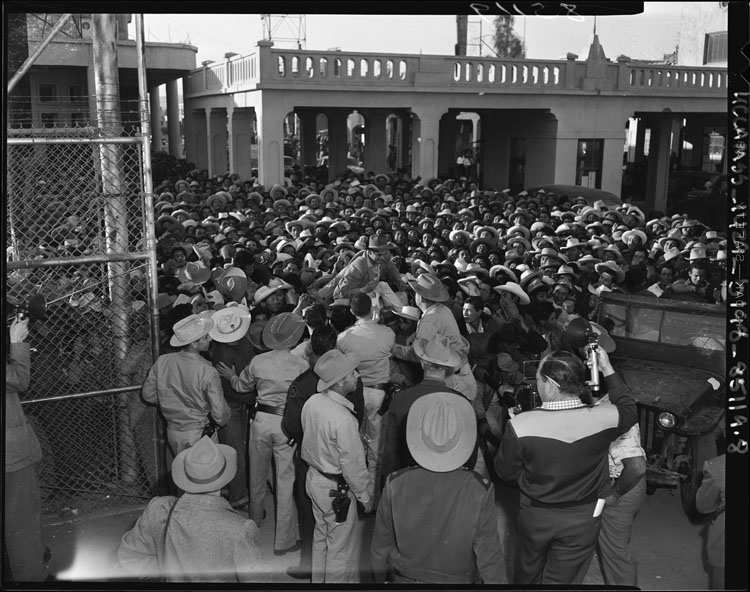
Braceros at Mexicali, 1954 (Wikimedia Commons)
Except for those workers, the program was a “win-win”… Mexican officials (who may have also pocketed some of those escrow payments) like the “bracero” program because it created jobs for otherwise unemployable, mostly rural, workers that couldn’t otherwise be brought into the growing industrialized economy during a time of unprecedented population growth. In the U.S., it provided a flexible rural workforce, and — unfortunately — one that employers felt less compunction about abusing than they might feel about native workers. As a result, the “temporary” program was extended, and remained until the U.S. reformed its immigration laws in 1965.
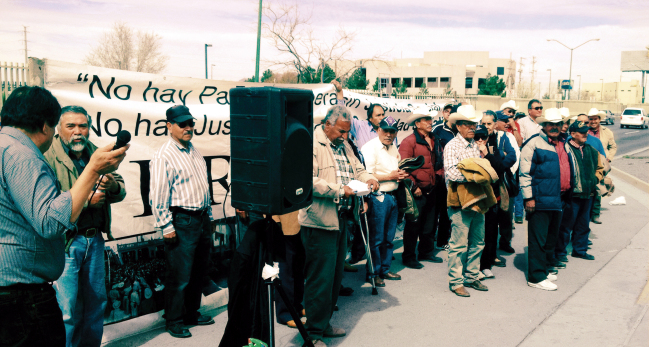
Braceros in Juarez, 2014 (Lorena Figueroa / El Paso Times)
The program was a mess, and what monies remained unpaid, stayed unpaid. Various bank consolidations over the years unclosed massive frauds in the United States, while the frauds in Mexico … which might have been disclosed given a thorough examination of the records, became impossible after most of the surviving records were lost in the 1985 Mexico City earthquake. Various lawsuits and settlements with U.S. banks created a fund, which with additional funds from the Mexican government was created to compensate the unpaid “braceros”… but, with the workers themselves no longer having the records, many will never receive their over-due payments. That’s a tragedy.
However, simply to cut off the attempts to pay is an insult. Neither the U.S. nor the Mexican government comes out of this one unscathed.
Best attempt yet at figuring out the Venezuelan opposition
Celina Andreassi, in The Argentina Independent:
What the opposition had in economic power and support from the elites, it lacked in street presence. Here’s where the students come in. […] students from private universities in Venezuela have been trained and financially supported by the opposition’s traditional ally – the US – since as early as 2008. …
Indeed, US support of Venezuelan opposition is a story on its own. It is nothing new […] Back in 2002, George W. Bush’s administration was quick to justify the illegitimate and short-lived government of Pedro Carmona that resulted from a military coup, and it has been alleged that, at the very least, it knew about -if not cooperated directly with- the coup. Buxton estimates the combined financial support from US institutions to Venezuelan opposition groups since 2002 in as much as US$45m, much of it aimed at ‘youth outreach programmes’ […].
 Existing everyday problems faced by Venezuelan society, such as insecurity, high inflation, and shortages -probably caused by a mix of economic sabotage and the ineffectiveness of an increasingly hypertrophied and corrupt state- were used as excuses for the students’ mobilisations. However, these are situations that have existed for some time now, that have not lost the government any elections, and where no significant changes have been verified in recent times. The most recent objective change in Venezuela’s situation seems to be within the opposition, rather than the government.
So, what are López and company trying to achieve? Whilst they talk about pushing for Maduro’s “exit”, it has been profusely pointed out that the opposition does not have the support of the armed forces, so attempting a traditional coup d’êtat or a strategy based on street violence can only result in a -probably ineffective- bloodbath.
They have definitely appealed to the international public opinion by intensifying the smear campaign the international press has been waging on the Venezuelan government for years. However, it’s uncertain how this could have an immediate impact on the local situation, especially since regional organisations and neighbouring governments have closed ranks behind the defence of institutional stability in Venezuela.
Well-worth reading in its entirety. HERE.
NAFTA v farmers
While not as detailed as I’d like, and unfortunately still of the mindset that Mexico was an “undeveloped” country (meaning that the country with a several millenia old culture hadn’t “developed” the way some industrial societies had… which itself is stupid, Mexico having always been an urban culture, and one with an industrial and manufacturing history at least as old as those in most “developed” Central European nations), a nice precís of the issues raised by “free trade” for small scale farmers:
Sombrero tip to Deborah Bonello
Come to your Census! Muslims in Mexico
While rather interesting, the article by William Schaefer for Global Post about Islam in Mexico (“Mexican Catholics find God in Islam“) is highly misleading in suggesting that there is any growth within the tiny Islamic community in Mexico. While there are a few converts every year, Islam is only the religion of one percent of the population. Schaefer’s contention that “a small yet growing group of converts are seeking spiritual salvation in Islam” doesn’t seem to hold up, given the author’s reference source: a 2011 study by Pew of “The Future of the Global Muslim Population“.
Ignoring the one indigenous Muslim community in Mexico, formed by formerly Presbyterian Tzotziles and Tzeltales who underwent a mass conversion to Islam after being driven out of a traditionalist Catholic community, only to find themselves persecuted by Evangelicals, it appears Mexican Muslims are either immigrants, from immigrant families, converts through marriage, or… as Schaefer focuses on … those who convert from Roman Catholicism for any number of reasons.
While Schaefer relies on the Pew study, which “estimates Mexico will be home to 126,000 Muslims by 2030, up from 111,000 in 2010″, the 2010 Mexican Census found 3,760 Mexicans claims “Islamica” as their religious preference. The Pew figures would show Islam as the religion of one percent of Mexicans (and slated to grow to… one percent of Mexicans by 2030), the latter as less than 0.004 percent. It’s possible that Muslims did not answer the question, or described themselves as belonging to “other religions” … or… as is common in Mexico for people who practice more than one faith simultaneously (normally Roman Catholicism and some offshoot of indigenous beliefs that incorporate Catholic or other Christian practices… Fidencioismo, Luz del Mundo, etc.), at least publicly, the person claims to be Catholic or of no particular faith.
At any rate, even using the much higher Pew estimates, Mexico has one of the smallest Islamic communities in the America. Canada, about eight percent Muslim has the highest percentage in North America; Argentina (also about eight percent) the largest in Latin America and Dutch speaking Suriname (15 percent) the largest in the hemisphere.
As it is, there are probably more Buddhists than Muslims in Mexico . Unofficially there are an estimated 100,000 Mexican Buddhists, although the 2010 Census came up with nly 18,000 members of “Religiones de origen oriental”… lumping together Buddhists, Shintos and Hindus (including Hare Krishnas among the latter). Again the Census numbers are much lower than estimates or self-reported numbers, indicating either reluctance by members of minority sects to state their faith, or that the people the sects consider as members, the people themselves do not.
As it is, I don’t see Islam or Buddhism likely to ever be more than very minor sects within Mexico, nor to factor in political or social policy.
Sources:
Workers unite… we have nothing to lose but our fat
When I first moved to Mexico, there was a big push to end malnutrition. That a person could be obese and malnourished — thanks to the high price of healthy food  and the over-availablity of sugary snack food — was noted by then Sec. of Public Health, Julio Frenk Mora, but with former Coca-cola executive Vicente Fox in Los Pinos, such talk was about as popular as mentioning global warming was under the oil-industry regime of George W. Bush. While Frenck Mora’s public health service did push for healthier eating, there was little he could do to get better food into people’s bellies, and nothing he could do about the Fox Administration’s decision to allow the import of high fructose syrup (in a sugar exporting country!).
Thankfully, despite a massive raise in military spending during the Calderón administration, and having not frittered away the national treasury on overseas wars (we’ve only had one… against Japan and Germany… and managed to cut the military budget while doing so), social spending has always had the priority in the national budget.
While neither the Calderón Administration nor the present one has done much of anything to bring down the price of fruit and vegetables, raising the price of sugary foods…combined with propaganda for better eating habits and exercise … might have some effect on public health.
PBS News Hour:
Huapanga
Happy feet and sad songs:
(Sombrero tip to Laura Carlsen)
This TIME, they went too far…
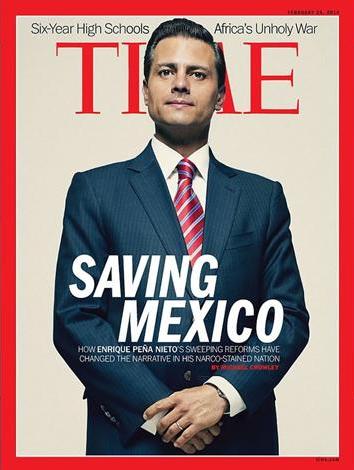 Via El Deforma (the Mexican equivalent of The Onion):
El Deforma would like to express an official statement regarding the recent events and content made public by the American magazine “Time”. El Deforma would like to make clear that we have no ties to said publication and there is no connection whatsoever between the two.
El Deforma is well known for writing satiric and fictional news posts, but we would never have the courage to come up with such a controversial title that would cause anger to the Mexican people, like Time magazine did.
As always, we are strong advocates of freedom of speech, be it in our country or anywhere in the world, but we strongly believe that there is a fine limit to the jokes that such a widely read site can divulge.
We strongly disapprove the way Time is mocking our President with such a sarcastic cover and we reiterate our absolute independence to their head company Time Warner.
Regarding the rumors of a possible purchase of Time magazine by Grupo Mexicano El Deforma, we would like to state that there is no such negotiation and that an offer was never presented.
Sincerely
El Deforma’s Editorial Chief


The (counter) revolution will not be
We’re seeing a decent dose of wishful thinking from the media coverage of [Wednesday’s protests in Caracas], but the fact (not speculation but fact) that a large chunk of the Venezuelan population supports the current government is given very short shrift; we only get to hear from those who “want change” (that very 21st century euphemism for something much darker). We’re also seeing bad things from the Maduro government, such as the censorship of TV stations that covered the violence and the calls to arrest the supposed ringleader Leopoldo López… near-term don’t expect the big changes that are currently getting hyped to you.
Ever since the failed putsch in 2002, the mainstream English-language media (and much of the more conservative Spanish-language media… U.S. based Univision and Mexico’s Televisa, to name two) have been predicting a violent demise to the Bolivarian Revolution. Hugo Chavez was an out-sized iconic figure, but then again, so were Franklin Delano Roosevelt and Benito Juarez… neither of whose passing spelled the end of the transformation of their nation’s economic and social systems. Nicolas Maduro … like Harry S. Truman in the United States or Sebastian Lerdo de Tejada in Mexico … was never going to live up to the iconic status of his predecessor and to hold the line against reaction was all that they had to do. While Lerdo de Tejada was violently removed from office, it had more to do with his personality (or lack thereof) than opposition to radical social change.

Photo: Fox News
And, as with any period of social change, there is bound to be bitter opposition. While the depth of the actual opposition to the Bolivarian Revolution is probably fairly sizable, the opposition in the streets is not as huge as the media would have us believe. That’s not to say there isn’t opposition to Maduro himself…due more to his own personal inadequacies, and those of some of the post-Chavez leadership, and basic economic conditions (ironically, a more equatable society means people have come to expect access to certain consumer goods like toilet paper, leading to anger when the goods become scarce). That means grumbling, and maybe electoral gains by opponents, or calls for bureaucratic shakeups, but hardly a call for revolution.
While the activities of those “much darker” elements (read CIA, foreign oil interests, and the “economic hitmen” of multinational corporations) that were irrelevant to Truman or Lerdo de Tejado (though, when you think of it, U.S. bankers and railroad corporations… the multinationals of the day… did play a role in financing Porfirio Diáz’ coup) are at play … as they have been since Chavez first took power away from the old elites, these protests — although they have led to violence — may have no more significance than the “TEA Party” protests in the United States had a few years back.
Monsanto v the Monarchs
Via Firedoglake.com:
On January 29, 2014, the World Wildlife Fund reported that the “number of monarch butterflies hibernating in Mexico reached an all-time low in 2013.” Since recording of overwintering areas began, the butterflies reached a peak in 1995, covering 44.5 acres in the pine and fir forests west of Mexico City. Now they cover only 1.65 acres. Their decline can no longer be explained away by seasonal aberration. The monarchs are literally disappearing.

The steady and now statistically significant disappearance of the monarch butterfly coincides with habitat loss that began with the introduction of hideous agribusiness giant Monsanto’s product Roundup (glyphosate), the expansion of Roundup-ready corn and soybean crops and the wiping out of milkweed, the food source for the caterpillars.
It’s not easy being green…
Something he ate?
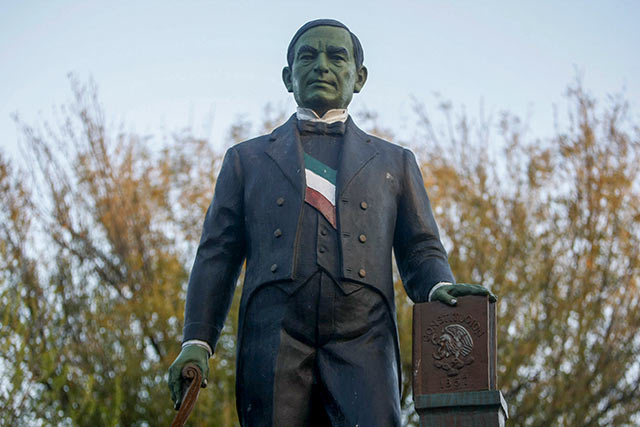
Whoever it was who was contracted to restore the Benito Juárez statue in San Nicholas de la Garza (a wealthy suburb of Monterrey) had the bright idea of putting some color into Don Benito’s presidential sash… and a bit too much color into Don Benito.
This is the second or third botched “restoration project” I’ve heard of, or seen, in the past few months. The most notorious was the damage done to the 18th century lost wax bronze “Caballito” in Mexico City, which did permanent damage to one of the world’s best known monuments (and the largest sculpture of its kind in the Americas). Here in Mazatlan, the Continuidad de la Vida (an oddball composition featuring dolphins, a giant snail shell and anatomically correct buff naked people) was also spiffed up… leaving the naked buff people with some horrible skin rash and big patches of black against their bronzed complexion.
Either there are a bunch of incompetents working at the INAH (the federal agency overseeing monuments and archeological sites) … or they always claim to be shocked and appalled by the work… or they’re letting contracts to people they shouldn’t or maybe — in the latest artistic atrocity — the Austrians are behind it. They never got over the botched job done on their monmentally stupid installation … that of Maximilian von Hapsburg as Emperor of Mexico. After Juárez had the hapless Hapsburg shot, the Austrians wanted the corpse. The surgeon who did Max’s autopsy had never embalmed anyone before. Though he could find a recipe for embalming fluid, he didn’t have the have the right ingredients on hand, so sort of winged it. But, at least when the Mexicans shipped back a bright green dead Archduke, they had the good sense to slap some gilding on his hands and face, making him look like he had at least a ghost of a tan.


 mexfiles.net