A win for the wixárica?
Once again, Inca Kola News scoops Mex Files. Not that I mind… I’m on virtual vacation anyway):
In precedent-setting news from Mexico, First Majestic (FR.to) (AG) and Frisco (the Carlos Slim mining company) have had all their mining concession licences in the Wirikuta region suspended by Mexico, as the country’s beaks have come down in favour of locals who have been protesting for years about the concessions due to them being on sacred ground for indigenous peoples. La Jornada has the story here.
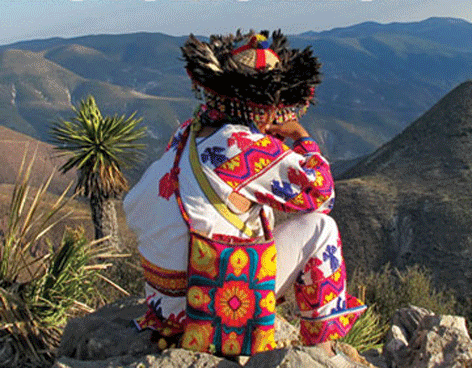 The Wikiruta is the territory occupied by the wixárica… the people better known as the Huicholes. While best known for using peyote in their religious practices (and being pestered by foreign tourists who have torn up the desert landscape seeking the slow-growing rhizome) more important to the wixárica has been the land itself, which they see as integral to their understanding of the sacred. Not at all unsophisticated, in recognizing that the long fight against environmental encroachment and a world that sees the land not as a sacred being, but as a commodity to be bought and sold, have begun training their own cadre of warriors — sending off many of their best and brightest to law school.
And sometimes they win.
Paybacks are a bitch…
Via Mexico Trucker:
Interesting, but not unsurprising news coming out of Mexico this week as T21mx, an industry trade magazine is reporting that CANACAR is vigorously pursuing ratification of it’s 2009 arbitration action against the United States for it’s willful non compliance with the trucking provisions of NAFTA. The lawsuit seeks compensation for all Mexican carriers who have been damaged economically by the United States refusal to fully open the border as required under NAFTA, and the Pilot Program that was established at the urging of US protectionist interests in an effort to keep Mexicans out of the country.
… and via Inca Kola News:
Enrique Peña Nieto: “Ready to accept a 5% royalty on revenues, mining people? Because if you don’t STFU right now, it’s going to be 7.5% minimum and 8% for precious metals.”
The monster of 9-11… 1973
These guys uniforms remind you of anything from the late 1930s, early 1940s?

Photojournalist Julio Etchart spent the 70s and 80s documenting Pinochet’s 16-year dictatorship in Chile and, by “keeping a low profile and my head down”, he says he was able to capture much of the rising resistance on camera. This 11 September marks 40 years since the military coup that began Pinochet’s rule, during which thousands of suspected political opponents were detained, tortured, killed or simply “disappeared”. In memory of his victims, Amnesty International UK is hosting an updated version of Julio’s 1988 exhibition Chile’s 9/11 at the Human Rights Action Centre in Shoreditch, London, on weekdays from 9-20 September (Guardian)
“Lily Langtree” (Memory in Latin America) provides links to British and U.S. media reports on the 40th anniversary of the 11 September 1973 blow to Latin American democracy in the name of making Chile safe for I.T.T. … and turning the Chileans — much like the Jews and gays and gypsies in the occupied territories of 1939-1945 Europe into guinea pigs for insane experimenters. In Chile’s case, the made scientist was Milton Freidman. Unlike the Nazi “scientists” went off on a tangent based on the half-baked theories of the long dead Arthur de Gobineau and Francis Galton, Friedman personally convinced the Pinochet regime to implement economic “reforms” based on his understanding of the “philosophy” of screenwriter and fantasy novelist, Ayn Rand, by “whatever means necessary”.
Of course, economics is more a political theory (or perhaps a theology) than a true science, but even so, one assumes it is based in logic and not suppositions. Which is not to say that some of the “reforms” of the Pinochet era weren’t beneficial to Chile (which is sort of like justifying the Nazis because the Volkswagen Sedan was a great car), but at the cost of years of terrorism and mass murder.
Friedman defended his relationship with Pinochet by saying that if Allende had been allowed to remain in office Chileans would have suffered “the elimination of thousands and perhaps mass starvation . . . torture and unjust imprisonment.” But the elimination of thousands, mass hunger, torture and unjust imprisonment were what was taking place in Chile exactly at the moment the Chicago economist was defending his protégé. Allende’s downfall came because he refused to betray Chile’s long democratic tradition and invoke martial law, yet Friedman nevertheless
insisted that the military junta offered “more room for individual initiative and for a private sphere of life” and thus a greater “chance of a return to a democratic society.” It was pure boilerplate, but it did give Friedman a chance to rehearse his understanding of the relationship between capitalism and freedom.

At least 3000 Chileans died, and another 40,000 were tortured (and several million lived in abject terror) during the Pinochet era. For a country with a population about 12 million during those years, to compare the damage done on 9-11-1973 to that on 9-11-2001 the U.S. would have had to have seen 75,000 dead and one million tortured as a result of their own 9-11… not there yet, at least with their own citizens.
From Emperor Maximiliano to AMLO… The oil is ours!
Judith Amador Tello, in Proceso (translated by Jane Brundige for Mexico Voices) writes that the nationalistic sensibility which surrounds PEMEX, and makes it so hard for foreigners to understand why it is that Mexicans overwhelming reject any foreign intervention in their oil industry is not a new issue dreamed up by the Mexican left, but one that goes back to.. of all people… the Emperor Maximiliano:
Maximilian of Hapsburg [Emperor of Mexico, 1864-1867] decreed “eminent domain of the State over oil, bitumen and coal”, but granted some of the first concessions [licenses] to foreign companies. Sánchez also relates the animosity that these [foreign companies] aroused in workers and residents for their abuse, and how the idea of oil as a national good began to emerge, since the “oilmen were ‘thieves’ who had come to ‘deprive us’ of something that was ‘ours'”. Thus, he concludes that
“one of the great successes of General Lázaro Cárdenas was, of course, having been able to capitalize on these anti-foreign sentiments in relation to oil.”
But he explains that the fears were not unjustified, as there was definitely abusive treatment, which was not only unfair and discriminatory in labor practices, but caused environmental and cultural damage.
The researcher does not stop to detail the time of the expropriation, as it has already been “recounted many times”, but he emphasizes that
“never shall Cárdenas’s courage and political acumen be sufficiently lauded for making a decision so risky as that of expropriating the [oil] companies.”
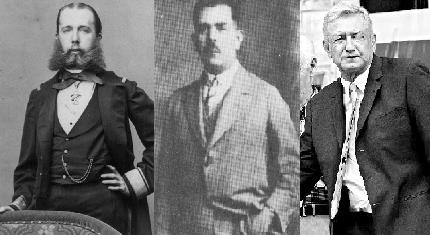
Sánchez Graillet also recognizes the Mexican scientific community of the early twentieth century, such as the geologist Juan de Dios Villarello, Ezequiel Ordóñez, Miguel Bustamante and many others, who contributed their knowledge and the idea that Mexico could exploit “their” oil without foreigners. As always, he relates, there have been voices that say there is no capacity and it is not advisable. By the 1930’s, however, Petromex, the first Mexican company, had been established.
Not ignored is the fact that after the expropriation by Cárdenas and the birth of Pemex, the National Action Party [PAN] emerged to oppose “statist” policies in general, particularly the nationalization of oil, but the then president achieved majority public support, and he recalls the “famous popular collections”. Those collections, he argues, may not have entirely helped to cover the payments to the [oil] companies, but they definitely contributed in a “valuable” way to
“creating a bond of solidarity among Mexicans, and consolidating the general feeling that the nationalized oil industry was the property of each and every one of them.”
That effort led to a sense of belonging. So in 2008 (still before Enrique Peña Nieto’s new reform proposal) the Mexicans considered the oil to be their own, because “it was our grandparents who paid for it with their belongings”.
The tax-man cometh…
It’s a new trend with the Peña Nieto administration to release new, complex “reforms” at weird hours, and no surprise the long-awaited tax bill came out on Sunday, too late for the talking head shows and Sunday papers. Thank Huitzipotchti for the internet!
Business Week of course focuses on a raise in the capital gains tax and a raise of two percent (from 30 to 32 percent) for incomes over 500,000  pesos, and ignores the 16 percent flat Value Added Tax (IVA) — which, despite calls from the right, will not be applied to food (except for pet food and candy) and medication, which was guaranteed to bring still more protestors into the streets.
The tax bill is actually better than I anticipated. It closes several loopholes, treats PEMEX profits the same as other businesses which should free up the capital it supposedly needs (to steal?) and weakens the argument for injecting foreign capital into the state agency. Whether PEMEX, as a state agency that also runs a parallel social service network of hospitals and health care centers and the like SHOULD be considered just a business is another story. Incidentally, while the cost of gasoline will still go up every month, the bill calls for a smaller monthy increase.
Right-wing columnist (weirdly enough, published in the once leftist Sendero de Peje Noticias — “Lamp of Peje… the nickname for Ándres Manuel López Obrador — SDPNoticias), Federico Arroeola in cynically claiming the Peña Nieto tax bill undercuts the left is admitting that — aside from the increase in the sales tax — the rest of the bill is progressive.
However, on the same site, Hector Castillo argues that several provisions of the bill — including financing for unemployment insurance and an across the board old age pension — are concessions to the left.
Some may not be populist, particularly Although food for human consumption is exempt, feeding Fido and Fluffy and Tweety is going to be more expensive, with the sales tax applying to pet food and supplies. However, dogs and cats and birds are considered to “reflect a contributive social capacity” in bureaucratese, so there’s no tax bite when you buy a pet … at least a “nice” one. Still undefined is what the tax is on “manifestly dangerous animals”… though one can assume the price of lions will go up.
Also apparently contributing to social capacity are the movies and circuses… tickets for which are specifically exempt from sales tax. Whether tickets for other forms of public entertainment — concerts, operas, ballets, luche libre, rodeos, bull fights, art shows, etc. — will be taxed isn’t yet clear. The film and clown industries must have better lobbyists than the ballerinas and matadors.
The rich and middle class won’t like it, but private education will be taxable. Maybe not such a bad thing. With public schools and public education under attack by this administration, there’s no telling how many parents will be now switching to the public schools — and demanding the types of resources be made available to their kids that they received in the privates.
There are some “sin taxes” being added. Soft drinks and sugar-added fruit drinks will be taxed at 10 percent, and the tax on alcoholic beverages goes up … to 26.5 percent on beer, and 53 percent on liquor. Boozers and wannabe diabetics unite!
The business people are already carping about not just the rise in capital gains taxes, and the new tax on stock market gains and dividends (a flat 10 percent) , but also that business taxes won’t go down… and most “loopholes” are being plugged. Worse, according to Claudio X. González, President of something called “Consejo Mexicano de Hombres de Negocios” (The Council of Mexican MEN of Business… I guess no women own businesses or something) carps that
“Taxes simply transfer [money] from the private to the public sector”
Brilliant!
No word yet on whether reading materials will be taxed. That would seriously suck!
Who are these teachers?
Paul Imison in Counterpunch on the Mexican teacher-s strike, and the spin put on it by the Mexican and foreign media:
Like everything in Mexico, it’s a case of the haves and have-nots. The teachers I’ve spoken to from the CNTE don’t oppose testing – on the contrary, many want better training and support from the government – but they’re well-aware of the lunacy of applying a one-size-fits-all evaluation to vastly unequal regions of the country. Not to mention that in many of the poorest areas, teachers work outside of the national curriculum, giving classes based on usos y costumbres – traditional customs – to students for whom Spanish is a second language.
To call the CNTE “radical” – as much of the media has done – is laughable. Presumably they’re on the same side as the “radical” students who opposed widespread vote-buying and fraud during last year’s election. This, too, is part of media relations under Peña Nieto. Opposition to the reforms is a sign of backwardness; a failure to embrace the neoliberal future. Private investment in education is also a key element of the reform bill.
This battle between the city and the countryside, corporatization and autonomy, is key to understanding civil resistance movements in Mexico. Only this summer the Zapatista Army of National Liberation (EZLN) in Chiapas invited journalists and activists the world over to visit their autonomous schools in the caracoles, ahead of the twentieth anniversary of their legendary 1994 uprising.
As such, it’s easy for the Mexican government to turn public opinion against protesters. The CNTE, like the Zapatistas, are “rebels” who refuse to enter the modern world. They don’t speak for the average person, even if very few Mexicans in the short term stand to gain anything from these reforms. What’s lacking, above all, is any honest debate about where the country is headed.
Don’t trust the experts: the “reforms”
It’s no wonder the political left doesn’t trust the Peña Nieto “reforms”… what is a wonder is why anyone else does, given the results of the latest round of “opening” the social system (i.e., screwing the workers and opening the nations coffers to foreign investors).
Via SDP Noticias (my translation, literally laced with snark):
Although it was assumed (by the neo-conservatives and foreign cheerleaders like The Economist) that last year’s labor “reforms” would lift Mexico thirty whole points in the “World Economics Forum Global Competitiveness Report 2012-2013” over last year’s listing in the annual ranking of 144 national economies, instead the “reforms” have caused Mexico to slip 11 places.
 The labor “reforms” were passed under the Calderón Administration, are part of the same various package of “economic reforms” picked up by the Peña Nieto administration (which has a better chance of passing them, simply because it has better control over the legislative process than the hapless, drug-war obsessed Calderonistas did). Supposedly, by slashing the already barely adequate wages of Mexican workers, and making it easier to fire workers as well as weakening unions and allowing employers to “outsource” jobs, Mexico would rise in “efficiency” to the standards of those paragons of labor abuse Brazil, India, and Indonesia.
Manuel Molando, of the ” Instituto Mexicano para la Competividad (IMCO)” whines that the situation would change IF labor UNION “reforms” were implemented.
What we expected was complete reform the labor market. We thought there would be a breakthrough , but the reality is that we didn’t get the comprehensive reform we wanted. …
What we have so far is an incomplete reform… we have to enter the union issue
I suppose Mexico could go way up in “competitiveness” if it did like the Chinese, and just did away with all labor rights and outsourced convicts prisoners to “free enterprise” . Any wonder school teachers having to work in building with dirt floors and no electricity and sent textbooks full of misspellings sort of resent being blamed for the poor showing of Mexican education, and the drive to de-legitimize their unions through false media presentations of the issues, or why workers and taxpayers don’t quite cotton on to the idea of paying higher taxes so that PEMEX can contract out some tasks to foreign companies and contribute less to the national treasury (and more to foreign investors)?
Oddly enough, just a couple of weeks ago, The Economist was suggesting that the biggest reform Mexico needed was a larger domestic economy. Which means, paying workers enough to buy stuff, and that doesn’t mean competing for the booby prize in worker’s rights.
World Economic Forum Global Competitiveness Report 2012-2013
Not just Mexico City…
The CNTE strike (by the dissident teacher’s union) is growing, and starting to attract SNTE (the tame, “official” teachers’ union) members as well. In Baja California , 11000 grade school teachers have joined the strike, up to 50,000 in Chiapas, and at least 7000 joined protests the state capital of Veracruz, Xalapa. Teachers in Puebla state — generally a more conservative, “pro-government” state — are also joining the strike.
It occurs to me that in some ways, the Peña Nieto administration brought this on themselves, when — in order to start breaking the power of the unions (already underway, with the Calderòn Administration’s takeover of the union-owned Luz y Fuerza power company in the Mexico City region) — they went after the low hanging fruit by arresting the most obvious “corrupto”, Elba Esther Gordillo, and leaving SNTE basically floundering… which gave CNTE an opening to take the lead in fighting for teachers and students.
Despite attempts to spin the strike as just complaints about testing teachers, the issues include job security, the pay packet for rural teachers and shortages of texts and training material (as well as continuing education for teachers themselves).
Xalapa, from CNN:
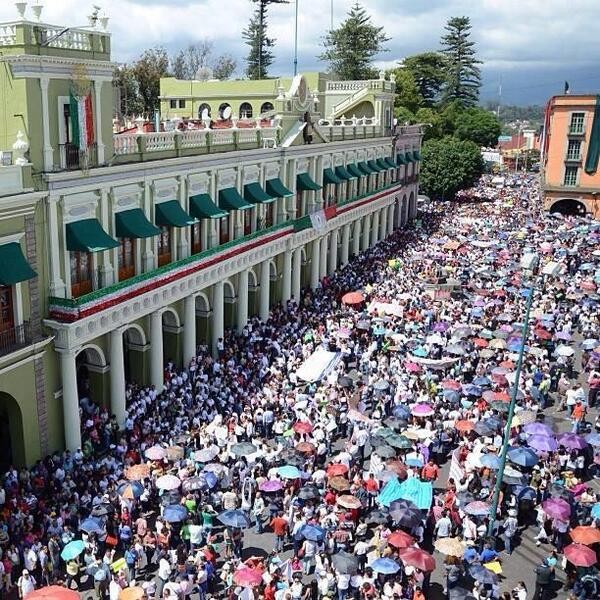
… And in Tuxtla Guti¿errez, Chiapas (photo by Isaín Mandujano/Proceso):

Somebody DID frighten the horses
Though maybe they were just joining the protests… just say NEIGH! to the privatization!
Don’t frighten the horses: Colima
My dear, I don’t care what they do, so long as they
don’t do it in the street and frighten the horses.
(British actress, Mrs. Patrick Campbell)
I know this is old hat to most people, but some English-speakers still have a problem understanding that a “Socialist” is not necessarily a “liberal”.
While “Liberalism”, especially in the United States, has come to signify to their opponents a rejection of “traditional values”, as a poltical/economic theory, as its used in Latin America (and most of the world) “liberals” are just old fashioned laissez.faire capitalists, and any skepticism for “traditional values”… or slightly more positively, “tolerance”, is more a matter of policy. If Spaniards wanted to do business with the English (or vice-versa), the traditional values of killing each other as heretics had to be put aside.
Socialism, of course, has more concern with social class and community than the individualism assumed by Liberalism. Despite the Socialists generally being the ones in this country upholding the rights of minorities, and the ones most skeptical of “traditional values” — especially when those traditional values are used to oppress minorities — there are exceptions.
I wrote not long ago on the tricky way the State Legislature of Colima avoided that state being the next to legalize same-sex marriage. Faced with the prospect of losing a federal lawsuit that would overturn a “one man-one woman” law, which would have been upheld by the Supreme Court (and… with the Supremes already having ruled that one man-one woman marriage laws were unconstitutional in other state cases, would have been the a key ruling in making same-sex marriage legal throughout the republic), the Colima legislature created a “judicial form” called the enlace conyugal (marital bond) which supposedly
provides “the same rights and obligations in regulatory law, including inheritance and social security law [as a marriage]…
but
While the Supreme Court decided in August 2010 that a marriage (or “free union”) in a state which allows same-gender marriages is valid everywhere in the Republic, there is no guarantee that an enlace conyugal will be valid anywhere outside Colima, or that persons entering into an enlace will be covered by federal law.
Although leaders of the two main Socialist parties (PRD and Morena) both offered their assistance in overturning the bill, and in bringing forward a lawsuit to make same-sex marriage a legal reality in Colima, same-sex couples needed at least some recognition of their relationships: at least 28 couples have entered into “enlaces conyugales” — and another 20 couples have applied for a license — in the Municipio of Cuauhtémoc alone.
Which has resulted in PRD Deputy Rafael Mendoza Godínez being another State Legislator one must single out for complete dickishness.
Deputy Mendoza, sent a letter to Muncipal President to complain about the local Registrar Civil (the administrative judge who performs marriages in Mexico — and, in Colima, “”enlaces conyugales”) not because the Judge isn’t doing her job… but because she is doing her job in public.

Unfrightened horses in the Muncipio de Cuauhtémoc
Making the very strange argument that “Mothers have expressed their concern that children witnessing public ceremonies between persons of the same sex might alter their perception of their relationship to their parents” the Deputy wants the Municipal President to have the legal ceremonies performed only in private, behind closed doors: presumably in a closet.
For the children.
The Deputy claims he is “only the voice of the people”, and that his constituents aren’t ready for the sight of somebody else getting … well, not married, but at least forming a “marital bond”. But with 48 of his constituents, even in a “traditional” kind of place like Cuauhtémoc … where the mainstay of the economy is farming, the local arts scene is mariachi music, and having its only historical significance as a former stronghold of the Cristeros … getting “bonded”, he’s not exactly standing up for solidarity with the masses… not at all liberal, and complaining about public celebrations… rather unsocial I’d say.
Yesterday in Mexico City
… of course, barely covered by Televisa:
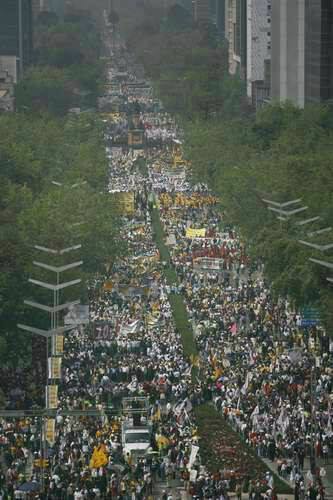
Peña Nieto’s “Grand Transformation” (of deformation, to fit U.S. business interests) is not going down well, and — although I suspect much of the “reforms” will come to pass — it won’t be without some very noisy and messy resistance. Please note, it is not just teachers who oppose the changes (which require Constitutional changes to labor law) but also those who’ve cottoned onto the fact that this undermines public education… and Mexico’s ownership of its own natural resources.


 mexfiles.net