Going Dutch?
According to Jan-Albert Hoosten, Latin American correspondent for Dagblad Trouw and DPD De Persdienst Mexico has been far ahead of the curve when it comes to social legislation:
Here’s the funny thing about gay marriage in Mexico: as happened recently in Oaxaca, Colima and now in Yucatán, local courts are increasingly interpreting that the constitutional mandate of universal equality before the law should always prevail over state legislature concerning what constitutes marriage (which in many states is purely ‘a man and a woman’).
If this tendency continues, it won’t mean that gay marriage will be legalized, but that, according to the courts, it was never outlawed in the first place. Seeing as how Mexico’s constitution dates back to 1917, this could theoretically mean that, according to these ‘interpretations’, Mexico in retrospect is the first country in history to legalize gay marriage.
Take that, Holland! 🙂
Take it away Dutch boys ( Dwayne Verheyden, Geert Verheijden and Maurice Rohan) performing with Max Baca on vocals:
Spy centennial
Let us now praise(?) clandestine men…
May 24 marked the 100th anniversary of the arrival in Mexico of the first official U.S. government spy. Hale’s report to his immediate supervisor — newly elected President Woodrow Wilson — was sent dated June 18, 1913.
The report itself was simple confirmation that the U.S. ambassador, Henry Lane Wilson, worried about the “lunatic” ideas put forth by President Francisco I. Madero, had actively supported his overthrow. The immediate consequence was that Lane Wilson was recalled.
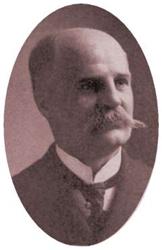 Bayard Hale continued travelling throughout Latin America as an envoy, although his real job was informing Wilson of what he saw, which complemented the work done by another group, code named “the dark room” … code breakers intercepting telegrams from the Mexican revolutionary generals in 1913-14. According to historian James Bamford, the “dark room” was a remote ancestor of the current National Security Agency (NSA).
Wilson and his agents in 1915 staged another intervention in Mexican political life, when they learned that the ousted Victoriano Huerta, encouraged by the Germans, sought to return to Mexico. German interest was obvious: U.S. prevent entry to the European war.
After the First World War, during a congressional hearing, it was also discovered that Hale had been working for another intelligence service, that of Kaiser Wilhelm II.
Bolivia: marking out their position
Via Inca Kola News:
So both France and Portugal suddenly decide to deny  air passage of the Bolivian Presidential aircraft, with Evo Morales on board, which then has to turn tail and make (what’s being called at least) an emergency landing in Austria because of suspicions that Snowden had hitched a ride with Evo… [the] Vice-Minister of Communications, one Sebastián Michel, […] asks his fellow citizens to go and urinate on (presumably the walls of, but you never know) the French Embassy in La Paz Bolivia in retaliation…

Why bother raising issues at the United Nations, when you effectively register your country’s complaints through Urine-nations?
UPDATE: Actually, it’s not funny. President Morales’ plane was denied access to the airspace of France, Italy, Spain and Portugal and forced to land in Vienna in violation of several international treaties (including, of course, the Vienna Convention). Peruvian President Ollanta Humala of Peru, in his role as president pro-tem of the Union of Latin American States (UNASUR) has called for an emergency meeting set for this Thursday.
Our friends (eaves)drop in all the time
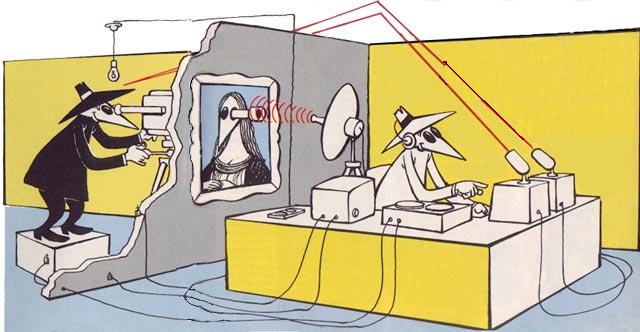
US intelligence services are spying on the European Union mission in New York and its embassy in Washington, according to the latest top secret US National Security Agency documents leaked by the whistleblower Edward Snowden.
One document lists 38 embassies and missions, describing them as “targets”. It details an extraordinary range of spying methods used against each target, from bugs implanted in electronic communications gear to taps into cables to the collection of transmissions with specialised antennae.
Along with traditional ideological adversaries and sensitive Middle Eastern countries, the list of targets includes the EU missions and the French, Italian and Greek embassies, as well as a number of other American allies, including Japan, Mexico, South Korea, India and Turkey. The list in the September 2010 document does not mention the UK, Germany or other western European states.
Ewen MacAskill and Julian Borger, “New NSA leaks show how US is bugging its European allies” The Guardian 30 June 2013
So, can Mexico launch drone strikes on Texas gun shops now? And, they really do need to keep an eye (and ear) on the oil companies looking to glom on to PEMEX. C’mon, fair is fair.
Oh, crap!
Via La Prensa (San Antonio, Texas):
Mexico City, Jun 26 (EFE).- Imports of live hogs from the United States have been restricted and inspectors are working to detect any cases of porcine epidemic diarrhea, or PED, in Mexico, the Agriculture Secretariat said.
Live hog imports are subject to a case-by-case review to ensure that health regulations are being followed, the secretariat said.
The National Food Health, Safety and Quality Service, or Senasica, has asked the U.S. Department of Agriculture, or USDA, to provide technical information about the PED outbreak and the measures being taken to keep the virus from spreading, the secretariat said.
The Senasica also asked the USDA to provide information about the actions taken to ensure exports are safe, the secretariat said.
The USDA’s National Veterinary Services Laboratories, or NVSL, confirmed on May 17 that the porcine epidemic diarrhea virus was present in the United States.
The disease, however, is not one of the illnesses that must be reported to the World Organization for Animal Health, or OIE.
PED is spread by infected animals or contaminated equipment, the secretariat said.
Pork producers should take measures to ensure that biosafety procedures are being followed in their facilities, the secretariat said.
PED is quite similar to gastroenteritis, a common illness among hogs.
You can’t fault the Mexicans for erring on the side of caution when it comes to hog-related illnesses (remember this?):

Mexico City, 24 April 2009
The H1N1 virus, allegedly arising from the Granjas Carrol de Mexico hog farm (population: 500,000 porkers) in La Gloria, Veracruz (population, 2,243 humans)
For those north of the border in hog producing states like Iowa and North Carolina… can you imagine what it’ll be like with those “containment ponds” if a half million hogs come down with diarrhea. OINK!
Politicians… think of the children….
DON’T HAVE ANY!
Via SDPNoticias:
Ignacio Segura, son of the PRI candidato for presidencia municipal 0f Parras, Coahuila, ran over and then beat up a pedestrian outside a liquor store on the Saltillo-Monterrey highway
 It wasn’t enough for the son of Ignacio Segura Teniente to hit a guy with his BMW X5 and to be driving while intoxicated. Nacho Junior got out of the car and beat up the pedestrian. Then the arrogant prick left without looking back.
But the story does not end there. After the fact, Nacho Jr. claimed “victory” and posted photos of his bruised hands and bragged of the violent episode via WhatsApp.
Ignacio Segura Teniente was formerly Presidente Municipal of Parras from 2006 to 2008 and a Deputy in the State Legislature from 2009 to 2011.
Perhaps Ignacio Segura Teniente needs to spend more time with his children… burying their bodies.
Water. water everywhere… for the corporations
Via the indispensable Mexico Voices.
I’ve always thought it was one of the better things about Mexico was that water (and access to water) was considered a national security issue… one reason the Army plants trees as part of its regular activities is to safeguard watersheds… and that the reason natural resources were to be managed by the government for the benefit of the people. Although we haven’t been so degraded yet, the sense that “corporations are people too (just with more rights than you and I) is creeping into our political and social consciousness:
Translated from Jornada (28 June 2013) by Stuart Taylor
In accordance with Óscar Pimental González, the General Coordinator of the Emergencies and Advice Service in Cuenca – part of the National Water Commission (CONAGUA) –, the federal government intends to promote the intervention of the private initiative in the organizations in charge of the public service’s water supply operation over a six-year period. In the official’s opinion, such a plan is underpinned by the need to adopt corporative practices as a basis for undertaking improvement, professionalization and modernization processes. Its fulfillment would bring such benefits as a cleaning up of the public organizations’ finances, it would offset their dependence on subsidies and it would facilitate the gradual addition of infrastructure, operation and maintenance costs to the prices that users pay for the service.
It is unavoidable to perceive this announcement as part of an integrated project to hand over natural resources and public services to private enterprises – the majority of which are foreign. Similar arguments to those used by the federal official may be employed, that is to say, the supposed technical, operational and financial ineffectiveness of the public organizations in charge of managing such resources and services.
Also fitting in to this context is the national oil industry’s eagerness to privatize – an industry that persists in the current federal administration contrary to the constitutional mandate and the views of the majority of the population – as well as the gradual handover of the electricity industry to transnational companies that, today, generate more than a third of the energy consumed in the country.
In this case, the intention to allow private entry into operation, management and distribution tasks of water resources is especially inappropriate given that those activities are extremely important social, economic and health issues and could even threaten national security.
It is also unavoidable to assume that finalizing the CONAGUA plans would result in similar scenes to those that have come about as a result of other privatization processes throughout the world. Far from contributing to guaranteeing universal access so water, operating with business logic will end up favoring the demand of large consumers (industries with diverse sections) to the detriment of the needs of wide strands of the population, especially those sectors that are disadvantaged, such as rural areas, which in themselves are impoverished due to the chronic abandonment of the field, and the neighbors of the popular colonies who already suffer from a lack of regular water supply.
Furthermore, the historic experience accounts for the risk of political instability that is involved when handing over natural resources to corporations that, in general, are characterized by displaying predatory, abusive behavior that generates social discontent. The water war in Cochabamba is an inescapable; a series of protests held in the Bolivian city between January and April 2000 after the Government’s controversial decision to give the water system of that region to the multinational company Aguas del Tunari for 40 years. The episode ended in a brutal clash with police, causing one death, injuries to 500 people and tens of arrests.
Currently, as we observe a growing international trend in the recognition of having access to water as an essential human right in the civilizing process and in an effort to guarantee the viability of the human race, the intention to give this resource to private parties is unfitting and risky from any point of view. It is hoped that the federal government will realize this and end its attempt to add yet another layer of division and nonconformity to the political and social landscape of this country.
Size matters?
A measly 50,000 people turned out for Mexico City’s annual Gay Pride Parade.

Priorities, priorities

The new conquistadors
Via White Wolf:
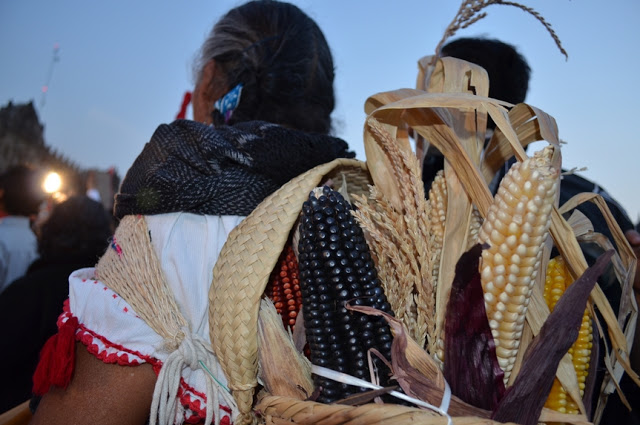
Photo by Alfredo Acedo
Monsanto–along with Pioneer, Dow and other chemical/biotech firms– has been pushing hard to take over production of the world’s third major staple crop: corn. Small farmers in the U.S. have long experienced the pressure exerted to move them out of the way. Monsanto predicts that its corn seed will be planted on 96 million acres in the United States this year. But the key to its plans to conquer the market lies south of the border.
The powerful corporation, the largest seed seller in the world, desperately wants permission for unrestricted planting of its GM corn in Mexico. If GM corn is planted in Mexico, it will accelerate the transfer of acreage and water rights from small farmers to corporate GM corn cultivation, thus transferring control of the national food supply as well. Widespread open planting of GM corn will lead to contamination of native varieties. This is a scientific fact. Mexico has already detected many native cornfields contaminated by GM corn during the period when open planting was prohibited—a strong indication of the impossibility of controlling open pollination between native and GM varieties.
[…]
More than sixty thousand farmers and supporters from workers’ and environmental organizations marched through Mexico City on Jan. 31 to avoid this fate. It was one of the largest mobilizations to date to reject the Monsanto game plan, and it’s no coincidence that it took place in the heart of the Aztec Empire.
Olegario Carrillo, president of Mexican small farm organization UNORCA, addressed the crowd in the central plaza, “During the last 30 years, successive governments have tried to wipe us out. They’ve promoted measures to take away our lands, our water, our seeds, plant and animal varieties, traditional knowledge, markets. But we refuse to disappear.”
“For peasant farmers, GMOs represent looting and control,” he stated.
Did I say that? Peña Nieto and PEMEX
Although I’m not a believer that polling statistics can be, and usually are, skewered to give the results desired by whomever is paying for the polls, this is interesting. Polls conducted by CIDE (Centro de Investigación y Docencia Económicas — the Center for Economic Research and Education — a state-supported “think tank” leaning towards neo-liberal policies) and the Secretaría de Relationes Exteriores (the foreign ministry) found that only slightly more than half of Mexicans are open to foreign investment in Mexican electrical production and a clear majority (65%) REJECT any foreign investment in PEMEX.
What’s surprising about the statistics is that they come from the same government that has been pushing for privatization (as was the previous, PAN administration), making the claim that PEMEX “doesn’t have the financial capacity to be in every single front of energy generation” as Enrique Peña Nieto said in London on his way to kowtow to the G-8 leaders. However, news of a pending privatization bill has been pushed into the background in Mexican media, and — if there is this much rejection of the idea now — one can only expect it to grow as it becomes a better known issue.
I’ve been holding back writing anything about this, waiting on the administration bill, which was supposed to be submitted to the legislature earlier this week. But wasn’t.
The so-called “Pact for Mexico” (an agreement among the three main parties to avoid squabbles over “necessary” legislation) is hanging by a thread, and will be revisited (if the pact still exists) after the state and municipal elections — 7 July… a week from this coming Sunday. A key piece of that “pact”… sold mostly abroad, and kept out of the discussions here has been the “third rail of Mexican politics” … opening PEMEX to foreign investment.
In London, en route to the Belfast G-8 meeting, Peña Nieto made remarks to the English-language press that are taken to mean, as Bloomberg reports:
…he’s confident Congress will end the state oil monopoly this year, opening the way for companies such as Exxon Mobil Corp. and Royal Dutch Shell Plc (RDSA) to tap the nation’s reserves.
In the model envisioned by Pena Nieto, state-owned Petroleos Mexicanos would develop some fields, while others are tapped by foreign and private companies. He declined to discuss more details of the proposal, or whether it would require a change in the constitution.
Back home, the administration is looking to re-brand privatization not as opening Mexican oil to the same people the country threw out in 1938, but simply as some sort of cash infusion… based on what it seems is a false premise to begin with. Not that the Mexican fields are producing less oil (they are, but they’ve been worked since the 1880s, and nothing lasts forever), but that PEMEX is an oil company.
Yes, PEMEX is one of the top ten oil producing companies in the world, but it is only an oil company in the same way that the U.S. Postal Service is a package delivery company. That is, a state owned enterprise that does not have to return a monetary profit to its shareholders, but is expected to provide a service to those shareholders … and, in PEMEX’s case, it doesn’t have to sell oil, or even pump oil, since it’s purpose is to use the oil to the nation’s advantage. Which may be leaving it in the ground, or using it domestically.
Of course, there is a good argument for bringing cash into PEMEX to permit it to pump more oil (and, maybe even get into fracking… like Peña Nieto mentioned in his London interview), but politically, it would be imprudent to say so at home. So, when his push for privatization was challenged by Marcelo Ebrard, the former Federal District head of government (and presumed front-runner for the PRD in 2018) he has tried to deny saying any such thing.
The former head of Government of DF, Marcelo Ebrard, already received response from the Presidency on a debate that requested with Enrique Peña Nieto, on energy reform which aims to promote.In a letter, signed by Erwin Lino, private secretary to Peña Nieto, which incidentally was wrongly dated, the Chief Executive argues that he has not yet sent any initiative to the Chamber of Deputies or the Senate on this matter, therefore if Ebrard “has any comments or proposal “, he must send them to the Secretariat of Energy’s Undersecretariat for Hydrocarbon Development.
Don’t ask, don’t tell? But don’t be surprised if there are huge demonstrations and street actions if — or when — the issue does seep into the public consciousness.


 mexfiles.net