Well, what did you expect?
Via The Daily Beast:
… the public message that the Border Patrol has trumpeted for much of the last decade, mainly through press releases about its seizures, has emphasized Mexican drug couriers, or mules, as those largely responsible for transporting drugs.
It turns out that U.S. citizens are the predominant culprits that the Border Patrol busts for drug possession and transportation, according to an analysis of records obtained by the Center for Investigative Reporting.
Three out of four people found with drugs by the border agency are U.S. citizens, the data show. Looked at another way, when the immigration status is known, four out of five busts—which may include multiple people—involve a U.S. citizen.
As I’ve said before… if the world’s #1 narcotics using country is all that concerned about it, they can send their death squads out against their own people, and stop harassing Mexican (and Andean) farmers trying to make a living and stop financing and arming the gangsters who those narcotics users employ to keep production and distribution moving along. And, maybe we need to rethink who really are the distributors.
Are you my mummy?
Wars are a boon to science and technology (alas) and the “drug war” is no exception.
Mexican forensic expert Alejandro Hernandez dips dry, yellowish cadavers in a see-through bath, hoping his technique to rehydrate mummified bodies will solve murders in crime-infested Ciudad Juarez.
The city bordering Texas has endured drug-related violence and a wave of murders of women in recent years, with bodies dumped anywhere and drying up quickly in the desert climate, complicating the task of identifying victims and their cause of death.
With his special solution, whose recipe he keeps secret, Hernandez can rehydrate bodies, making facial features as well as gunshot or stab wounds reappear.
“It is common with the climate in Ciudad Juarez…for bodies to mummify or stiffen, with the skin stretched like drums,” Hernandez, an expert at the Chihuahua state prosecutor’s office, told AFP.
It’s not that unusual for bodies to mummify in a lot of different parts of Mexico (besides the famous Guanajuato Mummies, I’ve seen the ones accidentally dug up by Emiliano Zapata’s troops in San Angel, still on display at the Ex-Convento del Carmen), which aren’t particularly ancient (at most going back only two centuries), but long enough in the past that any forensic examination is more a matter of social history (“What did people die of back then? “What did they eat?”) than of administering justice. Though… our best crime fighters have had to deal with some of our old mummies before…
Ours, or mine?
In 1992 the Salinas Administration undid one of the cornerstones of the Mexican Revolution. Although the ten-year revolution had institutionalized the theory that the natural resources of the nation belonged to the nation (and should be managed for the welfare of the nation), Salinas’ Institutional Revolutionary Party turned the theory on its head. Following the neo-liberal script being laid out throughout the Americas, the mining industry was opened to foreign concessionaires on terms not seen since Don Porfirio was run out of the country. Prior to 1992, Mexican mining was owned by Mexican firms, which at least meant most of the money earned from exploiting limited resources, stayed in the country. After 1992, mining activity increased dramatically, but with the bulk of the profits going to Canadian coupon-clippers. While the mining firms can point to creating 300,000 direct jobs, they overlook not just the job losses in agriculture, but the social and 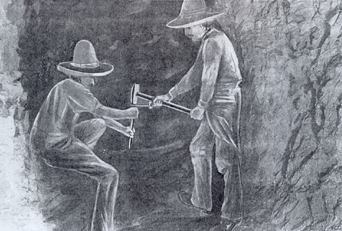 environmental costs (disrupted and displaced communities; toxic waste in the drinking water; air pollution and more) that have been “socialized” — left to the Mexican government — or, more commonly, simply written off as a cost of doing business. For the Mexicans, not the coupon-clippers.
As throughout the hemisphere, the mining operators pay a pittance of land use fees (from 0.36 to 1.08 US$ per hectare) for the rights to exploit Mexican silver, bismuth, lead, gold, copper and other minerals.
Mining operators will tell you they invested 7 billion dollars in Mexico last year, but that doesn’t mean that Mexicans (even rich Mexicans) are receiving 7 billion dollars, nor that 300,00 Mexicans have decent jobs. While the foreign companies also pay income tax, given the vagaries of the Mexican tax code, nowhere near the 22 billion dollars they pull out of the ground (and out of the country) every year. Nor paying for the lost jobs in other sectors (although the toxic wastes left behind, especially by strip mining operations, does create work for oncologists and hospice nurses).
With more mining operations — and more social conflict (and more disease and death and ruined agricultural districts) — every year, and growth in the industry only limited by the obvious fact that minerals are a non-renewable resource, a more equitable mining law is overdue.
Two proposals — one drafted by the government, and another drafted by labor, agricultural and environmental groups — are being put forward. And… naturally… the government proposal (which wouldn’t bring Mexico back even to the Colonial standard of a twenty percent royalty on the deposits) would likely include SOME royalties and SOME consideration of social and environmental costs racked up by the mostly Canadian and U.S. based firms. The alternative proposal (and good luck with that) would end strip-mining, and leave much more of the profits in the local community.
(More from InterPress Service: Emilio Godoy, “Civil Society Seeks to Influence Mexican Mining Law Reform“)
Going bananas
I wonder what made this so… uh… ap-pealing this morning.

What I wrote wrote back in December 2009 was more about trade agreements and and agriculture anyway:
Bananas may not be such a big deal, but peel back the assumptions — that the rich countries get to play by a different set of rules than the rest of the planet — and the whole “free” part of “free trade” is called into question. Agricultural subsidies and tariffs, more than anything else, have called the whole assumptions of the World Trade Organization into question. International trade agreements broke down in 2003 (in Cancún) over the agricultural subsides (the banana controversy being the symbolic issue) and have stalled since.
Probably somebody just slipped up. And I got bunches of hits.

No place like home
In California, the cities named for saints, and full of sinners. Or so somebody supposedly said. On the other hand…
I’m from California but didn’t realize how incredibly silly the names of some of the towns in our proud state were until I started living in Mexico. There are cities like Rancho Palos Verdes (Green Sticks Ranch), El Cajon (The Drawer), Tiburon (Shark), Calabasas (albeit misspelled but it means “Pumpkins” or “Squashes”), Los Gatos (The Cats), Vacaville (“vaca” means “cow”) and Placerville (“placer” means “pleasure”).
“Tauromaja”, a California native, an afficiando of bullfighting, flamenco and films, is a 15-year resident of Mexico, blogging at The Fumi Chronicles: Searching for Glamour in Living, Loving and Triathlons.
Today’s must read:
Steven Dudley at Insight Crime asks “Is Mexico’s Peña Nieto Moving Toward a New Narco-Reality?”
Meet the new narco war, same as the old narco war:
When he came to power, Peña Nieto promised lower levels of violence, and this week he appealed to the public to judge his policies after one year had passed. Still, we may be getting an early glimpse of how he plans on reaching his goals, which may be trying to please too many people at once and may end up pleasing no one at all.
The first sign of Spring…
… the New Agers flock to Teotihuacán to celebrate the Spring Equinox:

Virtual sex and real money… “Condom-gate”
Missing: three and a half million condoms. Please return to the State of Puebla Secretariat of Health.
Via Animal Politica (my translation):
In 2009, the state of Puebla, then under the administration of governor Mario Marín spent 77 million pesos for the purchase of contraceptives [including the 3.5 million condoms]. However, there are no records showing either the purchase, or the receipt of contraceptives in the State Secretariat of Health.
 In 2010, a women’s health organization, in researching state spending on reproductive health issues, couldn’t help noticing that the budget State of Puebla’s budget for contraceptives had increased almost 2000 percent between 2008 and 2009,but returned to previous spending levels in 2010. Although brought to the attention of state officials, no explanation was ever offered.
Reach out and touch-pad someone…
I’m sure it was just out of the kindness of their hearts, or pure patriotism that Telmex “gifted” the Chamber of Deputies with 500 new iPads. We’re told this has absolutely nothing to do with an overhaul of the telecommunications industry now under consideration in said chamber (and allow for 100% foreign ownership of communications systems).
Why… that might be construed as improper (or, rather, as business as usual).

Awwwwwwww!
Only once have I seen a guy propose the old fashioned way… wearing his best suit, serenading his fiance (with a mariachi band backing him up) and on his knees before her… and her mother. There’s something elegant about the old customs, even if the forms have somewhat changed…
From Brazil:
Up the Irish
Michael Hogan for Latino Rebels:
For most Mexicans, solidarity with the Irish is part of a long tradition and they remembered the help they received from the Irish and their friendship. In the words of John Riley, written in 1847 but equally true today, “A more hospitable and friendly people than the Mexican there exists not on the face of the earth… especially to an Irishman and a Catholic.”
Riley sums up what cannot be clearly documented in any history: the basic, gut-level affinity the Irishman had then, and still has today, for Mexico and its people. The decisions of the men who joined the San Patricios were probably not well-planned or thought out. They were impulsive and emotional, like many of Ireland’s own rebellions – including the Easter Uprising of 1916. Nevertheless, the courage of the San Patricios, their loyalty to their new cause, and their unquestioned bravery forged an indelible seal of honor on their sacrifice.
Irish-Americans need to remember they were the original wetbacks (and having to cross the Atlantic in coffin-ships, there was a lot more wet on their 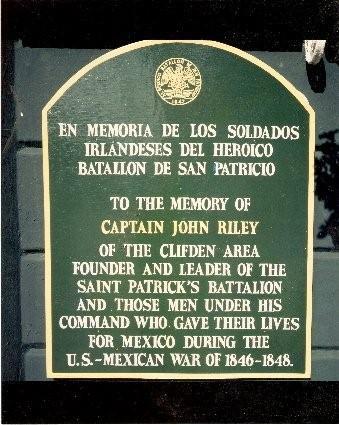 backs than people who leave their dead in the desert seeking to cross a river), refugees from the economic dislocation created by foreign control of their natural resources. The Mexican and Irish revolutions of the 1910s both were fueled by nationalist sentiment and the sense that their English-speaking neighbors had too much economic and cultural control over their lives.
While neither nation was “successful” in the sense that they wer able to completely achieve complete economic independence from foreign control, they did achieve a large measure of political and social independence, develop a foreign policy that often was completely at odds with the former controlling power, and an internationally recognized cultural identity.
I think people are tired of being scared
That one quote says it all… from the annual media report on Texans going to Mexico on spring break.


 mexfiles.net