What happens now? The TEPJF hearing
Roughly translated, and rewritten from an article El Independiente del Sureste (Villahermosa, Tabasco) what follows is about as clear an explanation of the process by which the validity or invalidity of the 1 July Election is going to be determined as any.
TEJPF is, as I keep reminding people, a court of law, and is empowered to determine not just if votes were counted right, but if the election as a whole was democratic and fair. As far as I can determine, this is not something that is then bumped up to a higher court — it is the high court when it comes to the electoral process. However, as Jorge Carrasco Araizaga writes in Proceso, the court has bent over backwards to protect PRI and Peña Nieto in the past. Still, there is a process, and the evidence is going to be presented tomorrow.
Cesar Astudillo, a full-time research associate at the UNAM Institute of Legal Research is a specialist in constitutional and procedural law. Here, he outlines the process under which an election could be overturned based on the principle of the “presumption of validity.”
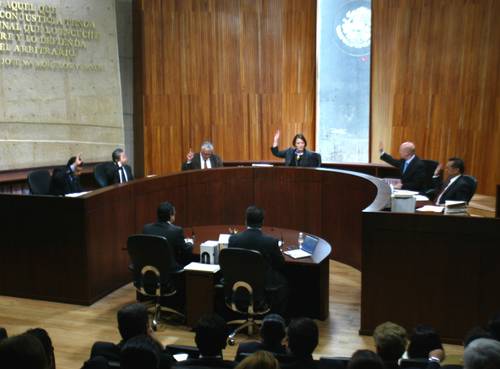 Astudillo says there are two ways to invalidate the election process. The first is to request the application for revocation of the results based on the criteria specifically mentioned in the code.
The grounds for invalidating this election are clearly spelled out in the election code. At least 25% or more of the 143,000 polling stations would have to meet one or more of the following criteria:
• Were open at the wrong time, or set up in the wrong place
• The wrong ballot boxes were delivered, or ballot boxes were improperly handled.
• Citizens were allowed to vote without voter registration cards.
• Qualified voters were prevented from voting, either by error or malice
• Votes were not counted properly.
• Physical threats or other pressure was put on the voter or those counting the votes.
A second option is based on a request to TEPJF to invalidate the election based on case law.
The Electoral Tribunal of Judicial Power of the Federation (TEPJF) has to confirm that elections are “substantially” run according to the fundamental democratic principles, that “if violated, make it impossible to declare that the election was free and genuine, and lead to undermining their credibility or legitimacy.”
To invalidate the election, the TEPJF would need to find, in Astudillo’s words, “Severe defects in the transcendent constitutional principles, which result in an election lacking constitutional support, and thus preventing the recognition of its legal validity.”
Since December 2008, when the TEPJF first invalidated an election (in Acapulco, Guerrero), for “violation of constitutional principles” the judicial body has identified a number of additional Constitutional principles which apply to elections or reflect the main points of general principles under which decisions are made. Some of these constitutional points have been discussed, but are open to argument.
To prevail in the suit to invalidate the First of July election, Astudillo says the “dissatisfied” complainants “must demonstrate by strong evidence that irregularities actually occurred and above all that they were crucial in blurring the 3 million 200 thousand vote difference between the first and second place finishers.”
Beyond the keyboard
I find it fascinating as a foreign observer that the historical protests here in Mexico, like those in other parts of the world, are being said to be “internet” driven movements, when it is the people in the streets who are the ones forcing change. Communications may be more rapid and easier than in the days when Madero had to write books, and take out newspaper ads, or Zapata had to go village to village, and ask the local priest to translate his speeches into Nahuatl, and type the up for him, but still…
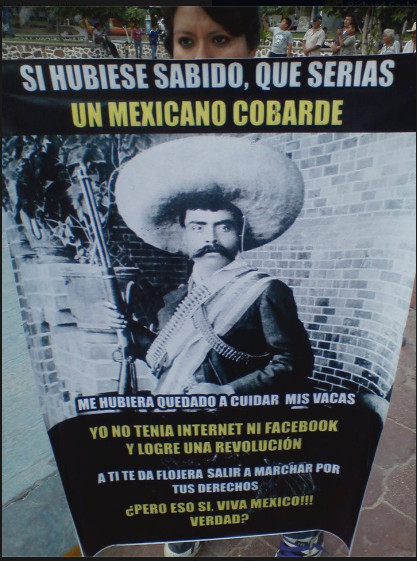
If I’d been smart, I would have been a Mexican coward too … I would have stayed home tending my cattle, I didn’t have the Internet or Facebook: I had a Revolution.
So you’re too lazy to stand up for your rights? Is that it? Viva Mexico, right?
Unprecedented
The Electoral Tribunal (TEPJF: Tribunal Electoral del Poder Judicial de la Federación) will start considering the evidence tomorrow morning on challenges to the July 1 Presidential election.
It may be the street demonstrations that are getting the little press that protests to the imposition of the PRI candidate is receiving, but the TEJPF seems to be taking their constitutional role quite seriously, and has teams of lawyers and investigators lined up to examine evidence from every one of the 300 electoral districts. I expect there will be some hair-splitting and lawyerly hemming and hawing, but just the fact that the TEPJF is considering the case is something of a wonder.
TEPJF is a court of law. We may not have a presumption that one is guilty until proven innocent any more… not in theory anyway, but it’s a clear indication that those who have raised questions about Peña Neito’s winning margin aren’t being seen as cranks and sore losers, but as aggrieved parties with more than probable cause for their charges.
The very long “transition” from one administration to the next,a whole six months, may not be as retro as it seems. I don’t make predictions (when I do, they’re normally wrong), but I will offer a historical precedent for dealing with an unprecedented bump in the transition process. When Obregón was assassinated after his election in 1928, but before taking office — the Chamber of Deputies followed the constitution and appointed an interim president, Emiliano Portes Gil, who only served the 18 months until a new election could be held. Portes Gil basically used his term to guarantee that his party choice won. Which he did. While it seems unlikely at this point that the election would be annulled, the evidence, along with continued leaks and anti-Peña Neito press and propaganda, and possible street action, could convince his party that Peña Neito, the object of the protests, is the impediment to their return to power. They PRI leadership might “convince” the presumed President-elect to step down in favor of an interim president acceptable (or at least tolerable) to at least the PAN side of the opposition.
“That night of dirty wind”…
So what if the votes aren’t counted right? Who loses? Just the candidate, the “sore loser” right? Or somebody else?
‘I, Excellency, voted “no”. “No”, a hundred times “no”. I know what you told me: necessity, unity, expediency. You may be right; I know nothing of politics. Such things I leave to others. But Ciccio Tumeo is honest, poor though he may be, with his trousers in holes’ (and he slapped the carefully mended patches on the buttocks of his shooting breeches) ‘and I don’t forget favours done me! Those swines in the Town Hall just swallowed up my opinion, chewed it and then spat it out transformed as they wanted. I said black and they made me say white. The one time when I could say what I thought that bloodsucker Sedara went and annulled it, behaved as if I’d never existed, as If I never meant a thing, me, Francesco Tumeo La Manna son of the late Leonardo, organist of the Mother Church at Donnafugata, a better man than he is! To think I’d even dedicated to him a mazurka composed by me at the birth of that…’ (he bit a finger to rein himself in) ‘that mincing daughter of his!’
At this point calm descended on Don Fabrizio, who had finally solved the enigma; now he knew who had been killed at Donnafugata, at a hundred other places, in the course of that night of dirty wind: a new-born babe: good faith; just the very child who should have been cared for most, whose strengthening would have justified all the silly vandalisms. Don Ciccio’s negative vote, fifty similar votes at Donnafugata, a hundred thousand ‘no’s’ in the whole Kingdom, would have had no effect on the result, have made it, in fact, if anything more significant; and this maiming of souls would have been avoided. Six months before they used to hear a rough despotic voice saying: ‘Do what I say or you’re for it!’ Now there was already an impression of such a threat being replaced by a money-lender’s soapy tones: ‘But you signed it yourself, didn’t you? Can’t you see? It’s quite clear. You must do as we say, for here are the IOU’s; your will is identical with mine.’
Giuseppe Tomasi Di Lampedusa, The Leopard

You must do as we say, for here are the IOU’s; your will is identical with mine.
Perhaps Don Ciccio was wrong to oppose the unification of Sicily and Italy in the 1860 referendum. Perhaps the need to appear united was justified in the short run. In the long run… without an honest ballot, will there be honest men like Don Ciccio.
The fictional Don Ciccio, in some ways was vindicated. Unification with the wealthier north — like a certain trade agreement (never ratified by any referendum, fixed or otherwise) that tied two wealthy northern states to a less wealthy southern one — had a disastrous effect on Sicily, leading to a collapse in the agricultural economy, massive emigration, entrenched criminal “cartels” and… a loss of faith in democracy.
México según los mexican@s

CLICK on the photo to see it in its full glory.
proles, polls, and pols … but maybe not a prez
… There is absolutely nobody on the streets celebrating the apparent victory of Enrique Peña Nieto. In contrast, streams of young people have been coming out to express their opposition to the
impositionof a new president who seeks to turn back the clock on the little progress we have made in building a democracy. More people participated in Saturday’s mega-march that showed up to pack Azteca Stadium for Peña Nieto’s campaign finale two weeks ago. If the PRI candidate is finally endorsed as president-elect by the Electoral Court of the Judiciary of the Federation (TEPJF), his mandate promises to be one of the weakest and most dubious in history.
(John M. Ackerman in Jornada. My translation)
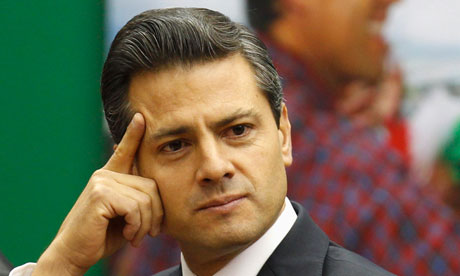 Perhaps it’s an admission that Mexico is more elitist than one wants to think, but in pointing out that the more education a voter has, the less likely they were to support Peña Nieto, Ackerman is also highlighting a serious weakness in the presumed winner’s future support. His base is overwhelmingly the very people “dissed” in his campaign (those “proles” Peña Nieto’s daughter dismissed as unimportant) and women. The presumed president elect will have a particularly difficult time as President and an even more difficult time for Mexico. But, while there are masses in the streets, this will be a battle of the elites.
Keeping the educated elites in line would require:
… that Peña Nieto … exclude and repress their opponents out of pride, instead of accepting [his relative political] weakness with humility. One of the most vulnerable areas, for example, would be free speech. Although it is hard to believe, a Peña Nieto government could easily become much worse for journalists, both in terms of personal safety and tolerance for divergent views than the present situation. In Veracruz, where nine journalists have been killed in just 18 months, is governed by another representative of the “new” PRI, Javier Duarte — possibly reflecting the likely scenario.
There is another way:
Serious irregularities in the electoral process, including the grossly exceeding campaign spending limits, vote buying, media manipulation and fraudulent polling are more than enough to justify the possible annulment of the presidential election for failing to comply with the constitutional principles of “authenticity” and “freedom.” But besides being legally feasible, such an outcome would also be politically expedient given the situation of widespread public rejection to Peña Nieto and the precedent it guarantees to sets for impunity after one of the dirtiest elections in history.
In short, something not well understood, is that simply counting the votes, as IFE did, does not make Peña Nieto the President-Elect. With even Felipe Calderón now agreeing that investigations into the election are warranted, we may find ourselves in one of those ironic situations where the Mexican Constitution and “rule of law” forces a solution that isn’t one the United States government, nor the multinationals and financial elites have a vested interest in creating.
Role models
This video is a few years old, but it’s worth posting to remind us that before we start dismissing today’s “indignados” as just youngsters, that most of those who fought the much harder struggle for dignity and a freer, fairer Mexico were teenagers or youths themselves at the time… and some of today’s indignados had the good fortune to know them.
Democratic Vistas
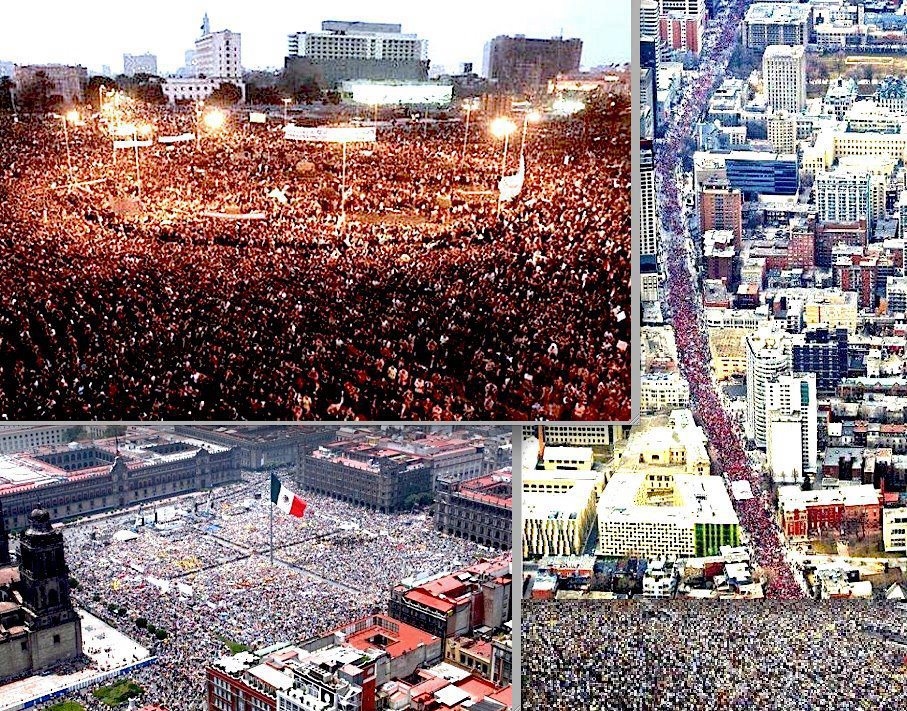
THIS is what democracy looks like. Although PAN appears to be backing away from filing formal complaints with TEJPF (the electoral tribunal), the unseemly rush to legitimize the election of Enrique Peña Neito is creating the largest political protests in the history of the planet. While tiny in numbers, we even have a few protests in the tourist zone here in Mazatlán (oh where oh were is today’s Rafael Buelna?) .
There are those who would dismiss the protests as either pro-AMLO or simply the disaffected young. Neither of these are true, although there is some validity in the criticism…but so what?
If the vote for Peña Neito was invalid, or if Pena Neito was an invalid candidate to begin with, then AMLO was the winner. And, anyway, the protests are not pro-AMLO, but anti-Peña Neito and anti-“mainstream media”. That the media (both here in Mexico and abroad) is doing everything possible to avoid covering these very real issues is reason enough to take to the streets. Attention must be paid.
And why shouldn’t the protesters be the young? Who fights in the front lines of other wars for much less worthy causes … the old?
Look who’s talking
The issue of the [gift] cards, the accounts and all, is an issue that I don’t know if it will be sufficient to overturn an election with these margins, but it should be resolved.
When Felipe Calderón is saying this you know it’s become painfully obvious even to him that there was a huge problem with the July election. Although his party (PAN) is not calling for annulling the election, it has issued separate complaints from MoReNa, the Citizen’s Movement-Workers-Democratic Revolutionay coalition against the PRI.
About the only holdout to resisting a PRI imposition is former President Vicente Fox — who, in issuing statements encouraging voters from his own party (PAN) to rally behind Peña Neito has pretty much guaranteed he will be expelled from his party.
(source: CBC News)
Jefe Diego’s revenge?
Hmmmm… remember this?

Diego Fernández de Cevallos was kidnapped back in May 2010, held fby some shadowy group calling itself Red de Transformación Global (Global Transformation Network) After the payment of a twenty million dollar ransom, Jefe Diego resurfaced, safe and sound, in late December.
There was always a few things that bothered me about the kidnapping, besides the seeming spontaneous appearance, and subsequent disappearance of the Red de Transformación Global. As I wrote after the Jefe’s re-emergence (or release):
Red de Transformación Global published a strange, very long three-part manifesto. I started to translate it, but manifestos (especially ones running fifteen pages of dense single spaced text) give me splitting headaches. If anything, it’s anti-globalist, yet begins with a quote from Berthold Brecht … and one that took me forever to find (from “Über das Töten” a fugitive essay on Bolshevism from the 1956 Mi-Ti Buch der Wendungen]. I’m not sure why a German Communist playwright would be quoted to rationalize a direct action agains the Mexican elites, especially when the manifesto’s analysis of the Mexican situation (and the justification for their action) seems to echo (with really bad writing) concerns expressed in Andres Manuel López Obrador’s speeches and books.
Besides never having been heard of before or since, “Global Transformation Network” sounds more like the name of a banking service than a kidnapping gang. Which is what I have always presumed that the “kidnapping” was… a slick way to transform 20 million dollars from Mexico to somewhere else on the globe… Zurich, the Caymans, Panama?
Fernández de Cevallos is a power, even now, in PAN, and was once the party’s Presidential Candidate (back in 1994), but he’s always been close to the Carlos Salinas de Gotari machine within PRI:
 Jefe Diego, as he’s known, is not particularly well-liked even in his own party. Rather, he commanded (or commands) respect mixed with fear as as a power-broker and strategist: a sort of Mexican love child of Richard Nixon and Karl Rove. Every foreign report mentions that he was PAN’s 1994 presidential candidate and tries to re-brand him as a great democratic figure for his role in the Fox campaign’s victory over the PRI in 2000. What’s overlooked is that when there was clear evidence of an opposition victory in 1988, until a “mysterious” computer fire stopped the ballot counting, Jefe Diego was the key figure in throwing PAN support to the government, burning the ballots and giving the presidency to Carlos Salinas.
The Salinas presidency was very good to Fernández de Cevallos who — as a lawyer for the private business interests that prospered from hasty denationalization, and as the defense attorney for individuals whose egregious behavior was too much even for the Salinas administration to swallow — made himself extremely rich. As a legislator, he at least had the virtue of not being a hypocrite… openly admitting to supporting legislation in his personal interest or those of his clients. As a lawyer, his reputation as “the Devil’s Advocate” doesn’t refer to his intellectual prowess, but to his client list: the bankers who looted bailout money in the 90s, media monopolies and drug lords.
Not only did Fernandéz de Cevallos benefit from his relationship with the Salinas machine during the latter’s presidential administration, he actively took part in various Salinas operations afterwards. Jefe Diego was a go-between in setting up Carlos Ahumada’s bribery operation, meant to discredit then Mexico City’s “Jefe de Gobierno” Andres Manuel Lopez Obradór — at the time, a growing threat to the “old boy” network and the PAN/PRI (or, as it is known on the left, “PRIAN”) hold on economic and political power.
At the time of the kidnapping, it was speculated that the “plan” — if there was one — was to position Jefe Diego to run as the PAN candidate in 2012. Of course, things have changed since 2010, and after all, the old rogue is 71 years old, and a younger, more pliable, Salinas-crony was available.
Which would take a lot of money, more than can legally go into a campaign.
Like… maybe… US$20,000,000?
The keeper of the flame

86 year old Coyoacán resident Don Esteban Volkov reads the newspapers and surfs the Internet, and has nothing but praise for today’s “indignant” youngsters who — in his words — want to “shake up the archaic system.” Don Esteban, is heir to a pretty hefty shaker upper of an earlier archaic system … being the grandson and heir of Leon Trotky.

Esteban, with his grandparents Leon Trotsky and Natalia Sedova
Volkov claims he didn’t intend to live so long, it’s just that somebody had to level out the normal mortality rate for his immediate family: his father and grandfather having been murdered by Stalin, his uncle dying young under mysterious circumstances, and his mother committing suicide rather than face deportation back to the Soviet Union).
Don Esteban was interviewed by Bernado Marín of El País (Madrid) on Trotsky and the relevance — if any — of “class struggle” in our time, as well as his own witness to history, and art history: the night Siqueiros created that mixed media work, “Machine gun bullets in plaster” (1940) on the Trotsky’s walls, 14 year old Esteban hid beneath his bed, as six of the estimated 200 bullets fired on the Trotsky’s were pumped into his mattress.
Loyal to his grandfather, he says that revolutionary violence, and authoritarian measures were necessary, but that Stalin was staging a counterrevolution and perpetuated a civil war.
Loyal to Mexico, which he calls his “true homeland, generous and colorful”, he is, of course, a supporter of the student-led democratization movements sweeping the country.
“Trotsky left us the arsenal we need to carve out a path to true socialism. But who knows when that will happen.”
… spoken like a real Mexican.
(Sombrero tip to Aguachile.blogspot.com)


 mexfiles.net