Send us your tired, your poor (oligarchs)…
Ah, another refugee… Oleg Tinkoff managed to flee the war in eastern Europe, arriving with nothing but his boat, a mere 77 meters long and 6.5 deep and the small remains of his once vast fortune. Thanks to sanctions, stock market dives and asset freezes, his five billion dollar personal fortune ($5,000,000,000) has been reduced to a mere $800,000,000.
So, what’s a near penniless refugee to do, but get to work? Rumors are that TInkoff… who already owns a large chunk of prime real estate in Cabo San Lucas plans to turn his little boat into a floating luxury hotel… a seaside dacha, no doubt coming down in the world, but a little reminder of the glory days in the balmy Decembers of Moscow.

Seriously, the guy is making all the right noises about having opposed the war with Ukraine, and questioning the financial hit Russia is taking… which makes me wonder whether or not his claimed anti-war statement is genuinely motivated by altruism, and how much by how much his pocketbook has taken a hit.
(Magnate ruso deja su país tras invasión a Ucrania y se refugia con su yate en Los Cabos)
Seldom pure and never simple: Ukraine
The Truth is seldom pure and never simple.
Oscar Wilde
Ukraine has next to nothing to do with Latin America, other than two nuclear powers are playing chicken, and the rest of the world is just standing by. With propaganda and total bullshit piling up everywhere, there’s not much to say other than not every nation, or faction in a nation, is going to read the situation the same way. This is a site on Mexico, and my broadly Latin America. So, we posted from the Cuban media a few days ago. Today, we’re looking at the Mexican left-leaning media: José Blanco, Estados Unidos vs. China y Rusia in today’s La Jornada, my translation. Take it or leave it, this is what’s being said.
Our contemporary ethos is to be intensely anti-war. War is resoundingly rejected, morally condemned regardless, an unpardonable crime, an inhuman aberration. Russian rejection of its war against Ukraine has almost unanimous approval in the Western media. The same goes for the voices on the right, the “center” and the left. Democrats and Republicans in the US, Bergoglio [Pope Francis] and some “Soviet” leftists (there are some, defending Lenin against Putin), have all embarked on that holy crusade. Great!
But, since the fall of the USSR, the US alone –or accompanied by the rest of NATO–, has bombed Panama, 1989; Iraq, 1991; Kuwait, 1991; Somalia, 1993; Bosnia 1994, 1995; Sudan, 1998; Afghanistan, 1998; Yugoslavia, 1999; Yemen, 2002; Iraq, 1991-2003; Iraq, 2003-2015; Afghanistan, 2001-2015; Pakistan, 2007-2015; Somalia, 2007-2011; Yemen, 2009, 2011; Libya, 2011, 2015; Syria, 2014-2016. Endless massacres year after year. Today’s holy crusaders of all stripes had the opportunity to be outraged, but weren’t. No that anyone shouldn’t be outraged about the war in Ukraine but, damn it, you sure wonder where those holy crusaders were between 1989 and 2016. Or even berore: 1989, the US bombed 16 countries and hundreds of thousands of bombs dropped, millions dead, since 1950.
NATO was created in 1949 to defend the West from possible attacks by the USSR. In 1989 the Soviet world collapsed and therefore NATO’s raison d’être disappeared; but not NATO, which began bombing Yugoslavia. From an Atlantic alliance for defense, NATO went on the offensive. Unrestrained, it expanded eastward, adding countries, armed with the latest weapons, the countries of the [former] Warsaw Pact, the Baltics and others, until it encircled Russia. It had yet to do so with Georgia and Ukraine, two countries with which Russia has a number of outstanding issue — a story, by the way, that did not begin on February 24, around 6 AM, when Russia crossed the borders of Ukraine.
Russia said a thousand times that it was deceived by the West because NATO (especially the US) had not honored the commitment to not expand to the East. A thousand times the EU and Brussels have denied there ever was a commitment. However, On February 18, the German newspaper Der Spiegel published “a note from the British National Archives, which has just come to light, supporting the Russian claim that the West has violated the commitments made in 1990 with the expansion towards the West. East NATO. American political scientist Joshua Shifrinson has found the previously classified document. It refers to a meeting of the political directors of the Foreign Ministries of the US, Great Britain, France and Germany, held in Bonn on March 6, 1991”.
Russia has reiterated again and again and again: it was unacceptable that NATO in Ukraine would place missiles within just five minutes of Moscow. The US has been deaf to this claim. Russia has proposed a thousand times an agreement on the basis of indivisible security: security for all, simultaneously. The US has turned a deaf ear to this proposal. Russia was led into war by the West. That was what it was about. Russia was escaping that fate, without immolating itself that had existed since February 7, 2019, when Ukraine approved an amendment to its constitution which made NATO membership possible.
The plan, in fact, pushes Russia further: placing it in a position to be subject to unprecedented sanctions, stopping the possibility of economic growth dead in its tracks. Not because it is a great economic power (3 percent of world GDP), but because it is a military power. The expected third party has already appeared on stage: China (18.8 percent of global GDP). It is not an unexpected departure, given the current political policy of the US to stop Russian and Chinese growth by any means necessary. Russia and China seem to have expected this.
The formation of the China-Russia axis breaks the balance. It changes the face of the world in an abyssal way, splitting it into two disconnected and antagonistic poles: the US and China/Russia. While Europe, docile and submissive, will move to a lesser plane. Perhaps we are witnessing that. A dangerous world for humanity, a new cold war always on the brink of becoming a very high temperature one: an all-encompassing insecurity, the risk of walking towards terminal hell. Disengagement from China, however, seems very difficult, given the vast fabric of its economic relations with the world. Although it is not necessary to cut all that ties; it is enough to do it with certain strategic goods, such as microchips. The war waged by the US against China and Russia may also enter uncertain zones given the political and economic cracks in the US, exposed to whoever wants to see them. In Ukraine, NATO is not for de-escalation. We will see.
Ukraine, the view from Havana
Take it for what it’s worth, but in the “fog of war”, with media and “pundits” having settled on a simple “good guy-bad guy” narrative, and our information in neutral Mexico (whose only role in all this is happening to chair the UN Security Council right now), and having more access to US filtered news than that filtered thru Russia, what came before tends to be erased. My translations from “Rusia-Ucrania: Cronología de un nuevo capítulo de tensiones (+ Infografía)” Prensa Latina, 26 Feb 2022:
Havana, Feb 24 (Prensa Latina) The history of Russia and Ukraine dates back to the Middle Ages, both countries part of the ancient Slavic state from the end of the 9th century to the middle of the 13th century.
Although the two nations took different historical paths with two languages and cultures emerging, Ukraine was part of the Russian Empire and later the Union of Soviet Socialist Republics until December 1991.
The latest chapter in their diplomatic relations since that time opened with movements by the North Atlantic Treaty Organization (NATO) into Eastern Europe.
NATO increased its forces in the region and currently has 13,000 soldiers, 200 tanks, 400 armored vehicles and three dozen planes and helicopters stationed in the region. IN Ukraine, it has 10 thousand “instructors”.
In early December 2021, the largest shipment of US military equipment in its history, including helicopters, unmanned aerial vehicles, infantry fighting tanks (IFVs) and artillery for NATO’s annual Atlantic exercis, were unloaded in the Greek port of Alexandroupolis.
A chronology of the main events of recent months follows
December 21, 2021 Russian Defense Minister Sergei Shoigu reported that 120 US mercenaries delivered chemical weapons in the Ukrainian-controlled cities of Avdeevka and Krasny Liman for use in a possible attack that could be blamed on Russia.
January 10, 2022 Negotiations were held in Geneva, Switzerland between Russia and the United States, in which Washington put on the table possibly coercive demands Moscow .
January 12, 2022 Meetings between Russia and NATO member countries began in Brussels, Belgium to discuss mutual concerns about security in Europe.
January 12, 2022 Russia made clear it was essential to obtain legally binding guarantees of non-expansion from NATO and that there not be any deployment near its borders of strike forces that could hit targets on its territory. It added that routine military exercises would continue as normal.
January 13, 2022 The last of the meetings on the proposals for security guarantees with the Organization for Security and Cooperation in Europe (OSCE) concluded in Vienna, Austria.
January 14, 2022 White House press secretary Jen Psaki and Pentagon spokesman John Kirby accused Russia, without presenting any evidence, of preparing an operation as a pretext for an eventual invasion of Ukraine.
January 16, 2022 Moscow reiterated that there wereno Russian military personnel in the Donbass region, or in Ukraine in general, and clarified that its forces were on their own territory.
January 19, 2022 Russia reiterated that NATO expansion in the region was unacceptable. The statement came from deputy foreign minister, Sergey Riabkov, who added that his country needed legal guarantees in the form of a bilateral treaty with the United States and a multilateral agreement with NATO.
January 20, 2022 Russian Foreign Ministry spokesperson, María Zajárova, denounced that the United Kingdom for sending military transport planes with 460 tones of weapons to Ukraine. Poland, Lithuania and Ukraine moved security forces, supplies and construction equipment rto the Belarus border.
January 22, 2022. The United States handed over 90 tons of weapons to Ukraine and a further 80 tons the following day, part of an aid package equivalent to 200 million dollars, amid repeated complaints from Russia about the danger the military build-up posed to its own territory.
January 23, 2022 After threatening trade sanctions, US Secretary of State Antony Blinken acknowledged on CNN that imposing new coercive measures on Russia could affect current deterrence efforts.
January 24, 2022 Moscow reported constant process of exercises, maneuvers and military construction was on-going. United States President, Joe Biden, and other government officials of his government intensified their propaganda campaign to label Russia an aggressor, despite denials from Moscow.
January 24, 2022 The US State Department ordered relatives of employees at its embassy in Kiev to leave Ukraine.
January 25, 2022. Croatia President, Zoran Milanovic, says that in the event of a conflict between Russia and Ukraine his country with withdrawal its troops from NATO, since he does not want to be involved in the military build-up in Europe.
February 1, 2022 Blinken and Russian Foreign Minister Sergey Lavrov hold telephone conversations to follow up on Moscow’s security proposals, regarding the acceptance of new NATO members among neighboring countries.
February 1, 2022 Ukrainian Defense Minister Alexei Reznikov confirms delivery of the sixth batch of US weapons to Kiev since January 22: a total of 500 tons of US defense equipment.
February 2, 2022 Joe Biden, approves the deployment some three thousand soldiers to Poland and Romania , in addition to the thousand already in Germany.
February 4, 2022 Turkish President Recep Tayyip Erdogan accuses the United States and its allies of worsening the conflict between Russia and Ukraine and expresses his willingness to mediate a diplomatic solution to the tensions.
5 February 2022 UK Prime Minister Boris Johnson and French President Emmanuel Macron call for peaceful solutions.
February 7, 2022 Macron travels to Russia and holds talks lasting over five hours with his Russian counterpart, Vladimir Putin, about the security guarantees required by the Kremlin from NATO.
February 8, 2022 Within the framework of the Weimar Triangle (Germany, France, and Poland), the presidents of France and Poland (Andrzej Duda) and the German Federal Chancellor, Olaf Scholz, met in Berlin to agree on common positions on cooperation issues.
February 8, 2022 US soldiers arrive in Romania as part of the continued military deployment of the North American nation in the region.
February 8, 2022 US Senator Jeanne Shaheen announces that the Senate Foreign Affairs Committee was close to reaching an agreement between Democrats and Republicans on a bill for coercive actions against Moscow.
February 11, 2022 During a visit to Hungary, NATO Secretary General Jens Stoltenberg ratified the deployment of new combat groups starting next month in Eastern Europe.
February 11, 2022 The United States approved the deployment of five thousand soldiers in Poland.
February 12, 2022 Putin and Biden hold phone conversations, as to Defense Ministers, Shoigú and Lloyd Austin.
February 14, 2022 The Group of Seven (G7) threatens Russia with heavy economic and financial sanctions if its troops invade Ukraine.
February 14, 2022 UK announces that it will send a “small number” of troops to Lithuania.
February 14, 2022 About 350 German troops and 100 military vehicles move to Lithuania while Scholz traveled to Ukraine.
February 15, 2022 Putin and Scholz discussed the Ukraine situation, security guarantees and the Nord Stream 2 gas pipeline.
February 16, 2022 Former United States Ambassador Jack F. Matlock described the campaign unleashed by Washington against Russia as false.
February 16, 2022 Moscow ends of military exercises on the Crimean peninsula.
February 17, 2022 The United Nations (UN) Security Council holds a session on the seventh anniversary of the Minsk Agreements, in which the conflict in Donbass is discussed, at the proposal of Russia.
February 18, 2022 The drastic increase in shelling with prohibited weapons inside the Donbass region, violating the Minsk agreements, is reported.
February 21, 2022 The Southern Military District of the Russian Armed Forces eliminates five infiltrators from a group of saboteurs who crossed into the country from Ukrainian territory.
February 21, 2022 President Putin signs the decree establishing Russian recognition of the independence of the Donetsk and Lugansk People’s Republics and announced that friendship, cooperation and assistance agreements will also be approved between Moscow and those territories.
February 24, 2022 Putin announces the decision to launch a special military operation in the Donbass region of eastern Ukraine. The president pointed out that his country in acting in its own defense, in the face of aggression from the West and the threat of NATO expansion.
Lost causes: Confederates and the Emperor Maxmiliano

Ashley, let’s run away. We’d go to Mexico. We could be so happy there. I’d work for you, I’d do anything for you.
(Scarlett O’Hara, “Gone With The Wind”)
When the American Civil War broke out, England and France — both countries having a thriving clothing industry — welcomed the conflict, hoping to profit from a Confederate victory, creating a weak nation (or perhaps several weak nations, if the Confederacy, with it’s prickly “states rights” attitude broke up into a series of smaller republics) dependent on agricultural exports. However, this would have entailed a naval invasion, and the Union had one powerful ally… Russia. The Russian fleet was sent to guard Union ports, and, the total cock-up of the Crimean War fresh in the minds of the Russians, the British and the French, any such plans were quickly scrapped.
Which did not mean the Confederates did not continue to pin their hopes on foreign assistance. Nor that the European empires didn’t hope to profit from the Civil War.
Napoleon III had gambled that a protracted war in the United States would give his army the sufficient time to establish Maximiliano on the Mexican throne without interference from the United States. Not only would this give France a strong position in the growing market for manufactured goods and financial services in Latin America, it would also give France control of Mexican raw materials… specifically gold and silver.
So, of course, Maximilio’s foreign policy … dictated by the French occupation force… favored the Confederacy. By the spring of 1865, the French, Maximiliano, and the Confederates were having to rethink their positions. Well, maybe not Maximiliano, not certain southern gentlemen who neverlet facts get in the way of own obtuse fantasies of imperial splendor and racial supremacy.
When Robert E. Lee surrendered the Army of Northern Virginia at Appomadox (9 April 1865), there were still other armies in the field, mostly in the west. Among those who had yet to surrender was General Jo Shelby:
On June 1, 1865, with his army disintegrating around him, he determined to take as many of his men as would go to Mexico to continue the war. With a few hundred well-disciplined and orderly men, with all their cannons, arms, and ammunition, he marched from Corsicana through Waco, Austin, and San Antonio to Eagle Pass. Prominent persons joined them along the way. While crossing the Rio Grande at Piedras Negras, they sank their Confederate guidon in the river, in what came to be known as the “Grave of the Confederacy Incident”.
(Leatherwood)
Shelby’s rag-tag force was, at most, reluctantly welcome. Forced to “sell” their artillery and equipment to the first soldiers they met (Juarez’ Republican fighters), about 600 of them would be reluctantly mustered into the imperial forces as an auxillary unit, see action in a few engagements, but nothing significant in what the beginning of a long withdrawal by the French.
Not only Shelby, but other prominent Confederate military officers , like John B. (Jeb) Magruder, James Slaugher, Sterling Price, and Edmund Kirby Smith, had made the same decision to offer their services to Maximilaino. Although it may have been they hoped to market their military skills, perhaps more importantly, as traitors to their country, following Abraham Lincoln’s assassination less than a week after Lee’s surrender (15 April 1865), they had little to expect but malice towards them, and no charity at all.
Likewise, there was one prominent Confederate who at least had more to offer than a few defeated regiments: Matthew Fontaine Maury. Maury had been a United States naval officer at the time, but had chosen — unwisely — to join the Confederate Navy when his native Virginia left the union. In addition to working as a spy and diplomat, Maury had invented numerous weapons, including new torpedoes and underwater explosives. At the end of the war, he was in London, working both as a diplomat seeking British support, and overseeing the construction of Confederate war ships and arms production. Given his importanceto the now lost cause, he had every expectation that returning home would mean trial and execution. Failing to interest either the British or Swedish navies in his services, he turned to the one foreign admiral he knew who was in a position to help: Maximiliano.
One of Max’s … perhaps his only … talent had been in reorganizing the administration of the small Austrian Imperial Navy. Maury, among his several medals and awards for his contributions to oceanography, had been highly honored by then Prince Admiral von Hapsburg.
And — one might add — as a “southern gentleman” Maury shared the plantation owner class’ pretension to membership in some sort of international aristocracy. Although Maximiliano was initially more interested in having Maury oversee port modernization and the Mexican merchant fleet, he also believed not just in the natural superiority of his kind, but — typical of the 19th century elites — believed that progress in the Americas depended on “whitening” the population through immigration. Marshall Bazaine, the real power in Mexico (he headed the French military forces, the only people who put — and could keep — Maximiliano on his throne), while not particularly awed by aristocrats (he was a “soldier’s soldier”, having come up through the ranks, most of his service in the definitely not-elite French Foreign Legion), he had the same outlook, estimating that somewhere between 50 and 60,000 “white” migrants would be needed to pacify the country (in other words, subdue the native indigenous people and mestizos).
Despite the emperor’s claim to be upholding indigenous rights and privileges (such as they were), he accepted Maury’s proposal to promote emigration by the former secessionists to Mexico. This nicely dove-tailed into the fever dreams of those from the old plantation class (like Maury) who saw themselves in the model of Europe’s landed aristocracy, both Maury and Bazaine got part of what they wanted.
Bazaine’s proposal led to an offer of 50 dollars in gold and free land to any U.S. immigrant. Maury, in a rather deluded attempt to return to the ways of the “old South” had asked for too much, but got something. He tried to get around the one thing that could not be recreated in a “New Virginia”… slavery. Instead, he got Maximilano to sign off on “apprenticeship” for those former slaves accompaning their former masters. A new name for an old concept … indentured servitude. “Apprentices” would serve 10 years without pay in return for a promise of a plot of land at the end, and maybe some limited rights. To no one’s surprise, former slaves didn’t take up the offer, and, those Confederate migrants who tried to make a go farming with “apprentices”, had to look, mostly unsuccessfully, for Chinese laborers.
As it was, despite Maximilano’s financing (and, remember, the Mexican treasury had been emptied out to remodel Chapultepec Castle and some incidentals, like paying the French Army), Maury was expected to settle a string of “white” colonies in Mexico. Widely advertised (even in the northern states) he never found many takers, despite the generous terms (cheap land, tax breaks and the like). The offer of 50 dollars and a plot of land, was not much of an incentive to the old aristocratic southern gentlemen, but appealed more to landless, unemployed, and often illiterate and uneducated people with no other prospects. Some of whom would join the Republican side, most of whom would eventually give up and return home, or simply be assimilated into those very communities they were meant to “whiten” into the future.
By the time the project got going, it was obvious to anyone who read the news that the Empire was doomed, and there were no guarantees the Republic would honor the contracts. Even newspapers that leaned towards supporting the Empire were full of stories about “Republican banditos” attacking Europeans. Still, Maury and the old self-identified aristocrats were at pains to present their “colonies” (notably “New Virginia” or “Colonia Carlota”) in the best possible light.
… accustomed to framing themselves as white in opposition to US blacks, the Southerners in Mexico had to reconstruct their whiteness in opposition to non-white Mexican neighbors. At the same time, they shaped an exocticied form of whiteness for their “Spanish” neighbors in order to prove to their friends and family in the United States that Mexico was a sufficiently civilized place.
…
Maximilian had placed the promotion of immigration as a cornerstone of his government’s policy, and the Confederates were a convenient source of immigrants. Maximilian offered key Confederates positions in his own government to facilitate immigration and gave land grants at cheap prices for the immigrants.
(Kinney, “Leaving the United States for the Land of Liberty”)
Despite glowing reports sent back (or at least hopeful ones) by John Newman Edwards… who’d arrived with Shelby, and was the acknowledged “founding father” of New Virginia., of his sizable land grant, “the garden spot of all that I have seen in the continent of America”, and was even publishing an English language newspaper, the Mexican Times.
By 1866 — only a year into the colonization project, Maury had already skipped back to England — and Edwards was aware that that trouble was brewing.
Edwards claimed — spitting in the wind — that “I do not apprehend any difficulty with the United State”. Something likely to be questioned not just by the Mexican republicans who were winning their asymmetical war against the French (what sympathetic US newspapers of the day tried to write off as “bandito attacks”) but a dubious proposition to a fe gringos, likeGenerals Sherman, Sheridan, and Grant. They used the plausible excuse of pacifying Confederate resisters in Texas, to openly supply the Mexican republican with both seized Confederate, and surplus Union Army and equipment.
And worse for the “colonists”: Napoleon III, sensing a growing threat from Prussia and unwilling to invest any more in the gamble in Mexico, pulled his support and his army. Within less than a year, it was over. Maximilano was executed (19 June 1867), New Virginia and the other scattered small “colonies” were all but abandoned, their lands soon expropriated by the restored republic. They were, to coin a phrase, gone with the wind.
Maury, like other Confederate leaders… willing to take an oath to never take arms against the United States again, returned home, Some like Shelby and Sterling Price would become living symbols of the “lost cause”, while the disgraced politicians among them would resume careers in the “Jim Crow” post-reconstuction era. John Newman Edwards, his short career as a land baron and owner of the “Mexican Times” behind him, would emigrate to Kansas City, founding the Kansas City Times, and making a name for himself as the spokesman for Jesse James. Matthew Fontaine Maury would become a professor at the University of Virginia, his statue among the heroes of the Confederacy in Richmond, mentioning him only as a pioneering oceanographer. It was removed in 2020.
Sources:
Kinney, Emily Rose, “Leaving the United States for the ‘Land of Liberty’: Postbellum
Confederates in Mexico” (MA Thesis, University of Texas at Austin, 2011)
Corbin, Diana Fontaine Maury. A Life of Matthew Fontaine Maury. London: Sampson, Low, Marston, Searle & Rivington, 1888. on-line reprint
Drynan, “The Confederate ‘Invasion’ of Mexico,” El Oja del Lago” (September 2017).
Frazier, Donal S. Review of Davis, Edwin Adams, Fallen Guidon: The Saga of Confederate General Jo Shelby’s March to Mexico. H-CivWar, H-Net Reviews. February, 1996. URL: http://www.h-net.org/reviews/showrev.php?id=304
Hanna, A.J., The Role of Matthew Fontaine Maury in the Mexican Empire. The Virginia Magazine of History and Biography Vol. 55, No. 2 (Apr., 1947), pp. 105-125 (21 pages) Published by: Virginia Historical Society
Hulsey, Terry, “Confederates in Mexico” Abberyville Institute (24 July 2018).
Leatherwood, Art. “Shelby Expedition” Handbook of Texas, 1952, 2015.
Lewis, Charles Lee. Matthew Fontaine Maury: The Pathfinder of the Seas (United States Naval Institute, 1927) Project Guttenberg).
Sherman, William Tecumseh. Letter to to John Sherman, November 7, 1866, in The Sherman Letters:
Correspondence between General and Senator Sherman from 1837 to 1891, ed. Rachel Sherman Thorndike (New York: C. Scribner’s Sons, 1894), 285-6.
New York Times, November 12, 1865, page 8
“You just can’t get good help these days”
From El Financiero (18 Feb 2022).
For a few years now, rents in the Roma and Condesa neighborhoods in Mexico City have skyrocketed.
These areas have become ‘the cool place’ to live in the country’s capital and foreigners have been those to ‘make the most of it’. In other words, the rent for apartments and houses are through the roof for most Mexicans, but accessible to people from other countries living here. A dynamic seen here, as in other Latin American cities.
A few days ago, Becca Sherman stirred up a fair bit of controversy with a tweet to her more than 2,000 followers:
Do yourself in favor and remote work in Mexico City — it is truly magical ✨ pic.twitter.com/QRHRYp0qpv — Becca Sherman 🤝 (@becsherm) February 16, 2022

The problem is that the “netizens” from other countries actually come to live here, work remotely and don’t pay taxes.
Meanwhile, gentrification is not a new phenomenon. According to academic researchers Antoine Casgrain and Michael Janoschka, (Gentrification and Resistance in Latin American Cities) gentrification over the last fifty years has meant the reconquest of the central and consolidated areas of cities by economic power, in which spaces are appropriated by private real estate agents and capitalization of ground rent is sought. Casgrain and Janoschka assert that it reproduces class inequality.
“It can be considered an increasingly intense and central mechanism, typical of the contemporary era of late and globalized capitalism that focuses its efforts on cementing the domination of the wealthy classes over the processes of reproduction of social life,” they write.
In addition, according to the Polytechnic University of Madrid, gentrification seeks to replace the urban population with the ‘non-population’, that is, international tourism or foreigners who come to live in certain areas of the city. Here we remember Sherman again and her love for CDMX. This also implies that the urban population with fewer resources moves to the periphery, thus leaving foreigners in areas such as La Condesa or La Roma. The experts agree that a possible solution to this phenomenon is the real estate regulation of rents.
An Inquisition into “Inquisicion sobre la Inquisicion”
Nobody expects to find (very many) defenders of the Spanish Inquisition. I did– thanks to my friends at Librería México Antigüo, for only 150 pesos (and delivered to my door!), Alfonso Junco’s Inquisicion sobre la Inquision (a 1967 reprint of a book originally published in 1933… that will be important later).
This is not the modern interpretation… which seeks to get beyond the “Vincent Price movie” scenarios we have, but — based on the actual court records (and the Inquisition was one of the first European courts to keep full transcripts) which present a very different picture.

Not Vincent Price, but not (quite) Monty Python… and, in an era when European states were merrily executing all kinds of dissenters and “free-thinkers”, surprisingly lenient compared to most. As I’m fond of pointing out, between Henry VIII and Elizabeth I, the Tudors, just in little old England, managed to execute somewhere about 10 times their citizenry than the Inquisition did during its entire 250 year history (at a time when the sun never set on the Spanish Empire)… maybe 3000 people, and mostly for what were generic capital crimes (murder, rape, etc.) in the course of their “heresy”. What particularly has struck me, from works like Henry Kaman’s The Spanish Inquisition (Yale University, 1997), is that so many of our preconceptions were wrong: witches were never much of a concern to the Inquisitors (they needed verifiable evidence, not the “spectral evidence” we read about with the Salem trials) which was mostly laid down to mental illness or (here in Mexico) magic mushrooms. And, while people were, indeed, burned at the stake (usually after kindly executions slit the throats or strangled the unfortunate victims) the events were extremely rare, and most of the “people” being burned were effigies of those who’d been condemned but allowed to escape, or died in prison. And, as it was, the inquisitors — as clergymen — were forbidden to shed blood, so any torture (a feature, not a bug, of all European “justice systems” of the time) was limited, and in the rare cases it was used, the accused had to be turned over to the regular courts. As it was, canny lawyers often encouraged their clients to commit blasphemy in court, in order to be transferred to the more lenient inquisition, which also kept cleaner, more sanitary, and safer jails than that housing “ordinary, decent criminals”.
Even if, as Kamen mentions, the 90% of Spaniards would have been unaware that the Inquisition even existed (and my estimate for the colonies is closer to 99%) and never would have been affected by it one way or another, it was designed to root out “thought crimes” and ruthlessly stamp out dissent. With the “Enlightenment” thinkers of the 18th century mostly seeing “heresy” as a relatively harmless difference of opinion rather than a serious criminal matter, and Spain, and its colonial subjects, if not “good” Catholics, at least not openly challenging the supremacy of the Church, the Inquisition mostly turned its attention to crimes by the clergy (especially “seduction”… mostly what today we’d call sexual harrassment, generally taking place during confessions… and incidentally, one reason the Church introduced confession booths to keep the confessor and confesse physically separate) and thorny theological issues related to marriage and family life (one of the more interesting Inqisition investigations in Mexico was in 1758 case of “Mariano Aguilera — an intersex who, intially Mariana,,at adolescence becoming Mariano and considered male by his community and his family. And the family of the girl he wanted to marry, although his parents, and their parish priest, had their doubts as to Mariano’s ability to perform his conjugal duties, as the Church required for a canonical marriage. The inquisitors went to the trouble of meauring Mariano’s vestigal penis, and calling in what passed for sex therapists in their day as consultants in considering whether such a marriage would be lawful. Deciding it wasn’t, the inquisitors refused a marriage license, but … with a wink and a nod… suggested the couple just move somwhere they were unknown, and get on with their lives [Sex and the Colonial Archives: The Case of “Mariano” Aguilera, Hispanic American Historical Review, 2016, 96:3, pp 421-443]). As it was, the Mexican Inquisition had too small a staff (headquartered in Mexico City), and expected to cover a territory stretching at times from Alaska to the Straits of Darien, as well as the Philippines, Guam, and the Pacific Islands to be much of a threat or even a presence to … anyone, including the clergy.
What makes the Inqisition of historical interest — as interesting as Mariano’s case is, and the abiding interest in unquestionably unjust persecutions like that of the Carvajal family (of Jewish descent, the original “sin” was that the head of the family was dealing in indigenous slaves, in violation of Pope Paul III’s bull of 1537, Sublimis Dei, the case went on for years as documents had to be notarized and sent from Spain to Mexico, and ended with a few family members being burned at the stake [García-Molina Riquelme, Antonio M. La familia Carvajal y la Inquisición de México, UNAM, nd]) is less what it did, than how it has been the touchstone for any and all ideolgical persecutions.
The short answer, of course, is it fed into the ideological demands of Spain’s political rivals, especially the English (whose historical point of view most of us inherited), and — from the mid 18th century onwards, of those within Spain and the Spanish speaking world, who sought to reform their governments and/or at the very least separate Church and State, or were inately hostile to the Catholic Church.
Which puts those of us interested in the “Black Legend” in a quandry. The field was originated, and largely dominated by reactionaries, the first scholars having been Spanish monarchists who — while they couldn’t exactly hope to “Make Spain Great Again” — could at least justify the darker corners of their history, and claim Spain had had a “civilizing mission” unlike the perfidious English and devious French and uncouth Dutch, with their heretical and tacky commercial interests in the world.
Which finally brings us to Inquisicion sobre la Inquisicion. Written before the Inquisition archives were open to scholars in the late 1990s, it’s a product as much of its time, as of its author. In 1933, when Inquistion first appeared, Mexico was done with Catholic counter-revolutions, the Cristiada having been crushed by 1929, the remnants either scattered, having taken refuge in the United States, or absorbed into the nascent fascist Synarchist movement. Alfonso Junco was a rare bird, never “officially” a Synarchist, but a fascist none-the-less. Despite his decidenly out of step (especially during the Cardenás era) ideas… openly supporting the Spanish Nationalists while the state was busy rescuing the resettling Spanish leftists and shipping what Ernest Hemingway called “good Mexican rifles” to the Republicans. Along with his intellectual peers like Octavio Paz, willing to fight the good fight against Franco and his minions.
What’s unusual is not that Junco makes some of the same points more modern writers note… the Inquisition wasn’t THAT bad , and there weren’t THAT MANY people burne (yuck!) — he comes up with only 43 in Mexico between 1527 and 1715, based on research published in 1905 — but that he argues that the Inqusition was not only necessary, but moreover correct to insure conformity among the people, and to foster the authoritarian state.
Having written on the Cristero movement (Gorostieta and the Cristiada: Mexico’s Catholic Insurgency 1926-1929, Kindle Edition, 2011… AHEM!!!!) I’ve read plenty of Fascist “historians” and am familiar with Junco’s publisher, Editorial Jus and the pro-Francoist Mexican press of the era. It wasn’t all that unusual at the time to find people defending the “traditional” Church, or even authoritarian government within Mexico (which was, after all, more than slightly authoritarian anyway), or an admiration for Spain (apparently still with us in the 21st century) but the authors of these documents are either forgotten, or like the too-long lived Salvador Borrego ( who, among other books wrote a “. . . glowing biography of Hitler [Pintor, Soldado, Fuehrer], and an apologia for the Waffen SS . . .” before he was sent to Hell at the age of 103), best forgotten.
Oscar Wilde said “There are no bad books, only badly written ones” and Inquisicion is not all that badly written. There is some useful data, the quotes appear to be correct, and there is value in Junco’s careful exposition of the ideological arguments going back to Aquinas that permitted atrocities, even if — as he (and even I admit) — were less atrocious than many of us have been led to believe. And Junco for all his most grievious faults, was not a bad writer.
cultural inappropriation
Imitatation may be the sincerest form of flattery, but there is only one Café Habana… and it’s not in New York, Tokyo, Malibu, or Miami. Definitely not the last.
While yes, it is of interest that THE Café Habana (corner of Morelos and Bucarelli) has included Fidel Castro and Ché Guevara among their patrons, it is better known as serving up the “drug of choice” (cafe cubano) that fueled Latin American literature, it’s clientele having included at least three Nobel laureates (Octavio Paz, Gabriel García Marquez, Mario Vargas Llosa), as well as any number of novelists, poets, artists, actors, journalists, wannabes, never would bes, and ordinary business men and women.
Certainly, Mexico grew coffee (not great, but decent, coffee), but mostly for export. Cubans, jonesing for a fix of their national beverage, of course hung out there… along with a lot of other people, like intellectuals, a well-known for their “cosmopolitan” and “decadent” tastes for exotica… like decent coffee. And… a decent lunch, near what was then “newspaper row” (and most writers at the time having at least a day job in the dailies) and the theater district.
In the style of mid-20th century branding, a name associated with coffee was a no brainer … Habana. And by way of “Cubanizing” a bunch of sepia prints of various landmarks in that city. And that was all, other than much better (imported) coffee to make it “Cuban”.

In the 21st century, with a cafe on every corner of every city in the Americas (and, thankfully, better domestic coffee in Mexico), a new style of “branding” is called for. That an WiFi though I’ve never seen anyone in THE Café Habana plugging in a laptop.
Well, sure, the chance to pee in the same men’s room used by el Comandante and Ché (though, yes, the plumbing has been upgraded) might be a draw for the adventurous gringo, more is needed when “inspiring” a US knockoff.
When Sean Meenan, a fifth-generation New Yorker and “entrepreneur”, appropriated the name of the Mexico City institution, it hardly fir the style of 21st century branding.
Those “other” Cafés Habana… in New York, Tokyo, etc. being neither Mexican nor Cuban in their origin had to … perhaps what might charitably be labeled ” creatively re-imaginated” … the one and only. Their menus include fake Mexican dishes like burritos — something, if found in Mexico at all, either on a restaurant servicing tourists, usually a US owned chain restaurant, or up on the northern border — and some kind of weird salsa called “chipotle mayonaisse”(when everyone knows the only “real” mayonaisse in Mexico is that with lime in it).
Furthermore, the US style of branding being “celebrity endorsements”, AND… about the only thing people outside Latin America knowing about Cuba is a couple beared commies and a guy on a tee-shirt… dead celebrities of a revolutionary bent are perfect to give it that slightly “edgy” image to compliment it’s off-beat “fusion” menu.
Even with it’s somewhat bizare ideas of what all that means (a portrait of rapper Biggie Smalls as “El Comandante”) the knock-offs seem to have done well in their (hipster) market… until…
… the chain (and nothing ruins a solid institution’s reputation faster than becoming a chain, though thankfully THE Café Habana has been able to defend its turf against the barbarian counterfeits) has made the terrible mistake of assuming fake Cuban (or fake Mexican) would do well in Miami. AKA, Habana Norte in a weird 1950s time warp (three or four generations later).
Where a Cuban establishment in Mexico would perforce mention famous Cubans like Martí or Castro (and there’s a chain of Argentinian restaurants here that have pictures of Eva Peron, Diego Maradona, and Pope Francis in their logo with no one paying much attention) in Miami, where Castro and company aren’t hazily recalled historical figures, it goes over about as well as a reference to Hitler might go over in a German restaurant. Unless, of course, “edgy” as a marketing tactic means a slap in the face.
Frías, Carlos “‘Inspired by Che Guevara and Fidel Castro,’ a New York restaurant missteps in Miami” (Miami Herald, 8 February 2022)
El ratón que rugía?
Irish writer Leonard Wibberly’s 1955 satire, “The Mouse That Roared” satirize the Cold War and the Marshall Plan in the story of a tiny mythical country (Grand Fenwick) declaring war on the United States, planning to lose and receive the “benefits” of rehabilitation. Of course, in the novel, through a series of improbable events, Grand Fenwick wins.
It seems Ecuador has taken a page or two out of the fantasy satire. After signing an trade agreement with China, the US Senate has introduced the “United States-Ecuador Partnership Act of 2022” to… among other things… “address corruption, crime, and negative foreign influence” i.e. Chinese investments.
Naturally the bill is “bi-partisan”, meaning both US parties are… in the spirit of Woodrow Wilson… going to teach “them” to (in this case, not elect, but select) good men (to do business with).
Hmmm… can we get Putin to meet with AMLO?
DW (Spanish edition), “Senadores de EE. UU. proponen estrechar lazos con Ecuador”
United States Senate Comittee on Foreign Relations, “Menendez, Risch, Kaine, Rubio Unveil New Legislation to Bolster U.S.-Ecuador Relationship“
Mary Anastasia O’Grady: oops, she did it again
What is there to say about the Wall Street Journal’s Mary Anastasia O’Grady … her bone-headed intellectual dishonesty, her inability to comprehend political processes, and her tendency to claim “dark forces” are at work wherever — and whenever — Latin American states pursue a policy opposed to her own… other than she’s been at it again. This time, a triple play — intellectually dishonest, factualy wrong, with a soupçon of “dark forces” (here, the Biden Administration).
Her 6 February column, “A U.S. Ambassador Takes Mexico’s Side” excoriates U.S. Ambassador Ken Salazar for his “bad judgement” and concludes with a not so veiled suggestion that the President fire him.
FOR…? Being diplomatic — something ambassadors are not always known to be when dealing with Mexico (or any other Latin American nation, for that matter) — in following up on U.S. Energy Secretary Jennifer Granholm’s recent meeting with Mexican President López Obrador regarding proposed constitutional changes that would regulate our electrical power system.
While there are legitimate concerns that bringing the generating and transmission of electricity under more state control (with private generating plants limited to 46% of total energy production), mostly having to do with the possibility of more fossil-fuel usage (about that in a minute). O’Grady’s misguided wrath falls on the Ambassador for admitting that AMLO has the right (or, rather, Mexico has the right) to make changes to the 2013 “reforms” that (in her words) “opened the energy market”.
Or, to put it bluntly: she’s carping that Salazar was not so undiplomatic as to say “you can’t do that!” rather than, as he did, “You can make changes” [of course Mexican can change its laws], “BUT” [there’s always a “but” in diplo-speak] “under existing treaties”.

While the biggest villains in the private energy sector are not US firms (Iberodola and Respol… both Spanish firms, are the usual suspects), the complaint is that US “investors” MIGHT lose out
Somehow. There are a couple US power plants on the Mexican side (mostly solar) which it’s hard to see affected by any overall quota on foreign controlled energy production, so O’Grady instead has to claim that NOT RENEWING contracts is an “assault on the North American energy market, a key component of USMCA and the development on both sides of the border”.
Uh…. not renewing a contract isn’t a violation of anything. When a contract term is up, its up. if some investors assumed their contract would be renewed (especially under the original terms, when the terms were seen as disadvantagous to one side) they’re kidding themselves. As to USMCA (aka NAFA 2.0) there is a provision for the signatories to control assets for “national security” reasons, something AMLO has raised, but hasn’t been decided yet (and the Mexican grid doesn’t provide very much power to the US, other than a few communities right along the border now), the only change … other than a cap on foreign investments… would be that CFE (the Mexican power authority) would be the one controlling the sale and distribution of electrical power.
But that is enough:
The US has an obligration to call for formal consultations. Mexico’s most important trading partner needs to understand where AMLO is headed with his energy reforms and related discinntion already taking place. It out to advise the Mexican president that violations of the trade agreement will have consequences, including painful retaliation.
You, and whose army (errrr… don’t answer that!)
O’Grady is just up to her usual imperialist self… given her neo-liberal bias, and her connection with the “free market/pro-corporate” Liberty Fund … infamous for having groomed pro-business judges during the Reagan Administration and after … it isn’t surprising. Given the tenor of the comments on her article, about half claiming that Biden is a commie or a half-wit (or a half-witted commie) and the other half claiming the same about AMLO (none of which has anything to do with the energy reforms), at least one can say she knows her audience. Too bad she hazy on facts and logic.
SIDE NOTE: One commentator did note (and based on some speculation by Mexicans opposed to energy reform) that with PEMEX moving away from foreign sales towards concentrating on the domestic market, some otherwise useless petroleum by-products would likely be used to generate electricity. While concerning, there hasn’t been any evidence this is going to happen, although possibly coal fired plants might still be running at least in the short run.
Carlos Garduño Nuñez, 12-05-1919 — 03-02-2021
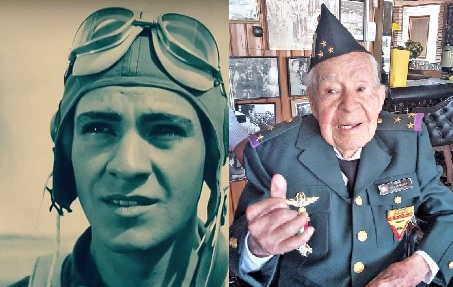
Colonel Garduño Nuñez was the last surviving pilot of Mexico’s Escuadron 201, and… the last WWII Mexican combat veteran.
Incidentally, the photos are from the Russian Embassy, the then Soviet Union and Mexico having fought fascists on different fronts well before the other Allies were all in.
Down a rabbit hole: “Expats”, 1912
While looking for something else (specifically, the short lived “Confederate colonies” of the 1860s, when Maximiliano — or rather his French overlords — came up with the “brilliant” idea of importing defeated Confederates and dispossessed [of their slaves] white southerners in an attempt to “civilize” the populace, or replace them, maybe) when I found this.
Of course, the horrendous word “expat” didn’t exist at the time, ony coming into vogue with former colonial masters after the Second World War who either stayed on, or who were looking for someplace where their money allowed them to aspire to a lifestyle they never enjoyed at home. Before that, while writers like Hemingway used the verb “expatriate” as a noun, to expatriate, was just a synonym for to migrate:: although to expatriate implied a voluntary migration, with undertones of turning one’s back on the “old country” and adopting the mores of the new, rather than — as now — to mean migration (temporary or permantly) from a wealthy country, with all the priviliges — and cultural baggage — intact.
What Maximiliano forgot, or (clueless dolt that he was) just never understood, was less than 20 years after the US invasion and annexation of a massive chunk of the country, gringos (expatriates or migrants) were not about to be welcome with open arms by native Mexicans. Even in 1912, they were still viewed (and to a large extent, for reasons still relevant today) would they be.
From El Diario (30 January 1912): an interview with Texas county judge (and later long-serving member of the House of Representatives) J. J. Mansfield, who at the time was acting on behalf of a colonizing company, which intended to to settle iin the area of Coatzacoalcos, Veracruz. One thing the reporter, and the paper, failed to take into account was that the Coatzacoalcos River region is oil country. While the proposed colony under discussion did attract “settlers” they would soon sell out to the oil companies, US corportations controlling the area until the 1938 Expropriation.
“Regarding the discussed problem of North American colonization in our Republic, we had an interview yesterday with one of the future settlers from the neighboring nation, in which we fully and frankly discussed the danger that said colonization might present for our nation. The gentleman, who finely and intelligently and openly answered all our questions, was Judge JJ Mansfield, of Columbus, Texas, editor and owner of that city’s Colorado Citizen newspaper. He was returning to the United States after inspecting to the extensive holdings of an American colonizing company, whose lands cover some 160,000 acres. Extending from the Coatzacoalcos River, to the east of Santa Lucrecia, Veracruz.
Mansfield came to this Republic as one of a party of 180 people organized by the land company, about eighty of whom had stayed in Veracruz, to colonize portions of the aforementioned land, and he told us that many of the others have considered returning with their families. W brieflye outlined for Mr. Mansfield the concerns Mexican patriots have regarding the dangers of North American colonization, especially in states bordering on the neighboring nation and Central America, and how to avoid the fear of a second annexation , as happened in Texas.
“-As far as I know -he answered us seriously- neither the Government of the United States, nor the American people want to annex more foreign land. They only wish to cultivate close relations with Mexico for the advantages that will accrue to both countries in a political, intellectual, and especially commercial sense. Being neighbors, the two countries should not push for anything more more than the feelings of greater cordiality. Speaking on behalf of the region that I represent, I can say that Texans esteem the Government of Mexico and it is in their interest that they respect the country’s integrity.
“-There are those who point out, Your Honor, that of all the immigrants who come to colonize our country, the North Americans are the least willing to adapt to our laws, customs and language. That it is precisely what the Americans do. Americans claim it is their “manifest destiny,” to permeate and “saxonize”(to coin a word) the entire Western Hemisphere, and that once the social conquest has been achieved in this way, it matters little whether or not they politically annex of our land, with their documents and corresponding signatures, because by then we will already belong to them – that they like to command, and hope to absorb us completely, without a fight.

“Frankly, what do you think the Americans can, or will, adapt to our institutions? Do the people you just met with send their children to our schools, or to special ones with classes in English? Do they have relations with the Indians in the region? Do they show inclination to take Mexican citizenship? Do they easily learn Spanish?
“-The American colonists of the region that I have just visited, Mr. Mansfield answered us, have been in their new environment for a short time, and have not yet managed to establish schools. Naturally, the first schools to be established will have to conduct their classes in English, as their students are ignorant of any other language for the inculcation of ideas. But of course the main study of these schools will be the Spanish language, because it is absolutely essential being the official language of the country, for the conduct of their business, and their social life. The colonists are generally middle class people, not particularly rich, and it is certain they will send their children, as soon as possible, to the public schools in the region where they live. Such schools, I am given to understand, by law conduct their classes in Spanish. For the rest, the eagerness of the current settlers to learn Spanish in textbooks and by any other opportunity that is offered to them has caught my attention. They laboriously study the language on the trains, on their walks, and after finishing their day’s work. Their children will grow up alongside the indigenous people, they will go to school with them and they will be Mexicans, if not in one generation, then in two for sure.”
.
Didn’t happen: as mentioned, the “colony” never came to much, which may have been the purpose all along. Mansfield sat on several congressional committes (and chaired at least one) dealing with oil and gas interests.
Ukraine and Latin America… a fair question
From David Brooks’ (Jornada’s Brooks, not the New York Times guy) “American curios“:
[Biden’s] Secretary of State, Antony Blinken, says that the US defense of the “sovereign right (of Ukraine) to write its own future” (he is talking about joining NATO) against Russia is a moral issue. He emphatically states that “a country does not have the right to dictate the policies of others or tell that country who it can associate with… a country does not have the right to exercise a sphere of influence. That notion should be relegated to the dustbin of history.”
Now that’s news! I mean, has the Monroe Doctrine been thrown in the dumpster yet? Have US military and clandestine operations in this hemisphere been suspended already? Are they about to close Guantánamo and dismantle the Southern Command? Has Washington accepted responsibility for the invasions, interventions and coups they justified as being in the so-called “national interests” and “national security” of the United States?
Inquiring minds want to know.


 mexfiles.net